Strategic Defense,
From First DUI to Death Penalty
From First DUI to Death Penalty





Short answer: Florida police need a warrant for most digital tracking that reveals where you have been or what is on your phone. The U.S. Supreme Court requires a warrant, in most cases, to search a phone’s contents, to attach a GPS tracker to a car, and to obtain cell phone location history, and Florida law bars police drones from gathering evidence without a warrant or another listed exception. Police can usually act without a warrant when they record what anyone could see from a public place, use a single license plate camera read, or receive video or posts that a private person chose to share. Whether a warrantless search of weeks of license plate reader history is legal is still undecided in Florida.
Most surveillance evidence in a Florida criminal case was gathered before anyone was arrested, by a camera, a database query, or a records request the person never knew about. I am Rocky Brancato, founder of The Brancato Law Firm, P.A., a Tampa criminal defense firm, and a former police academy instructor who taught officers the search and seizure rules they are supposed to follow. Over more than 25 years in Hillsborough County courtrooms and more than 150 jury trials to verdict, I have learned that the strongest suppression arguments come from asking exactly which tool police used and what the law required for that tool. Our attorneys start every surveillance case there.
This guide is the starting point for our series on police surveillance in Florida. It explains the legal framework once, then summarizes each tool police use, with a link to the full guide on that tool. The law below is current through November 2026.
Police can track what you expose to the public without a warrant, but they generally need one to collect detailed digital records of your movements or to open your phone. The dividing line is set by the Fourth Amendment and by Article I, section 12 of the Florida Constitution, and the answer changes from tool to tool. The comparison below sums up where the law stands on each one.
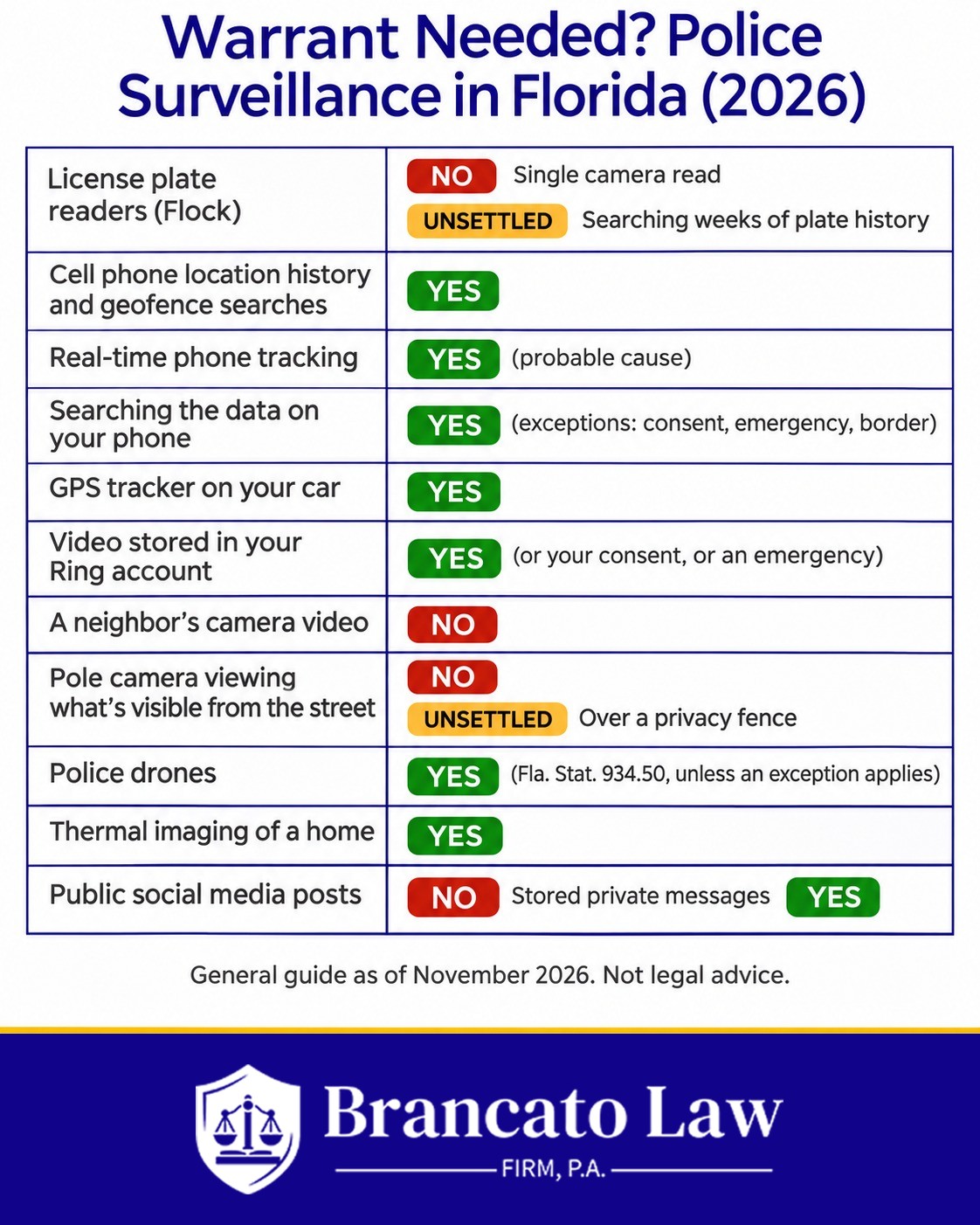
| Tool | Warrant needed? | Key authority | Full guide |
|---|---|---|---|
| License plate readers and Flock | Single read: no. Historical multi-camera query: unsettled | Knotts (1983); Kyle (N.D. Okla. 2026); s. 316.0777 | Warrantless Flock searches |
| Cell phone location history and geofences | Yes, in most cases | Carpenter (2018); Chatrie (2026) | Phone location data |
| Real-time phone tracking | Yes, probable cause required | Tracey (Fla. 2014) | Phone location data |
| Searching the data on your phone | Yes, unless consent, emergency, border, or some probation searches | Riley (2014); Smallwood (Fla. 2013) | Cell phone searches |
| GPS tracker on your car | Yes, in most cases; Florida requires a court order | Jones (2012); s. 934.42 | GPS trackers |
| Video stored in your Ring account | Warrant, your consent, or an emergency | Ring policy; s. 934.23 | Ring and smart home data |
| A neighbor’s camera video | No, a private owner may share it | Fourth Amendment limits only the government | Ring and smart home data |
| Pole camera on views open to the street | No; over a privacy fence: unsettled | Gregory (11th Cir. 2025) | Pole cameras and drones |
| Police drones | Yes, unless a statutory exception applies | s. 934.50 | Pole cameras and drones |
| Thermal imaging of a home | Yes | Kyllo (2001) | Pole cameras and drones |
| Facial recognition | No statute; a match alone is a lead, not probable cause, under PCSO policy | No Florida statute | Facial recognition |
| Social media | Public posts: no. Stored private messages: warrant for content 180 days old or less | 18 U.S.C. s. 2703 | Social media evidence |
Two notes on reading the chart and table. “Unsettled” means courts disagree and no court that binds Florida has decided the question, so the issue is still worth litigating. And “No warrant” does not mean the evidence is safe from challenge: a stop, a detention, or an identification built on surveillance can still be attacked on other grounds.
A Fourth Amendment “search” happens when police intrude on a reasonable expectation of privacy, or physically intrude on your property to get information. The privacy test comes from Katz v. United States, 389 U.S. 347 (1967), where FBI agents recorded a man’s calls from a public phone booth without a warrant. The Court said the Fourth Amendment “protects people, not places,” and that what a person “knowingly exposes to the public” is not protected. Justice Harlan’s concurrence added the two-part test courts still use: a person must have an actual expectation of privacy, and it must be one “society is prepared to recognize as ‘reasonable.'”
Florida follows that federal rule by constitutional command. Article I, section 12 of the Florida Constitution protects against unreasonable searches and “the unreasonable interception of private communications by any means,” and it says the right “shall be construed in conformity with the 4th Amendment to the United States Constitution, as interpreted by the United States Supreme Court.” So every new U.S. Supreme Court surveillance decision applies in Florida courtrooms the day it issues, and Florida judges cannot give more protection than the Supreme Court recognizes.
The third-party doctrine says you generally have no privacy interest in information you voluntarily hand to a company. In Smith v. Maryland, 442 U.S. 735 (1979), police had the phone company install a pen register to record the numbers dialed from a robbery suspect’s home phone. The Supreme Court held that “a person has no legitimate expectation of privacy in information he voluntarily turns over to third parties,” so the pen register was not a search and needed no warrant. Prosecutors still rely on that rule for bank records, subscriber information, and other business records.
Carpenter held that digital location records are different because they reveal the whole of a person’s movements. In Carpenter v. United States, 585 U.S. 296 (2018), the FBI obtained 127 days of a robbery suspect’s cell-site location records from his wireless carriers with a court order instead of a warrant. The Court declined to extend Smith to those records, held that accessing seven days of them is a search, and ruled that the government “must generally obtain a warrant supported by probable cause.” It explained that location data lets police “travel back in time to retrace a person’s whereabouts.”
Courts call this reasoning the mosaic theory: individual data points may reveal little, but assembled over time they expose a person’s private life. The idea traces to the concurrences in United States v. Jones, 565 U.S. 400 (2012), where five justices said long-term tracking of a car raises privacy concerns on its own. Carpenter also limited itself. The Court called the decision “a narrow one” and said it did not “call into question conventional surveillance techniques and tools, such as security cameras.” Prosecutors rely on that sentence in camera and plate reader cases, so the defense has to show how much the particular tool reveals.
In Chatrie v. United States, 609 U.S. 605 (2026), decided June 29, 2026, police used a geofence warrant to get Google Location History for phones near a Virginia credit union that had been robbed, and Google eventually gave them three names. Justice Kagan, writing for five justices, held that police conducted a search when they obtained the Location History, “even though for only a limited time, and from a third-party tech company.” Justice Gorsuch concurred in the judgment. The Court rejected the argument that two hours of data was too short to count, and it held that the third-party doctrine does not apply because the data is “not truly shared.” It sent the case back to decide whether the warrant was valid and whether the good-faith exception saves the evidence.
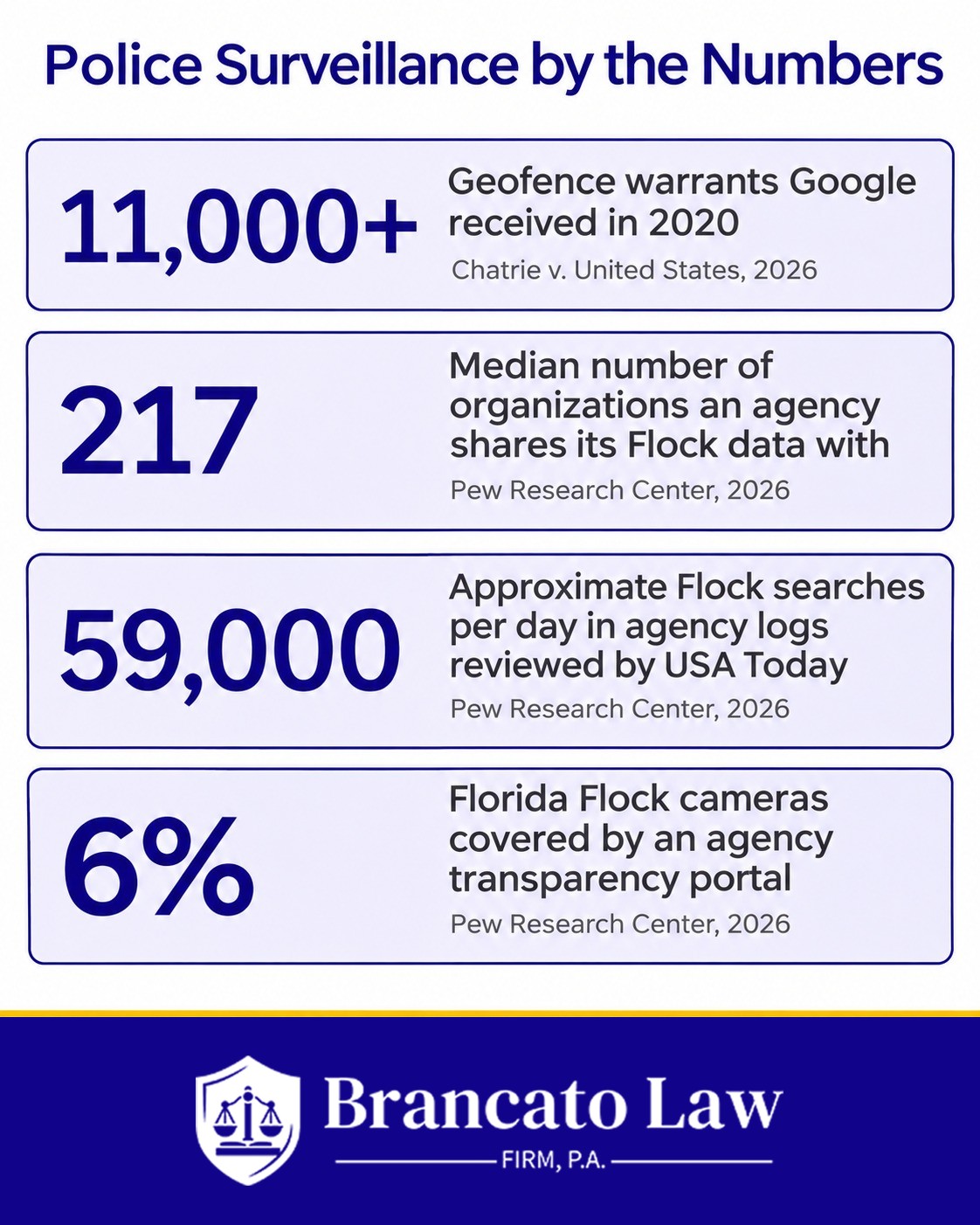
The opinion also shows how fast this kind of surveillance grew. Google received its first geofence warrant in 2016, 982 in 2018, and more than 11,000 in 2020, the Court noted, citing Google’s own disclosure. Our guide to whether police can track your phone without a warrant in Florida explains the decision in depth.
A single plate camera photographing your car on a public road is almost never a search, but the law on searching weeks of plate reader history is unsettled. In United States v. Knotts, 460 U.S. 276 (1983), where police followed a car with a radio beeper, the Supreme Court held that a driver has no reasonable expectation of privacy in movements on public roads, while reserving “dragnet type law enforcement practices” for another day. Florida’s plate reader statute, section 316.0777, Florida Statutes, regulates camera placement on state highways and makes the images confidential, but it does not require a warrant or a reason for a query.
Most courts that have ruled say a plate reader query is not a search. One federal judge disagreed in United States v. Kyle, No. 4:26-cr-00189 (N.D. Okla. Oct. 1, 2026), where a deputy pulled a month of multistate Flock sightings on a car with a California plate, and the court suppressed the evidence. The Eleventh Circuit, which covers Florida, has not decided the question: in United States v. Mapson, 96 F.4th 1323 (11th Cir. 2024), it applied the good-faith exception instead. The court noted how little scholarship existed, citing a 2022 Vanderbilt Journal of Entertainment and Technology Law note that found courts had not squarely confronted whether aggregating a person’s public travels implicates the Fourth Amendment.
The scale of the network is the core of the defense argument. Agencies that disclose their practices report sharing Flock data with a median of 217 other organizations, and a USA Today review of agency logs found about 59,000 Flock searches a day, according to a Pew Research Center analysis published November 9, 2026. Pew also found that only 6% of the Florida Flock cameras listed on OpenStreetMap are covered by an agency transparency portal. Our guides explain how Flock cameras work in Tampa Bay, whether warrantless Flock searches are illegal, and what happens when officers misuse Flock cameras.
Generally no: after Carpenter and Chatrie, police need a warrant for historical cell-site records and for app-based location history such as Google’s. Real-time tracking has its own Florida rule. In Tracey v. State, 152 So. 3d 504 (Fla. 2014), Broward officers with an order for a pen register used real-time cell-site data to follow a suspect’s phone, and the Florida Supreme Court held that real-time tracking was a search “for which probable cause was required.”
Geofence warrants, which ask a company to identify every device in an area during a time window, are searches after Chatrie, so the fight now centers on whether each step of the warrant was particular and supported by probable cause. Location data can also help the defense, as our guide on using cell phone location evidence for an alibi explains.
No, not without a warrant, absent a real emergency. A Stingray, or cell-site simulator, imitates a cell tower so nearby phones connect to it, and Florida’s Fourth District held in State v. Sylvestre, 254 So. 3d 986 (Fla. 4th DCA 2018), that police need probable cause and court authorization before using one. A location order sent to the phone company does not cover it. Our post on whether Florida police can use a Stingray without a warrant covers Hailstorms, airborne dirtboxes, and how our attorneys find out a simulator was used.
It depends on the court, and no Florida appellate court has decided the question. A tower dump is the phone company’s list of every phone that connected to a cell tower during a set window, so it sweeps in bystanders along with any suspect. A federal judge in Tampa upheld a warrantless tower dump in 2025, while a federal judge in Mississippi held in 2026 that tower dumps are unconstitutional general warrants. Our attorneys explain both rulings, and how to challenge tower dump evidence, in our guide to whether police cell tower dumps are legal in Florida.
Yes, with a warrant, and some agencies use reverse keyword warrants that ask Google to list every user who searched a particular address or phrase during a set window, before police have a suspect. No Florida appellate court has ruled on these warrants, and courts in Colorado, Pennsylvania, and Virginia have admitted the evidence while leaving room to challenge how a warrant was drawn. Our attorneys cover those rulings in our post on whether police can get your Google search history in Florida.
Usually not. In Riley v. California, 573 U.S. 373 (2014), the Supreme Court unanimously held that police who arrest someone must generally get a warrant before searching the data on the phone. Florida’s Supreme Court reached the same result a year earlier in Smallwood v. State, 113 So. 3d 724 (Fla. 2013), where an officer scrolled through a robbery suspect’s phone after the arrest. Police may still search with valid consent, in a real emergency, at the border, and in some probation settings.
Whether police can force you to give up your passcode is unsettled in Florida, and Tampa Bay judges follow a decision that allowed it. The Second District, whose decisions bind trial courts in Hillsborough, Pinellas, and Pasco Counties, allowed a compelled passcode in State v. Stahl, 206 So. 3d 124 (Fla. 2d DCA 2016), a video voyeurism case, while other district courts have refused. Our guide on whether police can search your cell phone in Florida covers the exceptions and the passcode split. If police are asking about your AI chatbot history, our guide on using ChatGPT or AI in a Florida criminal case explains why those chats can be seized like texts.
In most cases, yes. Jones held that attaching a GPS device to a car and using it to monitor the car’s movements is a search; federal agents there tracked a Jeep for 28 days. Florida’s tracking statute, section 934.42, Florida Statutes, lets an officer apply to a judge for an order to install a tracker, and subsection (5) says “the standards established by the United States Supreme Court for the installation and monitoring of mobile tracking devices shall apply.”
Because the statute only asks for a certification that the information is relevant to an investigation, our attorneys argue that the order must also rest on facts showing probable cause before it can satisfy Jones. Trackers placed by an employer, a lender, or a family member raise different questions. Our guide to whether police need a warrant to put a GPS tracker on your car covers both.
Police can get video stored in your Ring account with your consent, with a search warrant, or in a real emergency. Ring’s law enforcement guidelines say it does “not produce content information in response to subpoenas” and releases videos under “valid and binding search warrants.” Florida’s stored communications statute, section 934.23, Florida Statutes, also requires a warrant for a Florida officer to compel a provider to disclose communications held in electronic storage for 180 days or less.
Smart speaker recordings follow the same path: Amazon has turned over Echo recordings in homicide investigations, including a 2019 Hallandale Beach case, when served with a warrant or when the owner agreed. A neighbor’s camera is different. The Fourth Amendment limits the government, so a neighbor can usually hand video to police without a warrant. Our guide to whether police can get your Ring camera footage in Florida explains each route and how to preserve video that helps you.
Pole cameras that record only what is visible from the street are not a search under current federal appellate law in Florida. In United States v. Gregory, 128 F.4th 1228 (11th Cir. 2025), agents ran two warrantless cameras on an Alabama home from October 2018 through August 2019, and the Eleventh Circuit held there was no search because the yard was visible from a public road and alley. The court expressly left open whether a camera recording over a privacy fence into an enclosed backyard would be a search.
Drones are where Florida law gives more protection than the Fourth Amendment. Under section 934.50, Florida Statutes, “a law enforcement agency may not use a drone to gather evidence or other information” unless an exception applies, such as a judge-signed search warrant, a terrorism threat, or reasonable suspicion that swift action is needed to prevent imminent danger, an escape, or the destruction of evidence. Subsection (6) says evidence obtained in violation “is not admissible as evidence in a criminal prosecution in any court of law in this state.”
A helicopter flyover gets less protection. In Florida v. Riley, 488 U.S. 445 (1989), a Pasco County deputy spotted marijuana through a greenhouse roof from 400 feet, and a plurality held the naked-eye observation was not a search. Technology that sees inside a home is treated differently: Kyllo v. United States, 533 U.S. 27 (2001) held that aiming a thermal imager at a house to learn about its interior is a search. When police hide cameras inside a business under a warrant, State v. Kraft, 301 So. 3d 981 (Fla. 4th DCA 2020) requires them to limit what gets recorded. Our guide to police pole cameras and drones in Florida covers all four.
Police can use facial recognition to develop a lead, but the match by itself is not supposed to be the basis for an arrest. Florida has no statute that regulates police facial recognition. The Pinellas County Sheriff’s Office, which runs the statewide FACES system, says its results are investigative leads and never probable cause on their own, so officers must corroborate a lead with independent evidence. A search often happens weeks before an arrest and may never appear by name in the police report, which is why our attorneys ask for it directly. Our guide on whether police can arrest you based on facial recognition in Florida explains the disclosure fight.
Police can view anything you post publicly without a warrant, because you exposed it to the public. For private messages, the federal Stored Communications Act, 18 U.S.C. section 2703, requires police to get a warrant before a provider must disclose the contents of messages stored for 180 days or less, and they can ask the provider to preserve your records for 90 days, renewable for another 90, while they apply. A post you delete today may already be frozen on the company’s servers. Our guide to social media evidence in Tampa criminal cases explains how posts and photos are used in court and challenged.
Police may use crime data to decide where to patrol, but a computer score or a place on a “prolific offender” list is not reasonable suspicion to stop or search anyone. Pasco County ended its person-based intelligence-led policing program in a December 2024 federal settlement whose recitals say deputies’ repeated home checks exceeded the implied license to knock. Our post on whether predictive policing is legal in Florida covers the Pasco case and how our attorneys challenge list-driven stops.
Evidence from an unconstitutional search can be excluded from your trial through a motion to suppress. In Mapp v. Ohio, 367 U.S. 643 (1961), Cleveland officers forced their way into a woman’s home and searched it, and the Supreme Court held that evidence obtained by searches and seizures in violation of the Constitution “is, by that same authority, inadmissible in a state court.” Florida’s constitution applies the same rule: evidence is excluded when the U.S. Supreme Court’s Fourth Amendment decisions would exclude it.
The rule also reaches evidence police found by exploiting the illegal search. Under Wong Sun v. United States, 371 U.S. 471 (1963), where federal agents’ illegal entry led them to heroin held by another man, the question is whether the evidence was “come at by exploitation of that illegality or instead by means sufficiently distinguishable to be purged of the primary taint.” Lawyers call this the fruit of the poisonous tree. In a surveillance case, the tree is often a single query or camera, and the fruit is the stop, the search warrant, the identification, or the statement that followed.
Since July 13, 2026, Florida Rule of Criminal Procedure 3.190(g) governs suppression motions for both evidence and statements, and the motion must be filed before trial or by the deadline the judge sets. Our guide to the motion to suppress evidence in Florida explains the hearing, and our guide to how a Florida criminal case moves from arrest to trial shows where suppression fits.
The State usually answers a suppression motion with one of a few doctrines. Each one turns on facts our attorneys can test in discovery.
| State argument | What it means | How the defense responds |
|---|---|---|
| Good faith | Under Davis v. United States, 564 U.S. 229 (2011), evidence is not excluded when police relied on binding appellate precedent that authorized the search. | Show that no binding Florida or Eleventh Circuit decision approved the tool, as with historical Flock queries. |
| No search | The tool captured only what was exposed to the public, as with a single plate read or a street-facing pole camera. | Show how much the tool revealed: duration, number of cameras, views over a fence, or data from inside a home. |
| Private party | A neighbor, employer, or company collected the data on its own, so the Fourth Amendment does not apply. | Show that police directed the collection, or that they went beyond what the private party shared. |
| Standing | The defendant had no privacy interest in the car, phone, or account that was searched. | Show ownership, lawful possession, or control while the tracking or search happened. |
| Consent | The owner agreed to the search or to share the data. | Show who consented, whether that person had authority, and whether police stayed inside the scope of the consent. |
Act within days, because many of the records that win or lose a suppression motion are deleted on a schedule. Flock’s default retention was 30 days until August 2026, when the company lowered it to seven, Pew reported. Home cameras overwrite clips based on the owner’s settings, and pole camera and drone records can be purged. Our attorneys follow the same first steps in every surveillance case:
Do not delete data, destroy a device, or remove a tracker you find on your car; photograph it and call a lawyer. Do not consent to a phone search, and do not try to explain the evidence to detectives. If you believe you are under investigation, our representation before charges are filed lets our attorneys address the investigation and demand preservation before an arrest. Surveillance often ends with a search warrant for a home, and our guide on when police can enter your home without a warrant in Florida covers that step.
Tampa Bay agencies use most of the tools in this guide, and each agency keeps different records. In Hillsborough County cases, our attorneys ask whether a plate reader hit came from the Sheriff’s Office “Eye on Crime” system, a city camera, or a network shared from another state, and whether a video clip came through a camera registry, a Ring request, or a detective’s knock on the door. The Pinellas County Sheriff’s Office runs the statewide FACES facial recognition system and, in 2026, arrested a former deputy after an audit found more than 100 unauthorized plate reader and driver’s license queries, which makes the agency’s audit history fair game in Pinellas County cases.
Our Hillsborough County criminal defense attorneys file these motions in the Thirteenth Judicial Circuit, where appeals go to the Second District Court of Appeal. That court’s decisions bind trial judges across Hillsborough, Pinellas, and Pasco Counties, including Stahl on passcodes. Surveillance most often drives drug trafficking and gun investigations, which is why our Tampa drug crimes attorney page explains how we attack searches built on cameras, trackers, and phone data. When digital evidence needs an independent examiner, our Tampa criminal forensic science attorney team works with outside experts.
Not without probable cause. The Brancato Law Firm relies on Tracey, where the Florida Supreme Court suppressed real-time cell-site tracking done under a pen register order, and our guide to phone location data after Chatrie explains how the 2026 decision added to that protection.
Florida police run these searches without warrants today, and no Florida or Eleventh Circuit decision has held the practice illegal. Our attorneys at The Brancato Law Firm challenge historical, multi-camera queries using Kyle, Carpenter, and Chatrie, as explained in our guide to warrantless Flock searches.
Not unless an exception in section 934.50 applies, because the statute makes evidence gathered in violation of it inadmissible in a Florida criminal prosecution. The Brancato Law Firm demands the flight log and the agency’s written policy to test whatever exception the State claims.
Usually not, so many people learn about a tracker, a geofence warrant, or a plate reader search only after an arrest. The Brancato Law Firm offers pre-file advocacy to people who think they are under investigation, including early preservation demands for records that would otherwise expire.
Yes, a neighbor can choose to give police video from their own camera, and the Fourth Amendment does not stop a private person from sharing it. Our attorneys at The Brancato Law Firm still test the clip’s time stamps, completeness, and the identification it supposedly shows, and we look for other cameras that tell a different story.
Yes, if the suppressed evidence was the core of the State’s case, prosecutors often have to drop or reduce the charges. The Brancato Law Firm maps every piece of evidence back to the surveillance that produced it so derived evidence is challenged too, as explained on our drug crimes defense page.
Surveillance records disappear on schedules no one in your case controls, so the first week matters most. Call The Brancato Law Firm, P.A., founded by Tampa Criminal Defense Attorney Rocky Brancato, at (813) 727-7159. We are available 24/7, our office is two blocks from the courthouse, and our attorneys will start by identifying every tool police used and demanding the records behind it. Our firm has Spanish-speaking staff, and attorney Jean-Luc Adrien speaks Spanish, Haitian Creole, and French.
For more about our defense strategies, visit our Tampa Drug Crimes Attorney page.
The Brancato Law Firm, P.A.
620 E. Twiggs Street, Suite 205, Tampa, FL 33602
(813) 727-7159
Serving Hillsborough, Pinellas, and Pasco Counties
The Brancato Law Firm, P.A. is a Tampa-based criminal defense practice. We are not affiliated with any other Brancato-named law firms.

Tampa, FL 33602

Free Legal Consultation (813) 727-7159
