

From First DUI to Death Penalty



Are Warrantless Flock Camera Searches Illegal? (2026)



Short answer: No court that binds Florida has decided whether a warrantless Flock search is illegal. As of November 2026, most courts, including the Fifth Circuit, the Virginia Court of Appeals, and federal trial courts in Florida, Alabama, and Virginia, have held that pulling a car’s license plate reader history is not a Fourth Amendment search. One federal judge in Oklahoma held in October 2026 that a 30-day, multistate Flock query is a search that needs a warrant and threw out the evidence. The U.S. Supreme Court and the Eleventh Circuit, which covers Florida, have not decided the question, so defense lawyers can and should challenge these searches.
If a detective found your car by typing your plate into Flock and scrolling back through weeks of camera hits, the first question in your case is whether that search needed a warrant. Our firm, The Brancato Law Firm, P.A., is a Tampa criminal defense practice founded by Rocky Brancato, a former police academy instructor with more than 25 years in Hillsborough County courtrooms and more than 150 jury trials to verdict. Our attorneys use that training to test every plate reader query the State relies on: who ran it, why, how far back it reached, and whether a judge ever approved it.
This guide answers the legality question. For how the cameras work and where they sit in Tampa Bay, see our guide to Flock cameras and license plate readers in Tampa. For officers who abuse the system, see our guide on whether police can be charged for misusing Flock cameras in Florida.
Are Warrantless Flock Camera Searches Illegal?
The accurate answer in 2026 is that it depends on the court and on what the officer searched. A single camera photographing a plate on a public road is almost never a search. The fight is over the historical query: an officer typing a plate into a network of thousands of cameras and getting back days or weeks of the car’s movements, often from cameras owned by other agencies in other states. A small number of courts now treat that query as a search; most still do not.
At The Brancato Law Firm, we believe a warrantless historical or multi-camera Flock query that reconstructs where a person drove is an unlawful search, and that evidence flowing from it should be suppressed.
What Counts as a Search Under the Fourth Amendment?
A search happens when the government intrudes on a reasonable expectation of privacy or physically intrudes on property to get information. Six U.S. Supreme Court decisions frame every Flock argument, and both sides cite them. Our attorneys start every license plate reader motion with this line of cases.
| Case | What happened | Why it matters for Flock |
|---|---|---|
| Katz v. United States, 389 U.S. 347 (1967) | FBI agents recorded calls from a public phone booth without a warrant. | The Fourth Amendment protects people, not places. Justice Harlan’s concurrence created the reasonable expectation of privacy test courts still use. |
| United States v. Knotts, 460 U.S. 276 (1983) | Police used a radio beeper to follow a car to a cabin. | A person driving on public roads has no reasonable expectation of privacy in those movements. But the Court reserved “dragnet type law enforcement practices” for another day. |
| United States v. Jones, 565 U.S. 400 (2012) | Agents put a GPS tracker on a Jeep and followed it for 28 days. | The majority found a search based on the physical trespass. Five justices in two concurrences said long-term tracking of a car’s movements violates privacy on its own. |
| Riley v. California, 573 U.S. 373 (2014) | Police searched phones seized during arrests. | Digital records are different in kind. The Court’s answer was simple: get a warrant. |
| Carpenter v. United States, 585 U.S. 296 (2018) | The FBI got 127 days of cell-site location records without a warrant. | People have a reasonable expectation of privacy in the whole of their physical movements, and seven days of records is a search. |
| Chatrie v. United States, 609 U.S. 605 (2026) | Police used a geofence warrant to get Google Location History near a bank robbery. | Getting location history is a search even for two hours and even from a third party. |
Knotts is the case the State cites first. In Knotts, the Court said a driver “has no reasonable expectation of privacy in his movements from one place to another,” but it added that if “dragnet-type law enforcement practices” ever appeared, “there will be time enough then to determine whether different constitutional principles may be applicable.” Our argument is that a camera network recording every car, every day, and sharing the data across state lines is that dragnet.
Jones supplied the mosaic theory. Justice Alito, writing for four justices, said society expects that police would not “secretly monitor and catalogue every single movement of an individual’s car for a very long period.” Justice Sotomayor added that GPS monitoring creates a record that reveals a person’s “familial, political, professional, religious, and sexual associations.” Carpenter adopted that idea and noted that location data lets police “travel back in time to retrace a person’s whereabouts.” That retrospective power is exactly what a Flock history search does.
Carpenter also handed the State its best line: the Court called its decision “a narrow one” and said it did not “call into question conventional surveillance techniques and tools, such as security cameras.” In Chatrie, decided June 29, 2026, Justice Kagan wrote for five justices, and Justice Gorsuch concurred in the judgment, that obtaining Location History was a search, adding that “it does not matter if the time period scrutinized was only two hours.” Chatrie does not mention license plate readers, but it quotes the Jones language about cataloguing “every single movement of an individual’s car.” Our guide to Chatrie and cell phone location data explains that decision in more depth.
How Have Courts Ruled on Flock and License Plate Reader Searches?
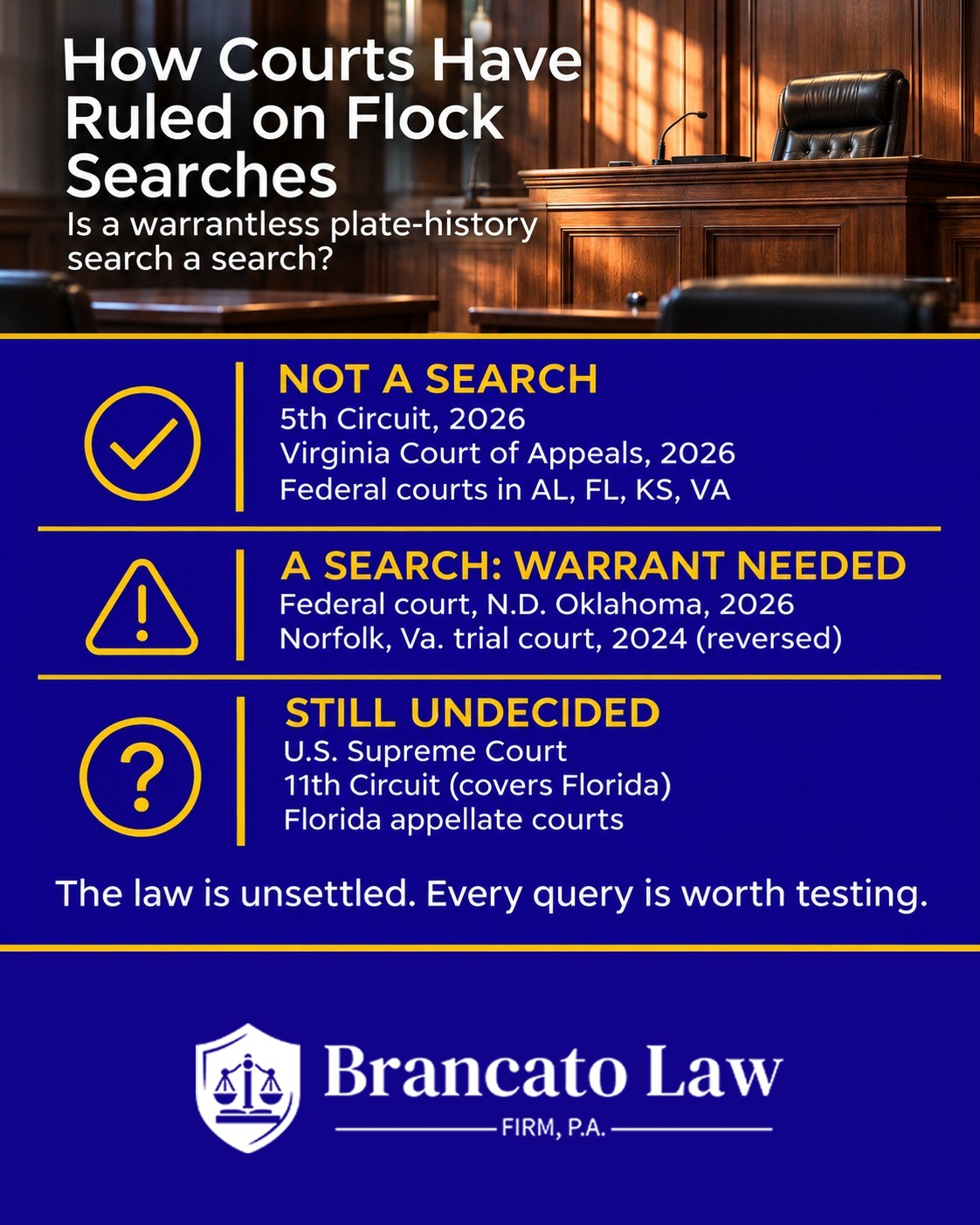
Most courts that have ruled so far say a license plate reader query is not a search, at least on the facts in front of them. One federal court has held the opposite and suppressed the evidence, and several other courts have left the door open for a denser network or a longer query. No federal appeals court has held that a Flock query requires a warrant.
| Court and case | Ruling | Key fact |
|---|---|---|
| N.D. Okla.: United States v. Kyle, No. 4:26-cr-00189 (N.D. Okla. Oct. 1, 2026) | Search; evidence suppressed | A month of data, more than 50 sightings across multiple states, pulled because the car had a California plate. |
| M.D. Ala.: United States v. Jones, No. 3:26-cr-00213 (M.D. Ala. Nov. 19, 2026) | Not a search; suppression denied | One camera hit plus a 30-day look-back at the same area. The court called Kyle unpersuasive. |
| D. Kan.: United States v. Blair, No. 5:25-cr-40018 (D. Kan. Nov. 19, 2026) | Suppression denied; court said a search “does not appear” to occur | An officer mined plate data for short trips to Southern California, then stopped the car for following too closely. |
| M.D. Fla. (Tampa): United States v. Floyd, No. 8:23-cr-00305 (M.D. Fla. Nov. 21, 2025) | Not a search; good faith would apply anyway | Vigilant and HCSO “Eye on Crime” hits near a string of Tampa Bay store robberies. |
| 5th Cir.: United States v. Porter, 170 F.4th 381 (5th Cir. 2026) | Not a search | A small-city system of about ten cameras that police could not use to find the car in traffic. |
| 11th Cir.: United States v. Mapson, 96 F.4th 1323 (11th Cir. 2024) | Question not decided; good faith applied | The queries were run the day before Carpenter was decided. |
| 9th Cir.: United States v. Yang, 958 F.3d 851 (9th Cir. 2020) | Question not decided; no standing | The defendant was driving an overdue rental car the company was trying to repossess. |
| Mass.: Commonwealth v. McCarthy, 484 Mass. 493 (2020) | Not a search on these facts | Four cameras on two bridges. The court said that with enough cameras in enough locations, ALPR data would be a search. |
| Va. Ct. App.: Robinson v. Commonwealth, 87 Va. App. 262 (2026) | Not a search | One image from Norfolk’s 172-camera Flock system within a two-hour window. |
| Norfolk Cir. Ct.: Bell v. Commonwealth, 113 Va. Cir. 316 (Norfolk Cir. Ct. 2024), followed in Commonwealth v. Church, No. 0737-25-1 (Va. Ct. App. Oct. 14, 2025) | Trial judge required a warrant; reversed on appeal in Church (unpublished) | Three images over about seven minutes. |
| E.D. Va.: Schmidt v. City of Norfolk, 819 F. Supp. 3d 492 (E.D. Va. 2026) | Not a search (civil case) | 176 cameras in 75 clusters with a rolling 21-day retention. |
| Ariz. Ct. App.: State v. Sidor, 558 P.3d 621 (Ariz. Ct. App. 2024) | Not a search on this record | A DEA plate database returned only one photo of the car while the defendant was driving it; the court warned the answer could change. |
The Oklahoma ruling that suppressed Flock evidence
In United States v. Kyle, No. 4:26-cr-00189 (N.D. Okla. Oct. 1, 2026), a Tulsa County deputy saw a Mazda with a California plate and, in Judge Sara E. Hill’s words, followed it “for no apparent reason other than the fact that it had a California license plate.” He ran the plate through Flock and a second plate reader system, entering “traffic violation” and “investigation” as his reasons. The query gave him “an entire month’s worth of location data,” including more than fifty sightings across multiple states. He stopped the car for following too closely and held the driver for a dog sniff.
Judge Hill suppressed everything on two independent grounds. First, the deputy unlawfully extended the stop. Second, the Flock query itself was a warrantless search, because it intruded on the driver’s expectation of privacy in the whole of her physical movements. The court called the network “a type of indiscriminate mass surveillance” and acknowledged that “nearly every court examining the issue to date” had gone the other way. Because the government identified no exception to the exclusionary rule, all evidence obtained after the query was suppressed as fruit of the poisonous tree. Flock has said it expects the ruling to be appealed, according to Newsweek.
The Alabama ruling that disagreed
Seven weeks later, Judge Bill Lewis of the Middle District of Alabama went the other way in United States v. Jones, No. 3:26-cr-00213 (M.D. Ala. Nov. 19, 2026), a case charging a man with transporting a minor across state lines. An investigator used Flock to spot the plate at one camera within a two-hour window and then checked that car’s hits in the area over the prior 30 days. Judge Lewis held that was not a search. He wrote that Flock “provides episodic snapshots of a person’s whereabouts on a public road with gaps of time between cameras,” found Kyle unpersuasive, and said the court “must rule on the facts as they are and may not speculate about what the future may hold for Flock’s capabilities.” He also noted that neither the Supreme Court nor the Eleventh Circuit has decided the issue.
What the appellate courts have said
The only federal appeals court to decide the search question is the Fifth Circuit. In United States v. Porter, 170 F.4th 381 (5th Cir. 2026), Gautier, Mississippi police used a system of about ten cameras, and the court held the use “did not constitute a search.” The court stressed that the system gave only “periodic information” and that the officer had failed to find the car on earlier hits because of heavy traffic. Porter does not mention Chatrie, which came three months later.
The Eleventh Circuit, whose decisions bind federal courts in Florida, has not decided the question. In United States v. Mapson, 96 F.4th 1323 (11th Cir. 2024), an appeal from the Northern District of Alabama, the court wrote: “We need not decide whether Carpenter requires a search warrant for ALPR data because the good-faith exception to the exclusionary rule applies.” The court noted that “very little” case law or scholarship addresses the issue, citing a 2022 Vanderbilt Journal of Entertainment and Technology Law note that found courts had not squarely confronted whether aggregating a person’s public travels implicates the Fourth Amendment. The Ninth Circuit also dodged the question in Yang by finding no standing.
State high courts have mostly reserved the issue. In McCarthy, the Massachusetts Supreme Judicial Court held that four bridge cameras were not a search but warned that “with enough cameras in enough locations, the historic location data from an ALPR system in Massachusetts would invade a reasonable expectation of privacy.” Florida’s cameras now number in the thousands, which is why we cite McCarthy in Florida motions.
What Is Florida Law on Flock Searches?
No Florida appellate court has decided whether a warrantless Flock query is a search. Florida’s two plate reader statutes regulate where cameras go and how long data is kept, but they do not require a warrant, an audit, or a reason for a query. That gap is where most Florida suppression arguments start.
- Section 316.0777, Florida Statutes, lets the Department of Transportation allow a law enforcement plate reader on a state highway right-of-way “for the purpose of collecting active criminal intelligence information or active criminal investigative information.” It makes plate reader images confidential and lets agencies share them with any criminal justice agency “in the performance of” its official duties. It says nothing about warrants or query limits.
- Section 316.0778, Florida Statutes, directs the Department of State, with FDLE, to set a retention schedule with “a maximum period that the records may be retained.” The statute itself sets no number of days.
- Article I, section 12 of the Florida Constitution must be “construed in conformity with the 4th Amendment,” and evidence is excluded only if it “would be inadmissible under decisions of the United States Supreme Court.” Florida courts therefore cannot give drivers more privacy than the U.S. Supreme Court recognizes.
The only Florida federal ruling we have found is Floyd, a Tampa case decided by U.S. District Judge Tom Barber in November 2025. Detectives tied a Mazda to store robberies in Lakeland, Riverview, and Temple Terrace through Vigilant hits and the Hillsborough County Sheriff’s Office “Eye on Crime” plate reader system. Judge Barber held the reads were a “snapshot” rather than tracking, and added in a footnote that even if Carpenter applied, “the good faith exception to the exclusionary rule would apply.” Floyd predates Chatrie, so we treat its reasoning as open to challenge in Hillsborough County cases.
Florida state courts are already admitting plate reader histories at trial without deciding the constitutional question. In Mathis v. State, No. 4D2024-1543 (Fla. 4th DCA Apr. 8, 2026), a Broward County murder case, readers showed the defendant’s car following the victim’s van into Lighthouse Point, and the database showed the car “had never been in Lighthouse Point before.” The Fourth District relied on that evidence to affirm the conviction. The opinion does not report a suppression motion, so it decided nothing about warrants.
Other states have gone further than Florida by statute. Virginia Code section 2.2-5517 limits queries to listed purposes, requires an audit trail with the reason, the offense type, and a case number for every query, purges data after 21 days, says an alert alone is not reasonable suspicion for a stop, and makes evidence obtained in violation of key parts of the law inadmissible against the defendant. New Hampshire RSA 261:75-b requires most plate reads to be purged within 3 minutes. Florida has none of those protections.
| Protection | Florida | Virginia | New Hampshire |
|---|---|---|---|
| Warrant required to query history | No | No, but queries limited to listed purposes | Data generally purged before it can be searched |
| Retention limit written in the statute | No; set by state schedule | 21 days | 3 minutes for most reads |
| Audit trail with reason and case number | Not required | Required | Not applicable to purged data |
| Statutory exclusion of evidence | No | Yes, for violations of key subsections | No |
Why We Believe Warrantless Flock Searches Are Unlawful
A historical Flock query is the dragnet Knotts reserved and the catalogue of a car’s movements that five justices warned about in Jones. Our attorneys build the argument on four points, each tied to the record in the client’s case.
- The query is retrospective. Carpenter treated the ability to “travel back in time” as the core privacy harm. A Flock history search does exactly that, for a driver nobody suspected when the photos were taken.
- Chatrie rejected the short-time-window defense. If two hours of phone location history is a search, the State’s argument that a few days of plate hits is too little to matter loses much of its force.
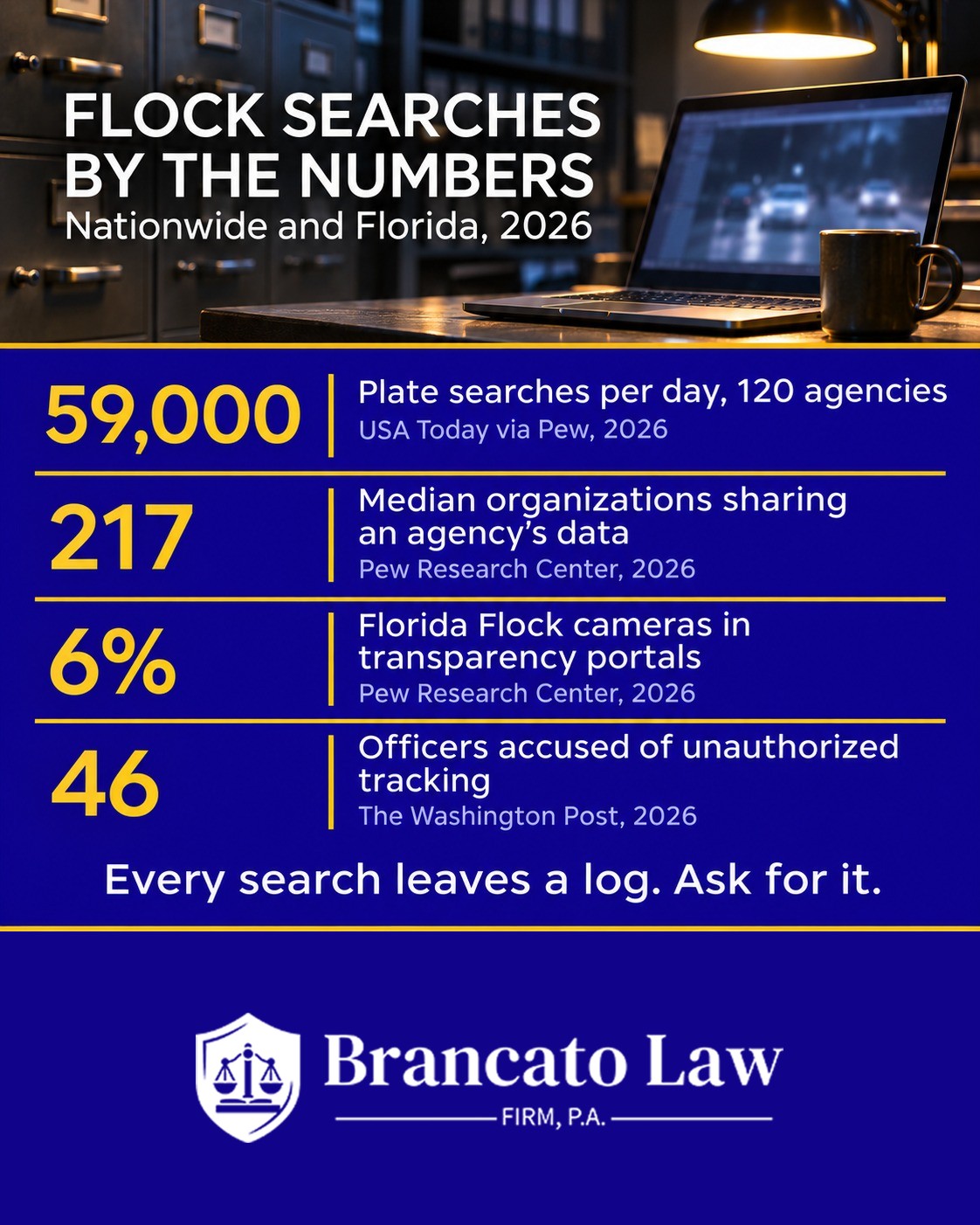
- The network is shared, not local. Agencies that disclose their sharing report giving their Flock data to a median of 217 other organizations, according to a Pew Research Center analysis published November 9, 2026. A query in Tampa can reach cameras in other states, which is how the Kyle deputy pulled sightings from multiple states.
- The volume is enormous. A USA Today review of raw logs from 120 agencies in 24 states found about 59,000 searches a day over three and a half years, Pew reported. Pew also found the most common reason given for searches is some form of the word “investigation,” which tells a judge nothing.
Florida’s own numbers make the oversight gap worse. Only 6% of the Florida Flock cameras Pew found on OpenStreetMap are covered by an agency transparency portal, the public page some agencies use to disclose retention, sharing, and search activity. In most Florida cases, the defense learns who searched a client’s plate only through discovery or a subpoena.
The counterarguments are real, and a judge will hear them. Most courts still follow Knotts. Porter is binding appellate law in the Fifth Circuit. Carpenter itself carved out security cameras. And on a narrow query, such as one camera hit in a two-hour window, a judge is likely to agree with Jones and Robinson. That is why the facts of each query decide these motions.
Does the Exclusionary Rule Apply to an Illegal Flock Search?
Yes, if the search was unconstitutional and no exception saves it, but the good-faith exception is the State’s strongest answer. The exclusionary rule exists to deter police misconduct. In Davis v. United States, 564 U.S. 229 (2011), the Supreme Court said the rule’s “sole purpose” is “to deter future Fourth Amendment violations” and held that evidence obtained “in objectively reasonable reliance on binding appellate precedent” is not excluded. In Herring v. United States, 555 U.S. 135 (2009), the Court held the rule reaches “deliberate, reckless, or grossly negligent conduct, or in some circumstances recurring or systemic negligence,” but not an isolated database mistake.
Florida follows those rules because of the conformity clause. The Second District, which hears appeals from Hillsborough, Pinellas, and Pasco Counties, applied Davis in Williams v. State, 421 So. 3d 860 (Fla. 2d DCA 2025), a Hillsborough County case, holding that officers who searched a car based on then-binding marijuana-odor precedent acted in good faith even though the precedent later changed. Our post on the Second District’s limits on the plain-smell doctrine covers that line of cases.
Our attorneys argue around good faith in three ways.
- No binding precedent authorized the query. Davis protects reliance on binding appellate precedent. No Florida appellate court and no Eleventh Circuit decision has ever held that a Flock history query is lawful; Mapson expressly left it open. In Carpenter v. State, 228 So. 3d 535 (Fla. 2017), the Florida Supreme Court refused to apply Davis where officers relied on a nonfinal decision in an unsettled, still-developing area of law, reasoning that officers should “err on the side of caution by obtaining a search warrant.” Justice Sotomayor’s Davis concurrence likewise flagged that unsettled law is a “markedly different question.”
- Mapson’s good-faith reasoning is tied to its timing. The Eleventh Circuit applied good faith because the officer ran the queries the day before Carpenter, when binding circuit precedent allowed warrantless location records. After Carpenter and Chatrie, that reliance argument is far weaker.
- The conduct is deliberate and deterrable. Herring reserves exclusion for deliberate or reckless conduct and systemic failures. A query run on a hunch, with a boilerplate reason code, through a system that logs every query, is a deliberate act. Agencies that fire officers for misusing Flock are admitting the conduct is knowable, traceable, and preventable.
What officer firings and prosecutions show about deterrence
Police departments across the country have fired, charged, and imprisoned officers for Flock searches made without a legitimate reason. In August 2026, The Washington Post reported that at least 46 officers nationwide had been accused of using plate cameras for unauthorized tracking, according to Al Jazeera. By November 2026, CBS News Atlanta had tracked more than three dozen law enforcement officials arrested or charged since August.
- Lufkin, Texas: an officer pleaded guilty to 100 counts of misuse of official information and was sentenced to five years in prison, KTRE reported.
- Haines City, Florida: an officer was charged under Florida’s computer crimes and official misconduct statutes after an affidavit said he searched his estranged wife’s car 717 times, WFTV reported.
- Braselton, Georgia: an officer was fired after an investigation found he improperly used the Flock system, and the case went to the Georgia Bureau of Investigation, Gray News reported.
- DeKalb County and Fayetteville, Georgia: a sheriff’s sergeant was fired and charged, and three Fayetteville officers lost their jobs for looking up their own plates or plates of people they knew, the Atlanta Journal-Constitution reported.
- Pinellas County, Florida: a former deputy was arrested after an agency audit found more than 100 unauthorized Flock and driver’s license queries, while charges against another deputy were dropped, the Tampa Bay Times reported.
Every one of those cases was proven with the same audit log a defense lawyer can request. For the exclusionary rule, that means something concrete. When agencies can find and punish a bad query after the fact, suppression works as intended: it gives every officer a reason to get a warrant or write a real reason before running a plate. Each of the officers above is presumed innocent until proven guilty, and none of these misuse cases decides whether an ordinary investigative query is a search.
What Should You Do If Flock Data Was Used in Your Case?
Ask your lawyer to request the full query record right away, before retention periods run out. Pew found the median agency with a transparency portal keeps Flock data for 30 days. Our attorneys request the following in discovery, by subpoena duces tecum to the agency, and when needed from the vendor.
| Record | Why it matters |
|---|---|
| The audit log for every query on the client’s plate | Shows who searched, when, how often, and from which agency. Kyle turned on the reasons the deputy entered and what the query returned. |
| The reason code and case number entered for each query | A blank, generic, or false reason supports a Herring argument and, in a warrant case, a Franks challenge. |
| The search parameters: date range, networks, and cameras searched | Separates a one-camera check from a 30-day, multistate history, which is the line courts are drawing. |
| The complete query output, not printouts the State selected | Shows every sighting returned and how many hits the database holds for the plate. |
| Hotlist entries and their timestamps | Shows whether an alert was still valid when the stop happened. |
| Sharing settings and the list of outside agencies with access | Shows whether the data crossed agency or state lines. |
| Retention policy and preservation confirmation | Shows what was deleted and when, and whether helpful reads were lost. |
| Raw images for every read | Lets us check whether the plate and the vehicle were read correctly. |
Then we decide which motions fit the record. A motion to suppress evidence attacks the query as a warrantless search and attacks any stop, detention, or search that followed from it. When an officer used Flock results to get a warrant, Franks v. Delaware, 438 U.S. 154 (1978), entitles the defense to a hearing on a substantial preliminary showing that the affidavit contained a deliberate or reckless falsehood necessary to probable cause, such as describing a weeks-long query as a single sighting. We also look for the separate violations that won Kyle, like a stop extended without reasonable suspicion, because a judge can suppress on that ground without reaching the Flock question.
We also check the obstacles the State will raise. Yang shows that a defendant must have standing in the car or the data, so a borrowed or overdue rental car can complicate the motion. Blair shows that an independent traffic violation can break the link between the query and the stop. Plate reader stops lead to many drug cases, which our Tampa drug crimes attorney page covers, along with gun and DUI cases, so we raise these issues wherever a hit started the case. Our guide to how a Florida criminal case moves from arrest through trial shows where suppression motions are filed.
How Do Our Attorneys Challenge Flock Evidence in Tampa Bay?
We treat every plate reader hit as evidence with a source, a time stamp, an operator, and a reason, and we make the State prove each one. In Hillsborough County cases we ask whether the read came from the Sheriff’s Office “Eye on Crime” system, a city camera, a private HOA camera, or a network shared from another state. In Pinellas County cases, the 2026 deputy arrests make the agency’s own audit history fair game in discovery. Our Hillsborough County criminal defense team files in the Thirteenth Judicial Circuit, where any appeal goes to the Second District.
When investigators are still pulling plate history and no one has been charged, our representation before charges are filed can address the investigation early, including preservation demands for records that would otherwise expire.
How Fast Do You Need to Act When Flock Data Is in Your Case?
Within days. The median agency with a public portal keeps Flock data for 30 days, Pew reported, and Florida’s statute leaves the maximum to a state schedule rather than a fixed number. Reads that help a client, such as a hit placing the car somewhere else at the key time, can disappear before the first court date. The Brancato Law Firm sends preservation letters at the start of the case so the audit log and the raw images survive until a judge can rule.
Frequently Asked Questions About Warrantless Flock Searches
Do police need a warrant to search Flock camera data in Florida?
Not under any Florida statute or binding Florida appellate decision as of November 2026, but the constitutional question is open. Our attorneys at The Brancato Law Firm argue that a historical, multi-camera query is a search under Carpenter and Chatrie and file motions to suppress when the record supports it.
Did a federal court rule that a Flock search was unconstitutional?
Yes. In United States v. Kyle, Judge Sara E. Hill of the Northern District of Oklahoma held on October 1, 2026, that a warrantless 30-day, multistate Flock query was a search and suppressed the evidence. The Brancato Law Firm cites Kyle, while being candid that an Alabama federal judge rejected it seven weeks later in United States v. Jones.
Can I get Flock evidence thrown out if the officer had no reason to search my plate?
Possibly, if the query was a search or it led to an unlawful stop or detention. The Brancato Law Firm demands the reason code and audit log for every query, because a search run on a hunch is the kind of deliberate conduct the exclusionary rule is meant to deter; our motion to suppress guide explains the hearing.
Does the good-faith exception save a warrantless Flock search in Florida?
It often decides the motion. Davis excuses reliance on binding appellate precedent, and our attorneys at The Brancato Law Firm argue that no Florida or Eleventh Circuit decision has ever approved a Flock history query, so there was nothing binding to rely on, citing Carpenter v. State.
Can I find out if police searched my license plate in Flock?
Sometimes. Section 316.0777 lets an agency disclose plate reader data about a plate registered to you unless it is active criminal intelligence or investigative information. Once a case is filed, The Brancato Law Firm gets the full audit log through discovery and subpoenas, which reaches much more than a public records request.
Can I be investigated through Flock before I am charged?
Yes. Investigators often pull plate history long before an arrest, and nothing in Florida law requires them to tell you. The Brancato Law Firm offers pre-file advocacy to deal with an investigation early and to push for preservation of records before they expire.
Flock records age out fast, so the first call matters. Call The Brancato Law Firm, P.A. at (813) 727-7159, any hour, and our attorneys will start by demanding the audit log, the reason codes, and the raw images for every query on your plate. The firm was founded by Tampa Criminal Defense Attorney Rocky Brancato, and our office is two blocks from the courthouse. Our firm has Spanish-speaking staff, and attorney Jean-Luc Adrien speaks Spanish, Haitian Creole, and French.
For more about our defense strategies, visit our Tampa Drug Crimes Attorney page.
The Brancato Law Firm, P.A.
620 E. Twiggs Street, Suite 205, Tampa, FL 33602
(813) 727-7159
Serving Hillsborough, Pinellas, and Pasco Counties
The Brancato Law Firm, P.A. is a Tampa-based criminal defense practice. We are not affiliated with any other Brancato-named law firms.
Visit Us

Tampa, FL 33602

Contact Us Now
Free Legal Consultation (813) 727-7159
