

From First DUI to Death Penalty



Is Predictive Policing Legal in Florida? Pasco Case (2026)


The answer
It depends on what police do with the prediction. Florida officers can use crime data to decide where to patrol, but a computer score or a spot on a “prolific offender” list is not legal grounds to stop, detain, or search anyone. Pasco County’s intelligence-led policing program ended in a December 2024 federal settlement whose recitals say deputies’ home “checks” went beyond what the Fourth Amendment allows.
Key takeaways
- A predictive policing score or a “prolific offender” label is not reasonable suspicion, so a stop based on it alone can be challenged under section 901.151 and Robinson v. State.
- Pasco County ended its intelligence-led policing program in a December 2024 settlement that paid $105,000 to four residents.
- Police may knock on your door once, but repeated pressure visits can exceed the implied license recognized in Florida v. Jardines.
- A real traffic violation still supports a stop, so pretext cases turn on whether the violation happened.
Being on a police list is not a crime, and Florida courts have held for decades that an officer’s memory of someone’s past arrest does not justify a stop. As founder of The Brancato Law Firm, P.A., a Tampa criminal defense firm, and a former police academy instructor who taught criminal procedure, I have spent more than 25 years in Hillsborough County courtrooms testing whether police had a lawful reason to stop, question, or search our clients. When a case starts with a “check,” a “flag,” or a name on a list, our attorneys go straight to that question.
What is predictive policing?
Predictive policing is the use of past police data to forecast crime and decide where officers go or whom they watch. It comes in two forms. Place-based systems forecast which blocks are likely to see crime, so patrols go there. Person-based systems score individuals by their records and contacts and send officers to those people.
The place-based kind is the more common and the less controversial. The person-based kind raises the hard legal questions, because it points police at a human being who has not been accused of a new crime. Pasco County’s program was person-based.
What did Pasco County’s intelligence-led policing program do?
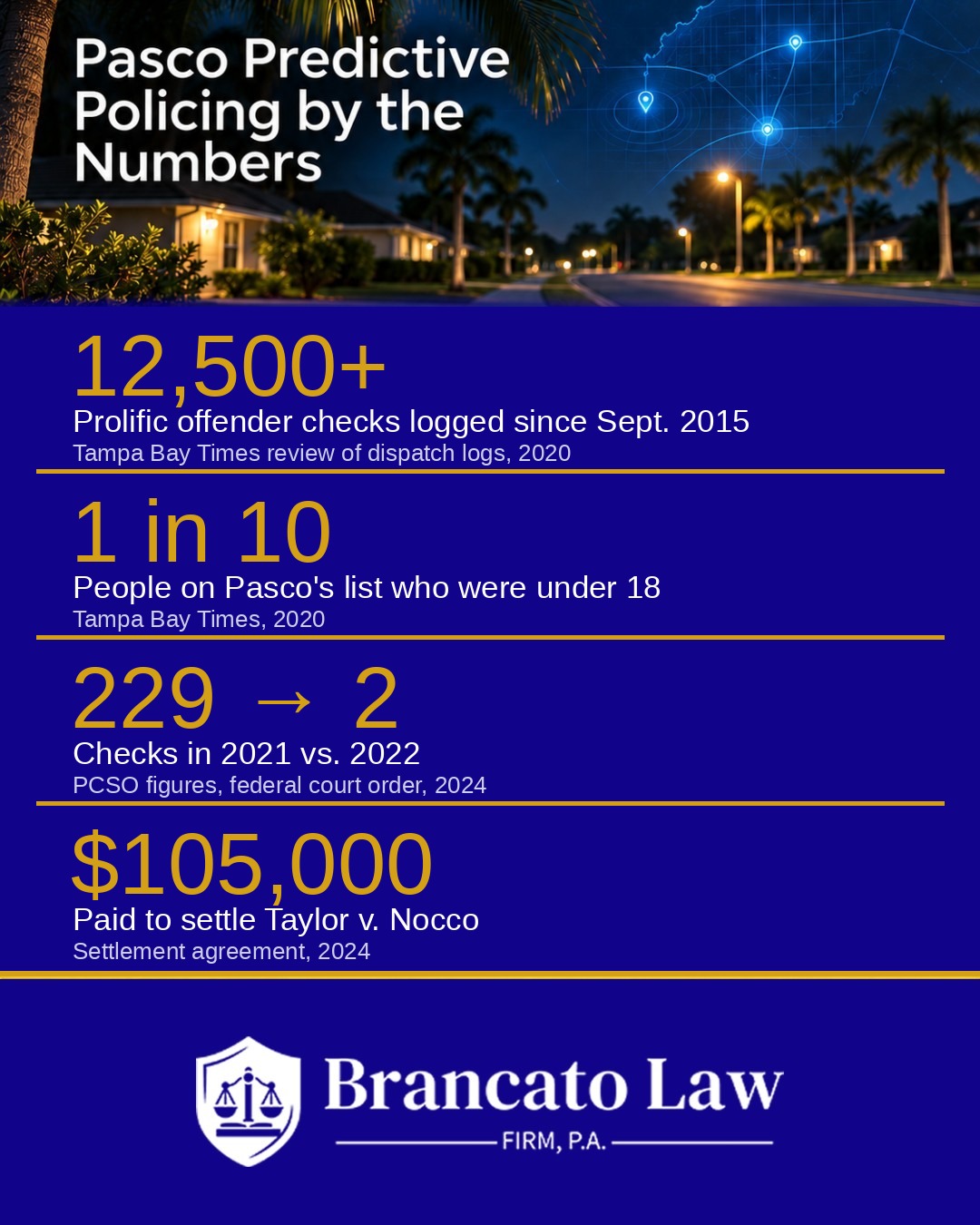
The Pasco Sheriff’s Office scored residents by their criminal histories, put the highest scorers on a “prolific offender” list, and sent deputies to their homes. A 2020 Tampa Bay Times investigation reported that people got points each time they were arrested, even when the charges were dropped, and points for merely being named as a suspect. The program, it found, had placed almost 1,000 people on the list in about five years, and at least 1 in 10 of them were under 18.
According to the Times, dispatch logs showed deputies had gone on these checks more than 12,500 times since September 2015. Families described deputies at the door late at night and code citations for tall grass, missing house numbers, and backyard chickens.
The Sheriff’s Office’s own figures, quoted in a federal court order, show how quickly it all stopped. Prolific offender checks fell from 229 in 2021 to two in 2022, according to the August 28, 2024 order in Taylor v. Nocco. The office said it ended the checks because of manpower limits and a shift to fentanyl enforcement.
A separate piece of the program used school data. The Times reported that the Sheriff’s Office drew on grades, attendance, and discipline records to list “at-risk” students. After the U.S. Department of Education opened an investigation in April 2021, the Sheriff’s Office and the school board agreed in May 2021 that school resource officers would no longer have access to student data. Florida law gives students and parents a right of privacy in education records under section 1002.22, Florida Statutes, which ties those rights to the federal Family Educational Rights and Privacy Act.
| Date | What happened |
|---|---|
| 2013 | Program in place, per the federal court’s description (2013 to 2022) |
| September 2015 | Start of the dispatch-log period in which the Times counted more than 12,500 checks |
| September 2020 | Tampa Bay Times publishes its investigation |
| March 2021 | Four Pasco residents file a federal civil rights suit |
| May 2021 | School resource officers lose access to student data |
| 2022 | Checks drop to two for the year |
| August 28, 2024 | Federal court sends the core claims toward trial |
| December 2024 | Settlement: $105,000 and an end to the program |
Did a court find Pasco’s program unconstitutional?
No court issued a final ruling, because the case settled on the eve of trial. The federal judge did decide two important things first. In Taylor v. Nocco, No. 8:21-cv-555-SDM-CPT (M.D. Fla. Aug. 28, 2024), four Pasco residents sued the sheriff over the checks. The court held that the program’s written manual was “not facially unconstitutional,” but it refused to throw out the residents’ Fourth Amendment, family-association, and due process claims, because the record raised real questions about how deputies carried the program out.
The December 2024 settlement agreement paid the four plaintiffs $105,000. Its recitals state that prolific offender checks at the plaintiffs’ homes “exceeded” the implied license police share with the public to knock on a door, and that they interfered with family relationships the First Amendment protects. The Sheriff also represented that he will not return to a substantially similar process of designating prolific offenders. The agreement includes a standard clause denying liability, so it is accurate to say the Sheriff agreed to those recitals rather than that a court found a violation.
A Pasco case that grew out of a home “check” or a list-driven stop deserves a hard look at how police got there, and our Pasco County criminal defense attorneys start with that history.
Can police stop you because an algorithm flagged you?
No. Under Florida’s Stop and Frisk Law, section 901.151, Florida Statutes, an officer may detain someone only when the circumstances “reasonably indicate” that the person has committed, is committing, or is about to commit a crime. A score or a list entry describes the past. It says nothing about what the person is doing at that moment.
Florida courts drew this line long before algorithms. In Robinson v. State, 388 So. 2d 286 (Fla. 1st DCA 1980), a detective stopped a man at the Jacksonville airport mainly because he remembered arresting him years earlier on a narcotics charge that was later dropped. The First District held that “an officer’s knowledge of a suspect’s previous arrest, standing alone, is insufficient” to justify a stop, and it ordered the cocaine found afterward suppressed. A computer-generated list is also a record of past contact with police, only compiled at scale.
Hypothetical
Say a deputy sees a 19-year-old walking near a convenience store at 9 p.m. and recognizes him from the agency’s watch list. He is not doing anything unusual. If the deputy detains him on that basis and finds marijuana in his pocket, the defense has a strong motion to suppress, because the only reason for the stop was his name on a list.
The data behind these lists has its own problem. In a 2016 study in the journal Significance, statisticians Kristian Lum and William Isaac ran a widely used predictive policing algorithm on Oakland, California drug arrest data. They found that it sent officers back to the same neighborhoods police already patrolled heavily, even though public health survey data showed drug use spread across the city (Lum & Isaac, “To Predict and Serve?” 2016). The prediction tracked where police had already been looking.
Can deputies keep showing up at your house?
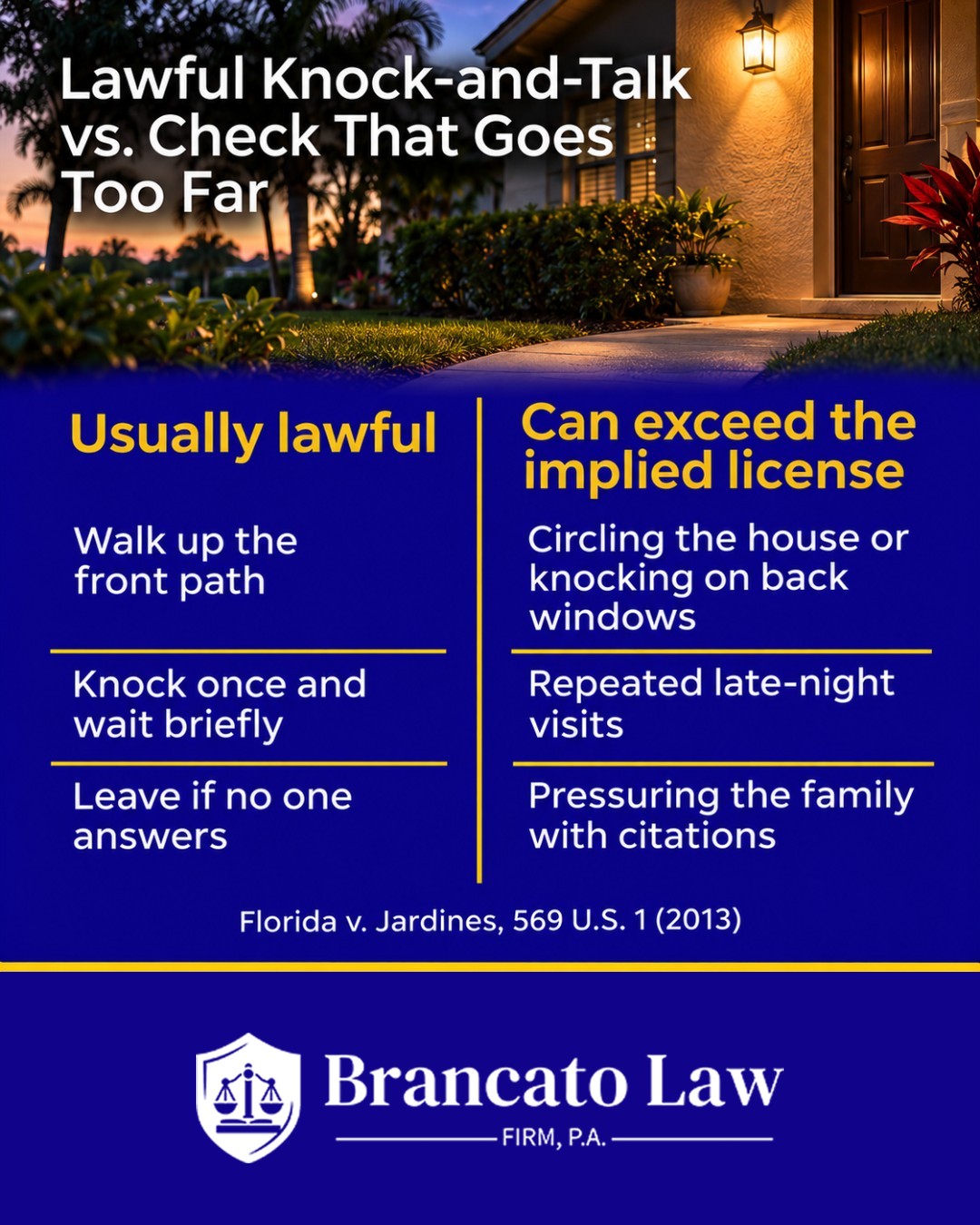
Police can knock on your door like any visitor, but only within the limits of what a visitor may do. In Florida v. Jardines, 569 U.S. 1 (2013), Miami-Dade detectives brought a drug dog to a front porch. The U.S. Supreme Court held that the implied license to approach a home lets a visitor walk up, knock promptly, wait briefly, and then leave, and that the license “is limited not only to a particular area but also to a specific purpose.” Because the officers used the porch to search, the Court held a Fourth Amendment search occurred.
Pasco’s settlement recitals rest on that rule. A single knock-and-talk is usually lawful, but circling the house, knocking on back windows at night, or returning again and again to pressure a family can go beyond it. When a visit goes beyond the implied license, evidence police gathered during it can be challenged in a motion to suppress.
If deputies come to your door for a “check”
Say this:
- “I don’t wish to speak with you. Do you have a warrant?”
- “I do not consent to any search.”
- “I want to speak with a lawyer before I answer questions.”
Not this:
- Opening the door wide or stepping outside to talk.
- Explaining where your son or daughter was last night.
- Arguing about the code violation on the spot. Take the citation and call a lawyer.
You do not have to open the door for a knock-and-talk, and you can speak through a closed door. A warrant changes that. If deputies say they have one, ask to see it.
What if the stop was for a real traffic violation?
A real violation usually makes the stop legal even if the officer’s true reason was a list. In Whren v. United States, 517 U.S. 806 (1996), the Supreme Court held that “subjective intentions play no role” when an officer had probable cause to believe a traffic law was broken. The Court added that the place to challenge discriminatory enforcement is the Equal Protection Clause, not the Fourth Amendment.
So in a pretext case, the fight is usually over whether the violation actually happened, and officers who already have a target in mind sometimes see violations that did not occur.
From the courtroom
One of my first suppression motions was a failure-to-maintain-a-single-lane stop. The officer wrote that my client also drove over a concrete curb. I went to the scene and photographed it. There was no curb. The judge granted the motion on the officer’s credibility. When police already know who they want to stop, the reason they give for the stop deserves that same scrutiny.
How do our attorneys find out if police flagged you?
We ask for it. The prosecution must disclose evidence favorable to the defense under Brady v. Maryland, 373 U.S. 83 (1963), where the Supreme Court held that suppressing favorable evidence on request “violates due process” when it is material to guilt or punishment. Proof that a stop was driven by a list rather than observed conduct can be exactly that kind of evidence.
In practice, our attorneys request the dispatch history for the client’s address, body-camera video from every visit, any intelligence bulletin or “be on the lookout” notice naming the client, and the officer’s reports for earlier contacts. In Taylor v. Nocco, the court record showed the Pasco Sheriff’s Office had discussed the plaintiffs by name at 2016 “Actionable Intelligence Meetings.” Records like those show what the officer knew before the stop.
If deputies are visiting your home but no charge has been filed, that is the time to act. Our firm’s representation before charges are filed puts a lawyer between you and the investigation at the earliest stage of a Florida criminal case.
Does predictive policing reduce crime?
The best controlled study found no measurable effect. In 2012, the Shreveport, Louisiana Police Department ran a randomized experiment for the National Institute of Justice, with three districts using predictive policing and three using ordinary hot-spot policing. RAND researchers reported “no significant differences in levels of property crime” between the two groups (NIJ, Evaluation of the Shreveport Predictive Policing Experiment).
Pasco’s local results point the same way. The Tampa Bay Times found in 2020 that Pasco’s drop in property crime was similar to the decline in the seven largest nearby jurisdictions, and that over the same period violent crime increased only in Pasco.
| Police action | Usually lawful? | Why |
|---|---|---|
| Patrolling a block a computer forecasts as high-risk | Yes | Driving public streets is not a search or seizure |
| One knock on the front door, then leaving | Yes | Within the implied license (Jardines) |
| Repeated late-night visits, back windows, pressure to move | Often no | Can exceed the implied license; Pasco’s settlement recitals say its checks did |
| Detaining someone because they are on a list | No | A past record alone is not reasonable suspicion (Robinson; s. 901.151) |
| Stopping a listed driver who actually ran a stop sign | Yes | A real violation supports the stop (Whren) |
| Using a child’s school records to flag future crime | Restricted | Education records carry a right of privacy (s. 1002.22; FERPA) |
Do Tampa Bay agencies still use predictive policing?
Pasco says its program is over, and the settlement commits it not to bring back a substantially similar one. For the rest of the region, the most recent public account is from 2020, when the Tampa Bay Times asked local agencies about the practice. The Hillsborough County Sheriff’s Office said it identifies prolific offenders and sometimes checks on them, while the Pinellas County Sheriff’s Office and Tampa Police Department said they do not use predictive analytics or algorithms to pick priority offenders.
License plate readers, facial recognition, and real-time crime centers raise the same question of who police decide to watch. Our police surveillance guide covers each tool, including warrantless Flock camera searches and facial recognition arrests.
I saw the juvenile side of this up close. I chaired the 13th Judicial Circuit Juvenile Justice Advisory Board from 2022 to 2024 and served for years on Hillsborough County’s juvenile civil citation committee. In my view, civil citations, which keep a child’s first mistake out of the court system, are the gold standard for reducing repeat offenses. Sending deputies to a teenager’s home over and over does the opposite.
What should you do if police are targeting you or your child?
- Do not consent. You can decline to open the door, answer questions, or allow a search.
- Write it down. Record the date, time, deputy names, and what was said at every visit.
- Save the video. Keep doorbell camera clips before the system overwrites them, often within days.
- Keep every citation. Code tickets issued during “checks” can show a pattern.
- Call a criminal defense lawyer before any interview, and right away if anyone is arrested.
Dispatch audio and video are not kept forever, and the best time to demand them is before the State builds its case. If the issue is a drug arrest that followed a stop, see our Tampa drug crimes attorney page.
Frequently asked questions about predictive policing in Florida
Is it legal for police to keep a “prolific offender” list in Florida?
Yes, keeping a list is not illegal by itself, and the federal court in the Pasco case found the program’s manual was not unconstitutional on its face. What matters is what officers do with the list, which is why The Brancato Law Firm looks at every stop, visit, and search that followed. Our GPS tracking post covers a related form of targeted surveillance.
Can police use my child’s school records to label them a future criminal?
Florida law gives students and parents a right of privacy in education records, and Pasco ended school resource officers’ access to student data in 2021. If a juvenile case relies on school records, our attorneys at The Brancato Law Firm ask how police got them and whether federal or state privacy law allowed it. See section 1002.22, Florida Statutes.
Do I have to open the door when deputies come for a “check”?
No. A knock-and-talk is voluntary unless police have a warrant, so you can stay inside and say you do not wish to talk. That is the first advice The Brancato Law Firm gives anyone who calls about repeated visits, along with a reminder to save any doorbell video.
Can a criminal case be thrown out because police used predictive policing?
Sometimes. A list does not void a case on its own, but if the stop or search had no lawful basis, the evidence it produced can be suppressed, and a case without its key evidence is often dropped. At The Brancato Law Firm, the suppression motion is built from the records of how police came to focus on the client. Read more about how our attorneys defend drug charges.
Did Pasco County admit its program was unconstitutional?
Not in so many words. The December 2024 settlement recites that the checks exceeded the implied license to knock and interfered with family relationships, while also stating that the Sheriff denies liability. When a client’s case traces back to that era, The Brancato Law Firm’s attorneys use the court record from Taylor v. Nocco to show how the checks worked.
Do I have to show ID to a deputy at my door?
No, not during a voluntary encounter where you are not being detained. Our attorneys at The Brancato Law Firm walk through the detention rules in Do You Have to Show ID to Police in Florida?
Sources
- Section 901.151, Florida Statutes (Stop and Frisk Law)
- Section 1002.22, Florida Statutes (education records)
- Taylor v. Nocco, No. 8:21-cv-555-SDM-CPT (M.D. Fla. Aug. 28, 2024) (order on summary judgment)
- Taylor v. Nocco settlement agreement (Dec. 2024)
- Robinson v. State, 388 So. 2d 286 (Fla. 1st DCA 1980)
- Florida v. Jardines, 569 U.S. 1 (2013)
- Whren v. United States, 517 U.S. 806 (1996)
- Brady v. Maryland, 373 U.S. 83 (1963)
- Tampa Bay Times, “Targeted” investigation (2020)
- National Institute of Justice, Evaluation of the Shreveport Predictive Policing Experiment
- Lum & Isaac, “To Predict and Serve?” Significance (2016)
If deputies keep coming to your home, or a stop seems to have started with your name instead of your conduct, call The Brancato Law Firm, P.A. at (813) 727-7159 before you answer questions. The firm was founded by Tampa Criminal Defense Attorney Rocky Brancato, and our attorneys can start requesting dispatch records and video while they still exist. Call us at any hour. Our firm has Spanish-speaking staff, and attorney Jean-Luc Adrien speaks Spanish, Haitian Creole, and French. For more about our defense strategies, visit our Tampa drug crimes attorney page.
The Brancato Law Firm, P.A.
620 E. Twiggs Street, Suite 205, Tampa, FL 33602
(813) 727-7159
Serving Hillsborough, Pinellas, and Pasco Counties
The Brancato Law Firm, P.A. is a Tampa-based criminal defense practice. We are not affiliated with any other Brancato-named law firms.
Visit Us

Tampa, FL 33602

Contact Us Now
Free Legal Consultation (813) 727-7159
