- Free Consultation 24/7: (813) 727-7159 Tap Here To Call Us


From First DUI to Death Penalty



Can Police Track Your Phone Without a Warrant in Florida?


Rewrite/update date: September 2, 2026
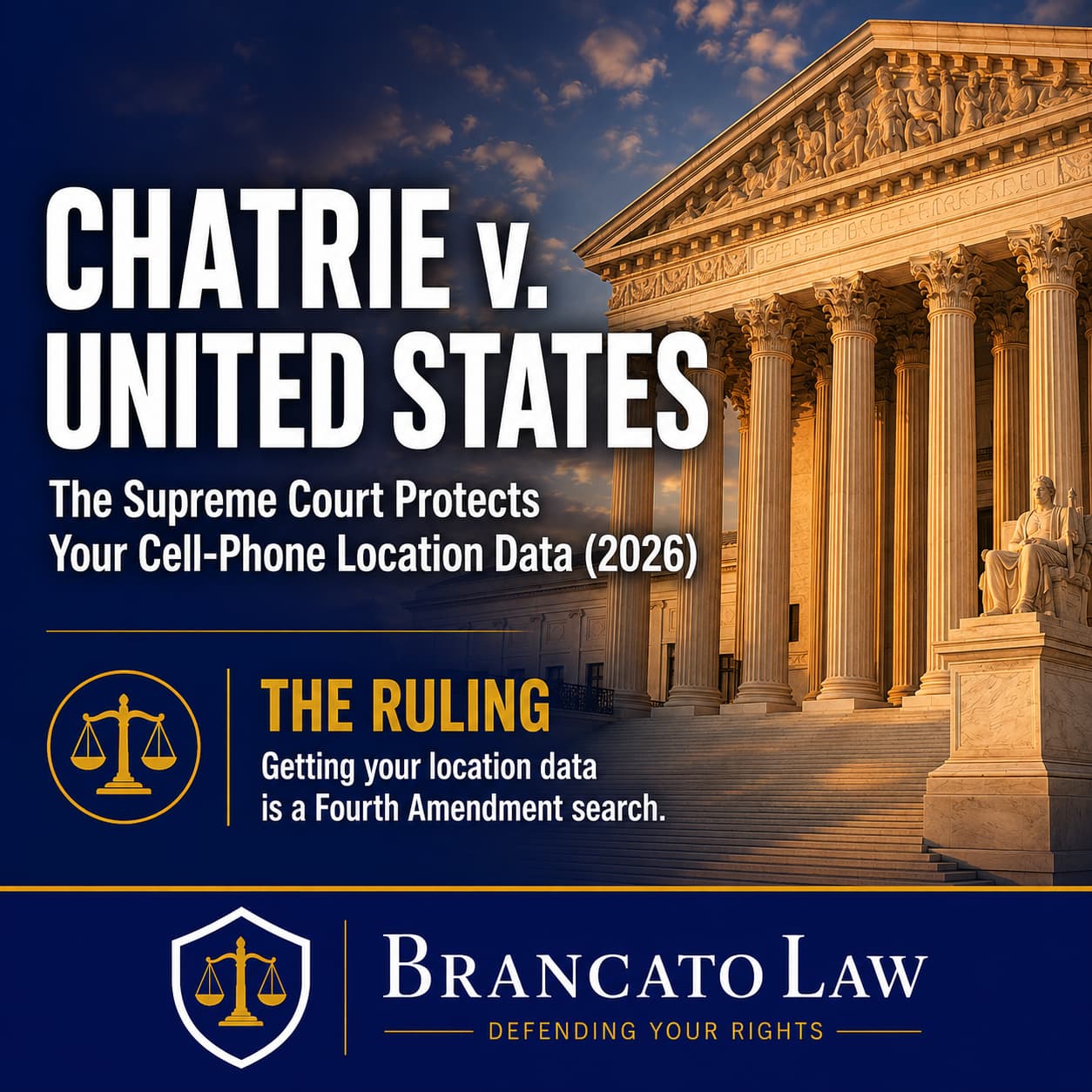
| No — not anymore, for the location history your phone quietly logs. In Chatrie v. United States (June 29, 2026), the U.S. Supreme Court held that police conduct a Fourth Amendment search when they obtain your cell-phone location data — even just two hours of it, and even though a company like Google stores it. That means a valid warrant is generally required, and a defective one can be challenged with a motion to suppress. The Court did not decide whether the warrant in Chatrie’s own case was valid or whether the evidence gets thrown out — those questions were sent back down, and they are exactly where the defense fight now lives. |
I’m Rocky Brancato, founder of The Brancato Law Firm, P.A., a Tampa criminal defense firm. As a former police academy legal instructor, I taught officers what the Fourth Amendment lets them do — and where the line sits. Our attorneys use that same line every week in suppression litigation, and Chatrie just redrew it for every criminal case in Florida built on cell-phone location data.
What Did the Supreme Court Decide in Chatrie v. United States?
The Supreme Court held that when police obtained a suspect’s Google “Location History” through a geofence warrant, they conducted a Fourth Amendment search — because people keep a reasonable expectation of privacy in their cell-phone location data. Chatrie v. United States, No. 25-112 (U.S. June 29, 2026), extends the Court’s landmark 2018 decision in Carpenter v. United States (which protected cell-site location records) to the far more precise location logs generated by smartphone apps.
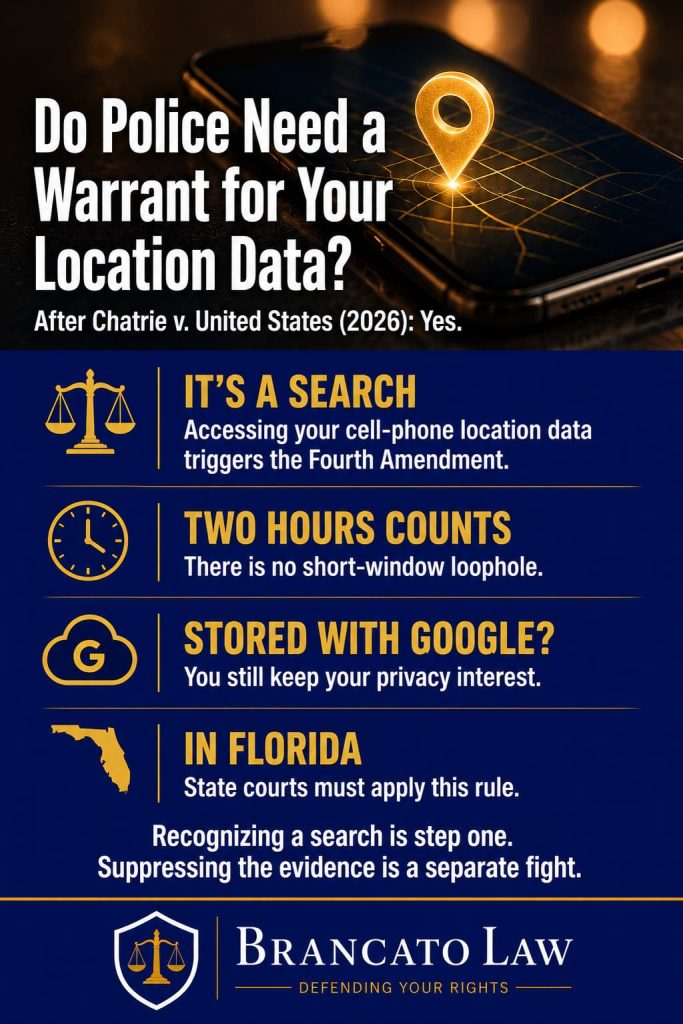
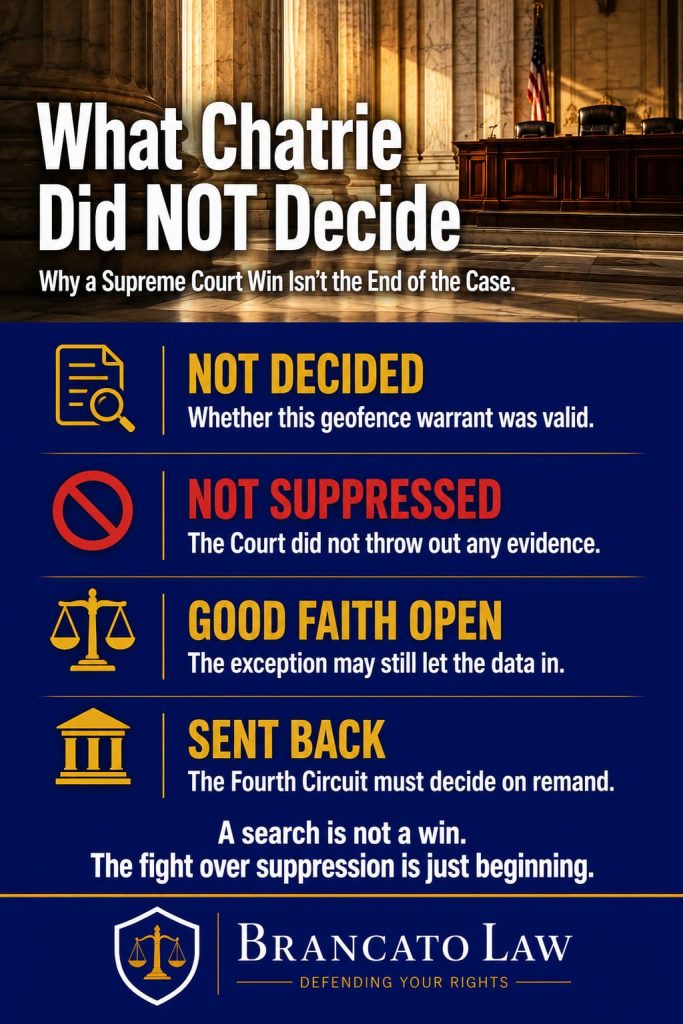
Three points from the decision matter most for anyone facing charges. First, duration doesn’t save the government: the Court rejected the argument that a “short” window — the two hours pulled in Chatrie’s case — is too little to trigger the Fourth Amendment, explaining that even brief location records can reveal deeply private facts. Second, storage by a third party doesn’t matter: the Court held the “third-party doctrine” does not apply, because location data is “not truly shared” in any meaningful sense — it is simply the automatic price of using a modern phone. Third, the Court decided only that a search occurred. It vacated the Fourth Circuit’s judgment and sent the case back to decide whether the warrant satisfied probable cause and particularity, and whether the good-faith exception saves the evidence if it did not.
What Was the Chatrie Case About?
The case began with a bank robbery that stumped investigators. On May 20, 2019, a man robbed a credit union in Midlothian, Virginia; witnesses and surveillance showed him approaching from the corner of a neighboring church while appearing to talk on a cell phone, but the trail went cold. Police then obtained a geofence warrant directing Google to identify devices with Location History enabled near the credit union around the robbery. That process ultimately pointed to Okello Chatrie, whose phone data placed him at the scene — two hours of his movements, pulled from Google’s servers. He moved to suppress, lost on good-faith grounds in the lower courts, and the Supreme Court took the case to answer the threshold question: was this a “search” at all? Six Justices said yes.
What Is a Geofence Warrant — and Can Google Still Answer One?
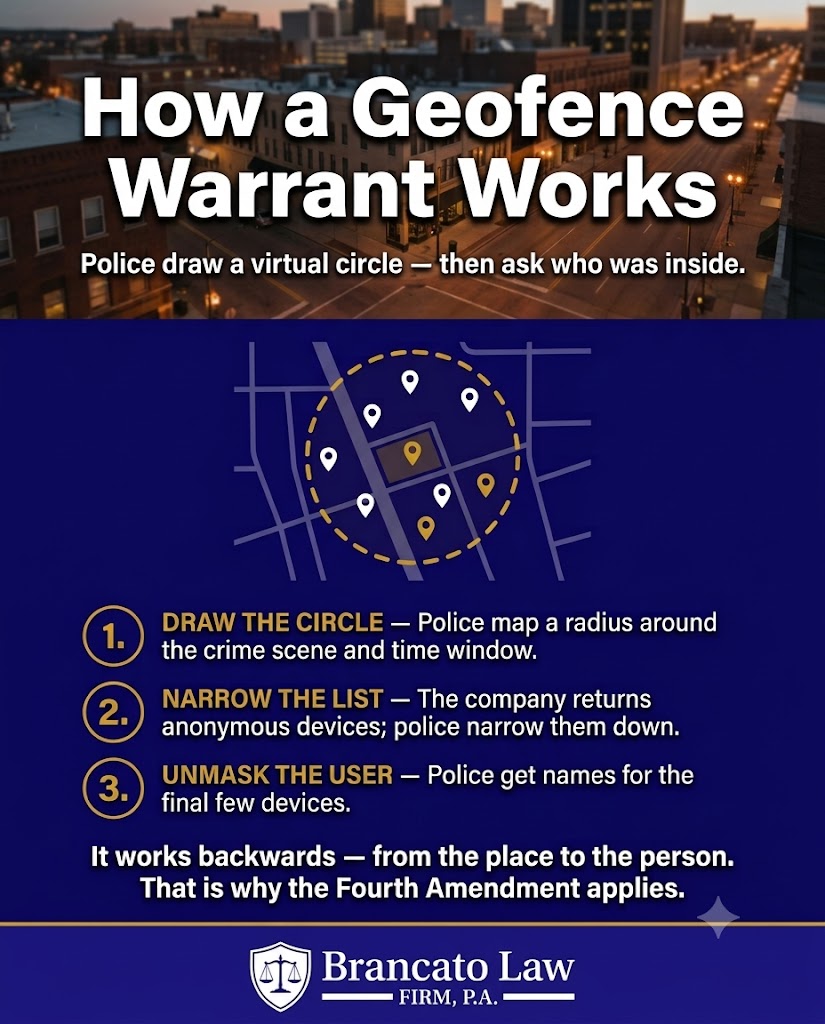
A geofence warrant works in reverse: instead of naming a suspect and searching their data, police draw a virtual perimeter around a crime scene and ask a company — most famously Google — to identify every device inside it during a time window. The process in Chatrie ran in steps: first an anonymized list of devices in the zone, then expanded data to narrow the list, then the “unmasking” of specific accounts — names, emails, phone numbers. Justice Jackson’s concurrence flagged the core defect defense lawyers now argue: the later steps often happen with no criteria and no judge supervising which devices get unmasked, leaving “too much to the discretion” of the officers.
Geofence Surveillance, By the Numbers
The scale of this surveillance tool is why the decision matters far beyond one Virginia robbery — the numbers below come from the opinion itself.
| Figure | What the Supreme Court’s opinion says |
|---|---|
| 1 → 982 → 11,000+ | Geofence warrants Google received in 2016, 2018, and 2020 — from a single request to more than eleven thousand in four years |
| 500 million+ | Users worldwide who have enabled Google Location History after the company’s repeated prompts |
| Every 2 minutes | How often Location History logs a phone’s position — roughly 720 chartings every day |
| Within 20 meters | The precision of those logs, which can even estimate elevation and reveal which floor of a building a phone is on |
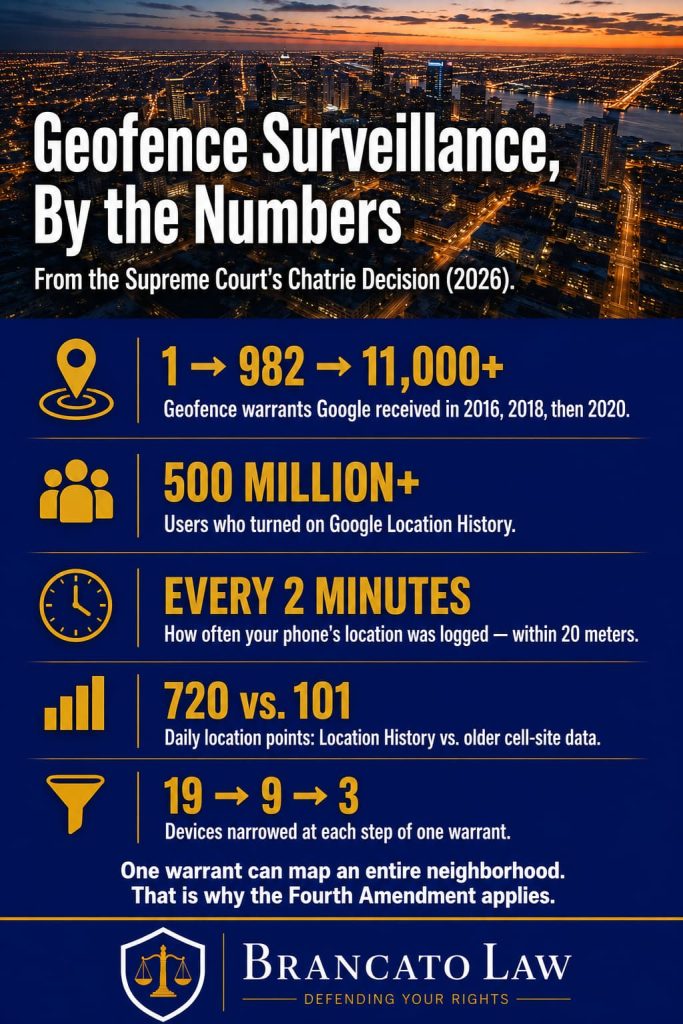
Two details from the opinion deserve emphasis. Location History runs constantly in the background once enabled — whether or not the app is open, whether or not the phone is in use — and it keeps running even if the user deletes the app that turned it on. And Android users are specifically warned their devices will not “work correctly” unless they turn it on. The Court treated that reality for what it is: tracking as a default condition of modern life, not a voluntary broadcast of your whereabouts.
Is My Cell-Phone Location Data Protected by the Fourth Amendment?
Yes — after Chatrie, your historical location data is constitutionally protected whether it comes from cell towers or from app-based logs, and regardless of how short the time window is. The decision closes the two arguments the government had been using to avoid Carpenter.
| Argument the government made | What the Court held |
|---|---|
| “Only two hours of data — too short to be a search” | Rejected. Even short-term location records can reveal familial, political, professional, religious, and sexual associations. There is no “Constitution-free zone” measured in hours. |
| “You shared it with Google, so the third-party doctrine applies” | Rejected. Location History is “not truly shared” — generating it is the automatic price of using a phone, and users reasonably understand the record as their own. |
| “Users opt in, unlike cell-site records” | Rejected as a distinction. Google repeatedly prompts users to enable it, and over 500 million have — the Court refused to treat that as a knowing surrender of privacy. |
| “The warrant here was valid, so it doesn’t matter” | Not decided. Warrant validity and the good-faith exception went back to the Fourth Circuit. |
The undecided fourth row is not a footnote — it is the battleground. A ruling that a search occurred means nothing in a specific case until a court examines whether the warrant (if there was one) was supported by probable cause and described the search with particularity. That examination is defense work, done case by case, device by device.
How Did the Justices Vote in Chatrie?
Justice Kagan wrote the majority opinion, joined by Chief Justice Roberts and Justices Sotomayor, Kavanaugh, and Jackson — with Justice Gorsuch concurring in the judgment, making six votes for the outcome. Justice Jackson added a concurrence (joined by Justice Sotomayor) arguing the multi-step geofence process gave officers an unsupervised “roving commission.” Justice Gorsuch would have reached the result on different reasoning. Justice Alito dissented — warning the decision “will send seismic waves through our Fourth Amendment doctrine” — joined in part by Justices Thomas and Barrett, and Justice Barrett filed her own dissent.
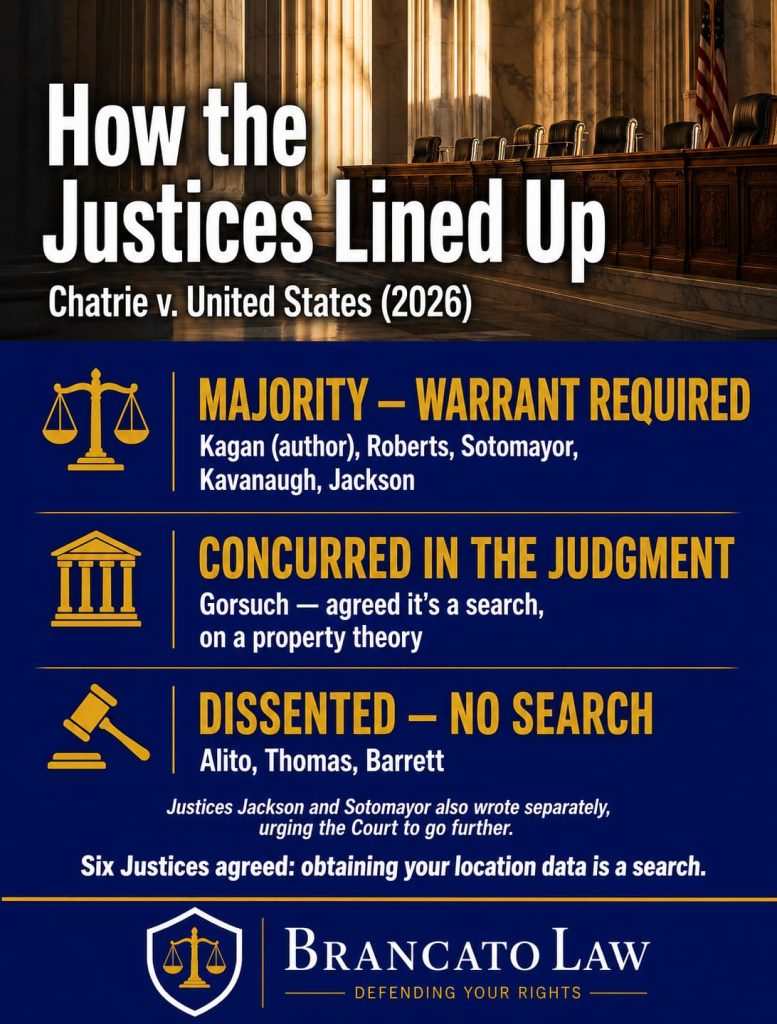
The lineup matters for what comes next: the majority’s reasoning was joined by five Justices, the case produced four separate opinions, and the open questions — warrant validity, good faith, other kinds of digital records — will be litigated against that backdrop for years.
Does Chatrie Apply to Criminal Cases in Florida?
Yes — immediately and automatically. Florida’s own constitution, Article I, Section 12, commands that Florida’s search-and-seizure right “shall be construed in conformity with the 4th Amendment to the United States Constitution, as interpreted by the United States Supreme Court.” So Chatrie is not persuasive authority here; it is the governing rule in every Florida courtroom, from the 13th Judicial Circuit in Tampa outward.
Florida law enforcement already works with location technology under state statutes like Fla. Stat. § 934.42, which lets officers get court orders for mobile tracking devices — and which expressly makes U.S. Supreme Court standards govern their installation and monitoring. After Chatrie, those standards now clearly include a warrant requirement for historical app-based location data. In practice, our attorneys look for location evidence in Tampa Bay cases in three familiar places: geofence-style requests tied to a crime scene, account-specific demands for a suspect’s Google or Apple data, and downloads from a seized phone itself. Each source now has its own constitutional checklist, and a defect in any of them supports a motion to suppress.
What Comes Next — Are Reverse Keyword Warrants Legal?
Chatrie answered the geofence question but teed up the next fight: reverse keyword warrants, where police ask a search engine to identify everyone who searched a particular term — a victim’s name, an address, a chemical — during a window of time. The logic of Chatrie (a dragnet over mostly innocent people’s private data, revealed only because using the internet is the price of modern life) applies with obvious force, but the Supreme Court has not yet decided it, and lower courts are split on how far Carpenter and now Chatrie reach. The same goes for other data dragnets: tower dumps, automated license-plate reader networks, and purchases of location data from commercial brokers. Currency matters in this area more than almost any other — the constitutional rules your case is judged by may literally change between arrest and trial, which is why preserving these issues early is essential.
What Should You Do If Police Used Phone Location Data in Your Case?
Get the warrant paperwork in front of a defense lawyer before you make any decisions about your case. After Chatrie, the questions our attorneys ask are concrete: Was there a warrant at all, or just a subpoena or “exigent” request? Does the affidavit establish probable cause tied to the place and time searched? Did the warrant limit the geofence’s size, duration, and the unmasking steps — or did officers get a blank check? Was your data pulled at step one or only after unsupervised narrowing? Every one of those defects is a suppression argument, and in a case built on placing your phone at a scene, suppression is usually the whole case. Location-data challenges also travel with the rest of the digital-privacy toolbox — see our guides to whether the State can get your medical records in a DUI case and what to do after being arrested in Tampa. And because these motions are won on timing — witnesses’ memories, preservation letters to Google, litigation before the State’s filing decision — the sooner the defense starts, the more options you have.
For more about our defense strategies, visit our Hillsborough County criminal defense page.
Frequently Asked Questions
Do police need a warrant to get my Google location history?
Yes. After Chatrie v. United States (2026), obtaining your historical cell-phone location data — including Google Location History — is a Fourth Amendment search, so police generally need a valid warrant supported by probable cause. Our attorneys examine whether the warrant in your case actually meets those requirements, because “a warrant existed” is not the same as “the warrant was valid.”
Can police still use geofence warrants after Chatrie?
Geofence warrants were not banned — the Court held only that they are searches, which means they require valid warrants. Whether any particular geofence warrant satisfies probable cause and particularity is now the contested question, and Justice Jackson’s concurrence gives the defense a roadmap for attacking the unmasking steps. We raise those challenges by motion to suppress in Florida courts.
Does Chatrie apply if police only got a couple hours of my location data?
Yes — that was precisely the government’s argument, and the Court rejected it. Two hours of Location History was enough to trigger the Fourth Amendment because even short windows reveal private associations. There is no minimum number of hours before your rights apply.
Will the evidence in my case be thrown out automatically?
No. Chatrie decided that a search occurred; whether evidence is suppressed depends on whether the warrant was valid and whether the good-faith exception applies — the questions remanded in Chatrie’s own case. That is exactly the analysis The Brancato Law Firm, P.A. performs when location data appears in discovery, because the suppression fight is where these cases are won or lost.
How do I know if a geofence warrant was used in my case?
You usually learn it from discovery — search warrant returns, affidavits, or references to Google legal process in reports. Defense counsel can demand the full warrant package, the data Google produced at each step, and the communications around it. If you were arrested in Hillsborough, Pinellas, or Pasco County and phone location evidence is involved, The Brancato Law Firm, P.A. can obtain and audit that paperwork.
Does turning off Location History protect me?
Turning it off stops Google’s Location History logging going forward, but other apps, your carrier’s cell-site records, and data brokers still generate location trails — each with its own legal protections. Chatrie and Carpenter now protect the two biggest categories. The safest assumption is that your phone creates records someone may one day try to use, and the Constitution now stands between those records and warrantless access.
Chatrie redrew the digital-privacy map on June 29, 2026, and the next rounds — warrant validity, good faith, keyword warrants — are being litigated right now. If cell-phone location data shows up anywhere in your Tampa Bay case, call the attorneys of The Brancato Law Firm, P.A. — founded by Tampa Criminal Defense Attorney Rocky Brancato — at (813) 727-7159 before the State’s filing decision is made. Suppression issues are strongest when they are raised early, and location-data challenges are the sharpest new tool in the box.
The Brancato Law Firm, P.A.
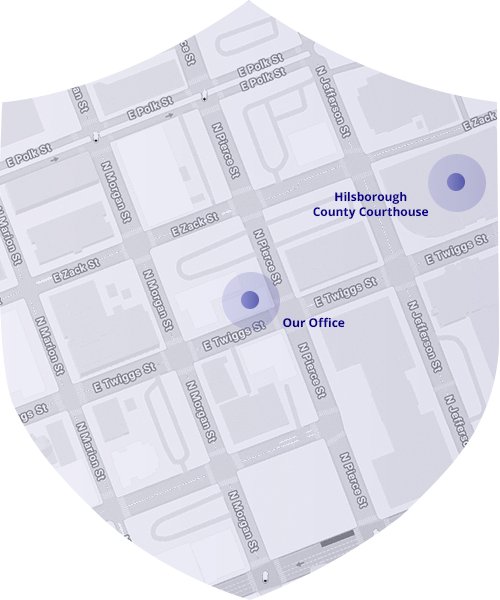
620 E. Twiggs Street, Suite 205, Tampa, FL 33602
(813) 727-7159
Serving Hillsborough, Pinellas, and Pasco Counties
The Brancato Law Firm, P.A. is a Tampa-based criminal defense practice. We are not affiliated with any other Brancato-named law firms.
Visit Us
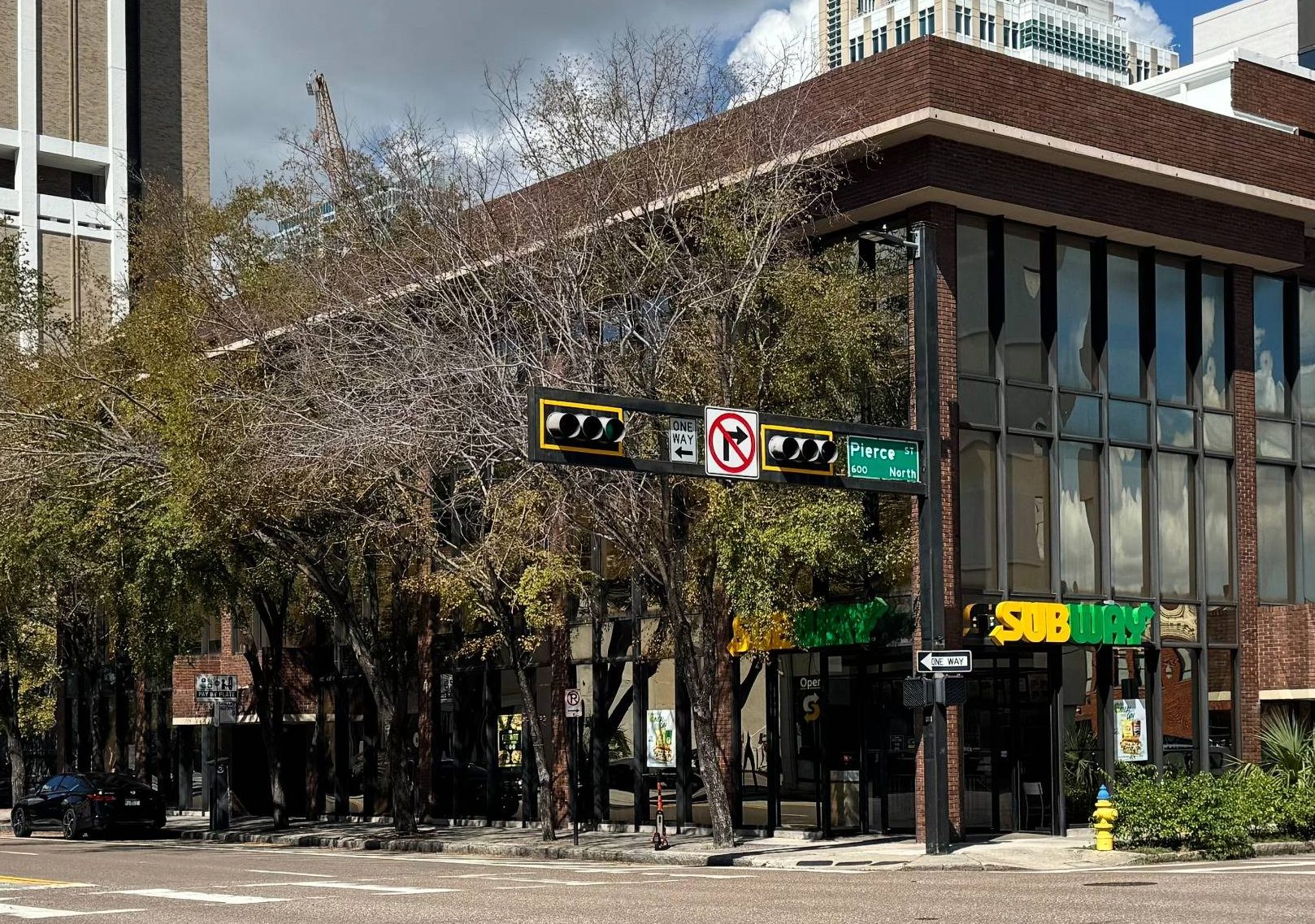
Tampa, FL 33602
Contact Us Now
Free Legal Consultation (813) 727-7159