Strategic Defense,
From First DUI to Death Penalty
From First DUI to Death Penalty





| Short answer: Hillsborough County offers several diversion programs that let an eligible person avoid a conviction by completing conditions instead of being prosecuted. The main adult programs are the Misdemeanor Intervention Program (MIP) for first-time misdemeanors, felony pretrial intervention (PTI), DETRR for low-level drug possession, DVIP for misdemeanor domestic violence, RIDR for a first DUI, and traffic diversion for license offenses, plus drug court, Veterans Treatment Court, and mental health diversion. Police can also issue a civil citation instead of making an arrest, through APAD for adults and JAAP for children. The State Attorney’s Office decides who gets into most of the adult programs, so the request is usually won or lost with the prosecutor, often before charges are filed. |
The right diversion program can turn an arrest into a dropped charge, and the wrong one can cost months and money without fixing the record. Rocky Brancato, founder of The Brancato Law Firm, P.A., a Tampa criminal defense firm, has spent more than 25 years in Hillsborough County courtrooms, including service as former Chief Operations Officer of the Hillsborough County Public Defender’s Office, where he oversaw a staff of over 100 attorneys. He also served on the 13th Judicial Circuit’s Problem-Solving Courts Oversight Committee from 2012 to 2023 and spent years on Hillsborough’s juvenile civil citation committee, helping develop and expand the use of civil citations. This page gathers our guides to each Hillsborough program in one place, and our attorneys use the same map to choose the program that fits each client’s charge and record.
A diversion program pauses or replaces prosecution while the accused person completes conditions such as supervision, classes, treatment, community service, or restitution. When the person finishes, most Hillsborough programs end with the State dropping the charge. Florida’s general pretrial intervention statute, section 948.08, Florida Statutes, requires that the person consult a lawyer, agree voluntarily, and waive the right to a speedy trial for the diversion period, and it lets prosecution resume if the person does not meet the program’s obligations.
Diversion programs differ in three ways that matter: which charges they cover, who has to consent, and what the record shows at the end. Most end in a nolle prosequi or dismissal. RIDR, the DUI program, is the main exception, because it ends in a plea to reckless driving with a withhold of adjudication rather than a dismissal.
These are the adult diversion programs and tracks available in Hillsborough County, with a link to our full guide where one exists:
| Program | Who it is for | How it usually ends | Our guide |
|---|---|---|---|
| Misdemeanor Intervention Program (MIP) | First-time misdemeanor defendants | Charge dropped by nolle prosequi after 3 to 5 months of monitoring | MIP in Hillsborough County |
| Felony pretrial intervention (PTI) | Certain first-time felony defendants | Charges dismissed after supervision | PTI in Hillsborough County |
| DETRR | Low-risk, nonviolent drug possession | Possession charge dismissed after six months arrest-free plus education or treatment | DETRR program |
| DVIP | Misdemeanor domestic violence with no disqualifying record | Charge dismissed after a batterers’ intervention program; the alleged victim can object | DVIP program |
| RIDR | First-time, non-aggravated misdemeanor DUI | Plea to reckless driving with a withhold of adjudication; no dismissal | RIDR program |
| Traffic diversion (DLAP) | Driving while license suspended and other license or registration charges | Charge dropped by nolle prosequi | Traffic diversion |
| Mental health diversion | Eligible charges where mental illness drives the case | State Attorney must consider dismissal after successful treatment | Florida’s mental health diversion law |
| Drug court (Division W) | Nonviolent felony defendants with a substance problem; pretrial and post-adjudication tracks | Pretrial track: charges dismissed at graduation. Post-adjudication track: treatment and probation in place of prison | Drug court in Hillsborough County |
| Veterans Treatment Court (Division V) | Veterans and servicemembers with a service-related condition | Diversion track: charges dismissed at graduation. Post-adjudication track: runs as probation | Veterans Treatment Court |
| Adult pre-arrest diversion (APAD) | Eligible misdemeanors with little or no record | Offered by law enforcement before an arrest; no charge is filed | APAD program |
| Juvenile Arrest Avoidance Program (JAAP) | Children ages 8 to 17 with no prior record and an eligible misdemeanor | Civil citation issued by the officer instead of an arrest; no arrest record after completion | JAAP civil citations |
The charge picks the program first, and the record and facts decide whether the prosecutor will consent. A first DUI goes to RIDR, not MIP. A domestic battery goes to DVIP. Possession of a small amount of a drug usually goes to DETRR. Other first-time misdemeanors are candidates for MIP with the State Attorney’s consent, and certain first-time felonies fit felony PTI. For how our attorneys defend the charges behind each program, see our domestic violence defense, drug crimes defense, criminal traffic defense, theft and property crimes defense, and criminal mental health defense pages.
| Your charge | Program to ask about | Main gate |
|---|---|---|
| Other first-time misdemeanor | MIP | State Attorney consent; no prior record |
| First-time third-degree felony | Felony PTI | State Attorney, victim, and judge consent under section 948.08 |
| Drug possession, no sale or trafficking | DETRR | Low-risk assessment; six months arrest-free |
| Misdemeanor domestic violence | DVIP | Alleged victim approval; no prior violence |
| First DUI, no crash injury or other aggravator | RIDR | Prosecutor’s sole discretion |
| Driving while license suspended | Traffic diversion | Why the license was suspended |
| Nonviolent felony driven by addiction, no dealing | Drug court | Substance problem; no evidence of sales |
| Veteran or servicemember | Veterans Treatment Court | Service-related condition; the judge decides eligibility |
| Child with a first-time misdemeanor | JAAP | The officer’s decision at the scene |
| Charge driven by mental illness | Mental health diversion | Diagnosis and a treatment plan |
Some cases fit more than one track, and some fit none on paper but can be reduced to a charge that does. Our attorneys look at the whole case before asking for a specific program, because the first request often shapes the prosecutor’s answer.
Yes, and that is often the best time to ask. In Hillsborough County, MIP, pretrial intervention, and other diversion programs can be worked out with the prosecutor before charges are filed. After an arrest, the State Attorney’s Office reviews the report and decides what to file, and a prosecutor who has not yet committed to a case is more open to diversion.
Adult pre-arrest diversion is different. It is offered by law enforcement at the time of the incident, before any arrest, and no attorney or prosecutor is involved. Once there has been an arrest, the path runs through the State Attorney’s Office. Our representation before charges are filed is built around that review period, and nearly every month cases handled by our firm never get filed because of early advocacy. Our guide to the Florida criminal case process shows where the filing decision falls.
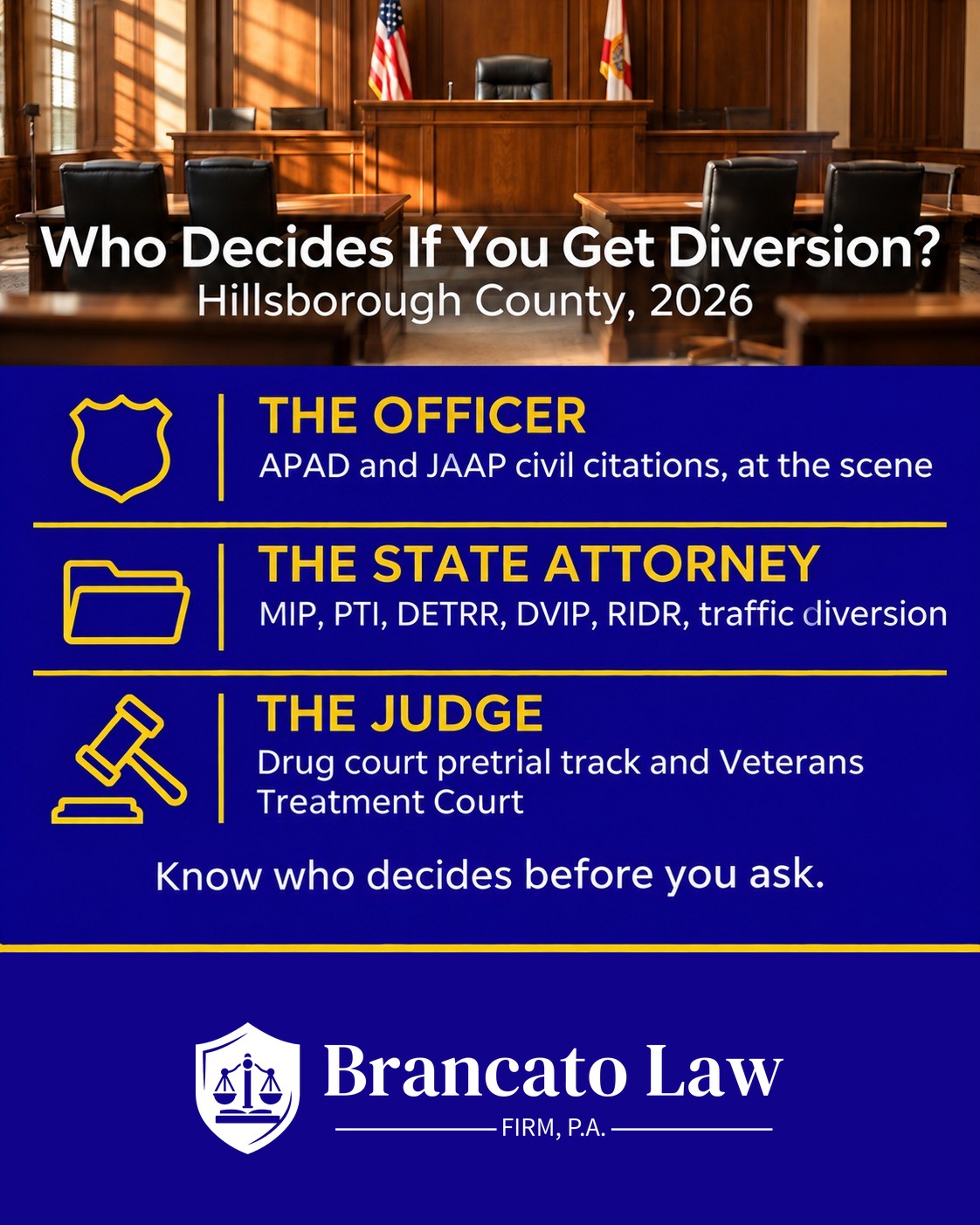
For most adult programs, the State Attorney decides, and a judge cannot override that decision. In Cleveland v. State, 417 So. 2d 653 (Fla. 1982), a defendant met every statutory requirement for pretrial intervention, but the prosecutor refused to consent and the trial judge ordered her into the program anyway. The Florida Supreme Court approved the appellate decision undoing that order and held that the State Attorney’s pretrial diversion decision is prosecutorial in nature and not subject to judicial review.
Three tracks work differently. In the pretrial track of drug court, the prosecutor’s consent is not required, and the judge must admit an eligible defendant unless the State proves at a preadmission hearing that the defendant was dealing. Since July 1, 2026, the judge, not the State Attorney, decides eligibility for Veterans Treatment Court; whether the State can still keep an eligible veteran out of the diversion track is set for hearing in Hillsborough on December 4, 2026. And APAD and JAAP civil citations are the officer’s call at the scene, before any arrest or prosecutor review.
That rule shapes how The Brancato Law Firm handles every diversion request. The case for admission is made to the assigned Assistant State Attorney with a clean record, proof of work or school, restitution ready to pay, treatment already underway where it fits, and a clear account of the facts.
When a program ends with the charge dropped or dismissed on all counts, Florida’s automatic sealing law usually applies. Under section 943.0595, Florida Statutes, the Clerk sends the disposition to the Florida Department of Law Enforcement, which seals the record without a petition, except for forcible felonies and certain listed sex offenses. A person can then often petition to have the record expunged under section 943.0585.
RIDR works differently because it ends in a plea to reckless driving with a withhold of adjudication, not a dismissal, so automatic sealing does not apply to it. Our attorneys explain the record result of each option before a client signs any diversion agreement.
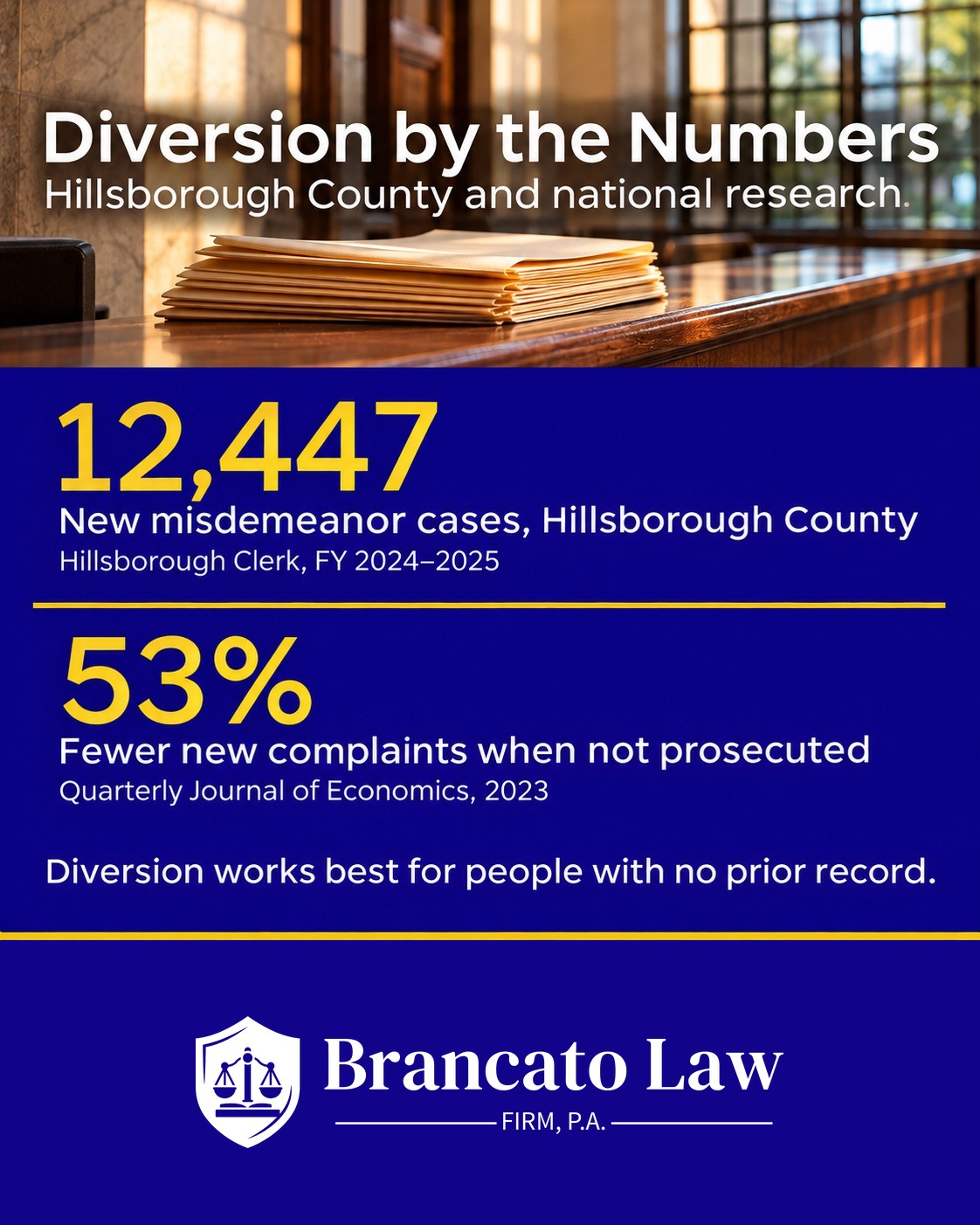
The research supports it, especially for people with no prior record. A 2023 study in the Quarterly Journal of Economics of nonviolent misdemeanor cases in Suffolk County, Massachusetts found that not prosecuting a nonviolent misdemeanor cut the likelihood of a new criminal complaint over the next two years by 53%, with the largest effects for defendants without a prior record. The volume is large here too: the Hillsborough County Clerk of Court reported 12,447 new misdemeanor cases filed in county fiscal year 2024–2025.
Diversion is a strong result, but it is not always the best one. Every program costs money and months of supervision, and a case with an illegal stop or search, a weak identification, or a strong self-defense claim may be dismissed outright. Our attorneys review the evidence first, then advise whether to push for dismissal, ask for diversion, or pursue both at once. Asking for diversion is not a plea, and in most programs defense motions can be kept in reserve while the request is negotiated.
Yes, some can. Felony pretrial intervention, DETRR for drug possession, mental health diversion, and drug court can all reach felony charges, and each has its own gates. The Brancato Law Firm reviews the charge and record to find which felony track, if any, fits, and our felony PTI guide explains the consents section 948.08 requires.
Yes. RIDR is the State Attorney’s program for first-time, non-aggravated misdemeanor DUI, and it ends in a reckless driving plea with a withhold of adjudication rather than a dismissal. Our attorneys at The Brancato Law Firm also evaluate the DUI defenses at the same time, and our Tampa DUI lawyer page covers how we defend those cases.
Sometimes. MIP is limited to first-time offenders, while section 948.08 allows pretrial intervention for a person with no more than one prior nonviolent misdemeanor conviction, and treatment-based tracks look at different factors. The Brancato Law Firm reviews your full history, including sealed and expunged records that some applications require you to list, before asking for any program.
Most Hillsborough diversion programs do not require a guilty plea, and they end with the charge dropped. RIDR is the main exception, because it requires a plea to reckless driving. Our attorneys at The Brancato Law Firm explain exactly what each agreement requires before you sign it.
The State can resume prosecution, and because you waived speedy trial for the program period, the case picks up where it left off. The Brancato Law Firm keeps the defense file intact during diversion so a client who falls out of a program is not starting over.
The window to ask for diversion is widest before the State Attorney’s Office files a charge, and it narrows with every court date. Our attorneys will review the arrest, identify the program that fits, and make the case to the prosecutor. Call The Brancato Law Firm, P.A., founded by Tampa Criminal Defense Attorney Rocky Brancato, at (813) 727-7159. You can call us at any hour. Our firm has Spanish-speaking staff, and attorney Jean-Luc Adrien speaks Spanish, Haitian Creole, and French.
For more about our defense strategies, visit our Hillsborough County criminal defense page.
The Brancato Law Firm, P.A.
620 E. Twiggs Street, Suite 205, Tampa, FL 33602
(813) 727-7159
Serving Hillsborough, Pinellas, and Pasco Counties
The Brancato Law Firm, P.A. is a Tampa-based criminal defense practice. We are not affiliated with any other Brancato-named law firms.

Tampa, FL 33602

Free Legal Consultation (813) 727-7159
