Strategic Defense,
From First DUI to Death Penalty
From First DUI to Death Penalty





Short answer: Student discipline in Tampa Bay runs on three different rulebooks. Public school districts such as Hillsborough County Public Schools follow Florida’s school discipline statutes, and an expulsion goes to a Chapter 120 hearing. Public colleges and universities such as USF and Hillsborough College must follow section 1006.60, Florida Statutes, which gives students notice, a presumption that no violation occurred, the right to remain silent, and an advisor or lawyer who may participate. Private schools such as the University of Tampa write their own procedures, and the University of Tampa bars attorneys from its conduct hearing boards. Title IX sexual harassment cases add a separate federal process, with live cross-examination by an advisor at colleges but not at K-12 schools.
The first question in any school discipline case is which rulebook applies, because the answer decides whether a lawyer can question witnesses, speak only through the student, or stay outside the room. As founder of The Brancato Law Firm, P.A., a Tampa criminal defense firm, and a former Chief Operations Officer of the Hillsborough County Public Defender’s Office, where I oversaw a staff of over 100 attorneys, I have spent more than 25 years in Hillsborough County courtrooms. I also chaired the 13th Judicial Circuit Juvenile Justice Advisory Board. Our attorneys prepare students for conduct and Title IX hearings at the schools below and handle the criminal case that often comes from the same incident.
The school’s legal status sets the rules. This table compares the main schools in Hillsborough County.
| School | Type | Rules that govern conduct cases | Lawyer’s role in a conduct hearing | Title IX sexual harassment hearing |
|---|---|---|---|---|
| Hillsborough County Public Schools | Public K-12 district | Sections 1006.07 to 1006.13, Florida Statutes; HCPS Student Code of Conduct; Chapter 120 for expulsion | May attend as the family’s representative; cross-examination in a formal expulsion hearing when facts are disputed | Hearing optional; parties submit written questions |
| University of South Florida | State university | Section 1006.60; Board of Governors Regulation 6.0105; USF Regulation USF6.0021 | Advisor or lawyer may directly participate by statute; the hearing body controls procedure | Live hearing; each party’s advisor cross-examines |
| Hillsborough College (formerly HCC) | Florida College System institution | Section 1006.60; the college’s code of student conduct | Advisor or lawyer may directly participate by statute | Live hearing; each party’s advisor cross-examines |
| University of Tampa | Private university | UT Student Code of Conduct | Attorneys may not participate in the hearing board process; one University support person allowed | Live hearing; advisor of choice, who may be a lawyer, cross-examines |
| Stetson Law and Cooley Law (Tampa) | Private law schools | Each school’s honor and conduct codes | Set by each school; outcome must be disclosed on the Florida Bar application | Live hearing; each party’s advisor cross-examines |
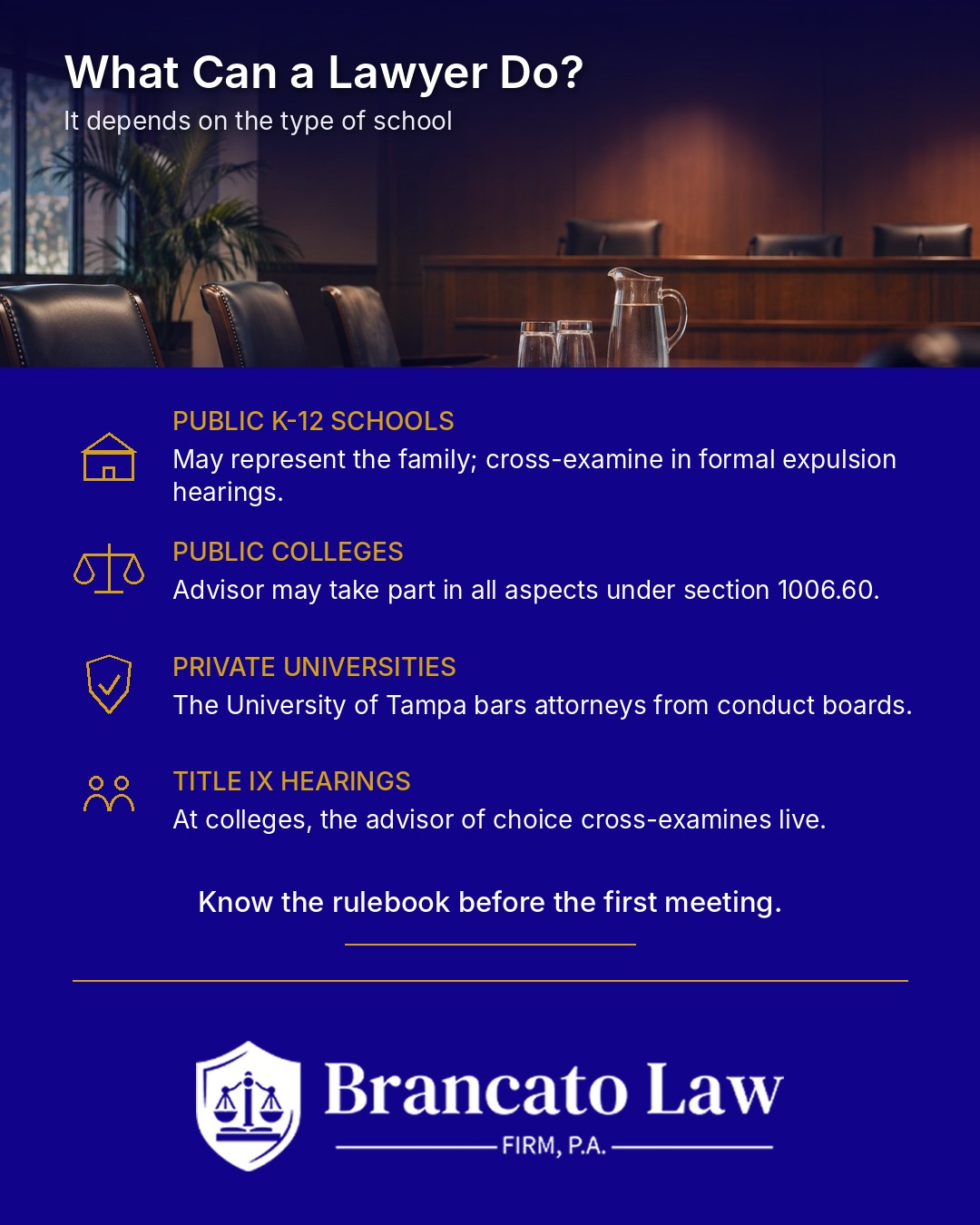
In Hillsborough County Public Schools (HCPS), the real decision is usually the change of placement hearing, not expulsion. In the 2024-25 school year, Florida Department of Education discipline data shows Hillsborough County placed 597 students in an alternative educational setting, while fewer than 10 were expelled. A family may bring a representative to the change of placement hearing, and if the case moves to expulsion, section 1006.07(1)(a) makes the hearing a Chapter 120 proceeding, with cross-examination when the facts are disputed.
I have represented a student at an HCPS hearing where I cross-examined the school’s witnesses and argued the case. Our full guide explains the hearing, the appeal deadline, zero-tolerance offenses, Title IX at the K-12 level, and how a juvenile plea can affect which school a child attends: What Happens at a Hillsborough County School Expulsion Hearing?
USF is a state university, so its Student Code of Conduct (Regulation USF6.0021) must meet the minimum protections in section 1006.60(3). Those include written notice at least 7 business days before the proceeding, a list of known witnesses and all known information, including information that helps the student, at least 5 business days before it, a presumption that no violation occurred, and a preponderance-of-the-evidence burden on the university. The student also has the right to remain silent, and that silence “may not be used against the student.”
The statute says an advisor or legal representative “may directly participate in all aspects of the proceeding, including the presentation of relevant information and questioning of witnesses.” USF’s own regulation now says the same thing. Regulation USF6.0021, last amended January 31, 2025, says the advisor “may participate in all aspects of the proceeding but shall not testify for the student,” and that an advisor who is “an advocate or legal representative” follows “the same guidelines as any other Advisor.” A lawyer at USF is an advisor with the same participation rights, not a lesser category. USF’s student conduct FAQ pages still say the advisor “may not speak for the charged student, act as attorney, nor otherwise participate,” which is the pre-2021 rule, and hearings have been run that way. We put the student’s rights under section 1006.60(3)(g) and the regulation in writing before the hearing, raise them again at the hearing, and preserve any refusal as an appeal issue. The hearing officer still controls the scope, direction, and tone of questioning, so preparing the student to carry the case remains a large part of our work.
A formal hearing at USF is either an Administrative Hearing before a single hearing officer or a University Conduct Board of two students and one faculty or staff member. Choosing the Administrative Hearing waives the Conduct Board. That choice deserves a lawyer’s input, because it changes who decides the case. Our guide to what happens at a USF student conduct hearing walks through each step, the advisor rule, interim suspensions, and the appeal.
Hillsborough Community College became Hillsborough College in July 2025, and it is part of the Florida College System. That status matters, because section 1006.60 applies to every Florida College System institution, so a Hillsborough College student has the same statutory notice, disclosure, silence, and advisor rights as a USF student. Title IX sexual harassment cases at Hillsborough College go to a live grievance hearing, and the college publishes rules of decorum that govern advisors’ conduct at that hearing.
The same statute protects students at St. Petersburg College and Pasco-Hernando State College, which are also Florida College System institutions in our service area.
Our full guide, What Happens at a Hillsborough College Student Conduct Hearing?, walks through the Dean meeting, the College Code of Conduct Committee hearing, sanctions, appeal deadlines, and the Title IX rules of decorum.
The University of Tampa is a private university, so section 1006.60 does not apply, and UT’s own code controls. UT tells families that “attorneys are not permitted to participate in the student conduct hearing board process.” A student may be assisted by one University support person, who must be a current UT student, staff member, or faculty member; parents and alumni cannot serve. UT’s student conduct page for parents and families sets out those limits.
At UT, preparation is most of the defense. Our attorneys work with the student before every meeting: what to say, what to leave out because of a pending criminal case, which documents to bring, and how to answer the hearing board’s questions. Title IX is the exception. Because UT receives federal funds, a Title IX sexual harassment case must go to a live hearing where each party’s advisor of choice, who may be a lawyer, conducts the cross-examination.
Our guide Can a Lawyer Help With a University of Tampa Conduct Hearing? explains the Incident Review Meeting, the hearing boards, sanctions, the 3-business-day appeal, and the Title IX exception.
Title IX sexual harassment complaints follow a separate federal grievance process. On September 29, 2026, the U.S. Department of Education formally restored the 2020 Title IX regulations. Under 34 C.F.R. § 106.45(b)(6)(i), every college and university must hold a live hearing where each party’s advisor cross-examines the other party and the witnesses “directly, orally, and in real time.” K-12 schools may skip the hearing, but they must let each party submit written questions and limited follow-up questions under section 106.45(b)(6)(ii).
The practical result is that a lawyer often has a larger role in a Title IX hearing than in an ordinary conduct hearing at the same college. A sexual misconduct accusation can also bring a criminal investigation, so the Title IX strategy and the criminal strategy have to be built together. See our sex crimes defense page for the criminal side.
For a law student, any honor code or conduct accusation becomes a Bar admission question. The Florida Board of Bar Examiners investigates every applicant’s character and fitness, and its application asks whether the applicant was ever accused of violating an honor code or student conduct code. In Florida Board of Bar Examiners re John Doe, 770 So. 2d 670 (Fla. 2000), an applicant failed to report a law school honor code accusation that the school’s judicial committee had resolved in his favor. That omission was one of several false answers, and the Florida Supreme Court approved denying his admission for at least two years.
Tampa Bay law students attend Stetson University College of Law in Gulfport and at its Tampa Law Center, and Cooley Law School’s Tampa campus. For these students, the goal is a conduct outcome they can disclose accurately and explain years later. As a former training director at the Public Defender’s Office who has trained hundreds of Tampa Bay lawyers, I plan the conduct case around the Bar application that will follow it.
Yes. Statements a student makes in a conduct meeting or hearing can reach police and prosecutors, and the school case often moves faster than the criminal case. For students at public colleges and universities, section 1006.60(3)(d) protects the right to remain silent without that silence being held against the student. Using that right well takes planning, because silence in one meeting can affect how the school weighs the rest of the evidence.
Our firm decides with the student what to say, when to say it, and when to say nothing, and we work the criminal case at the same time, often through representation before charges are filed. Parents of college students can start with our guide My College Student Was Arrested in Tampa: What Should Parents Do?, and our overview of the Florida criminal case process explains each stage of the court case. For teens and families, our free book Before It Becomes a Case covers how one incident can create several proceedings at once.
The charges that most often come with a school or campus discipline case are weapons, threats, fake IDs, and alcohol, and a juvenile arrest can also lead to civil citation or a later expungement. These guides from our attorneys cover the criminal side of those cases:
Yes, under current law. Section 1006.60(3)(g) and USF Regulation USF6.0021 both let an advisor, including a lawyer, participate in all aspects of the proceeding, although USF’s FAQ pages still describe the older, silent-advisor rule. The Brancato Law Firm asserts those rights in writing before the hearing and prepares the student to lead the presentation in case the hearing officer limits the advisor’s role, under section 1006.60(3).
No. UT does not allow attorneys to participate in its student conduct hearing board process, and the student may bring only one University support person. The Brancato Law Firm prepares UT students before every meeting and represents them in Title IX hearings, where the advisor of choice may be a lawyer.
Yes. The 2020 Title IX regulations, formally restored on September 29, 2026, require a live hearing with cross-examination conducted by each party’s advisor at every college and university. Our attorneys at The Brancato Law Firm prepare the cross-examination and, when police are also investigating, coordinate it with our Tampa sex crimes defense work on the criminal case.
Yes. The Florida Bar application asks about accusations of honor code or student conduct code violations, even ones resolved in the applicant’s favor. The Brancato Law Firm helps law students resolve conduct cases in a way they can disclose accurately, because an incomplete answer is often treated more harshly than the underlying accusation.
Many school conduct cases start with an email asking the student to come in and talk, and that first meeting is where the record begins. The Brancato Law Firm, P.A., founded by Tampa Criminal Defense Attorney Rocky Brancato, prepares students and families in Hillsborough, Pinellas, and Pasco Counties for student conduct, expulsion, and Title IX proceedings, and defends the criminal case that often comes with them. Call (813) 727-7159; you can call us at any hour. Our firm has Spanish-speaking staff, and attorney Jean-Luc Adrien speaks Spanish, Haitian Creole, and French.
The Brancato Law Firm, P.A.
620 E. Twiggs Street, Suite 205, Tampa, FL 33602
(813) 727-7159
Serving Hillsborough, Pinellas, and Pasco Counties
The Brancato Law Firm, P.A. is a Tampa-based criminal defense practice. We are not affiliated with any other Brancato-named law firms.

Tampa, FL 33602

Free Legal Consultation (813) 727-7159
