- Free Consultation 24/7: (813) 727-7159 Tap Here To Call Us


From First DUI to Death Penalty



Can Police Be Charged for Misusing Flock Cameras in Florida?


Yes. Florida prosecutes officers who use Flock cameras, automated license plate readers (ALPRs), or other police databases for personal reasons under the Florida Computer Crimes Act, section 815.06, and the official misconduct statute, section 838.022. Each offense is a third-degree felony punishable by up to five years in prison. On September 30, 2026, the Pinellas County Sheriff’s Office arrested two former deputies on those charges: one accused of using state databases to research a 17-year-old girl, and one accused of running a woman’s license plate through the agency’s ALPR system about 300 times.
I’m Rocky Brancato, founder of The Brancato Law Firm, P.A., a Tampa criminal defense firm. I served as Chief Operating Officer of the Hillsborough County Public Defender’s Office, overseeing a staff of over 100, taught at the police academy, and am on call for the Tampa PBA and Suncoast PBA. Today our attorneys handle license plate reader cases from both sides of the badge: people whose movements were tracked, and officers accused of tracking them.
Our earlier guide, What Are Flock Cameras and ALPRs in Tampa?, explains how the cameras work. This article covers what happens when the people with access abuse it.
What Happened in the Pinellas County Deputy Arrests?
Two former Pinellas County deputies were arrested on September 30, 2026, in separate cases involving personal use of law enforcement databases, Sheriff Bob Gualtieri announced. Both men had resigned before their arrests, and both are presumed innocent. The facts below come from the sheriff’s public account, as reported by IONTB.
The 17-year-old and the “ALPR hit” that never happened
Former Deputy Travis Stanton, 33, was a community deputy in Seminole. According to the sheriff, a 17-year-old restaurant worker told him her age and her car on July 28, 2026. Minutes later, Stanton allegedly ran her plate through the Florida Crime Information Center (FCIC) and then used other databases to identify her mother’s household and pull driver’s license photos of the girl and her twin sister. On August 19, he allegedly ran more searches from the Seminole High School parking lot, entering the reason code “verifying an identity.”
Stanton later told the girl he had received an ALPR alert showing her license was suspended for truancy. Gualtieri said no such alert existed, and that Stanton’s case did not involve misuse of the ALPR database itself. Stanton is charged with unlawful access to a computer network under section 815.06 and official misconduct under section 838.022.
381 searches of one woman across five databases
Former Deputy Karl Gwynne, 57, joined the agency in 2005. According to the sheriff, he ran 381 searches on a 35-year-old woman across five databases between January 2025 and July 2026, including 300 ALPR searches. He made 207 of them off duty. Gwynne had arrested the woman in 2010, and she had rejected his advances. He faces four counts of unlawfully accessing a computer system and one count of official misconduct. In our experience, cases like these are decided by the audit trail, and both will likely turn on what the logs show.
What Florida Crimes Apply When an Officer Misuses a License Plate Reader?
Two felony statutes carry most Florida prosecutions, and a third law decides the officer’s pension. Our attorneys analyze all three at the outset of any officer database case.
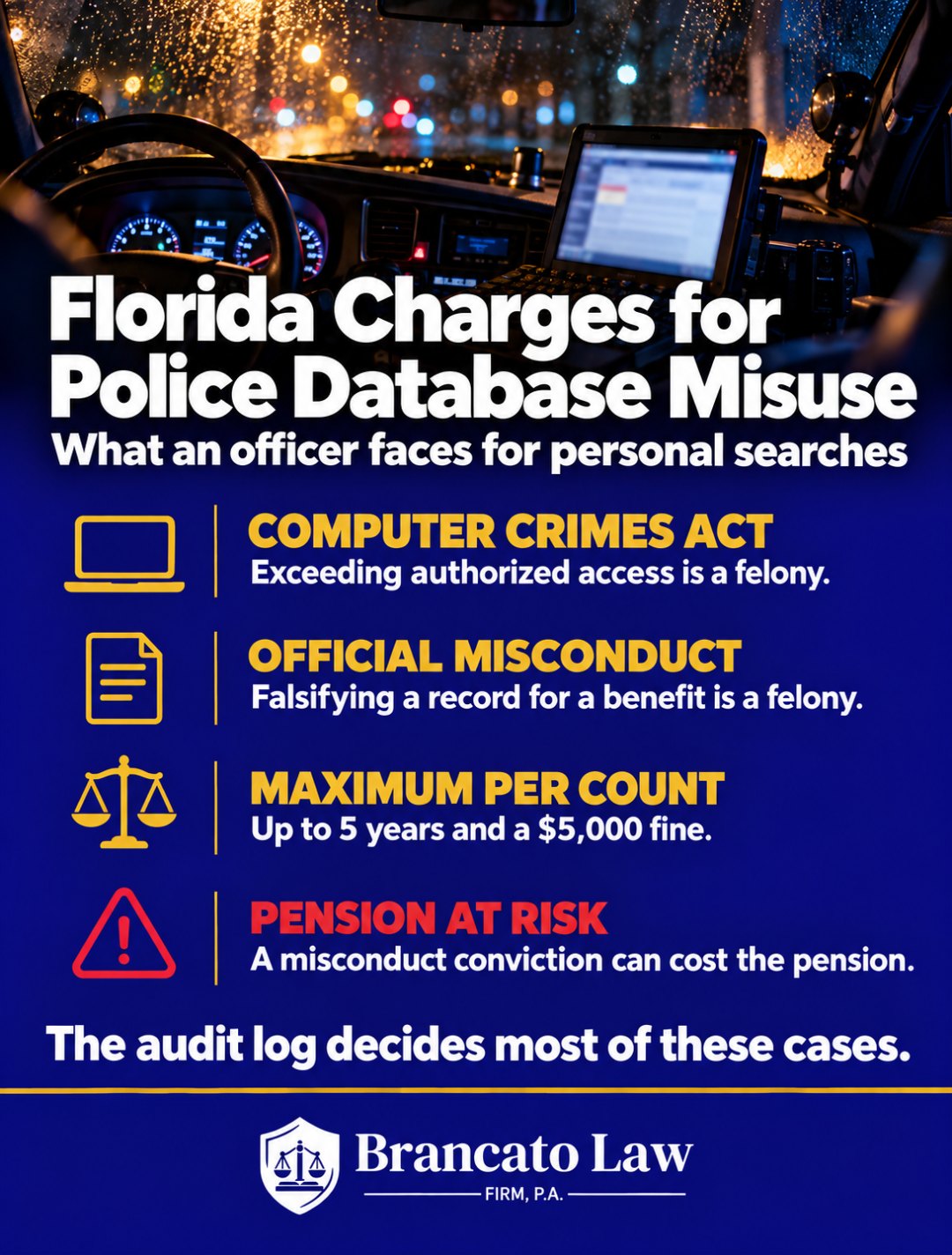
| Law | What it covers | Consequence |
|---|---|---|
| Fla. Stat. 815.06(2)(a) (Florida Computer Crimes Act) | Knowingly accessing a computer system without authorization, or in a manner that exceeds authorization | Third-degree felony; up to 5 years in prison and a $5,000 fine |
| Fla. Stat. 838.022 (official misconduct) | A public servant knowingly obtains a benefit or causes unlawful harm by falsifying, concealing, or altering an official record | Third-degree felony; up to 5 years in prison and a $5,000 fine |
| Fla. Stat. 112.3173 (pension forfeiture) | Conviction of a “specified offense,” which includes felonies in chapter 838 | Loss of public retirement benefits except the officer’s own contributions |
Why “exceeds authorization” is the heart of the case
Florida courts have debated this question for 30 years. In Gallagher v. State, 618 So. 2d 757 (Fla. 4th DCA 1993), a Sunrise Police Department aide ran her boyfriend through NCIC and FCIC out of curiosity. The Fourth District affirmed her conviction without an opinion, while Chief Judge Glickstein dissented, arguing that the statute punished unauthorized access, not improper use. The current statute closes that gap. The 2018 version reached only access “without authorization,” and the version in force after the 2019 amendment also reaches access where “the manner of use exceeds authorization.”
Even so, section 815.06(7)(b) exempts a person acting “within the scope of his or her lawful employment.” Purpose is therefore the battleground. Prosecutors prove it with case numbers, reason codes, and timing, such as Gwynne’s 207 off-duty searches. Our Tampa internet crimes attorney page explains how we defend computer crimes charges.
Why official misconduct is harder to prove
Official misconduct requires two things beyond a bad search. The state must prove the officer falsified, concealed, or altered an official record, and the statute limits “official record” to public records. The state must also prove the officer acted to obtain a “benefit,” which section 838.014 defines as any gain or advantage, including anything the person regards as one.
The benefit element is where these cases are won and lost. In Jones v. State, No. 6D2023-0311 (Fla. 6th DCA June 23, 2023), a Polk County detective falsified investigative reports for two years. The Sixth District ordered acquittal on all 18 official misconduct counts because the state never proved he falsified the reports to obtain a benefit. Trial courts in Pinellas and Hillsborough follow Jones unless the Second District rules otherwise.
The pension consequence few people discuss
A conviction for a chapter 838 felony forfeits a public employee’s retirement benefits under section 112.3173, and a no contest plea counts as a conviction. The exact count matters. In Houston v. City of Tampa Firefighters & Police Officers’ Pension Fund Board of Trustees, 303 So. 3d 233 (Fla. 2d DCA 2020), a Tampa police sergeant accused of using the DAVID driver’s license database in a tax refund scheme pleaded guilty only to receiving stolen federal property. The Second District reversed the forfeiture of her pension and ordered it restored with interest, because her plea did not establish a specified offense. For an officer, what the plea says matters as much as whether there is one.
How Common Is Flock and ALPR Misuse by Police?
Documented cases now number in the dozens. In August 2026, The Washington Post reported that at least 46 officers nationwide had been accused of using license plate cameras for unauthorized tracking, according to Al Jazeera. Our firm tracks these prosecutions because the sentences are rising.
| Case | Allegation | Outcome |
|---|---|---|
| Kechi, Kansas (2022) | Lieutenant used Wichita’s Flock system to monitor his estranged wife | Misdemeanor plea; 18 months of probation (Sedgwick County DA) |
| Lufkin, Texas (2026) | More than 25,000 non-law-enforcement searches, mostly on an ex-girlfriend and her circle | Guilty plea to 100 counts; 5 years in prison (KTRE) |
| Haines City, Florida (2026) | Officer allegedly searched his estranged wife’s plate 717 times | Charged under sections 815.06 and 838.022 (WFTV) |
| Indianapolis (2026) | Four officers and one former officer | Fraud and misconduct; one also charged with stalking (WSAW) |
| Pinellas County, Florida (2026) | Two former deputies | Charged under sections 815.06 and 838.022; pending |
In 2023, the Kansas lieutenant received probation. By September 30, 2026, the Texas officer was headed to prison for five years.
Who Catches Officers Who Misuse License Plate Readers?
Outsiders catch most of them. Where the public record shows how a case began, the first alarm usually came from a victim, a victim’s friend, or a reporter reading public search logs. Agencies then acted quickly. Our attorneys look first at how a case surfaced, because it shapes both the proof and the defense.
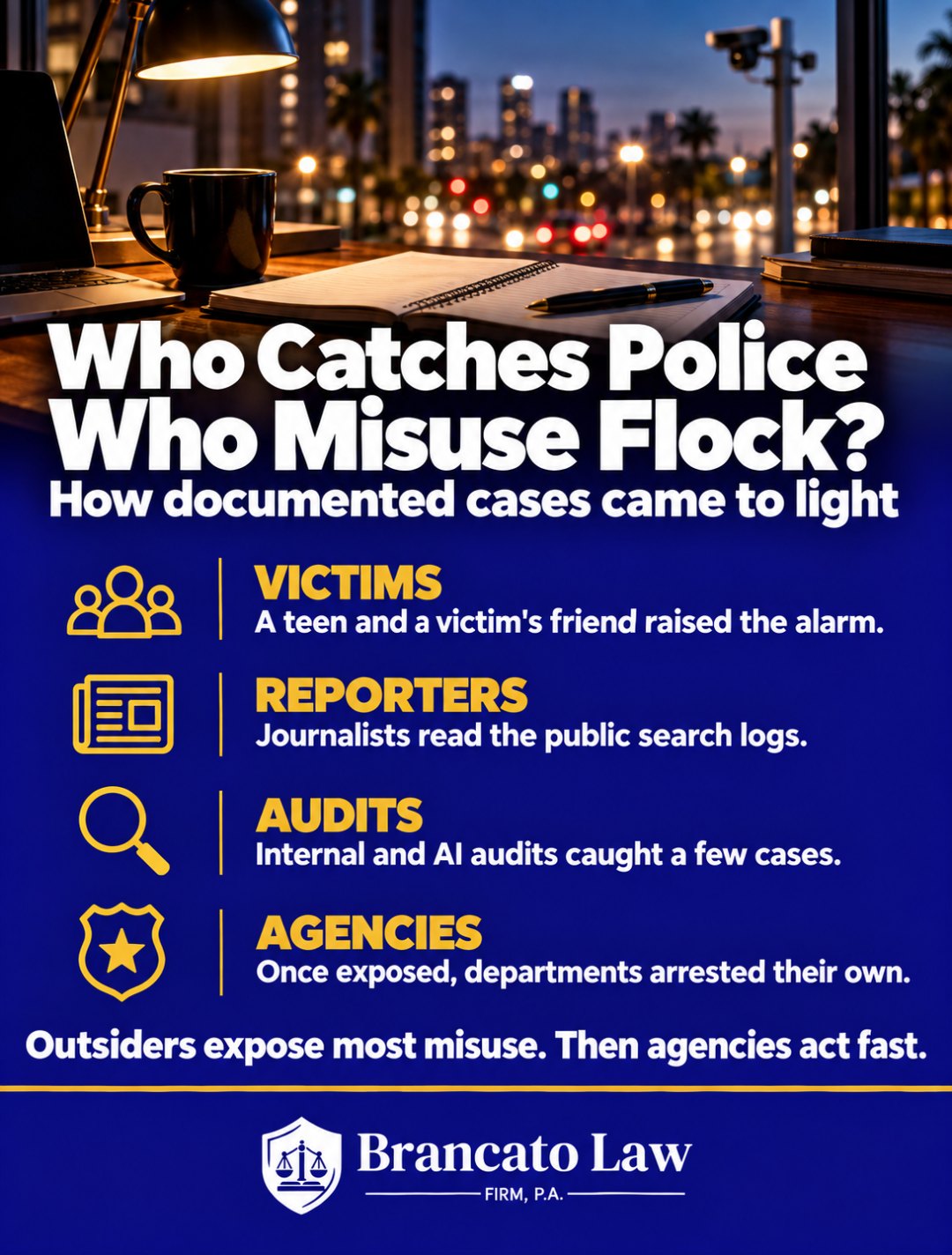
| Case | How the misuse surfaced | Who investigated |
|---|---|---|
| Pinellas, Gwynne | TCPalm reporter asked about unusual searches; the agency first said all queries were valid | Pinellas County Sheriff’s Office |
| Pinellas, Stanton | The 17-year-old reported him | Pinellas County Sheriff’s Office |
| Haines City | The Washington Post contacted the officer’s estranged wife; he then told a supervisor | Haines City Police Department |
| Kechi, Kansas | Victim’s friend asked a Wichita officer about a stalking order | Wichita Police Department |
| Indianapolis | Disputed: the Post credits its outreach; the chief cites a self-report and internal audit | IMPD and Marion County Prosecutor |
| Shively, Kentucky | Flock’s AI auditing tool | Shively Police Department |
| Albany, Georgia | Internal audit | Georgia Bureau of Investigation |
Sources: Creative Loafing Tampa, Dexerto, The Washington Post, CNN, and Tech Times.
The Washington Post put it bluntly in an August 2026 headline: “Police departments weren’t looking for officers abusing Flock. We did it for them.” Its review of search logs led to discipline in two departments.
Where the thin blue line holds, and where it breaks
Detection is the weak point. Once misuse is exposed, agencies have acted fast. Pinellas arrested its own deputies, Lufkin called in the Texas Rangers, and Haines City arrested its officer within a day of learning of the searches. In the cases reviewed here, no agency shielded an officer once the facts were public. Four gaps explain why detection lags:
- No audit requirement. Florida’s ALPR statutes, section 316.0777 and section 316.0778, govern placement, retention, and public records. Neither requires an agency to review who searched what.
- Empty reason codes. “Investigation” was the most common reason Wisconsin agencies entered for Flock searches in early 2025, the Wisconsin Examiner found.
- Shared logins. Pinellas runs searches through a shared “service account” across three vendors, so its public log cannot show which deputy searched, TCPalm reported.
- Shrinking outside visibility. Flock now redacts officer names and plates from public audit logs, which narrows the channel that has caught the most officers.
Who decides the charges
The arresting agency does not make the final charging decision in Florida. The State Attorney for the Sixth Judicial Circuit, which covers Pinellas and Pasco, will decide whether and how to charge Stanton and Gwynne. In Hillsborough, that decision belongs to the Thirteenth Circuit State Attorney. For an accused officer, the investigation’s path shapes the defense. A shared service account forces the state to prove who ran each search, while an officer’s own admission to a supervisor, as in the Gwynne and Haines City cases, leaves far less room.
What Did Governor DeSantis Order on License Plate Readers?
Governor Ron DeSantis directed the Florida Department of Transportation to revoke permits for ALPRs on state highway rights-of-way, effective September 30, 2026. The FDOT memorandum cited reports of misuse and data privacy concerns. DeSantis said, “I don’t want to have this become a surveillance state,” Axios reported.
Section 316.0777 supplies the authority: ALPRs sit on state highway rights-of-way only at FDOT’s discretion, and must come down within 30 days of notice. The order does not reach city streets, county roads, or private property. Our attorneys tell Tampa Bay drivers the same thing: the cameras moved off state roads, and local networks remain.
| Agency | Status as of September 30, 2026 |
|---|---|
| Tampa Police Department | Removed 17 cameras on state roads; keeps the rest |
| Hillsborough County Sheriff’s Office | Removed cameras from state rights-of-way; no broader change |
| Pinellas County Sheriff’s Office | Complying on state roads; continuing elsewhere |
| Pasco County Sheriff’s Office | Ended its Flock contract; about 70 cameras coming down |
| St. Petersburg Police Department | Removing 6 cameras on state roads |
Sources: Axios Tampa Bay and ABC Action News.
Where Do Florida Candidates Stand on Flock Cameras?
Neither major-party nominee for governor has promised a full ban, but both support the DeSantis order. Democrat David Jolly wants a judicial warrant before police use the data, and Republican Byron Donalds wants harsher penalties for officers who abuse it, the Tampa Bay Times reported. Donalds called for a pause on Flock contracts in July. Jolly also wants a special legislative session and a ban on use for immigration enforcement.
Locally, former Governor Charlie Crist proposes a moratorium on expanding St. Petersburg’s Flock system, while Mayor Ken Welch defends it, ahead of their November 3 runoff, per Bay News 9. Nationally, more than 150 local governments have deactivated or canceled ALPR contracts, according to the advocacy group DeFlock, and Texas Governor Greg Abbott blocked state agencies from spending on Flock’s networks, Claims Journal reported. Any rewrite the Legislature passes next session will change what ALPR evidence looks like in Tampa Bay courtrooms, and our firm will update this guide when it does.
What Is Law Enforcement’s Case for Keeping License Plate Readers?
Sheriffs and chiefs argue the cameras solve violent crimes and find missing people, and that the answer to misuse is punishment. “Don’t throw the baby out with the bathwater,” Gualtieri said on September 30, crediting the cameras with solving homicides and rapes. According to the Tampa Police Department, its ALPR system has assisted in 622 arrests, 485 vehicle recoveries, 68 firearm recoveries, and 14 missing-person cases since 2021, per Florida Politics.
The strongest evidence involves abducted children. In 2024, the National Center for Missing & Exploited Children partnered with Flock to push AMBER Alert vehicles into the camera network. In August 2026, Lake City police used Flock to find a woman’s SUV that her boyfriend allegedly drove off with while her two children were inside, WFLA reported.
Controlled research is more modest on deterrence. In a randomized experiment across 30 crime hot spots in Northern Virginia, George Mason University researchers found no statistically significant drop in crime from license plate reader patrols during a 30-day follow-up (Lum et al., Journal of Experimental Criminology, 2011), as summarized by the Justice Department’s CrimeSolutions program. That study tested patrols, not investigations. Both claims can hold: the cameras may prevent little crime, yet still find a specific car carrying a specific child. Our attorneys see the same tension in court, where an ALPR hit can be strong evidence of location and weak evidence of anything else.
Does the Fourth Amendment Limit Police Searches of Flock Data?
The law is unsettled, and 2026 moved it toward privacy. In Carpenter v. United States, 585 U.S. 296 (2018), the FBI obtained months of a robbery suspect’s cell-site location records without a warrant, and the Supreme Court held that acquiring them was a search. In Chatrie v. United States, 146 S. Ct. 2193 (2026), police used a geofence warrant to obtain Google location data near a Virginia bank robbery. By a 6-3 vote, the Court held that obtaining location history this way is a search, even for a short period. Justice Kagan wrote for five justices, and Justice Gorsuch concurred in the judgment, as the Congressional Research Service explains. Chatrie never mentions license plate readers, but it repeats Carpenter’s point that society has not expected police to “secretly monitor and catalogue every single movement of an individual’s car.”
The Tampa license plate reader ruling
In United States v. Floyd, No. 8:23-cr-00305 (M.D. Fla. Nov. 21, 2025), detectives tied a robbery suspect’s Mazda to a string of Tampa Bay store robberies through Vigilant hits and the Hillsborough County Sheriff’s Office “Eye on Crime” ALPR system. U.S. District Judge Tom Barber denied suppression, holding that the readers captured discrete snapshots on public roads and that querying the databases was not a search. Floyd predates Chatrie, so our attorneys treat the question as open again for any client whose case rests on a long trail of ALPR hits.
Elsewhere, Schmidt v. City of Norfolk, No. 2:24-cv-621 (E.D. Va. Jan. 27, 2026), upheld Norfolk, Virginia’s network of about 176 Flock cameras. The appeal, No. 26-1227, is tentatively set for Fourth Circuit argument in December 2026. Losing a motion to suppress does not end the issue. At trial, the defense can still challenge whether the camera read the plate correctly and whether the alert was current.
What Should You Do If You Think an Officer Tracked You?
Act within days, write everything down, and demand that the agency preserve its audit logs. Our attorneys take these steps for clients who believe they were tracked:
- Document the red flags. Write down dates, places, and anything an officer knew about you without a reason to know it. In the Stanton case, the claimed “ALPR hit” was the tell.
- Request your own ALPR data. Section 316.0777(4)(b) allows an agency to release plate data to the person the plate is registered to, unless it is active criminal intelligence or investigative information.
- File an internal affairs complaint in writing. Ask the agency to preserve the audit log for your plate, name, and driver’s license number.
- Ask about protective options. A stalking injunction or a referral to an outside agency, such as FDLE, may fit when the officer’s own department is slow to act.
If you are an officer under investigation
Say nothing about your searches until you have counsel. Under Fla. Stat. 112.532(1)(i), an officer has the right to counsel during an interrogation about fitness for duty. In Garrity v. New Jersey, 385 U.S. 493 (1967), the Supreme Court held that statements compelled under threat of job loss cannot be used in a criminal prosecution. Voluntary statements, texts, and audit logs remain fair game. See our law enforcement officer representation articles.
Why Does Timing Matter in a License Plate Reader Case?
Images disappear fast. In August 2026, Flock cut its recommended default retention from 30 days to 7, and Florida caps retention under the schedule set by section 316.0778. A preservation letter sent in the first week can decide a case, whether our firm represents the person tracked or the officer accused. The same is true of messages and phone records, as we explain in our guide to social media evidence in Tampa criminal cases.
Frequently Asked Questions About Flock Camera Misuse
Is it a crime for a Florida officer to look up someone’s license plate for personal reasons?
Yes. Using a police database for a reason outside the job can violate section 815.06, which punishes access that exceeds authorization as a third-degree felony. A false reason code can add official misconduct under section 838.022. In our experience, the audit log is the most important evidence on either side.
Did the Pinellas deputy use Flock cameras to track the 17-year-old girl?
No, according to Sheriff Gualtieri. Stanton allegedly used FCIC, driver’s license, and agency records systems, then falsely told the girl he had received a license plate reader alert. The other deputy, Karl Gwynne, is accused of about 300 ALPR searches on a different woman.
Do police departments audit officers’ Flock searches?
Rarely on a routine basis, based on the public record. Florida law does not require ALPR audits, and in many documented cases a victim or reporter first exposed the misuse. Our attorneys request the full audit log in every case where license plate reader searches are at issue.
Can I find out whether police searched my license plate?
Possibly. Section 316.0777 permits an agency to disclose ALPR data about a plate registered to you, unless it is part of an active criminal investigation. Because retention is short, The Brancato Law Firm recommends a written request and a preservation demand as soon as you suspect misuse.
Are Flock cameras still operating in Tampa and Hillsborough County?
Yes. The Tampa Police Department and the Hillsborough County Sheriff’s Office removed cameras from state rights-of-way by September 30, 2026, but both still operate license plate readers on city and county roads. Pasco County is the local exception, having ended its Flock contract.
Can an officer lose a pension over a Flock misuse conviction?
Yes, if the conviction is for a “specified offense” such as official misconduct. Under section 112.3173, a conviction or no contest plea to a chapter 838 felony forfeits public retirement benefits except the officer’s contributions. Our attorneys weigh this in every plea discussion in an officer’s case.
What should I do if I am an officer accused of misusing Flock or FCIC?
Call a lawyer before you answer questions about your searches. Florida’s Law Enforcement Officers’ Bill of Rights gives you the right to counsel during an interrogation, and the criminal case often moves on a separate track from internal affairs. The Brancato Law Firm represents officers in both proceedings at (813) 727-7159.
For more about our defense strategies, visit our Tampa Internet Crimes Attorney page.
If an officer tracked you, or you are an officer facing a database misuse investigation, call the attorneys of The Brancato Law Firm, P.A., founded by Tampa Criminal Defense Attorney Rocky Brancato, at (813) 727-7159. ALPR images may be deleted in as little as 7 days, so contact us before the evidence is gone.
The Brancato Law Firm, P.A.
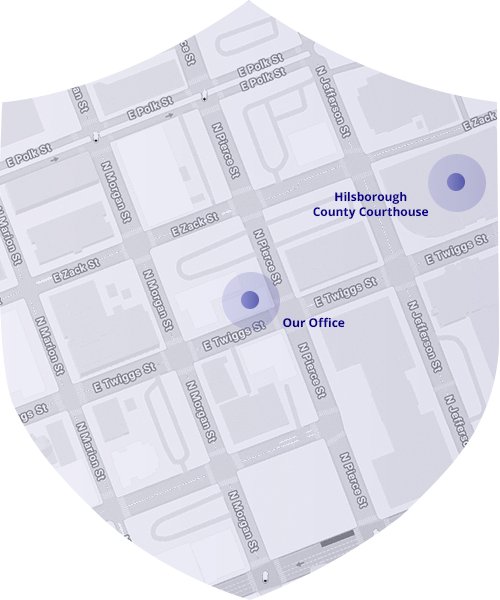
620 E. Twiggs Street, Suite 205, Tampa, FL 33602
(813) 727-7159
Serving Hillsborough, Pinellas, and Pasco Counties
The Brancato Law Firm, P.A. is a Tampa-based criminal defense practice. We are not affiliated with any other Brancato-named law firms.
Visit Us
Tampa, FL 33602
Contact Us Now
Free Legal Consultation (813) 727-7159