

From First DUI to Death Penalty



Can Police Search Your Cell Phone in Florida? (2026)


Short answer: Usually not without a warrant. In Riley v. California (2014), the U.S. Supreme Court held that police must generally get a warrant before searching the data on a phone taken during an arrest, and Florida’s Supreme Court had already said the same in 2013. Police can still search a phone if you consent, if a real emergency exists, at the border, or in some probation settings. Whether police can force you to give up your passcode is unsettled in Florida, and Tampa Bay trial courts follow a Second District decision that allowed it.
If police took your phone during an arrest or asked you to unlock it, what happens next can decide whether your texts, photos, and location history ever reach a jury. I am Rocky Brancato, founder of The Brancato Law Firm, P.A., a Tampa criminal defense firm, and a former police academy instructor who taught officers the search and seizure rules they are supposed to follow. I have tried more than 150 jury trials to verdict, and our attorneys review every phone warrant, consent form, and extraction report before we decide which evidence to challenge.
This guide covers the warrant rule, the exceptions police rely on, how far a phone warrant can reach, the passcode question that divides Florida’s appeals courts, and how our attorneys fight phone evidence. It is part of our series on police surveillance in Florida, which starts with our guide to what police can track without a warrant in Florida, and also covers cell phone location data and geofence warrants.
Do Police Need a Warrant to Search Your Phone in Florida?
Yes, in most cases police need a warrant to look through the data on your phone. In Riley v. California, 573 U.S. 373 (2014), officers searched David Riley’s smartphone after a traffic stop turned into a gun arrest, and officers in a separate case opened Brima Wurie’s flip phone to trace a number labeled “my house.” The Supreme Court ruled 9 to 0 that the search-incident-to-arrest exception does not cover the digital contents of a phone and that officers “must generally secure a warrant before conducting such a search.”
The Court explained why phones are different. A phone collects “many distinct types of information” in one place, its records can reach back years, and a person would never carry that volume of paper in a pocket. Police may still seize the phone itself at arrest to keep it safe. Opening it is the step that needs a warrant.
Florida’s Supreme Court reached the same result a year earlier. In Smallwood v. State, 113 So. 3d 724 (Fla. 2013), an officer arrested a robbery suspect, secured him in a patrol car, then scrolled through his phone and found photos of a gun and cash. The Florida Supreme Court held that “a warrant was required before the information, data, and content of the cell phone could be accessed and searched,” and ordered a new trial. Florida’s Constitution, article I, section 12, also protects against “the unreasonable interception of private communications by any means,” though it is read in conformity with the Fourth Amendment as the U.S. Supreme Court interprets it.
When Can Police Search a Phone Without a Warrant?
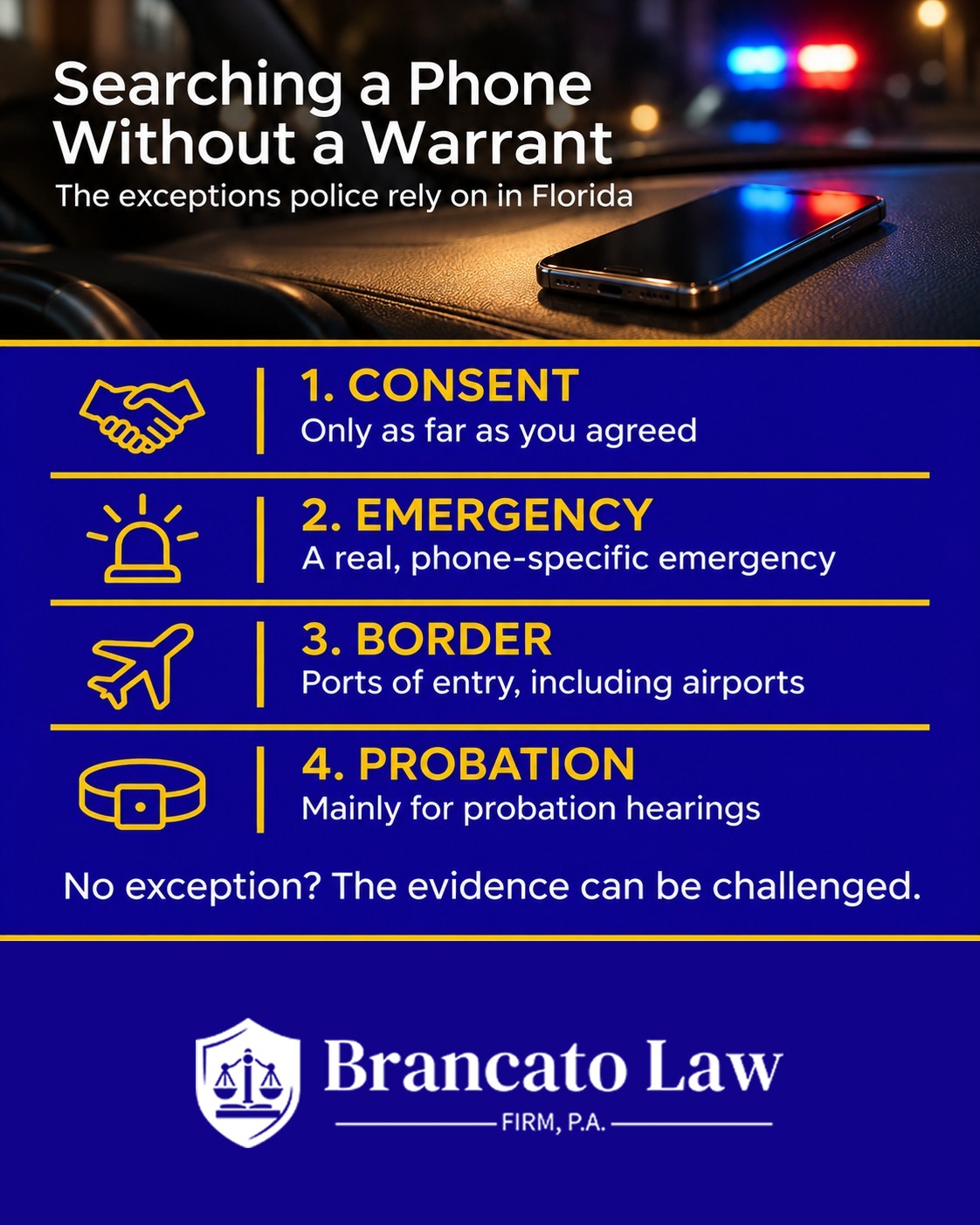
Police can search a phone without a warrant only when a recognized exception applies, and the State carries the burden of proving it. Riley itself said case-specific exceptions survive, especially exigent circumstances such as preventing the imminent destruction of evidence, chasing a fleeing suspect, or helping someone who is seriously hurt or in danger. Each emergency claim is judged on its own facts.
| Exception | What the State must show | Where it often fails |
|---|---|---|
| Consent | You freely agreed, and the search stayed inside what you agreed to | Consent was limited to one app or task, or it was withdrawn |
| Exigent circumstances | A real emergency specific to this phone and this moment | The phone was already secured and could not be changed |
| Border search | The search happened at the border or an international airport | Advanced CBP searches need reasonable suspicion under CBP policy |
| Probation supervision | A probation officer searched for use in probation proceedings | The results were used to file a new criminal charge |
| Abandonment | You gave up any privacy interest in the phone | A password-protected phone keeps its privacy interest |
Two Florida decisions show how narrowly courts read these exceptions. In State v. K.C., 207 So. 3d 951 (Fla. 4th DCA 2016), officers found a phone left in a stolen car and searched it as abandoned property. The Fourth District affirmed suppression because the phone was password protected, and paraphrased Riley’s answer: “get a warrant.” In Carpenter v. State, 228 So. 3d 535 (Fla. 2017), a technician searched an arrested man’s phone without a warrant in 2012, and the Florida Supreme Court refused to apply the good-faith exception because the law was still unsettled at the time.
Does Consent Let Police Search Everything on My Phone?
No. Consent lets police search only as far as a reasonable person would understand the agreement to reach. If an officer asks to “check your last text” and then scrolls through your photo gallery, the search went past the consent. Florida courts apply this rule strictly. In Colas v. State, 196 So. 3d 565 (Fla. 4th DCA 2016), officers had consent to enter a bedroom to retrieve a stolen iPhone, then opened dresser drawers after they had the phone. The Fourth District held that consent ended once the phone was found and reversed the denial of the motion to suppress.
You can also limit or withdraw consent. A refusal is not evidence of guilt, and it does not give officers probable cause. If you already agreed to a search, tell your lawyer exactly what was said, because the words of the request and your answer usually decide how far the search could go.
Can Police Search My Phone at the Border or an International Airport?
Yes. Border searches are the broadest exception, and they apply at ports of entry, including international airports. In United States v. Touset, 890 F.3d 1227 (11th Cir. 2018), the federal appeals court that covers Florida held that the Fourth Amendment does not require suspicion for a forensic search of an electronic device at the border. U.S. Customs and Border Protection policy is narrower than that ruling: CBP says its “advanced” searches, where an officer connects outside equipment to copy or analyze a device, require reasonable suspicion and a senior manager’s approval.
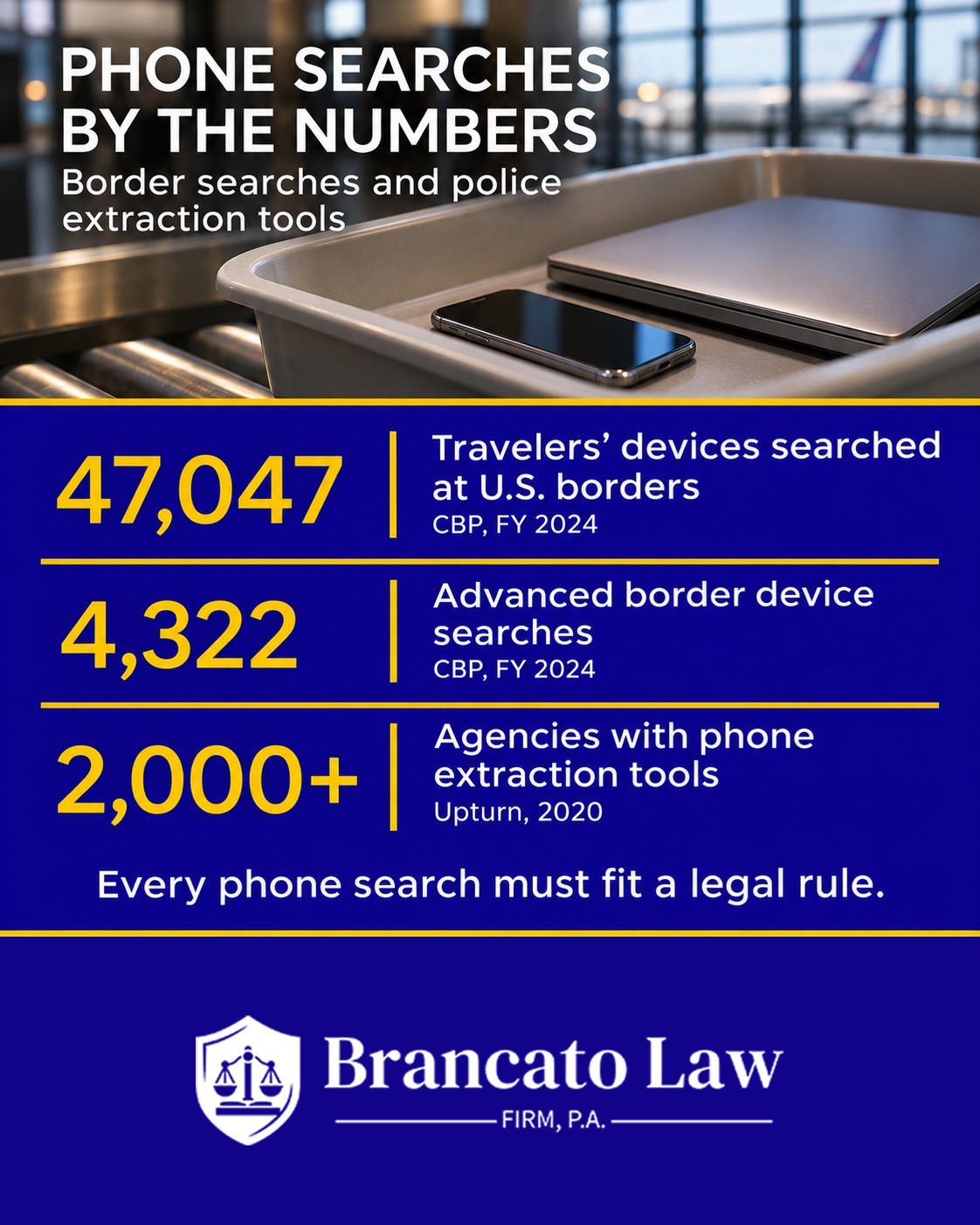
In fiscal year 2024, CBP searched the electronic devices of 47,047 international travelers out of more than 420 million travelers processed, and 4,322 of those were advanced searches, according to CBP’s published border search statistics. Those numbers are small as a share of travel, yet every one of those searches can produce evidence that ends up in a state or federal case.
Can a Probation Officer Search My Phone?
Sometimes, and the answer depends on who searches and how the results are used. Florida’s long-standing rule from Grubbs v. State, 373 So. 2d 905 (Fla. 1979) is that a probation officer’s warrantless search is valid only to the extent the evidence is used in probation violation proceedings. Using that evidence to prove a new crime “requires compliance with customary fourth amendment requirements.”
Phones have tested that rule. In State v. Phillips, 266 So. 3d 873 (Fla. 5th DCA 2019), a probation officer forensically downloaded the phones of a man on sex offender probation without a warrant or suspicion, and the Fifth District held the search reasonable because the results were used only in probation proceedings. In Parker v. State, No. 2D19-2013 (Fla. 2d DCA Dec. 11, 2020), the Second District upheld a probation officer’s look through an unlocked phone where the officer had reasonable suspicion that a man on probation for stalking was violating his no-contact condition, and noted the officer did no forensic download. If you are on probation and your phone was searched, our Tampa violation of probation attorney page explains how these cases are defended, and our post on internet and device conditions on sex offender probation covers the device rules in detail.
How Far Can a Phone Search Warrant Reach?
A phone warrant can reach only the data the warrant particularly describes, and officers must stay inside it. Florida’s warrant statute, section 933.05, requires an affidavit “particularly describing the property or thing to be seized,” and article I, section 12 adds that a warrant must describe “the nature of evidence to be obtained.” Section 933.05 also gives police 365 days to return a warrant for an electronic device, and the warrant counts as timely executed if the phone was seized within 10 days of issuance.
Those deadlines do not widen what police may look at. In Young v. State, 394 So. 3d 1174 (Fla. 4th DCA 2024), a detective took Facebook records seized under a theft-and-fraud warrant and searched them for evidence of an unrelated homicide without getting a new warrant. The Fourth District held that search violated the Fourth Amendment, refused to apply the good-faith exception, and ordered a new trial. The same reasoning applies to a full phone extraction: data copied for one crime cannot be mined for a different crime without new judicial approval.
Most phone searches today are full extractions with tools such as Cellebrite or GrayKey. The 2020 Upturn report Mass Extraction, built on 110 public records requests, documented more than 2,000 agencies in all 50 states and Washington, D.C. that had bought mobile device forensic tools. A full extraction copies far more than any single warrant usually justifies, which is why our attorneys read the warrant’s list of data categories and date ranges line by line against the extraction report.
Can Police Force You to Give Up Your Phone Passcode in Florida?
Florida’s appeals courts disagree, and the Florida Supreme Court has not decided the question. The issue is the Fifth Amendment privilege against self-incrimination: telling police a memorized passcode can be “testimonial,” which the Fifth Amendment protects, unless the State shows the “foregone conclusion” exception applies.
| Case | Court and year | Result |
|---|---|---|
| State v. Stahl, 206 So. 3d 124 | 2d DCA 2016 | Passcode could be compelled: “a case of surrender and not testimony” |
| G.A.Q.L. v. State, 257 So. 3d 1058 | 4th DCA 2018 | Order quashed; the State must know what data sits behind the passcode |
| Pollard v. State, 287 So. 3d 649 | 1st DCA 2019 | Order quashed; broad categories of data were not specific enough |
| Garcia v. State, 302 So. 3d 1051 | 5th DCA 2020 | Order quashed; foregone conclusion does not apply to spoken testimony |
| State v. Garcia, 350 So. 3d 322 | Fla. 2022 | Fifth District decision quashed on jurisdiction; the Fifth Amendment question left open |
In State v. Stahl, 206 So. 3d 124 (Fla. 2d DCA 2016), a man accused of video voyeurism in a store first consented to a phone search, then withdrew consent, and the State got a warrant it could not execute without his passcode. The Second District held he could be compelled because the State knew the passcode existed and the phone was his. The Fourth District rejected that approach in G.A.Q.L. v. State, 257 So. 3d 1058 (Fla. 4th DCA 2018), a case about a minor ordered to give up his iPhone passcode and iTunes password, holding that “the object of the foregone conclusion exception is not the password itself, but the data the state seeks behind the passcode wall.” The First District took the same side in Pollard v. State, 287 So. 3d 649 (Fla. 1st DCA 2019).
The Fifth District went further in Garcia v. State, 302 So. 3d 1051 (Fla. 5th DCA 2020), holding that compelled oral disclosure of a passcode is testimonial and that the foregone conclusion exception does not apply to spoken testimony at all. The Florida Supreme Court then quashed that decision in State v. Garcia, 350 So. 3d 322 (Fla. 2022) because the Fifth District lacked certiorari jurisdiction, and it said the case may “pose questions we have not previously answered.” The Fifth Amendment question remains open statewide.
Why Does the Passcode Split Matter More in Tampa Bay?
It matters because trial judges in Hillsborough, Pinellas, and Pasco Counties must follow the Second District, and the Second District decided Stahl. Under section 35.03, the Second Appellate District includes the Sixth Judicial Circuit (Pinellas and Pasco) and the Thirteenth Judicial Circuit (Hillsborough). Under Pardo v. State, 596 So. 2d 665 (Fla. 1992), “if the district court of the district in which the trial court is located has decided the issue, the trial court is bound to follow it.”
That means a prosecutor in a Hillsborough County criminal case can ask a judge to order a passcode under Stahl, while the same motion would face G.A.Q.L. in Broward County. Our attorneys build the record for appeal in every passcode fight here: we press the differences between the facts in Stahl, which turned partly on the defendant’s earlier consent, and we preserve the Fifth Amendment objection so the issue is ready if the Florida Supreme Court takes it up. Fingerprint and Face ID unlocking is a separate, undecided issue in Florida; in Garcia, the Fifth District declined to reach it because the record did not show the phone could be unlocked that way.
How Do Our Attorneys Challenge a Cell Phone Search?
Our attorneys challenge phone evidence by testing every step between the seizure and the report the State plans to use at trial. The usual vehicle is a motion to suppress evidence, filed before trial and heard by the judge. Phone cases often involve digital forensics, so our Tampa criminal forensic science attorney team works with independent examiners when an extraction needs a second look.
- Was there a warrant at all? If not, the State must prove a specific exception, and we hold it to that burden.
- Was consent real and how far did it reach? We compare body camera audio to the officer’s report and the consent form.
- Does the warrant describe particular data? Warrants that authorize “any and all data” invite a particularity challenge under section 933.05 and article I, section 12.
- Did the search stay inside the warrant? We compare the extraction report and the examiner’s notes to the warrant, as the court did in Young.
- Was a passcode compelled? We object under the Fifth Amendment and preserve the issue for appeal.
- What evidence flowed from the search? Anything derived from an illegal search, including later warrants built on it, can be suppressed as well.
Phone evidence also shows up in other forms. Our guides on social media evidence in Tampa criminal cases and using cell phone location evidence for an alibi explain how the same data can help or hurt the defense.
What Should You Do If Police Want Your Phone?
You should stay calm, say clearly that you do not consent to a search, and ask to speak with a lawyer before answering questions or unlocking anything. Do not physically resist if officers take the phone; that can add a resisting charge. Do not delete data after you learn about an investigation, because that can create a tampering charge that is easier to prove than the original accusation.
If police are asking about your phone before any arrest, representation before charges are filed gives your lawyer a chance to deal with warrants and subpoenas early. Our Florida criminal case process guide explains where a suppression motion fits between arrest and trial.
Frequently Asked Questions About Phone Searches in Florida
Can police look at my phone during a traffic stop in Florida?
Not without consent, a warrant, or a real emergency. The Brancato Law Firm regularly challenges roadside phone checks that officers describe as “quick looks,” because Riley makes no exception for a brief search.
Can police unlock my phone with my face or fingerprint?
Florida appellate courts have not decided whether forcing a fingerprint or Face ID unlock violates the Fifth Amendment. Our attorneys at The Brancato Law Firm object to any compelled biometric unlock and preserve the issue, since the law may change while a case is pending.
Can police get my iCloud or Google data without my phone?
Yes. Police can seek cloud data directly from Apple, Google, or another provider through a warrant or other legal process, without ever touching your phone. The Brancato Law Firm reviews provider warrants for the same particularity and scope problems that affect phone extractions, as explained on our forensic science defense page.
What happens if a judge suppresses the phone evidence?
The State cannot use the suppressed data or anything derived from it, and the case may be dismissed if the phone was its core proof. Our attorneys at The Brancato Law Firm map each piece of evidence back to the phone search so derived evidence is challenged too.
Do I have to give police my passcode if they have a warrant?
A warrant lets police search the phone, but whether you can be ordered to reveal your passcode is an open Fifth Amendment question in Florida. The Brancato Law Firm litigates these motions in Tampa Bay courts, where judges follow Stahl, so it is important to have a lawyer before any hearing on a motion to compel.
Can police keep my phone while they get a warrant?
Yes. Police may seize and secure a phone found during an arrest while they apply for a warrant, as both Riley and Smallwood recognized, but they may not open it in the meantime. The Brancato Law Firm checks how long the phone was held and what happened to it before the warrant issued, and our pre-file advocacy work often addresses phone seizures before charges are filed.
Talk to a Tampa Defense Lawyer About a Phone Search
Phone evidence is easiest to challenge before the State finishes its forensic report, so call before you agree to anything or appear at a hearing. The Brancato Law Firm, P.A., founded by Tampa Criminal Defense Attorney Rocky Brancato, is available 24/7 at (813) 727-7159, and our attorneys will start by getting the warrant, the consent paperwork, and the extraction report. Our firm has Spanish-speaking staff, and attorney Jean-Luc Adrien speaks Spanish, Haitian Creole, and French. For more about our defense strategies, visit our Forensic Science page.
The Brancato Law Firm, P.A.
620 E. Twiggs Street, Suite 205, Tampa, FL 33602
(813) 727-7159
Serving Hillsborough, Pinellas, and Pasco Counties
The Brancato Law Firm, P.A. is a Tampa-based criminal defense practice. We are not affiliated with any other Brancato-named law firms.
Visit Us

Tampa, FL 33602

Contact Us Now
Free Legal Consultation (813) 727-7159
