

From First DUI to Death Penalty



Can You Use ChatGPT or AI to Defend Your Criminal Case in Florida? (2026)



Updated November 26, 2026
Short answer: You can use ChatGPT, Claude, Gemini, or Copilot to learn general legal terms, but using AI to plan the defense of your own Florida criminal case is risky. In February 2026, a federal judge in New York held that a defendant’s chats with an AI tool about his case were not protected by attorney-client privilege or work product, and prosecutors got to read them after the FBI seized them in a search. AI chats can be subpoenaed, seized from your phone with a warrant, and used at trial, and AI tools still invent fake cases. Conversations with your defense lawyer are privileged under Florida law; conversations with a chatbot are not.
Prosecutors now read defendants’ chatbot histories the same way they read text messages and search history. As founder of The Brancato Law Firm, P.A., a Tampa criminal defense firm, and a former Chief Operations Officer of the Hillsborough County Public Defender’s Office, where I oversaw a staff of over 100 attorneys, I have spent more than 25 years in Hillsborough County courtrooms watching people’s own words become the State’s best evidence. Our attorneys keep that from happening by moving the client’s questions out of the chat window and into a privileged conversation, early.
This guide covers what courts have ruled about AI chats in criminal cases through November 2026, what prosecutors have done with them, the new Florida rule on AI-made citations, and what is safe to type. Because AI chats are often seized from phones, see also our guide to what police can track without a warrant in Florida.
Are Your ChatGPT or AI Chats Protected by Attorney-Client Privilege?
No. In Florida, the lawyer-client privilege covers confidential communications between a client and a “lawyer,” which section 90.502, Florida Statutes defines as a person authorized, or reasonably believed to be authorized, to practice law. A chatbot is not a lawyer, and a communication is “confidential” only if it is not meant to be shared with outside third parties. Typing your case into an AI tool shares it with the company that runs the tool.
The first court to decide the question in a criminal case agreed. In United States v. Heppner, 820 F. Supp. 3d 292 (S.D.N.Y. 2026), a former executive charged with securities fraud and wire fraud had used Anthropic’s Claude, after receiving a grand jury subpoena, to write reports on his possible defense strategy. FBI agents seized about 31 of those AI documents when they searched his home on the day of his November 4, 2025 arrest. Judge Jed S. Rakoff ruled on February 17, 2026 that the documents were not privileged for three reasons:
- Claude is not a lawyer, and the court said the lack of an attorney-client relationship “alone disposes” of the privilege claim.
- The chats were not confidential. The court pointed to Anthropic’s written privacy policy, which said the company collects user inputs and outputs and may disclose data to third parties, including government authorities and in connection with litigation.
- He was not seeking legal advice from a lawyer, and Claude itself says it cannot give legal advice. Sending the AI output to his defense lawyers later did not turn it into a privileged communication.
The court also rejected work-product protection because the defendant made the documents on his own, not at his lawyers’ direction. Judge Rakoff left one door open: if counsel had directed the client to use the AI tool, the analysis might differ. That is a reason to bring your lawyer in before you use any tool on your case. Our firm uses technology carefully and under lawyer supervision, and an attorney decides what, if anything, goes into any tool.
Civil courts have split somewhat. In Warner v. Gilbarco, Inc., 820 F. Supp. 3d 629 (E.D. Mich. 2026), a self-represented employment plaintiff was allowed to shield her ChatGPT materials as work product, with the court calling AI programs “tools, not persons.” That case involved civil discovery rules and a litigant acting as her own advocate. We have not found a Florida appellate decision on AI chats and privilege as of November 2026, so the safest assumption for anyone under investigation in Florida is the Heppner rule: your chats can be read.
Can Police or Prosecutors Get Your ChatGPT History?
Yes, through two main routes. The first is your own device. Under Riley v. California, 573 U.S. 373 (2014), police generally need a warrant to search the data on a phone seized at arrest, and the Supreme Court noted that a phone’s search and browsing history can reveal a person’s private concerns. Once a judge signs that warrant, an AI app’s saved chat history sits on the phone or laptop with everything else. Our Tampa criminal forensic science attorney page explains how our attorneys test the extraction reports that come from those searches.
The second route is the AI company. OpenAI’s own policy on civil requests says it responds to valid subpoenas and court orders for user data, and its transparency page reports that in January through June 2026 it received 146 government requests for the content of user accounts, 620 non-content requests, and 28 emergency requests. Each of those numbers comes from OpenAI’s own reporting for that six-month period.
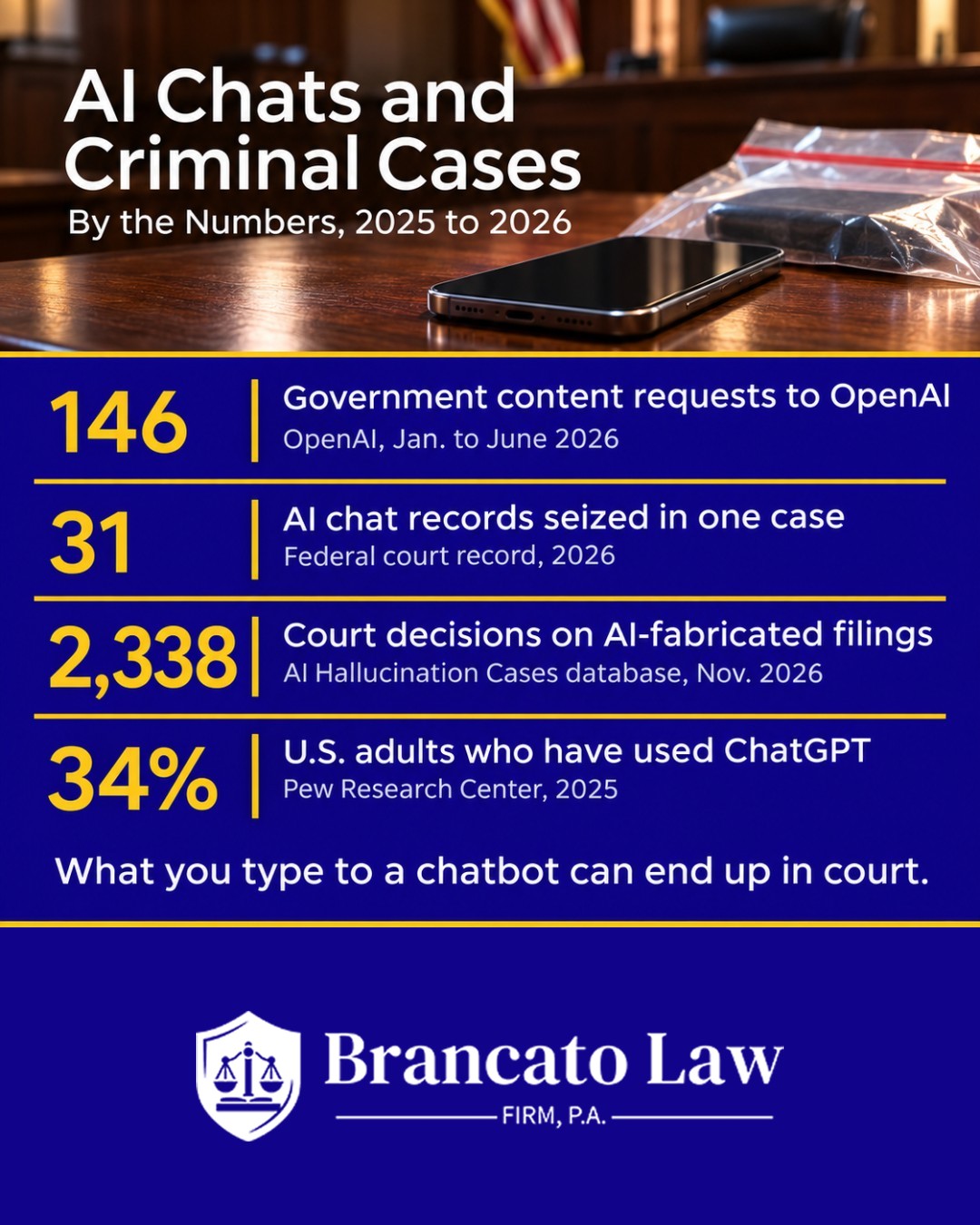
Courts have also ordered AI companies to keep chats users thought were deleted. In the copyright suit brought by The New York Times, a federal magistrate judge ordered OpenAI on May 13, 2025 to “preserve and segregate all output log data that would otherwise be deleted,” including data deleted at a user’s request (In re OpenAI, Inc. Copyright Infringement Litigation, No. 25-md-3143 (S.D.N.Y.)). A later stipulated order ended the ongoing obligation as of September 26, 2025, but OpenAI agreed to keep the data it had already preserved. Hitting “delete” does not guarantee a chat is gone.
Have Prosecutors Used a Defendant’s AI Chats as Evidence?
Yes. Federal prosecutors used Jonathan Rinderknecht’s ChatGPT records in both trials over the 2025 Palisades Fire in Los Angeles. According to NBC Los Angeles, prosecutors argued that he had asked ChatGPT whether he could be responsible for a fire caused by a cigarette, and that his earlier ChatGPT-generated fire imagery showed his state of mind. The first trial ended in a hung jury in June 2026. At the retrial, the jury convicted him on November 20, 2026, with the ChatGPT evidence again part of the government’s case.
The lesson for anyone in Florida is the same one we give about texts and posts. Questions you type to a chatbot about “what if” scenarios read very differently to a jury than they felt when you typed them. Our post on social media evidence in Tampa criminal cases covers how prosecutors authenticate and use that kind of digital trail.
What Should You Never Type Into ChatGPT About Your Case?
Never type facts, admissions, or evidence about your case into an AI tool. Assume anything you type could be printed, marked as a State exhibit, and read aloud by a prosecutor. The table below sorts common uses by risk.
| Risky: do not type this | Reasonable: general learning |
|---|---|
| What you did, where you were, or what you meant to do | What a legal term means, such as “arraignment” or “nolle prosequi” |
| Names of co-defendants, witnesses, or the alleged victim | How a Florida criminal case moves from arrest to trial, in general |
| Photos, texts, or documents from your case | A list of questions to bring to your defense lawyer |
| “How do I explain…” or “what if I say…” questions about your facts | How to find the clerk’s website or your court date |
| Drafts of statements to police, the judge, or the alleged victim | General background reading you then confirm with your lawyer |
If you are not yet charged and think you may be under investigation, the stakes are higher, because what you type now can become the probable cause later. Our representation before charges are filed page explains how our attorneys deal with detectives and prosecutors at that stage.
Can Deleting Your AI Chats Get You in More Trouble?
It can. Under section 918.13, Florida Statutes, it is a third-degree felony to alter, destroy, conceal, or remove any record, document, or other item with the purpose of impairing its availability, when you know a criminal trial, proceeding, or investigation is pending or about to begin. The charge rises to a second-degree felony when the investigation involves a capital felony. Deleting a chat history after you learn police are looking at you can be argued as that kind of act.
Deleting also may not work. The chat may still sit on the company’s servers under a preservation order or retention policy, in a device backup, or in a forensic image police already made. Talk to a lawyer before deleting anything. Our post on how to fight a tampering with evidence charge in Florida covers how that statute is charged and defended.
Can You Use AI to Represent Yourself in a Florida Criminal Case?
You have a constitutional right to represent yourself, but AI does not make it safe. Faretta v. California, 422 U.S. 806 (1975) holds that a defendant may waive counsel if the waiver is knowing and intelligent, after the judge warns about the “dangers and disadvantages of self-representation.” The same opinion says a defendant who represents himself “cannot thereafter complain” that his own defense amounted to ineffective assistance of counsel. If an AI tool gives you bad advice, there is no appeal issue to fall back on.
Florida also now holds every filer, including self-represented defendants, to a citation rule. In In re Amendments to Florida Rule of General Practice and Judicial Administration 2.515, No. SC2026-0673 (Fla. May 28, 2026), the Florida Supreme Court amended Rule 2.515(d)(2), effective June 15, 2026, so that the signer of any filing represents that “the legal authorities identified exist and are accurately cited.” The court said the requirement applies to filings by unrepresented parties, and it allows sanctions including reprimand, contempt, striking the document, dismissal, costs, and attorneys’ fees. A companion administrative order told circuit courts to rely on the statewide rule rather than their own AI orders, so the same standard applies in Hillsborough, Pinellas, and Pasco.
In Hillsborough County, the first time most arrested people speak to a judge is at a first appearance held by video from the jail, and the Thirteenth Judicial Circuit records every one of those hearings. Our guide to what happens at a Hillsborough first appearance explains that hearing. A statement drafted by a chatbot and read aloud there becomes part of the court record. The Florida criminal case process hub walks through each later stage, from arraignment to trial.
What Happens When AI Invents Fake Cases in Court Filings?
Courts sanction the person who signed the filing, whether a lawyer or a self-represented litigant. The best-known example is Mata v. Avianca, Inc., 678 F. Supp. 3d 443 (S.D.N.Y. 2023), where two New York lawyers filed a brief citing six cases that ChatGPT had made up; the court fined the lawyers and their firm $5,000 and made them send letters to the judges falsely named as authors.
Florida appellate courts have seen the same problem from self-represented parties:
- Gutierrez v. Gutierrez, 399 So. 3d 1185 (Fla. 3d DCA 2024): a self-represented appellant filed briefs in which “the bulk” of the cited cases did not exist. The Third District dismissed his appeals as a sanction and barred further filings without a Florida Bar member’s signature.
- Hessert v. Hessert, 431 So. 3d 610 (Fla. 6th DCA 2026): of 13 cases cited in a self-represented petition, five did not exist and four did not say what the petition claimed. The Sixth District denied the petition, ordered her to show cause why she should not be sanctioned, and warned that litigants “cannot satisfy” their duty by relying on AI to cite-check.
Researcher Damien Charlotin’s AI Hallucination Cases database listed 2,338 court decisions worldwide involving AI-hallucinated material as of November 26, 2026. The Florida Bar’s Ethics Opinion 24-1, adopted January 19, 2024, already tells lawyers they may use generative AI only to the extent they can reasonably guarantee compliance with their duties of confidentiality, candor, and competence. A chatbot answering a defendant directly is under none of those duties.
Why Is Talking to a Defense Lawyer Different From Talking to AI?
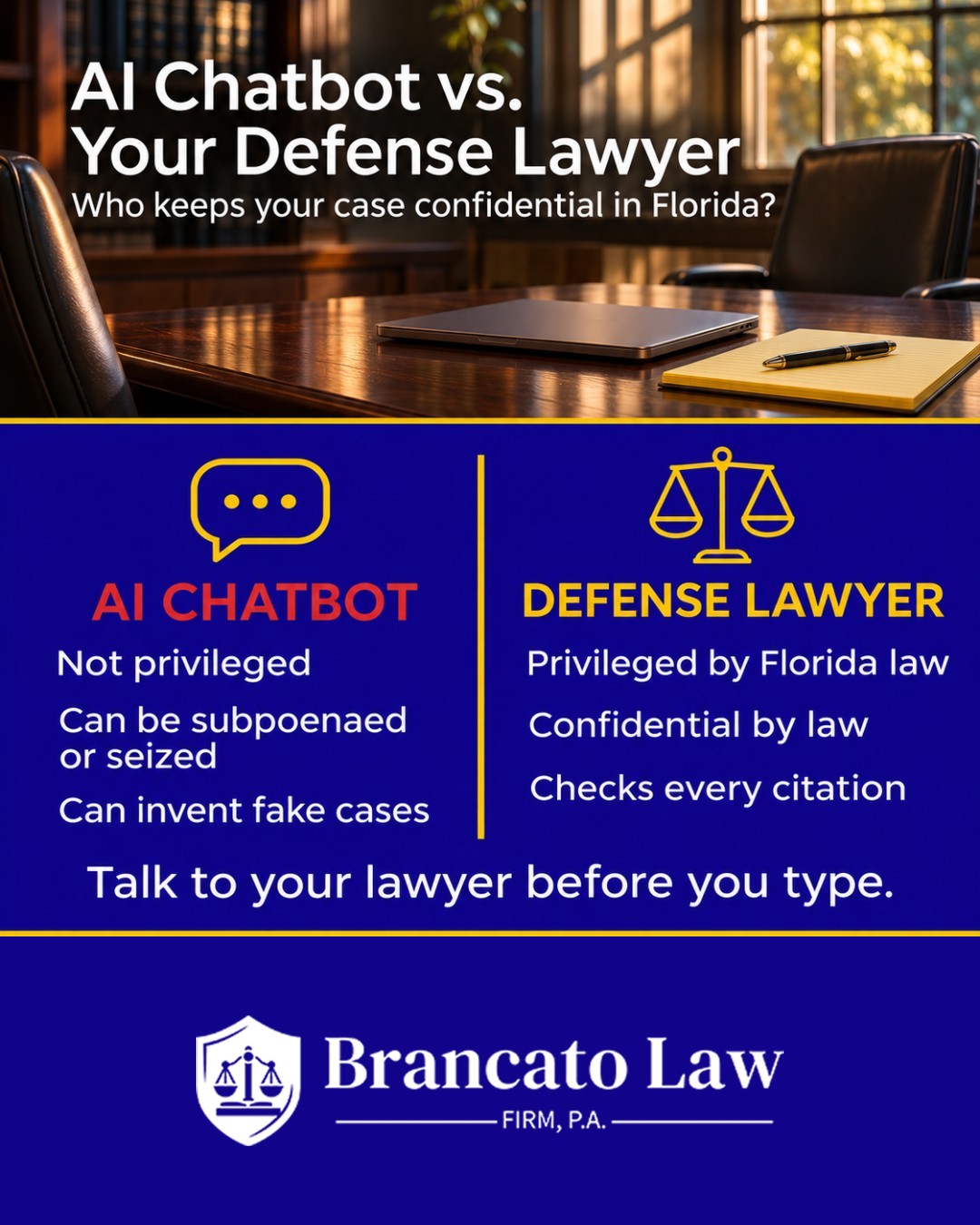
A conversation with your defense lawyer is privileged, confidential, and covered by professional duties that a chatbot does not have. The comparison below lays out the practical differences.
| Question | AI chatbot | Your defense lawyer |
|---|---|---|
| Is the conversation privileged? | No, under Heppner (S.D.N.Y. 2026) | Yes, under section 90.502, Florida Statutes |
| Can it be subpoenaed or seized? | Yes, from the company or your device | Privileged communications are protected from disclosure |
| Does it know your judge, prosecutor, and local practice? | No | Yes, from daily practice in the 13th Judicial Circuit |
| Who answers if a cited case is fake? | You do, under Rule 2.515(d)(2) | The lawyer, who must verify every citation |
| Can it negotiate, file motions, or try your case? | No | Yes |
About a third of American adults (34%) had used ChatGPT by 2025, according to the Pew Research Center, so it is natural to reach for it first. Use it to prepare better questions, then bring those questions to a lawyer. Our attorneys review the evidence, look for a motion to suppress or a weakness in the State’s case, and handle every conversation with police and prosecutors. For a look at how AI is showing up on the police side, read our post on AI-written police reports in Florida, and for a darker angle, our piece on the AI ChatGPT insanity defense. To see how we approach a case from start to finish, visit our Hillsborough County criminal defense attorney page.
Will Courts Change the Rules on AI-Generated Evidence?
They are working on it, but no new federal rule is in force yet. Proposed Federal Rule of Evidence 707 would apply expert-witness reliability standards to machine-generated evidence offered without an expert. According to the Center for Democracy and Technology, the federal Advisory Committee on Evidence Rules chose in May 2026 not to advance the draft in its current form and asked for more input. Until a rule is adopted, AI-generated and deepfake evidence is challenged under the existing authentication and expert rules, which is work our attorneys do with qualified forensic experts.
Frequently Asked Questions
Can prosecutors subpoena my ChatGPT history in Florida?
Yes. AI companies such as OpenAI say they respond to valid subpoenas and court orders, and police can also search a phone or laptop with a warrant. The Brancato Law Firm reviews any subpoena or warrant return for overbreadth and other defects before that data reaches a jury; our pre-file advocacy work starts before charges, when that review matters most.
Is it illegal to delete my AI chats after I am arrested?
It can be. Deleting records you know are relevant to a pending or expected investigation can be charged as tampering under section 918.13, Florida Statutes, a third-degree felony. Our attorneys at The Brancato Law Firm tell clients what to preserve and what to leave alone at the first meeting.
Does sharing my ChatGPT chat with my lawyer make it privileged?
No. In United States v. Heppner, the court held that forwarding AI-generated documents to defense counsel did not make them privileged after the fact. The Brancato Law Firm asks clients to tell us what they know directly, in a privileged conversation, instead of handing us chatbot output.
Can I use ChatGPT to write a motion in my own criminal case?
You can, but you are responsible for every citation in it. Since June 15, 2026, Florida Rule 2.515(d)(2) makes every signer, including a self-represented defendant, represent that cited authorities exist and are accurate, and courts can sanction false citations. Motions drafted by our attorneys at The Brancato Law Firm are researched and cite-checked by a lawyer; see our Tampa-area criminal defense page for the kinds of motions we file.
Can the State use my AI chats to show my state of mind?
It can try, as federal prosecutors did with ChatGPT records in the Palisades Fire case. Whether the chats come in depends on relevance, authentication, and unfair prejudice, and The Brancato Law Firm challenges that evidence the same way we challenge texts and posts, as explained in our social media evidence post.
Is it safe to use AI to learn about Florida criminal law in general?
General questions with no facts about your case carry little risk, but the answers may be wrong or out of date. The Brancato Law Firm suggests writing down what you learn and confirming it with your defense lawyer before relying on it.
Talk to a Lawyer Before You Talk to a Chatbot
What you type tonight can be read in court months from now, so make the first conversation a privileged one. Call The Brancato Law Firm, P.A., founded by Tampa Criminal Defense Attorney Rocky Brancato, at (813) 727-7159, any hour, and our attorneys will start by reviewing what has already been said and saved. Our firm has Spanish-speaking staff, and attorney Jean-Luc Adrien speaks Spanish, Haitian Creole, and French. For more about our defense strategies, visit our Hillsborough County criminal defense page.
The Brancato Law Firm, P.A.
620 E. Twiggs Street, Suite 205, Tampa, FL 33602
(813) 727-7159
Serving Hillsborough, Pinellas, and Pasco Counties
The Brancato Law Firm, P.A. is a Tampa-based criminal defense practice. We are not affiliated with any other Brancato-named law firms.
Visit Us

Tampa, FL 33602

Contact Us Now
Free Legal Consultation (813) 727-7159
