

From First DUI to Death Penalty



Can Police Use Pole Cameras and Drones in Florida? (2026)


Short answer: It depends on the tool. Florida’s drone law, section 934.50, bars police from using a drone to gather evidence unless an exception applies, such as a warrant or an emergency, and evidence collected in violation of the law cannot be used in a Florida criminal prosecution. Pole cameras have no Florida statute of their own, and in 2025 the federal appeals court covering Florida held that cameras recording only what anyone could see from the street is not a Fourth Amendment search. Cameras that look over a privacy fence or into a home raise much stronger suppression arguments.
Surveillance cases are often decided by one question at the suppression hearing: could an ordinary person standing in a public place have seen what the camera saw? I learned to ask that question first as a former police academy instructor who taught officers search and seizure law, and I have asked it in more than 25 years in Hillsborough County courtrooms. I am Rocky Brancato, founder of The Brancato Law Firm, P.A., a Tampa criminal defense firm, and our attorneys demand the camera placement records, drone flight logs, and retention policies in every case built on video surveillance.
This guide explains the law on long-term pole cameras, Florida’s drone statute, where facial recognition fits in, and how these tools are challenged in court. It is part of our series on police surveillance in Florida, which starts with our guide to what police can track without a warrant in Florida, along with our guide to Flock license plate cameras in Tampa.
Is a Police Pole Camera Pointed at Your House a Search?
Usually not, under current federal appellate law, if the camera records only what is visible from public streets. A pole camera is a video camera mounted on a utility pole or streetlight near a home, often running 24 hours a day and stored for later review. Courts analyze it under the Fourth Amendment test that asks whether police invaded an expectation of privacy that society accepts as reasonable.
The most important ruling for Floridians is United States v. Gregory, 128 F.4th 1228 (11th Cir. 2025). Federal agents put two cameras near one defendant’s Alabama home without a warrant, one on the front and one on the backyard, and recorded continuously from October 2018 through August 2019. The Eleventh Circuit, which hears federal appeals from Florida, held this was not a search because the cameras captured only areas exposed to the public street and alley. The court expressly left open whether a camera recording over a privacy fence into an enclosed backyard would be different, and one judge wrote separately that long-term recording of what goes on around a home “might” implicate the Fourth Amendment.
Do Courts Disagree About Long-Term Pole Camera Surveillance?
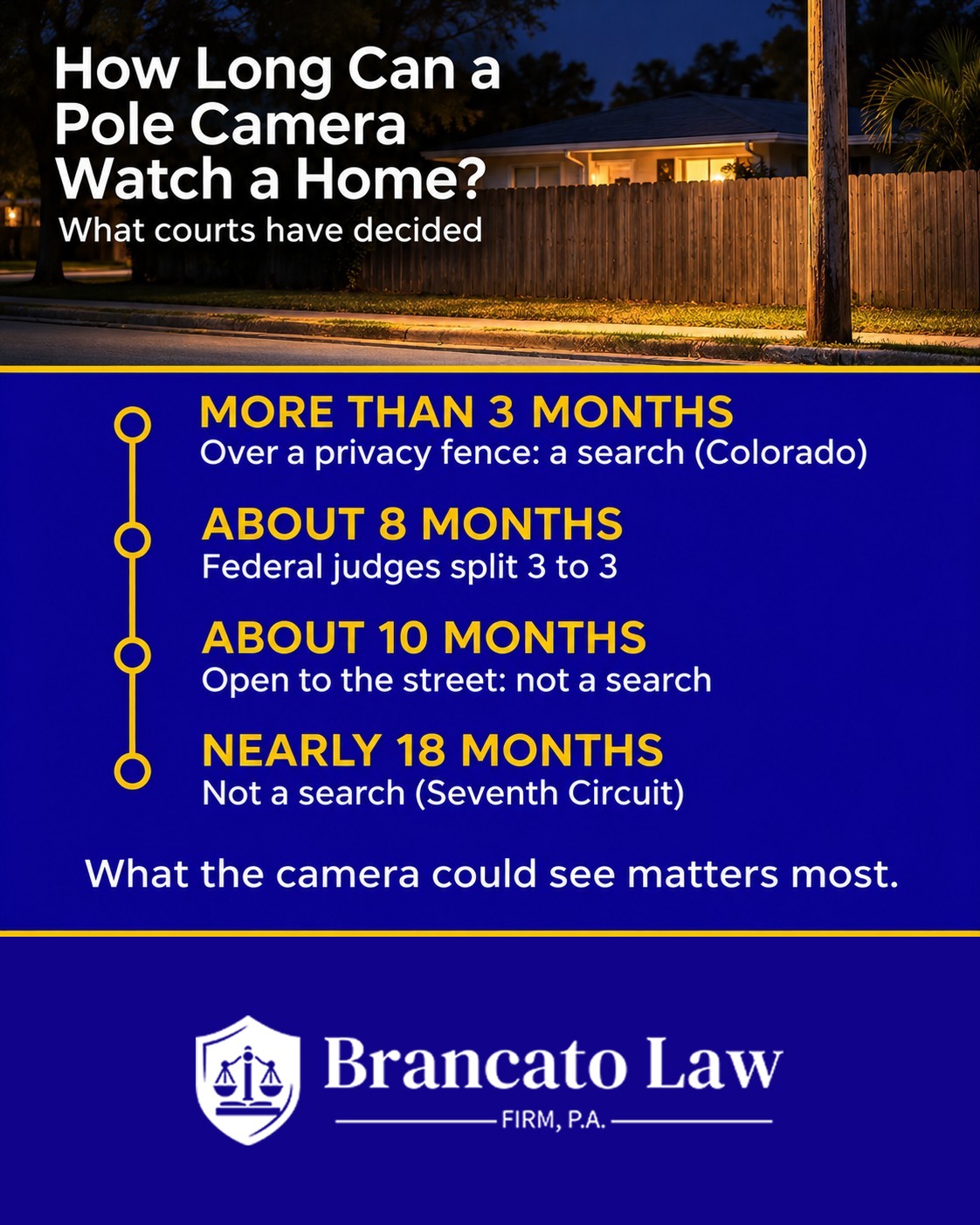
Yes, and the split turns on how long the camera ran and what it could see. The U.S. Supreme Court has not decided a pole camera case. In Carpenter v. United States, 585 U.S. 296 (2018), it required a warrant for long-term cell phone location records but said it was not calling into question “conventional surveillance techniques and tools, such as security cameras.” Lower courts have read that sentence differently.
| Case | How long the camera ran | Result |
|---|---|---|
| People v. Tafoya, 2021 CO 62 (Colo. 2021) | More than three months, over a six-foot privacy fence | A search; convictions reversed |
| United States v. Moore-Bush, 36 F.4th 320 (1st Cir. 2022) (en banc) | About eight months of the front of a home | Judges split 3 to 3 on whether it was a search; evidence admitted under good faith |
| United States v. Gregory, 128 F.4th 1228 (11th Cir. 2025) | October 2018 through August 2019 (about 10 months) | Not a search where the views were open to the public |
| United States v. Tuggle, 4 F.4th 505 (7th Cir. 2021) | Nearly 18 months | Not a search |
In United States v. Tuggle, 4 F.4th 505 (7th Cir. 2021), three cameras watched an Illinois home for nearly 18 months during a methamphetamine investigation. The Seventh Circuit found no search but admitted it was “not without unease” about the implications for future cases. In United States v. Moore-Bush, 36 F.4th 320 (1st Cir. 2022), six judges unanimously reversed suppression of eight months of footage of a Springfield, Massachusetts home, yet three of them concluded the surveillance was a search and admitted the evidence only because agents had relied in good faith on older circuit precedent.
The Colorado Supreme Court went the other way in People v. Tafoya, 2021 CO 62 (Colo. 2021). Police mounted a camera across the street from a suspected stash house, zoomed and panned it remotely, and recorded the backyard behind a six-foot privacy fence for more than three months, storing the footage indefinitely. The court held that was a warrantless search and wrote: “We find the extended duration and continuity of the surveillance here to be constitutionally significant.”
How Do Florida Courts Handle Pole Cameras?
Florida courts start from the Fourth Amendment and the U.S. Supreme Court’s decisions, because article I, section 12 of the Florida Constitution must be read in conformity with them. We have not found a published Florida appellate decision deciding whether long-term pole camera surveillance of a home is a search. That leaves Florida trial judges to weigh persuasive decisions like Gregory, Tuggle, and Tafoya, and it means the facts of the camera’s placement carry the motion.
Pole cameras show up most often in drug investigations, where agents watch a house for traffic before seeking a search warrant. If the warrant for your home rested on pole camera footage, our Tampa drug crimes attorney page explains how we attack the warrant and everything it produced. The key facts are whether the camera could see over a fence or through a window, whether police could zoom remotely, how long it ran, and how long the footage was kept.
Can Police Hide a Camera Inside a Business or Home?
Only with a warrant, and Florida courts require the warrant to limit what gets recorded. In State v. Kraft, 301 So. 3d 981 (Fla. 4th DCA 2020), Jupiter police used a fake bomb threat to clear a day spa, installed hidden cameras in four massage rooms, and recorded continuously for five days under a warrant with no minimization instructions. The cameras captured innocent customers, including women who were never suspected of anything. The Fourth District held that minimization is required by the Fourth Amendment for covert video surveillance and affirmed suppression of all the footage, including the videos of the defendant.
Kraft matters in any case where police recorded inside a private place. The warrant must describe how officers will avoid recording people and activity outside the investigation, and officers must actually follow those limits.
Can Police Fly a Drone Over Your House in Florida?
Not to gather evidence, unless an exception in Florida’s drone statute applies. Section 934.50, known as the Freedom from Unwarranted Surveillance Act, says that “a law enforcement agency may not use a drone to gather evidence or other information,” except as the statute allows. The Florida Legislature amended the law in 2015 after a staff analysis warned that a drone with the right equipment could “watch a building,” “look inside the building,” and listen to conversations inside, as the Fourth District recounted in Rosaly v. Konecny, 346 So. 3d 630 (Fla. 4th DCA 2022).
| Exception | What the statute requires |
|---|---|
| Search warrant | A judge signs a warrant authorizing use of a drone, which may include searching an area where evidence of a crime might reasonably be found |
| Emergency | Reasonable suspicion that swift action is needed to prevent imminent danger to life or serious property damage, stop an escape or destruction of evidence, or find a missing person |
| Terrorism | The U.S. Secretary of Homeland Security determines credible intelligence shows a high risk of attack by a specific person or group |
| Crowds of 50 or more | Written agency policies on use, storage, and release of video, plus written authorization from the agency head |
| Traffic management | Allowed, but no traffic citation may be issued from drone images or video |
| Crime and crash scenes | Collecting evidence at a crime scene or traffic crash scene |
Under section 934.50(6), “evidence obtained or collected in violation of this act is not admissible as evidence in a criminal prosecution in any court of law in this state.” An aggrieved person may also sue the agency for relief under section 934.50(5). That exclusionary rule comes from the statute itself, so a defendant does not have to win a Fourth Amendment argument to keep unlawful drone evidence out.
How Is a Drone Different From a Helicopter Flyover?
A drone is governed by section 934.50, while a helicopter flyover is judged only under the Fourth Amendment, which gives less protection. In Florida v. Riley, 488 U.S. 445 (1989), a Pasco County deputy who could not see into a greenhouse from the road circled over it in a helicopter at 400 feet and spotted marijuana through openings in the roof. The Supreme Court reversed the Florida Supreme Court: a four-Justice plurality held that this naked-eye observation was not a search, and Justice O’Connor, who supplied the deciding vote, warned that lower flights over a home’s curtilage could violate reasonable privacy expectations.
Florida’s drone law gives Pasco, Hillsborough, and Pinellas residents more protection than Riley does, because it limits the drone itself rather than asking whether a member of the public might have flown overhead. Thermal or other sense-enhancing cameras add another layer. In Kyllo v. United States, 533 U.S. 27 (2001), the Court held that using technology “not in general public use” to learn details about the inside of a home is a search that is presumptively unreasonable without a warrant.
How Many Police Agencies Use Drones?
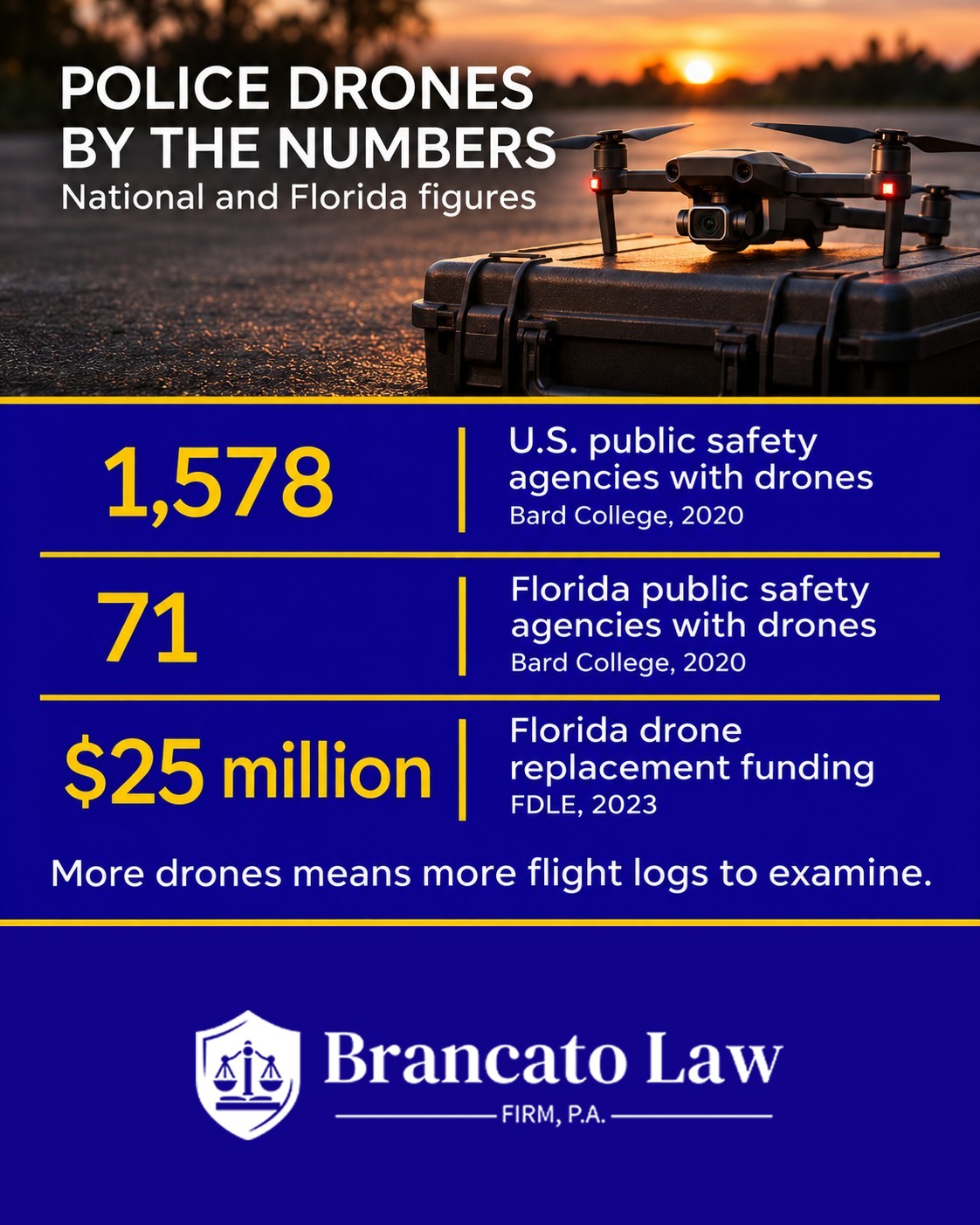
Police drone use is widespread and growing. A March 2020 study by the Center for the Study of the Drone at Bard College counted at least 1,578 state and local public safety agencies in the United States with drones, including 71 in Florida, and found that 70 percent of them work in law enforcement. The study noted its count does not capture every agency.
Florida has also spent public money to keep its police drone fleets flying. According to the Florida Department of Law Enforcement, the Legislature appropriated approximately $25 million in the 2023 session for a Drone Replacement Program that reimburses agencies for replacing drones that no longer meet state requirements, up to $25,000 per drone. More drones in the air means more cases where the flight log, the exception claimed, and the agency’s written policies decide what evidence survives.
What About Facial Recognition From Cameras and Drones?
Facial recognition is a separate tool that often runs on footage from pole cameras, drones, and business cameras. A match can point police toward a suspect, but it is an investigative lead that needs independent confirmation, and misidentification is a documented risk. We cover the law, the disclosure rules, and the challenges in detail in our guide, can police arrest you based on facial recognition in Florida, and our post on challenging eyewitness identification explains how a faulty match can taint a later photo lineup.
How Do Our Attorneys Challenge Camera and Drone Evidence?
Our attorneys challenge surveillance evidence by reconstructing exactly what the device saw, from where, and for how long, then holding the State to the rule that applies. The usual tool is a motion to suppress evidence, and it often reaches every warrant and arrest that grew out of the surveillance.
- Identify the device. Pole camera, drone, hidden camera, doorbell camera, or helicopter each has a different legal test.
- Get the placement and flight records. Installation dates, camera angles, zoom capability, drone flight logs, and altitude.
- Test the drone exception. Under section 934.50 the State must fit the flight into a listed exception or the evidence is inadmissible.
- Measure duration and view. Long-term recording over a fence or into a home supports the Tafoya line of cases.
- Check the warrant and minimization. Covert recording inside a private place needs limits like those required in Kraft.
- Follow the fruit. Search warrants, traffic stops, and identifications built on unlawful footage can fall with it.
What Should You Do If You Think Police Are Watching Your Home?
You should not tamper with, block, or damage a camera or drone, and you should talk to a lawyer before talking to police. Damaging equipment can create a new charge, and statements made to “clear things up” are often the strongest evidence in a surveillance case. Write down what you saw and when, and keep any of your own camera footage that shows the device.
If you believe you are under investigation, representation before charges are filed lets your lawyer address the investigation early. Our Florida criminal case process guide shows how an investigation moves to arrest and where a suppression motion fits, and our guide on when police can enter your home without a warrant covers the physical searches that often follow surveillance.
Frequently Asked Questions About Pole Cameras and Drones in Florida
Can my neighbor fly a drone over my backyard in Florida?
Section 934.50 also restricts private drone surveillance of people on private property in some circumstances, and it gives property owners and occupants a civil remedy for certain violations. The Brancato Law Firm handles the criminal side of these disputes, and the Fourth District in Rosaly held that repeated drone flights can support a stalking injunction.
How long can police leave a pole camera on my house without a warrant?
We have not found a Florida appellate decision setting a time limit, and the Eleventh Circuit upheld roughly ten months of recording in Gregory. Our attorneys at The Brancato Law Firm focus on what the camera could see and whether it looked past a fence or into the home, which is where the strongest arguments are, as explained on our drug crimes defense page.
Can police use a drone to look for a missing person or a fleeing suspect?
Yes. Section 934.50(4)(c) allows drone use when police have reasonable suspicion that swift action is needed to prevent imminent danger, stop an escape, prevent destruction of evidence, or find a missing person. The Brancato Law Firm examines whether the emergency was real at the moment of the flight or was claimed after the fact.
Is drone video taken without a warrant automatically thrown out?
Only if no exception applied; video gathered in violation of section 934.50 is inadmissible in a Florida criminal prosecution. Our attorneys at The Brancato Law Firm demand the flight log and the agency’s written policy to test the exception the State claims.
Can police record video inside my business with a warrant?
Yes, but the warrant and the officers must limit recording of people and activity outside the investigation. The Brancato Law Firm relies on State v. Kraft, where all of the hidden-camera footage from a Jupiter spa was suppressed because those limits were missing.
Talk to a Tampa Defense Lawyer About Camera or Drone Surveillance
Camera placement records and drone flight logs can be overwritten or purged, so ask for help while they still exist. Our attorneys will start by preserving the surveillance records and testing each device against the rule that governs it. Call The Brancato Law Firm, P.A., founded by Tampa Criminal Defense Attorney Rocky Brancato, at (813) 727-7159; we are available 24/7 and our office is two blocks from the courthouse. Our firm has Spanish-speaking staff, and attorney Jean-Luc Adrien speaks Spanish, Haitian Creole, and French. For more about our defense strategies, visit our Drug Crimes page.
The Brancato Law Firm, P.A.
620 E. Twiggs Street, Suite 205, Tampa, FL 33602
(813) 727-7159
Serving Hillsborough, Pinellas, and Pasco Counties
The Brancato Law Firm, P.A. is a Tampa-based criminal defense practice. We are not affiliated with any other Brancato-named law firms.
Visit Us

Tampa, FL 33602

Contact Us Now
Free Legal Consultation (813) 727-7159
