

From First DUI to Death Penalty



Do Police Need a Warrant to Put a GPS Tracker on Your Car in Florida? (2026)


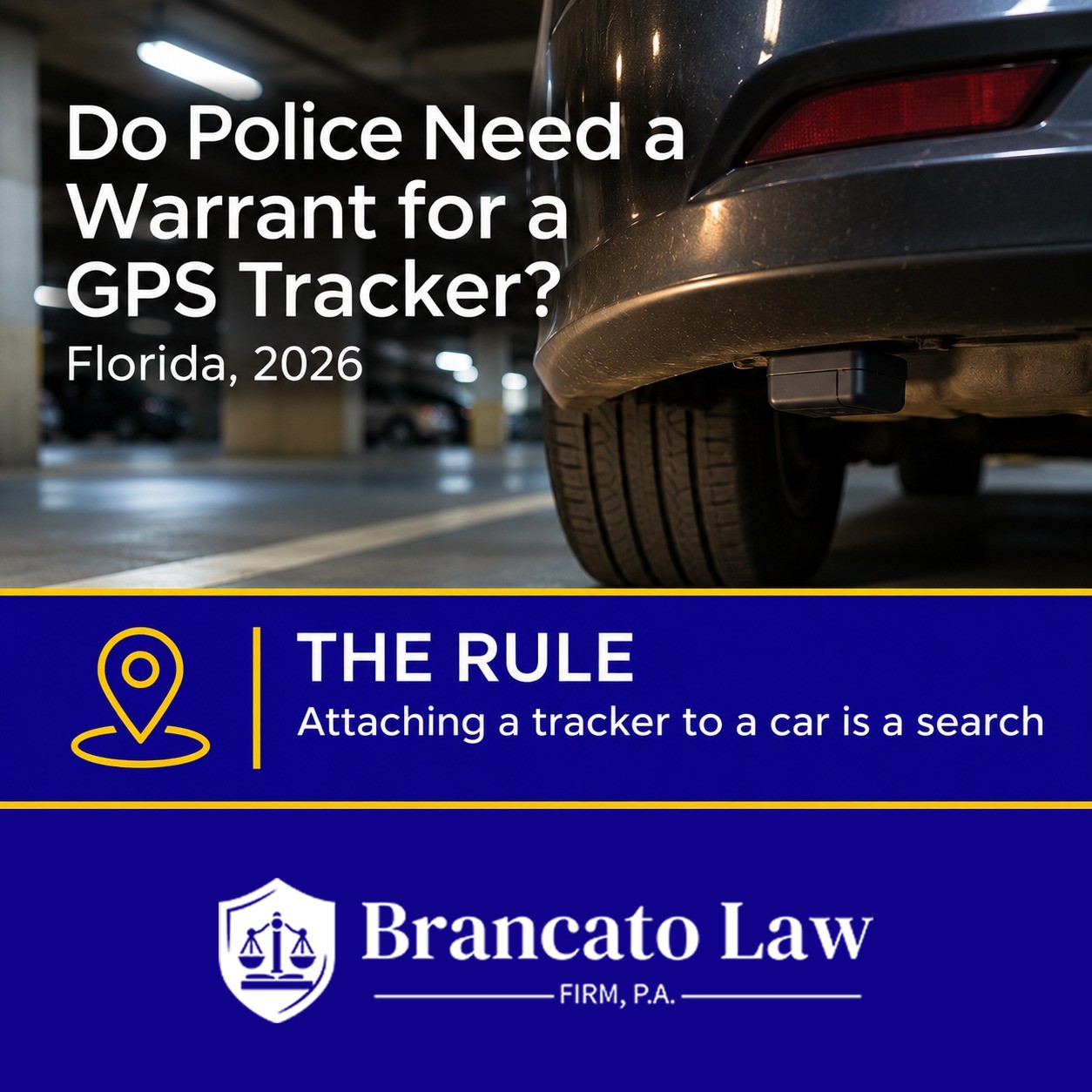
Short answer: In most cases, yes. In United States v. Jones (2012), the U.S. Supreme Court held that attaching a GPS tracker to a car and using it to follow the car is a Fourth Amendment search. Florida’s tracking statute, section 934.42, lets police ask a judge for an order to install a tracker and requires that Supreme Court standards be followed. The main exceptions are consent from the vehicle’s owner, emergencies, cars you have no privacy interest in, and good-faith reliance on law that has since changed. A tracker placed without proper approval can lead to suppression of the evidence it produced.
A Florida judge deciding a GPS suppression motion starts with two questions: did you have a privacy interest in the car, and did a judge approve the tracker before it went on? I have spent more than 25 years in Hillsborough County courtrooms. I am Rocky Brancato, founder of The Brancato Law Firm, P.A., a Tampa criminal defense firm, and a former police academy instructor who taught officers the search and seizure rules they are expected to follow. Our attorneys request the tracking application, the order, and the installation records in every case where a tracker led police to a client.
This guide explains the Supreme Court cases on vehicle tracking, what Florida’s statute actually requires, how phone tracking differs, and what happens when an employer, a finance company, or a family member put the tracker on the car. It is part of our series on police surveillance in Florida, alongside our guides on Flock license plate cameras in Tampa and phone location data after Chatrie.
What Did United States v. Jones Decide About GPS Trackers?
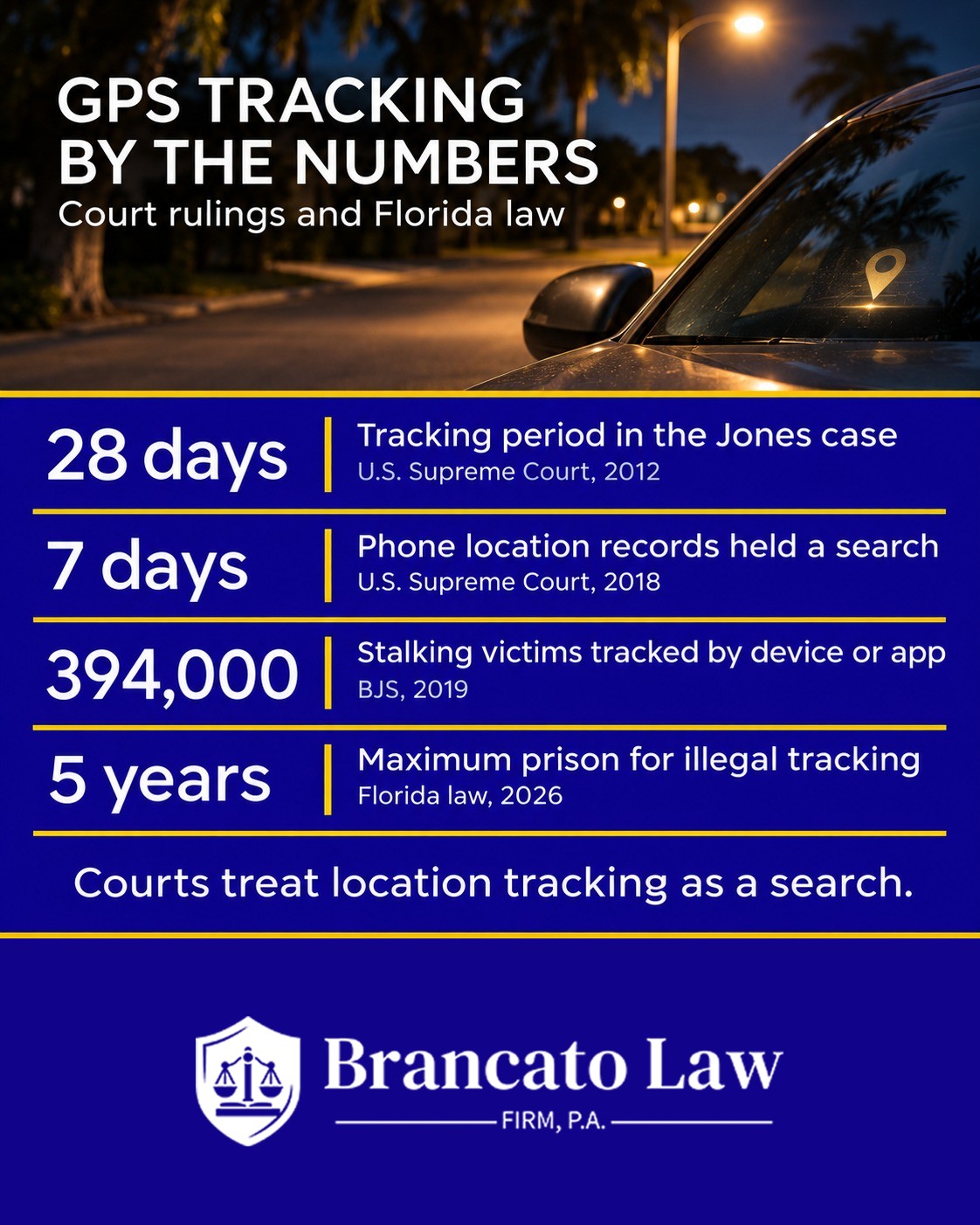
Jones decided that installing a GPS device on a vehicle and using it to monitor the vehicle’s movements is a “search.” In United States v. Jones, 565 U.S. 400 (2012), federal agents investigating a cocaine distribution case got a warrant that allowed installation in the District of Columbia within 10 days. They installed the device on the 11th day, in Maryland, on a Jeep registered to Jones’s wife that he drove exclusively, and tracked it for 28 days. The Court held that the government “physically occupied private property for the purpose of obtaining information.”
Three points from Jones matter in Florida courtrooms today:
- The majority decided the case on trespass: physically attaching a device to a car to gather information is a search, no matter how short the tracking.
- Four justices, in Justice Alito’s concurrence, said “longer term GPS monitoring in investigations of most offenses impinges on expectations of privacy,” and that “the line was surely crossed before the 4-week mark.” They added that when officers are unsure, “the police may always seek a warrant.”
- The Court did not decide whether a warrant is always required. The government had argued that the search was reasonable anyway, and the Court treated that argument as forfeited because it was not raised in the lower court.
The government responded quickly. A 2012 Congressional Research Service report, United States v. Jones: GPS Monitoring, Property, and Privacy by legislative attorney Richard M. Thompson II, noted press reports that the FBI turned off thousands of GPS devices after the ruling, and observed that none of the opinions “expressly required that police get a warrant in future GPS tracking cases.”
| Case | What happened | Why it matters |
|---|---|---|
| United States v. Knotts, 460 U.S. 276 (1983) | Police used a radio beeper to follow a car on public roads. | A person traveling on public roads has no reasonable expectation of privacy in those movements. Prosecutors still rely on it. |
| United States v. Karo, 468 U.S. 705 (1984) | Agents put a beeper in a can of ether with the seller’s consent, then monitored it inside a house. | Installing with the owner’s consent was lawful, but monitoring a device inside a private home without a warrant violated the Fourth Amendment. |
| United States v. Jones, 565 U.S. 400 (2012) | Agents installed a GPS tracker on a Jeep and tracked it for 28 days. | Installing and using a tracker on a car is a search. |
| Byrd v. United States, 584 U.S. 395 (2018) | An unlisted driver of a rental car challenged a search of the car. | Not being listed on the rental agreement does not by itself defeat the driver’s privacy interest. |
| Carpenter v. United States, 585 U.S. 296 (2018) | The government obtained a robbery suspect’s cell phone location records from his carriers. | Accessing seven days of historical cell-site records is a search, and a warrant is generally required. |
What Does Florida Law Require Before Police Install a Tracking Device?
Florida law requires police to apply to a judge for an order. Under section 934.42, Florida Statutes, an officer “may make application to a judge of competent jurisdiction for an order authorizing or approving the installation and use of a mobile tracking device.” The application must include:
- The identity of the applicant and the law enforcement agency conducting the investigation.
- A certification that the information likely to be obtained is relevant to an ongoing criminal investigation.
- The offense the information relates to.
- A statement of whether the device may need to be used outside the court’s jurisdiction.
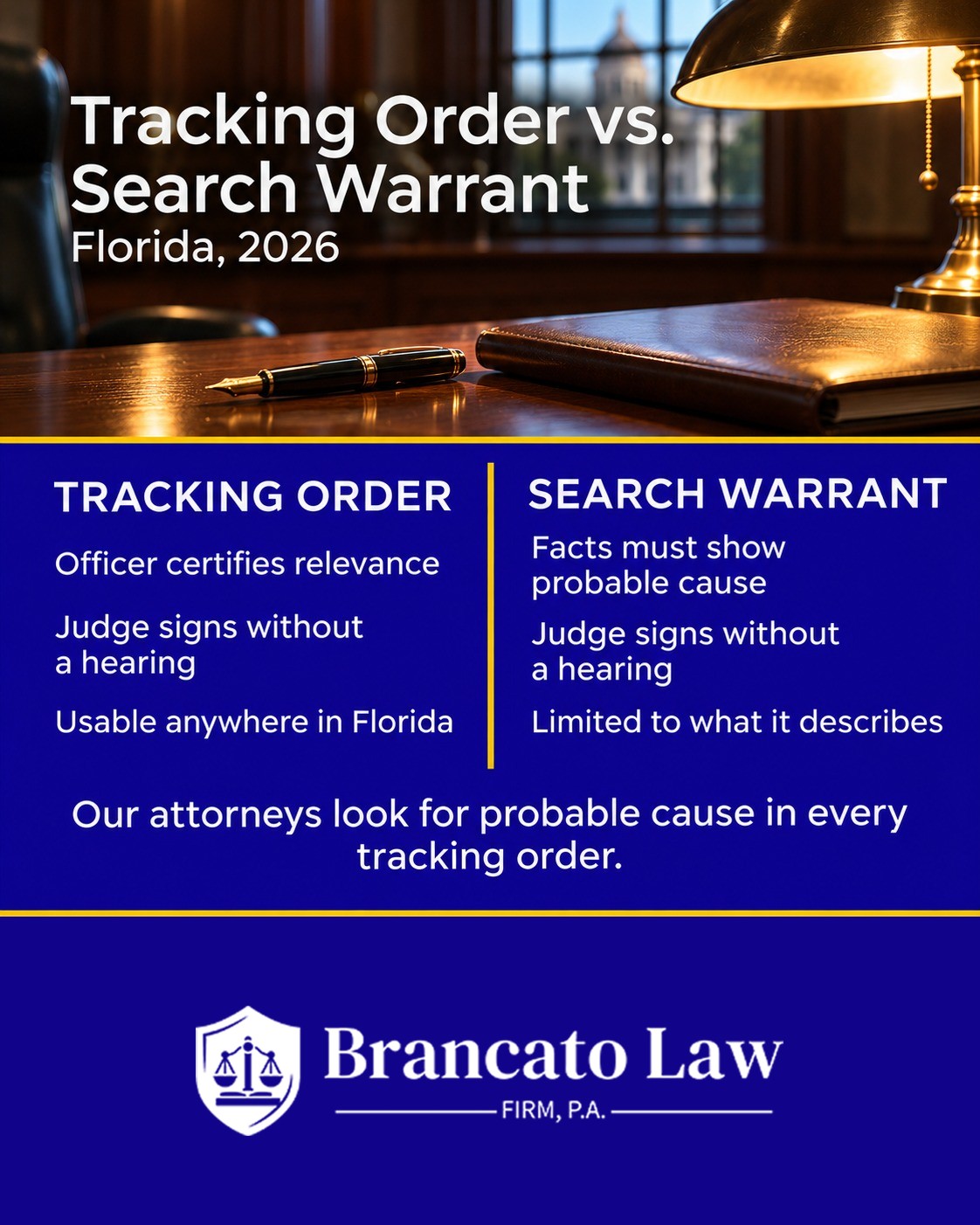
If those statements are made, the judge “shall enter an ex parte order,” and the order may authorize use of the device anywhere in Florida if it was installed within the court’s jurisdiction. The statute also says a court “may not require greater specificity or additional information” than the section requires. Read alone, that sounds like a low bar.
The key sentence is subsection (5): “The standards established by the United States Supreme Court for the installation and monitoring of mobile tracking devices shall apply.” Florida’s statute borrows the constitutional rules rather than replacing them. Because Jones held that installing and using a tracker is a search, a relevance certification alone is a weak foundation for a tracking order, and our attorneys argue that the order must rest on facts showing probable cause.
| Question | Section 934.42 order | Search warrant |
|---|---|---|
| What the officer must show | A certification that the information is likely relevant to an ongoing investigation | Facts establishing probable cause |
| Who decides | A judge, ex parte | A judge, ex parte |
| Where it applies | Installed in the court’s jurisdiction; may be used anywhere in Florida | Limited to what the warrant describes |
| How the defense attacks it | Argue the order lacks probable cause findings that Supreme Court standards require | Challenge the affidavit, the scope, and compliance with the warrant’s terms |
Is a Section 934.42 Order the Same as a Warrant?
It depends on what the judge actually found. In State v. Sylvestre, 254 So. 3d 986 (Fla. 4th DCA 2018), a Palm Beach County robbery case, police obtained an order for real-time cell-site location data and then used a cell-site simulator to pinpoint the defendant’s phone inside a home. The Fourth District upheld the location order only because the judge had made probable cause findings, explaining that without those findings the order “would have violated the Fourth Amendment.” The court added that the content of a court’s order, not its label, decides whether it satisfies the Fourth Amendment, and it upheld suppression of everything that came from the simulator, which no order had authorized.
The same court reached the same result a year later in State v. Martin, 287 So. 3d 645 (Fla. 4th DCA 2019), a Broward County case in which detectives obtained orders under sections 934.23 and 934.42 for location records but never told the judge they planned to use a simulator. The Fourth District affirmed suppression. For a GPS tracker, the lesson is the same: our attorneys read the application line by line, compare it to what police did, and look for probable cause findings in the order itself.
Does It Matter Whether Police Installed the Tracker or Only Monitored It?
Yes. Installation and monitoring raise separate questions, and each can be a separate ground for suppression.
- Installation. Under Jones, physically attaching a device to your car to gather information is a search. If the owner consented before you had the car, the installation itself may be lawful under Karo.
- Monitoring on public roads. Knotts held there is no reasonable expectation of privacy in a single trip on public roads, but the Jones concurrence said four weeks of monitoring crossed the line for most offenses.
- Monitoring inside private places. Karo held that warrantless monitoring of a device inside a home, revealing what police could not see from outside, violates the Fourth Amendment.
Our attorneys ask for the tracker’s full data download, including every location point, the dates of installation and removal, and any battery swaps, because a tracker that followed a client into a garage or kept running after an order expired can produce a separate suppression issue.
What If You Were Driving a Rental Car or Someone Else’s Car?
You may still be able to challenge the tracking. In Byrd, the Supreme Court held that “the mere fact that a driver in lawful possession or control of a rental car is not listed on the rental agreement will not defeat his or her otherwise reasonable expectation of privacy.”
Florida’s Fifth District applied that rule to a GPS case in Strong v. State, No. 5D18-1638 (Fla. 5th DCA Oct. 11, 2019). A Volusia County informant rented a car in her name, let police attach a GPS tracker, and then lent the car to the defendant, whom police tracked to a McDonald’s shortly before a 911 call reported a robbery there. The court said he could not challenge the tracker’s placement, because police attached it with the renter’s permission before he had the car, but that he had a reasonable expectation of privacy in the car while he possessed it and therefore had standing to challenge the tracking of his movements. His conviction was still affirmed, because police had probable cause from the tip, his location, and the 911 call, and he had not briefed the GPS issue on appeal.
What About Trackers Installed by an Employer, a Lender, or a Family Member?
The Fourth Amendment limits the government, not private parties, so a tracker an employer, lender, or relative installed for their own reasons is usually not a government search. The question becomes whether police could use the data that private tracker collected.
In Bailey v. State, 311 So. 3d 303 (Fla. 1st DCA 2020), a Duval County murder case, the defendant was driving his girlfriend’s Honda, which carried a GPS tracker under her agreement with her auto finance company. Police asked the finance company for the car’s location records for the night of the killing and the next day, and got them without a warrant. The majority held there was no search, relying on Knotts, because the records showed only travel on public roads in a car whose owner had agreed to tracking. One judge concurred only in the result, writing that he would not decide drivers lack privacy in their vehicle GPS records and would affirm on good faith instead. With one judge declining to join that reasoning, the question remains open in Florida.
Private tracking can also be its own crime. Under section 934.425, Florida Statutes, knowingly installing a tracking device or tracking application on another person’s property without consent, or using one to track another person, is a third-degree felony, punishable by up to 5 years in prison under section 775.082, and a second-degree felony when done to commit or facilitate a dangerous crime. The statute exempts lawful law enforcement tracking in a criminal investigation, tracking under a court order, certain parents of minor children, a person acting in good faith for a business with a legitimate business purpose, and owners or lessees of the vehicle, among others. Our guide on how to fight a tracking device charge in Florida covers that offense in depth.
Electronic tracking is common in stalking cases. According to the Bureau of Justice Statistics report Stalking Victimization, 2019 (published February 2022), about 394,000 stalking victims in 2019 had their whereabouts tracked with an electronic device or application, about 14% of victims stalked with technology.
Can Police Track Your Phone Instead of Your Car?
Yes, but in Florida real-time phone tracking requires probable cause. In Tracey v. State, 152 So. 3d 504 (Fla. 2014), a Broward Sheriff’s Office investigation, officers with an order for a pen register and trap and trace device used real-time cell-site location data to track the defendant’s phone. The Florida Supreme Court held that using real-time cell-site location information to track a person “was a search within the purview of the Fourth Amendment for which probable cause was required,” and that the evidence should have been suppressed.
For stored location history, Carpenter requires a warrant in most cases. For the newest forms of location searching, see our guide on the Chatrie decision and cell phone location data. Phone records can also help the defense, as our post on cell phone location evidence as an alibi explains.
When Does the Good-Faith Exception Save a GPS Search?
Good faith saves a search only when officers relied on binding appellate law that authorized what they did. Under Davis v. United States, 564 U.S. 229 (2011), a case where Alabama officers searched a car under Eleventh Circuit precedent that a later Supreme Court decision changed, the Court held that “when the police conduct a search in objectively reasonable reliance on binding appellate precedent, the exclusionary rule does not apply.” Florida courts apply it narrowly:
- In Tracey, the Florida Supreme Court refused to apply good faith because there was “no warrant, court order, or binding appellate precedent authorizing real time cell site location tracking.”
- In Martin, the Fourth District accepted good faith for location records obtained under a statute and existing precedent, but rejected it for the cell-site simulator, because “the government cannot rely on the absence of binding decisional law in this area to conduct a warrantless search.”
- In Bailey, the concurring judge would have applied good faith because Carpenter had not yet been decided when police got the GPS records in 2016.
For a tracker installed today, more than a decade after Jones, there is no binding precedent that approves warrantless installation, so our attorneys argue that good faith does not apply.
How Do Our Attorneys Move to Suppress GPS Tracking Evidence?
Our attorneys build a GPS suppression motion in five steps. Vehicle tracking often arises in drug trafficking investigations, as it did in Jones, which is why this work sits alongside our Tampa drug crimes attorney practice:
- Get the paperwork: the application, the order or warrant, any extensions, and the return.
- Compare the order with reality: where and when the device was installed, how long it ran, and where it followed the car.
- Establish standing: show the client owned, rented, or lawfully possessed and controlled the car while it was tracked.
- Attack the showing: argue that a relevance certification without probable cause findings fails the Supreme Court standards that section 934.42 adopts.
- Trace the fruits: identify every stop, search, statement, and lab result that came from the tracking data, and ask the court to suppress all of it.
Florida’s constitution, Article I, section 12, follows the U.S. Supreme Court’s Fourth Amendment decisions, so Jones, Karo, Carpenter, and Byrd govern in every Florida courtroom. In Hillsborough County cases, our attorneys litigate these motions in the Thirteenth Judicial Circuit, where appeals go to the Second District Court of Appeal. Our guide to the motion to suppress in Florida explains the hearing itself, and the Florida criminal case process page shows where suppression fits after arrest.
How Soon Should You Act If You Think You Were Tracked?
Act before charges are filed, if you can. If you found a device on your car, or police seemed to know where you were going, a lawyer can preserve the device and the records before they disappear. Our representation before charges are filed focuses on that window. Do not remove and throw away a device you find; photograph it where it sits and call a lawyer, because the device and its location can be evidence for you.
Frequently Asked Questions About Police GPS Trackers in Florida
Can police put a GPS tracker on my car while it is parked in my driveway?
Not without legal authority. Jones holds that attaching a tracker is a search, and entering the area around your home adds a second privacy problem; see our guide on when police can enter your property without a warrant. The Brancato Law Firm asks for proof of where and how every device was installed.
How long can police track my car with a GPS device in Florida?
Section 934.42 does not set a time limit, so the limit comes from the order itself and the Fourth Amendment. Four justices in Jones said four weeks of tracking was too long without proper authority, and our attorneys at The Brancato Law Firm compare the tracking dates against the order line by line.
Do police have to tell me they tracked my car?
Usually not while the investigation is active, so you may first learn of a tracker after an arrest. Once you are charged, The Brancato Law Firm demands the application, order, and full data download in discovery so a drug trafficking or other case built on tracking can be tested.
Can my employer’s fleet tracker be used against me?
Often, yes. A business tracking its own vehicles for a legitimate purpose is generally lawful under section 934.425, and courts, like the Bailey majority with a finance company’s records, have allowed police to obtain such records without a warrant. Our attorneys at The Brancato Law Firm still challenge how the records were requested, how complete they are, and whether they actually show who was driving.
Is it illegal for my spouse to put a GPS tracker on my car?
It can be. Section 934.425 makes it a felony to install a tracker on another person’s property without consent, subject to exceptions such as a vehicle owner tracking their own car. The Brancato Law Firm defends people accused under this statute, as explained in our tracking device charge guide.
What happens to my case if the GPS evidence is suppressed?
If the tracker led police to the drugs, the stop, or the arrest, suppression can remove the heart of the State’s case and sometimes ends it. Our attorneys at The Brancato Law Firm map every piece of evidence back to the tracking data before the suppression hearing so nothing derived from it slips through.
Talk to a Tampa Defense Lawyer About GPS Tracking
The tracking records that decide a suppression motion are easiest to get early, so make the call before your next court date. The Brancato Law Firm, P.A., founded by Tampa Criminal Defense Attorney Rocky Brancato, is available 24/7 at (813) 727-7159, and our attorneys will begin by demanding the tracking application, the order, and the device data. Our firm has Spanish-speaking staff, and attorney Jean-Luc Adrien speaks Spanish, Haitian Creole, and French. For more about our defense strategies, visit our Drug Crimes page.
The Brancato Law Firm, P.A.
620 E. Twiggs Street, Suite 205, Tampa, FL 33602
(813) 727-7159
Serving Hillsborough, Pinellas, and Pasco Counties
The Brancato Law Firm, P.A. is a Tampa-based criminal defense practice. We are not affiliated with any other Brancato-named law firms.
Visit Us

Tampa, FL 33602

Contact Us Now
Free Legal Consultation (813) 727-7159
