

From First DUI to Death Penalty



Are Police Cell Tower Dumps Legal in Florida? (2026)


Short version: It depends on the court, because no Florida appellate court has decided the question. A tower dump is a list of every phone that connected to a cell tower during a set window. In December 2025, a federal judge in Tampa upheld a warrantless tower dump in a robbery case, while a federal judge in Mississippi held in August 2026 that tower dumps are unconstitutional general warrants. In a Florida state case, the defense can still challenge how the dump was obtained, how broad it was, and what it actually proves.
If detectives tell you your phone “hit a tower” near a crime scene, they may have pulled a tower dump: a list of every phone that used that tower during a chosen window, often thousands of people at once. As founder of The Brancato Law Firm, P.A., a Tampa criminal defense firm, and a former Chief Operations Officer of the Hillsborough County Public Defender’s Office, where I oversaw a staff of over 100 attorneys, I know how much weight jurors give a phone record. Our attorneys check how every tower dump was obtained and test what it can and cannot show about where a person was.
What Is a Cell Tower Dump?
A tower dump is a phone company’s list of all devices that connected to a specific cell tower or site during a specific period. The U.S. Supreme Court defined it the same way in Carpenter v. United States, 585 U.S. 296 (2018): “a download of information on all the devices that connected to a particular cell site during a particular interval.” Police usually ask for windows of minutes to an hour around the time of a crime, then compare the list across several scenes to find numbers that show up more than once.
The list identifies phones, not people, and it does not include the content of calls or texts. It places a phone in the general area a tower serves, which can be large: in the 2025 Mississippi case discussed below, the government told the court a tower’s range can be between 1 and 1.5 miles. So a phone on a tower dump list may have been blocks or a mile from the scene.
| Tool | Question it answers | Whose data it collects |
|---|---|---|
| Tower dump | Which phones used this tower during this window? | Every phone that connected, suspects and bystanders alike |
| Historical cell-site records | Where has this one phone been over days or weeks? | One named phone number |
| Real-time “ping” | Where is this phone right now? | One named phone number |
| Geofence request to a tech company | Which accounts were inside this drawn area? | Every account with location data inside the area |
| Cell-site simulator (Stingray) | Exactly where is this phone inside this area? | The target phone plus phones nearby |
How Often Do Police Request Tower Dumps?
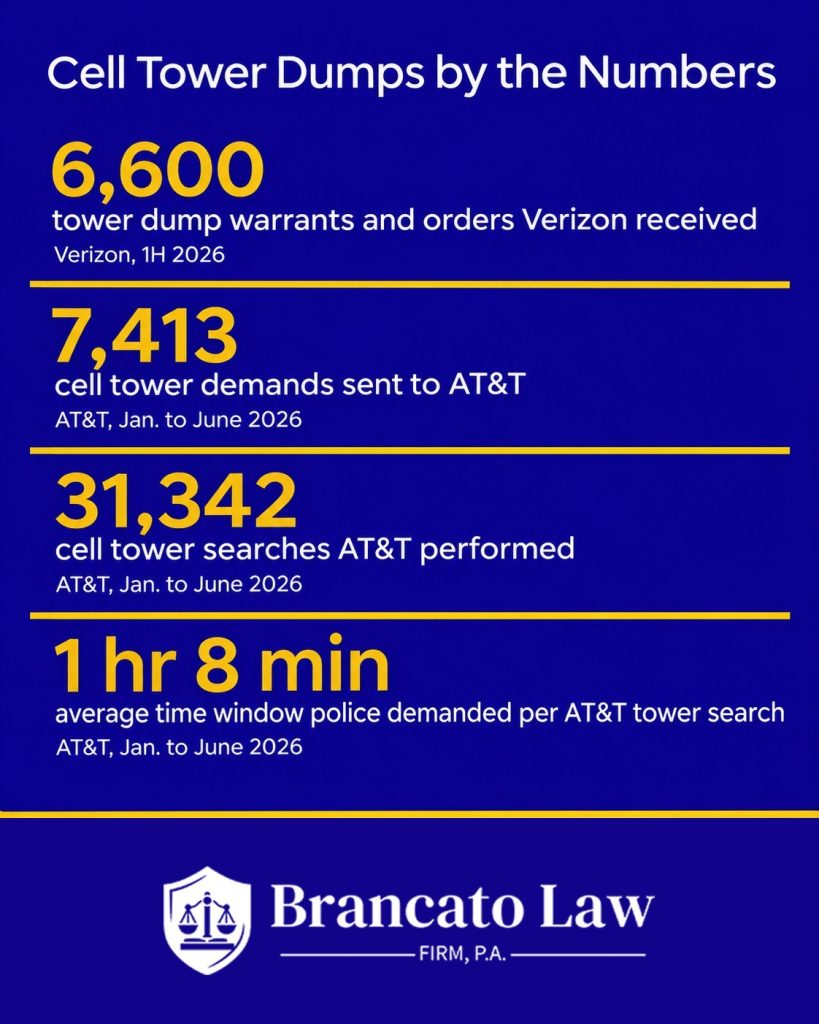
Thousands of times every six months, according to the carriers’ own reports. Verizon’s U.S. transparency report for the first half of 2026 lists 6,600 warrants or court orders for cell tower dumps in that period. AT&T’s transparency report lists 7,413 cell tower demands from January through June 2026, which required 31,342 separate tower searches, and says the average window police demanded was 1 hour and 8 minutes. AT&T also states it does not track how many phone numbers it hands over in response.
One case shows the scale. Emma Lux, writing in the American Criminal Law Review (Vol. 57, 2020), describes an FBI bank robbery investigation in which four tower dumps returned location data for 150,000 phone numbers, only two of which appeared near all four robberies. Lux argues that tower dumps should count as Fourth Amendment searches and that courts should limit how much innocent people’s data the government keeps.
Do Police Need a Warrant for a Tower Dump in Florida?
No court has settled that for Florida state cases. In Carpenter v. United States, 585 U.S. 296 (2018), the Supreme Court held that police generally need a warrant for seven days or more of one person’s historical cell-site records, but it said its decision did not address “real-time CSLI or ‘tower dumps.'” The Florida Supreme Court held in Tracey v. State, 152 So. 3d 504 (Fla. 2014) that tracking one phone in real time requires probable cause, and that case involved a single target, not a sweep of every phone at a location. Our research has not found a published Florida appellate opinion deciding whether a tower dump needs a warrant.
Florida’s statute sets a lower bar than a warrant. Under section 934.23, Florida Statutes, an officer can get a court order for a customer’s non-content records by offering “specific and articulable facts” showing reasonable grounds to believe the records are “relevant and material to an ongoing criminal investigation.” The same statute says an officer who gets records that way “is not required to provide notice” to the customer. In plain terms, people on a tower dump list are not told their numbers were collected.
| Paperwork | What the officer must show | Is the phone owner notified? |
|---|---|---|
| Court order under s. 934.23 | Specific and articulable facts showing the records are relevant and material to an ongoing investigation | No |
| Search warrant | Probable cause, with the place and things to be searched described with particularity | Not at the time of the search |
| Emergency or “exigent” request to the carrier | A claimed emergency, such as an ongoing threat or fleeing suspect; reviewed by a court only later | No |
What Did the Federal Court in Tampa Decide About Tower Dumps?
The federal court in Tampa upheld a warrantless tower dump. In United States v. Floyd, No. 8:23-cr-00305 (M.D. Fla. Dec. 5, 2025), police investigating an August 2023 armed robbery sent an “exigent data request” to the tower owner for a list of phones that connected near the store, without a warrant. After more robberies and a fingerprint and DNA match, officers learned of devices tied to the suspect and found one of them on the original tower dump list.
U.S. District Judge Tom Barber denied the motion to suppress. He found no reasonable expectation of privacy because the data showed only “a particular phone present near a particular place for a particular period of time,” unlike the long-term tracking in Carpenter. He added that exigent circumstances justified the requests, and that the good-faith exception would apply anyway. That ruling does not bind Florida state judges, but prosecutors in Hillsborough, Pinellas, and Pasco cases can be expected to cite it, which is why our challenges focus on the details of each request.
Why Did a Federal Court in Mississippi Reject Tower Dumps?
Because a tower dump searches everyone near a crime scene without probable cause as to any of them. In In re Four Applications for Search Warrants Seeking Information Associated with Particular Cellular Towers, No. 3:25-cr-00038 (S.D. Miss. Feb. 21, 2025), the FBI asked for dumps from four carriers covering nine locations in a gang investigation, with windows of ten minutes to an hour. Magistrate Judge Andrew S. Harris refused to sign the warrants, noting the areas included homes, a mall, medical clinics, schools, churches, and an airport. He wrote that the government was “asking the Court to allow it access to an entire haystack because it may contain a needle.”
In August 2026, U.S. District Judge Carlton W. Reeves denied the government’s request to reverse that ruling and went further: “this Court holds that tower dumps are per se unconstitutional general warrants,” in In re Four Applications for Search Warrants Seeking Information Associated with Particular Cellular Towers, No. 3:25-cr-00038 (S.D. Miss. Aug. 5, 2026). Both judges relied on United States v. Smith, 110 F.4th 817 (5th Cir. 2024), where the Fifth Circuit held that geofence warrants are unconstitutional general warrants, though it still denied suppression under the good-faith exception. Federal courts in Florida sit in the Eleventh Circuit, not the Fifth, and Florida state courts are bound by neither, so these rulings persuade but do not bind judges here.
| Court and year | Result |
|---|---|
| U.S. Supreme Court, Carpenter (2018) | Expressly left tower dumps undecided |
| Federal court in Tampa, Floyd (2025) | Warrantless tower dump upheld; no expectation of privacy, exigency, and good faith |
| Federal magistrate in Mississippi (Feb. 2025) | Tower dump is a search; warrants refused as general warrants |
| Federal district judge in Mississippi (Aug. 2026) | Tower dumps held per se unconstitutional general warrants |
| Florida appellate courts | No published decision found |
How Can a Defense Attorney Challenge Tower Dump Evidence?
By attacking the request, the scope, and the inference, usually in that order. Our attorneys start with the paperwork, because in many cases the dump came from a claimed emergency rather than a judge. Our Tampa violent crime lawyer team sees these records most often in robbery, shooting, and burglary series, where police link scenes by finding the same number on several lists.
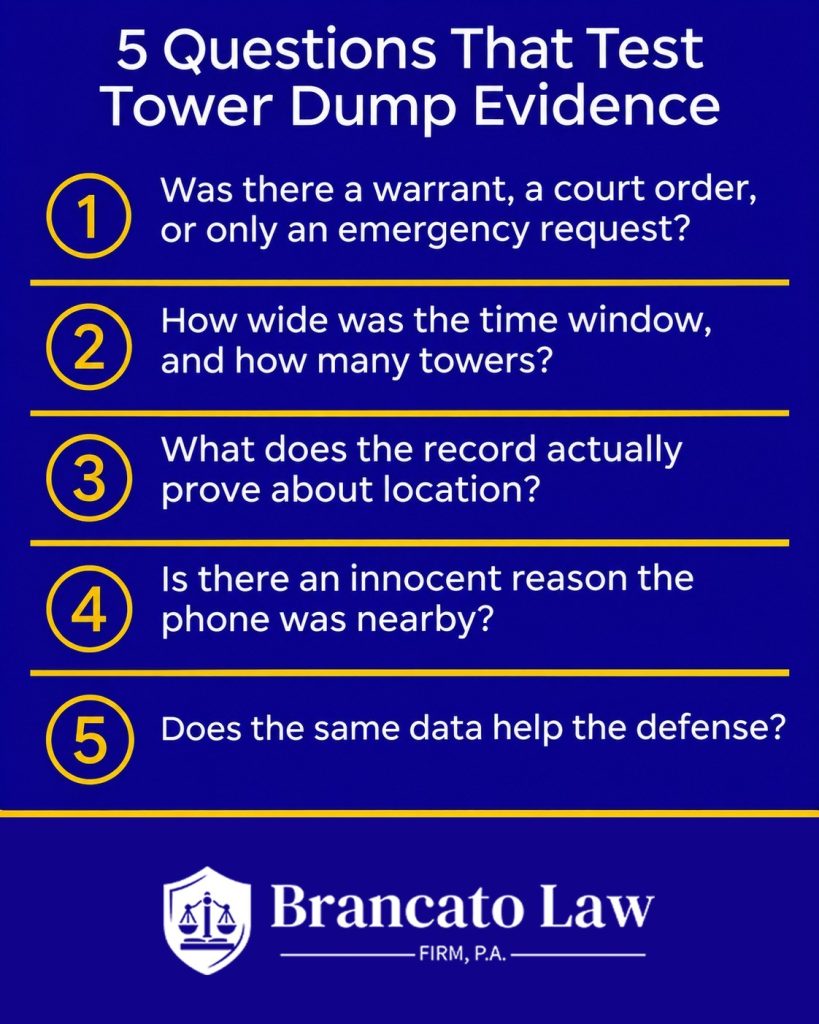
- Was there a warrant, an order, or only an emergency request? An “exigent” request has to rest on a real emergency. A dump requested days later, or after a suspect was already identified, invites a challenge.
- How wide was the window, and how many towers? A longer window and more towers mean more bystanders and a weaker claim that the request was tailored to the crime.
- What does the record actually prove? A tower contact puts a phone somewhere in the tower’s coverage area, not at a front door. Our attorneys work with cell-site experts through our forensic science practice to map the real coverage area.
- Is there an innocent reason the phone was there? People who live, work, or commute near a scene show up on dumps every day.
- Does the data help the defense? The same records can place a phone far from the scene, which can support a cell phone location alibi.
Say two convenience stores in Carrollwood are robbed on the same night. Detectives get tower dumps for both stores and find one number on both lists. The phone belongs to a man who lives between the two stores and drove home from work at that hour.
On paper, that looks like a match. In court, the defense shows that both stores sit inside the coverage of towers serving his own street, that his route home passes both, and that many other neighborhood phones also appear on both lists. The tower data proves he was in the area. It does not prove he was in either store.
What Should You Do If Detectives Say Your Phone Was Near a Crime?
Decline to explain your whereabouts until you have a lawyer, because anything you say about where you were will be compared with records you have not seen. A detective’s call about your phone usually means you are a suspect or a witness the police have not ruled out, and our pre-file advocacy work is built for that stage., and if the investigation turns into an arrest, the Florida criminal case process moves to first appearance and formal charges.
If a detective calls, say this: “I want to help, but I am not going to answer questions without my attorney. Please give me your name and number, and my attorney will contact you.”
Not this: “I was home all night,” “My phone is always with me,” or “Maybe I drove by there.” Each of these can be tested against the tower records and used against you if the records seem to differ.
Keep your phone, do not delete accounts or data, and write down where you were and who you were with while you still remember. If police also asked a tech company for your data, our post on what to do after a Google account legal request explains the next steps.
Frequently Asked Questions
Can a tower dump prove I was at the crime scene?
No. It shows a phone connected to a tower serving a broad area, which can stretch a mile or more, not that the phone or its owner was at a specific address. The Brancato Law Firm works with cell-site experts to show a jury how large that coverage area really is, which ties into our forensic evidence defense work.
Will I be told if my phone number was in a tower dump?
No, usually not. Under section 934.23, Florida Statutes, an officer who obtains records by court order does not have to notify the customer, so our attorneys at The Brancato Law Firm often learn of a dump only through discovery after an arrest. If you think you are under investigation, early representation can matter more than anything filed later.
Can police get a tower dump without a warrant in Florida?
Sometimes, through a court order under section 934.23 or an emergency request to the carrier, and Florida’s appellate courts have not ruled on whether that is enough. When a dump came in without a warrant, The Brancato Law Firm’s attorneys file a motion to suppress that relies on Carpenter, the Mississippi rulings, and the specific facts of the request.
Can robbery charges be dropped if the tower dump evidence is thrown out?
Yes, sometimes, when the tower dump was the main link between the defendant and the crime. At The Brancato Law Firm, we press that issue early in the robbery and violent crime defense we provide in Hillsborough, Pinellas, and Pasco, because prosecutors without that link may reduce or drop charges.
Is a tower dump the same as a geofence warrant?
No, though courts compare them. Our attorneys at The Brancato Law Firm explain in our police surveillance guide that a tower dump comes from the phone carrier and covers a tower’s whole service area, while a geofence request goes to a tech company for accounts inside an area drawn on a map.
Sources
- Carpenter v. United States, 585 U.S. 296 (2018)
- Tracey v. State, 152 So. 3d 504 (Fla. 2014)
- United States v. Floyd, No. 8:23-cr-00305 (M.D. Fla. Dec. 5, 2025)
- In re Four Applications for Search Warrants Seeking Information Associated with Particular Cellular Towers, No. 3:25-cr-00038 (S.D. Miss. Feb. 21, 2025)
- In re Four Applications for Search Warrants Seeking Information Associated with Particular Cellular Towers, No. 3:25-cr-00038 (S.D. Miss. Aug. 5, 2026)
- United States v. Smith, 110 F.4th 817 (5th Cir. 2024)
- section 934.23, Florida Statutes
- Verizon, U.S. Transparency Report, first half of 2026
- AT&T, Transparency Report, January to June 2026
- Emma Lux, Privacy in the Dumps: Analyzing Cell Tower Dumps Under the Fourth Amendment, 57 Am. Crim. L. Rev. Online (2020)
Tower dump evidence is easiest to challenge before the defense’s motion deadlines pass and before experts lose access to the carrier’s coverage data. The Brancato Law Firm, P.A., founded by Tampa Criminal Defense Attorney Rocky Brancato, takes calls at any hour at (813) 727-7159, from an office two blocks from the courthouse. Our firm has Spanish-speaking staff, and attorney Jean-Luc Adrien speaks Spanish, Haitian Creole, and French. For more about our defense strategies, visit our Violent Crimes Defense page.
The Brancato Law Firm, P.A.
620 E. Twiggs Street, Suite 205, Tampa, FL 33602
(813) 727-7159
Serving Hillsborough, Pinellas, and Pasco Counties
The Brancato Law Firm, P.A. is a Tampa-based criminal defense practice. We are not affiliated with any other Brancato-named law firms.
Visit Us

Tampa, FL 33602

Contact Us Now
Free Legal Consultation (813) 727-7159
