

From First DUI to Death Penalty



Can Police Get Your Google Search History in Florida? (2026)


What to know: Yes. Police can get Google search records with a warrant, and some agencies now use “reverse keyword” warrants that ask Google to list every user who searched a particular address or phrase during a set window, before police know who the suspect is. No Florida appellate court has ruled on these warrants. Courts in Colorado, Pennsylvania, and Virginia have let the evidence in, but each left room for challenges to how the warrant was drawn.
Cases built on a suspect’s Google searches often start with one question detectives could not answer any other way: who looked up the victim’s address? I’m Rocky Brancato, founder of The Brancato Law Firm, P.A., a Tampa criminal defense firm. I handled homicide and sex crime cases as a former Major Crimes Unit attorney and have tried more than 150 jury trials to verdict, and our attorneys treat search-history evidence as something to test from the warrant forward.
What Is a Reverse Keyword Warrant?
A reverse keyword warrant orders a search company, usually Google, to identify every user who searched for certain words during a set period. A normal warrant starts with a suspect and asks for that person’s records. A keyword warrant runs the other way: it starts with words tied to a crime, such as a victim’s address, and asks the company who searched them.
The process usually has steps. Google first returns anonymized results, often account identifiers or IP addresses. Police then seek the names behind the ones that look promising, and finally the full account records. In Florida, once police have an IP address, section 934.23, Florida Statutes lets them get a customer’s name, address, and “any temporarily assigned network address” from the provider with a subpoena.
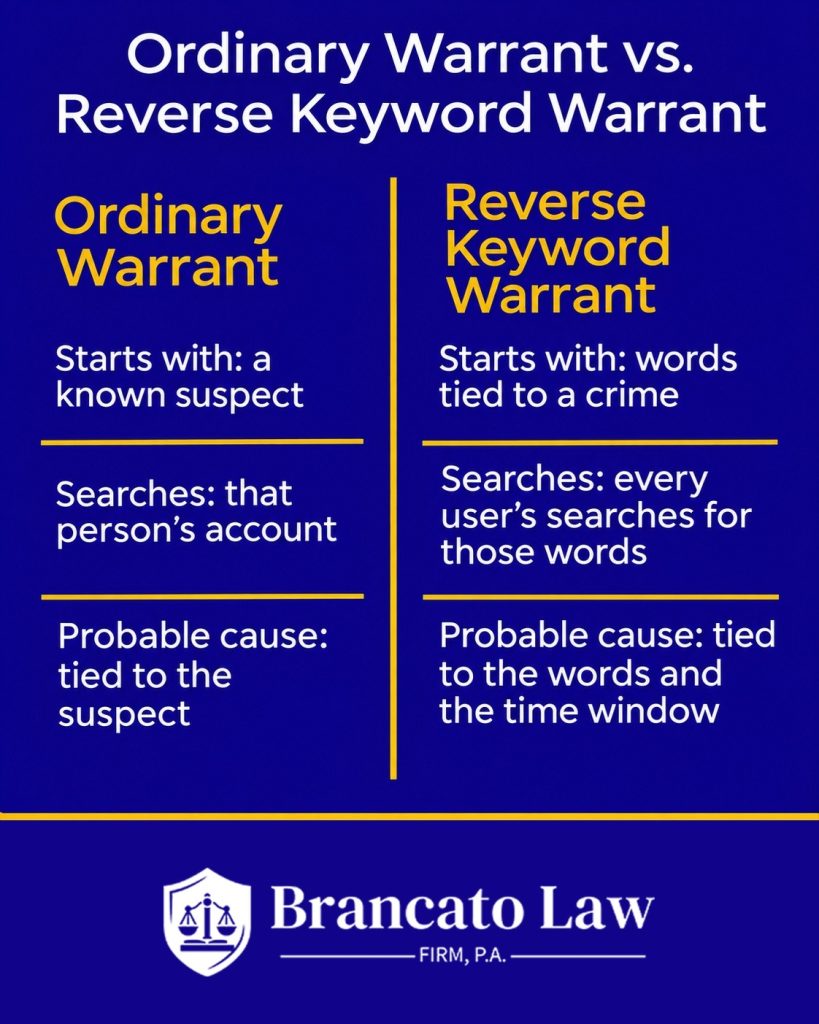
| Search | Starting point | Who gets swept in |
|---|---|---|
| Ordinary account warrant | A known suspect’s account | The suspect |
| Reverse keyword warrant | Words tied to a crime, such as an address | Every user who searched those words in the window |
| Geofence request | An area drawn on a map (held unconstitutional by the Fifth Circuit in United States v. Smith, 110 F.4th 817 (5th Cir. 2024)) | Every account with location data inside the area |
| Cell tower dump | A cell tower near a crime scene | Every phone that connected to the tower |
Can Police Get Your Google Search History in Florida?
Yes, with a warrant, and Florida courts have not yet limited reverse keyword warrants specifically. Our research has not found a published Florida appellate decision on them. That matters because Florida’s search-and-seizure clause, Article I, section 12 of the Florida Constitution, “shall be construed in conformity with the 4th Amendment to the United States Constitution, as interpreted by the United States Supreme Court.” A Florida court cannot give search history more protection than the U.S. Supreme Court does, which closes the route the Colorado court used, discussed below.
The U.S. Supreme Court has not decided a keyword warrant case. Its location-data rulings, summarized in our police surveillance guide and our post on whether police can track your phone without a warrant, are the closest guide Florida judges have, and defense lawyers here argue those rulings apply to search records too. Prosecutors argue the opposite: that people hand their searches to Google voluntarily.
What Happened in the Denver Arson Case?
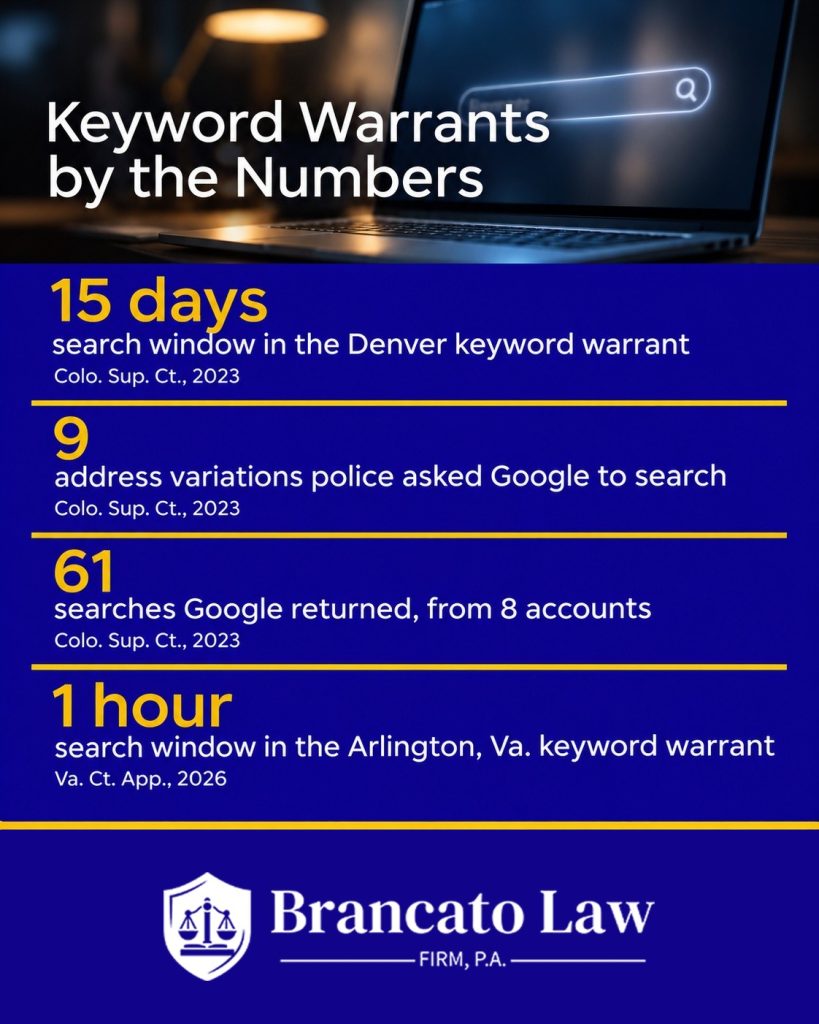
The leading case is People v. Seymour, 2023 CO 53, 536 P.3d 1260 (Colo. 2023). In August 2020, a fire at a Denver home killed five people. After two months and at least 23 search warrants, investigators had no suspect, so they theorized that whoever set the fire had looked up the address first. They obtained a warrant asking Google which users had searched nine variations of the address in the 15 days before the fire. Google returned 61 searches from eight accounts, five tied to Colorado IP addresses, and follow-up warrants led investigators to Seymour.
The Colorado Supreme Court held that Seymour had a reasonable expectation of privacy in his search history under the Colorado Constitution and found the warrant particular enough, pointing to the single address, the 15-day window, and the anonymized first step. It assumed without deciding that the warrant lacked probable cause, yet it refused to suppress the evidence under the good-faith exception (the rule that saves evidence when officers reasonably relied on a warrant). The court also noted a weakness in the theory: “people search addresses for much more innocuous reasons all the time.”
What Did Courts in Pennsylvania and Virginia Decide?
Both let the evidence in, for different reasons. In Commonwealth v. Kurtz, 348 A.3d 133 (Pa. 2025), Pennsylvania police investigating a kidnapping and rape got a keyword warrant for searches of the victim’s name or address during the prior week. Google reported two searches for the address a few hours before the attack from an IP address tied to John Kurtz’s home. A three-justice lead opinion held that an average user doing “general, unprotected internet searches” has no reasonable expectation of privacy in them, while noting the result “may, in fact, differ” for someone using a virtual private network or a browser that does not collect data.
In Clements v. Commonwealth, No. 2032-24-4 (Va. Ct. App. Aug. 11, 2026), published in August 2026, police in Arlington, Virginia asked Google who searched a woman’s address during a one-hour window on the night she was pushed from a moving SUV. Google returned one account. The majority affirmed the convictions under the good-faith exception and wrote that it expressed “no view today on the constitutional validity of reverse-keyword search warrants.” A concurring judge would have held this warrant unconstitutional for lacking particularized probable cause, though he agreed suppression was not required.
| Court and year | Search window | Result |
|---|---|---|
| Colorado Supreme Court, Seymour (2023) | 15 days | Privacy interest recognized; warrant particular enough; evidence admitted under good faith |
| Pennsylvania Supreme Court, Kurtz (2025) | One week | Lead opinion: no expectation of privacy in ordinary searches; conviction affirmed |
| Virginia Court of Appeals, Clements (2026) | One hour | Evidence admitted under good faith; constitutionality left open |
| Florida appellate courts | No published decision found |
How Can a Defense Attorney Challenge Keyword Warrant Evidence?
By attacking the premise, the breadth, and the identification, then answering the good-faith argument. Our Tampa homicide attorney team sees digital-search evidence most often in homicide, arson, and serious violent cases, where police have no suspect and turn to data.
- The affidavit has to show a fair probability that the offender searched these words on this service. Seymour’s own court called that theory “at least debatable,” and the Virginia concurrence would have found no showing tied to Google at all.
- Longer windows, common words, and many variations sweep in more innocent users. The Denver warrant passed partly because it named one address and 15 days.
- An IP address points to a router, not a person. Roommates, family members, and guests share connections.
- Delivery drivers, neighbors, buyers, and curious people look up addresses every day.
- Courts so far have excused officers because the technique was new. The defense argues that excuse weakens as courts and commentators flag the problems.
Scholars are split on how far these warrants should go. Mary D. Fan, in Big Data Searches and the Future of Criminal Procedure, 102 Tex. L. Rev. (2024), argues that tightly drawn keyword warrants can satisfy probable cause and that courts should weigh their effect on uninvolved users. Even on that view, the width of the window and the search terms decide whether a particular warrant holds up, which is where our attorneys focus.
What Usually Happens When a Case Relies on Search History?
So far, the evidence usually comes in. In all three appellate cases above, the courts refused to suppress, mostly under the good-faith exception. That does not make the evidence unbeatable at trial. A search for an address shows that someone using a device looked up a place; it does not show who typed it, why, or what that person did next. Our attorneys build the defense around those gaps, and the same analysis runs through our sex crimes defense work.
What Should You Do If Police Want Your Search History?
Do not delete it. Under section 918.13, Florida Statutes, destroying or altering a record while knowing an investigation is pending or about to begin is a third-degree felony, or a second-degree felony if the investigation relates to a capital felony. Call a lawyer instead, and do not explain your searches to a detective. If you think an investigation is coming, our representation before charges are filed gives you a voice before the State decides what to charge.
If you received a notice about a legal request for your Google account, our guide to what to do after a Google account legal request in Florida walks through your options. Chatbot conversations are now treated much like search history, a point covered in our post on using ChatGPT or AI in a Florida criminal case. The Florida criminal case process explains what follows if the investigation leads to an arrest.
Frequently Asked Questions
Can deleting my Google searches get me charged with a crime?
Yes, if you delete them knowing an investigation is pending or about to begin and you mean to keep them from investigators. The Brancato Law Firm advises anyone who expects police interest to preserve everything and call a lawyer, because section 918.13, Florida Statutes makes that deletion a separate felony.
Does incognito mode or a VPN keep police from getting my searches?
No, not reliably. The Pennsylvania lead opinion in Kurtz said the result “may, in fact, differ” for someone using a VPN or a non-tracking browser, and our attorneys at The Brancato Law Firm raise those facts when they exist, but no Florida court has addressed the point.
Can police use my searches against me at trial in Florida?
Yes, if the records were lawfully obtained and are relevant to the charge. When a case turns on search history, The Brancato Law Firm’s homicide and violent crime defense work includes testing who actually made each search and what else it could mean.
Can charges be dropped if a keyword warrant was illegal?
Sometimes, if the search records were the State’s main link to the defendant and a court suppresses them. At The Brancato Law Firm, we look for the weakest step in the chain, from the warrant’s premise to the identification of the user, because a break anywhere can leave the State without proof of identity.
Is a keyword warrant the same as a geofence warrant?
No. Our attorneys at The Brancato Law Firm explain in our police surveillance guide that a keyword warrant asks who searched certain words, while a geofence warrant asks whose devices were inside a drawn area; the Fifth Circuit has held geofence warrants unconstitutional.
Sources
- People v. Seymour, 2023 CO 53, 536 P.3d 1260 (Colo. 2023)
- Commonwealth v. Kurtz, 348 A.3d 133 (Pa. 2025)
- Clements v. Commonwealth, No. 2032-24-4 (Va. Ct. App. Aug. 11, 2026)
- United States v. Smith, 110 F.4th 817 (5th Cir. 2024)
- Article I, section 12 of the Florida Constitution
- section 934.23, Florida Statutes
- section 918.13, Florida Statutes
- Mary D. Fan, Big Data Searches and the Future of Criminal Procedure, 102 Tex. L. Rev. (2024)
Search records can be preserved, subpoenaed, and analyzed by the defense too, but only if someone starts early. Call The Brancato Law Firm, P.A., founded by Tampa Criminal Defense Attorney Rocky Brancato, at (813) 727-7159; we take calls at any hour, and our office is two blocks from the courthouse. Our firm has Spanish-speaking staff, and attorney Jean-Luc Adrien speaks Spanish, Haitian Creole, and French. For more about our defense strategies, visit our Homicide Defense page.
The Brancato Law Firm, P.A.
620 E. Twiggs Street, Suite 205, Tampa, FL 33602
(813) 727-7159
Serving Hillsborough, Pinellas, and Pasco Counties
The Brancato Law Firm, P.A. is a Tampa-based criminal defense practice. We are not affiliated with any other Brancato-named law firms.
Visit Us

Tampa, FL 33602

Contact Us Now
Free Legal Consultation (813) 727-7159
