

From First DUI to Death Penalty



Can Florida Police Use a Stingray Without a Warrant? (2026)


Bottom line: No, not unless a real exception such as an emergency applies. Florida’s Fourth District Court of Appeal held in 2018 that police must establish probable cause and get court authorization before using a cell-site simulator, the device sold under names like StingRay and Hailstorm. An order telling the phone company to hand over location data does not cover a simulator, so evidence police find with one can be challenged in a motion to suppress.
Florida judges throw out Stingray evidence when the defense proves two things: police used the device, and no probable cause warrant covered that use. The first part is usually the harder one, because tracking paperwork rarely uses the word “simulator.” I’m Rocky Brancato, founder of The Brancato Law Firm, P.A., a Tampa criminal defense firm. I taught criminal procedure as a police academy instructor and have spent more than 25 years in Hillsborough County courtrooms, and our attorneys read every tracking order, affidavit, and arrest report in a phone-location case for signs that a simulator did the real work.
What Is a Stingray Device?
A Stingray is a cell-site simulator: a portable device that pretends to be a cell tower so that nearby phones connect to it and give up their identifying numbers and signal data. Officers then follow the signal strength and direction to a specific building, and sometimes a specific unit. The Fourth District described the device this way in State v. Sylvestre, 254 So. 3d 986 (Fla. 4th DCA 2018): a simulator “locates cell phones by mimicking the service provider’s cell tower” and forces phones to send “pings” to it. StingRay, Hailstorm, and TriggerFish are product names for the same type of device.
Two features make simulators different from ordinary phone records. First, police run the device themselves, so no phone company stands between the officer and your location. Second, a simulator also captures signals from other phones in range, including the phones of people who are not under investigation, as the court noted in Sylvestre. The U.S. Department of Justice’s 2015 cell-site simulator policy says the devices, as federal agents configure them, collect location and identifying data, not emails, texts, contact lists, or images.
| Tool | What it is | Who runs it | What the record shows |
|---|---|---|---|
| StingRay | Handheld or vehicle-mounted cell-site simulator | Police or federal agents | Named in Sylvestre as a common name for a simulator |
| Hailstorm | Another cell-site simulator model | Police or federal agents | The device Baltimore police used to find a shooting suspect inside a house in the Andrews litigation |
| Airborne “dirtbox” | A simulator mounted on an aircraft | Federal agencies | Reported by the Wall Street Journal in 2014 to fly from five metropolitan airports since 2007; DOJ policy requires senior approval for any aircraft use |
| Carrier cell-site location data | Records the phone company keeps when your phone connects to its towers | The phone company, under a court order | Often narrows a phone to an area of several blocks, as in Sylvestre |
Do Florida Police Need a Warrant to Use a Stingray?
Yes. In State v. Sylvestre, 254 So. 3d 986 (Fla. 4th DCA 2018), a Palm Beach County robbery and murder case, detectives had an order requiring the suspect’s phone company to disclose real-time location data. That data put the phone within several square blocks. Detectives then used a cell-site simulator to pinpoint the phone inside a Fort Lauderdale residence, got a search warrant for the home, and found guns and a mask. The Fourth District affirmed suppression of that evidence and held that, absent a valid exception, “the government must establish probable cause and receive court authorization before using a cell-site simulator.” The court summed it up in three words: “get a warrant.”
The court followed that holding a year later in State v. Martin, 287 So. 3d 645 (Fla. 4th DCA 2019), a Broward County case. Detectives there admitted it was not their practice to tell the judge they planned to use a simulator when they applied for a location order. The court refused to apply the good-faith exception (the rule that sometimes saves evidence when officers reasonably relied on a court order or binding case law), because no order and no binding case law had authorized warrantless simulator use. The suppression order stood.
Both cases build on Tracey v. State, 152 So. 3d 504 (Fla. 2014), where the Florida Supreme Court held that using a phone’s real-time cell-site location information to track a person “was a search within the purview of the Fourth Amendment for which probable cause was required.” Tracey was a cocaine trafficking investigation, which is why phone tracking issues come up so often in the cases on our Tampa drug crimes attorney page. Four years later, Carpenter v. United States, 585 U.S. 296 (2018) held that police generally need a warrant to obtain historical cell-site records, while expressly leaving real-time tracking undecided.
Is a Court Order for Phone Location the Same as a Warrant?
No. Florida’s pen register statute, section 934.33, Florida Statutes, requires only that an officer certify the information is “relevant to an ongoing criminal investigation.” The tracking device statute, section 934.42, Florida Statutes, works much the same way: a judge enters the order once the officer’s certification and statements are in the application, and the statute says the U.S. Supreme Court’s standards for tracking devices apply. Neither statute mentions cell-site simulators.
A warrant is different because a judge must find probable cause from facts sworn in an affidavit. In Sylvestre, the location order survived only because the judge had made extra probable cause findings, and the court said that without them the order “would have violated the Fourth Amendment.” Even then, the order was directed to the phone company, so it did not authorize detectives to run a simulator themselves. Our post on whether police need a warrant to put a GPS tracker on your car walks through the same statute as applied to physical trackers.
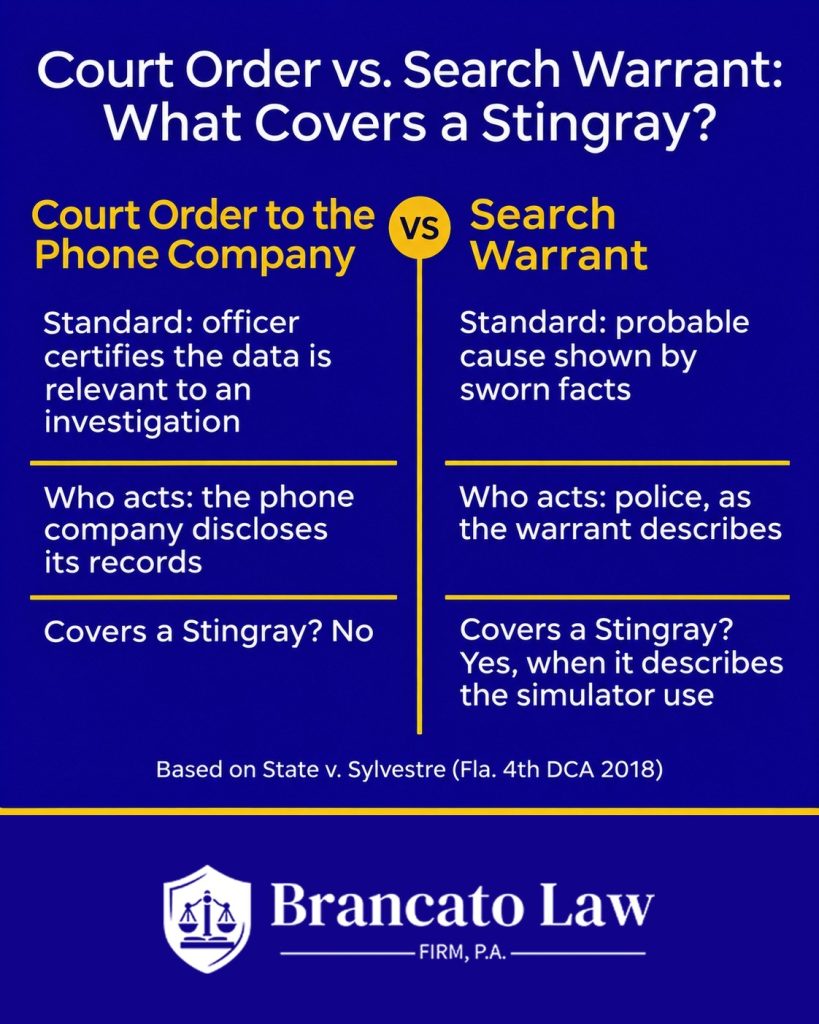
| Paperwork | Standard the judge applies | Does it authorize a Stingray? |
|---|---|---|
| Pen register or trap and trace order (s. 934.33) | Officer certifies the information is relevant to an ongoing investigation | No. Sylvestre held such an order did not authorize location tracking |
| Tracking device order (s. 934.42) | Officer’s certification and statements; U.S. Supreme Court tracking standards apply | Not by itself. Martin rejected the argument that a “mobile tracking device” order covered a simulator |
| Search warrant | Probable cause shown by sworn facts | Yes, when it describes the simulator use and is supported by probable cause |
How Often Do Florida Agencies Use Stingrays?
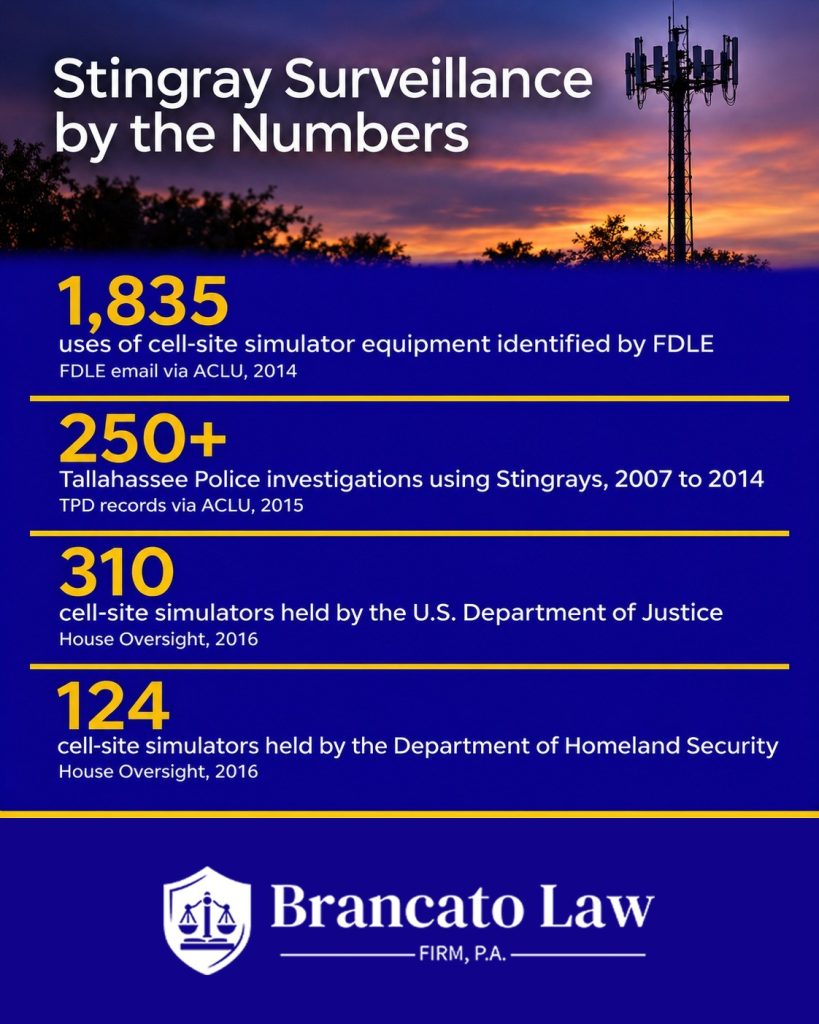
More often than most people expect. Records the ACLU obtained from Florida agencies and published in February 2015 include a May 2014 Florida Department of Law Enforcement email identifying 1,835 uses of cell-site simulator equipment. The same records show FDLE spent more than $3 million on Stingrays and related equipment since 2008 and signed sharing agreements with at least 11 local and regional agencies, and that the Tallahassee Police Department used the devices in more than 250 investigations from September 2007 through February 2014. These are the most detailed Florida usage figures available, and they are more than a decade old.
Federal agencies carry far more. A bipartisan House Oversight Committee staff report released in December 2016 found that the Department of Justice had 310 cell-site simulation devices and spent more than $71 million on the technology in fiscal years 2010 through 2014, and that the Department of Homeland Security had 124 devices and spent more than $24 million over the same period. When a federal task force helps a local agency find a suspect in Tampa Bay, the device may belong to a federal agency.
Do the Stingray Rulings Apply in Hillsborough, Pinellas, and Pasco Counties?
Yes, as things stand. Under Pardo v. State, 596 So. 2d 665 (Fla. 1992), “in the absence of interdistrict conflict, district court decisions bind all Florida trial courts.” Hillsborough, Pinellas, and Pasco appeals go to the Second District Court of Appeal, and our research has not found a published Second District opinion deciding simulator use. Until one does, Sylvestre and Martin bind trial judges in the Hillsborough County courthouse and across Tampa Bay, and our attorneys cite them in suppression motions here.
Local agencies have said little about their own use. In the same 2014 records requests, the Tampa Police Department and the Pasco County Sheriff’s Office told the ACLU they had no responsive records, and the Pinellas County Sheriff’s Office denied the request, according to the ACLU’s summary. That silence is one reason the defense has to dig for the facts in discovery instead of waiting for the State to volunteer them.
Why Is It Hard to Prove Police Used a Stingray?
Because the paperwork is often written so it never says so. In Sylvestre, the search warrant affidavit said only that “[m]obile tracking was activated” on the phone “pursuant to a lawful court order.” In Martin, the affidavits for the location orders did not mention a simulator at all. The 2016 House report also found that agencies had signed nondisclosure agreements about the devices and recommended replacing them with agreements requiring “clarity and candor to the court.”
Legal scholars flagged the gap years before Florida courts addressed it. Stephanie K. Pell, a former federal prosecutor in the Southern District of Florida, and technologist Christopher Soghoian wrote in A Lot More Than a Pen Register, and Less Than a Wiretap, 16 Yale J.L. & Tech. 134 (2013) that the technology “has never been explicitly authorized by Congress for law enforcement use,” even after more than two decades in service. Phrases our attorneys treat as red flags in a report include:
- “Mobile tracking was activated” or “electronic surveillance located the device”
- A suspect found inside one apartment or room when the phone company records point only to a several-block area
- A “confidential source” or “investigative means” cited for the exact location, with no further detail
- A U.S. Marshals or federal task force arrest team on a state warrant
What Rules Apply to Hailstorms and Airborne Dirtboxes?
The same Fourth Amendment rules apply to every cell-site simulator, whatever its brand or platform. Under the DOJ’s September 2015 policy, federal agents must get a search warrant supported by probable cause before using one, except in exigent or other exceptional circumstances, and any use of a simulator on an aircraft needs approval at the agency’s executive or headquarters level. The policy also requires agents to delete data once a known target phone is located, and no less than once daily.
Airborne use is the least documented. The Electronic Frontier Foundation reported in 2016 that FOIA records showed the FBI used airborne cell-phone geolocation around 2009, while its own lawyers were still discussing the need for a “coordinated policy” in 2014.
Courts outside Florida have reached the same warrant answer. In State v. Andrews, 134 A.3d 324 (Md. Ct. Spec. App. 2016), a Maryland appeals court held that Baltimore police’s warrantless Hailstorm use was a search and affirmed suppression. In September 2026, the federal appeals court in Andrews v. Baltimore City Police Department, No. 18-1953 (4th Cir. Sept. 24, 2026) held that “the Fourth Amendment requires a valid warrant for the use of a cell-site simulator,” but ruled the detectives were immune from money damages because the right was not clearly established in 2014. That civil ruling does not bind Florida courts, but it makes the Fourth Circuit the latest appellate court to require a warrant.
When Does Stingray Evidence Get Thrown Out?
Evidence is suppressed when the simulator use was unlawful and the evidence flowed from it, with no exception that saves it. In Sylvestre and Martin, the guns, mask, and car evidence were found only because the simulator put officers at the right door, so all of it went out. Suppression is not automatic, though. In Andres v. State, 254 So. 3d 283 (Fla. 2018), the Florida Supreme Court denied relief even assuming the simulator use was improper, because police already had a probable cause warrant to search the defendant’s body, home, and van, and the evidence fell within that warrant.
Hypothetically: say detectives investigating a Brandon burglary get a court order for a suspect’s phone company records. The records place the phone somewhere in a large apartment complex. That night, officers knock on one unit, the suspect opens the door, and they see stolen electronics inside.
The defense question is how officers chose that door. If a simulator picked the unit and no warrant authorized it, everything that followed, including what officers saw and any statement the suspect made at the door, is a candidate for suppression under Sylvestre and Martin. If the State can show a lawful, independent route to the same unit, the outcome may differ.
To show how officers really found the door, our attorneys compare the phone company’s records with the time and place of the arrest, request the tracking orders and applications, and work with experts when the timeline shows precision the carrier data could not provide. Our forensic science defense work covers the same records.
Common Myths About Stingray Tracking
| Myth | Fact |
|---|---|
| “The judge signed an order, so the tracking was legal.” | An order to the phone company does not authorize police to run a simulator. Sylvestre and Martin both suppressed evidence despite court orders. |
| “Police can only find me through my phone company.” | A simulator connects to your phone directly. No carrier record is needed for the final pinpoint. |
| “If the State never mentions a Stingray, none was used.” | Detectives in Martin testified it was not their practice to disclose planned simulator use in their applications. |
| “Illegal tracking means the case is dismissed.” | Suppression removes the tainted evidence. Andres shows evidence found under a separate valid warrant can survive. |
What Should You Do If Police May Have Tracked Your Phone?
Talk to a defense attorney before you talk to detectives, and do not try to explain where you were or why your phone was somewhere. Location cases often start with a quiet investigation, and our representation before charges are filed can shape what the State asks for and what it learns. If you have already been arrested, keep the arrest affidavit and any paperwork you received; the wording of that affidavit is often the first clue. Our guide to the stages of a Florida criminal case explains where a motion to suppress fits after arrest.
- Do not consent to a search of your phone or give your passcode without a lawyer.
- Write down when and where officers found you and how quickly they arrived.
- Do not delete apps, accounts, or data; that can lead to a separate tampering charge.
- Ask your attorney to request the tracking applications, orders, and returns; the same records can also support a cell phone location alibi defense.
Frequently Asked Questions
Can police track my phone in real time without a warrant in Florida?
No, not without probable cause or a valid exception such as an emergency. Under Tracey, real-time tracking through cell-site location data is a Fourth Amendment search, and The Brancato Law Firm’s attorneys check every location order against that rule and the newer rulings on whether police can track your phone without a warrant.
Can a Stingray read my text messages?
Not as federal agents configure the devices under the DOJ’s 2015 policy, which says the simulator does not capture emails, texts, contact lists, or images. Content usually comes from a separate warrant for the phone itself or for an online account, which is the next thing our attorneys at The Brancato Law Firm look for when deciding whether police could lawfully search your cell phone.
Will prosecutors tell me if police used a Stingray in my case?
Not always. In Martin, detectives admitted it was not their practice to mention planned simulator use when they applied for orders, so The Brancato Law Firm treats the question as something to prove through discovery and depositions. Our drug crimes defense team handles these issues often because trafficking investigations rely heavily on phone tracking.
Can charges be dropped if police used a Stingray without a warrant?
Sometimes, when the State’s key evidence came from the simulator and is suppressed. At The Brancato Law Firm, we file the motion with the carrier records and arrest timeline attached so the judge can see how the defendant was actually found, and prosecutors left with too little evidence may drop the case.
Is a Hailstorm different from a Stingray under Florida law?
No. Florida courts treat StingRay, Hailstorm, and TriggerFish devices as the same category, cell-site simulators, and the same warrant rule applies to each. The Brancato Law Firm’s police surveillance guide covers other tracking tools, from license plate cameras to GPS devices.
Sources
- Tracey v. State, 152 So. 3d 504 (Fla. 2014)
- State v. Sylvestre, 254 So. 3d 986 (Fla. 4th DCA 2018)
- State v. Martin, 287 So. 3d 645 (Fla. 4th DCA 2019)
- Andres v. State, 254 So. 3d 283 (Fla. 2018)
- Carpenter v. United States, 585 U.S. 296 (2018)
- Pardo v. State, 596 So. 2d 665 (Fla. 1992)
- State v. Andrews, 134 A.3d 324 (Md. Ct. Spec. App. 2016)
- Andrews v. Baltimore City Police Department, No. 18-1953 (4th Cir. Sept. 24, 2026)
- section 934.33, Florida Statutes
- section 934.42, Florida Statutes
- U.S. Department of Justice, Policy Guidance: Use of Cell-Site Simulator Technology (Sept. 3, 2015)
- House Committee on Oversight and Government Reform, Law Enforcement Use of Cell-Site Simulation Technologies (Dec. 19, 2016)
- ACLU of Florida, ACLU-Obtained Documents Reveal Breadth of Secretive Stingray Use in Florida (Feb. 2015)
- Stephanie K. Pell & Christopher Soghoian, A Lot More Than a Pen Register, and Less Than a Wiretap, 16 Yale J.L. & Tech. 134 (2013)
If your phone led police to your door, the tracking records need to be requested early, before deadlines for motions and depositions pass. Call The Brancato Law Firm, P.A., founded by Tampa Criminal Defense Attorney Rocky Brancato, at (813) 727-7159; you can call us at any hour, and our office is two blocks from the courthouse. Our firm has Spanish-speaking staff, and attorney Jean-Luc Adrien speaks Spanish, Haitian Creole, and French. For more about our defense strategies, visit our Drug Crimes Defense page.
The Brancato Law Firm, P.A.
620 E. Twiggs Street, Suite 205, Tampa, FL 33602
(813) 727-7159
Serving Hillsborough, Pinellas, and Pasco Counties
The Brancato Law Firm, P.A. is a Tampa-based criminal defense practice. We are not affiliated with any other Brancato-named law firms.
Visit Us

Tampa, FL 33602

Contact Us Now
Free Legal Consultation (813) 727-7159
