

From First DUI to Death Penalty



Can Police Get Your Ring Camera Footage in Florida? (2026)


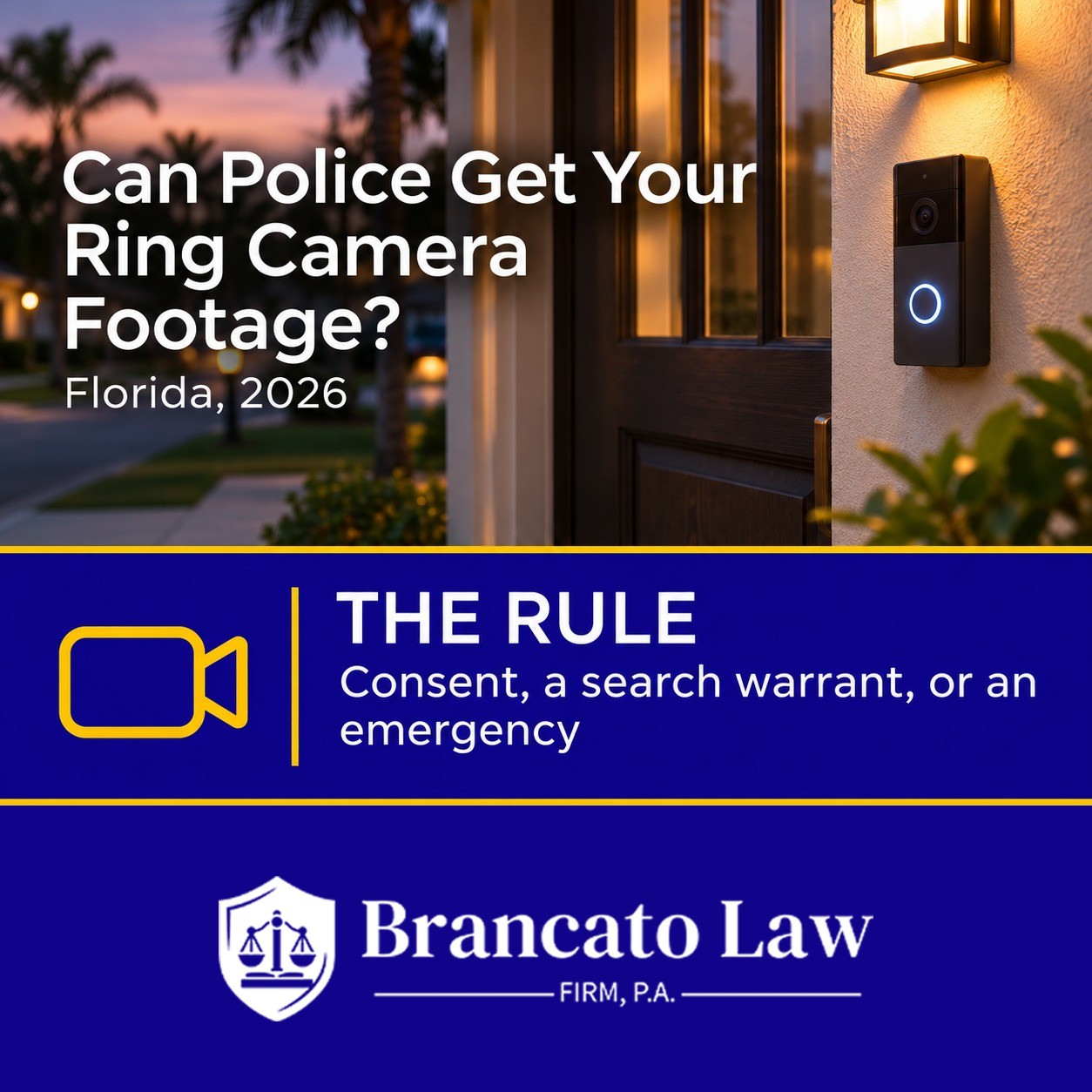
Short answer: Usually only with your consent, a search warrant, or a true emergency. Ring says it does not hand over videos in response to a subpoena; it releases stored video to police with a valid search warrant, or without one when it believes someone faces imminent danger of death or serious injury. Police can also simply ask you, or your neighbor, to share footage, and anything shared voluntarily can be used in court. Amazon has turned over Alexa recordings in murder investigations when served with a warrant or when the owner agreed.
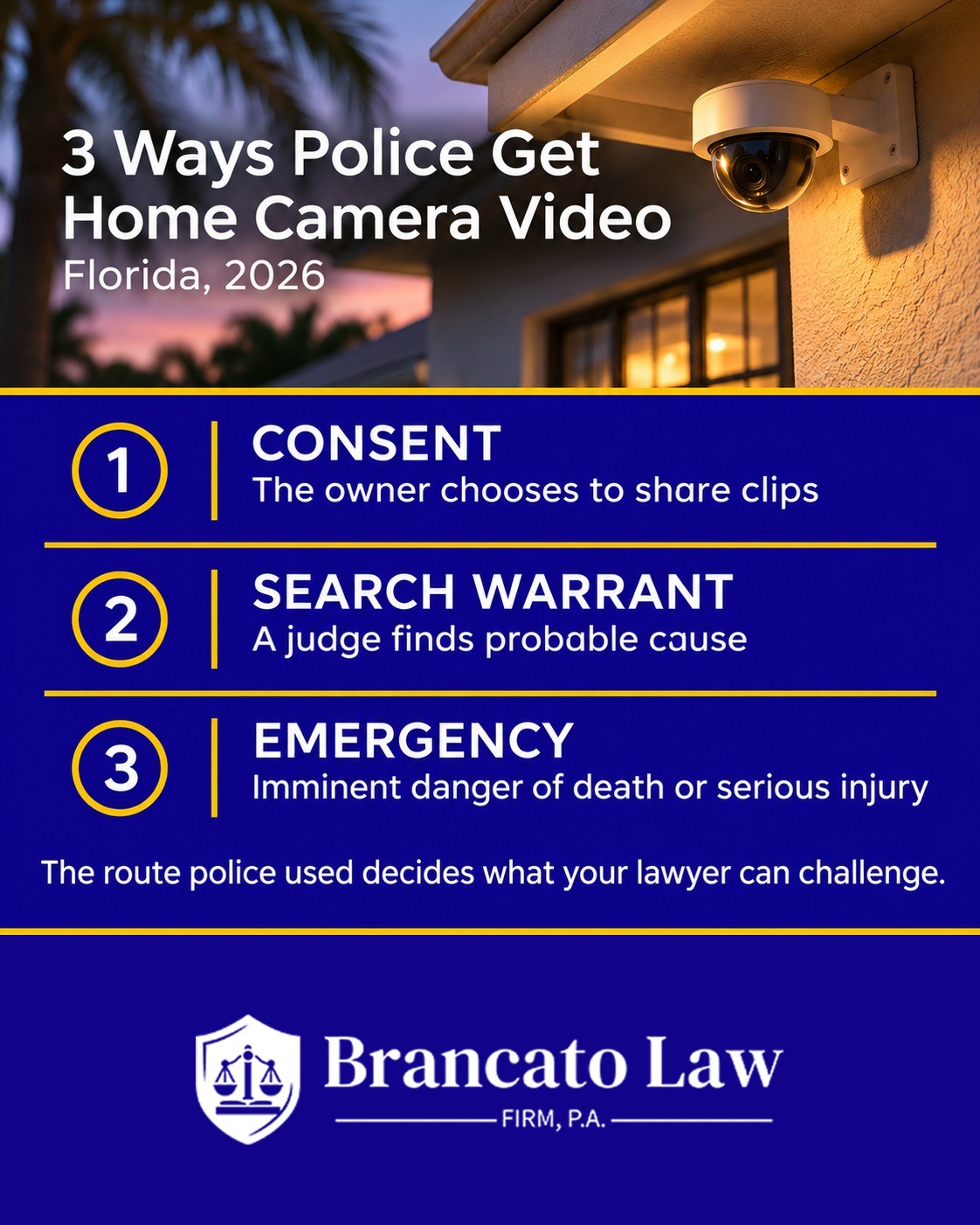
Home camera video usually reaches a Florida prosecutor in one of three ways: the owner hands it over, a judge signs a warrant, or the company releases it in an emergency. Which route the police used decides what our attorneys can challenge. As founder of The Brancato Law Firm, P.A., a Tampa criminal defense firm, I taught officers search and seizure as a police academy instructor, and as a former Chief Operations Officer of the Hillsborough County Public Defender’s Office, where I oversaw a staff of over 100 attorneys, I saw how often video decides a case. Our attorneys trace every clip back to how it was collected, who touched it, and what was left out.
This guide covers Ring’s current police policies through November 2026, the Fourth Amendment rules that apply to footage stored with Amazon or Google, real cases where smart speaker recordings were sought, and how camera video can help the defense. It is part of our series on police surveillance in Florida, which starts with our guide to what police can track without a warrant in Florida, alongside our guides on Flock license plate cameras in Tampa and phone location data after Chatrie.
Can Police Get Your Ring Camera Footage Without a Warrant?
Yes, in two situations: when the owner consents and when there is a genuine emergency. Otherwise, police who want video stored in a Ring account need a search warrant signed by a judge. Each route leaves a different paper trail, and the trail matters when our attorneys decide whether to file a motion to suppress.
| Route | How it works | What our attorneys check |
|---|---|---|
| Consent | The owner shares clips after a door knock, a phone call, or a Ring Community Request. | Who consented, whether that person controlled the camera, and whether police kept every clip they received. |
| Search warrant | A judge finds probable cause and orders Amazon or Ring to produce stored video. | The affidavit, the date range and cameras named, and whether police viewed more than the warrant allowed. |
| Emergency disclosure | Ring releases video without a warrant because it believes someone faces imminent danger of death or serious injury. | What emergency police described to Ring, and whether the facts matched it. |
What Does Ring Require Before It Gives Police Your Videos?
Ring requires a search warrant before it releases the content of your account, such as videos. Its published law enforcement guidelines say Ring does “not produce content information in response to subpoenas,” and that it may produce content and non-content information in response to “valid and binding search warrants.” A subpoena can reach only non-content information such as your name, address, email, and billing details.
The same guidelines set out several limits that matter in a criminal case:
- Ring says it notifies the account owner before disclosing user information in response to legal process, unless it is prohibited from doing so or has a clear indication of illegal conduct.
- Ring can reach your videos only if they are not protected by end-to-end encryption and you had a paid Ring subscription, or a free trial, in place when the event was recorded.
- Police can ask Ring to preserve an account for up to 90 days, and extend that once for another 90 days, while they seek a warrant.
- Legal process goes through Amazon’s law enforcement request portal, so there is a written record of every request.
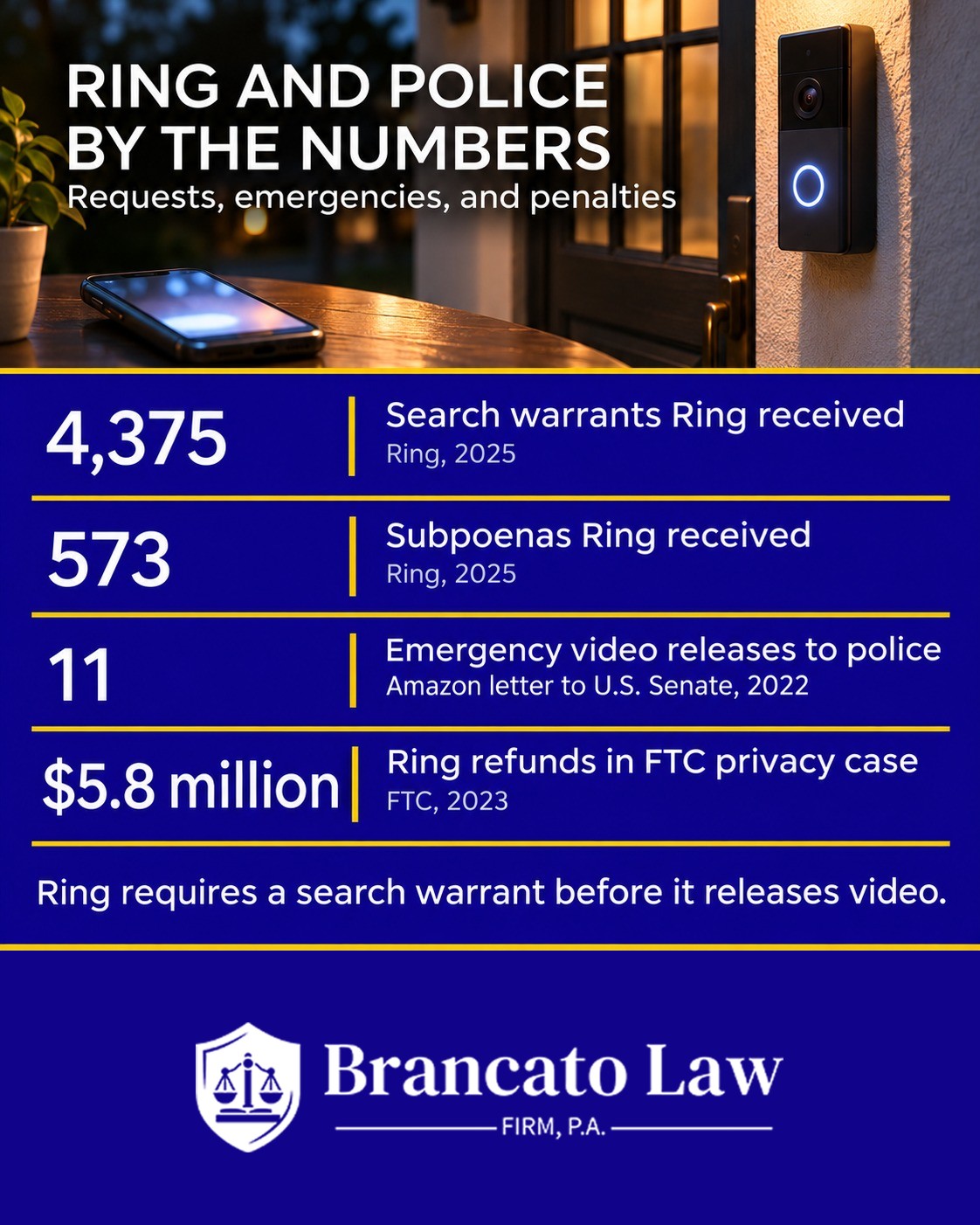
According to Ring’s semiannual Information Request Reports, Ring received 4,375 search warrants, 573 subpoenas, and 5,603 preservation requests from law enforcement in 2025, and notified users in response to 1,252 requests. Those figures are national and include requests from every kind of agency.
| Year | Search warrants | Subpoenas | Preservation requests |
|---|---|---|---|
| 2024 | 4,332 | 566 | 5,587 |
| 2025 | 4,375 | 573 | 5,603 |
What Are Ring Community Requests, and Did Ring Partner With Flock?
Community Requests are posts in Ring’s Neighbors app that let a local police or fire agency ask everyone with a Ring camera in a set area to share video from a set time window. Ring launched the feature on September 4, 2025, built on Axon’s evidence system. Sharing is optional, and Ring says agencies cannot see who received a request or who chose to ignore it.
The details on Ring’s Community Requests support page matter for anyone whose case involves shared video:
- Only local agencies with verified Neighbors accounts and Axon Evidence accounts can post a request, and each request needs an investigation code, a location, and a time frame.
- Neighbors have up to 60 days to respond. After that the post stays visible, but no new video can be submitted.
- When a Ring customer shares video, the customer’s home address and the email tied to the Ring account go to the investigator along with the clip.
- Requests cannot be edited or deleted once published.
This is the second version of police access through the Neighbors app. In January 2024, Ring ended its earlier “Request for Assistance” tool, which had let police ask users for video through the app. Ring brought requests back in 2025 through Axon. In October 2025 Ring also announced plans to let Flock Safety, the license plate camera company, connect to Community Requests. Ring canceled that plan in February 2026, days after public criticism of its Super Bowl advertisement, and said the Flock integration was never live and no videos were shared between the two services. As of November 2026, Ring’s support page names only Axon.
Can Ring Share Your Video With Police Without Your Consent?
Yes, in an emergency. Federal law allows a provider to disclose stored content to the government without a warrant if the provider, in good faith, believes that “an emergency involving danger of death or serious physical injury to any person requires disclosure without delay,” under 18 U.S.C. section 2702(b)(8). Ring’s guidelines reserve the same right and say it notifies the account owner after an emergency disclosure, except in limited circumstances.
Emergency disclosures are uncommon but real. In a July 1, 2022 letter to U.S. Senator Edward Markey, Amazon reported that Ring had given videos to law enforcement in response to emergency requests 11 times so far that year, each after a good-faith determination of imminent danger. Our attorneys at The Brancato Law Firm ask for the emergency request itself in discovery, because the facts police gave Ring should match what officers knew at the time.
Does the Fourth Amendment Protect Footage Stored With Amazon or Google?
Partly, and the law is still developing. Under the third-party doctrine from Smith v. Maryland, 442 U.S. 735 (1979), in which the Supreme Court held that a pen register the phone company installed at police request to record the numbers dialed from a man’s home was not a search, information you voluntarily give a company has traditionally received less protection. In Carpenter v. United States, 585 U.S. 296 (2018), where the government obtained a robbery suspect’s historical cell phone location records from his wireless carriers with a court order instead of a warrant, the Court held that accessing seven days of those records was a search and generally requires a warrant.
Carpenter also called its own decision “a narrow one” and said it does not “call into question conventional surveillance techniques and tools, such as security cameras.” Prosecutors cite that line. The defense answer is that a cloud account holding months of video from inside and around a home is very different from one store camera pointed at a parking lot.
Florida statutes add a layer. Under section 934.23, Florida Statutes, a Florida officer can require a provider to disclose the contents of an electronic communication held in electronic storage for 180 days or less “only pursuant to a warrant.” Florida courts read the state constitution’s search and seizure clause, Article I, section 12, in conformity with the U.S. Supreme Court’s Fourth Amendment decisions.
Legal scholars have flagged the gap. A 2020 Washington Law Review Online comment by Grace Egger, Ring, Amazon Calling: The State Action Doctrine & The Fourth Amendment, argues that Amazon should be treated as a state actor so Ring users keep Fourth Amendment protection, and a 2021 Boston University Journal of Science & Technology Law note by Justine Morris, Surveillance by Amazon, argues that police collection of Ring footage should be subject to strong warrant protections. Courts have not adopted those positions, but they give our attorneys a framework for arguing that consent obtained through a company platform deserves close review.
Can Police Get Your Alexa or Smart Speaker Recordings?
Yes, with a search warrant or the owner’s consent, and it has happened in homicide cases, including one in Florida. Smart speakers record after they hear a wake word, and those recordings are stored in the user’s account. Three cases show how the requests play out:
- Arkansas, 2017. In the Bentonville murder case against James Bates, Amazon objected to releasing Echo data and raised a First Amendment argument. It released the recordings after Bates consented, according to PBS NewsHour.
- New Hampshire, 2018. In the double murder case against Timothy Verrill, a judge ruled that investigators could examine recordings from an Echo speaker in the home where the killings happened, New Hampshire Public Radio reported.
- Florida, 2019. Hallandale Beach police obtained a search warrant for recordings from two Echo Dot devices in the death of Silvia Galva Crespo, whose husband was charged with second-degree murder, and the department confirmed it received material from Amazon, CBS News Miami reported.
Amazon’s own handling of home recordings has drawn federal scrutiny. In May 2023 the Federal Trade Commission announced a proposed order requiring Ring to pay $5.8 million in refunds after alleging that Ring had let employees and contractors access customers’ private videos. For a defense lawyer, that history is a reason to ask who, besides the police, viewed or handled a recording before trial.
What If a Neighbor’s Camera Recorded You?
Your neighbor can usually give that video to police, and you generally cannot stop it. The Fourth Amendment limits the government, not private people, so a homeowner who chooses to share video from a camera on their own property is not conducting an unconstitutional search. The legal fight then shifts to accuracy, completeness, and identification.
Police in Tampa Bay also have registration programs that tell them where private cameras are. The Hillsborough County Sheriff’s Office has worked with the company Fusus since 2021 on a surveillance camera registration program, FOX 13 reported in July 2023, and the Tampa Police Department maintains a voluntary registry of private surveillance cameras. Registration lets deputies know a camera exists; they still reach out to the owner to ask for footage. In Hillsborough County cases, our attorneys ask whether a clip came through the Sheriff’s Office registry, a Ring Community Request, or a detective’s knock on the door, because each route leaves different records to request.
Neighbor video cuts both ways. A camera across the street may show a different person, a different car, or a different time than the State’s theory. If you were arrested in Hillsborough County and nearby homes have cameras, the time to find that video is in the first days of the case, often while you are still under investigation, which is where our representation before charges are filed starts.
Does the State Have to Give the Defense All the Camera Footage?
The State must disclose evidence favorable to the defense, but lost video is harder to remedy. Under Brady v. Maryland, 373 U.S. 83 (1963), a murder case in which prosecutors withheld a companion’s statement admitting he did the actual killing, the Supreme Court held that suppressing evidence favorable to the accused violates due process when it is material to guilt or punishment, whatever the prosecution’s good or bad faith.
Footage that police never collected, or let expire, is treated differently. In Patterson v. State, 199 So. 3d 253 (Fla. 2016), a fire case in which the defendant’s burned truck was destroyed before his expert could inspect it, the Florida Supreme Court held that losing evidence that is only “potentially useful” violates due process only if the defendant shows bad faith, applying Arizona v. Youngblood, 488 U.S. 51 (1988). That is a hard standard to meet, so our attorneys send written preservation demands to police and, where needed, ask the court for subpoenas to camera owners early, before video is overwritten.
How Can Home Camera Footage Help the Defense?
Camera footage can prove where you were, show who started a fight, or reveal that a witness could not have seen what they described. Our firm uses video the same way we use cell phone location evidence for an alibi: we collect it, preserve the original file, and match it to a verified timeline.
The same reliability rules apply to both sides. Florida courts admit video from unmanned cameras under the “silent witness” theory. In Koerber v. State, 383 So. 3d 114 (Fla. 4th DCA 2024), a check-fraud case built on bank security camera stills, the Fourth District listed the factors a trial court weighs: the date and time of the recording, any evidence of editing or tampering, the condition and capability of the equipment, the procedures used to operate and secure it, and testimony identifying the people shown. A Ring clip with a wrong clock, missing segments, or no one who can explain how it was exported is open to challenge on those same grounds.
How Do Our Attorneys Challenge Doorbell and Smart Home Evidence?
Our attorneys start with how the video was obtained and then test what it shows. The steps follow the approach on our Tampa criminal forensic science attorney page, where digital evidence is treated as something to verify, never something to assume:
- Identify the route: consent, warrant, emergency request, or Community Request, and demand the paperwork for that route.
- Compare the warrant or request to what police actually collected, including date ranges, cameras, and accounts.
- Get the original export with its metadata, not a phone recording of a screen.
- Check the device clock, the motion-trigger gaps, and any clips that exist but were not produced.
- Locate other cameras in the area that may show a different picture, and preserve them.
- Challenge identification when the image is too dark, too far, or too brief to support it.
When collection went beyond what a warrant or consent allowed, the remedy is a motion to suppress. Our guide to the motion to suppress in Florida explains how those hearings work, and the Florida criminal case process page shows where suppression fits in the life of a case.
How Fast Should You Act When Camera Video Is Part of Your Case?
Act within days. Ring Community Requests close to new submissions after 60 days, police preservation requests to Ring last 90 days unless extended, and home cameras overwrite or delete clips based on each owner’s settings. Video that would help you can disappear before your first court date. The Brancato Law Firm sends preservation letters and identifies cameras as soon as we are retained.
Frequently Asked Questions About Police and Home Camera Footage
Do I have to give police my Ring video if they ask?
No. Without a warrant or a court order, sharing is your choice, and Ring says ignoring a Community Request is anonymous. The Brancato Law Firm can review your footage first, so you know what it shows before anyone else does; see our pre-file advocacy page.
Can police subpoena Ring for my videos?
A subpoena is not enough for video under Ring’s policy. Ring’s published guidelines say it does not produce content in response to subpoenas and requires a valid search warrant, though a subpoena can reach account details such as your name and address. Our attorneys at The Brancato Law Firm compare the legal process police served to what Ring actually produced.
Will Ring tell me if police got my footage?
Usually, but not always. Ring says it notifies account owners before disclosing information under legal process unless it is prohibited from doing so, and after an emergency disclosure except in limited circumstances. The Brancato Law Firm requests those notices and the underlying requests in discovery.
Can my own doorbell video be used against me?
Yes, if police obtain it with your consent, a warrant, or under an exception. Statements you make on camera, at your own door, can become evidence the same way posts and texts do, as explained in our social media evidence guide. The Brancato Law Firm reviews home video before any decision about sharing it.
Can police search my house to get my camera system without a warrant?
No, entering your home to seize a camera or recorder generally requires a warrant or a recognized exception such as exigent circumstances. Our guide on when police can enter your home without a warrant in Florida covers those exceptions, and The Brancato Law Firm challenges entries that do not fit them.
Can video from a neighbor’s camera prove I was not there?
It can, if it is preserved and authenticated. Our attorneys at The Brancato Law Firm locate cameras near the scene, request the original files, and match time stamps to phone and vehicle data to build a timeline a jury can follow.
Talk to a Tampa Defense Lawyer Before Camera Video Disappears
Every day matters once video is part of a case, because clips expire on schedules no one in the courtroom controls. Call The Brancato Law Firm, P.A., founded by Tampa Criminal Defense Attorney Rocky Brancato, at (813) 727-7159, any hour, and our attorneys will start by finding and preserving the footage on both sides. Our office is two blocks from the courthouse. Our firm has Spanish-speaking staff, and attorney Jean-Luc Adrien speaks Spanish, Haitian Creole, and French. For more about our defense strategies, visit our Forensic Science page.
The Brancato Law Firm, P.A.
620 E. Twiggs Street, Suite 205, Tampa, FL 33602
(813) 727-7159
Serving Hillsborough, Pinellas, and Pasco Counties
The Brancato Law Firm, P.A. is a Tampa-based criminal defense practice. We are not affiliated with any other Brancato-named law firms.
Visit Us

Tampa, FL 33602

Contact Us Now
Free Legal Consultation (813) 727-7159
