- Free Consultation 24/7: (813) 727-7159 Tap Here To Call Us


From First DUI to Death Penalty



Can Police Enter Your Home Without a Warrant in Florida?



Rewrite/update date: September 2, 2026
| Generally, no — a warrantless search of your home is presumed unconstitutional in Florida, and only a few narrow exceptions (consent, a true emergency, hot pursuit) allow police inside without one. Florida courts enforced that rule twice in 2026: the Second District threw out evidence after officers crawled through a window on a “welfare check” that was no real emergency, and the Third District suppressed a search where the State never produced the warrant it claimed to have. But the Florida Supreme Court also removed one remedy — evidence is no longer suppressed just because officers with a valid warrant failed to knock and announce first. |
I’m Rocky Brancato, founder of The Brancato Law Firm, P.A., a Tampa criminal defense firm. As a former police academy legal instructor, I taught officers exactly when the law allows them through a front door — and I served as Chief Operating Officer of the Hillsborough County Public Defender’s Office, where home-search suppression motions were daily work. Our attorneys litigate these entries in Tampa Bay courtrooms, and 2026 has redrawn several of the lines.
When Can Police Legally Enter Your Home in Florida?
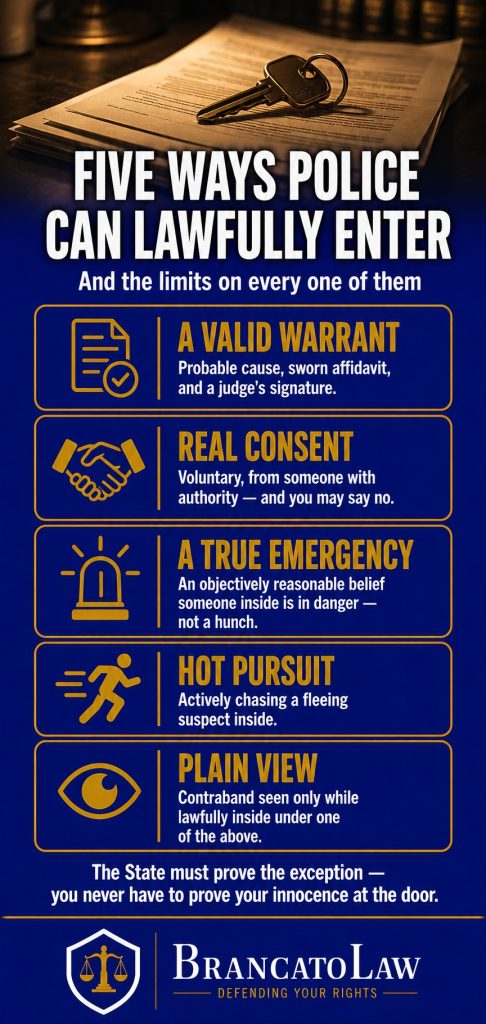
Police can enter your home only with a warrant, with valid consent, or under a recognized exception — because under both the Fourth Amendment and Article I, Section 12 of the Florida Constitution, a warrantless home search is “per se unreasonable.” The home is the most protected place in constitutional law, and the State always bears the burden of proving an exception applied.
| Way in | What the law requires |
|---|---|
| Search warrant | Probable cause, sworn affidavit, judge’s signature, particular description of the place and things to be searched |
| Consent | Voluntary agreement from someone with authority over the home — and you may refuse or limit it |
| Emergency aid / exigent circumstances | An objectively reasonable basis to believe someone inside is seriously injured or in imminent danger — not a hunch |
| Hot pursuit | Officers actively chasing a fleeing suspect into the residence |
| Plain view (once lawfully inside) | Contraband officers see while lawfully present under one of the above |
Everything below is about how those boxes get tested in real cases — because the difference between “welfare check” and “warrantless search,” or between “we had a warrant” and “here is the warrant,” decided three major Florida decisions within weeks of each other this year.
Can Police Enter Your Home for a Welfare Check?

Only if the facts would make a reasonable officer believe someone inside is seriously hurt or about to be — and a Tampa Bay-area appellate court just held officers to that standard. In State v. Ford, No. 2D2025-0324 (Fla. 2d DCA July 10, 2026), detectives entered a man’s home without a warrant, claiming they feared a medical emergency, and found evidence they hoped to use against him. The trial court suppressed it, finding the officers’ fear was built on “a hunch or a guess or a speculation” — and the Second District, whose decisions bind courts across Hillsborough, Pinellas, and Pasco Counties, affirmed.
What sank the State was the officers’ own behavior. They did not call 911. They did not kick the door or break a window to render immediate aid. They called dispatch for a backup officer — “not with lights and sirens, just regular” — waited, and then went looking for an open window to climb through. None of them looked through the windows to confirm anyone inside actually needed help, and the court found they had plenty of time to get a warrant. The lesson our attorneys use in suppression hearings: exigency is measured by the totality of the circumstances, and officers who act like there is no emergency cannot later justify an entry by claiming one. The emergency-aid exception is real — police genuinely rescuing someone need no warrant — but Ford confirms it is “not a shortcut by which police may circumvent the requirement of a search warrant.”
Do Police Have to Knock and Announce Before a Raid?
Yes — Florida law still requires it — but as of June 2026, breaking that rule no longer gets the evidence thrown out. Florida’s knock-and-announce statute, Fla. Stat. § 933.09, lets officers executing a search warrant break open a door or window only after giving “due notice” of their authority and purpose and being refused admittance. For sixteen years, Florida courts suppressed evidence when officers violated it, under the Florida Supreme Court’s Cable decision.
That ended with State v. Times, No. SC2024-0647 (Fla. June 25, 2026). Officers executing a valid search warrant announced it but did not give the occupants enough time to answer the door before going in; the trial court suppressed the evidence under Cable, and the First District affirmed. On a certified question, the Florida Supreme Court held 6-1 that suppression is not an available remedy for a statutory knock-and-announce violation, receding from Cable. The court reasoned that § 933.09 contains no exclusionary rule of its own, and the Legislature chose a different remedy: under Fla. Stat. § 933.17, an officer who willfully exceeds his authority executing a search warrant — or exercises it “with unnecessary severity” — commits a second-degree misdemeanor. The court noted the U.S. Supreme Court reached the same conclusion for federal constitutional purposes in Hudson v. Michigan back in 2006.
Read carefully, Times is narrower than the headlines suggest. It applies to searches conducted under a valid warrant — the underlying warrant must still survive scrutiny — and the court answered only the § 933.09 question, leaving other doors open. For anyone whose home was raided, the defense analysis simply shifts one step earlier: from how the officers entered to whether the paperwork authorizing entry holds up at all. Which brings us to the third 2026 decision.
What If the State Can’t Produce the Search Warrant?
Then the search is treated as warrantless — and everything found, plus everything you said afterward, can be suppressed. In Cabrera v. State, No. 3D2024-1324 (Fla. 3d DCA May 13, 2026), a detective and federal agents entered a fenced Miami-Dade residential property based on a federal search warrant that was under seal — and when the defense moved to suppress, the State never produced the warrant or its supporting affidavit. The trial court denied suppression anyway, admitting it was “just skipping over” whether the warrant was valid.
The Third District reversed with instructions to grant suppression. A court reviewing a warrant is confined to the four corners of the probable cause affidavit; with no warrant and no affidavit in the record, there was no way to find probable cause — and no way to apply the good-faith exception, because the detective who entered had never even seen the warrant he claimed to rely on. The court went further: because the search was illegal, Cabrera’s post-search statements were “fruit of the poisonous tree” and had to be suppressed too. For defendants, Cabrera is a reminder that “we had a warrant” is a claim the State must prove with paper, not testimony — and that a successful challenge takes down not just the physical evidence but the statements that followed it.
What Evidence Gets Thrown Out After These Decisions?
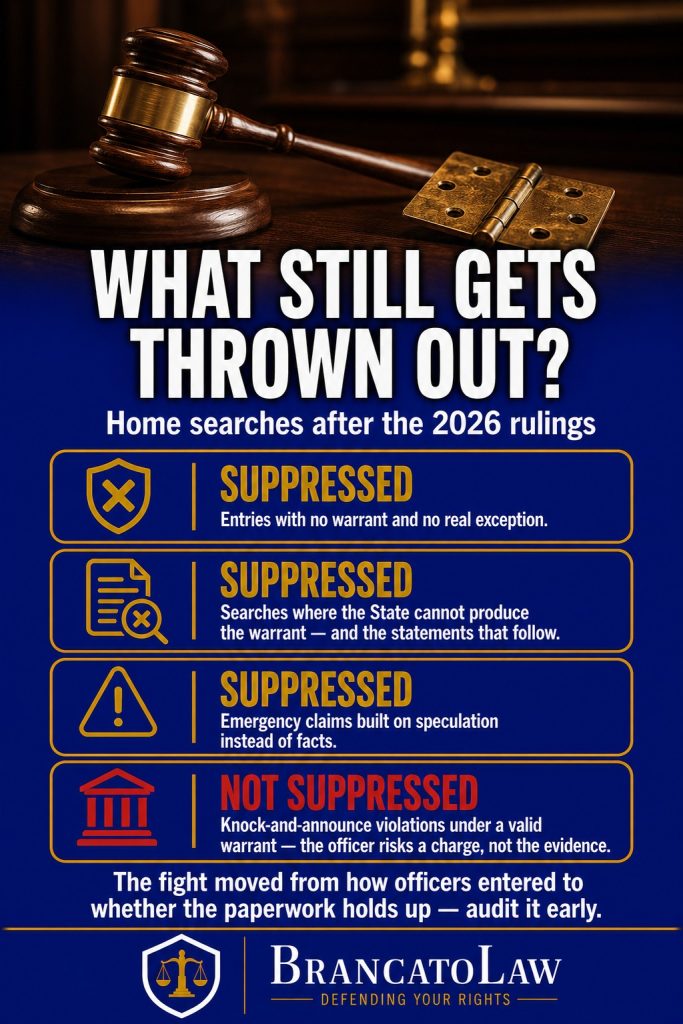
The 2026 decisions sort home-search defenses into clear lanes — some stronger than ever, one now closed.
| Defect in the entry | Is suppression available in Florida (2026)? |
|---|---|
| No warrant, no valid exception (Ford) | Yes — the evidence is suppressed |
| “Emergency” entry with no objectively reasonable basis | Yes — a hunch is not an exigency |
| State cannot produce the warrant or affidavit (Cabrera) | Yes — treated as warrantless; statements fall with it |
| Warrant affidavit lacks probable cause or particularity | Yes — four-corners review |
| Valid warrant, but officers violated knock-and-announce (Times) | No — suppression unavailable for the § 933.09 violation; the officer may face a misdemeanor instead |
| Consent obtained by coercion or from someone without authority | Yes — invalid consent is no consent |
One practical note about consent, because it decides more home searches than any doctrine: you are allowed to say no. Officers at your door without a warrant may ask to “take a look around,” and declining is not evidence of guilt. Step outside, close the door behind you if you speak with them, and say clearly that you do not consent to a search. If they enter anyway, do not resist — the remedy is a suppression motion, not a confrontation, and our attorneys would rather litigate a clean record of non-consent than untangle a disputed one.
Can Police Search Your Yard, Porch, or Fenced Property?
The Fourth Amendment’s protection extends beyond your walls to the “curtilage” — the area immediately surrounding the home, like a porch, carport, or fenced yard, where the intimate activity of home life happens. That mattered in Cabrera, where the property agents entered without a producible warrant was a fenced residential lot. The controlling principle comes from a Florida-grown U.S. Supreme Court case: in Florida v. Jardines, 569 U.S. 1 (2013), officers walked a drug dog onto a Miami front porch, and the Court held that bringing an investigative tool into the curtilage to gather evidence is itself a search requiring a warrant.
The practical rules for Tampa Bay homeowners follow from that. Officers, like anyone else, may walk up to your front door, knock, and ask questions — the “knock and talk” — because that is what any visitor may do. What they may not do without a warrant is exceed that implied invitation: linger to peer into windows, walk the back yard, open a gate into a fenced area, or deploy a dog at the threshold. Evidence gathered from inside the curtilage without a warrant, consent, or true exigency is suppressible on the same footing as evidence from inside the house — and in our experience, entries “just to check the back door” are among the most commonly overlooked suppression issues in home-search cases.
What Should You Do If Police Searched Your Home?
Write down everything while it is fresh, and get the paperwork audited by a defense lawyer before the State’s charging decision. The questions that decided Ford, Times, and Cabrera are the questions we ask in every Tampa Bay home-search case: Was there a warrant, and can the State actually produce it and its affidavit? Does the affidavit establish probable cause within its four corners? If there was no warrant, what exception is the State claiming — and did the officers’ actual conduct match the emergency they now describe? Were your statements taken after the entry, so that they fall if the entry falls? In Hillsborough County, felony cases move from arrest to the State Attorney’s filing decision in a matter of weeks, and a suppression problem raised early can shape or stop the filing. These issues also connect to the rest of your digital and physical privacy — see our guides on whether police can track your phone without a warrant, stop and frisk on the street, and what to do after being arrested in Tampa.
For more about our defense strategies, visit our Hillsborough County criminal defense page.
Frequently Asked Questions
Can police enter my house if I don’t answer the door?
Not without a warrant, consent, or a genuine emergency. Simply not answering is not an emergency — and in State v. Ford, the Second District affirmed suppression where officers responded to an unanswered door by climbing through a window on nothing more than speculation. If officers have a valid search warrant, however, § 933.09 allows forced entry after they announce and are refused.
Can police come in for a welfare check?
Only when the facts give them an objectively reasonable belief that someone inside is seriously injured or in imminent danger. A true emergency justifies entry without a warrant; a hunch does not, and officers who wait around and search for an open window undercut their own claim of urgency. Our attorneys examine officers’ actual conduct minute by minute in these cases.
If police broke down my door without knocking, will my case be thrown out?
Not automatically — after State v. Times (Fla. 2026), evidence is no longer suppressed for a knock-and-announce violation when officers had a valid search warrant. But the warrant itself must still be valid, and other defects in the entry or the affidavit still support suppression. The Brancato Law Firm, P.A. audits the entire warrant package in every home-search case, because Times moved the fight — it didn’t end it.
Do police have to show me the search warrant?
You are entitled to know they have one, and the State must be able to produce it in court — Cabrera v. State (Fla. 3d DCA 2026) suppressed a search where the warrant was sealed and never produced, along with the statements that followed. At your door, don’t physically interfere; note the time, the agency, and what officers say, and call a lawyer immediately.
Can police search my home if my roommate lets them in?
A person with authority over the home can consent to entry of shared areas, but not to spaces exclusively yours, like your private bedroom — and if you are present and object, your refusal generally controls as to you. Consent questions are fact-heavy, and we litigate them regularly in Hillsborough, Pinellas, and Pasco Counties.
Does an arrest warrant let police enter my home?
An arrest warrant lets officers enter the suspect’s own residence when they reasonably believe the person is home — it is not a search warrant for the whole house, and it does not authorize entering someone else’s home without more. Evidence found beyond those limits can be challenged, and The Brancato Law Firm, P.A. handles exactly these motions.
Home-entry law moved three times in 2026 — Cabrera in May, Times in June, Ford in July — and the difference between a suppressed search and an admitted one now turns on details most people never think to write down. If officers entered or searched your home anywhere in Tampa Bay, call the attorneys of The Brancato Law Firm, P.A. — founded by Tampa Criminal Defense Attorney Rocky Brancato — at (813) 727-7159 before the State makes its filing decision. The suppression motion that ends a case is built in its first weeks.
The Brancato Law Firm, P.A.
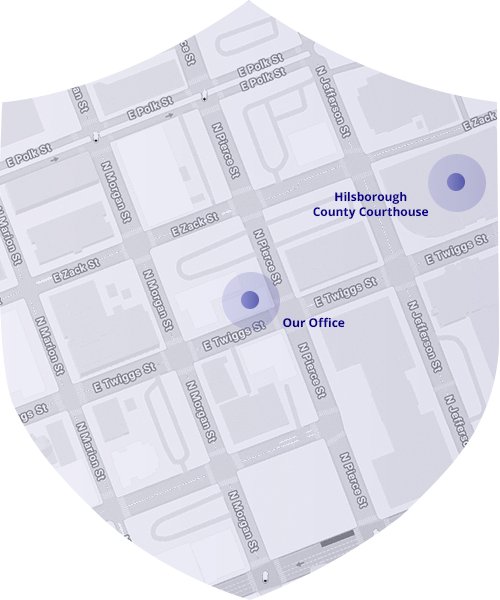
620 E. Twiggs Street, Suite 205, Tampa, FL 33602
(813) 727-7159
Serving Hillsborough, Pinellas, and Pasco Counties
The Brancato Law Firm, P.A. is a Tampa-based criminal defense practice. We are not affiliated with any other Brancato-named law firms.
Visit Us
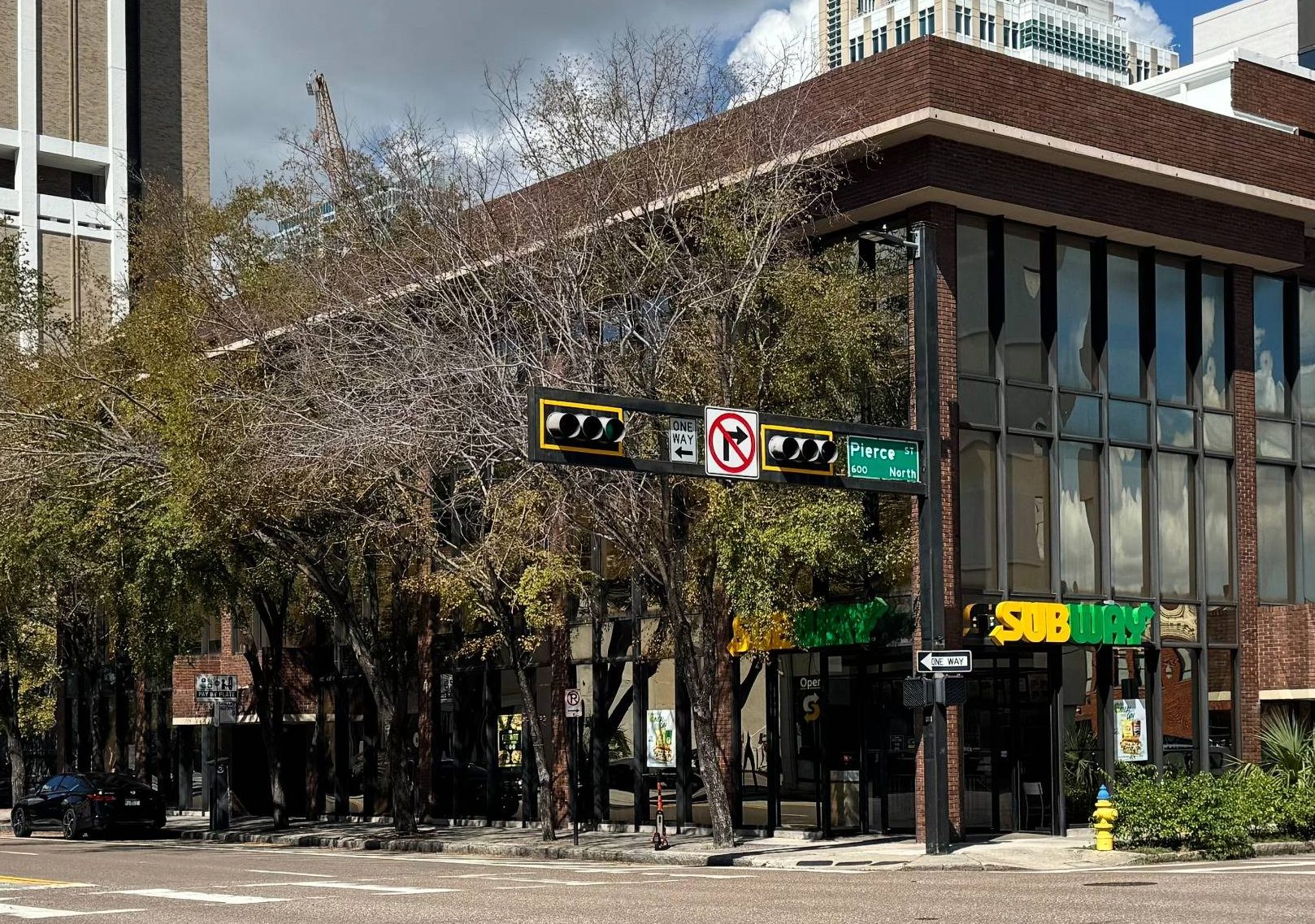
Tampa, FL 33602
Contact Us Now
Free Legal Consultation (813) 727-7159