- Free Consultation 24/7: (813) 727-7159 Tap Here To Call Us


From First DUI to Death Penalty



Can Police Arrest You Based on Facial Recognition in Florida? (2026)


Updated November 15, 2026
Yes, Florida police can arrest you after a facial recognition search, but the match alone is not supposed to be enough. Florida has no statute that regulates police facial recognition, and the Pinellas County Sheriff’s Office, which runs the statewide FACES system, says its results are investigative leads that are never “matches” and never probable cause by themselves. Officers must corroborate the lead with independent evidence. When they skip that step, the arrest, the warrant, and any identification that followed can be challenged.
A facial recognition search usually happens in a back office, weeks before anyone is arrested, and it rarely appears by name in the police report. That is why it is so often missed. As founder of The Brancato Law Firm, P.A., a Tampa criminal defense firm, and a former Chief Operations Officer of the Hillsborough County Public Defender’s Office, where I oversaw a staff of over 100 attorneys, I have spent more than 25 years in Hillsborough County courtrooms watching identification cases turn on how police first settled on a suspect. Our attorneys treat a facial recognition lead as forensic evidence: we find out which system was used, what photo went in, what list came out, and what police did to check it.
What Is Police Facial Recognition and How Does It Work in Florida?
Police facial recognition is software that compares a photo of an unknown person, called the probe image, against a database of known faces and returns a ranked list of possible candidates. It does not return a single answer. A human analyst then looks at the list and decides whether any candidate is worth passing to the detective. Every step after the software runs is a human judgment, and every step can be tested.
In Florida, most agencies run these searches through FACES (Face Analysis Comparison & Examination System), now called FACESNXT, which the Pinellas County Sheriff’s Office has operated for more than two decades. As of 2026, FACESNXT holds about 15 million booking photos and about 25 million Florida driver’s license photos, and 221 local, state, and federal agencies have access, according to reporting by The Florida Trib published by WLRN on September 29, 2026. The Tampa Police Department and the Hillsborough County Sheriff’s Office are both listed as FACES users in the Electronic Frontier Foundation’s Atlas of Surveillance.
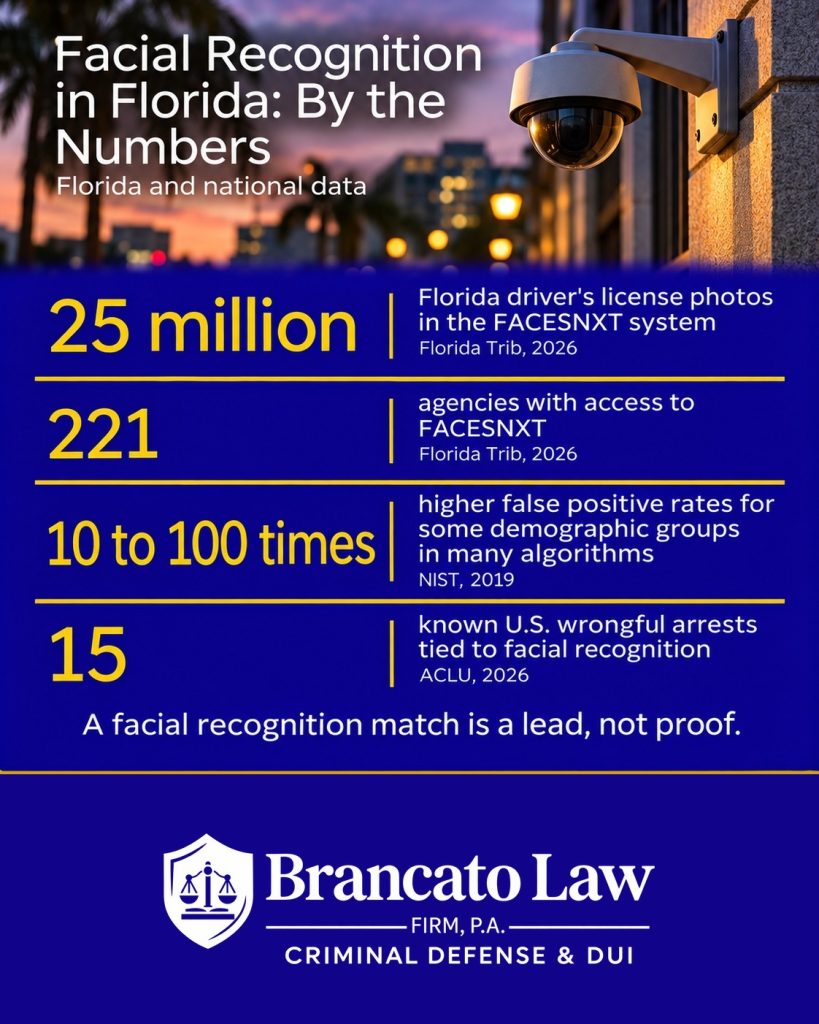
Florida law supplies the driver’s license photos. Under section 322.142, Florida Statutes, the Department of Highway Safety and Motor Vehicles keeps a digital image of every licensee, and reproductions may be issued “in response to law enforcement agency requests.” That means most Florida adults are in the search pool even if they have never been arrested. In August 2026, Daytona Beach approved a separate agreement with the department so its officers can run driver’s license photos through the Pinellas system, and the agreement states that comparisons return investigative leads, not a “positive comparison,” according to Biometric Update.
| Step | What happens | What our attorneys request |
|---|---|---|
| 1. Probe image | An officer pulls a still from surveillance video, a phone, or social media | The original image and every edited version (cropped, brightened, rotated) |
| 2. Search settings | The analyst chooses filters such as race, sex, or county booking photos only | The search parameters and which databases were searched |
| 3. Candidate list | The software returns a ranked list with scores or stars | The full candidate list with each score, not just the photo forwarded |
| 4. Analyst review | A person picks a candidate as a possible lead | The analyst’s name, training, notes, and report |
| 5. Investigation | Detectives are supposed to corroborate the lead | Phone, location, plate-reader, and alibi checks done or skipped |
| 6. Identification | A witness may be shown a photo lineup that includes the candidate | The lineup, instructions, and confidence statement |
Is Facial Recognition Legal in Florida, and What Laws Apply?
Yes, police facial recognition is legal in Florida, and no Florida statute regulates how agencies use it. In 2026, Senate Bill 1202 would have added facial recognition rules to Florida’s eyewitness identification law, including limits on running a lineup after a facial recognition search, but the bill died in the Senate Criminal Justice Committee on March 13, 2026, and its House companion, HB 875, died the same day. Until the Legislature acts, the rules come from agency policies, the constitution, and general criminal procedure.
| Source of law | What it does in a facial recognition case |
|---|---|
| Fourth Amendment and art. I, s. 12, Fla. Const. | An arrest needs probable cause; a warrant affidavit that hides how the suspect was identified can be attacked |
| Section 92.70, Florida Statutes | Sets lineup procedures (independent administrator, five instructions); noncompliance is considered on a motion to suppress and can go to the jury |
| Section 322.142, Florida Statutes | Lets the state release driver’s license images to law enforcement on request |
| Brady v. Maryland and Fla. R. Crim. P. 3.220 | Require the State to disclose favorable evidence and discovery materials, which can include the search records |
| FACESNXT terms and agency policies | Say results are leads only and require independent investigation; violations are strong impeachment |
| Proposed SB 1202 (2026) | Would have regulated lineups after a facial recognition search; died in committee |
Can Police Arrest You Based Only on a Facial Recognition Match?
No, a facial recognition result alone should not support an arrest, because a candidate list is a lead, not an identification. The Pinellas County Sheriff’s Office has said so publicly: “Facial recognition results are never matches,” and “independent investigation is required,” according to WUSF reporting on June 18, 2026. In practice, the danger is that a detective treats a high score as proof and builds the rest of the case around the wrong person.
A federal judge put the problem plainly in November 2026. In Vizcay Osorio v. Kilmer, No. 2:26-cv-00004 (E.D. Ky. Nov. 9, 2026), a Nebraska man was arrested in Florida on January 9, 2025, extradited to Kentucky, and jailed for more than two weeks on forgery charges after a detective allegedly relied solely on an AI facial recognition result from bank surveillance video. The detective’s sworn complaint said only that he used “investigative tools,” and the department’s own policy said the technology is advisory and does not establish probable cause without further investigation. The charges were later dismissed with prejudice after the man showed he was working in Nebraska. Denying the detective qualified immunity at the pleading stage, Judge S. Chad Meredith compared exclusive reliance on the software to a fortune-telling toy: “a Magic 8 Ball alone will not cut it.” As Stephen Embry wrote in his November 13, 2026 Above the Law column on the ruling, the opinion is a warning about what happens when an officer hands the probable cause decision to a machine.
The lesson for a Florida defendant is twofold. First, a warrant affidavit that says “investigative tools” or “a database search” may be hiding a facial recognition search, and an affidavit that omits how the suspect was really identified can be challenged as misleading. Second, the agency’s own policy often says the result cannot be probable cause, which gives our attorneys at The Brancato Law Firm a written standard to hold the officer to on cross-examination.
How Often Does Facial Recognition Get the Wrong Person?
Facial recognition gets the wrong person often enough that wrongful arrests keep happening, and the risk is not the same for everyone. In its 2019 study of 189 algorithms from 99 developers, the National Institute of Standards and Technology (NISTIR 8280) found that most algorithms showed demographic differences, with false positive rates for Asian and African American faces often 10 to 100 times higher than for Caucasian faces, depending on the algorithm. The same study found higher false positive rates for African American women in one-to-many searches of a mugshot database, which is the kind of search police run.
The Georgetown Law Center on Privacy & Technology’s report The Perpetual Line-Up (2016) found that the Pinellas system was then searched about 8,000 times a month by 242 agencies, and that when the sheriff was asked whether his office audited searches for misuse, he answered, “No, not really.” Those are older figures, but they show the scale: a single Florida system is searched by hundreds of agencies, so a misidentification in one county can lead to an arrest in another.
The quality of the probe image matters as much as the software. A grainy still, a face turned to the side, poor lighting, or an image an analyst edited to make it searchable all reduce reliability. A system also returns its best candidates even when the real person is not in the database at all, so the top-ranked face can be a stranger who merely looks similar. These are the questions our attorneys at The Brancato Law Firm put to the State’s analyst.
Has Facial Recognition Caused Wrongful Arrests in Florida?
Yes. At least three Florida misidentifications have been reported since 2024, and each involved a search that police treated as more than a lead.
- Jacksonville Beach, 2024. Robert Dillon, a 52-year-old Fort Myers man, was arrested in August 2024 for allegedly trying to lure a child at a Jacksonville Beach McDonald’s after a FACES search returned him as a 93% candidate. He says he had never been to Jacksonville Beach, a plate-reader search showed none of his cars near the restaurant, and prosecutors dropped the charges in October 2024. The ACLU sued in June 2026 (Dillon v. City of Jacksonville Beach) and counts him among at least 15 known people wrongfully arrested in the U.S. because of facial recognition.
- Jacksonville, 2025. A Jacksonville supermarket manager and father of two was charged in May 2025 with soliciting a child via computer after facial recognition tools matched him to photos a convicted sex offender had taken from his Facebook page and used on a dating app. He was ordered away from his children for weeks before the real sender confessed and charges were dropped in August 2025; the case cost his family about $45,000, according to The Florida Trib’s September 2026 investigation.
- Jacksonville, reported 2026. Jalil Richardson, a Charlotte, North Carolina resident, was arrested by the Jacksonville Sheriff’s Office in a stolen-car investigation after a facial recognition search matched surveillance video to a fake Georgia ID, and he lost his job and custody of his children, according to Biometric Update’s October 1, 2026 report.
These cases share a pattern our attorneys look for in every identification case: one software result, little or no follow-up, and an arrest made far from where the person lives. Tampa has seen the limits of the technology before. In 2003, the Tampa Police Department ended its Ybor City facial recognition camera program after the chief said “there have been no positive identifications or arrests attributed to the software,” according to Security Sales & Integration.
Do You Have a Right to Know Police Used Facial Recognition in Your Case?
Often yes, but Florida law has not answered the question directly, so the defense has to ask for it. The leading Florida decision is Lynch v. State, 260 So. 3d 1166 (Fla. 1st DCA 2018). Undercover Jacksonville officers bought crack from a man called “Midnight” and photographed him with a phone. When other searches failed, a crime analyst ran the photo through a facial recognition program limited to Duval County booking photos; Willie Allen Lynch’s photo came back with one star, the highest-ranked result, though the analyst did not know how many stars were possible. Lynch argued the State violated Brady v. Maryland, 373 U.S. 83 (1963), by not disclosing the other candidate photos. The First District affirmed his conviction and eight-year sentence because he could not show those photos resembled him, so he could not show prejudice.
Lynch is narrower than it first looks. The court did not hold that the other candidates are never discoverable; it held that Lynch had not shown they would have changed the trial. A defendant who requests the full candidate list before trial, through discovery and a motion to compel, is in a much stronger position than one raising it for the first time on appeal. Our attorneys make that request early.
How often police use facial recognition in Hillsborough, Pinellas, and Pasco County cases is unknown, because the search rarely appears in a report by name. In our experience, police sometimes leave a facial recognition search out of the paperwork and present the identification as coming from other investigative leads that had nothing to do with it. When our attorneys suspect a search was run and its records could help the client, we move for disclosure instead of waiting for the State to volunteer it.
Courts outside Florida have gone further, and their reasoning is persuasive authority in a Florida courtroom. In State v. Arteaga, 476 N.J. Super. 36, 296 A.3d 542 (App. Div. 2023), a New Jersey appeals court ordered prosecutors to disclose the software’s name and version, its error rates, the original and edited probe images, the candidate list scores, and the analyst’s qualifications, because the evidence was “directly tied to the defense’s ability to test the reliability” of the technology. In State v. Miles, No. A-41-24 (N.J. June 24, 2026), a Jersey City murder case, the New Jersey Supreme Court held that the State must produce information identifying the facial recognition tools it used and how it used them, including the probe photo and the photos that “matched,” while leaving source code for a later showing of particularized need. The court said that basic information will, in most cases, be the minimum necessary for a fair trial.
| Case | Court and year | What it means for a Florida defendant |
|---|---|---|
| Lynch v. State | Fla. 1st DCA, 2018 | Other candidate photos were not Brady material on that record, because prejudice was not shown; request them before trial |
| State v. Arteaga | N.J. App. Div., 2023 | Persuasive: ordered broad discovery on the software, error rates, images, and analyst |
| State v. Miles | N.J. Supreme Court, 2026 | Persuasive: tool identity and how it was used are discoverable; source code needs a particularized showing |
| Vizcay Osorio v. Kilmer | E.D. Ky., 2026 | An officer who relies solely on AI and hides it in the affidavit can face a Fourth Amendment claim |
Can a Facial Recognition Identification Be Suppressed in Florida?
Sometimes. Florida courts suppress an out-of-court identification when police used an unnecessarily suggestive procedure that created a substantial likelihood of irreparable misidentification. That two-part test was restated by the Florida Supreme Court in Alahad v. State, 362 So. 3d 190 (Fla. 2023), a Broward County case about a show-up conducted three hours after a shooting. The court held that a trial judge’s ruling on that test is reviewed for abuse of discretion, which means the evidence our attorneys build at the suppression hearing usually decides the issue.
Facial recognition creates a specific suggestiveness problem. When the software picks a face that looks like the suspect, and police then build a photo lineup around that face, the witness is shown the one person in the array who was chosen because he resembles the offender. If the software was wrong, the real perpetrator is not in the lineup at all. Florida’s eyewitness identification law, section 92.70, Florida Statutes, requires an independent or blind administrator and instructions that the perpetrator might or might not be in the lineup; a failure to comply “shall be considered by the court” on a motion to suppress, and the jury can be instructed to weigh it. The statute does not mention facial recognition, which is why the details of the search have to be developed in discovery.
This issue does not end if the motion is denied. The same evidence about the software, the image, and the skipped follow-up goes to the jury as reasonable doubt about identity, and it supports an alibi defense when phone or work records place the client elsewhere. Our guide to how a motion to suppress works in Florida explains the hearing itself.
How Do Our Attorneys Challenge Facial Recognition Evidence?
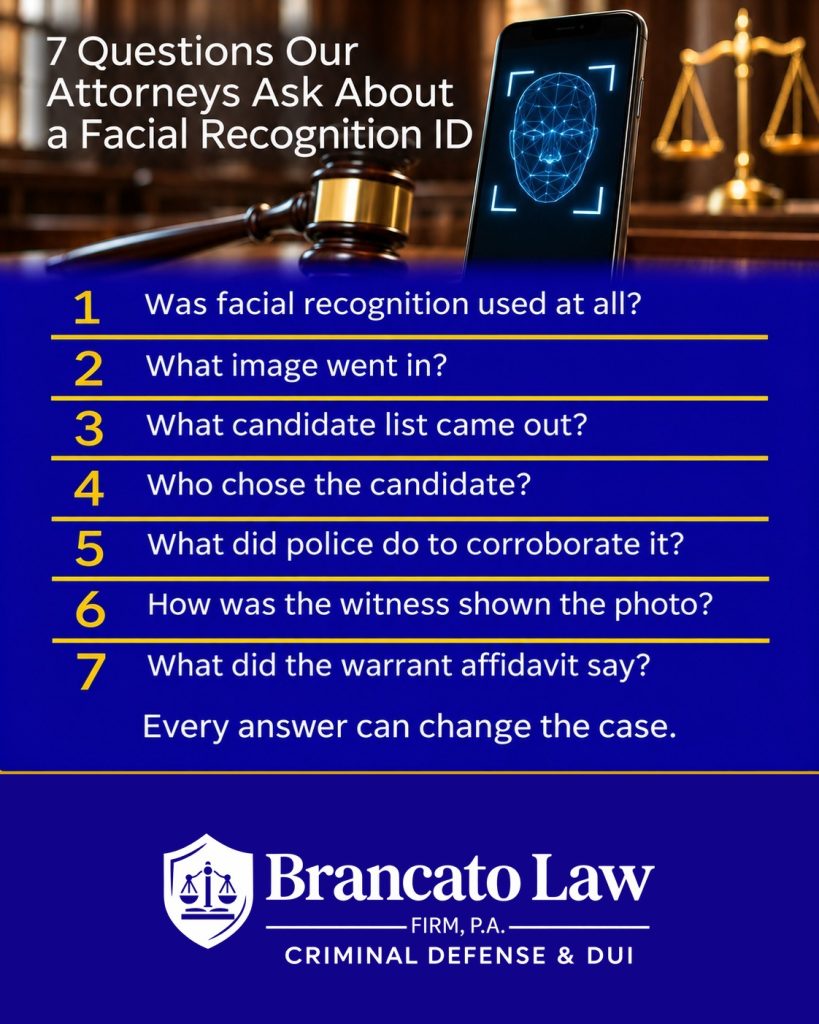
Our attorneys challenge facial recognition evidence by reconstructing the search from the first image to the arrest, then testing each step. Identification cases with digital evidence are handled through our Tampa criminal forensic science attorney practice, where we work with outside experts when the case calls for one. These are the questions we answer first:
- Was facial recognition used at all? Reports often say “investigative tools” or “a database search.” We ask directly, in discovery and at deposition.
- What went in? We obtain the original probe image and every edited version, and compare them to the source video.
- What came out? We request the full candidate list with scores, the search filters, and the databases searched.
- Who decided? We depose the analyst about training, how candidates were ranked, and why one face was forwarded.
- What did police do next? We look for the corroboration that policy required: phone records, location data, plate-reader reads, and alibi checks.
- How was the witness shown the photo? We test the lineup against section 92.70 and the suppression standard in Alahad.
- What did the warrant say? We compare the affidavit to what actually happened; an omitted facial recognition search can undermine probable cause.
Other location evidence often decides these cases. A license plate reader that puts the client’s car somewhere else, as in the Dillon case, can be the strongest proof of misidentification; our guide to Flock cameras and license plate readers in Tampa explains how to get those reads, and our guide on whether police can track your phone without a warrant in Florida covers cell location records.
What Should You Do If You Think Facial Recognition Led to Your Arrest?
Act quickly and preserve your proof of where you were. Video is overwritten and plate-reader data can be deleted in days, so the first week matters most.
- Do not talk to detectives about the photo or video without a lawyer; a statement that you “look like” the person can be used against you.
- Write down where you were on the date, and who can confirm it.
- Save phone location history, work schedules, receipts, and toll or app records for that day.
- Gather recent photos of yourself that show tattoos, scars, height, or features the suspect in the video does not share.
- Call a defense attorney so preservation and discovery requests go out before records disappear.
If detectives contact you before any charge is filed, our representation before charges are filed can put the alibi and the misidentification in front of the prosecutor before a decision is made. Our overview of the Florida criminal case process shows where these requests fit in a case.
Frequently Asked Questions About Facial Recognition in Florida
Does Florida have a law that regulates police facial recognition?
No, Florida has no statute that specifically regulates police facial recognition, and the 2026 bill that would have added rules (SB 1202) died in committee. The Brancato Law Firm relies on agency policies, the FACESNXT terms that call results leads only, and the constitutional rules on probable cause and identification; see our forensic science defense practice for how we use them.
Are Florida driver’s license photos used in police facial recognition searches?
Yes, section 322.142 allows the state to release driver’s license images in response to law enforcement requests, and FACESNXT holds about 25 million of them. Our attorneys at The Brancato Law Firm ask which databases were searched, because a search of license photos reaches people with no arrest record at all.
Can I find out if police used facial recognition to identify me?
Usually only through discovery after you are charged, because reports often describe the search vaguely. The Brancato Law Firm requests the probe image, candidate list, and analyst notes by name, and before charges are filed we can raise the issue directly through pre-file advocacy.
Can facial recognition charges be dropped in Florida?
Yes, charges built on a misidentification can be dropped when the defense shows the person was somewhere else or the search was never corroborated, as happened in the Jacksonville Beach and Jacksonville cases. Our attorneys at The Brancato Law Firm assemble that proof early and present it to the State Attorney’s Office before the case hardens.
Is facial recognition evidence admissible at trial in Florida?
No Florida appellate decision we have found approves a facial recognition score as identification evidence at trial; in Lynch, the jury compared the officers’ photo to the defendant himself. The Brancato Law Firm uses the search behind any later identification to challenge it, under the suppression test in Alahad v. State and in front of the jury.
What if facial recognition matched my photo from social media?
A match to a social media photo proves only that someone used your picture, not that you committed the crime, as the 2025 Jacksonville dating-app case showed. Our attorneys at The Brancato Law Firm obtain account, device, and IP records to show who actually controlled the account.
Does facial recognition misidentify some people more than others?
Yes, NIST’s 2019 study found false positive rates 10 to 100 times higher for some demographic groups, depending on the algorithm. The Brancato Law Firm asks which algorithm and version was used and how it performed in NIST testing, including in online stings like the 2025 Jacksonville case, which our Tampa internet crimes attorney page covers in more depth.
Talk to a Tampa Defense Attorney About a Facial Recognition Arrest
The records that prove a misidentification, from phone data to plate-reader reads, can disappear within days, so the time to start is now. Call The Brancato Law Firm, P.A., founded by Tampa Criminal Defense Attorney Rocky Brancato, at (813) 727-7159; our attorneys will begin by requesting the probe image, the candidate list, and the analyst’s notes, and by locking down your alibi. Call us at any hour. Our office is two blocks from the courthouse, and we defend cases in Hillsborough County, Pinellas County, and Pasco County. Our firm has Spanish-speaking staff, and attorney Jean-Luc Adrien speaks Spanish, Haitian Creole, and French.
For more about our defense strategies, visit our Forensic Science Defense page.
The Brancato Law Firm, P.A.
620 E. Twiggs Street, Suite 205, Tampa, FL 33602
(813) 727-7159
Serving Hillsborough, Pinellas, and Pasco Counties
The Brancato Law Firm, P.A. is a Tampa-based criminal defense practice. We are not affiliated with any other Brancato-named law firms.
Visit Us

Tampa, FL 33602

Contact Us Now
Free Legal Consultation (813) 727-7159
