Strategic Defense,
From First DUI to Death Penalty
From First DUI to Death Penalty





| Short answer |
|---|
| DUI manslaughter and vehicular homicide are second-degree felonies in Florida, punishable by up to 15 years in prison, and up to 30 years if the driver left the scene or has a prior conviction for a fatal driving offense. DUI manslaughter also carries a 4-year minimum mandatory prison sentence and permanent license revocation. Most of these cases turn on causation: whether the way the accused person drove actually caused the death. The Brancato Law Firm defends fatal crash cases in Hillsborough, Pinellas, and Pasco Counties with independent accident reconstruction and forensic toxicology, starting before charges are filed whenever we can. |
A fatal crash case is usually decided by evidence collected in the first hours: the scene measurements, the vehicles’ crash data, the video, and the blood sample. I’m Rocky Brancato, founder of The Brancato Law Firm, P.A., a Tampa criminal defense firm. I worked in the Major Crimes Unit, I am a member of the National College for DUI Defense, and I have tried more than 150 jury trials to verdict over more than 25 years in Hillsborough County courtrooms. I am also a former Chief Operations Officer of the Hillsborough County Public Defender’s Office, where I oversaw a staff of over 100 attorneys.
When a crash kills someone, our attorneys treat it as a homicide case from day one. We bring in our own reconstructionist and toxicologist, preserve the evidence the State does not collect, and test every link between the driving and the death. Below we cover DUI manslaughter, vehicular homicide, and leaving the scene of a crash involving death, the three charges that come out of most traffic homicide investigations in the Tampa Bay area.
DUI manslaughter requires proof that the driver was impaired, while vehicular homicide requires proof that the driver was reckless. Both charges require proof that the driving caused the death. Under section 316.193(3), Florida Statutes, DUI manslaughter is committed by a driver who is under the influence or over the legal limit and who, by operating the vehicle, "causes or contributes to causing" the death of a person or an unborn child. Under section 782.071, Florida Statutes, vehicular homicide is a killing caused by driving "in a reckless manner likely to cause the death of, or great bodily harm to, another."
Prosecutors often charge both counts for the same death, and the evidence for each looks different. A DUI manslaughter case is built on blood results, field observations, and hospital records. A vehicular homicide case is built on speed, video, crash data, and witness accounts of how the car was driven.
| Question | DUI manslaughter | Vehicular homicide |
|---|---|---|
| Statute | s. 316.193(3)(c)3., Fla. Stat. | s. 782.071, Fla. Stat. |
| What the State must prove about the driver | Impairment or a blood or breath alcohol level of 0.08 or more | Reckless driving likely to cause death or great bodily harm |
| Causation | The driving caused or contributed to the death | The reckless driving caused the death |
| Proof of carelessness | No separate negligence element | More than a failure to use ordinary care |
| Base degree | Second-degree felony | Second-degree felony |
| Minimum mandatory prison | 4 years | None (unless charged with leaving the scene) |
| Driver license | Permanent revocation | Revoked at least 3 years |
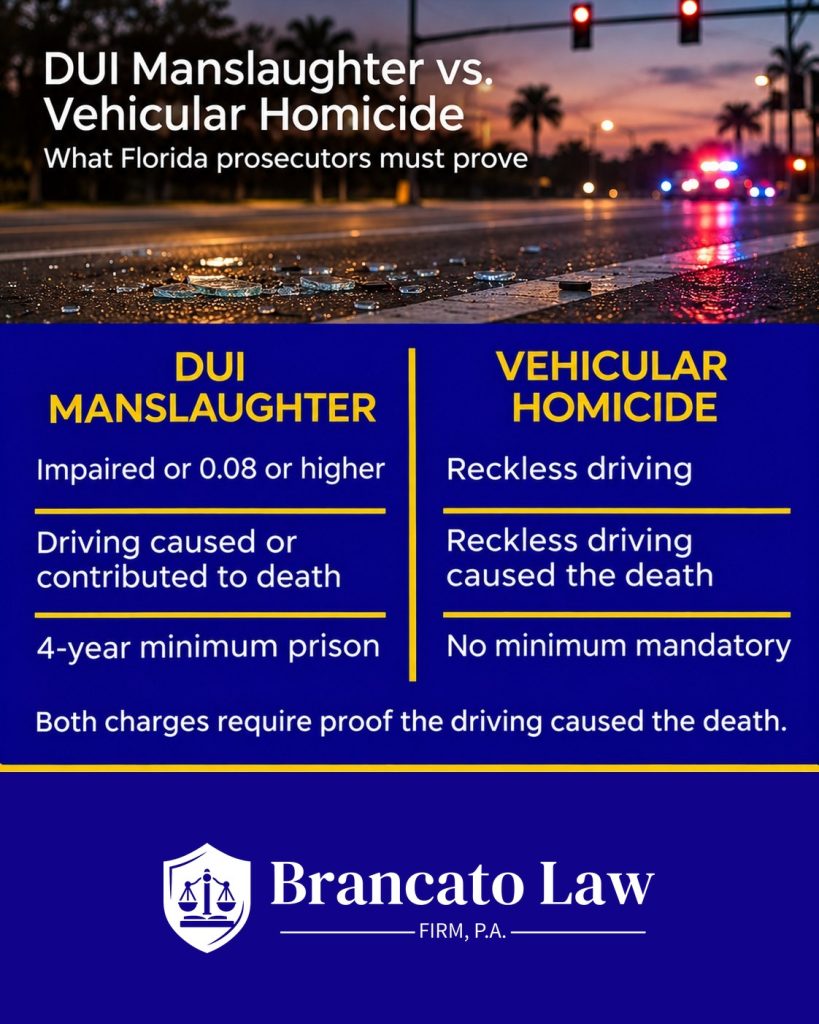
DUI manslaughter and vehicular homicide each carry up to 15 years in prison as second-degree felonies, and each becomes a first-degree felony punishable by up to 30 years if the driver knew or should have known a crash occurred and did not stop to give information and render aid. A DUI manslaughter conviction carries a 4-year minimum mandatory sentence under section 316.193(3) and permanent revocation of the driver license under section 322.28, Florida Statutes. Both charges also become first-degree felonies when the driver has a prior conviction for DUI manslaughter, BUI manslaughter, vehicular homicide, or vessel homicide.
| Charge | Degree | Maximum prison | Minimum mandatory | Offense level |
|---|---|---|---|---|
| DUI manslaughter | Second-degree felony | 15 years | 4 years | Level 8 |
| DUI manslaughter, failing to render aid | First-degree felony | 30 years | 4 years | Level 9 |
| Vehicular homicide | Second-degree felony | 15 years | None | Level 7 |
| Vehicular homicide, failing to render aid | First-degree felony | 30 years | None in s. 782.071 | Level 8 |
| DUI manslaughter or vehicular homicide with a prior fatal-driving conviction | First-degree felony | 30 years | 4 years for DUI manslaughter | Not separately ranked |
| Leaving the scene of a crash involving death | First-degree felony | 30 years | 4 years | Level 7 |
| DUI with serious bodily injury | Third-degree felony | 5 years | None | Level 7 |
The scoresheet usually drives the sentence. Florida’s Criminal Punishment Code worksheet in section 921.0024 adds 120 victim injury points for each death. For a person with no prior record and one count, our math puts the lowest permissible sentence at about 124.5 months for DUI manslaughter (74 points for Level 8 plus 120) and about 111 months for vehicular homicide (56 points for Level 7 plus 120). That is roughly 10 years and 9 years before anything else is scored. A judge can sentence below the scoresheet only with a legal reason for a downward departure, supported by evidence. In practice, the realistic paths away from prison are a reduced charge or a defense that defeats causation or impairment.
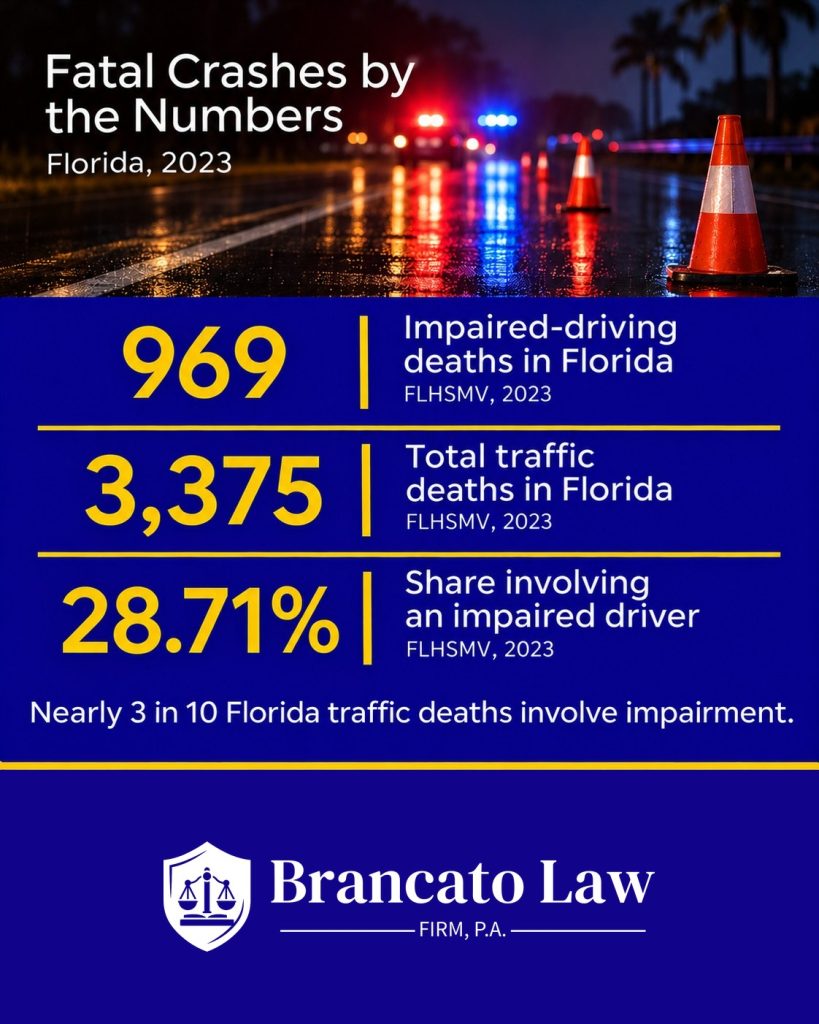
In 2023, Florida recorded 969 impaired-driving traffic deaths out of 3,375 total traffic deaths, or 28.71 percent, according to the Florida Department of Highway Safety and Motor Vehicles 2025 Impaired Driving Annual Report.
Our attorneys have won a DUI manslaughter trial and kept a vehicular homicide client out of prison. These are published results from our firm’s cases.
| Charge | Case | Result |
|---|---|---|
| DUI manslaughter | A defense accident reconstructionist showed the other driver was going nearly twice the speed limit, and a forensic toxicologist showed the client’s alcohol was still being absorbed at the time of driving | Not guilty at trial (read the case study) |
| Vehicular homicide | Fatal single-vehicle crash in Tampa | Reduced to reckless driving with serious bodily injury; 48 months of probation, no prison |
Past results do not guarantee future outcomes. Every case depends on its own facts. More results are on our case results page.
A traffic homicide investigation is the criminal investigation that follows a fatal crash, and it often runs for months before anyone is charged. Depending on where the crash happened, the investigator may be with the Florida Highway Patrol, the county sheriff’s office, or a city police department such as Tampa, St. Petersburg, or Clearwater police. The investigator measures and maps the scene, downloads the vehicles’ crash data, collects video, interviews witnesses, and requests blood results and medical records. The State Attorney’s Office then decides what, if anything, to charge.
That gap between the crash and the charging decision is the most valuable time in the case. Our firm offers representation before charges are filed, and in fatal crash cases that means sending our own reconstructionist to the scene before it changes, preserving the client’s vehicle and its data, finding video before it is recorded over, and deciding case by case what, if anything, to share with the investigator or the prosecutor. The Florida criminal case process page explains where the investigation stage fits in the life of a case.
No, not before you have a lawyer, because anything said to a traffic homicide investigator can become evidence in a homicide prosecution. Florida’s crash report privilege in section 316.066(4), Florida Statutes keeps statements made to an officer for the purpose of completing the crash report out of evidence at trial. The protection is narrow. It does not cover everything a driver says at the scene, at the hospital, or in a later interview, and whether a statement falls inside it is often a fight. Our post on the accident report privilege explains where the line usually falls.
Our attorneys defend fatal crash cases by testing each thing the State must prove: that the client was driving, that the client was impaired or reckless, and that the driving caused the death. We use independent experts, and we check the investigator’s reconstruction against our own. Our Tampa forensic science defense page describes the expert network behind this work.
Causation is the center of most of these cases. In Magaw v. State, 537 So. 2d 564 (Fla. 1989), the Florida Supreme Court held that DUI manslaughter requires proof that the operation of the vehicle caused the death, although the State does not have to prove that the alcohol caused it or that the driver was the only cause. In State v. Hubbard, 751 So. 2d 552 (Fla. 1999), the Court confirmed that causation, not a separate negligence element, is what the jury decides. So the question for the defense is concrete: would this crash have happened the same way no matter who was driving? A speeding driver, a red-light runner, a pedestrian in the dark, a blocked sight line, or a road defect can each break that chain. Our case study on a crash caused by the car, not the driver shows how a reconstructionist and a mechanic found a stuck accelerator in a vehicular homicide case, and the client received probation instead of prison.
Our attorneys challenge both the legal basis for the blood draw and the science behind the result. Section 316.1933, Florida Statutes allows police to force a blood draw only when an officer has probable cause to believe that an impaired driver’s vehicle caused a death or serious bodily injury. We challenge draws taken without that probable cause or without a warrant, hospital blood obtained through improper subpoenas, and lab results with gaps in the chain of custody. We also use retrograde extrapolation and forensic toxicology to show what the alcohol level was at the time of driving, which can be very different from the level hours later. Our posts on warrantless blood draws and medical records in DUI cases go deeper.
The State’s reconstruction is an opinion built on measurements, and our reconstructionist checks every one of them. We download the airbag control module and other crash data ourselves, compare speed estimates against video, and examine lighting, signal timing, and sight lines at the scene. Investigators’ reports rest on assumptions about speed, reaction time, and point of impact, and those assumptions can be wrong.
Vehicular homicide requires recklessness, which is more than ordinary carelessness. In McCreary v. State, 371 So. 2d 1024 (Fla. 1979), the Florida Supreme Court held that vehicular homicide requires negligence that is "more than a mere failure to use ordinary care" but less than the culpable negligence needed for manslaughter. Many fatal crashes come from an ordinary driving error. When the evidence shows a mistake rather than recklessness, our attorneys move to dismiss or fight the charge at trial, and that line is often how a vehicular homicide charge is reduced.
The leaving-the-scene enhancements to DUI manslaughter and vehicular homicide require proof that the driver knew or should have known that a crash occurred. The separate charge of leaving the scene of a crash involving death under section 316.027(2)(c), Florida Statutes is a first-degree felony with a 4-year minimum mandatory sentence, though the defense can ask the judge to depart from that minimum when the driver was not under the influence. For that charge, the State must prove the driver actually knew of the crash, as the Florida Supreme Court held in State v. Dorsett, 158 So. 3d 557 (Fla. 2015). At night, in rain, or with a pedestrian who was not visible, knowledge is a real question. Our post on leaving the scene of an accident in Florida covers the elements.
After an arrest for DUI manslaughter or vehicular homicide in Hillsborough County, the person sees a judge at first appearance, usually within 24 hours, where bond is set or denied. Some drivers are arrested at the scene or the hospital, and others are arrested weeks or months later on a warrant once the investigation is finished. Our attorneys appear at first appearance and, when the bond is too high, ask for a bond hearing with evidence about the client’s ties to the community and the facts of the crash.
The license consequences start early. A DUI arrest can trigger an administrative suspension, and a conviction brings the revocations described above. We handle cases throughout the Hillsborough County courts, as well as in Pinellas County and Pasco County.
For more about our defense strategies, visit our Tampa homicide defense attorney page, our Tampa DUI lawyer page, and our Tampa criminal traffic lawyer page.
Yes. A DUI manslaughter charge can be reduced when the defense shows a problem with impairment, causation, or the blood evidence, most often to vehicular homicide, DUI with serious bodily injury, or reckless driving. Our attorneys at The Brancato Law Firm build that leverage with our own reconstruction and toxicology before negotiating, and our DUI manslaughter defense guide explains how.
Yes, but usually only through a reduced charge or a downward departure, because a single vehicular homicide count with one death scores about 111 months on the lowest permissible sentence. The Brancato Law Firm obtained probation in a vehicular homicide case by proving that a mechanical failure, not reckless driving, caused the crash. Learn more on our homicide defense page.
Possibly, because Florida no longer follows the old rule of one homicide conviction per death. In State v. Maisonet-Maldonado, 308 So. 3d 63 (Fla. 2020), the Florida Supreme Court held that the "single homicide rule" no longer applies, in a case involving fleeing and eluding and vehicular homicide. Our attorneys at The Brancato Law Firm review every count stacked on a fatal crash and challenge any that the law does not allow.
No. If the other driver’s conduct, and not the accused driver’s operation of the vehicle, caused the death, the State cannot prove the causation element even if the accused driver was over the limit. The Brancato Law Firm won a not guilty verdict on this point in a DUI manslaughter trial where the other driver was traveling at nearly twice the speed limit.
Yes. The weeks after a fatal crash are when evidence disappears and when the investigator is deciding what to recommend. The Brancato Law Firm offers pre-file advocacy to preserve the evidence, protect you from interviews, and present the defense to the prosecutor before a charging decision is made.
Yes. Florida law requires permanent revocation of the driver license after a DUI manslaughter conviction, and a vehicular homicide conviction brings a revocation of at least 3 years under section 322.28. Our attorneys at The Brancato Law Firm explain the license consequences of every plea offer before a client decides.
If a fatal crash is under investigation, the first days decide what evidence will still exist when the case reaches a courtroom. Call The Brancato Law Firm, P.A., founded by Tampa Criminal Defense Attorney Rocky Brancato, at (813) 727-7159. You can call us at any hour, and our office is two blocks from the courthouse. Our firm has Spanish-speaking staff, and attorney Jean-Luc Adrien speaks Spanish, Haitian Creole, and French.
The Brancato Law Firm, P.A.
620 E. Twiggs Street, Suite 205, Tampa, FL 33602
(813) 727-7159
Serving Hillsborough, Pinellas, and Pasco Counties
The Brancato Law Firm, P.A. is a Tampa-based criminal defense practice. We are not affiliated with any other Brancato-named law firms.

Tampa, FL 33602

Free Legal Consultation (813) 727-7159
