- Free Consultation 24/7: (813) 727-7159 Tap Here To Call Us


From First DUI to Death Penalty



What Is Vehicular Homicide in Florida? (2026 Guide)


Rewrite/update date: October 12, 2026
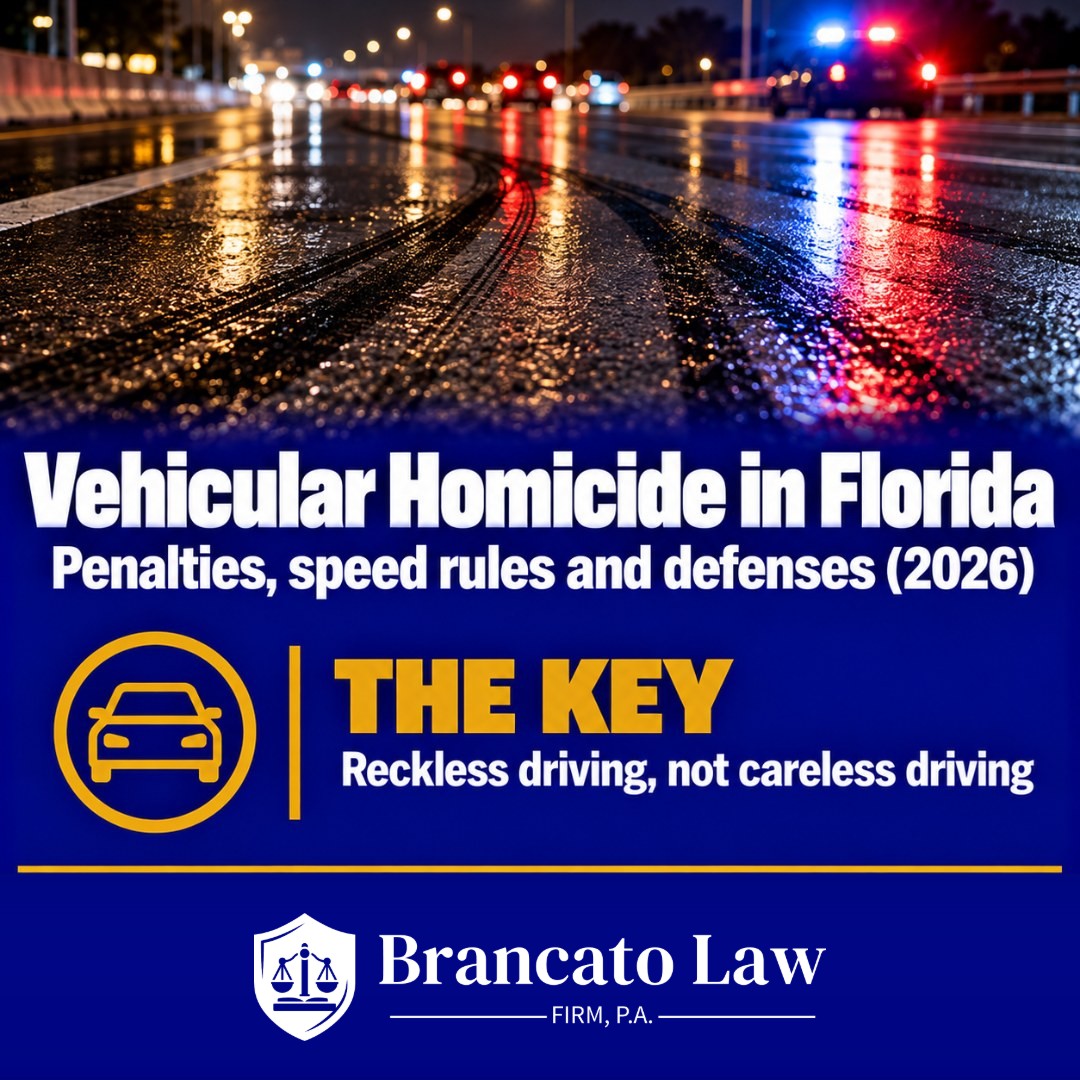
| Vehicular homicide in Florida is causing a death by driving “in a reckless manner likely to cause the death of, or great bodily harm to, another,” under section 782.071, Florida Statutes. It is a second-degree felony punishable by up to 15 years in prison, and a first-degree felony punishable by up to 30 years if the driver failed to give information and render aid or has a prior qualifying conviction. The State does not have to prove impairment, but it must prove reckless driving, not mere carelessness. In October 2026, a Florida appeals court ordered a new trial because a detective’s formula-based speed estimate reached the jury without the screening required for expert testimony. |
I’m Rocky Brancato, founder of The Brancato Law Firm, P.A., a Tampa criminal defense firm. I meet the Florida Rule of Criminal Procedure 3.112 qualifications for capital cases, spent years in the Major Crimes Unit of the Hillsborough County Public Defender’s Office, and have taken more than 150 jury trials to verdict. When our attorneys defend a vehicular homicide case, the first call we usually make is to an accident reconstruction expert.
How does Florida define vehicular homicide?
Vehicular homicide is the killing of a human being, or of an unborn child by injury to the mother, “caused by the operation of a motor vehicle by another in a reckless manner likely to cause the death of, or great bodily harm to, another.” That definition comes from section 782.071, Florida Statutes.
The key word is reckless. Vehicular homicide does not require alcohol, drugs, or any intent to hurt anyone. It does require more than a mistake. Reckless driving means driving with willful or wanton disregard for the safety of people or property, the same standard used for reckless driving under section 316.192. A moment of inattention, a misjudged left turn, or ordinary speeding that ends in a death is not automatically vehicular homicide. Our Tampa homicide attorney page explains how we defend every type of homicide charge, including this one.
Fatal crashes are common in Tampa Bay. In 2024, 180 people died in traffic crashes in Hillsborough County, down from 230 in 2023 and 225 in 2022, according to the Florida Department of Highway Safety and Motor Vehicles’ Florida Traffic Crash Facts Annual Report 2024. Statewide that year, 449 people were killed in crashes flagged for speeding or aggressive driving, and 321 of those deaths involved speeding. Most of those crashes never lead to a homicide charge, because the State must prove recklessness, not just a tragic outcome.
What are the penalties for vehicular homicide in Florida?
The base offense is a second-degree felony with a maximum of 15 years in prison and a $10,000 fine. Two circumstances raise it to a first-degree felony with a 30-year maximum.
| Offense | Statute | Classification | Maximum prison |
|---|---|---|---|
| Vehicular homicide | § 782.071(1)(a) | Second-degree felony | 15 years |
| Vehicular homicide where the driver knew or should have known of the crash and failed to give information and render aid | § 782.071(1)(b) | First-degree felony | 30 years |
| Vehicular homicide with a prior qualifying conviction (Trenton’s Law) | § 782.071(1)(c) | First-degree felony | 30 years |
| Leaving the scene of a crash involving death (a separate charge) | § 316.027(2)(c) | First-degree felony | 30 years, with a 4-year mandatory minimum |
The failure-to-render-aid enhancement does not require proof that the driver knew anyone was hurt, only that the driver knew or should have known a crash occurred. Trenton’s Law, enacted in chapter 2025-121, Laws of Florida, took effect October 1, 2025. It makes vehicular homicide a first-degree felony when the driver has a prior conviction for vehicular homicide, DUI manslaughter, boating under the influence manslaughter, or vessel homicide.
A conviction also brings a driver license revocation of at least 3 years under section 322.28(4)(a). The court may order 120 hours of community service in a trauma center or hospital that regularly receives crash victims, and courts order restitution to the victim’s family. The 4-year mandatory minimum for leaving the scene appears in section 316.027, not in the vehicular homicide statute, and section 316.027(2)(g) lets the court depart from it in some cases that do not involve impairment. We cover that charge in what is leaving the scene of an accident in Florida.
What must the State prove to convict you of vehicular homicide?
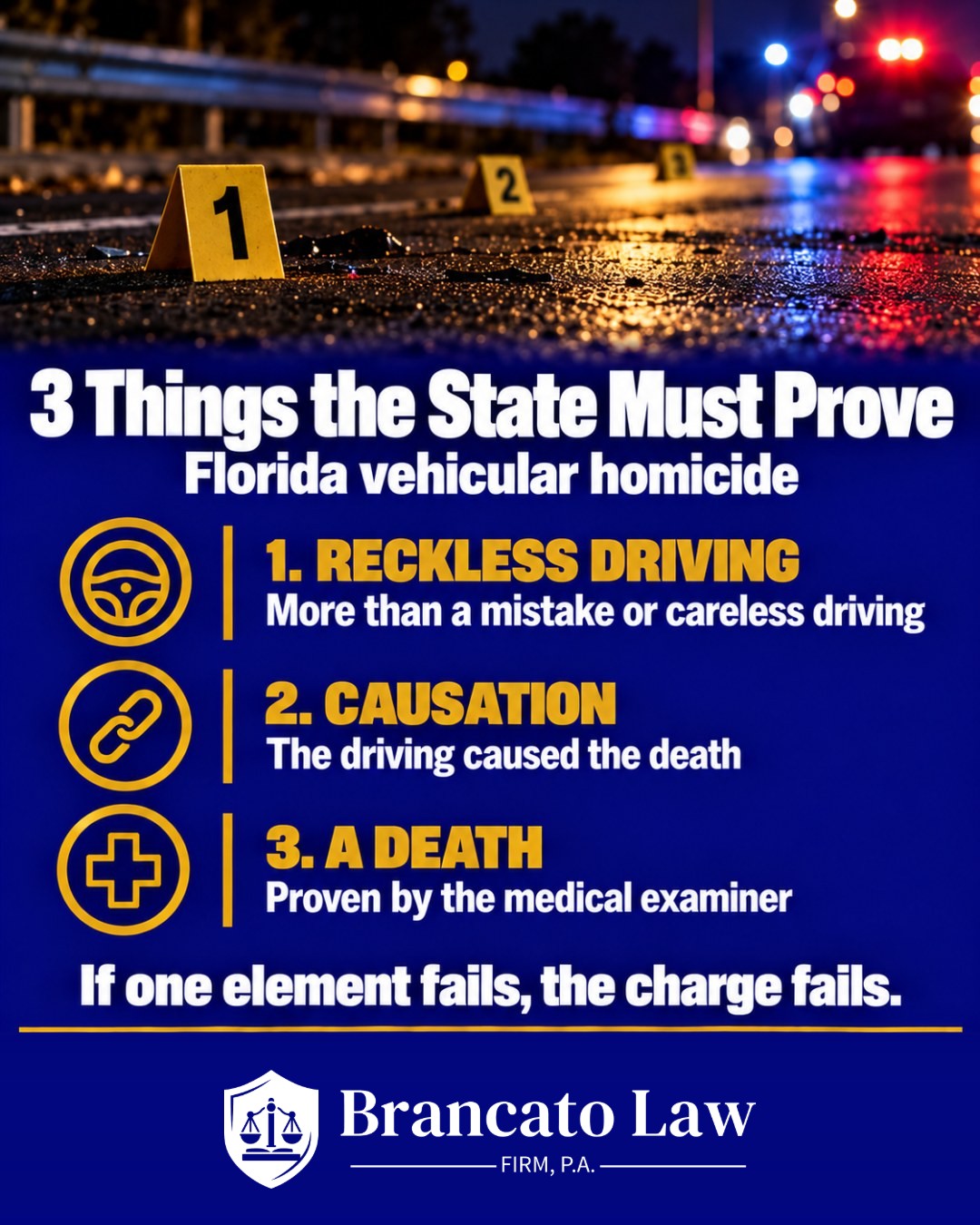
The State must prove three elements beyond a reasonable doubt:
- Reckless operation of a motor vehicle. The driving must show willful or wanton disregard for safety, not negligence. Most vehicular homicide defenses focus here.
- Causation. The reckless driving must have caused the death. Another driver running a red light, a mechanical failure, or a road hazard can break that chain.
- The death of a human being or an unborn child. The medical examiner usually proves this, but the State must still connect the death to the crash rather than to a separate medical event.
Can speeding alone be vehicular homicide in Florida?
In Hillsborough, Pinellas, and Pasco Counties, ordinary speeding alone is not enough. The Second District Court of Appeal, which hears appeals from all three counties, has held that “[s]peed alone will not support a charge of vehicular homicide.” That rule comes from House v. State, 831 So. 2d 1230 (Fla. 2d DCA 2002), where the driver was going about 60 mph in a 30 mph residential zone.
The Second District repeated the rule in State v. Desange, 294 So. 3d 433 (Fla. 2d DCA 2020), a Tampa case from a fatal crash near 40th Street and Lake Avenue. The court said “merely speeding, without any other facts or circumstances demonstrating recklessness as distinguished from negligence, is insufficient.” The court still reinstated the jury’s verdict, because Desange was also weaving through heavy traffic, using turn lanes and bike lanes, sideswiping a car without stopping, and cutting right from the left lane. In Harris v. State, 318 So. 3d 645 (Fla. 2d DCA 2021), the court held that driving 94 mph in a 40 mph zone, standing alone, did not prove reckless driving.
Courts in other parts of Florida have held that grossly excessive speed can be enough by itself:
| Court | Case | Speed and setting | Result |
|---|---|---|---|
| 2d DCA | House (2002) | About 60 in a 30, residential | Speed alone not enough |
| 2d DCA | Desange (2020) | 72 mph five seconds before impact, plus weaving and a sideswipe, Tampa | Verdict reinstated because of the other conduct |
| 2d DCA | Harris (2021) | 94 in a 40 | Not reckless driving |
| 3d DCA | Luzardo v. State, 147 So. 3d 1083 (2014) | 83.9 in a 55, the driver tried to swerve | Conviction reversed |
| 4th DCA | Pozo v. State, 963 So. 2d 831 (2007) | 67 to 90 in a 35, residential, in rain | Evidence sufficient (reversed on another issue) |
| 4th DCA | Natal v. State, 278 So. 3d 705 (2019) | 82 to 85 in a 40, accelerating | Reckless driving verdict affirmed |
| 5th DCA | Ruiz v. State, 286 So. 3d 338 (2019) | Racing at the time of the crash | Evidence sufficient |
The Third District summed up the tension in Luzardo: “if there must be a jingle in this area of the law, we would prefer, ‘Speed alone is not enough, except when it is.’” Most recently, the Sixth District affirmed a vehicular homicide conviction in Audinot Lugo v. State, No. 6D2025-1884 (Fla. 6th DCA Aug. 14, 2026), in a short opinion citing Luzardo, Pozo, and Ruiz.
The Legislature responded to the speed-alone gap in 2025 by creating a separate crime of dangerous excessive speeding, which we explain in Florida’s new dangerous excessive speeding crime. Local procedure is covered on our Hillsborough County criminal defense page.
How does the State prove how fast you were going?
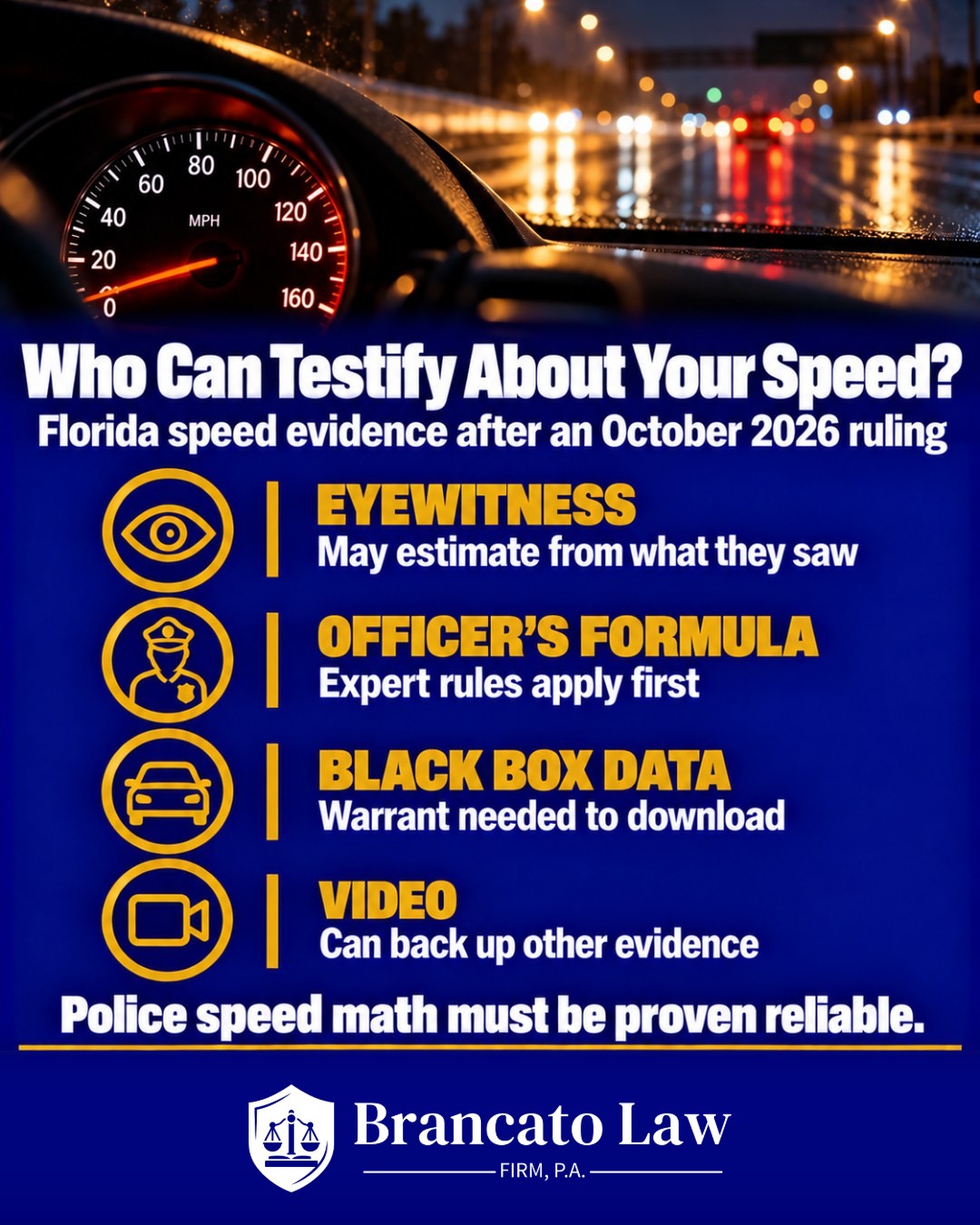
The State usually proves speed through some combination of eyewitnesses, police calculations, video, and the car’s event data recorder, often called the black box. Each type of evidence has its own rules.
| Type of speed evidence | What the law requires | Key authority |
|---|---|---|
| Eyewitness estimate | A witness who had a real chance to observe can estimate speed as a matter of common observation | Lewek v. State, 702 So. 2d 527 (Fla. 4th DCA 1997) |
| Officer’s calculation from a formula, crush damage, or skid marks | Expert testimony that must meet the reliability test in section 90.702 | Faustin (2026); Kemp (2019) |
| Event data recorder download | A warrant is required to download it from an impounded car, absent an emergency | State v. Worsham, 227 So. 3d 602 (Fla. 4th DCA 2017) |
| Video-based speed calculation | Can corroborate other speed evidence | Desange (2d DCA 2020) |
Black-box data is strong but not perfect. A 2011 National Highway Traffic Safety Administration test of event data recorders in Toyota vehicles, Event Data Recorder: Pre-Crash Data Validation of Toyota Products, found the recorded speeds accurate within about 1.5 mph in low-speed tests, but the data was recorded once per second and could be up to about half a second old. Reconstruction formulas have their own limits. An engineering paper published by SAE International, L. D. Metz and L. G. Metz, Sensitivity of Accident Reconstruction Calculations (SAE Technical Paper 980375, 1998), notes that crash inputs are “almost always” estimated or measured approximately and warns of “the inherent sensitivity of some of the calculations to seemingly small variations in variable magnitudes.”
What did Faustin v. State decide about police speed testimony?
In Faustin v. State, Nos. 4D2024-2667 & 4D2024-2669 (Fla. 4th DCA Oct. 7, 2026), the Fourth District held that a detective’s speed calculation using a “momentum formula” is expert testimony, and it reversed two vehicular homicide convictions because the trial court let the jury hear it without screening it as expert evidence.
Neckson Faustin was convicted in Broward County of two counts of vehicular homicide and one count of reckless driving causing property damage. At trial, Detective Michael Wiley, “a lay witness who acknowledged he was not an accredited accident reconstructionist,” told the jury how fast the vehicles were going “based on his calculation using what he called a ‘momentum formula.’” The trial judge allowed it on the theory that the detective was “merely testifying about his investigation.”
The Fourth District disagreed: “Because Wiley’s calculation depended on specialized knowledge and methodology, it constituted expert opinion testimony subject to section 90.702.” Under section 90.702, which the Florida Supreme Court adopted as Florida’s Daubert standard in In re Amendments to the Florida Evidence Code, 278 So. 3d 551 (Fla. 2019), expert testimony must rest on sufficient facts or data and reliable methods that the witness applied reliably to the case.
The detective’s work failed that test on this record. The court noted that he:
- Used vehicle weights “derived from averages found through internet searches.”
- Calculated departure angles “using Google Maps and a protractor,” while admitting the angles had to be “very accurate.”
- Assumed the Corolla’s approach angle was zero because “[t]hat is how we are taught to do it when we use this formula.”
- Could no longer produce the field sketch behind his calculations.
The State argued the error was harmless because the cars’ event data recorders also showed speed. The court rejected that argument because “testimony established that the data could not be reliably interpreted without independent accident reconstruction.” The detective’s numbers “purported to corroborate that evidence on an issue central to whether the defendant drove recklessly.” The court ordered a new trial.
Faustin does not say that only accredited reconstructionists may testify about speed. It says a formula-based calculation is expert opinion, so the judge must decide whether it is reliable before the jury hears it. The Fourth District reached a similar result in Kemp v. State, 280 So. 3d 81 (Fla. 4th DCA 2019), a vehicular homicide case where a corporal’s opinion from “eyeballing” crush damage failed the reliability test and the court also ordered a new trial. As the Kemp court put it, “repeated invocation of the magic words ‘training and experience’ was insufficient.”
Faustin is a Fourth District decision. Trial courts in Tampa Bay follow other districts’ decisions when the Second District has not ruled otherwise, and the section 90.702 standard applies statewide.
The challenge to police speed math can be raised at three points: in a pretrial motion asking the judge to hold a reliability hearing, by objection at trial, and on appeal if the judge lets unreliable testimony in. Losing at one stage does not end the issue at the next.
How do our attorneys defend vehicular homicide charges?
We attack the two elements the State most often overreaches on, recklessness and causation, with independent expert work rather than argument alone. Our defense in these cases typically includes:
- An independent reconstruction. Our expert reviews the scene measurements, crush damage, video, and black-box data before the State’s version hardens.
- Reliability challenges to State experts. Under Faustin and Kemp, we ask the court to screen speed and braking opinions before the jury hears them. Our Tampa criminal forensic science attorney page explains how we work with experts.
- Suppression of black-box data. If police downloaded the event data recorder without a warrant or a real emergency, we move to suppress it under Worsham.
- Mechanical and other causes. ASE-certified mechanics inspect for brake failure, tire failure, and steering defects, and we investigate the role of other drivers and road conditions.
- The speed-alone rule. In our district, the State must prove more than speed. We hold it to House, Desange, and Harris.
| Case result | Outcome |
|---|---|
| Vehicular homicide charge after a crash our reconstruction expert and an ASE-certified mechanic traced to a stuck accelerator | Probation instead of prison |
| Vehicular homicide charge after a single-vehicle crash | Reduced to reckless driving with serious bodily injury after our reconstruction expert’s analysis; 48 months of probation, no prison |
Past results do not guarantee future outcomes. We tell the full story in When the Car, Not the Driver, Caused the Crash.
What should you do if you are under investigation after a fatal crash?
Talk to a lawyer before you give any statement. Vehicular homicide charges are often filed weeks or months after the crash, while the traffic homicide investigator waits for toxicology, downloads the event data recorders, and reconstructs the scene. In the 13th Judicial Circuit, fatal crashes are assigned to traffic homicide investigators from the Florida Highway Patrol, the Hillsborough County Sheriff’s Office, or the Tampa Police Department.
There is no deadline that protects you by running out. Under section 775.15(1), “a felony that resulted in a death may be commenced at any time.”
That investigation window is when a defense expert can still photograph the scene, inspect the vehicles before they are released or repaired, and preserve electronic data. What you say to the investigator, even to explain, often becomes the recklessness evidence. Our pre-file advocacy work manages contact with law enforcement and gets preservation demands out early. Our guide to whether the Florida accident report privilege requires you to talk to police after a crash explains what you must tell an officer and what you can decline.
For more about our defense strategies, visit our Homicide Defense page.
Frequently asked questions about vehicular homicide in Florida
Can police use my car’s black box data without a warrant in Florida?
Not usually. In State v. Worsham, the Fourth District held that police need a warrant to download event data from an impounded car unless an emergency exists. The Brancato Law Firm checks how and when the black box was downloaded in every fatal crash case.
Does a traffic homicide investigator have to be an accredited reconstructionist to testify about speed?
Faustin v. State (2026) did not require accreditation, but it held that a formula-based speed calculation is expert testimony. Under Faustin, the judge must decide whether the method is reliable and was applied reliably before the jury hears it. Our attorneys at The Brancato Law Firm file those challenges before trial so the issue is decided on a full record.
Can a witness testify about how fast they think I was driving?
Yes, if the witness had a real opportunity to observe. Florida courts treat a speed estimate as common observation, but the estimate must rest on what the witness actually saw. The Brancato Law Firm investigates each eyewitness’s vantage point, lighting, and distance to test that estimate.
Is there a statute of limitations for vehicular homicide in Florida?
No. Section 775.15(1) allows prosecution of “a felony that resulted in a death” at any time. Because charges can come months later, The Brancato Law Firm begins preserving evidence as soon as a client calls.
Can vehicular homicide charges be dropped or reduced in Florida?
Yes, when the recklessness or causation evidence is weaker than the tragedy suggests. A charge can be reduced to reckless driving when the defense shows negligent rather than reckless driving, or dropped when an independent cause produced the death. The Brancato Law Firm builds those arguments on independent expert analysis, as our Tampa criminal traffic lawyer page describes for reckless driving cases.
What is the difference between vehicular homicide and DUI manslaughter?
Vehicular homicide requires reckless driving but no impairment, while DUI manslaughter requires impairment or an unlawful alcohol level but no recklessness. Prosecutors sometimes charge both from the same crash. Our attorneys at The Brancato Law Firm explain the differences in our guide to DUI manslaughter in Florida.
Does Trenton’s Law make a second vehicular homicide a first-degree felony?
Yes. Since October 1, 2025, section 782.071(1)(c) makes vehicular homicide a first-degree felony when the driver has a prior conviction for vehicular homicide, DUI manslaughter, boating under the influence manslaughter, or vessel homicide. The Brancato Law Firm examines every prior conviction the State relies on to confirm it actually qualifies.
Is vessel homicide treated the same way?
Yes. Section 782.072 applies the same penalty structure to deaths caused by reckless operation of a boat. Our attorneys at The Brancato Law Firm defend vessel homicide charges with the same expert-driven approach, adding the navigation rules and wake conditions that replace lanes and traffic signals on the water.
Talk to a Tampa criminal defense attorney after a fatal crash
If you or a loved one is under investigation or has been charged after a fatal crash in Hillsborough, Pinellas, or Pasco County, the attorneys of The Brancato Law Firm, P.A., founded by Tampa Criminal Defense Attorney Rocky Brancato, can get an independent reconstruction started now. Call (813) 727-7159 before you speak with the traffic homicide investigator. Vehicles get released, data gets overwritten, and scenes get repaved.
The Brancato Law Firm, P.A.
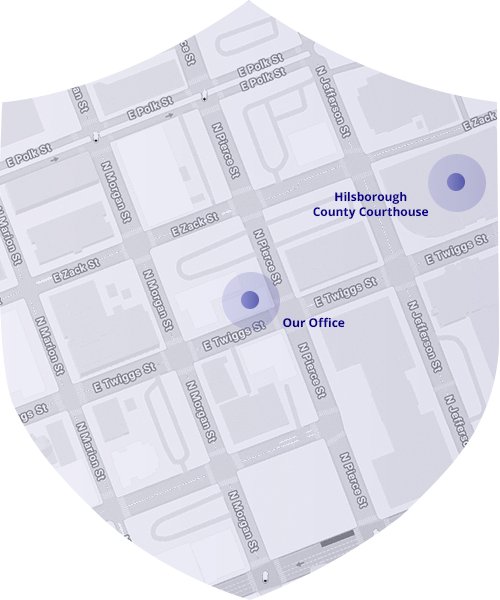
620 E. Twiggs Street, Suite 205, Tampa, FL 33602
(813) 727-7159
Serving Hillsborough, Pinellas, and Pasco Counties
The Brancato Law Firm, P.A. is a Tampa-based criminal defense practice. We are not affiliated with any other Brancato-named law firms.
Visit Us
Tampa, FL 33602
Contact Us Now
Free Legal Consultation (813) 727-7159