Strategic Defense,
From First DUI to Death Penalty
From First DUI to Death Penalty






You got pulled over for speeding. Now you’re facing a felony.
In Florida, what starts as a routine traffic stop can quickly escalate into criminal charges that carry jail time, license revocation, and a permanent criminal record. Criminal traffic offenses are different from traffic tickets. They follow you for life.
A Tampa criminal traffic attorney defends clients against charges including DUI, reckless driving, driving with a suspended license (DWLS), fleeing to elude, and leaving the scene of an accident. The Brancato Law Firm, P.A. has defended these cases throughout Tampa Bay for more than 25 years.
Rocky Brancato founded the firm after spending nearly 24 years at the Hillsborough County Public Defender’s Office, where he rose to Chief Operations Officer and Chief Assistant Public Defender, leading the largest criminal defense operation in Tampa Bay. He is a member of the National College for DUI Defense (NCDD) and brings system-level knowledge of how charging decisions, license suspension hearings, and criminal traffic cases move through the local courts. If you are charged with a criminal traffic offense, the firm can help.
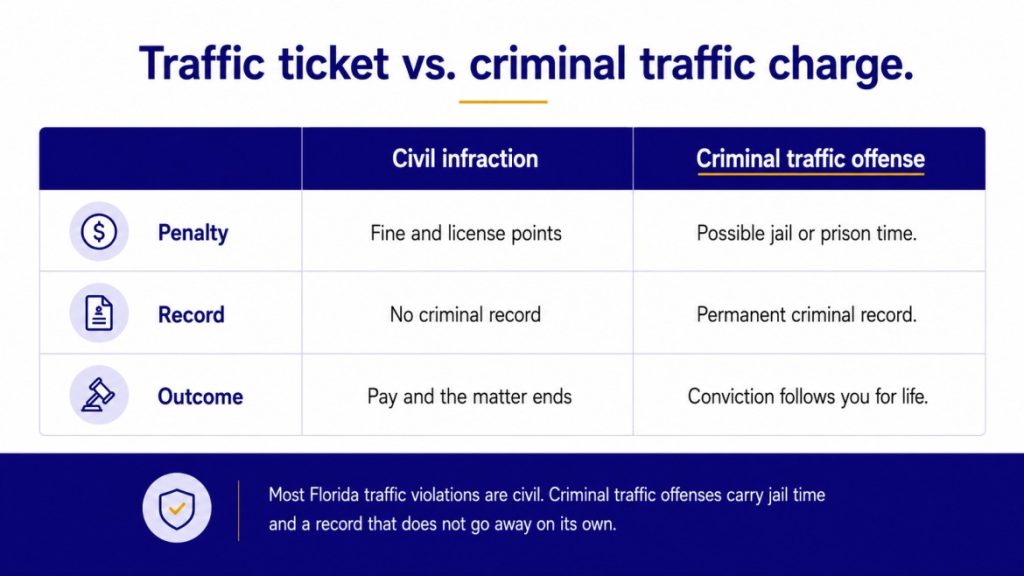
Most traffic violations in Florida are civil infractions. You pay a fine, points hit your license, and the matter ends. Criminal traffic offenses work differently. They carry potential jail or prison time, mandatory license revocation, and a criminal record that does not go away on its own. An arrest does not equal a conviction. With the right defense, criminal traffic charges can often be reduced or dismissed.
Common criminal traffic charges include:
Penalties under Florida’s criminal traffic statutes range from $25 for a first-offense reckless driving conviction to $10,000 for offenses such as DUI manslaughter, leaving the scene of a fatal crash, and aggravated fleeing causing death. The table below summarizes the statutory maximums.
| Charge | Florida Statute | Classification | Maximum Penalty |
| Reckless driving (1st conviction) | §316.192 | 2nd-degree misdemeanor | 90 days jail; $500 fine |
| Reckless driving causing serious bodily injury | §316.192 | 3rd-degree felony | 5 years prison; $5,000 fine |
| Dangerous excessive speeding (1st conviction) | §316.1922 | Criminal traffic offense | 30 days jail; $500 fine |
| Dangerous excessive speeding (2nd within 5 years) | §316.1922 | Criminal traffic offense | 90 days jail; $1,000 fine; license revocation 180 days–1 yr |
| DUI (1st offense) | §316.193 | 2nd-degree misdemeanor | 6 months jail; $1,000 fine ($500 min) |
| DUI (3rd within 10 years) | §316.193 | 3rd-degree felony | 5 years prison; $5,000 fine; 30-day mandatory jail |
| DUI with serious bodily injury | §316.193 | 3rd-degree felony | 5 years prison; $5,000 fine |
| DUI manslaughter (baseline) | §316.193 | 2nd-degree felony | 15 years prison; $10,000 fine; 4-year mandatory minimum |
| DUI manslaughter (Trenton’s Law, repeat offender) | §316.193(3)(c)3.c. | 1st-degree felony | 30 years prison; $10,000 fine |
| Vehicular homicide | §782.071 | 2nd-degree felony | 15 years prison; $10,000 fine |
| DWLS (knowing, 1st conviction) | §322.34 | 2nd-degree misdemeanor | 60 days jail; $500 fine |
| DWLS (3rd+ with qualifying predicate) | §322.34(2)(c) | 3rd-degree felony | 5 years prison; $5,000 fine |
| Habitual Traffic Offender | §322.34(5) | 3rd-degree felony | 5 years prison; $5,000 fine |
| Fleeing or eluding (basic) | §316.1935 | 3rd-degree felony | 5 years prison; $5,000 fine |
| Aggravated fleeing causing death | §316.1935(4)(b) | 1st-degree felony | 30 years prison; $10,000 fine; 3-year mandatory minimum |
| Leaving the scene with injury | §316.027 | 3rd-degree felony | 5 years prison; $5,000 fine |
| Leaving the scene with death | §316.027(2)(c) | 1st-degree felony | 30 years prison; $10,000 fine; 4-year mandatory minimum |
These figures reflect statutory maximums only. Actual sentences depend on Florida’s Criminal Punishment Code scoresheet, mandatory minimums, prior record, and judicial discretion.
Note on DWLS: a third or subsequent conviction is only charged as a third-degree felony when the underlying license suspension was for DUI, refusal to submit to testing, or a traffic offense causing death or serious bodily injury. Otherwise the offense remains a misdemeanor.
DUI charges are among the most common and most defensible criminal traffic offenses. A DUI arrest does not mean a DUI conviction. The firm challenges every aspect of the State’s case, from the legality of the traffic stop to the accuracy of the breath test.
The firm defends:
If you are charged with DUI, see the firm’s dedicated Tampa DUI Attorney page for additional information on defense strategy and the administrative license process.
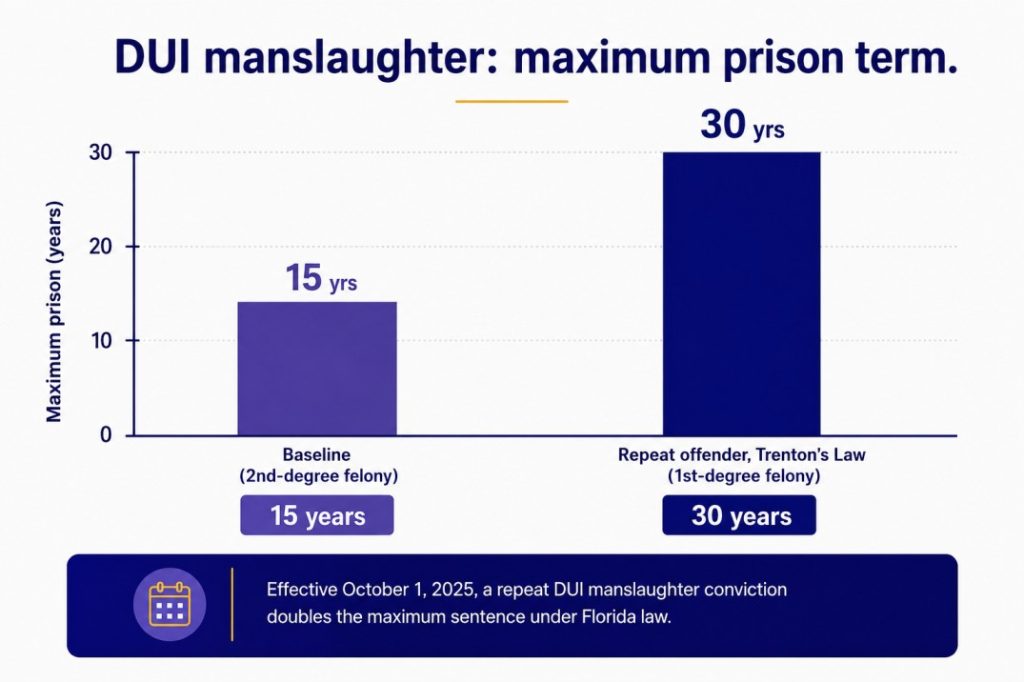
Effective October 1, 2025, Florida’s “Trenton’s Law” (HB 687, ch. 2025-121) raised the penalty for DUI manslaughter when the defendant has a prior DUI manslaughter, BUI manslaughter, or vehicular or vessel homicide conviction. Under the new §316.193(3)(c)3.c., the charge is a first-degree felony punishable by up to 30 years in prison. Baseline DUI manslaughter remains a second-degree felony with a mandatory minimum four years in prison.
If a prior conviction is part of the State’s case, prior-conviction evidence and the predicate offenses themselves can be challenged. Out-of-state convictions, in particular, often fail to meet the statutory definition required to trigger the enhancement.
For decades, speeding in Florida was a civil traffic infraction: a fine, points on your license, and the matter ended. That changed on July 1, 2025. Under HB 351 (ch. 2025-77), codified at §316.1922, Fla. Stat., extreme speeding is now a criminal offense, formally called dangerous excessive speeding and sometimes referred to as Florida’s “super speeder” law. Many drivers are surprised to learn that a speed-based stop can now result in a criminal charge rather than a ticket.
A driver commits the offense in one of two ways:
A first conviction carries up to 30 days in jail and a $500 fine. A second conviction within five years carries up to 90 days in jail, a $1,000 fine, and mandatory license revocation for 180 days to one year. Because the charge is criminal, a mandatory court appearance is required, and a conviction becomes part of your permanent criminal record, not just your driving record.
The firm defends dangerous and excessive speeding charges by challenging the accuracy and calibration of the speed-measuring equipment, the legality of the stop, and the officer’s observations. Under the 100-mph prong, the State’s burden to prove a dangerous manner of driving can create an opening where no other vehicles or people were nearby. For a complete breakdown of the law, the penalties, and the available defenses, see the firm’s guide to Florida’s dangerous excessive speeding law.
Every criminal traffic case is built on facts the State must prove. The firm’s defense strategy focuses on attacking those facts at every available point.
The firm’s approach to criminal traffic cases applies the same forensic rigor used in homicide and major-crimes defense. A first-offense DUI receives the same level of preparation as a felony case.
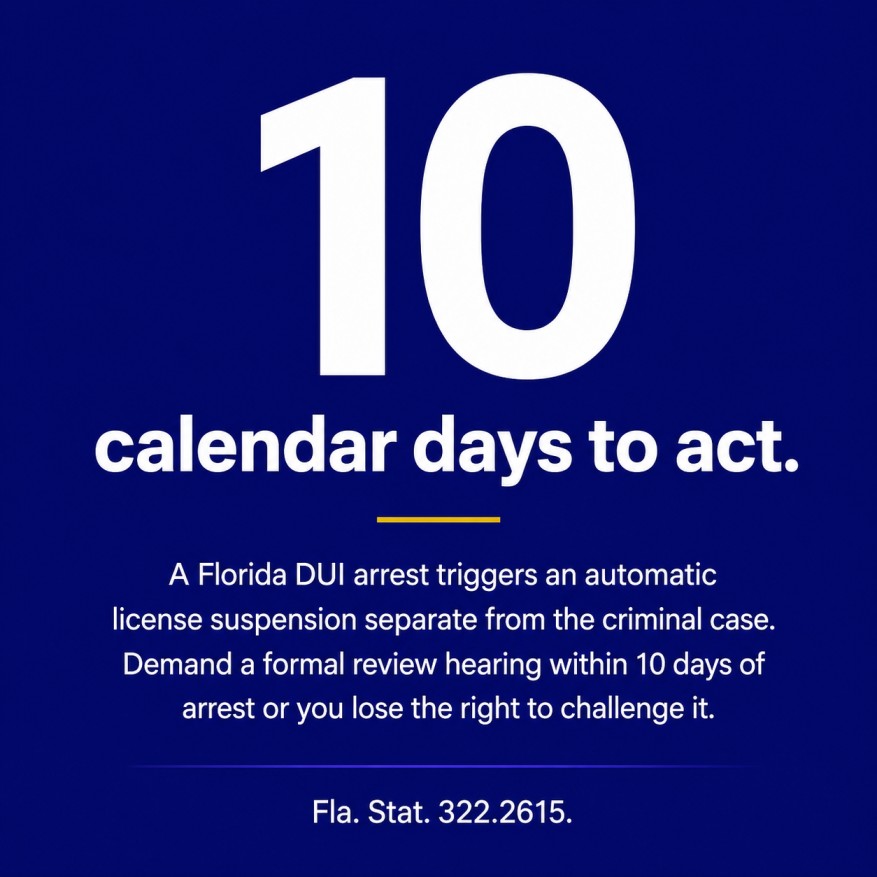
A DUI arrest in Florida triggers an immediate administrative license suspension that is separate from the criminal case. Under §322.2615, Fla. Stat., a driver has 10 calendar days from the date of arrest or issuance of the notice of suspension, whichever is later, to demand a formal review hearing before the FLHSMV Bureau of Administrative Reviews.
Missing this deadline waives the right to challenge the administrative suspension. It also forfeits a valuable defense tool: the ability to subpoena and cross-examine the arresting officer and breath-test operator at a sworn proceeding before the criminal case proceeds.
The firm represents clients at formal review hearings and uses the proceeding both to challenge the suspension itself and to develop the defense to the underlying criminal charge.
Not every criminal defense attorney handles criminal traffic cases at the same depth. When evaluating attorneys, consider:
The firm serves clients throughout Tampa Bay, including Hillsborough County, Pinellas County, and Pasco County.
Yes. Under §316.193, Fla. Stat., DUI is a criminal offense in Florida from the first conviction. A first-offense DUI is a second-degree misdemeanor punishable by up to six months in jail and a fine of up to $1,000. Enhanced penalties apply when the driver’s blood alcohol level is 0.15 or higher or when a minor is in the vehicle.
Most speeding is a civil traffic infraction handled with a fine and points. However, since July 1, 2025, driving more than 50 mph over the posted limit, or 100 mph or more in a dangerous manner, is a criminal offense under §316.1922, Fla. Stat., known as dangerous excessive speeding. A first conviction carries up to 30 days in jail and a $500 fine, and the charge requires a mandatory court appearance rather than a payable ticket.
Yes. Reckless driving charges are often reduced to civil infractions such as careless driving when the evidence is weak or the driver has a clean record. Reduction usually requires negotiation with the prosecutor and may involve completing a driving course or community service.
You lose the right to a formal review hearing and the administrative suspension takes effect. You may still apply for a hardship license, but only after the mandatory “hard suspension” period (30 days for a breath-test failure, 90 days for a refusal) has expired.
Yes. Criminal traffic convictions are part of your permanent criminal record and cannot be sealed or expunged after conviction. The only exception is when charges are dismissed or when a withhold of adjudication is entered, in which case sealing or expungement may be possible depending on the offense.
Fees vary depending on the charge, the complexity of the case, and whether the case is set for trial. The firm provides flat-fee quotes after a free consultation so you know your defense costs before committing.
Yes. The firm handles the full range of serious criminal traffic offenses, including DUI manslaughter, vehicular homicide, and leaving the scene of a fatal accident. These cases require forensic toxicology, accident reconstruction, and expert testimony, all of which are routine components of the firm’s defense strategy.
The Brancato Law Firm fights to keep criminal traffic offenses off your record and your license in your hands. Call (813) 727-7159 for a confidential consultation, or visit the firm’s contact page to schedule online.
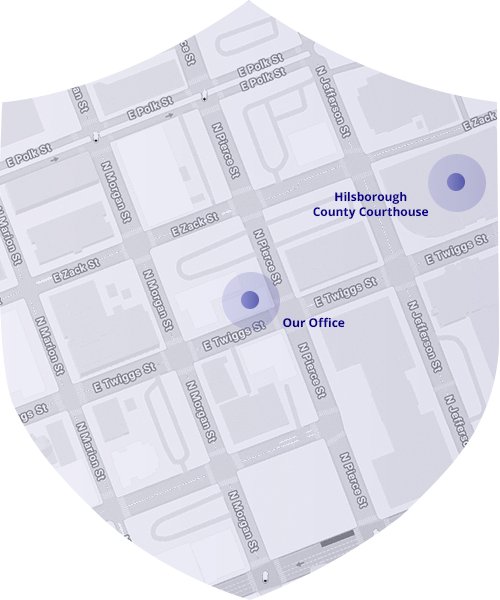
The Brancato Law Firm, P.A. 620 E Twiggs Street, Suite 205, Tampa, FL 33602 (813) 727-7159
The Brancato Law Firm, P.A. is not affiliated with any other Brancato-named law firms.
Each case is unique. Past results do not guarantee future outcomes. The information on this page is provided for general informational purposes and is not legal advice.
Tampa, FL 33602
Free Legal Consultation (813) 727-7159