- Free Consultation 24/7: (813) 727-7159 Tap Here To Call Us


From First DUI to Death Penalty



What Is DUI Manslaughter in Florida?


Completely rewritten and updated September 1, 2026. Originally published February 22, 2026.
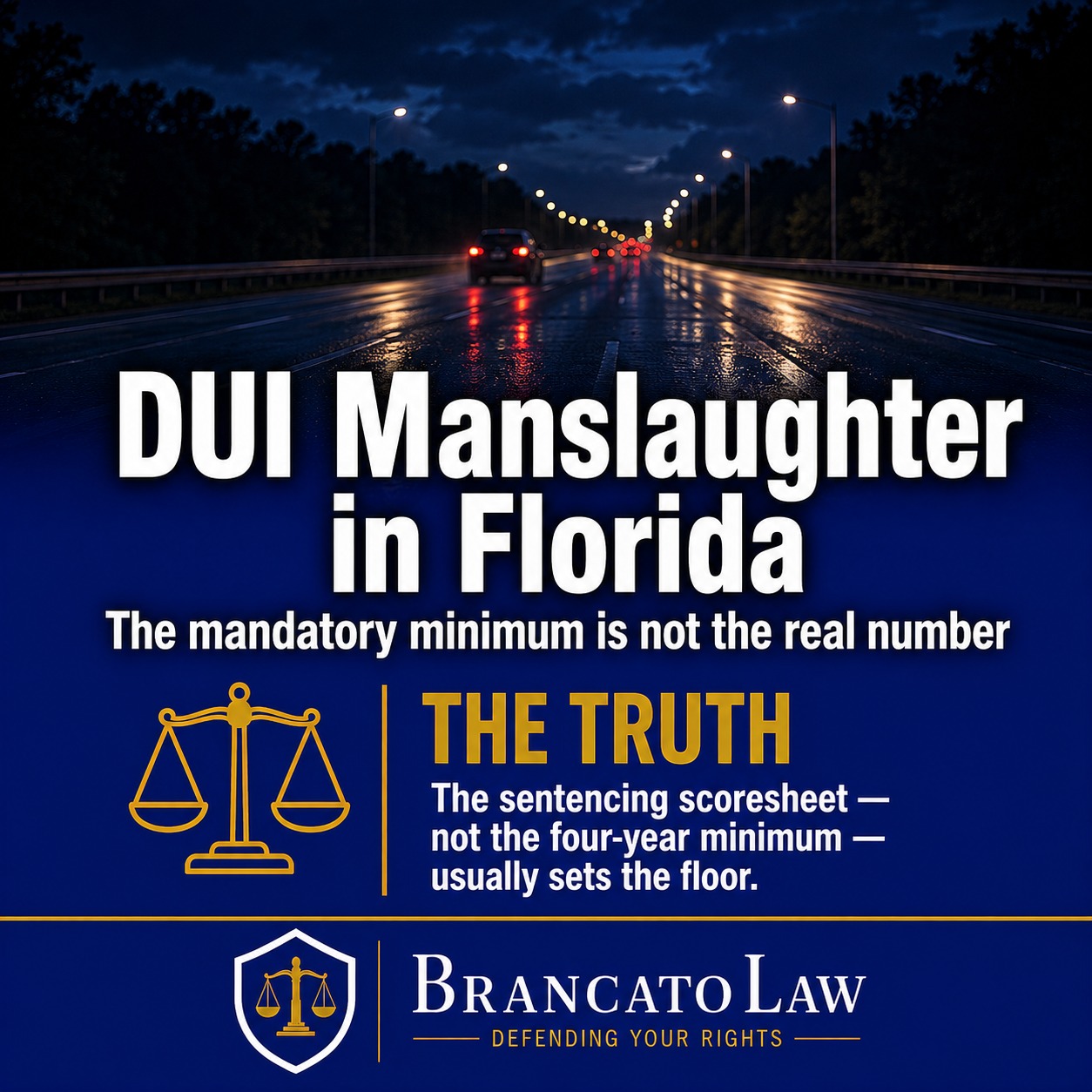
| Key Takeaway: DUI manslaughter under section 316.193(3)(c)3., Florida Statutes, is driving under the influence and, by that operation, causing or contributing to the death of another person or an unborn child. It is a second-degree felony with a 4-year mandatory minimum prison term and a 15-year maximum — and it becomes a first-degree felony with a 30-year maximum if the driver failed to give information and render aid, or has a prior qualifying conviction. A conviction also permanently revokes your driver license. |
I’m Rocky Brancato, founder of The Brancato Law Firm, P.A., a Tampa criminal defense firm. I am a member of the National College for DUI Defense, I taught at the police academy, and I have taken more than 150 jury trials to verdict — and DUI manslaughter is the case our attorneys treat as the most defensible serious charge in Florida, because it is built entirely on scientific evidence that can be tested, challenged, and suppressed.
How Does Florida Define DUI Manslaughter?
DUI manslaughter has three parts under section 316.193(3), Florida Statutes: the driver was under the influence (impaired normal faculties, or a blood- or breath-alcohol level of .08 or above); the driver operated a vehicle; and, by reason of that operation, the driver caused or contributed to causing the death of a human being or an unborn child.
Notice what is missing: intent. No one charged with DUI manslaughter meant to hurt anyone, and the law does not require that they did. Notice also what is not missing: causation.
| The words that matter: “causes or contributes to causing.” The State does not have to prove your driving was the only cause of the death — but it still has to prove a causal link, and that link is where these cases are won and lost. |
The “contributes to” language means the State can convict even when the other driver shares fault — but it cannot convict on impairment alone. If the crash would have happened exactly the same way with a sober driver behind your wheel — the other car ran the red light, the pedestrian stepped out from between parked cars, the motorcycle crossed the center line — the death was not caused by reason of your operation, and our attorneys have built entire defenses on that distinction.
What Are the Penalties for DUI Manslaughter in Florida?
| Offense | Classification | Penalty |
|---|---|---|
| DUI manslaughter — § 316.193(3)(c)3.a. | Second-degree felony | Up to 15 years prison, $10,000 fine — with a 4-year mandatory minimum prison term |
| DUI manslaughter where the driver knew or should have known the crash occurred and failed to give information and render aid under § 316.062 — § 316.193(3)(c)3.b. | First-degree felony | Up to 30 years prison |
| DUI manslaughter with a prior conviction for DUI manslaughter, BUI manslaughter (§ 327.35(3)(a)3.c.), vehicular homicide (§ 782.071), or vessel homicide (§ 782.072) — § 316.193(3)(c)3.c. (Trenton’s Law) | First-degree felony | Up to 30 years prison |
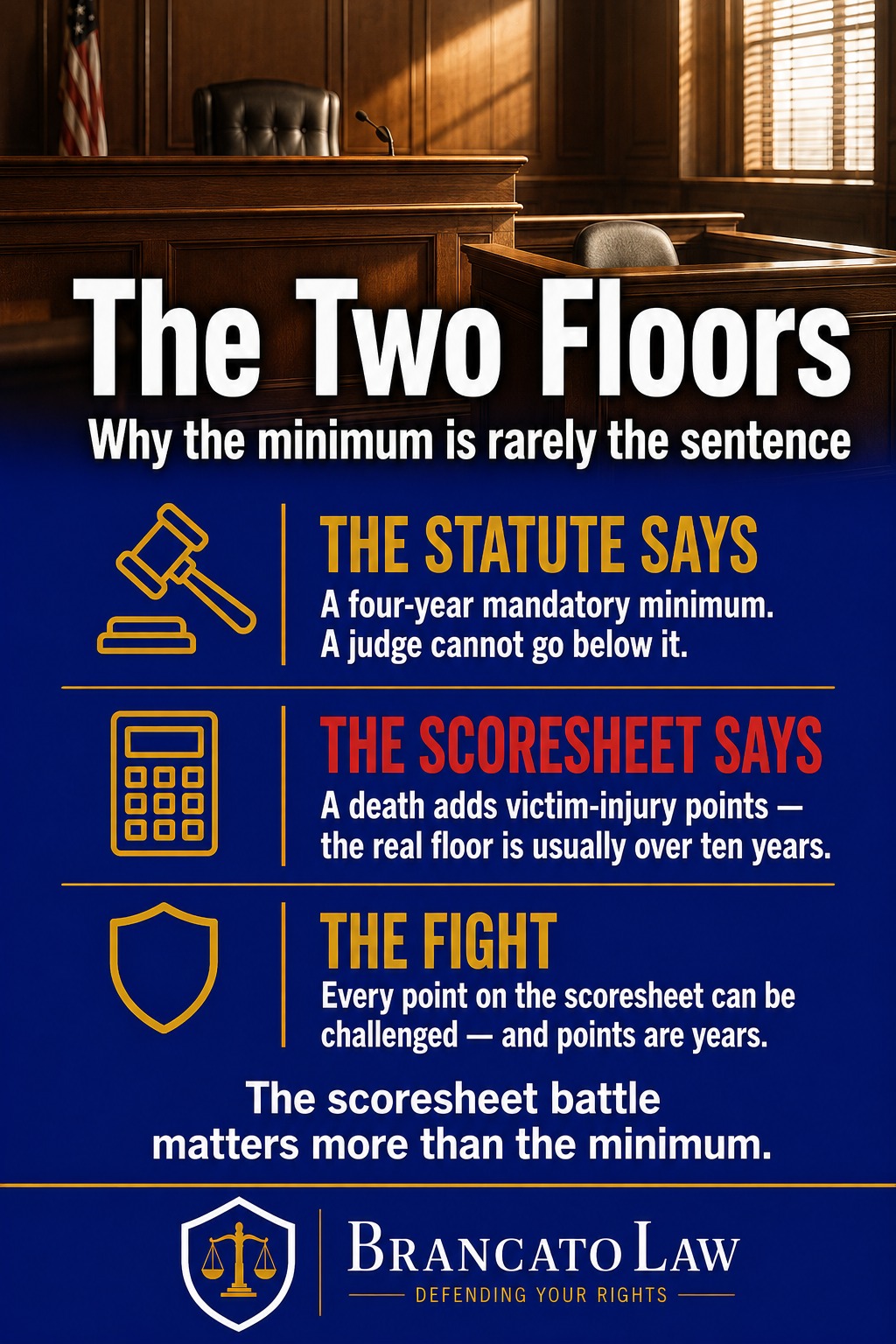
The 4-year mandatory minimum means exactly what it says: no matter how sympathetic the facts, a judge cannot go below four years in prison on a DUI manslaughter conviction. And the sentencing scoresheet usually demands far more — the death itself adds victim-injury points that typically put the lowest permissible sentence above ten years before a single aggravator is considered. That gap between the 4-year floor and the scoresheet’s number is one of the most important battlegrounds in these cases.
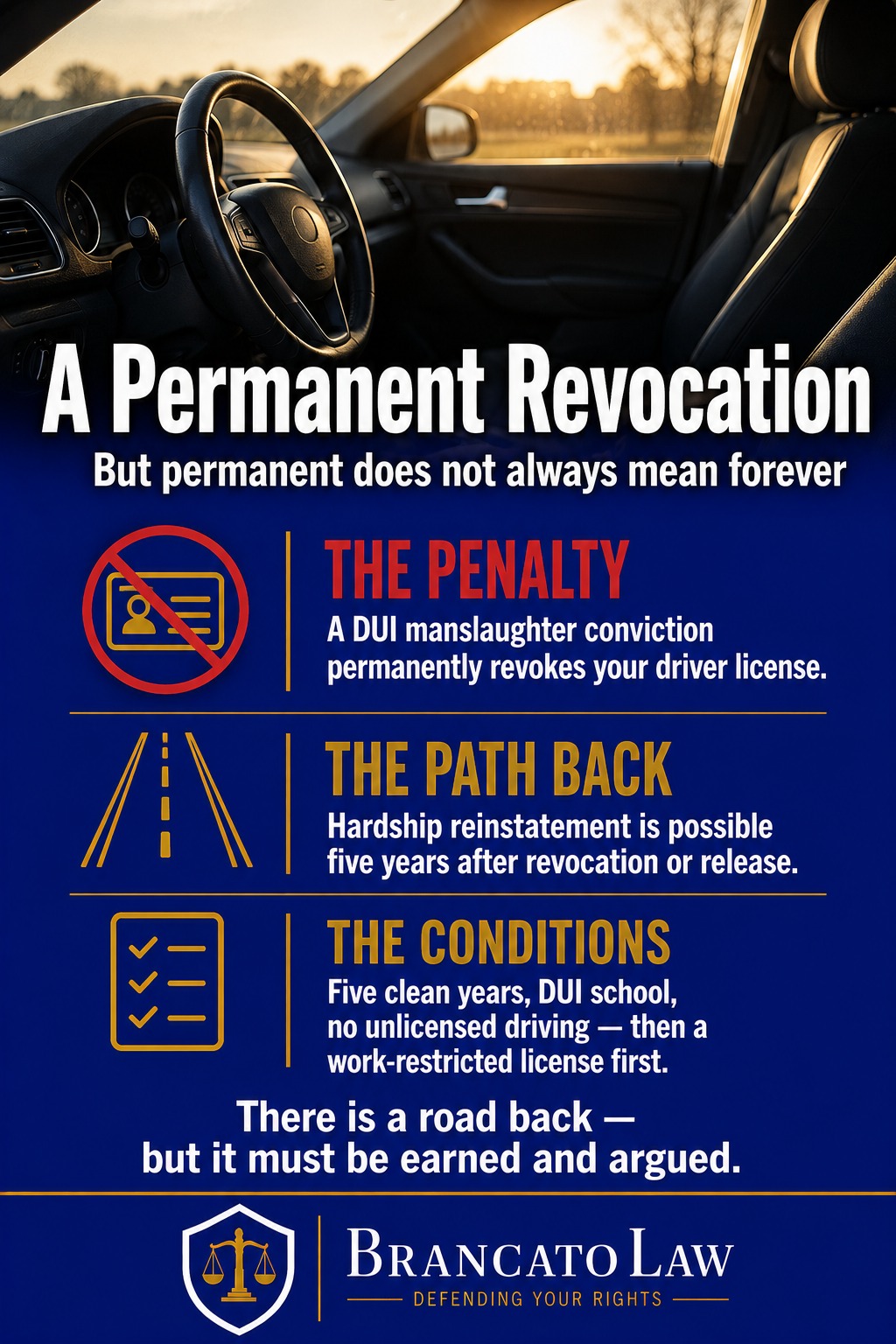
Beyond prison, a DUI manslaughter conviction carries permanent revocation of your driver license under section 322.28 — the court must impose it, and if the court doesn’t, the DHSMV will. The one door the Legislature left open: under section 322.271(4), a driver with no prior DUI-related convictions may petition for hardship reinstatement five years after the revocation or the end of incarceration, whichever is later — after proving five drug-free years, no unlicensed driving, and completion of DUI school, with an employment-restricted license for the first year.
How Does Sentencing Actually Work in a DUI Manslaughter Case?
Three different numbers control a DUI manslaughter sentence, and understanding the space between them is where defense work pays off:
| The number | Where it comes from | What it means |
|---|---|---|
| 4 years | Statutory mandatory minimum | The floor — no judge can go below it on a conviction |
| The scoresheet’s “lowest permissible sentence” | Florida’s Criminal Punishment Code | Usually the real floor — victim-injury points for a death drive it well above the 4-year minimum in most cases |
| 15 or 30 years | Statutory maximum | The ceiling — 15 for the second-degree felony, 30 for the first-degree versions |
The scoresheet is where many families are blindsided: they hear “4-year minimum” and expect a number near it, then learn the Criminal Punishment Code calculation demands more than a decade. But the scoresheet is not untouchable. Florida law recognizes grounds for a downward departure — and in these cases, the mitigation is often real: a defendant with no record, genuine remorse, cooperation, and a crash in which the victim’s own conduct played a role. Our attorneys build the sentencing case in parallel with the trial defense, because in a charge with a mandatory minimum, the plea negotiations are conducted in the shadow of both numbers.
A conviction also brings the DUI-specific consequences that follow any conviction under section 316.193 — among them mandatory probation conditions including a licensed DUI program and substance abuse treatment, community service, and vehicle impoundment rules — layered on top of the prison term and the permanent license revocation discussed above.
What Must the State Prove to Convict You?
Three elements, each beyond a reasonable doubt:
- Impairment or unlawful alcohol level. Proven through the blood or breath test, officer observations, field sobriety exercises, and video. Every link in that chain — the stop, the draw, the lab, the analyst — is contestable.
- Operation of a vehicle. Usually undisputed, but not always: in multi-occupant crashes and ejection cases, who was driving becomes the entire trial.
- Causation. By reason of that operation, the driver caused or contributed to causing the death. This is where accident reconstruction lives — speed, angles, timing, right-of-way, and what the other vehicle was doing.
Can You Fight the Blood Test in a DUI Manslaughter Case?
September 2026 update: Yes — and the ground shifted on September 2, 2026. In State v. Marlin, No. 4D2025-1448 (Fla. 4th DCA Sept. 2, 2026), the Fourth District affirmed suppression of a forced blood draw in a fatal Turnpike crash, held that the natural dissipation of alcohol is never a per se exigency, and receded from the “probable cause” language in State v. Acevedo that prosecutors had been treating as an exception to the warrant requirement. Absent actual consent or case-specific exigent circumstances, a warrant is required — regardless of Florida’s implied consent law. Our full analysis is in can police take your blood without a warrant in Florida.
Yes — and in our firm’s experience the blood evidence is where DUI manslaughter cases most often crack. Florida’s appellate courts spent 2025 reminding trial judges how narrow the State’s authority to take blood really is. In State v. Marshall, No. 4D2024-1115 (Fla. 4th DCA Aug. 13, 2025), a driver’s blood was drawn twice at an accident scene, and the case turned on whether the draw was lawful — the appellate court sent it back because the trial court’s findings on consent and implied consent contradicted each other.
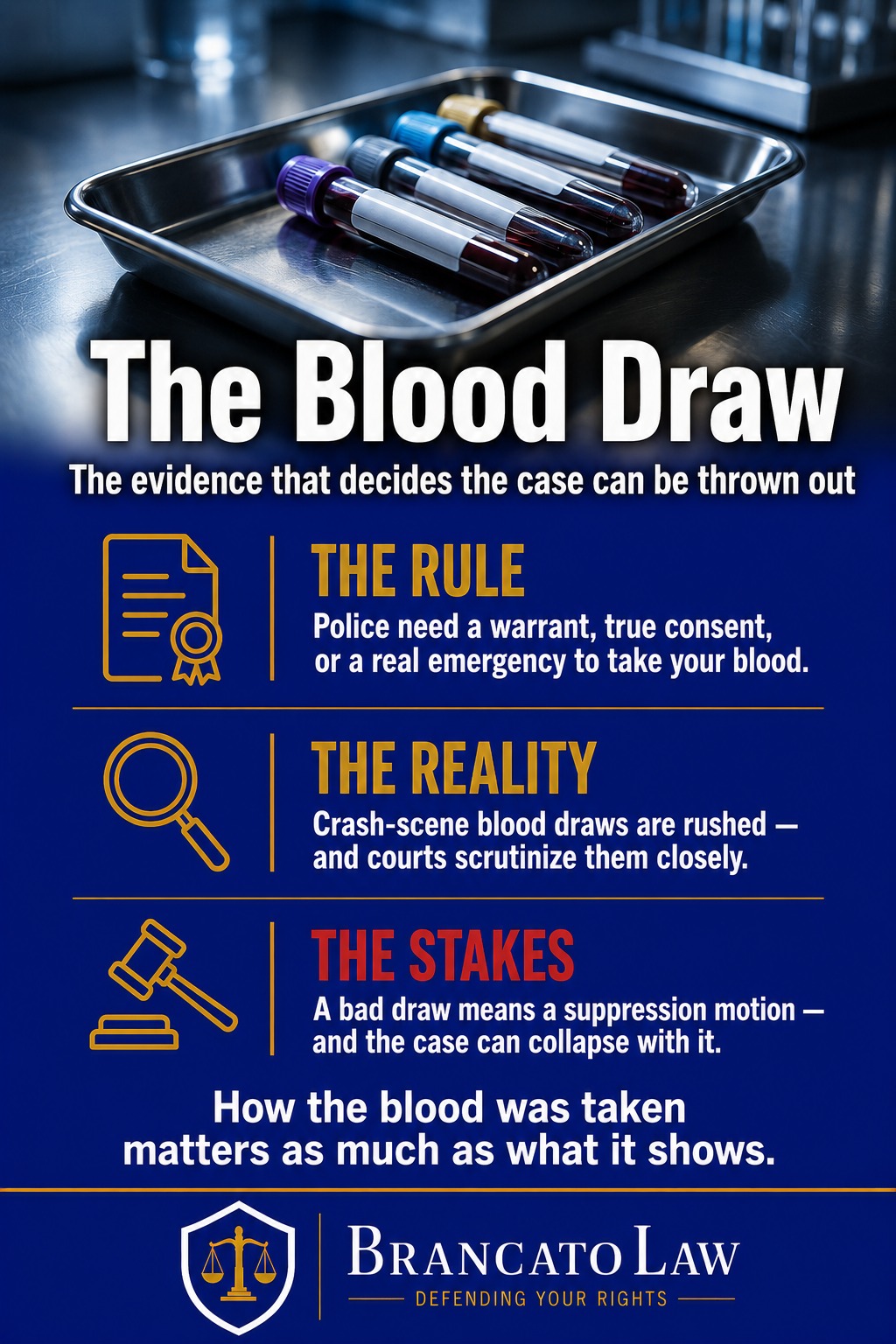
Marshall collects the rules that matter. A mandatory blood draw under section 316.1933 requires probable cause of two things at the roadside — that the driver was impaired and that the driver’s vehicle caused death or serious bodily injury. Implied consent applies only to blood taken based on probable cause of a qualifying DUI offense. And when the State claims the driver voluntarily consented, the State carries the burden of proving voluntariness under the totality of the circumstances — mere submission to authority is not consent.
The practical translation: in a case where everything flows from a number in a vial, the defense examines how that vial was filled. Was there probable cause of causation at the moment of the draw, or just a hunch? Was “consent” given by a person in shock, in handcuffs, or in an ambulance? Was the kit expired, the draw non-medical, the chain of custody clean? Our attorneys litigate these motions in Hillsborough County courtrooms, and a suppressed blood result changes everything that follows.
How Do We Defend DUI Manslaughter Charges?
By attacking each element with its own expert. On causation, we retain accident reconstruction experts to analyze the physics of the crash — because “impaired driver” plus “someone died” does not equal “the impairment caused the death,” and juries understand that distinction when it is shown to them with data. On impairment, we litigate the stop, the draw, and the lab: suppression of the blood result, rising-alcohol timelines, and the difference between the level at testing and the level at driving. On operation, where the facts allow it, we hold the State to its proof of who was behind the wheel. And on sentencing, we fight the scoresheet — victim-injury points, downward departure grounds, and the space between the statutory minimum and the State’s demand.
One more thing our attorneys do from day one: preserve the evidence that helps you. Vehicles get crushed, event data recorders get overwritten, and surveillance video gets deleted on retention schedules measured in days. A preservation demand in the first week is often worth more than any motion filed a year later.
What Is the Difference Between DUI Manslaughter and Vehicular Homicide?
They are alternative theories for the same tragedy, with different elements. DUI manslaughter requires impairment but not bad driving — a legally intoxicated driver who causes a fatal crash can be convicted even if the driving itself was unremarkable. Vehicular homicide (§ 782.071) requires reckless driving but no impairment. Prosecutors often charge both from one crash; a defendant cannot be convicted of both for the same death, and the interplay between the two counts is itself a defense opportunity — each theory concedes the weakness of the other.
What Should You Do If You Are Under Investigation for DUI Manslaughter?
Retain counsel immediately — before the charging decision, not after. DUI manslaughter charges are often filed weeks or months after the crash, while the traffic homicide investigator waits for toxicology and reconstructs the scene. That window is when the defense can still inspect the vehicles, download the event data recorders, photograph the roadway, and demand preservation of every recording. It is also when statements do the most damage: what you tell the traffic homicide investigator — even a polite explanation at the hospital — becomes evidence. Our attorneys step in during the investigation, handle all law-enforcement contact, and put our own experts on the physical evidence before it disappears.
For a case study on how blood alcohol timing can win a DUI manslaughter case, read what retrograde extrapolation is in a Florida DUI case.
Frequently Asked Questions About DUI Manslaughter in Florida
What is the mandatory minimum sentence for DUI manslaughter in Florida?
Four years in prison — a judge cannot sentence below it on a conviction, no matter the circumstances. The realistic exposure is higher: the maximum is 15 years (30 for the first-degree versions), and the sentencing scoresheet’s victim-injury points usually put the lowest permissible sentence well above the 4-year floor. Our attorneys fight both numbers — the conviction itself and the scoresheet math.
Can DUI manslaughter charges be reduced or dismissed?
Yes, when an element fails. A suppressed blood test can gut the impairment element; reconstruction evidence can break causation; and either can drive a reduction to DUI, reckless driving, or another lesser offense. The Brancato Law Firm, P.A. builds these cases around independent expert work from the first week, because that is when the evidence that wins them still exists.
Will I lose my license permanently?
A DUI manslaughter conviction requires permanent revocation — but permanent does not always mean forever. If you have no prior DUI-related convictions, section 322.271(4) lets you petition for hardship reinstatement five years after the revocation or your release from prison, whichever is later, after DUI school and five clean years. Our attorneys plan for that petition as part of the case, not as an afterthought.
What if the other driver caused the crash?
Then causation — an element the State must prove beyond a reasonable doubt — is in play. The statute’s “causes or contributes to causing” language tolerates shared fault, but it still requires that your operation contributed to the death; if the crash would have happened the same way with a sober driver in your seat, that element fails. This is precisely what accident reconstruction experts are for, and it is the first thing our firm evaluates.
Can the police take my blood without my consent?
Only within narrow limits. A mandatory draw under section 316.1933 requires probable cause at the scene that you were impaired and that your vehicle caused death or serious bodily injury; anything less requires a warrant or genuinely voluntary consent, which the State must prove — submission to an officer’s authority is not consent. As the Fourth District’s 2025 decision in State v. Marshall shows, courts scrutinize these draws closely, and a bad draw means a suppression motion.
Does Trenton’s Law apply to DUI manslaughter?
Yes. A DUI manslaughter conviction is a first-degree felony — a 30-year maximum — if you have a prior conviction for DUI manslaughter, BUI manslaughter, vehicular homicide, or vessel homicide. Whether a prior actually qualifies is a legal question worth litigating, and The Brancato Law Firm, P.A. scrutinizes every alleged qualifying prior. Call (813) 727-7159 for a free, confidential review of your case.
For more about our defense strategies, visit our Tampa DUI Lawyer page.
Related reading: What Is DUI in Florida? · What Is Vehicular Homicide in Florida? · What Is Breathalyzer Refusal in Florida? · What Is Leaving the Scene of an Accident in Florida? · What Happens After a DUI Arrest in Hillsborough County?
The Evidence That Wins These Cases Disappears First
If you or a loved one is facing a DUI manslaughter investigation or charge in Hillsborough, Pinellas, or Pasco County, the blood evidence, the vehicles, and the electronic data are being processed right now — and the State’s version of events hardens a little more every week you wait. Call the attorneys of The Brancato Law Firm, P.A. — founded by Tampa Criminal Defense Attorney Rocky Brancato — at (813) 727-7159 before you give any statement. The mandatory minimum is four years; the case deserves your best defense from day one.
The Brancato Law Firm, P.A.
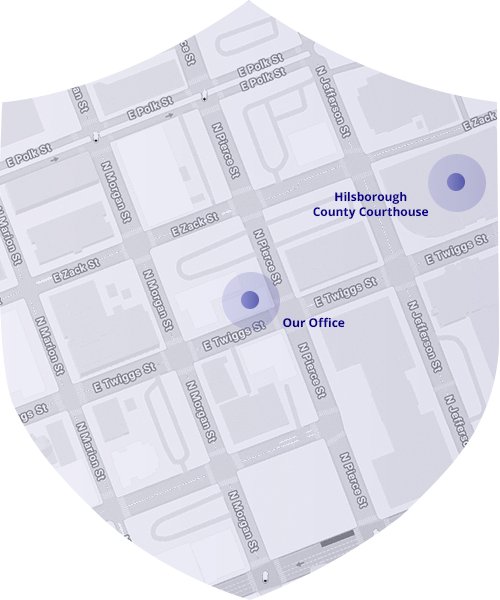
620 E. Twiggs Street, Suite 205, Tampa, FL 33602
(813) 727-7159
Serving Hillsborough, Pinellas, and Pasco Counties
The Brancato Law Firm, P.A. is a Tampa-based criminal defense practice. We are not affiliated with any other Brancato-named law firms.
Visit Us
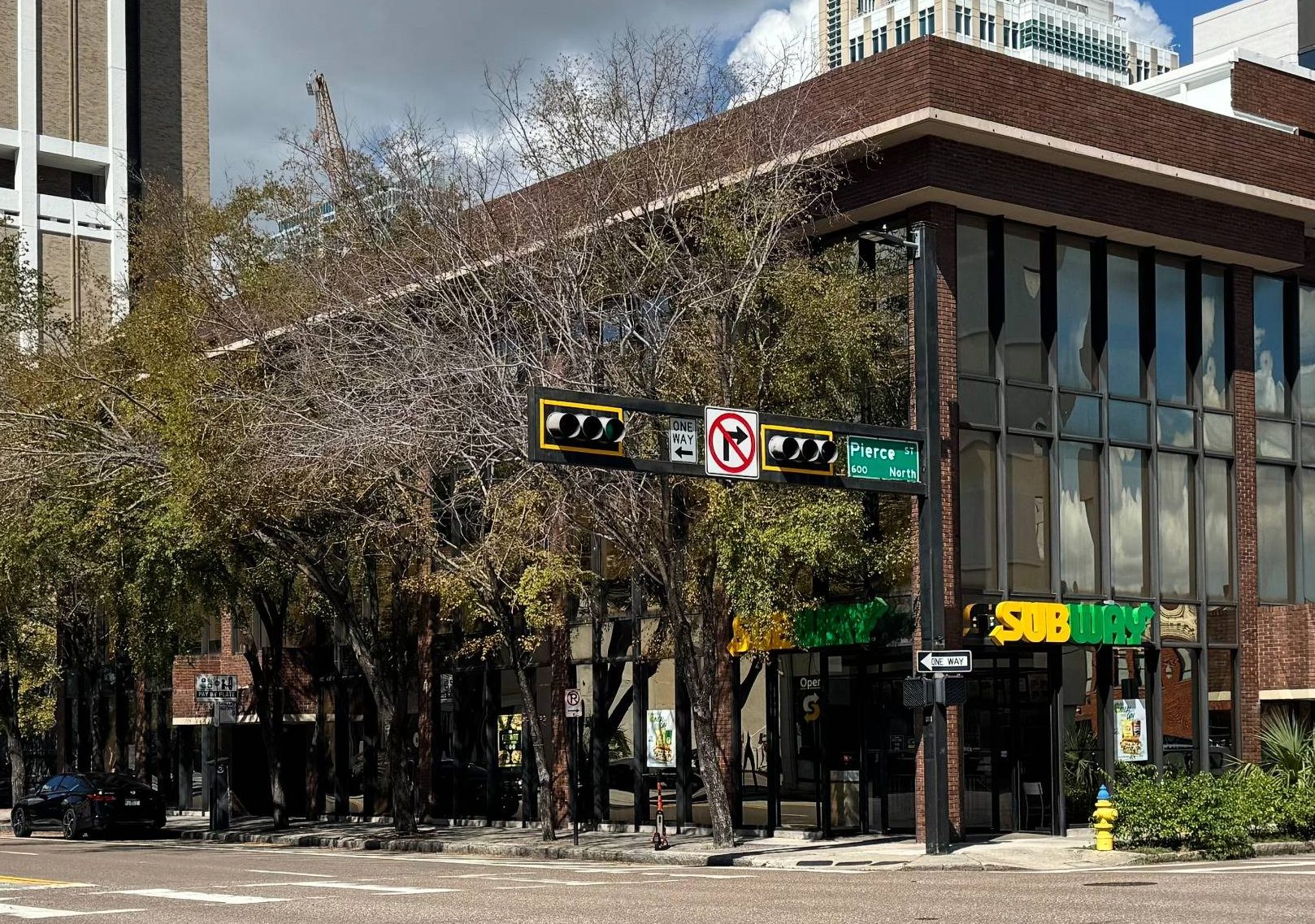
Tampa, FL 33602
Contact Us Now
Free Legal Consultation (813) 727-7159