- Free Consultation 24/7: (813) 727-7159 Tap Here To Call Us


From First DUI to Death Penalty



Is a BUI the Same as a DUI in Florida?


Fully rewritten and updated September 3, 2026.
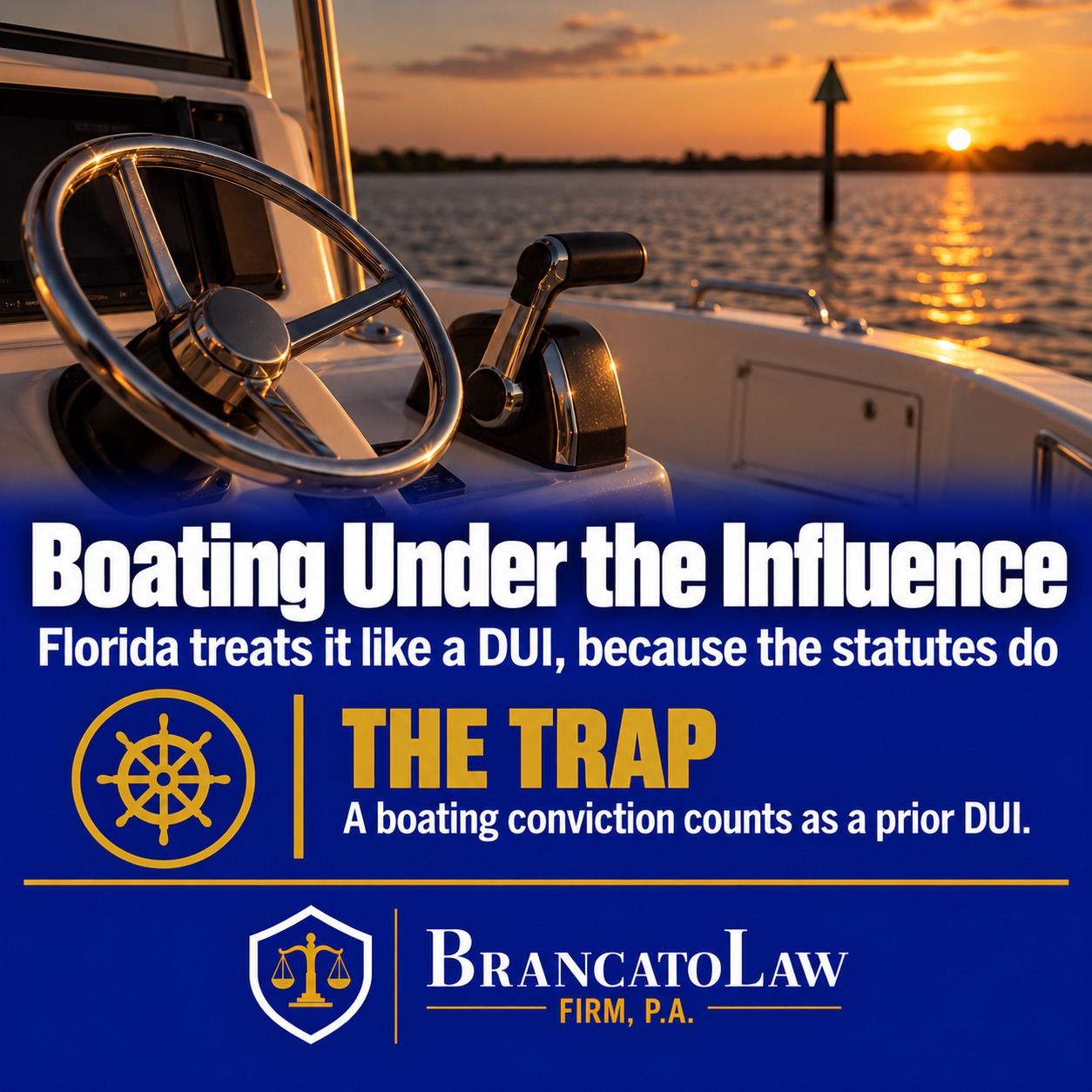
| Almost — and where the two differ, the differences cut both ways. Boating under the influence is its own crime under section 327.35, Florida Statutes, with the same 0.08 threshold, the same impairment standard, and a penalty ladder that reaches mandatory jail on a second conviction and a third-degree felony on a third. A BUI conviction does not suspend your driver license, and there is no ten-day administrative suspension to fight. But a BUI counts as a prior DUI, and a DUI counts as a prior BUI — so one bad night on the water can make a future traffic case a felony. |
I’m Rocky Brancato, founder of The Brancato Law Firm, P.A., a Tampa criminal defense firm. In more than 25 years of Hillsborough County practice I’ve defended these cases on both sides of the causeway, and the thing clients almost never know when they call is that the charge they think of as “a boating ticket” is scored against them for the rest of their driving life. Our attorneys treat a BUI exactly as we would treat a DUI, because the statute books do.
What Does Florida’s BUI Law Actually Require?
Three things: a vessel, operation of it, and impairment. Under section 327.35, Florida Statutes, a person commits BUI who is operating a vessel in Florida and either is under the influence of alcohol, a chemical substance, or a controlled substance to the extent that their normal faculties are impaired, or has a blood-alcohol level of 0.08 or more grams per 100 milliliters of blood, or a breath-alcohol level of 0.08 or more grams per 210 liters of breath.
Two of those three elements are defined far more broadly than people expect. Section 327.02, Florida Statutes defines “operate” to mean being in charge of, in command of, or in actual physical control of a vessel on the waters of this state — or exercising control over, or having responsibility for, the vessel’s navigation or safety while it is underway, or steering a vessel being towed. So the myth that you are safe if the engine is off, or if a sober friend is technically at the helm, is exactly that: a myth. Actual physical control is enough.
The same section defines “vessel” as synonymous with a boat, including every description of watercraft, barge, and airboat other than a seaplane on the water, “used or capable of being used as a means of transportation on water.” Floating structures — floating homes, floating restaurants, and similar permanently moored structures — are expressly excluded.
That last phrase is where the real litigation happens, and Tampa Bay’s own appellate court has told us so. In State v. Davis, No. 2D12-1409 (Fla. 2d DCA Feb. 27, 2013) — a Punta Gorda case in which an officer watched the defendant shift a twenty-five-foot boat between forward and reverse twenty-five yards off a waterfront bar — the Second District held that the State does not have to prove the boat was subject to a license tax to prove BUI. What matters, the court explained, is “the vessel’s use for transportation on water,” not its registration status. (Read the opinion.) The practical read for a defense lawyer is the flip side of the holding: if the thing your client was aboard is not used or capable of being used to transport people on water, it is not a vessel, and there is no BUI.
How Is a BUI Different From a DUI in Florida?
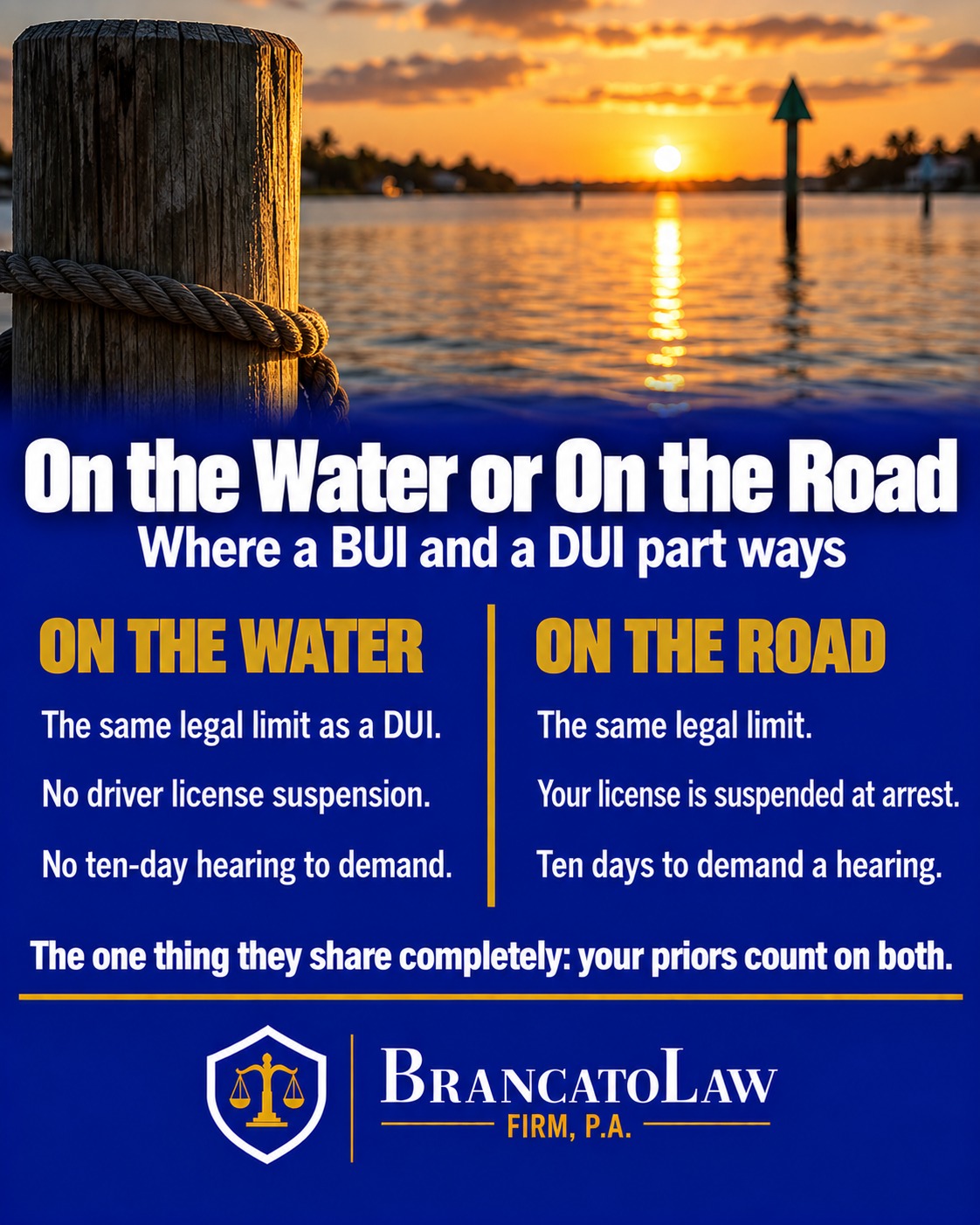
Side by side, the two statutes are close cousins with a few consequential differences:
| BUI (§ 327.35) | DUI (§ 316.193) | |
|---|---|---|
| Threshold | 0.08 blood or breath, or impaired normal faculties | Identical |
| Conduct element | Operating a vessel — includes actual physical control | Driving or in actual physical control of a vehicle |
| License consequence | None. A BUI conviction does not suspend a driver license, and there is no vessel-operator license to suspend | Mandatory revocation periods; administrative suspension at arrest |
| Administrative case | No DHSMV formal review hearing — nothing to fight in ten days | Ten-day window to demand a formal review |
| Refusal | $500 civil penalty; criminal only on a qualifying repeat | First refusal is now itself a criminal offense |
| Priors | A DUI counts as a prior BUI | A BUI counts as a prior DUI |
| Ignition interlock | Not applicable to vessels | Required in defined cases |
| Vehicle/vessel hold | Vessel impoundment 10, 30, or 90 days as a probation condition | Vehicle impoundment provisions |
The cross-counting is the part that ambushes people, and it runs in both directions by express statutory text. Section 327.35 provides that a conviction for violating section 316.193 counts as a previous conviction under the BUI statute; section 316.193 in turn provides that “any conviction for a violation of s. 327.35” is also considered a previous conviction under the DUI statute. A client who took a quick plea on a BUI five years ago because “it’s not a driving charge” can walk into a first-ever traffic stop and find themselves charged as a second offender, with the mandatory minimums that come with it.
The absence of a license suspension cuts the other way, and honestly: it removes the single biggest source of urgency in an ordinary DUI. There is no ten-day clock. That is genuinely good news, and it is also why BUI clients so often wait too long to hire counsel — nothing forces the issue until the case is already deep in the discovery calendar.
What Are the Penalties for a BUI in Florida?
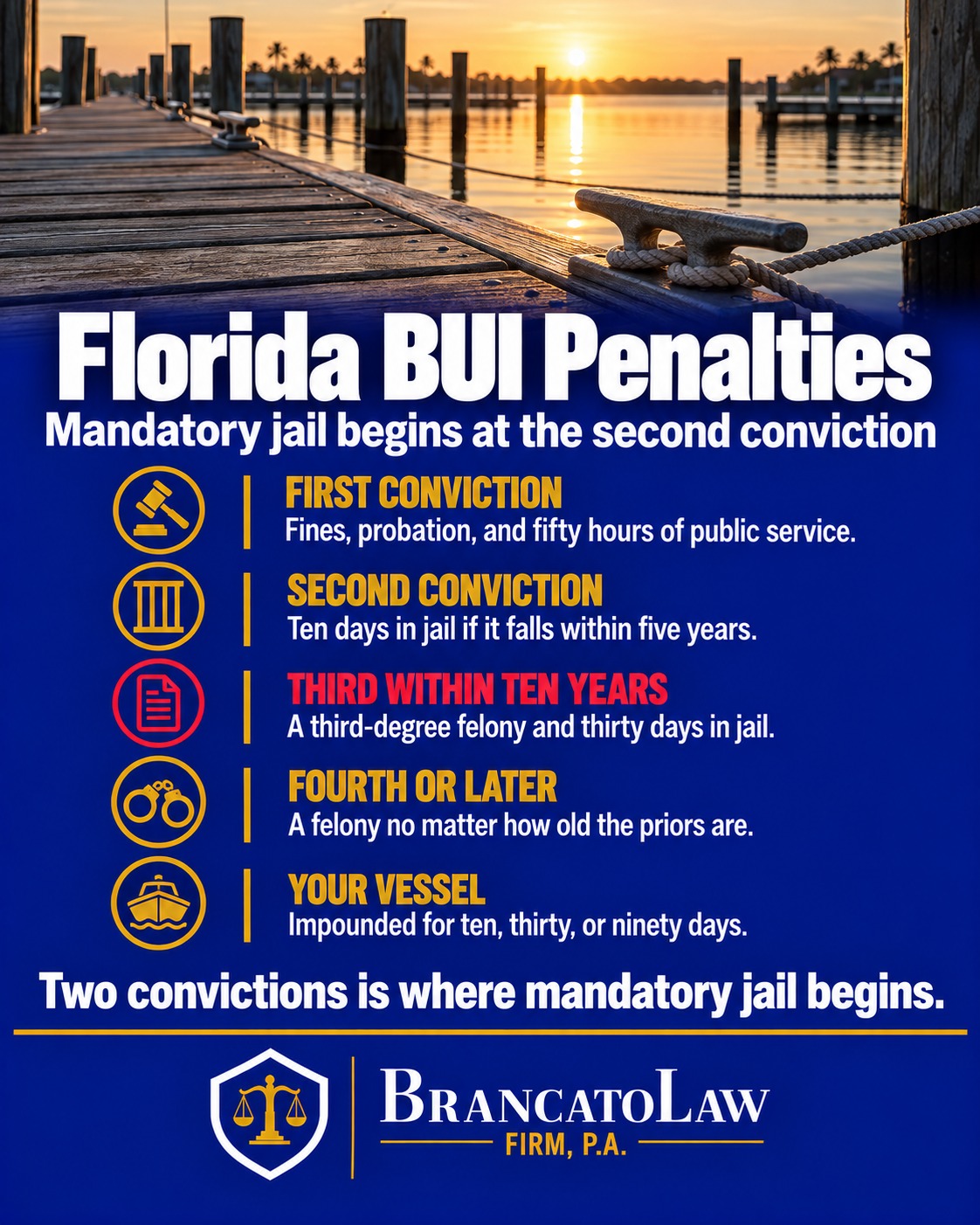
They escalate on the same shape of ladder as a DUI, and the mandatory jail arrives on the second conviction:
| Conviction | Charge level | Penalty | Mandatory minimum |
|---|---|---|---|
| First | Misdemeanor | $500–$1,000 fine; up to 6 months | 1 year probation cap; 50 hours public service; 10-day vessel impoundment |
| Second | Misdemeanor | $1,000–$2,000 fine; up to 9 months | 10 days jail if within 5 years; 30-day vessel impoundment |
| Third within 10 years | Third-degree felony | Up to 5 years prison | 30 days jail; 90-day vessel impoundment |
| Third after 10 years | Misdemeanor | $2,000–$5,000 fine; up to 12 months | 90-day vessel impoundment |
| Fourth or subsequent | Third-degree felony | Up to 5 years prison — regardless of when the priors occurred | — |
Two enhancements sit on top of that ladder. A blood- or breath-alcohol level of 0.15 or higher, or having a passenger under 18 aboard, raises the fine range to $1,000–$2,000 for a first conviction, $2,000–$4,000 for a second, and at least $4,000 for a third or subsequent — and raises the jail exposure to nine months on a first and twelve on a second. For the 0.15 enhancement, only the instant offense has to qualify.
And every BUI conviction, regardless of level, carries mandatory monthly reporting probation and a court-specified substance abuse course, with evaluation and treatment at the defendant’s expense as a condition of that probation. When at least 48 hours of a mandatory sentence must be served consecutively, the statute says so — which is the answer to the common question of whether the ten days can be split into weekends.
When Does a BUI Become a Felony in Florida?
The moment somebody gets hurt. Section 327.35(3) grades BUI by consequence, not by intent:
- Damage to the property or person of another — first-degree misdemeanor.
- Serious bodily injury to another, as defined in section 327.353 — third-degree felony.
- Death of any human being, or of an unborn child — BUI manslaughter, a second-degree felony.
- BUI manslaughter with aggravation — a first-degree felony if the operator knew or should have known an accident occurred and failed to give information and render aid as required by section 327.30, or if the operator has a prior BUI manslaughter, DUI manslaughter, vehicular homicide, or vessel homicide conviction.
And since Lucy’s Law took effect on July 1, 2025, a BUI manslaughter conviction carries a mandatory minimum term of four years in prison — the same floor the Legislature had already imposed for DUI manslaughter. That is a sentence a judge cannot go below no matter how sympathetic the defendant or how cooperative the plea. Our full breakdown of the 2025 changes is in our article on Lucy’s Law and the new BUI and boating felony rules; the parallel to the road is covered in DUI manslaughter in Florida.
Prosecutors also routinely stack a separate charge under section 327.33, Florida Statutes, which now grades reckless operation of a vessel — willful or wanton disregard for the safety of persons or property — as a second-degree misdemeanor with no accident, a first-degree misdemeanor if the accident damages property or injures a person, and a third-degree felony if it causes serious bodily injury. Careless operation, by contrast, is a noncriminal violation. The line between “careless” and “reckless” is doing a great deal of work in these cases, and it is worth fighting over.
Can Police Stop My Boat Without a Reason?
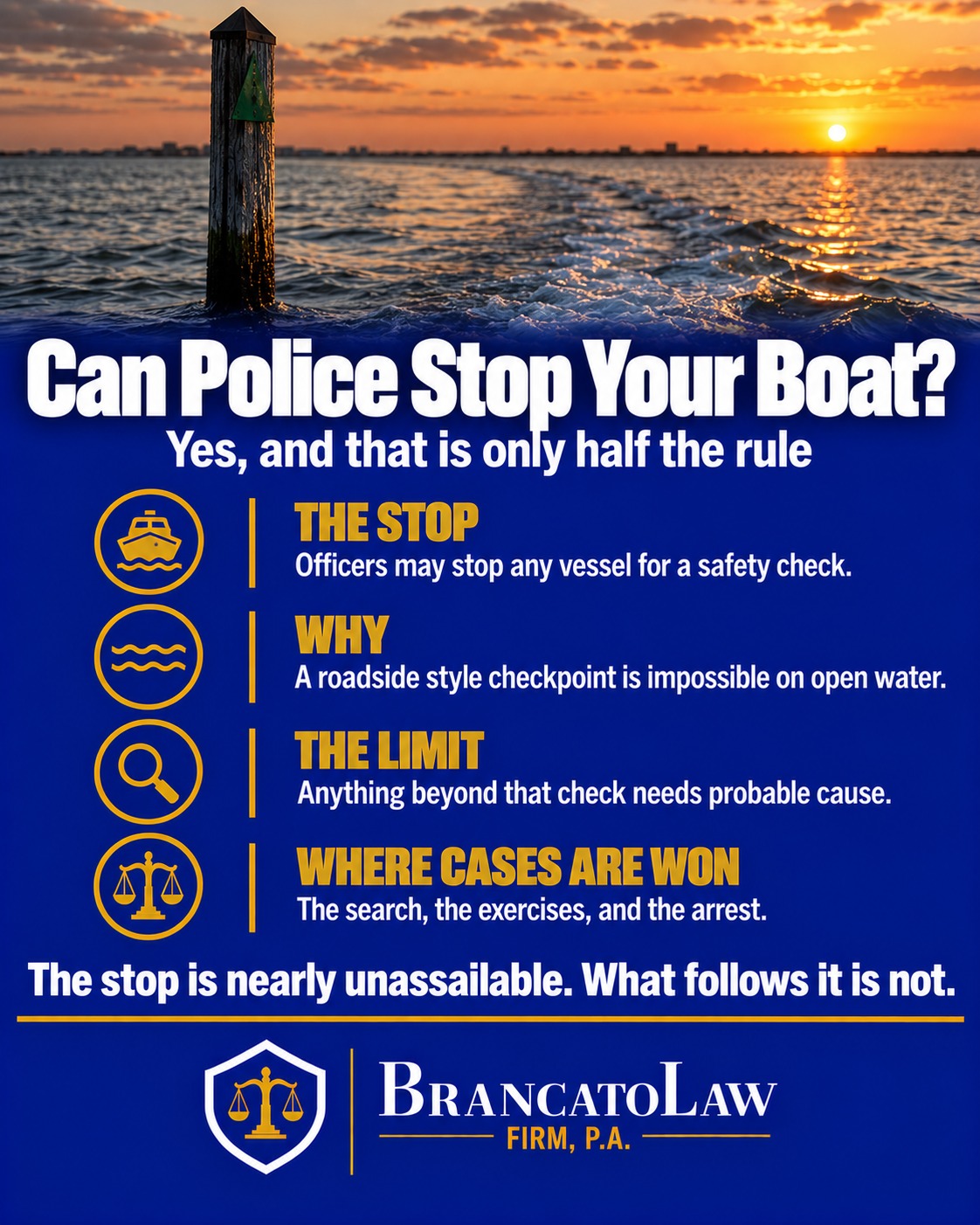
Yes — and this is the single biggest legal difference between the water and the road. Section 327.70, Florida Statutes authorizes Florida Fish and Wildlife Conservation Commission officers, sheriff’s deputies, municipal police, and other certified officers to “cause any inspections to be made of all vessels” under chapters 327 and 328. And in State v. Casal, 410 So. 2d 152 (Fla. 1982) — a case in which the Marine Patrol stopped a motorboat off the Florida coast to check permits and registration — the Florida Supreme Court held that random stops of motorboats for the limited purpose of checking fishing permits, registration certificates, and safety equipment are reasonable under the Fourth Amendment. The court’s reasoning was practical: “Unlike an automobile, a boat at sea can travel in any direction,” and it “would be impossible to establish a checkpoint on the water since boats cannot come to a complete stop and line up behind each other on the water as cars can on roads.” (Read the opinion.)
So the answer to “he had no reason to stop me” is usually that he did not need one. But Casal is only half a holding, and the second half is where cases are won. The same court held that “after the initial stopping and boarding a vessel the marine patrol must have probable cause before conducting any further search or inspection” — and it found that the specific facts before it (no registration certificate, and an icebox with no ice on a boat supposedly bound for the Bahamas) were “suspicious circumstances but did not constitute probable cause.”
That two-step structure is the framework for every BUI suppression motion our attorneys file. The regulatory stop is nearly unassailable. What follows it is not: the expansion into an impairment investigation, the order to submit to seated exercises, the search of the cabin and the cooler, and ultimately the arrest each need their own justification, and the officer’s report frequently supplies less of it than the officer believes.
For more about our defense strategies, visit our Hillsborough County criminal defense page.
What Happens If You Refuse the Breath Test on the Water?
Something quite different from what happens in a car — and the difference has narrowed sharply in the last year. Under section 327.352, Florida Statutes, anyone who operates a vessel in Florida is deemed to have consented to a breath test for alcohol, or a urine test for chemical or controlled substances, incidental to a lawful arrest where the officer has reasonable cause to believe the person was operating under the influence. A blood test is reserved for circumstances in which breath or urine testing is impractical or impossible. And the statute makes the refusal itself admissible: refusal to submit to a lawful chemical or physical breath test “is admissible into evidence in any criminal proceeding.”
The penalty structure then splits in two:
| Situation | Consequence |
|---|---|
| First qualifying refusal | $500 civil penalty under § 327.35215 — not a crime |
| Failing to pay or request a hearing within 30 days | Unlawful to operate a vessel on Florida waters |
| Refusal after a prior § 327.35215 fine, or after a prior license suspension for a DUI-related refusal | First-degree misdemeanor under § 327.359 |
Read that third row twice, because it is the trap. Section 327.359, Florida Statutes makes a refusal on the water a criminal offense not only for the boater with a prior boating refusal, but for the boater whose driver license was previously suspended for refusing a breath, urine, or blood test in a car case. A driver who refused years ago on Dale Mabry can commit a first-degree misdemeanor by refusing for the first time ever on Tampa Bay. That provision arrived with Trenton’s Law, which we cover in Trenton’s Law and Florida’s enhanced DUI and BUI penalties, alongside the parallel change to car refusals discussed in breathalyzer refusal in Florida.
Note also what section 327.35215 requires of the State: certified statements from law enforcement documenting probable cause for the arrest and the refusal, plus sworn confirmation that the person was advised of the penalties and of the hearing procedure. Those are elements, not formalities, and they are not always in the file.
How Do Our Attorneys Defend BUI Charges?
By attacking the two elements that the marine environment makes weakest.
The impairment evidence. Roadside field sobriety exercises were designed, validated, and normed for a person standing on flat, stationary pavement. Almost none of that survives a boat deck. A person who has spent six hours in the sun, in wind, on a rocking hull, dehydrated, sunburned, and hearing-fatigued from an outboard motor will perform badly on balance and divided-attention tasks while stone sober — and “sea legs” persist for a meaningful period after stepping onto a dock. Officers know this, which is why the water versions of these exercises are seated tasks with far thinner scientific pedigree than the walk-and-turn. Cross-examination on what the exercise actually measures, and on whether the officer administered and scored it as trained, is often the whole case.
The vessel and operation elements. Davis tells us the State must prove a vessel used or capable of being used to transport people on water. Where a client was aboard a floating structure, a disabled hull, or something the statute excludes, that element fails. And where the person charged was not in charge, in command, or in actual physical control — a passenger, a person asleep in a berth, a person whose sober companion had the helm — the State’s proof on operation is frequently assumption dressed up as observation.
Beyond that, the ordinary chemistry defenses all apply: the breath test on a BUI is administered at a dock or a jail, often well after the last drink and well after the stop, which raises both the rising-BAC problem and a foundation problem about the twenty-minute observation period. Body-camera coverage on the water is far spottier than on the road; where the video does not exist, the report is the only account, and reports are testable. And because there is no administrative suspension to litigate, the entire fight lives in the criminal case, where the burden is beyond a reasonable doubt.
What Should You Do After a BUI Arrest?
Treat it as the DUI it will one day be counted as. Before your first court date:
- Say nothing about how much you drank, to anyone but your lawyer. The single most damaging sentence in most of these files is the client’s own estimate.
- Write down the day while you remember it — when you launched, what you ate, how long you were in the sun, who was at the helm, what the water was doing, and what the officer said and did in what order.
- Preserve the evidence that disappears. Photos and video from everyone aboard, the marina’s cameras, receipts that fix a timeline, and the names of witnesses who will scatter within the week.
- Get counsel before the arraignment. Not because a clock is running, but because the first plea offer in a BUI case is usually built on the assumption that no one is going to test the officer’s report.
- Count your priors accurately, including DUIs. Whether your prior is a car case or a boat case, it counts. The difference between a second and a third conviction is the difference between mandatory days and a felony.
Frequently Asked Questions About BUI in Florida
Can you get a BUI on a kayak, canoe, paddleboard, or jet ski?
A jet ski is unambiguously a vessel, and BUI applies. Human-powered craft are the harder question: the statutory definition reaches “every description of watercraft” used or capable of being used as a means of transportation on water, which on its face includes a kayak or canoe, and Florida officers do charge these cases. Paddleboards raise a genuinely contestable definitional argument. If you were charged while on a paddleboard, kayak, or canoe, the vessel element is worth litigating rather than conceding.
Does a BUI suspend my driver license in Florida?
No. A BUI conviction under section 327.35 carries no driver license suspension or revocation, and there is no administrative suspension at arrest and no ten-day formal review hearing to demand. Be careful, though: refusing the test on the water can produce criminal exposure under section 327.359 if your license was previously suspended for a refusal in a car case.
Do prior DUI convictions count toward a BUI enhancement?
Yes — and the reverse is equally true. Section 327.35 counts a prior conviction under section 316.193 as a previous BUI conviction, and section 316.193 counts a prior BUI as a previous DUI conviction. Out-of-state alcohol- and drug-related driving convictions can also count. This is the reason we pull a complete criminal and driving history in every one of these cases before discussing any resolution.
Can I be charged with BUI if the boat was anchored or the engine was off?
Possibly, yes. “Operate” is defined to include being in charge of, in command of, or in actual physical control of a vessel — the same actual-physical-control concept that lets the State charge DUI for a parked car. Whether the State can prove it on your facts is a different question, and one worth fighting. Whether the craft counts as a vessel at all is the other.
What is BUI manslaughter, and is there a mandatory prison sentence?
BUI manslaughter is a BUI that causes or contributes to causing the death of a human being or an unborn child. It is a second-degree felony, elevated to a first-degree felony if the operator knew or should have known an accident occurred and failed to give information and render aid, or has a qualifying prior. Since July 1, 2025 it carries a mandatory minimum of four years in prison.
Is a BUI checkpoint on the water legal?
The Florida Supreme Court’s reasoning in Casal was that a fixed checkpoint is physically impossible on open water, which is precisely why random regulatory stops of vessels were held reasonable. In practice, what you encounter is a safety and registration inspection that can lawfully begin without any suspicion at all. What officers do after that first contact is where the Fourth Amendment still has teeth.
Will a BUI show up on a background check?
Yes. A BUI is a criminal charge and a criminal conviction, and it appears in the same places a DUI does. Structuring a disposition with that consequence in view — a withhold of adjudication, a reduction, a diversion where available — is often more valuable to a client than shaving days off a sentence.
If you or a family member has been arrested for boating under the influence anywhere on Tampa Bay, the attorneys of The Brancato Law Firm, P.A. — founded by Tampa Criminal Defense Attorney Rocky Brancato — will look at the stop, the exercises, the test, and the vessel itself before anyone talks about a plea. Call (813) 727-7159. The charge is treated like a DUI by the statute books; it deserves to be defended like one.
The Brancato Law Firm, P.A.
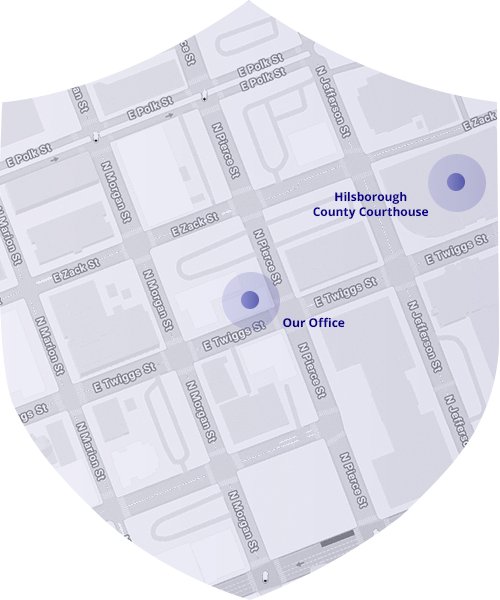
620 E. Twiggs Street, Suite 205, Tampa, FL 33602
(813) 727-7159
Serving Hillsborough, Pinellas, and Pasco Counties
The Brancato Law Firm, P.A. is a Tampa-based criminal defense practice. We are not affiliated with any other Brancato-named law firms.
Visit Us

Tampa, FL 33602
Contact Us Now
Free Legal Consultation (813) 727-7159