

From First DUI to Death Penalty



How to Fight DUI With Serious Bodily Injury in Florida? (2026)


To fight a DUI with serious bodily injury charge in Florida, the defense attacks each link the State must prove: that the driver was impaired or at 0.08 or higher, that the driver’s operation of the vehicle caused or contributed to the crash, and that another person suffered a serious bodily injury as defined in section 316.1933. Under section 316.193(3)(c)2, the offense is a third-degree felony punishable by up to 5 years in prison, ranked Level 7 on the sentencing chart, with a driver license revocation of at least 3 years. A first offender with no record still scores a prison sentence unless the defense wins a reduction or a downward departure.
Serious-injury DUI cases are usually decided by three pieces of evidence: the blood draw, the crash reconstruction, and the medical records. I’m Rocky Brancato, founder of The Brancato Law Firm, P.A., a Tampa criminal defense firm, a member of the National College for DUI Defense, and a former police academy instructor who taught officers how DUI investigations are supposed to be done. Over more than 25 years in Hillsborough County courtrooms and more than 150 jury trials to verdict, I have seen these cases turn on whether the blood was drawn lawfully and whether the injury actually meets the statute. Our attorneys test all three pieces from the first day, while the evidence is still fresh.
What is DUI with serious bodily injury in Florida?
DUI with serious bodily injury is driving under the influence and, by reason of that operation, causing or contributing to causing serious bodily injury to another person. Section 316.193(3), Florida Statutes, requires three things: the person was in violation of the DUI law (impaired normal faculties, or a blood or breath alcohol level of 0.08 or more), the person operated a vehicle, and the operation “causes or contributes to causing” the injury. The same subsection makes DUI causing property damage or a lesser injury a first-degree misdemeanor and DUI causing death the separate crime of DUI manslaughter.
“Serious bodily injury” has a specific legal meaning. Section 316.1933(1)(b) defines it as “an injury to any person, including the driver, which consists of a physical condition that creates a substantial risk of death, serious personal disfigurement, or protracted loss or impairment of the function of any bodily member or organ.” Our Tampa DUI lawyer page explains how our attorneys defend every level of DUI charge, from a first misdemeanor to these felony cases.
What are the penalties for DUI with serious bodily injury in Florida?
DUI with serious bodily injury is a third-degree felony punishable by up to 5 years in prison and a $5,000 fine. The offense severity chart in section 921.0022 ranks it at Level 7, which scores 56 points under section 921.0024. Because a Criminal Punishment Code scoresheet over 44 points requires prison, a first offender scores a lowest permissible sentence of 21 months before any victim injury points are added. If the court scores the injury as severe, 40 more points are added, raising the minimum to about 51 months.
The license consequences are separate and severe. Under section 322.28(4)(a), the court “shall revoke the driver license of the person convicted for a minimum period of 3 years,” and a second DUI conviction can trigger the longer revocations for repeat offenders. Each injured person can support a separate count, so a crash with two seriously injured passengers can mean two Level 7 felonies on one scoresheet.
| Offense | Statute | Degree and level | Maximum penalty |
|---|---|---|---|
| DUI (first offense, no crash) | 316.193(1)-(2) | Misdemeanor | 6 months jail, $500 to $1,000 fine |
| DUI causing property damage or injury | 316.193(3)(c)1 | First-degree misdemeanor | 1 year jail, $1,000 fine |
| DUI causing serious bodily injury | 316.193(3)(c)2 | Third-degree felony, Level 7 | 5 years prison, $5,000 fine, 3-year minimum license revocation |
| DUI manslaughter | 316.193(3)(c)3 | Second-degree felony (first-degree in some cases) | 15 years prison (30 if first-degree), 4-year mandatory minimum |
What counts as a serious bodily injury in a Florida DUI case?
A serious bodily injury is one that creates a substantial risk of death, serious permanent disfigurement, or a protracted loss or impairment of a body part or organ. A broken bone, a laceration needing stitches, or a concussion is not automatically serious bodily injury; the question is how lasting or dangerous the injury was. That is why our attorneys obtain the full medical records, treating physician testimony, and follow-up records, rather than relying on the officer’s description at the scene or a first-day emergency room note.
The injury must also be to another person. In Smith v. State, 793 So. 2d 1118 (Fla. 1st DCA 2001), the only person seriously injured was the defendant driver. The First District held that section 316.193(3)(c)2 “does not authorize a conviction of DUI causing serious bodily injury where only the driver has been injured,” reversed the felony, and ordered a conviction for simple DUI instead. The definition in section 316.1933 includes the driver for blood-draw purposes, but the felony requires injury “to another.”
| Injury to another person | Likely charge | What the defense examines |
|---|---|---|
| Property damage or minor injury | DUI with damage or injury, first-degree misdemeanor | Whether the client caused or contributed to the crash |
| Injury disputed as serious | Felony charged, misdemeanor possible | Medical records, recovery, and expert opinion on whether the injury is protracted or life-threatening |
| Clear serious bodily injury | Third-degree felony, Level 7 | Causation, blood draw legality, and test reliability |
| Only the driver injured | Simple DUI | Smith bars the felony |
Does the State have to prove the DUI caused the crash?
The State has to prove the driver’s operation of the vehicle caused or contributed to the injury, but it does not have to prove the alcohol caused the crash. In State v. Hubbard, 751 So. 2d 552 (Fla. 1999), a DUI manslaughter case interpreting the same “causes or contributes to causing” language, the Florida Supreme Court held there is no separate negligence element. It repeated that “the state is not required to prove that the operator’s drinking caused the accident,” and that the operator need not be “the sole cause.” What the State must prove is a causal connection between the defendant’s driving and the harm.
That causal connection is where many serious-injury cases are won. If the other driver ran a red light, a pedestrian stepped into traffic outside a crosswalk, or a road defect caused the crash, our attorneys argue that the client’s driving did not cause or contribute to the injury. We hire accident reconstruction experts, download the vehicles’ event data recorders, and pull traffic camera and dashcam video to show what actually happened in the seconds before impact.
Can police force a blood draw after a serious-injury DUI crash?
Florida law directs officers to take blood when they have probable cause to believe an impaired driver caused death or serious bodily injury, and section 316.1933(1)(a) allows “reasonable force if necessary.” Only a physician, certified paramedic, nurse, authorized hospital personnel, or licensed clinical laboratory staff may draw the blood at an officer’s request. The Fourth Amendment still applies. In Missouri v. McNeely, 569 U.S. 141 (2013), the U.S. Supreme Court held that the natural dissipation of alcohol does not automatically justify a warrantless blood draw, so officers need a warrant, valid consent, or proof of specific exigent circumstances.
A blood draw that fails those rules can be suppressed. Our attorneys examine whether the officer had probable cause of both impairment and serious bodily injury at the time of the draw, whether a warrant was sought, how long the draw took, who drew the blood, and whether the chain of custody and lab procedures were followed. Hospital blood drawn for medical treatment raises its own issues, because it often measures serum rather than whole blood and must be converted before it means anything under the 0.08 standard.
How do our attorneys fight a DUI with serious bodily injury charge?
We fight these charges on every element and on sentencing at the same time, because a reduction from the felony changes everything. These are the defenses we raise most often.
- No causation. The other driver, a pedestrian, or a road condition caused the crash, and the client’s driving did not contribute to it under Hubbard.
- The injury is not serious bodily injury. The medical records show an injury that healed without lasting impairment or a substantial risk of death, which supports a reduction to the misdemeanor.
- Unlawful blood draw. A warrantless draw without valid consent or proven exigency can be suppressed under McNeely, and a draw by an unauthorized person violates section 316.1933(2).
- Unreliable test results. Retrograde extrapolation, hospital serum results, delays, and lab errors can undermine the claim that the client was at 0.08 or higher while driving.
- No impairment. Without a reliable test, the State must prove impaired normal faculties, and crash injuries such as a concussion can mimic signs of impairment.
- Double jeopardy. Under Velazco v. State, 342 So. 3d 614 (Fla. 2022), the State cannot convict a driver of both DUI with damage and DUI with serious bodily injury for the same victim in one crash.
- Downward departure. When the facts are hard to contest, we build a mitigation case for a sentence below the scoresheet, such as an unsophisticated, isolated incident followed by genuine remorse, or restitution to the injured person.
In Velazco, a driver ran a red light and hit a man on a scooter, seriously injuring him and damaging the scooter. The Florida Supreme Court held that convictions for both DUI causing damage to property or person and DUI causing serious bodily injury, for the same victim in a single episode, are “degree variants of the same offense” and violate double jeopardy. The court noted that separate convictions remain permitted when several people are injured.
How common are serious-injury DUI crashes in Florida?
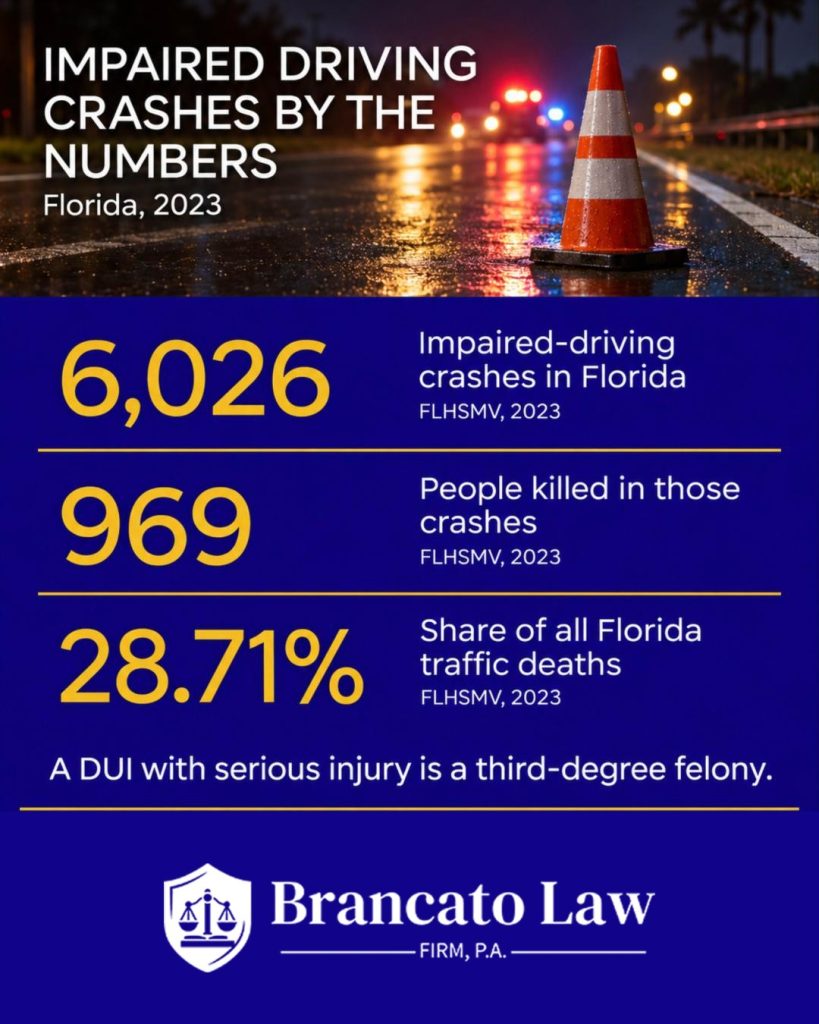
Impaired-driving crashes are a small share of Florida crashes but a large share of serious harm. In 2023, Florida recorded 6,026 crashes in which alcohol, drugs, or both were confirmed, and those crashes killed 969 people, 28.71 percent of all traffic deaths, according to the Florida Department of Highway Safety and Motor Vehicles Impaired Driving Annual Report. Alcohol-confirmed crashes alone produced 395 incapacitating injuries and 2,709 other injuries that year, per the department’s 2023 Traffic Crash Facts Annual Report.
Research also shows why test results drive these prosecutions. A National Highway Traffic Safety Administration case-control study, Richard P. Compton and Amy Berning, “Drug and Alcohol Crash Risk,” DOT HS 812 117 (February 2015), compared more than 3,000 crash-involved drivers with 6,000 control drivers in Virginia Beach and found that drivers at a breath alcohol level of 0.08 were about 3.9 times as likely to crash, and at 0.15 about 12 times as likely. The same study found that marijuana use was not associated with a significant increase in crash risk once it adjusted for age, gender, ethnicity, and alcohol, a finding our attorneys use when a drug-based DUI charge rests on a THC result alone.
How are serious-injury DUI cases handled in Hillsborough County?
In Hillsborough County, DUI with serious bodily injury is a felony prosecuted by the State Attorney’s Office for the 13th Judicial Circuit in circuit court, not the county DUI docket. These cases are usually investigated by traffic homicide or crash investigators from the Florida Highway Patrol, the Hillsborough County Sheriff’s Office, or the Tampa Police Department, and blood results and reconstruction reports can take weeks, so many drivers are arrested well after the crash. If you were in a serious crash and investigators are still working, our representation before charges are filed can preserve evidence and protect you before an arrest decision.
When an arrest happens, the judge at first appearance in Hillsborough County sets bond and usually orders no driving and no alcohol. Pretrial diversion is rarely offered on a Level 7 felony with an injured victim, so the realistic paths are a reduction to the misdemeanor, a downward departure, or trial. Our guide to the Florida criminal case process explains each stage, and our article on DUI penalties in Hillsborough County covers the misdemeanor sentences that a reduction can bring.
Can DUI with serious bodily injury charges be dropped or reduced in Florida?
Yes. DUI with serious bodily injury charges are reduced or dropped when the injury does not meet the statutory definition, when the blood evidence is suppressed or unreliable, or when the evidence shows the client did not cause the crash. The most common favorable outcome is a reduction to DUI with property damage or injury, a misdemeanor, which removes the prison scoresheet and the 3-year revocation. Our attorneys build that case with medical experts, a reconstructionist, and a toxicologist, and we present it to the prosecutor before the case is set for trial.
Frequently asked questions about DUI with serious bodily injury in Florida
Is DUI with serious bodily injury a mandatory prison sentence in Florida?
There is no mandatory minimum term in the statute, but the Level 7 ranking means the scoresheet calls for prison even for a first offender. The Brancato Law Firm seeks reductions and downward departures that allow probation or community control instead, and our DUI defense attorneys start building that mitigation at the first meeting.
What if the injured person was my passenger?
A passenger counts as another person, so a seriously injured passenger can support the felony. Our attorneys at The Brancato Law Firm examine whether the passenger knew of the impairment, whether seat belt use affected the injury, and how the passenger’s own statements fit the crash evidence.
Can I refuse a blood test after a crash with serious injuries in Florida?
Section 316.1933 directs officers to obtain blood with reasonable force when they have probable cause of impairment and serious bodily injury, so refusal may not stop the draw. The Brancato Law Firm challenges whether that probable cause existed and whether a warrant or exigency supported the draw under McNeely.
How long will I lose my license for DUI with serious bodily injury?
A conviction requires a revocation of at least 3 years under section 322.28(4)(a), and longer if it is a repeat DUI. The Brancato Law Firm explains hardship license eligibility after a revocation, and our guide to FR-44 insurance after a Florida DUI covers the insurance you will need to drive again.
Can a marijuana DUI be charged as serious bodily injury?
Yes. The statute covers impairment by alcohol, chemical substances, or controlled substances, so a crash attributed to marijuana can be charged the same way. Our attorneys at The Brancato Law Firm challenge whether a THC result proves impairment at the time of driving, as our article on marijuana DUI charges in Florida explains.
What happens if the injured person later dies?
If the injured person dies from crash injuries, the State can amend the charge to DUI manslaughter, a second-degree felony with a 4-year mandatory minimum. The Brancato Law Firm reviews the medical cause of death closely in those cases, as described in our guide to DUI manslaughter in Florida.
For more about our defense strategies, visit our DUI page.
Blood samples, vehicle data, and intersection video can be lost within days of a crash, and our attorneys move to preserve them right away. Talk with The Brancato Law Firm, P.A., founded by Tampa Criminal Defense Attorney Rocky Brancato, by calling (813) 727-7159; you can call us at any hour. Our firm has Spanish-speaking staff, and attorney Jean-Luc Adrien speaks Spanish, Haitian Creole, and French. Our office is two blocks from the courthouse, and we defend serious-injury DUI cases in Hillsborough, Pinellas, and Pasco counties.
The Brancato Law Firm, P.A.
620 E. Twiggs Street, Suite 205, Tampa, FL 33602
(813) 727-7159
Serving Hillsborough, Pinellas, and Pasco Counties
The Brancato Law Firm, P.A. is a Tampa-based criminal defense practice. We are not affiliated with any other Brancato-named law firms.
Visit Us

Tampa, FL 33602

Contact Us Now
Free Legal Consultation (813) 727-7159
