- Free Consultation 24/7: (813) 727-7159 Tap Here To Call Us


From First DUI to Death Penalty



Is Leaving the Scene of an Accident a Felony in Florida? (2026)


Updated October 22, 2026
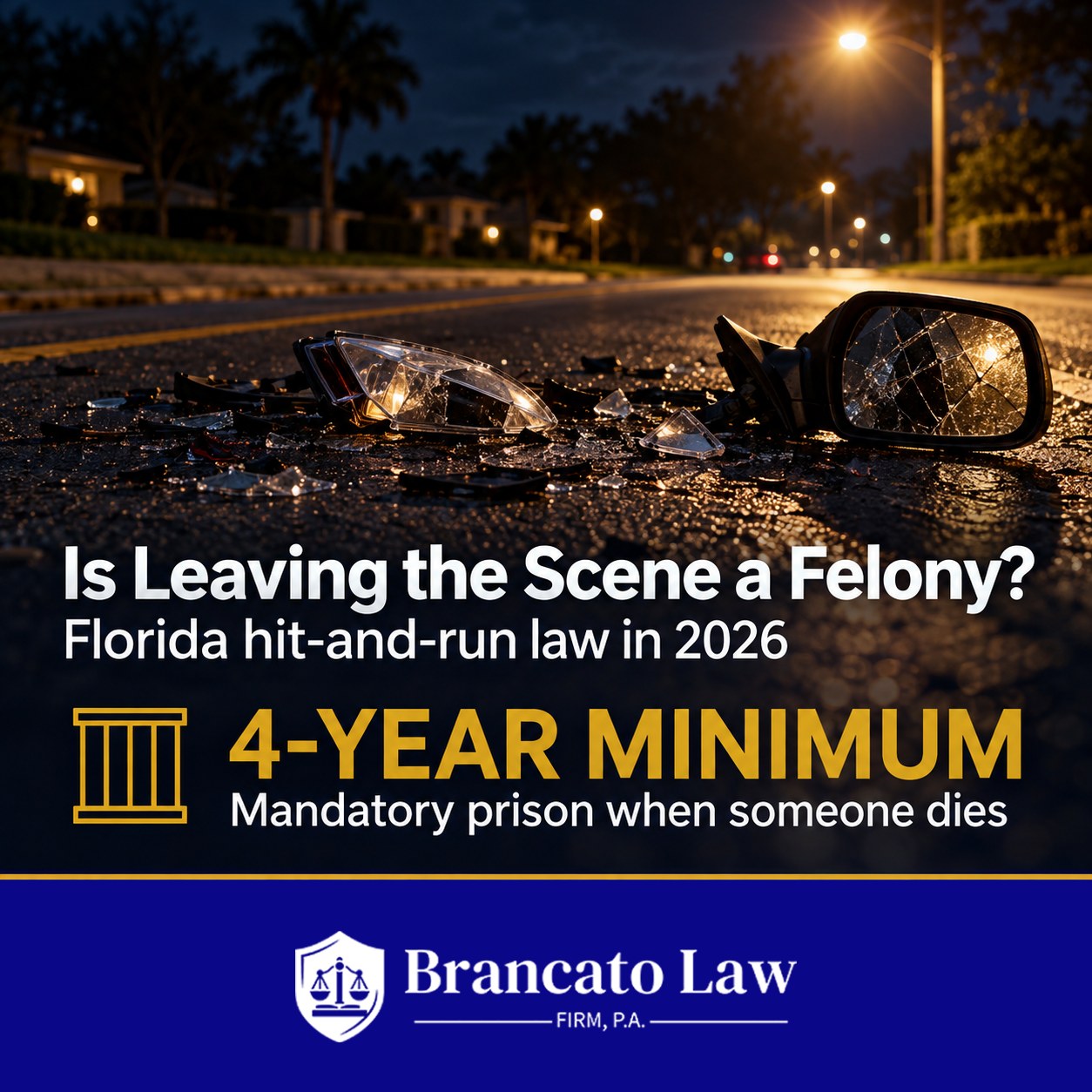
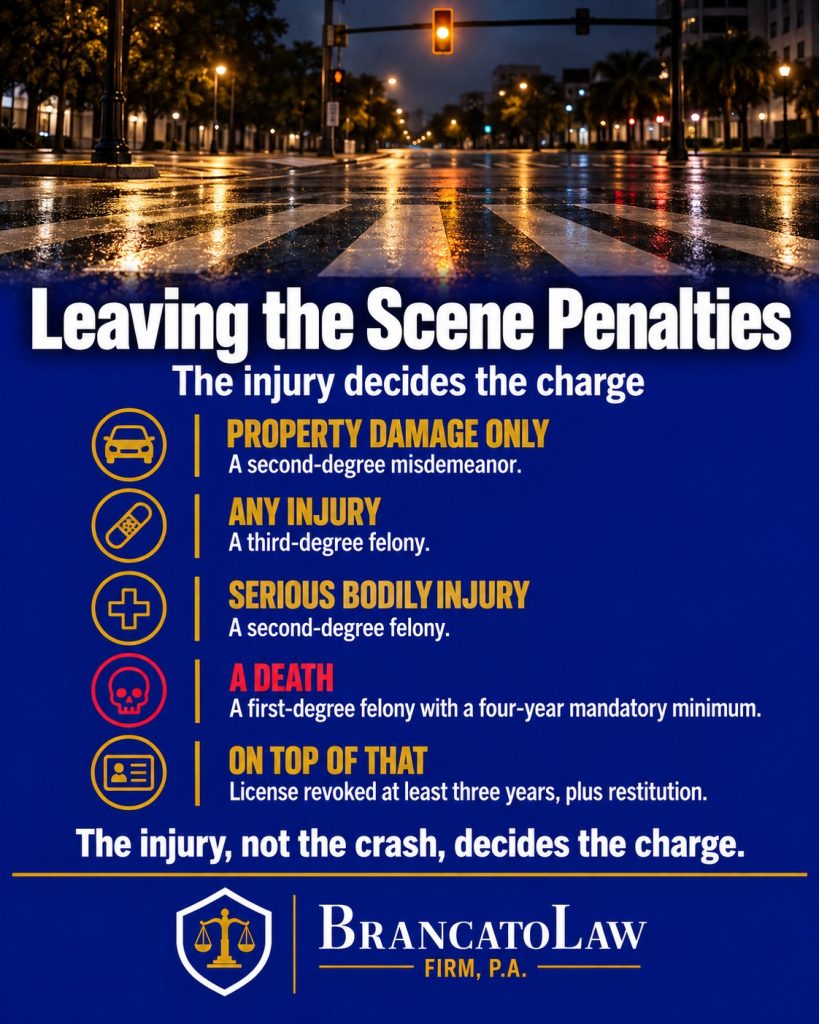
Leaving the scene of an accident is a felony in Florida whenever someone was injured or killed. Under section 316.027, leaving a crash with an injury is a third-degree felony, a serious bodily injury makes it a second-degree felony, and a death makes it a first-degree felony with a 4-year mandatory minimum prison sentence. Leaving a crash that caused only property damage is a second-degree misdemeanor under section 316.061. In every tier, the State must prove the driver actually knew a crash happened.
Hit-and-run cases are often decided by one fact the State has to prove beyond a reasonable doubt: that the driver actually knew there had been a crash. Rocky Brancato, founder of The Brancato Law Firm, P.A., a Tampa criminal defense firm, has spent more than 25 years in Hillsborough County courtrooms watching that question shape these cases from the first investigation to the verdict. Our attorneys defend leaving the scene charges across Hillsborough, Pinellas, and Pasco Counties, from property damage misdemeanors to fatal-crash felonies, and we often step in while police are still investigating.
Is leaving the scene of an accident a felony in Florida?
Yes, when the crash caused injury or death. Section 316.027, Florida Statutes requires a driver to “immediately stop” and “remain at the scene of the crash until he or she has fulfilled the requirements of s. 316.062.” The degree of the felony depends on the harm. A crash with only property damage falls under section 316.061, Florida Statutes and is a misdemeanor.
| What the crash caused | Statute | Charge | Maximum penalty |
|---|---|---|---|
| Property damage only | § 316.061 | Second-degree misdemeanor | 60 days in jail, $500 fine |
| Injury | § 316.027(2)(a) | Third-degree felony | 5 years in prison, $5,000 fine |
| Serious bodily injury | § 316.027(2)(b) | Second-degree felony | 15 years in prison, $10,000 fine |
| Death | § 316.027(2)(c) | First-degree felony | 30 years in prison, $10,000 fine, 4-year mandatory minimum |
The maximums come from section 775.082, Florida Statutes and section 775.083. Our Tampa criminal traffic lawyer team checks the injury classification first, because the line between “injury” and “serious bodily injury” can move a case a full felony degree.
What does Florida law require a driver to do after a crash?
Stop, stay, share information, and help anyone hurt. Under section 316.062, Florida Statutes, the driver must give a name, address, and vehicle registration, show a license on request, and “render to any person injured in the crash reasonable assistance, including the carrying, or the making of arrangements for the carrying, of such person to a physician, surgeon, or hospital … if it is apparent that treatment is necessary, or if such carrying is requested.” If no one is able to receive the information and no officer is present, the driver must report the crash “forthwith” to the nearest police office.
Two parts of that statute matter in defense work. Section 316.062(3) says the duty does not require information that “would violate the privilege of such person against self-incrimination.” Section 316.062(4) makes a violation of section 316.062 by itself a noncriminal traffic infraction. The crime comes from leaving before the duties are met.
A driver cannot leave first and report later. In Paleveda v. State, No. 2D2024-0980 (Fla. 2d DCA Jan. 23, 2026), a Hillsborough County fatal crash case, the defense asked for a jury instruction allowing a driver to leave “to find the nearest police station so he could report the accident.” The Second District held the judge properly refused it, because the driver had to stay and determine the victim’s condition first. “Paleveda did not stop. He ran,” the court wrote, and the conviction was affirmed “in all respects.” Our attorneys at The Brancato Law Firm build the defense around what the driver knew and did in those first minutes.
What does the State have to prove in a leaving the scene case?
The State must prove that the defendant was the driver, that the driver knew a crash occurred, that the driver knew or should have known someone was hurt (for the felony tiers), and that the driver willfully failed to stop, remain, or give information and aid. Fault for the crash is not an element. A driver who did nothing wrong in the collision can still be convicted for leaving.
Knowledge of the crash must be actual knowledge. In State v. Dorsett, 158 So. 3d 557 (Fla. 2015), the Florida Supreme Court held that “the State must prove beyond a reasonable doubt that the driver had actual knowledge of the crash, an essential element of the crime.” The standard jury instruction had allowed a conviction if the driver “knew or should have known” of the crash, and the Court held that wording was wrong as to the crash.

The injury element uses a lower standard. Under Dorsett, the State may prove knowledge of injury by showing the driver knew or reasonably should have known of it “from the nature of the accident.” That split matters at trial. A light impact at night, loud music, or a collision with the rear of a long vehicle can each create doubt that the driver knew anything happened, and our attorneys at The Brancato Law Firm reconstruct exactly what the driver could see and hear.
What is the mandatory minimum for leaving the scene of a fatal crash?
Four years in prison. Section 316.027(2)(c) provides that a driver who leaves a crash involving a death “shall be sentenced to a mandatory minimum term of imprisonment of 4 years.” The same 4-year minimum applies if the driver was also DUI. The minimum, the serious bodily injury tier, and the 3-year revocation came from the Aaron Cohen Life Protection Act, chapter 2014-225, Laws of Florida.
The minimum can sometimes be avoided. Under section 316.027(2)(g), the defense may move to depart from the 4-year minimum unless the violation involved DUI. The State may object, and the court may depart only if the minimum “would constitute or result in an injustice,” with reasons stated in open court. A driver arrested on a fatal leaving the scene charge who has certain prior convictions, including a prior leaving the scene or DUI conviction, “shall be held in custody until brought before the court for admittance to bail.”
Sentencing points are another fight. In Chang v. State, No. 2D2023-2090 (Fla. 2d DCA May 14, 2025), a Sarasota County driver pleaded to leaving the scene of a fatal crash and tampering. The judge scored 120 victim-injury points under section 921.0021(7)(e), which allows those points when “the offender caused victim injury,” even though leaving the scene did not cause the death. The Second District upheld the statute against a facial challenge and affirmed a sentence of 15 years in prison followed by probation. The lesson is to contest causation-based points rather than stipulate to them. When the State also claims the driver caused the death, the case may overlap with DUI manslaughter or vehicular homicide, which our attorneys defend as well.
What other penalties come with a leaving the scene conviction?
License revocation, restitution, and possible enhancements:
- Revocation. Section 316.027(2)(e) requires revocation “for at least 3 years” for any injury, serious bodily injury, or death conviction. Before reinstatement, the driver must complete a victim’s impact panel or an approved vulnerable road user course.
- Restitution. For the felony tiers, the court “shall order the driver to make restitution to the victim for any damage or loss unless the court finds clear and compelling reasons not to.” Since October 1, 2025, chapter 2025-14, Laws of Florida also lets a court order restitution for property damage in a section 316.061 case when the driver “caused or otherwise contributed to the crash.”
- Vulnerable road user enhancement. If the victim was a pedestrian, bicyclist, motorcyclist, scooter rider, road worker, or another vulnerable road user, the offense is “ranked one level above” its normal ranking under section 316.027(2)(f).
Our attorneys at The Brancato Law Firm check each of these before any plea discussion, because a 3-year revocation can matter as much as the sentence.
How do police build a hit-and-run case?
Usually from the scene outward. Investigators start with what was left behind, such as vehicle parts and paint transfer. They canvass for home and business cameras along the route, then identify the vehicle and its registered owner. The last step is often an interview at the owner’s front door, before any arrest.
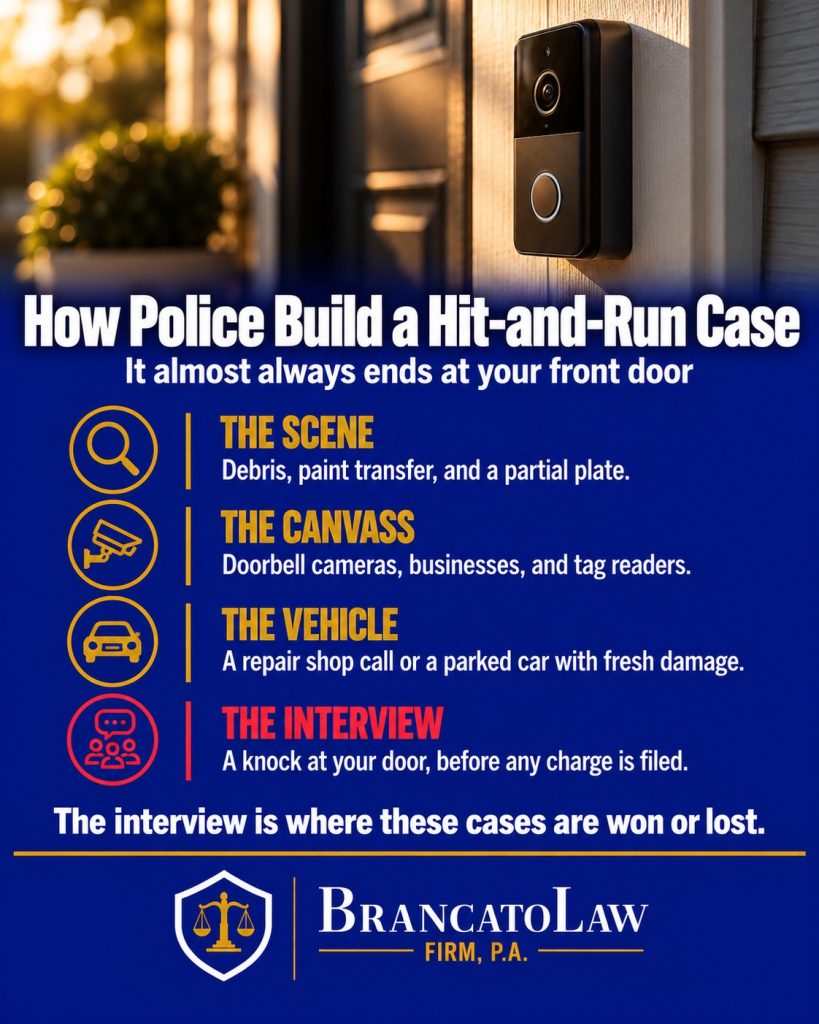
That interview is where many cases are made. The registered owner is not always the driver, and the officer at the door is trying to close that gap with your own words. Our post on the accident report privilege explains how Florida treats statements made for a crash report. If a detective has called or left a card, our representation before charges are filed can handle the contact, gather the video and phone records that help you, and speak with the State Attorney’s Office before a charging decision.
How common are hit-and-run crashes in Florida?
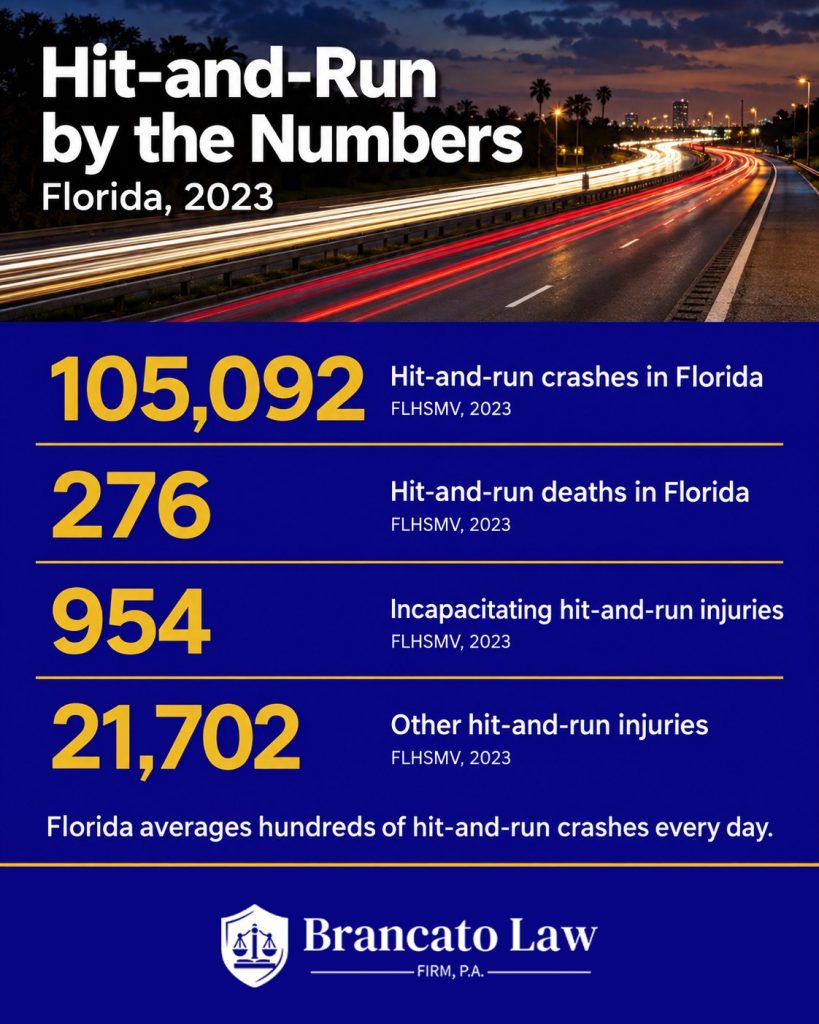
Common. In 2023, Florida recorded 105,092 hit-and-run crashes, which killed 276 people and caused 954 incapacitating injuries and 21,702 other injuries, according to the FLHSMV Traffic Crash Facts Annual Report 2023. The same report counted 107,844 hit-and-run crashes in 2022 and 109,646 in 2021.
National research shows why identity is so often disputed. The AAA Foundation for Traffic Safety reported in Understanding the Increase in Fatal Hit-and-Run Crashes (March 2026) that hit-and-run deaths nationwide peaked at 2,972 in 2022, 7% of all traffic deaths, and that nearly 80% of those deaths happened in darkness. Among hit-and-run drivers who were identified, over half were driving a vehicle they did not own. Our attorneys at The Brancato Law Firm never assume the owner was the driver.
How do our attorneys fight a leaving the scene charge?
We test every element, then work on the charge level and the sentence:
| Defense | What it attacks | Where it comes from |
|---|---|---|
| No knowledge of the crash | The actual-knowledge element | State v. Dorsett |
| No reason to know of injury | The felony tiers | Section 316.027 and Dorsett |
| Someone else was driving | Identity | Video, phone data, witnesses |
| Duties were fulfilled | Willful failure to remain and report | Section 316.062 |
| Wrong injury tier | Serious bodily injury versus injury | Medical records |
| Departure from the 4-year minimum | The mandatory sentence | Section 316.027(2)(g) |
| Contested victim-injury points | The scoresheet | Chang v. State |
In practice, that means our attorneys:
- Reconstruct what the driver perceived, using the vehicle damage, lighting, speed, and sound.
- Pin down who was driving, with cell phone location, toll and camera records, and witnesses.
- Document what the driver did do, such as stopping briefly, calling 911, or returning.
- Challenge the medical proof that an injury was “serious bodily injury.”
- Prepare a departure case early in fatal cases with no DUI allegation, with family, employment, and remorse evidence.
What should you do if police want to talk to you about a crash?
Call a lawyer before you answer questions. A detective’s request for “your side of the story” usually means the investigation already points at you or your car. In Hillsborough County, a person arrested on a leaving the scene charge sees a judge at first appearance within 24 hours, held at the Orient Road Jail, and the State Attorney’s Office for the 13th Judicial Circuit files the charging information. Our Hillsborough County criminal defense attorney team handles those first appearances. Until then:
- Do not explain the damage to your car to police, insurers, or friends.
- Do not repair, sell, or hide the vehicle.
- Save your phone records and any video from the time of the crash.
- Let your lawyer arrange any surrender, which can affect bond.
If the case also involves a police chase, see our guide on fleeing and eluding in Florida, since fleeing an officer while leaving a crash that caused injury or property damage is charged as aggravated fleeing.
Frequently asked questions about leaving the scene in Florida
Can leaving the scene charges be dropped in Florida?
Yes, when the State cannot prove the driver knew of the crash, cannot prove who was driving, or the driver’s own actions met the duties in section 316.062. The Brancato Law Firm often presents that evidence to prosecutors through our pre-file advocacy before a charge is filed.
Can I be charged with leaving the scene if the crash was not my fault?
Yes. Fault is not an element; the duty to stop applies to every driver involved, and our attorneys at The Brancato Law Firm focus instead on knowledge, identity, and what the driver actually did after the impact.
Can I leave a crash to go report it to the police?
Not before checking on anyone who may be hurt. In Paleveda v. State, the Second District rejected a jury instruction that would have let a driver leave to find a police station first, and our attorneys at The Brancato Law Firm explain how that ruling applies to your timeline. Our post on the accident report privilege covers what to say afterward.
Is there mandatory prison for leaving the scene with an injury in Florida?
No mandatory minimum applies to the injury or serious bodily injury tiers; the 4-year minimum applies only when someone died. The Brancato Law Firm works the scoresheet and the facts in injury cases to argue for a sentence without prison, as described on our criminal traffic defense page.
How long is your license revoked for leaving the scene in Florida?
At least 3 years for a conviction involving injury, serious bodily injury, or death, under section 316.027(2)(e). Our attorneys at The Brancato Law Firm consider the revocation in every plea discussion, because it can cost a client a job.
Should I turn myself in after leaving the scene of an accident?
Talk to a lawyer first, so the surrender is arranged and nothing you say adds to the State’s case. The Brancato Law Firm can contact the investigating agency on your behalf, as explained on our Hillsborough County criminal defense page.
Contact our Tampa leaving the scene defense attorneys
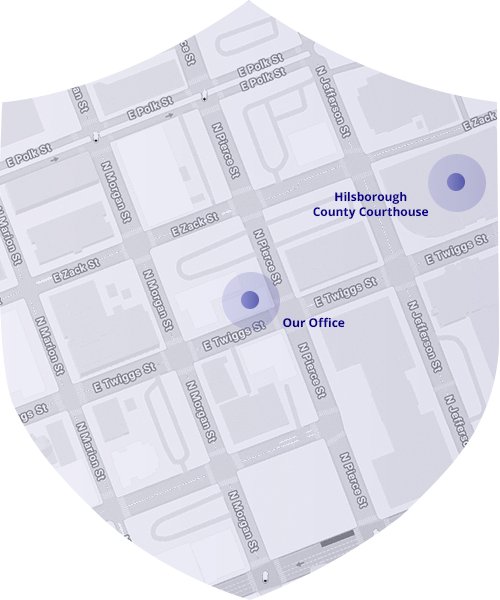
If a detective has left a card at your door or called about a crash, the investigation is already under way. The Brancato Law Firm, P.A., founded by Tampa Criminal Defense Attorney Rocky Brancato, will handle the police contact, gather the video and phone records, and press the knowledge and identity questions from the start. Call (813) 727-7159 for a free, confidential consultation. You can call us at any hour, and our office is two blocks from the courthouse. Our firm has Spanish-speaking staff, and attorney Jean-Luc Adrien speaks Spanish, Haitian Creole, and French. Read about our Spanish and Haitian Creole criminal defense services.
For more about our defense strategies, visit our Tampa Criminal Traffic Lawyer page.
The Brancato Law Firm, P.A.
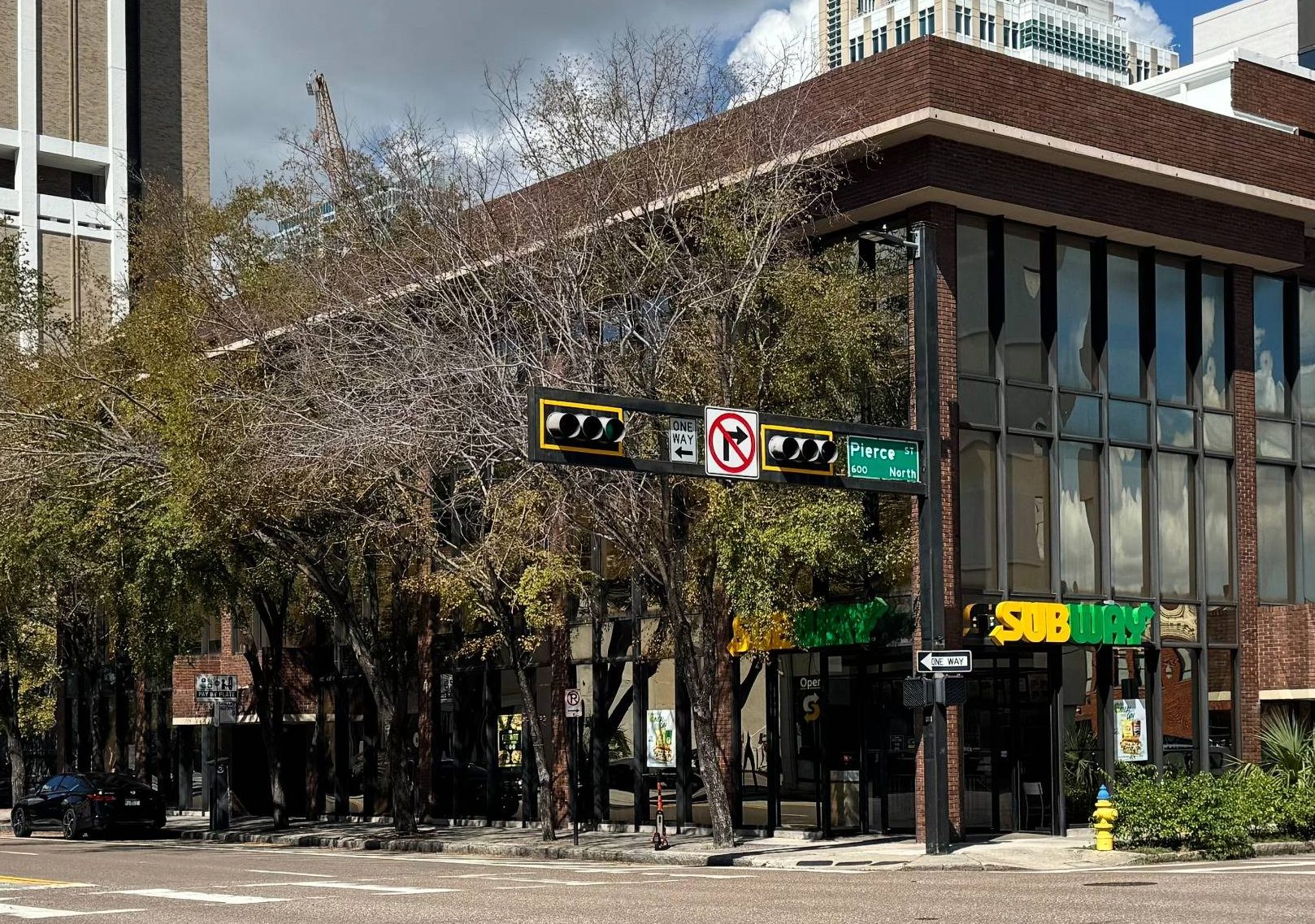
620 E. Twiggs Street, Suite 205, Tampa, FL 33602
(813) 727-7159
Serving Hillsborough, Pinellas, and Pasco Counties
The Brancato Law Firm, P.A. is a Tampa-based criminal defense practice. We are not affiliated with any other Brancato-named law firms.
Visit Us
Tampa, FL 33602
Contact Us Now
Free Legal Consultation (813) 727-7159