- Free Consultation 24/7: (813) 727-7159 Tap Here To Call Us


From First DUI to Death Penalty



How DUI Manslaughter Cases Are Defended in Florida



DUI manslaughter cases in Florida are defended on two things the State has to prove: that the driver was impaired, and that the driving caused or contributed to a death. Both elements carry a heavy burden of proof, and both can be attacked. The chemical evidence, the lawfulness of the stop and the blood draw, and the cause of the crash itself are all open to challenge. Most of the highest-value defense work happens early, often in the first 72 hours after a fatal crash, while evidence is still being collected and before a lawyer is even hired.
Impaired driving sits behind a large share of fatal crashes, with an estimated 11,904 alcohol-impaired-driving deaths in 2024 according to NHTSA. Fatal-crash cases draw intense pressure from prosecutors and the public, and that pressure is part of what a defense has to work against. At The Brancato Law Firm, we defend these cases across Hillsborough, Pinellas, and Pasco Counties, and our founder Rocky Brancato has tried more than 150 jury trials to verdict. Our starting point is straightforward: a serious charge is not the same as a hopeless one.
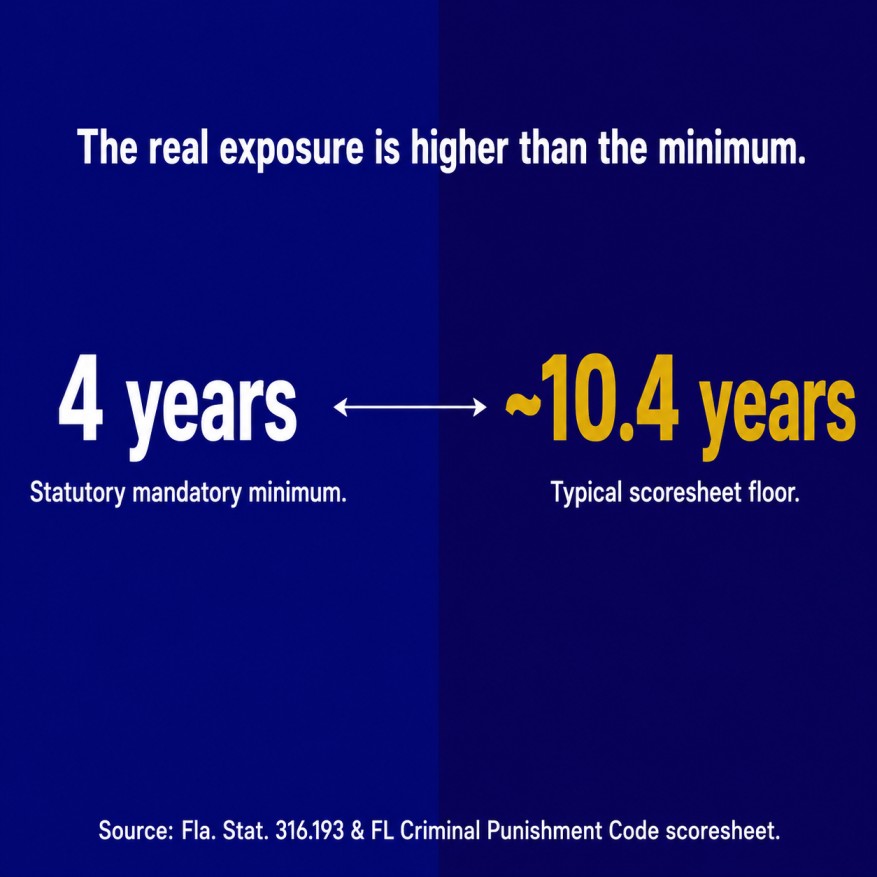
On paper, DUI manslaughter carries a four-year mandatory minimum. The realistic sentencing exposure is closer to ten years once Florida’s scoresheet is run. That gap is exactly why these cases are worth fighting hard, and why the work has to start fast.
What the State has to prove in a DUI manslaughter case
Under Florida Statute 316.193, the State has to prove three things beyond a reasonable doubt:
- The accused drove or was in actual physical control of a vehicle.
- The accused was impaired to the point that normal faculties were affected, or had a blood-alcohol or breath-alcohol level of 0.08 or higher.
- By reason of that operation, the accused caused or contributed to causing a death.
There is no intent requirement. The driver does not have to mean to hurt anyone. For a plain-language breakdown of the charge and its penalties, see our guide on what DUI manslaughter involves.
Impairment can be proven two separate ways. The “normal faculties” theory relies on officer observations, driving pattern, and field sobriety exercises. The “per se” theory relies on a chemical test reading of 0.08 or higher. Each path has its own weaknesses, which is why a real defense looks hard at both.
Why causation is where these cases are really won or lost
Florida’s causation standard is unusually low, and that is the most important thing for anyone facing this charge to understand. The statute requires only that the impaired operation “caused or contributed to causing” the death. The Florida Supreme Court in Magaw v. State held that the State does not have to prove the driver’s drinking caused the crash. It only has to prove that the operation of the vehicle did, and that any lack of care attributable to the impaired driver will satisfy the standard. Later cases like State v. Hubbard confirmed that simple negligence is enough and the driver need not be the sole cause.
That sounds discouraging. It is actually where the leverage is. Because the standard is so low, the defense invests heavily in proving that something else was the real cause.
There is a hard limit on the State’s theory. If the victim’s own conduct was the sole proximate cause of the death, there is no DUI manslaughter. The classic illustration is a pedestrian who darts into traffic where no sober driver could have avoided the collision. Impairment does not turn an unavoidable accident into a homicide.
This is why independent accident reconstruction is the single strongest line of defense. A reconstructionist examines:
- Speed, point of impact, and the angle of the collision
- Visibility, lighting, weather, and road conditions
- Whether a second driver ran a red light or otherwise intervened
- Whether a vehicle defect, such as failed brakes, a tire blowout, or steering failure, caused the loss of control
We have seen a mechanical failure rather than the driver change the entire analysis of a crash. The cause is not always the person behind the wheel. We have also taken causation fights to a jury, including a fatal wrong-way crash on the Selmon Expressway where the central battle was the State’s theory of what actually caused the collision. DUI manslaughter is a homicide charge, and we approach it with the same forensic depth we bring to any homicide defense. Each case is unique, and past results do not guarantee future outcomes.
Why the four-year mandatory minimum understates the real exposure
The statute sets a four-year mandatory minimum, and many people stop reading there. The real number is usually higher because of how Florida scores these cases.
DUI manslaughter is a Level 8 offense under Florida’s Criminal Punishment Code. A primary Level 8 offense scores 74 sentencing points. A death adds 120 victim-injury points. The code then subtracts 28 from the total and multiplies the remainder by 0.75 to produce the lowest permissible prison sentence. Because a death is always part of a DUI manslaughter case, the math runs like this:
- 74 points (primary offense) plus 120 points (death) equals 194 points
- 194 minus 28 equals 166
- 166 multiplied by 0.75 equals 124.5 months, or about 10.4 years
When the guideline floor is higher than the mandatory minimum, the higher number controls, unless the judge grants a lawful downward departure. So the working exposure on a standard DUI manslaughter case is closer to ten years than four. The same scoresheet, run without the death points, would land near 34.5 months. The death points are what make these cases so serious, and they are also why a credible attack on impairment or causation matters so much to the final sentence.
| Charge | Statute | Felony level | Maximum prison | Mandatory minimum |
| DUI with serious bodily injury | 316.193(3)(c)2 | Third degree | 5 years | None |
| DUI manslaughter | 316.193(3)(c)3.a | Second degree | 15 years | 4 years (guideline floor near 124.5 months) |
| DUI manslaughter, left the scene | 316.193(3)(c)3.b | First degree | 30 years | 4 years |
| Second DUI manslaughter (Trenton’s Law) | 316.193(3)(c)3.c | First degree | 30 years | 4 years |
How Trenton’s Law changed DUI manslaughter penalties in 2025
Trenton’s Law, passed as HB 687, took effect on October 1, 2025, and raised the stakes considerably for repeat fatal-driving cases. Two changes matter most.
First, a prior conviction for DUI manslaughter, BUI manslaughter, vehicular homicide, or vessel homicide now elevates a new DUI manslaughter to a first-degree felony, with exposure up to 30 years. Older priors count regardless of how long ago they happened.
Second, the law made refusing a breath or urine test its own separate crime in certain circumstances. The decision to refuse a test now carries its own consequences, which makes early legal advice even more important. We cover the mechanics in our explainer on refusing a breath test in Florida.
The practical takeaway: if there is any prior fatal-driving conviction in the picture, the case is in first-degree-felony territory, and the defense strategy changes accordingly.
How the chemical evidence gets challenged
The State’s impairment proof usually rests on a breath or blood test. Both are heavily regulated, and both are genuinely vulnerable when the rules are not followed.
Challenging the Intoxilyzer 8000 breath test
Florida’s evidentiary breath instrument is regulated by the Florida Department of Law Enforcement under Administrative Code Rule 11D-8. The defense can subpoena every maintenance, repair, and monthly-inspection record for the specific machine used and look for:
- Gaps in the required agency inspections
- Unauthorized repairs (only the manufacturer or an approved facility may repair the machine)
- A missing or interrupted 20-minute observation period, which guards against mouth-alcohol contamination
- Radio-frequency or temperature interference, which is worse when the machine sits in a patrol vehicle
Florida courts have excluded breath results when the program failed to follow these rules.
Challenging the blood test
In fatal crashes, blood is usually drawn. The defense scrutinizes the draw technique (an alcohol swab where a non-alcohol antiseptic is required can contaminate the sample), the chain of custody from collection through testing, and whether the lab measured hospital serum or plasma rather than whole blood. Serum readings tend to run higher than whole-blood readings, so an apparent number over 0.08 can shrink once an expert converts it correctly. Florida law also limits who may draw the blood to specific medical personnel.
Rising BAC and retrograde extrapolation
Alcohol keeps absorbing for roughly 30 to 90 minutes after drinking. A sample taken an hour or more after driving can overstate the BAC at the time the person was actually behind the wheel. A forensic toxicologist can work backward to argue the driver was below 0.08 while driving. We explore this in detail in our case study on why your BAC at the station is not your BAC behind the wheel.
Challenging the stop and the warrantless blood draw
September 2026 update: The law on warrantless blood draws just moved decisively in the defense’s favor. In State v. Marlin, No. 4D2025-1448 (Fla. 4th DCA Sept. 2, 2026), the Fourth District affirmed suppression of a forced blood draw in a fatal Turnpike crash, held that the natural dissipation of alcohol is never a per se exigency, and receded from the “probable cause” language in State v. Acevedo that prosecutors had been treating as an exception to the warrant requirement. Absent actual consent or case-specific exigent circumstances, a warrant is required — regardless of Florida’s implied consent law. Our full analysis is in can police take your blood without a warrant in Florida.
Two constitutional challenges come up repeatedly in fatal-crash cases.
The first is the stop. An officer needs reasonable suspicion of a traffic violation or probable cause of a crime to pull a vehicle over. If the stop was unlawful, everything that followed, including officer observations, the breath test, and the blood draw, can be suppressed as fruit of an illegal stop.
The second is the blood draw. The U.S. Supreme Court held in Missouri v. McNeely that a warrantless blood draw requires genuine exigent circumstances, and that the natural dissipation of alcohol is not, by itself, an automatic emergency. If officers had time to get a warrant and did not, the blood result may be thrown out. In a fatal crash where the driver is taken to a hospital, there is often time to seek a warrant, which makes this a live issue in many cases.
Why scene and hospital statements often get suppressed
People involved in a fatal crash are frequently questioned at the scene or in the hospital while in shock. What they say can often be kept out of evidence.
Florida’s accident-report privilege, found in Section 316.066, provides that a crash report or a statement made to an officer for the purpose of completing one may not be used as evidence in any trial, civil or criminal. Under what Florida courts call the “changing hats” doctrine, set out in State v. Norstrom, 613 So. 2d 437 (Fla. 1993), an officer who indicates the driver must answer has to expressly tell the driver that a criminal investigation has begun, then immediately give Miranda warnings, before those statements become admissible. Statements made during the crash-investigation phase, without that switch, are privileged.
This is a powerful suppression tool. It does not cover everything. An officer can still testify to physical observations like the odor of alcohol or slurred speech. But admissions made while a frightened driver believed he was simply helping complete a report often cannot be used against him.
The experts who actually move these cases
A serious DUI manslaughter defense is built on retained experts, and the order matters. Reconstruction comes first, because causation is the element with the most leverage.
- Accident reconstructionist. Establishes speed, impact geometry, and what actually caused the crash.
- Forensic toxicologist. Interprets BAC, handles retrograde extrapolation, and addresses serum-versus-whole-blood conversion.
- ASE-certified mechanic. Inspects the vehicle for a defect that caused the loss of control.
- Medical expert. Addresses cause of death and any pre-existing conditions.
All expert testimony has to satisfy Florida’s Daubert standard before a jury hears it. Our firm maintains a network of forensic experts, including forensic pathologists, accident reconstruction specialists, and former medical examiners. Our founder also spent years as a police academy instructor, training officers on how to investigate and testify, which sharpens cross-examination of the State’s witnesses. This is the forensic rigor we bring when we challenge the State’s forensic evidence, and it is the same standard we apply regardless of the charge. Each case is unique, and past results do not guarantee future outcomes.
DUI manslaughter vs. vehicular homicide, and how they get stacked
A fatal crash often produces two charges from the same event: DUI manslaughter and vehicular homicide. They are both second-degree felonies, but they require the State to prove different things.
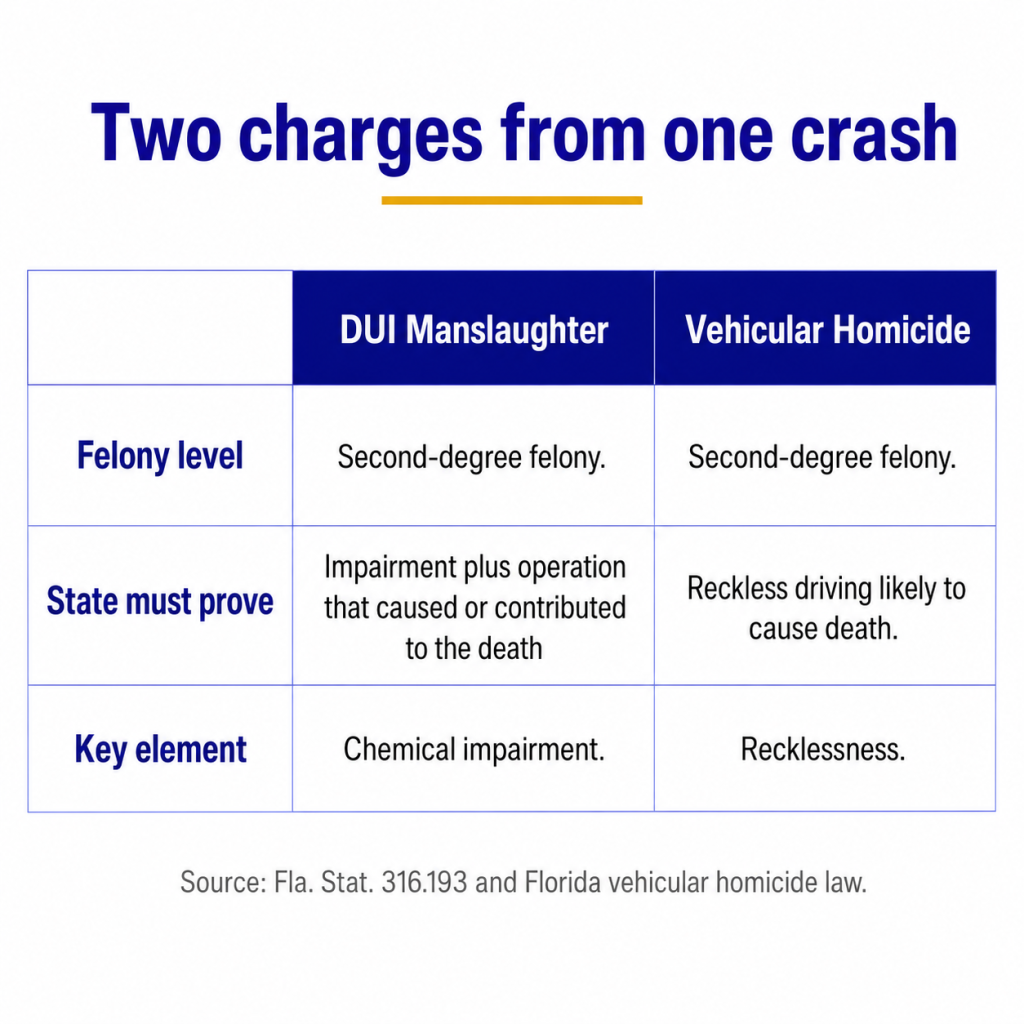
| DUI manslaughter | Vehicular homicide | |
| What the State must prove | Impairment or BAC of 0.08 or higher | Reckless driving likely to cause death or serious injury |
| Impairment required? | Yes | No, the driver can be completely sober |
| Causation standard | Caused or contributed to, simple negligence, need not be sole cause | Proximate cause, recklessness required |
| Mandatory minimum | 4 years | None |
| License consequence | Permanent revocation | Minimum 3-year revocation |
When both charges are filed, the defense builds independent defenses for each so the counts do not stack against the client. You can read more about the recklessness standard in our explainer on vehicular homicide in Florida.
What does a realistic reduction look like? Because of the mandatory minimum, the only path below four years is a negotiated reduction to a lesser charge, such as DUI with serious bodily injury or reckless driving, or a lawful downward departure. Reductions are harder to win in fatal cases than in standard DUIs, because prosecutors face public pressure. What moves the needle is the strength of the defense. A genuine problem with the State’s impairment proof, a credible causation theory pointing elsewhere, or suppressible evidence is what makes the State willing to talk.
Why the first 72 hours matter most
The single most important thing a person facing this charge can do is get an experienced Tampa DUI defense team working immediately. Fatal-crash investigations move fast, and evidence disappears.

In the first hours and days after a crash, the defense can:
- Preserve the vehicle’s event data recorder, or black box, which can show speed and braking before impact
- Track down dashcam and nearby surveillance footage before it is overwritten
- Identify and interview witnesses while memories are fresh
- Assert the accident-report privilege before damaging statements get locked in
- Get an independent reconstruction started while the scene is still intact
Once skid marks fade, footage is recycled, and witnesses scatter, that leverage is gone. Early counsel preserves the evidence the defense will need later. The sooner it starts, the more there is to work with.
Frequently asked questions about DUI manslaughter in Florida
Is DUI manslaughter a felony in Florida?
Yes. It is a second-degree felony punishable by up to 15 years in prison. It becomes a first-degree felony, with exposure up to 30 years, if the driver left the scene or has a qualifying prior conviction under Trenton’s Law.
What is the minimum sentence for DUI manslaughter in Florida?
The statute sets a four-year mandatory minimum. In practice, the sentencing scoresheet usually produces a higher floor, often around 124.5 months (about 10.4 years), because a death adds 120 points to the calculation.
Can a DUI manslaughter charge be reduced or dropped?
Sometimes. Because of the mandatory minimum, the routes below four years are a negotiated reduction to a lesser charge or a lawful downward departure. A serious problem with the State’s proof of impairment or causation is usually what makes a reduction realistic.
Does the State have to prove the driver caused the crash?
The State has to prove the impaired driving caused or contributed to the death, which is a low standard. But if someone else, or the victim’s own conduct, was the sole cause of the crash, there is no DUI manslaughter.
Serious charges still have real defenses
A DUI manslaughter charge is among the most serious a person can face in Florida, and the exposure is real. But the State carries the burden on impairment and on causation, and both are open to challenge. The chemical evidence has to be collected and maintained by the rules. The stop and the blood draw have to satisfy the Fourth Amendment. The cause of the crash has to hold up against an independent reconstruction. The work that decides these cases starts long before trial.
This is the kind of case our firm is built for. We keep a limited caseload so every case gets thorough preparation, we prepare every matter as if it will go to trial, and our founder ran the largest criminal defense operation in Tampa Bay as Chief Operations Officer of the Hillsborough County Public Defender’s Office, where he oversaw a staff of over 100 attorneys. That system-level knowledge informs how we read a fatal-crash case from the first day.
If you or someone in your family has been arrested or is under investigation for DUI manslaughter in the Tampa Bay area, the sooner you have a defense team in place, the more evidence can be preserved and the more options stay open. Call The Brancato Law Firm at (813) 727-7159 for a free, confidential consultation.
Each case is unique. Past results do not guarantee future outcomes.
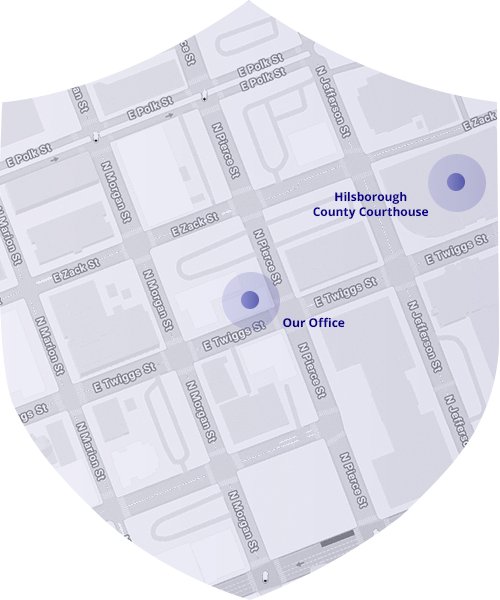
Visit Us
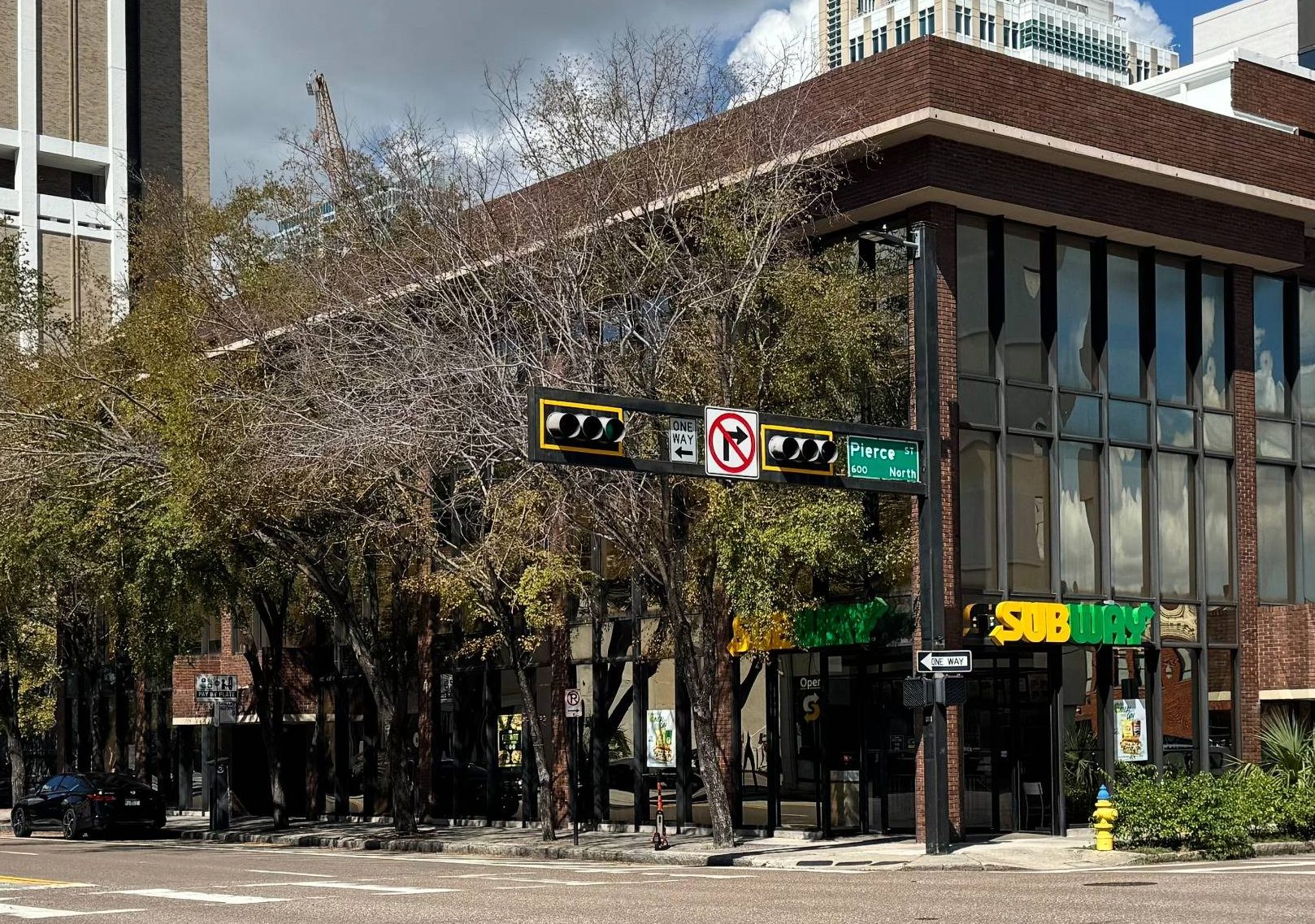
Tampa, FL 33602
Contact Us Now
Free Legal Consultation (813) 727-7159