- Free Consultation 24/7: (813) 727-7159 Tap Here To Call Us


From First DUI to Death Penalty



How Does a Bond Hearing Work in Tampa, Florida?


Completely rewritten and updated August 29, 2026.
| Key Takeaway: A bond hearing is where a Florida judge decides whether you will be released before trial and on what conditions. Unless you are charged with a capital offense or an offense punishable by life imprisonment and the State meets a heavy burden of proof, you are constitutionally entitled to pretrial release on reasonable conditions — and the judge must weigh statutory factors including your finances and community ties. For the most serious charges, a special hearing called an Arthur hearing decides whether bond is set at all. |
I’m Rocky Brancato, founder of The Brancato Law Firm, P.A., a Tampa criminal defense firm. I’ve fought bond hearings in Hillsborough County courtrooms for more than 25 years — including as COO of the Hillsborough County Public Defender’s Office, overseeing more than 100 defense attorneys — and today our attorneys handle bond and Arthur hearings across Tampa Bay every week.
Am I Entitled to Pretrial Release in Florida?
Yes — pretrial release on reasonable conditions is the constitutional default in Florida, not a favor from the court. Article I, Section 14 of the Florida Constitution puts it plainly:
| Fla. Const. art. I, § 14: “Unless charged with a capital offense or an offense punishable by life imprisonment and the proof of guilt is evident or the presumption is great, every person charged with a crime or violation of municipal or county ordinance shall be entitled to pretrial release on reasonable conditions.” |
There are two ways the State can take that right away: charge you with a capital or life-punishable offense and carry a very heavy burden of proof (the Arthur hearing, explained below), or convince the court that no conditions of release can protect the community, assure your presence at trial, or protect the integrity of the judicial process. Everything our firm does at a bond hearing is aimed at holding the State to those standards — because in our Hillsborough County practice, we regularly see bonds set high not because the law requires it, but because nobody pushed back.
What Factors Do Judges Consider When Setting Bail?
Florida law gives judges a specific list. Under Section 903.046, Florida Statutes, the purpose of bail is to ensure your appearance in court and protect the community — and the court must consider, among other factors:
| Statutory factor | What our attorneys present at the hearing |
| Nature and circumstances of the offense | The State’s actual allegations, not the worst-case headline |
| Weight of the evidence | The holes: identification issues, self-defense, weak witnesses |
| Family ties, residence, employment, financial resources, mental condition | Family members, employers, and pay records in the courtroom |
| Past conduct, criminal history, failures to appear | Context — old records, resolved cases, a clean appearance history |
| Danger to the community | A concrete release plan: GPS, no-contact, stay-away provisions |
| Source of bail funds | Clean documentation, prepared before the State asks |
The Brancato Law Firm, P.A. — Tampa bond hearing defense — (813) 727-7159
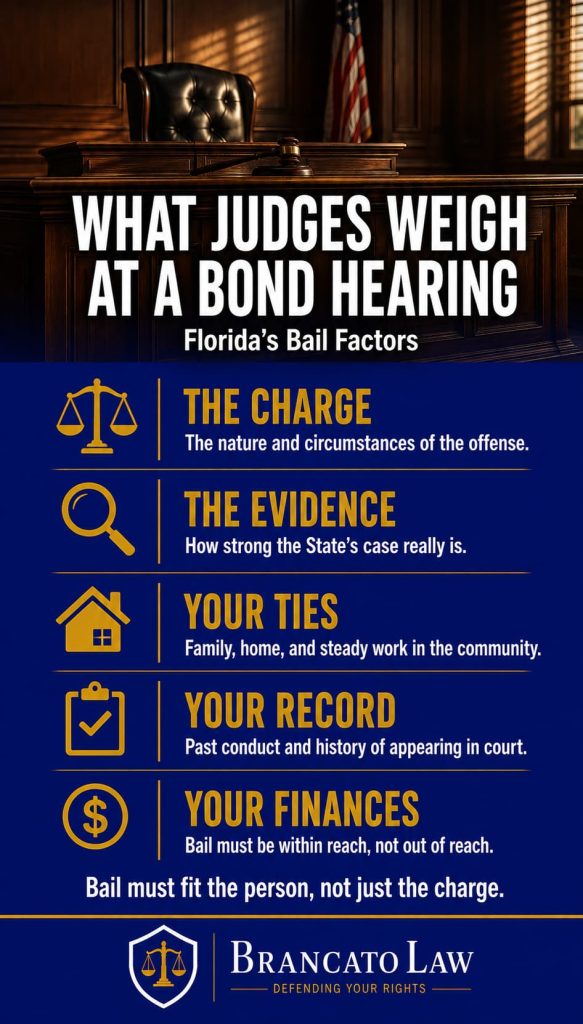
Financial resources are on that list for a reason: a bond you cannot possibly post does not serve the statute’s purpose — it just keeps you in jail. We put your real finances in the record at the first hearing, because that record is what wins reductions later.
What Conditions of Release Can the Court Order Instead of Cash?
Cash is only one tool — Florida courts can and do release defendants on conditions that cost nothing to post. Release on recognizance (ROR) means a written promise to appear with no money at all. Courts also routinely pair ROR — or a reduced monetary bond — with conditions tailored to the State’s stated concerns: no contact with the alleged victim or witnesses, travel restrictions, GPS monitoring or house arrest, drug and alcohol testing, and employment or treatment requirements.
One local reality our attorneys plan around: pretrial services supervision is not an available option in Hillsborough County, though some nearby counties in the Tampa Bay area do offer it. That difference changes the release plan we propose depending on where the case is pending — and it is exactly the kind of county-level detail that decides whether a judge says yes. Whatever the county, the goal is the same: answer the court’s real questions — will you appear, and is the community safe — without pricing release out of reach. A judge who is handed a supervised, condition-heavy release plan says yes far more often than one who is only given a dollar figure to cut.
What If the Bail Amount Is More Than You Can Afford?
A bond you cannot possibly post can be attacked as excessive — Florida courts have said an unattainable bond “is like having no bond at all.” In Norton-Nugin v. State, 179 So. 3d 557 (Fla. 2d DCA 2015), the appellate court quashed a $150,000 bond on four third-degree felonies where the defendant’s only asset was a $2,500 car, holding the amount was an abuse of discretion because the amount of bail cannot be used to punish an accused.
Norton-Nugin also confirms the vehicle for that fight: a petition for writ of habeas corpus is the proper way to challenge an order setting pretrial release conditions. That is why the record at the original bond hearing matters so much — when our firm puts your finances, ties, and release plan into the record and the court still sets an unattainable number, we have what the appellate court needs to fix it. The habeas petition moves fast compared to almost anything else in a criminal case.
What Is an Arthur Hearing?
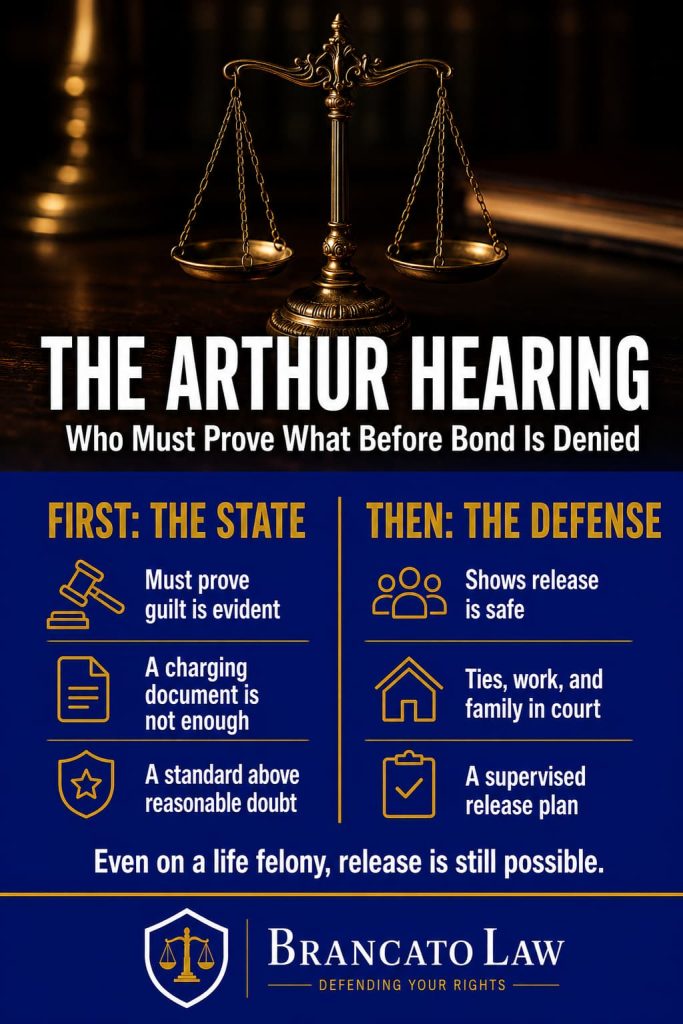
An Arthur hearing is the special bond hearing Florida requires before a person charged with a capital offense or an offense punishable by life imprisonment can be held without bond. It takes its name from State v. Arthur, 390 So. 2d 717 (Fla. 1980), where the Florida Supreme Court held that the State — not the defendant — bears the initial burden: it “must come forward with a showing that the proof of guilt is evident or the presumption is great,” and “[s]imply to present the indictment or information is not sufficient.” The State must present evidence that, viewed in its favor, would be legally sufficient to sustain a guilty verdict — and Florida courts describe the “proof evident, presumption great” standard as even greater than proof beyond a reasonable doubt.
The hearing runs in two stages:
| Stage | Who carries the burden | What must be shown |
| 1. Proof evident / presumption great | The State | Evidence legally sufficient to sustain a guilty verdict — an information or indictment alone is not enough |
| 2. Amenability to release | The defense | Why release is appropriate: ties, employment, no flight risk, a supervised release plan |
Even when the State carries its burden at stage one, the judge still has discretion to grant release — and stage two is where that discretion gets won. Arthur hearings are not unfamiliar territory for our firm: I’m death-qualified, our attorneys have defended homicide and attempted homicide cases throughout the 13th Judicial Circuit, and these are the fights we prepare for from the first phone call.
Can You Be Held Without Bond Before the Arthur Hearing Happens?
Yes, for a reasonable time — and knowing this prevents a painful surprise. In Thourtman v. Junior, 338 So. 3d 207 (Fla. 2022), the Florida Supreme Court held that when a defendant is charged with a capital or life-punishable offense, the trial court may defer the bond decision at first appearance and detain the defendant for a reasonable time to conduct a full Arthur hearing — without first finding that the proof is evident or the presumption great. The right to pretrial release is not lost until the court makes its definitive ruling.
The practical lesson cuts both ways. The court gets time to hold a real hearing — but so does the defense. The days between first appearance and the Arthur hearing are when our attorneys gather witnesses, employment records, and the release plan that stage two demands. Families who call The Brancato Law Firm at (813) 727-7159 in that window give us the time Thourtman builds into the process; families who wait often walk into the most important hearing of the case unprepared.
A New Ruling Confirms You’re Entitled to a Full Hearing, Not a Rushed One
In August 2026, a Florida appellate court ordered a new bond hearing for a defendant charged with attempted first-degree murder because the trial judge cut his hearing short. In Gardner v. State, No. 4D2026-1494 (Fla. 4th DCA Aug. 26, 2026), the court granted a writ of habeas corpus and held that a defendant facing a life felony must be given the opportunity to present evidence of his amenability to release — witnesses on every aspect of the bond issue, from whether the State’s proof is really “evident” to why he can safely be released. When the trial court ended the hearing before the defense could put on that evidence, it deprived him of the full hearing the law requires.
Gardner matters for every bond hearing, not just the most serious ones, because it names the problem out loud: judges in busy criminal divisions move fast, and a rushed hearing costs people weeks or months in jail the law never required. When our firm handles a bond hearing, we come with witnesses, documents, and a proposed release plan — and if the court won’t hear it, Gardner is now the case that says it must.
How Our Firm Builds a Strong Case for Reasonable Bond
A winning bond hearing is built, not improvised — and it is built around live witnesses and documents, not argument. Drawing on 25+ years in Hillsborough County courtrooms, here is what our attorneys bring:
- Witnesses, not promises. Family for stability, an employer confirming a job is waiting, community members who will vouch — the exact evidence Gardner says you are entitled to present.
- A concrete release plan. GPS monitoring, house arrest, no-contact provisions, treatment where appropriate — giving the judge conditions to say yes to instead of a number to say no with.
- Financial proof. Pay stubs, bank records, and honest asset pictures that make the § 903.046 financial-resources factor impossible to ignore.
- A record for review. Every witness and exhibit also builds the habeas record — if the court gets it wrong, we are already positioned to challenge it.
There’s a dollars-and-cents side too: a bond reduced from $100,000 to $20,000 saves a family thousands in nonrefundable bondsman premium alone — often more than the cost of having counsel at the hearing.
What to Do in the First 24 Hours After an Arrest in Tampa
The first 24 hours decide how prepared the bond hearing will be. If someone you love has been booked at Orient Road or Falkenburg Road Jail, three things matter now:
- Get counsel before first appearance. First appearance happens quickly, and what occurs there frames everything — including whether a bond gets set at a number no one pushed back on.
- Line up witnesses and documents. Employer letters, proof of residence, family members willing to appear — the raw material of the § 903.046 factors and stage two of an Arthur hearing.
- Guard what gets said.
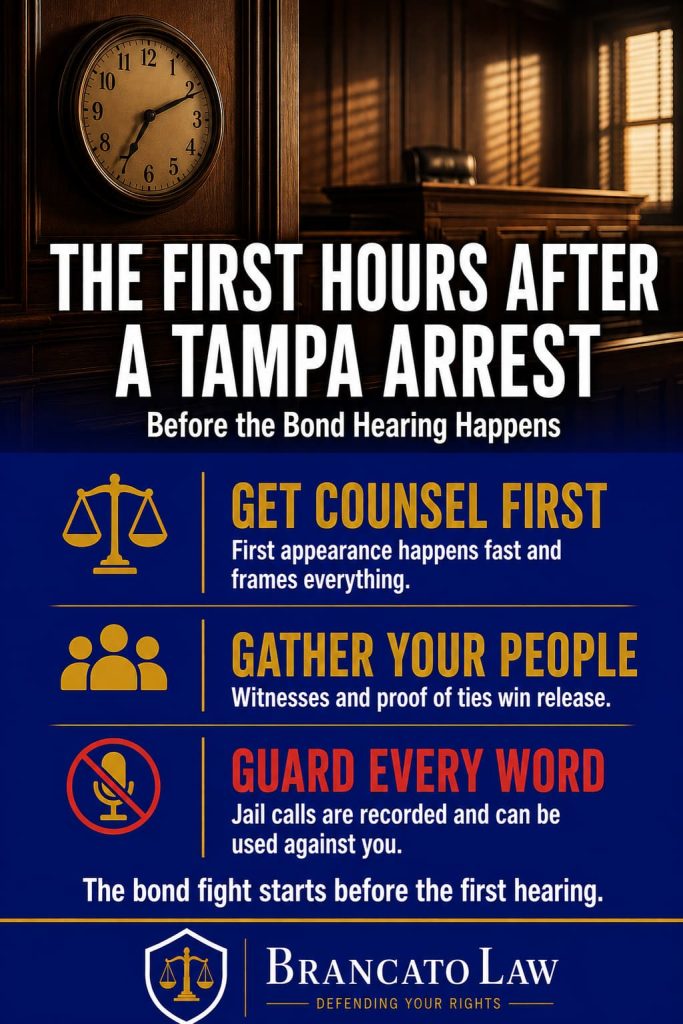
| Warning: Anything you or your family say at first appearance or on recorded jail phone lines can be used against you — including statements about the charges, the alleged victim, or money. Let your attorney do the talking about the case; your job is showing up with witnesses and proof of your ties to the community. |
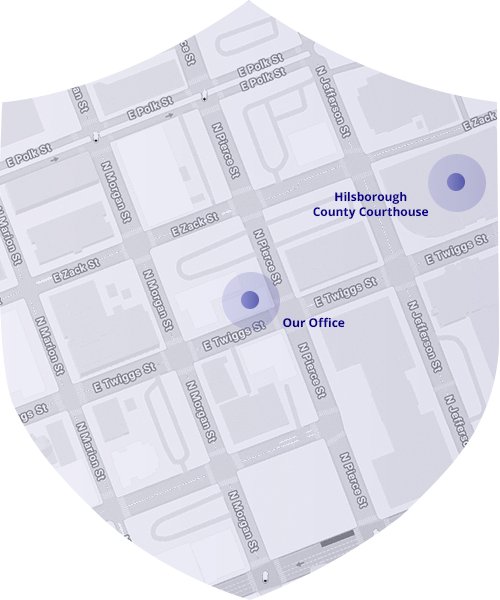
Call The Brancato Law Firm at (813) 727-7159 — our attorneys answer 24/7, and our office sits minutes from the Hillsborough County Courthouse.
Frequently Asked Questions: Tampa Bond Hearings
Am I entitled to pretrial release in Florida?
Yes, unless you are charged with a capital offense or an offense punishable by life imprisonment and the State proves the “proof of guilt is evident or the presumption is great.” Fla. Const. art. I, § 14. In our Hillsborough County cases, most clients are constitutionally entitled to release on reasonable conditions — the fight is over what “reasonable” means.
What is an Arthur hearing in Florida?
An Arthur hearing is the bond hearing required before someone charged with a capital or life-punishable offense can be held without bond, named for State v. Arthur, 390 So. 2d 717 (Fla. 1980). The State bears the initial burden with a standard even higher than beyond a reasonable doubt, and the defense then presents evidence of amenability to release. Our attorneys prepare both stages before we ever walk in.
Can I be held with no bond in Florida?
Yes, but only in limited circumstances — a capital or life-punishable charge where the State carries its heavy Arthur burden, or a finding that no conditions can protect the community or assure your appearance. Courts may also defer the bond decision for a reasonable time to hold a full hearing under Thourtman v. Junior, 338 So. 3d 207 (Fla. 2022). We use that window to build the release case.
Can my attorney get my bail reduced?
Yes — bond can be revisited by motion, and an unattainable bond can be challenged by writ of habeas corpus. Florida’s Second District has quashed a $150,000 bond where the defendant’s only asset was a $2,500 car. The Brancato Law Firm builds the financial record at the first hearing so a reduction motion or habeas petition has teeth.
What happens if I miss a court date while on bond?
The court can revoke your bond, issue a warrant, and the failure to appear becomes a factor against you at every future release decision under § 903.046, Fla. Stat. If a date was missed, acting immediately — before the warrant is served — usually produces a far better outcome; our firm handles these situations quickly.
Do I need a lawyer for a bond hearing?
Yes — the bond hearing is often the highest-leverage hearing in the entire case, and it is usually held within days of arrest. The attorneys of The Brancato Law Firm, P.A. have fought bond and Arthur hearings in Tampa Bay courtrooms for decades, and the record made at that hearing shapes everything that follows. Call (813) 727-7159 for a free, confidential consultation.
For more about our defense strategies, visit our Hillsborough County Criminal Defense page.
Related reading: What to Do After Being Arrested in Tampa, Florida · Missed Your Court Date in Tampa? Here’s What to Do Next · The Complete Guide to Homicide Charges in Florida · The Criminal Court Process in Hillsborough County
In Jail Tonight? The Bond Fight Starts Before First Appearance
The most important hearing in a criminal case is often the first one — and it can happen within hours of arrest. If someone you love is being held in Hillsborough, Pinellas, or Pasco County, call the attorneys of The Brancato Law Firm, P.A. — founded by Tampa Criminal Defense Attorney Rocky Brancato — now: (813) 727-7159. Every hour before the bond hearing is an hour we can use to get them home.
The Brancato Law Firm, P.A. is a Tampa-based criminal defense practice. We are not affiliated with any other Brancato-named law firms.
Visit Us
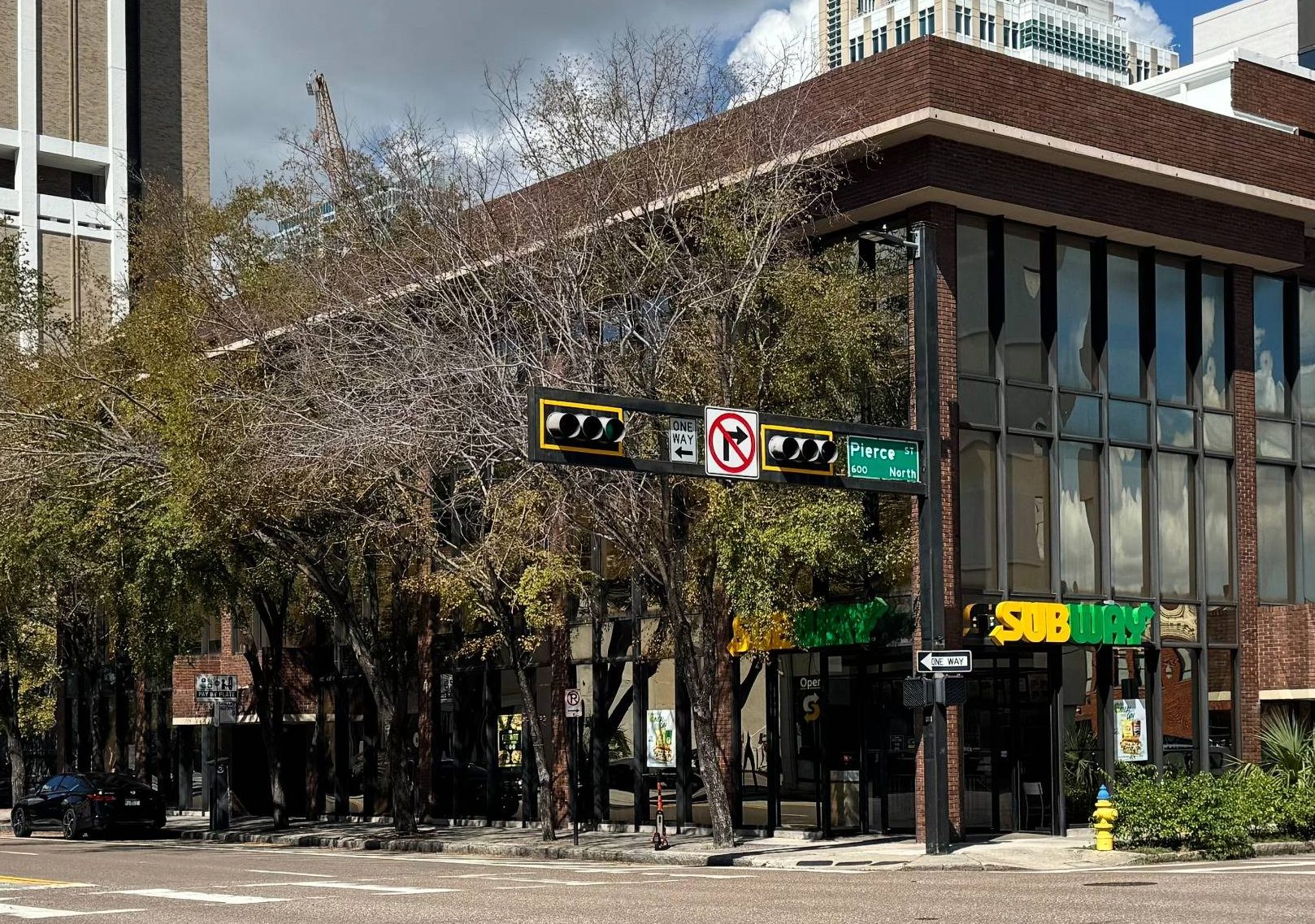
Tampa, FL 33602
Contact Us Now
Free Legal Consultation (813) 727-7159