- Free Consultation 24/7: (813) 727-7159 Tap Here To Call Us


From First DUI to Death Penalty



Can Police Take Your Blood Without a Warrant in Florida?


| Only in two situations: you actually consent, or a court later finds true exigent circumstances based on the specific facts of your case. Otherwise, officers need a warrant. On September 2, 2026, Florida’s Fourth District Court of Appeal in State v. Marlin affirmed the suppression of a forced blood draw in a fatal Turnpike crash, held that the natural burn-off of alcohol is never an automatic emergency, and withdrew its own earlier language that prosecutors had been treating as a “probable cause exception.” Florida’s implied consent law does not change any of this. |
I’m Rocky Brancato, founder of The Brancato Law Firm, P.A., a Tampa criminal defense firm. Before private practice I taught at the police academy and served as chief operating officer of the Hillsborough County Public Defender’s Office, and I have watched the law of DUI blood draws move steadily in one direction for more than a decade: toward the warrant. Marlin is the clearest Florida statement yet of where that road ends, and our attorneys are already using it.
What Does the Fourth Amendment Require Before Police Draw Your Blood?
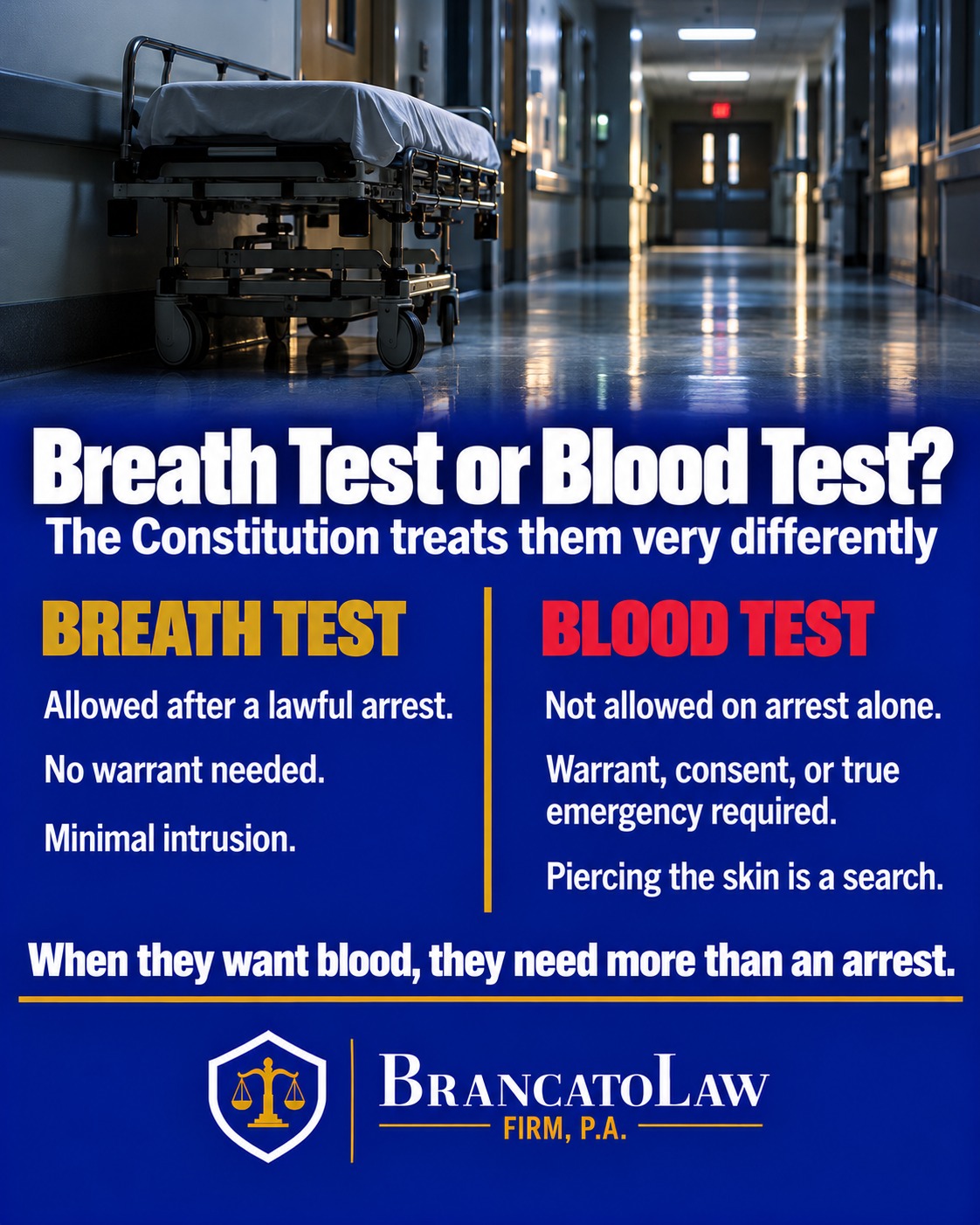
A warrant, unless a recognized exception applies — and the United States Supreme Court has spent the last thirteen years narrowing those exceptions for blood. Drawing blood is a search. In Missouri v. McNeely, 569 U.S. 141 (2013), the Court rejected the argument that because alcohol dissipates from the bloodstream over time, every drunk-driving investigation is automatically an emergency that excuses the warrant; exigency has to be shown case by case, on the totality of the circumstances. (Read the opinion.) Three years later, in Birchfield v. North Dakota, 579 U.S. 438 (2016), the Court drew the line that governs every roadside today: police may administer a breath test as a search incident to a lawful DUI arrest, but not a blood test — and a state cannot deem drivers to have “consented” to a blood test by criminalizing refusal. (Read the opinion.)
| Breath test | Blood test | |
|---|---|---|
| Incident to a lawful DUI arrest | Permitted without a warrant | Not permitted without a warrant |
| Intrusion | Minimal — air you exhale anyway | Piercing the skin and taking a bodily sample |
| Implied consent as substitute for a warrant | Workable | Rejected by the Supreme Court |
| Refusal | Admissible; criminal in Florida | Admissible; criminal penalty for refusing a warrantless draw is constitutionally suspect |
The practical takeaway is simple: when officers want breath, the arrest itself is usually enough; when they want blood, they need your actual agreement, a judge’s signature, or a genuine emergency they can prove later.
What Did the Fourth DCA Decide in State v. Marlin?
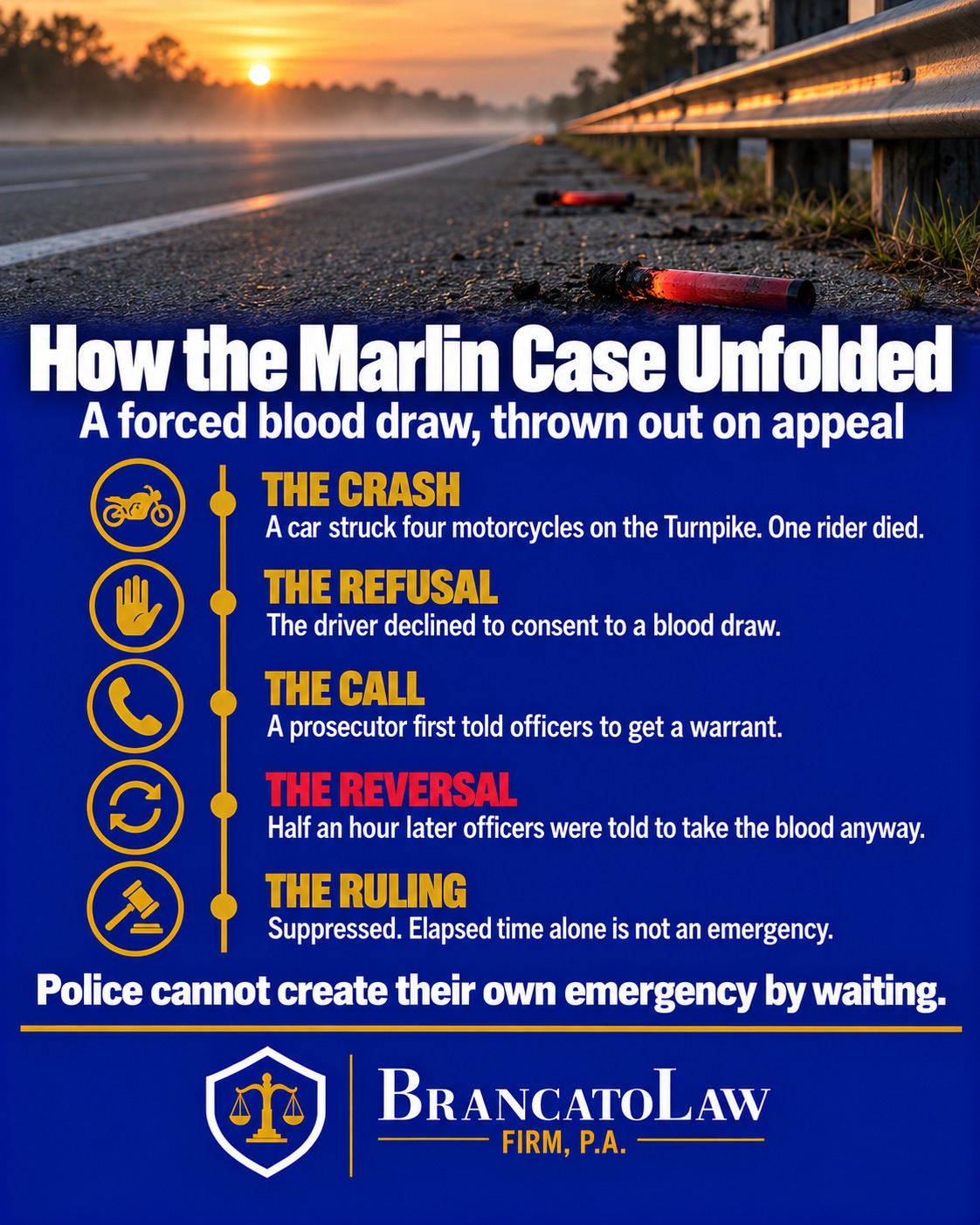
That prosecutors had been reading one of the court’s own opinions too generously, and that the warrant requirement means what it says. In State v. Marlin, No. 4D2025-1448 (Fla. 4th DCA Sept. 2, 2026), a driver drifted onto the shoulder of the Turnpike and struck four motorcycles, killing one rider and injuring two others. He was charged with two counts of DUI manslaughter, two counts of DUI with serious bodily injury, and additional injury and property-damage counts. Officers asked him to consent to a blood draw. He refused. Roughly two hours after the crash, law enforcement called a prosecutor, who told them to apply for a search warrant; about thirty minutes later the same prosecutor called back and said they could proceed without one because “exigent circumstances existed due to the elapsed time.” First responders then drew his blood by force.
The trial court initially denied suppression, openly “struggling” with a sentence in the Fourth District’s 2023 decision in State v. Acevedo that said an officer with probable cause could “coerce” a blood draw. On rehearing the judge reversed course and suppressed the results. The State appealed, and the Fourth District affirmed, holding:
- No per se exigency. The natural metabolization of alcohol does not, by itself, justify a warrantless blood draw. Exigency must be decided on the totality of the circumstances in the particular case.
- Warrant required regardless of implied consent. In the court’s words, “Unless a motorist gives actual consent or a court determines under the totality of the circumstances that exigent circumstances exist, a warrant must be obtained for a blood draw to satisfy the Fourth Amendment. This is true regardless of a state’s implied consent laws.”
- The crash statute is a directive to get a warrant, not a substitute for one. Section 316.1933, which tells officers to obtain blood in crashes causing death or serious injury, “must assume the blood draw will be obtained with a warrant, absent consent or proof of exigent circumstances.”
- Acevedo’s “probable cause” language is withdrawn. The court called that sentence “unnecessary to our decision and thus non-binding dicta,” noted that “the State has taken Acevedo’s language and run with it as a new exception to the Birchfield warrant requirement,” and receded from it: “We simply do not have the authority to create an exception contrary to United States Supreme Court authority.”
For defense lawyers who have been hearing “Acevedo says probable cause is enough” in suppression hearings for three years, that fourth holding is the one that matters most.
Does Florida’s Implied Consent Law Let Police Take Blood Anyway?
No — and this is the argument the State lost in Marlin. Florida has two statutes that talk about blood. Section 316.1932(1)(c), Florida Statutes, deems a driver who appears for treatment at a hospital, clinic, or “other medical facility” to have consented to a blood test when a breath or urine test is impractical or impossible, and expressly defines “other medical facility” to include an ambulance or other medical emergency vehicle. Section 316.1933, Florida Statutes, provides that when an officer has probable cause to believe an impaired driver caused death or serious bodily injury, the officer “shall require” a blood test and “may use reasonable force if necessary.”
Read in isolation, those statutes sound like authority to take blood on probable cause alone. Read against McNeely and Birchfield, they cannot be. A statute cannot supply the “consent” the Fourth Amendment requires — Birchfield said so directly — and the Fourth District followed the Fifth District’s decision in State v. Liles, 191 So. 3d 484 (Fla. 5th DCA 2016), which had already rejected the argument that statutory implied consent satisfies the Constitution when a driver actually refuses. Marlin therefore reads section 316.1933 as a set of marching orders to officers — go get the blood in serious crashes — with an unstated constitutional condition: get a warrant, unless the driver agrees or a real emergency exists.
Judge Shepherd’s concurrence adds two clarifications that will matter in Tampa hospital cases. First, actual consent and statutory implied consent are different things: if a driver voluntarily agrees to a blood draw, officers do not have to recite the implied consent warnings, and the technical requirements of the implied consent statute do not apply. Second, the location of the draw is not what decides the question. An ambulance is a “medical facility” under the statute, but a nonconsensual blood draw in a hospital “must still satisfy either the warrant requirement or the impractical/impossible prong” of the implied consent law. Being in an emergency room does not waive your Fourth Amendment rights.
When Is a Warrantless Blood Draw Still Lawful in Florida?
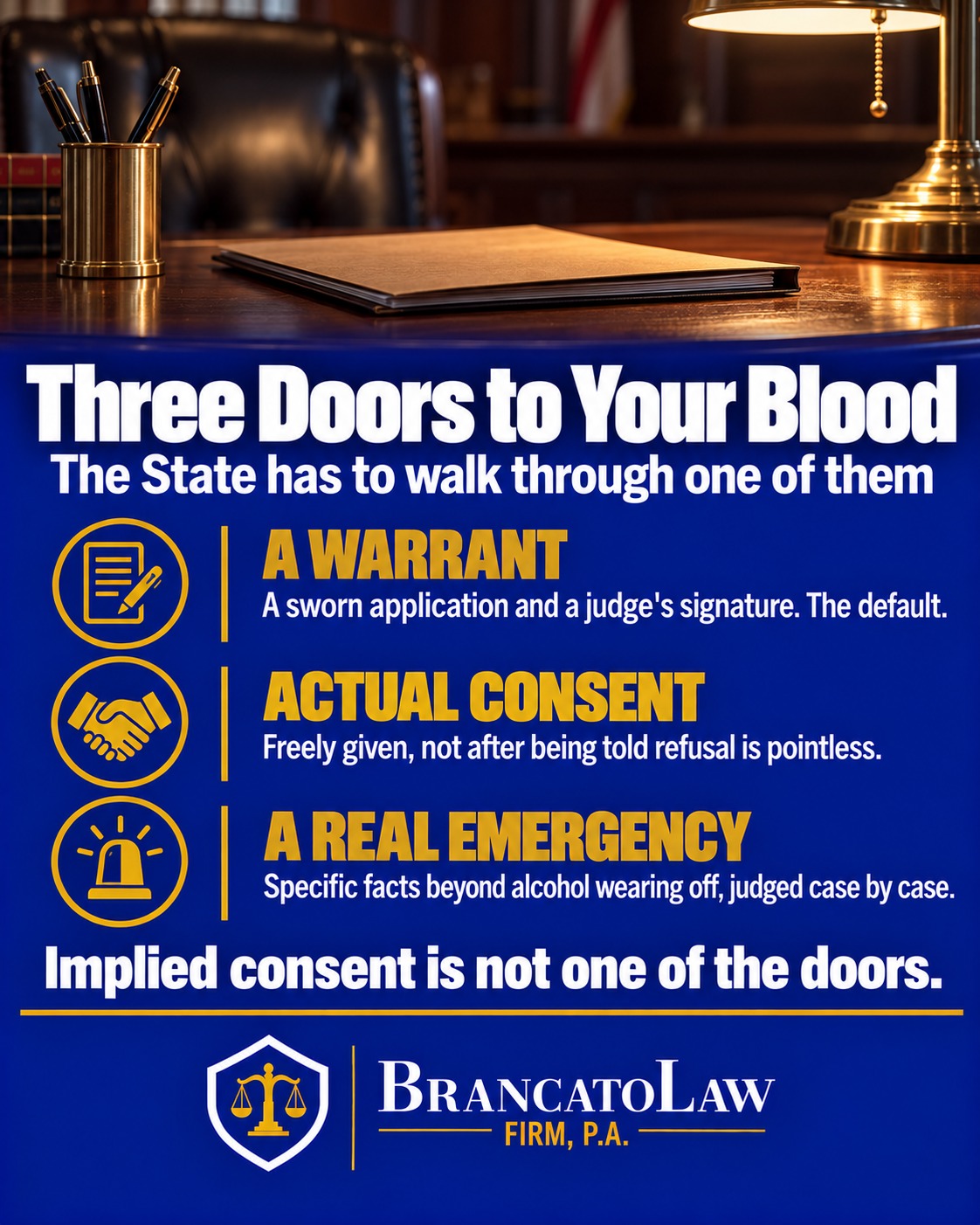
Two doors remain open, and the State has to walk through one of them:
| Path | What the State must show | Where it fails |
|---|---|---|
| Actual consent | You voluntarily agreed — not because you were told refusal was pointless, not while too injured or intoxicated to decide | Consent given after “we’ll just get a warrant anyway,” or with no meaningful ability to refuse |
| Exigent circumstances | Specific facts, beyond dissipation, that made getting a warrant impractical — multiple casualties, a remote scene, a genuine medical emergency | Delay that police themselves created; a decision to skip the warrant when there was time to apply for one |
| Warrant | A sworn application and a judge’s signature — the default path | Defects in the affidavit or execution |
The consent door is where most Tampa Bay cases are actually litigated. A driver in a hospital bed, in pain, surrounded by uniforms, who says “okay” after being told that officers will “just get a warrant” if he does not, has not given the kind of free and voluntary consent the Constitution requires — that is the fact pattern Acevedo itself arose from, where the trial court found the driver had been “misadvised that if he did not agree, law enforcement would get a warrant and take a blood sample against his will.” Our attorneys take the recording, the timeline, and the exact words used in every one of these cases, because the difference between consent and acquiescence is usually a single sentence.
What Counts as Exigent Circumstances — and What Does Not?
The test is the totality of the circumstances, and Marlin is a textbook example of the State failing it. Alcohol dissipating in the blood is a factor; it is never enough by itself. Delay that officers could have avoided does not count in the State’s favor. In Marlin, law enforcement had two and a half hours after the crash, a prosecutor on the phone who initially told them to get a warrant, and no explanation for why a warrant could not have been sought during that window. Calling the passage of time an “emergency” when the passage of time was the officers’ own choice is exactly what McNeely forbids.
Genuine exigency looks different: a mass-casualty scene that occupies every available officer, a driver being airlifted to a distant trauma center, a medical procedure that will contaminate the sample, or — under the Supreme Court’s plurality decision in Mitchell v. Wisconsin (2019) — an unconscious driver who cannot take a breath test and requires immediate medical care. Even there, the analysis is fact-specific, and the State bears the burden.
What Happens to a DUI Case When the Blood Draw Is Suppressed?
The “unlawful blood alcohol level” theory of the case usually collapses, but the impairment theory often survives — which is why suppression is the beginning of the fight, not the end. Florida charges DUI on two alternative theories: a blood or breath alcohol level of 0.08 or more, or impairment of normal faculties. Without the blood result, the State cannot prove the number. It can still call the officers, play the body-camera footage, and argue driving pattern, odor, speech, and field exercises. In a crash case it will also argue causation and the mechanics of the collision, which have nothing to do with the blood.
So the real value of Marlin is leverage and structure. A DUI manslaughter case with a suppressed blood result is a very different negotiation than one with a 0.18 on the lab report, and it is a very different trial. Our full treatment of that landscape is in what DUI manslaughter is in Florida and how DUI manslaughter cases are defended. And where the State cannot get the blood it drew, it will often try to subpoena the blood the hospital drew for treatment — a separate battle covered in can the State get your medical records in a Florida DUI case.
For more about our defense strategies, visit our DUI defense page.
Does Marlin Apply in Hillsborough County?
Yes. Under Pardo v. State, 596 So. 2d 665 (Fla. 1992), “in the absence of interdistrict conflict, district court decisions bind all Florida trial courts.” Marlin was decided by the Fourth District, which sits in West Palm Beach, but no other district court has adopted the probable-cause reading of Acevedo — Acevedo was the Fourth District’s own case, and the Fifth District’s Liles already pointed the same direction Marlin does. Until the Second District or the Florida Supreme Court says otherwise, a Hillsborough, Pinellas, or Pasco circuit judge is bound to follow it. Our attorneys are citing it in pending motions now.
What Should You Do If Police Took Your Blood After a Crash?
Write down everything you can remember about how it happened, before the details fade, and get counsel before you talk to anyone else:
- Whether you were asked, and what you said. “Yes,” “no,” “I guess,” and silence are four different legal events.
- What you were told would happen if you refused. A threat to “get a warrant anyway” or to charge you with refusal is the heart of a voluntariness challenge.
- The timeline. When the crash happened, when officers arrived, when the draw occurred, and whether anyone mentioned a warrant. In Marlin the timeline was the case.
- Where the draw happened and who did it. Roadside, ambulance, or hospital; paramedic, nurse, or technician. Section 316.1933 limits who may draw blood and how.
- Whether the hospital also drew blood for treatment. That sample is governed by different rules, and the State will come for it.
Do not assume the blood result is unassailable because it has a number on it. In Florida today, the number is only as good as the way it was obtained.
Your blood is only part of what happens at a crash scene. Our guide to whether the Florida accident report privilege requires you to talk to police after a traffic crash covers what you must tell the officer, what you can decline, and when your words can be used against you.
Frequently Asked Questions About Warrantless Blood Draws in Florida
Can I refuse a blood test in Florida?
You can decline to consent, and after Birchfield and Marlin the State cannot use your refusal as permission to draw blood without a warrant. Refusal of a lawfully requested blood test is admissible in evidence, and Florida’s refusal statute is written broadly, but whether refusing a warrantless blood draw can be punished criminally is constitutionally contested after Birchfield. If you refused and were charged, that is a defense issue, not a foregone conclusion.
Police got a warrant for my blood. Is that the end of it?
No. A warrant moves the fight from “was there a warrant” to “was the warrant good.” The affidavit must establish probable cause on its face, the officer’s sworn statements must be accurate, and the execution must comply with the statute’s limits on who may draw blood. Warrant-based draws are challenged less often than they should be.
I was in the hospital when they drew my blood. Doesn’t implied consent cover that?
Only if you did not refuse and a breath or urine test was genuinely impractical or impossible — and even then, Marlin and Judge Shepherd’s concurrence make clear that being in a hospital or ambulance does not lower the constitutional bar. If you refused, the State needs a warrant or real exigency, wherever you were.
What if I was unconscious?
The Supreme Court’s plurality in Mitchell v. Wisconsin said that an unconscious driver who cannot take a breath test will “almost always” present exigent circumstances, because the driver needs medical care and the evidence is disappearing. That is a strong argument for the State, but it is still a totality-of-the-circumstances analysis, and the State still bears the burden of proving it.
Does Marlin help me if I was charged before September 2026?
Potentially, yes. If your case is pending, a motion to suppress can be filed or renewed now. If you already pleaded or were convicted, the analysis is more complicated and time-sensitive; talk to an attorney about your options immediately rather than assuming the window has closed.
The officer said section 316.1933 required him to take my blood. Was he wrong?
He was reading the statute the way the State read it in Marlin. The Fourth District has now said the statute is a directive to obtain blood in serious crashes with a warrant, absent consent or true exigency. The word “shall” in the statute does not override the Fourth Amendment.
If you or a family member is facing a DUI, DUI with serious bodily injury, or DUI manslaughter charge anywhere in Tampa Bay and blood was drawn without your agreement, the attorneys of The Brancato Law Firm, P.A. — founded by Tampa Criminal Defense Attorney Rocky Brancato — want to see the timeline before anyone talks about a plea. Call (813) 727-7159. The law changed on September 2, 2026, and it changed in your favor.
The Brancato Law Firm, P.A.
620 E. Twiggs Street, Suite 205, Tampa, FL 33602
(813) 727-7159
Serving Hillsborough, Pinellas, and Pasco Counties
The Brancato Law Firm, P.A. is a Tampa-based criminal defense practice. We are not affiliated with any other Brancato-named law firms.
Visit Us

Tampa, FL 33602

Contact Us Now
Free Legal Consultation (813) 727-7159
