- Free Consultation 24/7: (813) 727-7159 Tap Here To Call Us


From First DUI to Death Penalty


Does the Florida Accident Report Privilege Require You to Talk to Police After a Traffic Crash?


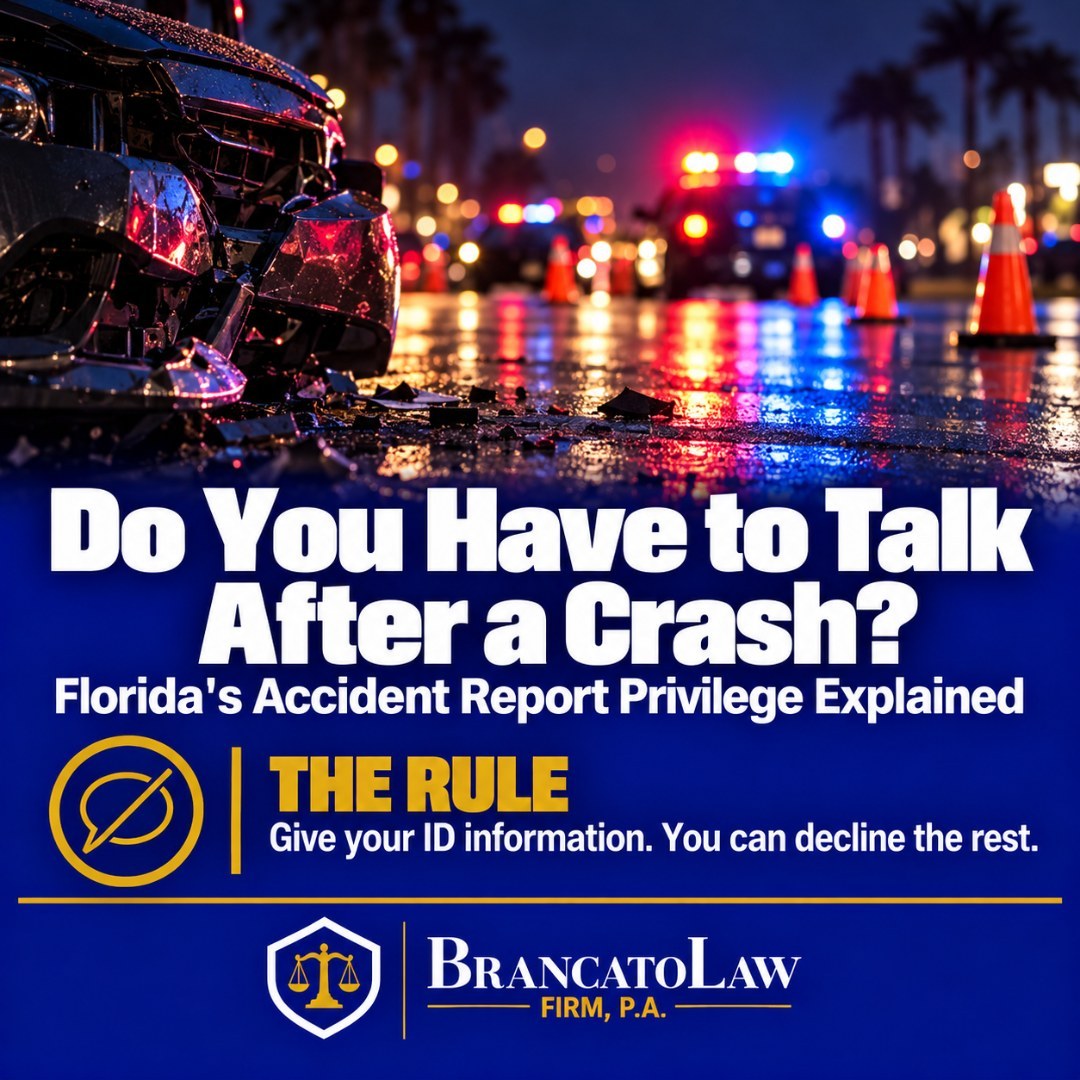
| Short answer: No. Florida’s accident report privilege, found in section 316.066(4) of the Florida Statutes, does not require you to explain how a crash happened. It protects statements you make to an officer for the crash report from being used as evidence at trial. After a crash involving death or injury, Florida law requires you to stop, stay at the scene, give your name, address, and vehicle registration, show your license, provide proof of insurance, and help anyone who is hurt. No Florida statute suspends or revokes a driver license because the driver declined to answer questions about how the crash happened. |
I’m Rocky Brancato, founder of The Brancato Law Firm, P.A., a Tampa criminal defense firm. I am a former police academy instructor and former Chief Operating Officer of the Hillsborough County Public Defender’s Office, where I oversaw a staff of over 100, and I have tried more than 150 jury trials to verdict. Today our attorneys represent drivers under investigation after fatal and serious-injury crashes in Hillsborough, Pinellas, and Pasco Counties.
This guide answers the questions we hear most often from drivers in the worst moment of their lives: Do I have to talk? What happens if I refuse? Can my license be taken? And if I already talked, can those words be used against me later, even to impeach me if I testify?
What Is Florida’s Accident Report Privilege?
Florida’s accident report privilege is a rule that keeps a driver’s crash-report statements out of evidence at trial. Section 316.066(4) says that any statement a person involved in a crash makes to a law enforcement officer “for the purpose of completing a crash report” is “without prejudice” to that person and “may not be used as evidence in any trial, civil or criminal.”
The privilege exists because Florida’s crash-reporting laws require drivers to provide certain information. Forcing a driver to supply information and then using it to convict that driver would raise a Fifth Amendment problem. The Florida Supreme Court explained this in Brackin v. Boles, 452 So. 2d 540 (Fla. 1984), a civil crash case in which the Court held that a blood-alcohol result was admissible because the statute “only prohibits the use of communications ‘made by persons involved in accidents’ in order to avoid a fifth amendment violation.”
The privilege has three limits every driver should know:
- It covers only your words to law enforcement for the crash report. Statements to paramedics, the other driver, witnesses, a 911 operator, or a family member on the phone fall outside it.
- It does not cover physical evidence. Under Brackin, skid marks, vehicle positions, damage, and what the officer sees, hears, and smells are admissible. The privilege also does not shield breath, blood, and urine results taken under sections 316.1932 and 316.1933. Whether a blood draw was lawful is a separate Fourth Amendment question, covered below.
- It ends when the criminal investigation properly begins. Statements made after an officer clearly announces a criminal investigation and gives the required warnings can be used at trial.
Do You Have to Answer Questions After a Fatal Crash in Florida?
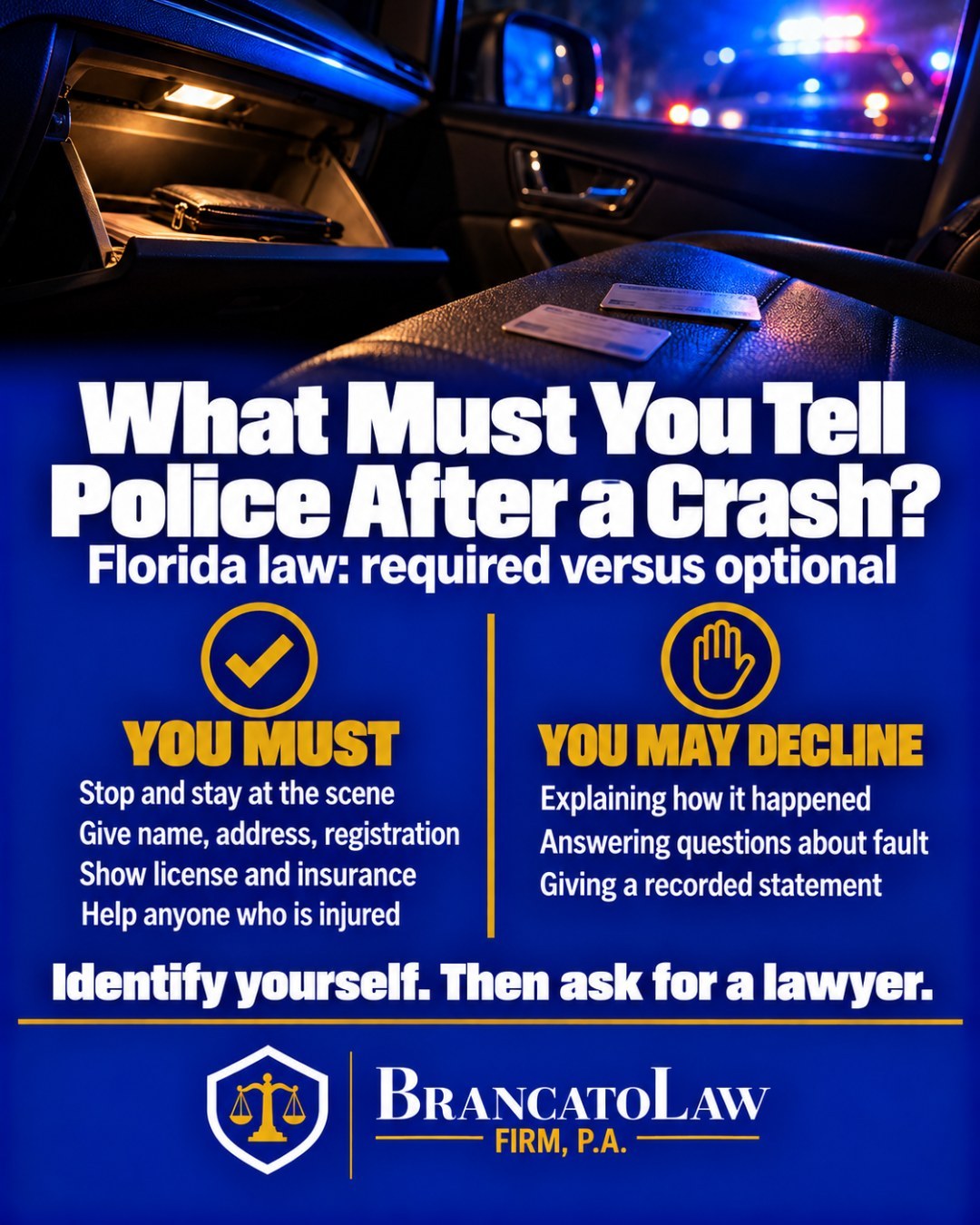
You must provide identifying information, but you do not have to describe how the crash happened. Under section 316.062, the driver of any vehicle in a crash causing injury or death must give “his or her name, address, and the registration number of the vehicle,” show a driver license on request, and render reasonable assistance to anyone injured. Section 316.066(1)(d) separately requires each party to provide proof of insurance.
The same statute limits that duty. Section 316.062(3) states that the duty to give information to an officer making a crash report “shall not be construed as extending to information which would violate the privilege of such person against self-incrimination.” In plain terms, the law that requires you to identify yourself also recognizes your right not to incriminate yourself.
Identity is a separate question. In State v. Jones, 283 So. 3d 1259 (Fla. 2d DCA 2019), a deputy working a multivehicle crash asked the driver for his name, date of birth, and Social Security number, ran the information, and learned the driver’s license was revoked. The Second District, whose decisions bind Hillsborough, Pinellas, and Pasco courts, held that the officer could testify to those identity statements because giving your identity does not violate the privilege against self-incrimination. The court certified conflict with another district on that point. In Tampa Bay courts, expect your name and identifying details to come in.
What Happens If You Refuse to Talk to the Officer?
If you give the required identifying information and decline to discuss the crash itself, the legal consequences are minimal. A violation of section 316.062 is “a noncriminal traffic infraction, punishable as a nonmoving violation,” which is a civil citation. Failing to provide proof of insurance is also a noncriminal, nonmoving infraction under section 316.066(1)(d), and the agency may void that citation if you produce proof of insurance valid at the time of the crash within 24 hours.
The real danger is leaving. Section 316.027 requires a driver in a crash involving death to stop and “remain at the scene of the crash until he or she has fulfilled the requirements of s. 316.062.” Willfully leaving a crash involving death is a first-degree felony with a four-year mandatory minimum prison sentence. Our firm’s guide to leaving the scene of an accident in Florida covers that offense in detail.
Your silence also has protection at trial. In State v. Horwitz, 191 So. 3d 429 (Fla. 2016), a murder case where prosecutors told the jury that the defendant’s silence before arrest showed consciousness of guilt, the Florida Supreme Court held that using pre-arrest, pre-Miranda silence as substantive evidence of guilt violates the Florida Constitution. Federal law is less protective. In Salinas v. Texas, 570 U.S. 178 (2013), a plurality of the U.S. Supreme Court required a suspect to expressly invoke the right before pre-arrest silence is protected, and Horwitz declined to apply that reasoning under Florida’s Constitution. A 2014 Florida Law Review note by Andrew M. Hapner, You Have the Right to Remain Silent, But Anything You Don’t Say May Be Used Against You: The Admissibility of Silence as Evidence After Salinas v. Texas, examines how Salinas changed the use of silence as evidence. Florida’s rule is stronger, but saying the words out loud is still the safest practice.
Can Your Driver License Be Revoked for Refusing to Talk?
No Florida statute suspends or revokes a license because a driver declined to answer questions about how a crash happened. Section 322.26, the mandatory revocation statute, lists convictions such as manslaughter with a motor vehicle, DUI offenses, felonies committed with a vehicle, and failure to stop and render aid. Refusing to give a statement is not on that list.
Your license can still be at risk after a fatal crash whether or not you talk. Under section 322.27(1)(a), the Department of Highway Safety and Motor Vehicles may suspend a license without a preliminary hearing on sufficient evidence that the driver committed an offense requiring mandatory revocation, and law enforcement must notify the department within 24 hours after any traffic fatality. Several actions at a crash scene also put your license at risk, and drivers often confuse them with refusing to talk:
| What you do at the scene | License consequence | Florida law |
|---|---|---|
| Decline to describe how the crash happened | None | No statute provides one |
| Fail to give name, address, registration, or license | Noncriminal nonmoving citation | § 316.062(4) |
| Leave the scene of a crash involving death | Conviction brings revocation for at least 3 years, plus a 4-year mandatory minimum prison term | §§ 316.027(2)(c), 322.28(4)(b) |
| Refuse a lawful breath or urine test | Suspension for 1 year (18 months with a prior refusal suspension) | § 322.2615 |
| Decline a blood draw in a death or serious-injury crash | Officers may seek a warrant; a forced draw without a warrant, actual consent, or proven exigency can be suppressed | § 316.1933; State v. Marlin |
| Convicted of vehicular homicide | Revocation for at least 3 years | § 322.28(4)(a) |
| Convicted of DUI manslaughter | Permanent revocation; a driver with no prior DUI may petition for reinstatement after 5 years | §§ 322.28, 322.271(4) |
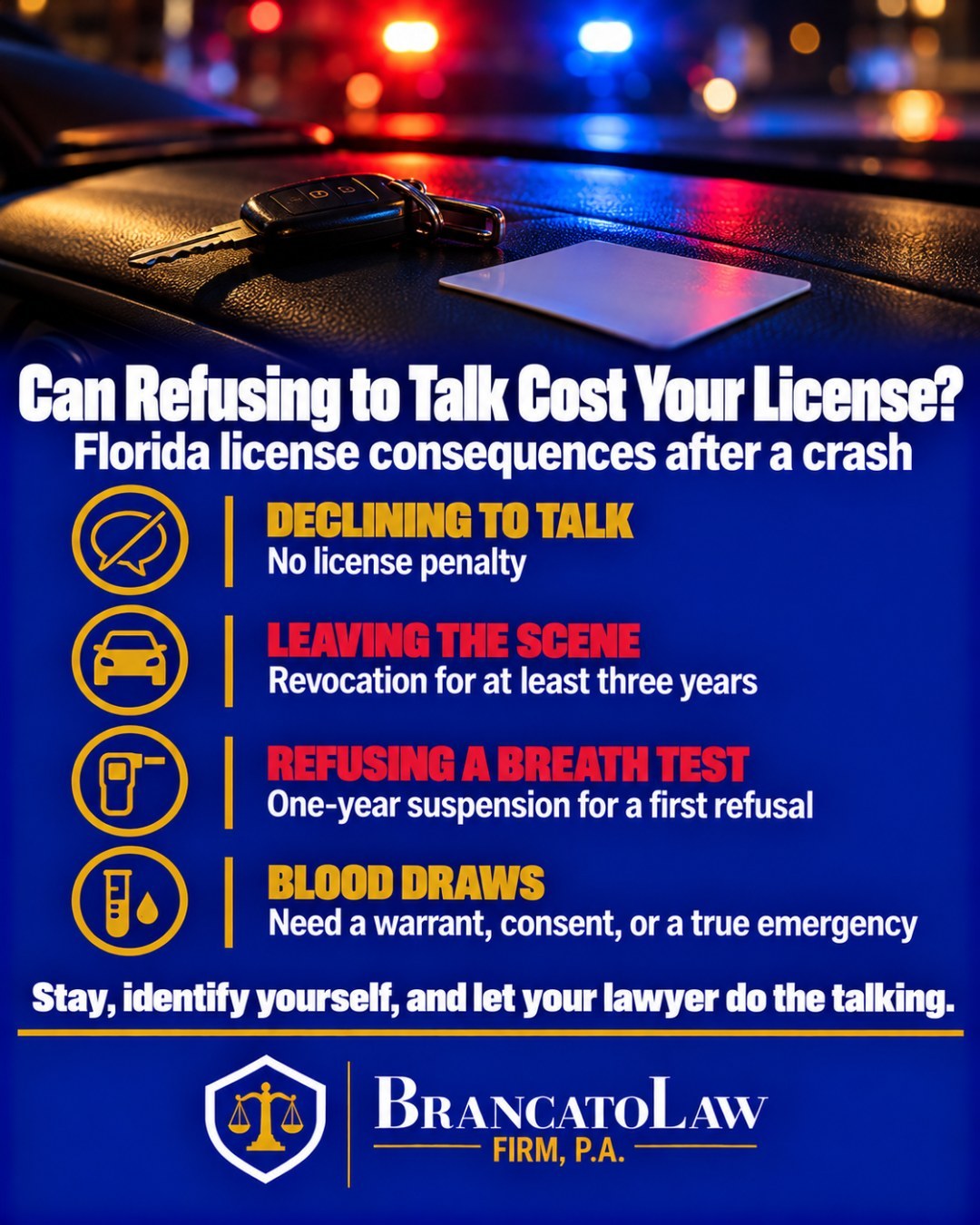
The blood draw deserves its own explanation, because section 316.1933 is often misread. The statute says that when an officer has probable cause to believe an impaired driver caused a death or serious bodily injury, the officer “shall require” a blood test and “may use reasonable force if necessary.” Probable cause alone does not make that draw constitutional. In Missouri v. McNeely, 569 U.S. 141 (2013), the U.S. Supreme Court held that the natural dissipation of alcohol does not create an automatic emergency, so exigency must be proven case by case. In State v. Marlin, No. 4D2025-1448 (Fla. 4th DCA Sept. 2, 2026), a driver’s car struck four motorcycles on the Turnpike, killing one rider. He refused a blood draw, and first responders drew his blood by force without a warrant. The Fourth District affirmed suppression of the result. It held that unless the driver gives actual consent or the State proves exigent circumstances, “a warrant must be obtained for a blood draw to satisfy the Fourth Amendment,” and it read section 316.1933 as a directive that “must assume the blood draw will be obtained with a warrant, absent consent or proof of exigent circumstances.” Our firm’s post on whether police can take your blood without a warrant in Florida walks through Marlin in detail. Declining to talk does not stop officers from seeking a warrant for your blood. In a DUI manslaughter case, the blood result is often the State’s central evidence, so how it was obtained matters as much as what it shows.
What If the Officer Says You Have to Talk Because of the Privilege?
When an officer tells you that you must answer, Florida law makes your answers inadmissible unless the officer clearly switches to a criminal investigation and reads you your rights. The Florida Supreme Court set that rule in State v. Norstrom, 613 So. 2d 437 (Fla. 1993).
Norstrom grew out of a fatal crash. A car struck seven people, killing one and seriously injuring two. The investigating officer later testified that she told the driver she was “changing hats” to signal that she was moving from the crash investigation to the criminal investigation. The driver was given Miranda warnings, waived them, and talked. Because he was never told he had to answer and he waived his rights, the Court held his statements admissible. The Court then laid down the rule that still governs: “if a law enforcement officer gives any indication to a defendant that he or she must respond to questions concerning the investigation of an accident, there must be an express statement by the law enforcement official to the defendant that ‘this is now a criminal investigation,’ followed immediately by Miranda warnings, before any statement by the defendant may be admitted.”
In State v. Marshall, 695 So. 2d 686 (Fla. 1997), the Court reaffirmed Norstrom after the Legislature amended the statute in 1991. Marshall’s officer announced a criminal investigation but never gave Miranda warnings, and his admission to drinking was inadmissible. The Court adopted the Third District’s opinion, which held that the privilege “remains fully operative” unless the statement was made after a waiver of Miranda rights or was otherwise unprotected.
Applied to a driver standing at a fatal crash scene, the rule works like this. If the officer says you are required to explain the crash, and you do, the State cannot use those words at trial unless the officer first said this is now a criminal investigation and immediately read Miranda. The officer’s pressure strengthens your suppression argument.
That does not make talking safe. Investigators have still heard what you said, and your words can point them toward bar receipts, phone records, and witnesses. Whether a particular sentence was made “for the purpose of completing a crash report” becomes a fact fight over body-camera footage at a suppression hearing.
Which Crash-Scene Statements Can Be Used Against You?
Whether a statement comes in depends on when you said it, who you said it to, and what the officer told you first. This table tracks a typical fatal-crash investigation:
| Moment at the scene | Can the State use it at trial? | Authority |
|---|---|---|
| You give your name, address, license, and registration | Yes | State v. Jones (Fla. 2d DCA 2019) |
| You blurt out something before any question (“I looked down at my phone”) | Usually yes; a spontaneous statement is not made to complete a report | State v. Marshall, 3d DCA opinion adopted by the Florida Supreme Court |
| The officer says you must explain the crash, and you answer | No, unless the officer first announced a criminal investigation and immediately gave Miranda; our firm argues it cannot be used to impeach you either | Norstrom; Marshall |
| The officer announces a criminal investigation and you talk while not in custody | Often yes | State v. Bender (Fla. 4th DCA 2023) |
| You are in custody and questioned without Miranda | Not in the State’s main case; possibly to impeach you if you testify | Miranda v. Arizona, 384 U.S. 436 (1966); Retherford |
| You receive Miranda warnings and stay silent | No | Doyle v. Ohio; State v. Hoggins |
| You decline to answer before arrest | Not as evidence of guilt; to impeach only if truly inconsistent with your testimony | Horwitz; Hoggins |
| Your blood or breath result | Yes, if lawfully obtained; blood requires a warrant, actual consent, or proven exigency | § 316.066(4); McNeely; Marlin |
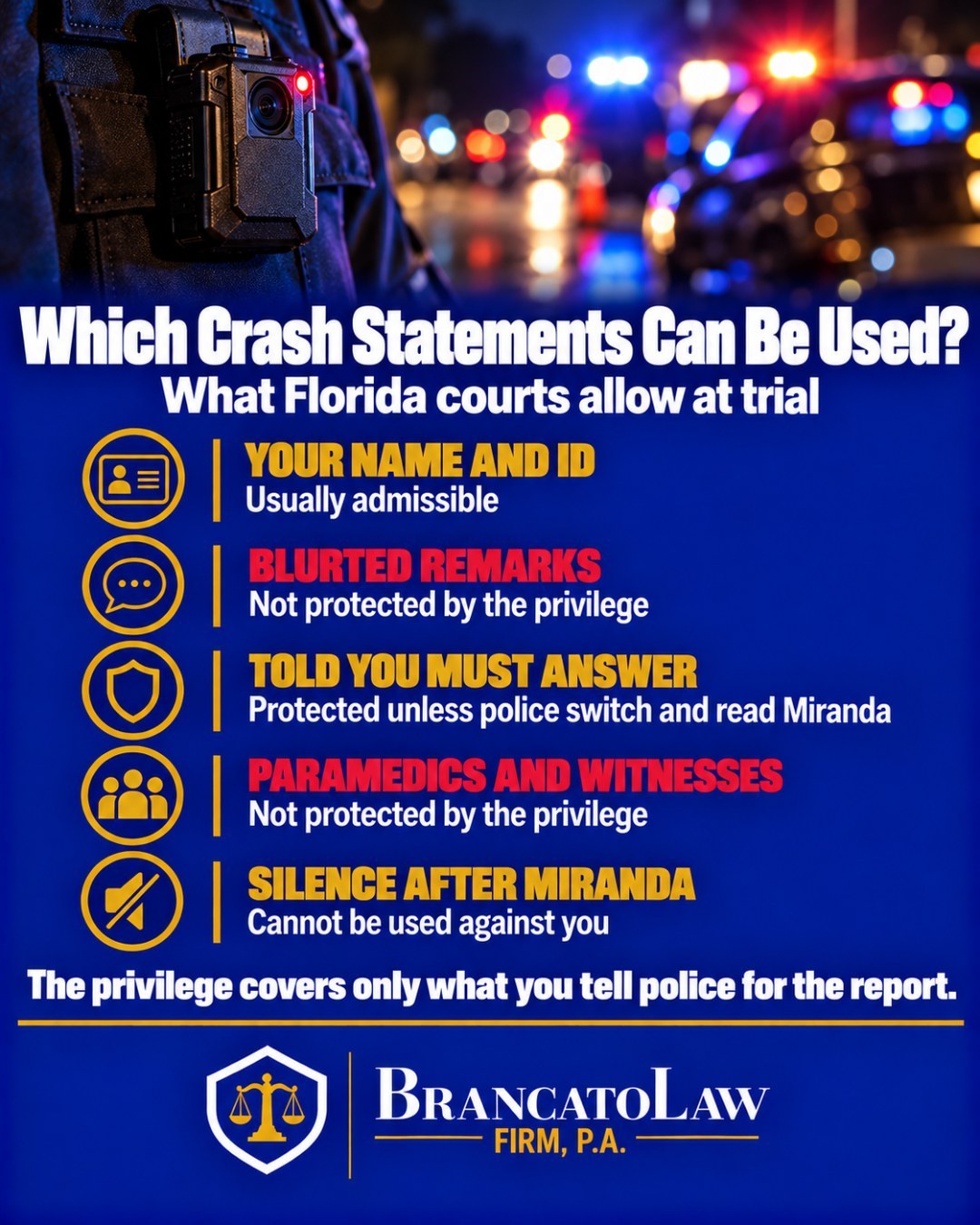
A 2023 appellate decision on the switch from crash investigation to criminal investigation shows how quickly protection can disappear. In State v. Bender, 357 So. 3d 697 (Fla. 4th DCA 2023), an officer announced a DUI investigation at a crash scene, and the driver then admitted drinking and later said “Oh God. I’m so stupid.” The county court suppressed those statements. On appeal, Bender argued that the officer’s failure to read Miranda the moment the crash investigation ended made everything inadmissible. The Fourth District rejected that bright-line rule and reversed. It held that once the officer announced the DUI investigation, the ordinary Miranda rules applied, and because Bender was not in custody and most of her statements were spontaneous, they were admissible. The lesson is that the announcement itself can end your protection, even before any warnings.
Can Privileged Statements Be Used to Impeach You If You Testify?
Our firm’s position is that they cannot. No Florida appellate court has squarely decided the question, so expect the State to argue otherwise. This is the scenario that worries careful clients: you talk at the scene because the officer said you had to, you are later read Miranda and say nothing more, and at trial you testify to a version of events that differs from what you said at the scene. Can the prosecutor confront you with the scene statement?
What Will the Prosecutor Argue?
The State will rely on the federal impeachment exception. In Harris v. New York, 401 U.S. 222 (1971), the U.S. Supreme Court held that a statement excluded because police failed to give proper Miranda warnings can still be used to impeach a defendant who testifies inconsistently, so long as the statement was voluntary. The Court extended that rule in Oregon v. Hass, 420 U.S. 714 (1975), where officers kept questioning a suspect after he asked for a lawyer, reasoning that Miranda should not become “a license to testify inconsistently, or even perjuriously.” Florida adopted the Harris exception in State v. Retherford, 270 So. 2d 363 (Fla. 1972).
The State’s best Florida authority is a dissent. In Hoctor v. Tucker, 432 So. 2d 1352 (Fla. 5th DCA 1983), a civil crash case about whether a car’s lights were on, Judge Cowart argued that the accident report privilege should yield to impeachment for the same reasons the Supreme Court gave in Harris.
Why Do We Argue Privileged Statements Cannot Be Used to Impeach?
We argue that Harris does not reach statements protected by the accident report privilege, for five reasons:
- The statute bars any use at trial. Section 316.066(4) makes the driver’s crash-report statements “without prejudice” to the driver and says they “may not be used as evidence in any trial, civil or criminal.” Its only exception for criminal trials applies when the driver’s “privilege against self-incrimination is not violated.” Confronting a driver with words the law required him to give is the self-incrimination problem the statute was written to prevent.
- Harris limited a court-made rule, and this is a statute. Harris and Hass weighed the deterrent value of the Miranda exclusionary rule against the risk of perjury. Section 316.066(4) is a command from the Legislature. A court balancing policy interests cannot carve an impeachment exception into a statute the Legislature chose not to write.
- Compelled statements cannot be used to impeach. Harris and Hass both turned on the fact that the statements were not coerced. In New Jersey v. Portash, 440 U.S. 450 (1979), the U.S. Supreme Court held that testimony compelled under a grant of immunity cannot be used to impeach, because compelled statements “may not be put to any testimonial use whatever against him in a criminal trial.” The Court said balancing in that setting “is not simply unnecessary. It is impermissible.” In Mincey v. Arizona, 437 U.S. 385 (1978), involving statements taken from a badly wounded suspect in a hospital, the Court held that an involuntary statement cannot be used “in any way” at trial, impeachment included.
- Florida treats these statements as immunized. The Florida Supreme Court held in Norstrom that the statute’s purpose is “to clothe with statutory immunity” the statements a driver “is compelled to make.” In Marshall, the Court adopted the Third District’s holding that the privilege “remains fully operative” unless the driver waived Miranda or the statement was otherwise unprotected. Immunized, compelled statements belong on the Portash side of the line.
- The courts that have ruled kept the statements out. The Hoctor majority held the driver’s statements inadmissible under the privilege and did not adopt the dissent’s impeachment exception. In State v. Allman, 3 Fla. Supp. 2d 129 (Fla. Palm Beach Cty. Ct. 1983), a county judge in DUI cases relied on Portash and Mincey and ruled that statements compelled under section 316.066 cannot be used for rebuttal or impeachment. A county court ruling does not bind other courts, but its reasoning is the reasoning we put before the trial judge.
When Can the State Use an Excluded Statement to Impeach You?
The answer changes if the statement was excluded only because of a Miranda violation. If the officer properly switched to a criminal investigation, you were in custody, and the officer questioned you without warnings, the privilege no longer applies. Under Retherford, the State can use a voluntary statement of that kind to impeach you if you testify inconsistently. That is why the exact sequence on the body-camera video matters so much.
How Does Our Firm Protect Clients Before They Testify?
Our attorneys do not wait for the question to come up while a client is on the stand. We file a motion in limine before trial asking the court to rule that privileged crash statements cannot be used for any purpose, including impeachment, so the client knows the risk before deciding whether to testify. We also prepare clients so their own testimony does not open the door, for example by volunteering what they told the officer at the scene.
What About Silence After You Are Read Miranda?
Silence after Miranda warnings cannot be used against you, either as evidence of guilt or to impeach your testimony. In Doyle v. Ohio, 426 U.S. 610 (1976), the U.S. Supreme Court held that using a defendant’s post-Miranda silence to impeach an explanation first offered at trial violates due process, because the warnings implicitly promise that silence carries no penalty.
Florida goes further. In State v. Hoggins, 718 So. 2d 761 (Fla. 1998), the Florida Supreme Court held that the Florida Constitution bars impeaching a testifying defendant with silence at the time of arrest, whether or not Miranda warnings were given. Hoggins drew one line that matters at a crash scene: silence before arrest may be used to impeach a defendant, but “only if the silence was inconsistent with the defendant’s testimony at trial,” meaning it came at a moment when it would have been natural to speak up. That is one more reason to state clearly that you are declining to answer on the advice of a lawyer, which explains your silence on the record.
Why Do Drivers Talk After Fatal Crashes?
Drivers talk because shock, guilt, and pressure push nearly everyone to explain themselves. Research backs this up. The American Psychology-Law Society’s white paper, Police-Induced Confessions: Risk Factors and Recommendations by Saul Kassin and five co-authors (Law and Human Behavior, 2010), identifies “the tendency to waive Miranda rights” as a risk factor, especially among innocent suspects.
The numbers show how many families in our area face this moment. In 2024, 180 people died in traffic crashes in Hillsborough County, 108 in Pinellas County, and 111 in Pasco County, according to the Florida Department of Highway Safety and Motor Vehicles’ Florida Traffic Crash Facts Annual Report 2024. Statewide, FLHSMV recorded 3,098 traffic deaths in 2,891 fatal crashes that year. Behind most of those deaths is a surviving driver who was asked to explain what happened.
In the 13th Judicial Circuit, fatal crashes are assigned to traffic homicide investigators from the Florida Highway Patrol, the Hillsborough County Sheriff’s Office, or Tampa Police. In our experience, charges for vehicular homicide or DUI manslaughter are often filed weeks or months after the crash while the investigator waits on toxicology, downloads event data recorders, and reconstructs the scene. The statement you give in the first hour is often the evidence the investigator builds the case around.
What Should You Do in the First 72 Hours After a Fatal Crash?
The first 72 hours decide what evidence exists and what you have said. Our firm advises drivers to follow these steps:
- Stop, stay, and call 911. Leaving a fatal crash is a first-degree felony with a four-year minimum mandatory sentence.
- Help the injured as far as you safely can. Section 316.062 requires reasonable assistance.
- Give your name, address, registration, license, and proof of insurance. These are required, and they will be admissible.
- Say this, calmly: “I want to cooperate. I’ve given you my information. On the advice of my attorney, I won’t answer questions about how the crash happened until I speak with a lawyer.”
- Do not argue, explain, apologize, or speculate, to the officer, the other driver, paramedics, or anyone on the phone. Only your statements to the officer for the report are privileged.
- Do not physically resist a blood draw, and remember the details. Note what officers asked, exactly what you said, what they told you would happen if you refused, whether anyone mentioned a warrant, and when and where the blood was drawn. Under Marlin, a forced draw without a warrant, actual consent, or proven exigency can be suppressed.
- Call a criminal defense attorney before any follow-up interview. If an investigator contacts you later to “finish the report,” treat that call as part of a criminal investigation.
Our firm’s guide to how DUI manslaughter cases are defended in Florida explains what happens next, including how scene and hospital statements are challenged. If you think you may already be a target, see our post on the signs you are being investigated for a crime in Florida. When a crash investigation turns criminal, our Tampa criminal traffic attorney team handles the case from the first contact with the investigator.
Frequently Asked Questions
Can police arrest me just for refusing to answer questions after a crash in Florida?
Declining to describe how a crash happened is not a crime in Florida. Failing to provide your name, address, registration, and license is only a noncriminal traffic infraction under section 316.062, and that statute says the duty does not extend to self-incriminating information. Officers can still arrest you if they develop probable cause for a crime such as DUI manslaughter from other evidence, so stay calm and courteous while you decline.
Is a Florida crash report admissible in a criminal trial?
Your statements to the officer for the report are not admissible, but much of the report’s other content is. Under Brackin v. Boles, the officer can testify to physical evidence such as vehicle positions, skid marks, and damage, and to what the officer personally observed. In our cases, the fight is usually over which of the driver’s words were made for the report and which were made after the investigation turned criminal.
Are my statements to paramedics or the other driver protected by the accident report privilege?
No. Section 316.066(4) protects only statements made “to a law enforcement officer for the purpose of completing a crash report.” Statements to paramedics, nurses, witnesses, the other driver, insurance adjusters, or a friend on a recorded call can all be used against you if they are otherwise admissible.
Does the accident report privilege apply in a DUI manslaughter case?
Yes, the privilege applies in any criminal trial, including DUI manslaughter and vehicular homicide prosecutions. It does not cover blood, breath, or urine results, which rise or fall on whether police followed the Fourth Amendment, including the warrant rule for blood draws applied in State v. Marlin. It also does not cover the officer’s observations of odor, speech, or balance. Our attorneys routinely litigate both the privilege and the legality of the blood draw in Hillsborough County cases.
What if I already answered the officer’s questions at the scene?
Your answers may still be suppressed. Under State v. Norstrom, if the officer indicated you had to respond, the statements are inadmissible unless the officer expressly announced a criminal investigation and immediately read Miranda first. The Brancato Law Firm reviews body-camera and dash-camera footage to pin down exactly what the officer said and when, because that sequence decides admissibility.
Can the prosecutor use my crash-scene statement against me if I testify at trial?
Florida appellate courts have not settled whether a statement protected by the accident report privilege can be used to impeach a defendant who testifies. Prosecutors will cite Harris v. New York, which allows impeachment with voluntary statements suppressed for Miranda violations. The Brancato Law Firm argues that section 316.066(4) bars privileged statements from “any trial” and that compelled statements cannot be used to impeach under New Jersey v. Portash, and we ask the court to rule before a client decides whether to testify.
How soon should I call a lawyer after a fatal crash in Hillsborough County?
Call before you speak with the traffic homicide investigator again, ideally within the first 24 to 72 hours. Charges often come weeks or months later, and the investigation phase is when evidence is preserved and statements are made. The Brancato Law Firm, P.A. can contact the investigator on your behalf and send preservation demands for video and vehicle data at (813) 727-7159.
Can the accident report privilege help me in a wrongful death lawsuit?
Yes. Section 316.066(4) bars privileged statements “in any trial, civil or criminal,” so they cannot be used against you in a civil wrongful death case either. Anything you say outside the privilege, including to your own insurer or the other side’s adjuster, can be used in both cases, so coordinate with criminal defense counsel before giving any recorded statement.
Talk to a Tampa Defense Attorney Before You Talk to the Investigator
If you were involved in a fatal or serious-injury crash, the attorneys of The Brancato Law Firm, P.A., founded by Tampa Criminal Defense Attorney Rocky Brancato, can step in before the traffic homicide investigator’s next call. Call (813) 727-7159 today, before any follow-up interview, while video and vehicle data can still be preserved. For more about our defense strategies, visit our Criminal Traffic page.
The Brancato Law Firm, P.A.
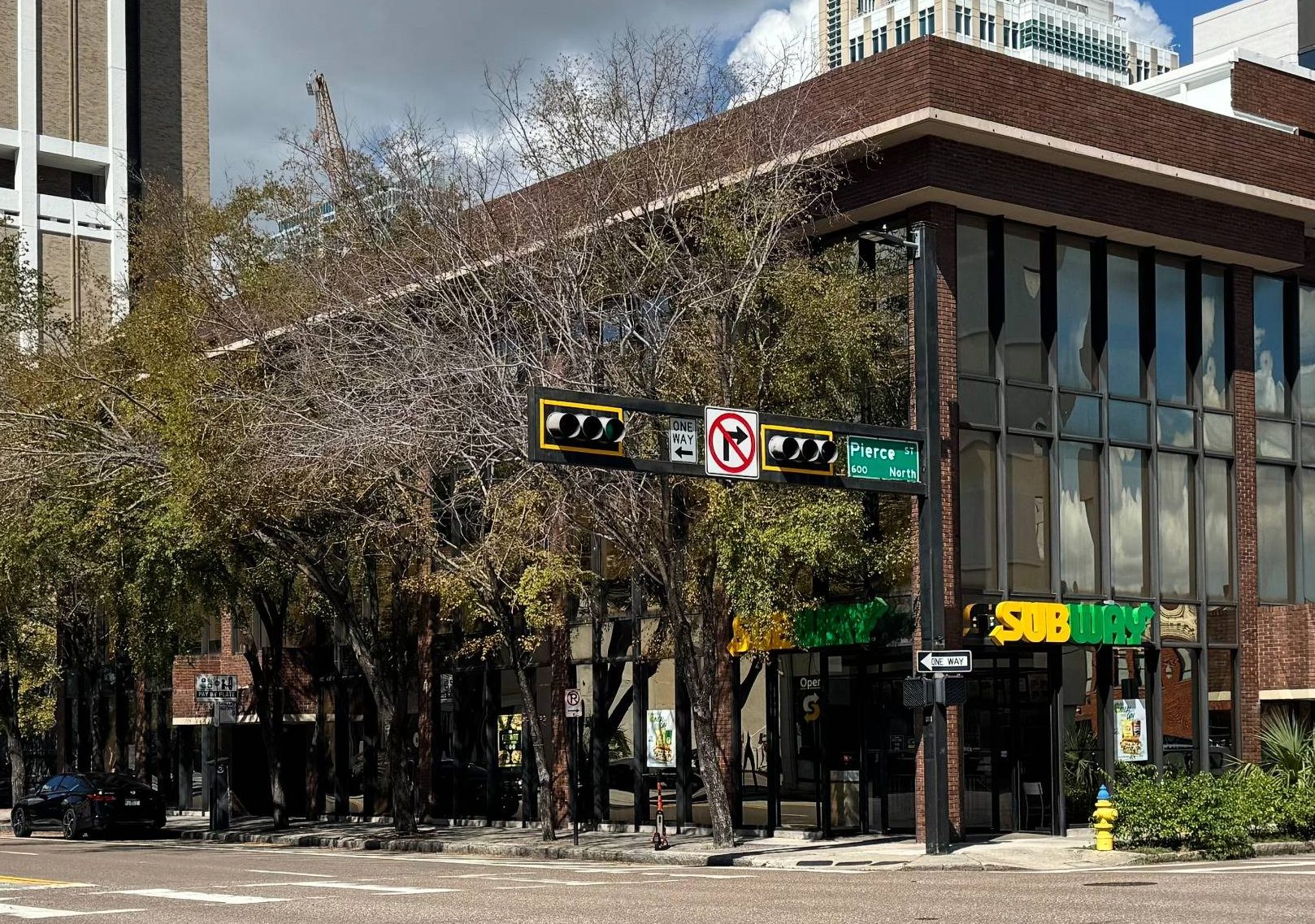
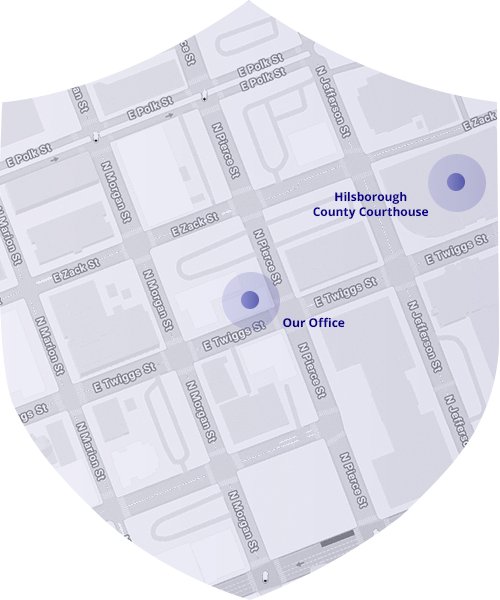
620 E. Twiggs Street, Suite 205, Tampa, FL 33602
(813) 727-7159
Serving Hillsborough, Pinellas, and Pasco Counties
The Brancato Law Firm, P.A. is a Tampa-based criminal defense practice. We are not affiliated with any other Brancato-named law firms.
Visit Us
Tampa, FL 33602
Contact Us Now
Free Legal Consultation (813) 727-7159