- Free Consultation 24/7: (813) 727-7159 Tap Here To Call Us


From First DUI to Death Penalty



How Does Drug Court Work in Hillsborough County? (2026)


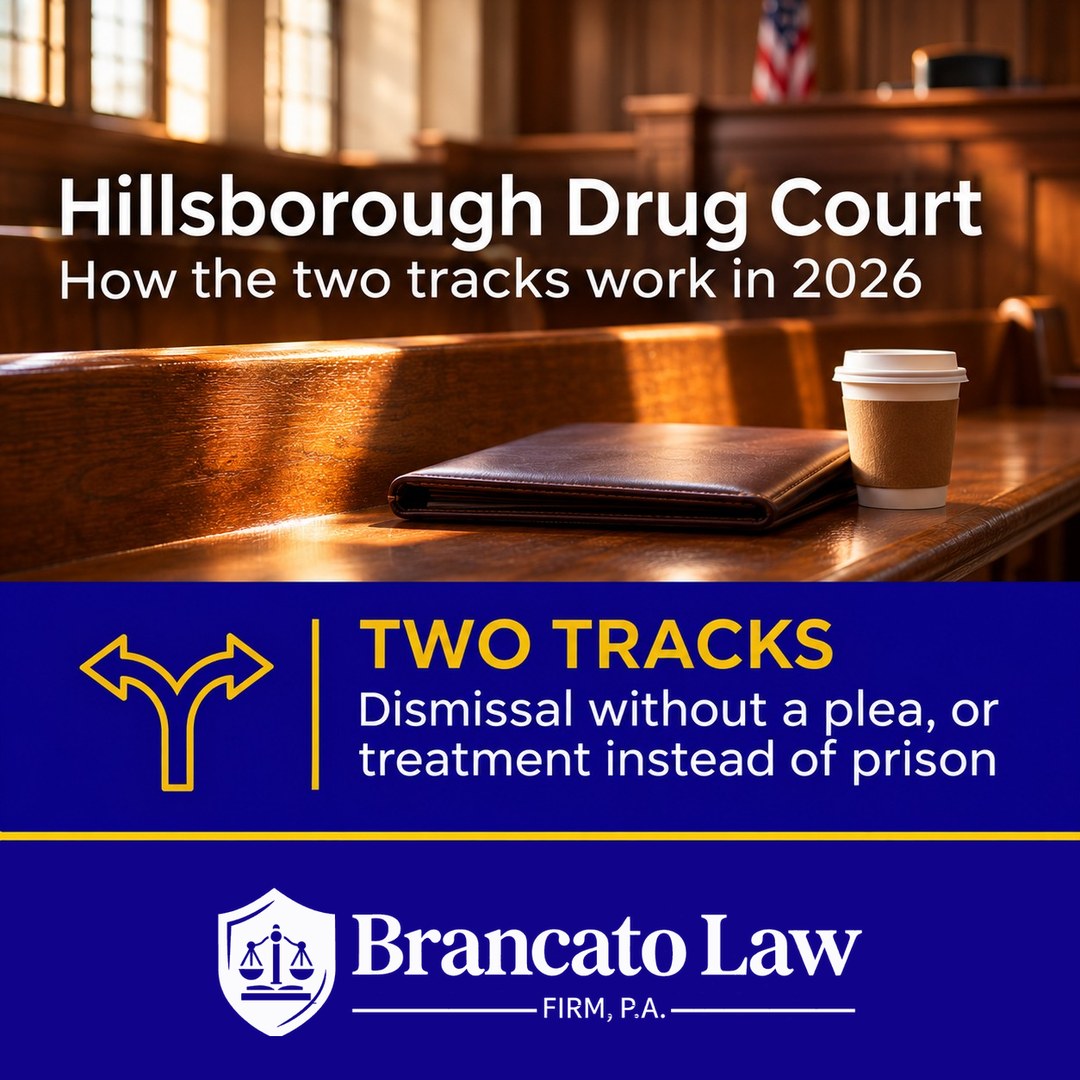
Hillsborough County drug court is a single treatment court, Division W of the 13th Judicial Circuit, with two tracks. The pretrial track requires no plea, and the felony charge is dismissed when the person graduates. The post-adjudication track requires a guilty or no contest plea and probation, but it can take a nonviolent felony that scores up to 60 points on the sentencing scoresheet, so it keeps many people out of prison. Either track lasts at least 6 to 14 months, with drug testing at least twice a week.
A Hillsborough judge must admit an eligible defendant to pretrial drug court, even when the prosecutor objects, unless the State proves the defendant was dealing or the judge weighs prior felonies against admission. As founder of The Brancato Law Firm, P.A., a Tampa criminal defense firm, I have seen that rule decide drug cases over more than 25 years in Hillsborough County courtrooms, including my years as former Chief Operations Officer of the Hillsborough County Public Defender’s Office, where I oversaw a staff of over 100 attorneys. From 2012 to 2023, I also served on the 13th Judicial Circuit’s Problem-Solving Courts Oversight Committee, the body that oversees drug court operations in Hillsborough County. Our attorneys build the drug court application early, with a treatment evaluation and the scoresheet in hand, so the case is ready when the judge decides eligibility.
What is drug court in Hillsborough County?
Drug court in Hillsborough County is the Adult Drug Treatment Court, a court-supervised treatment program in Division W of the 13th Judicial Circuit, the felony court for Hillsborough County criminal cases. Administrative Order S-2026-002, effective February 2, 2026, merged the former Drug Pretrial Intervention court and the former Post-Adjudication Drug Court into this one division. The circuit’s Problem-Solving Courts Oversight Committee oversees the court’s operations under the same order. Older websites, including some official ones, still describe two separate drug courts and the 2020 order that the new order replaced.
Florida authorizes drug courts in section 397.334, Florida Statutes. The statute requires every program to follow 10 key components, including frequent testing for alcohol and drugs, a coordinated team response to each participant’s progress, and ongoing contact between the judge and each participant. In practice, that means a judge, a prosecutor, a defense attorney, a probation officer, and treatment providers meet about each participant and decide what happens next.
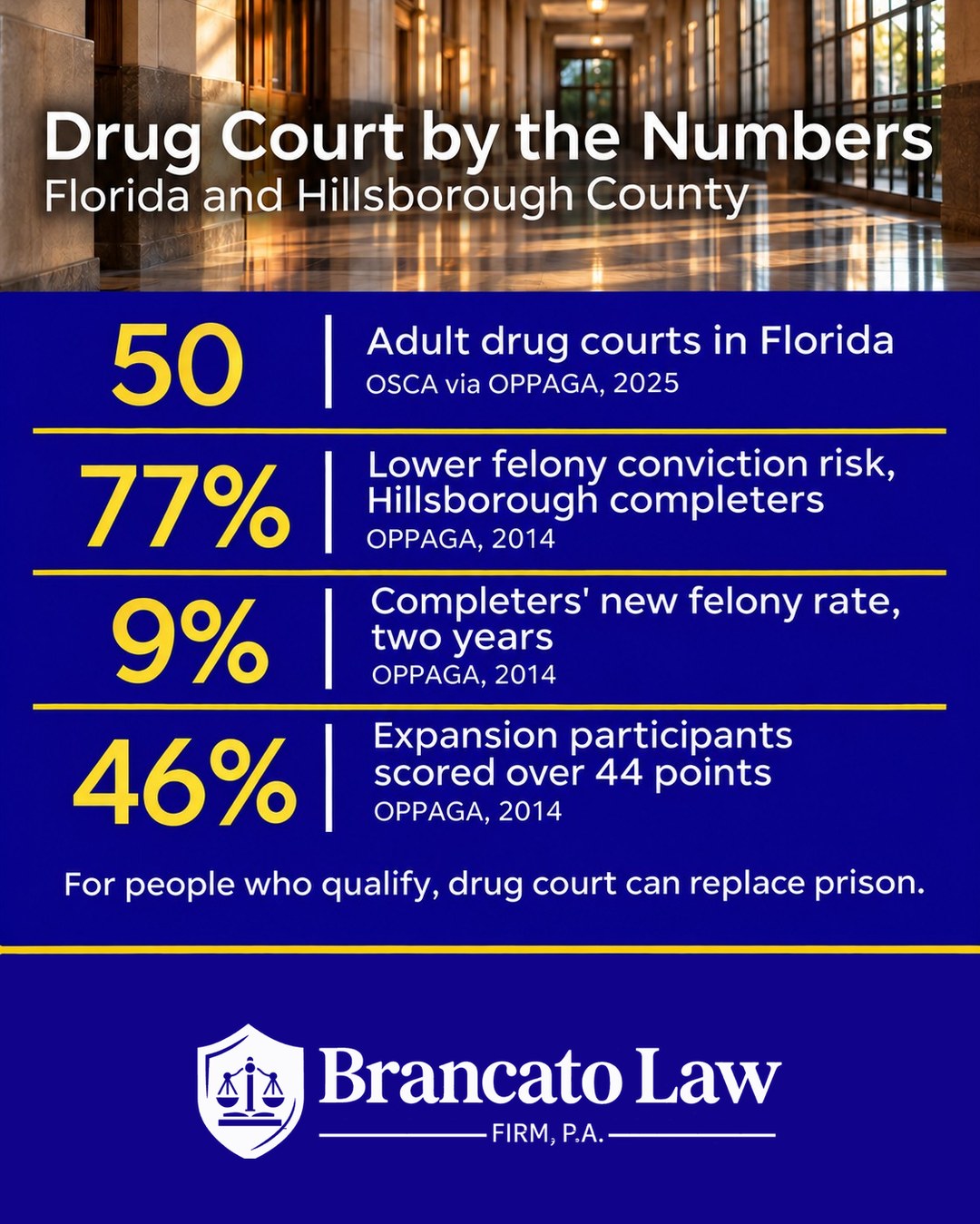
Hillsborough has run a drug court longer than almost any county in Florida. According to the 13th Circuit, the first session was held on June 22, 1992, with three defendants, and Judge Donald Evans started Florida’s first post-adjudication drug court here in 1994. Florida now has 50 adult drug courts, according to the Office of the State Courts Administrator as reported by OPPAGA in July 2025.
What is the difference between pretrial drug court and post-adjudication drug court?
The pretrial track ends in a dismissal with no plea, and the post-adjudication track starts with a plea and ends with probation terminated early and successfully. Both tracks run in the same courtroom under the same rules, but the stakes at the end are different. The track also decides where drug court fits in the Florida criminal case process: pretrial drug court replaces the prosecution, while post-adjudication drug court is a sentence.
| Pretrial track (diversion) | Post-adjudication track | |
|---|---|---|
| Plea | None. The defendant waives speedy trial for the program period | Guilty or no contest plea and sentence before transfer to Division W |
| Who qualifies | Nonviolent felony, no violent co-charge, two or fewer prior felony convictions (all nonviolent), a substance problem, and amenable to treatment | Nonviolent felony, scoresheet of 60 points or fewer, amenable to treatment, and qualifies under s. 397.334(3) |
| Prosecutor’s consent | Not required, but the State can block admission by proving dealing | The State’s recommendation is one factor the court weighs |
| Graduation | The charges are dismissed | Supervision ends successfully |
| Failure | The case goes back to the original division and the prosecution resumes | Probation ends and the judge resentences, which can mean jail or prison |
| Statutory fine | None for graduates; still owed after an unsuccessful discharge | May apply |
Who qualifies for pretrial drug court in Florida?
A person qualifies for pretrial drug court under section 948.08(6), Florida Statutes, if four things are true. The person:
- is identified as having a substance abuse problem and is amenable to treatment;
- is charged with a nonviolent felony;
- is not also charged with a crime involving violence, such as robbery, carjacking, or sexual battery; and
- has two or fewer felony convictions, all for nonviolent felonies.
The statute defines a nonviolent felony as a third-degree burglary under chapter 810 or any felony that is not a forcible felony. That covers most possession, prescription fraud, and theft-related charges. It does not cover a case with a violent co-charge, even when the violent charge is minor compared with the drug charge.
The prosecutor’s consent is not part of the test. In State v. Frank, 260 So. 3d 460 (Fla. 5th DCA 2018), the Fifth District explained the difference: regular pretrial intervention under section 948.08(2) requires the State’s consent, but drug court placement under section 948.08(6) does not. The court still quashed Frank’s placement because he did not meet the statute’s other requirements; his own evaluation found he needed no treatment.
A victim’s objection does not decide admission either. In Andrade v. State, 328 So. 3d 307 (Fla. 4th DCA 2021), a man charged with attempted burglary of a dwelling in Broward County was removed from drug court after the alleged victim objected. The Fourth District held that a victim’s objections must be heard and considered, but they are not determinative, and that a judge has no discretion to exclude an eligible defendant unless one of the statutory exceptions applies.
Can the State keep you out of drug court if it thinks you were dealing?
Yes. If the State proves at a preadmission hearing, by a preponderance of the evidence, that the defendant was involved in dealing or selling controlled substances, section 948.08(6)(c) requires the judge to deny admission. In our experience, the Hillsborough State Attorney’s Office will not agree to drug court when it believes the facts show dealing, so a case with scales, baggies, cash, or text messages about sales needs a different plan.
Dealing is a question of fact, and the defense gets to contest it. Our attorneys look at whether the evidence shows sales or only heavy personal use, and we start that work early, often before charges are filed, when the facts are still being sorted out. The judge also has discretion to deny admission to a defendant who has one or two prior felony convictions, so the application should explain why treatment will work this time.
What did a Florida appeals court say about drug court in 2025?
In Laguerre v. State, No. 4D2025-2539 (Fla. 4th DCA Nov. 19, 2025), the Fourth District ordered a Palm Beach County judge to admit a defendant into drug court. The defendant was charged with a nonviolent felony and had no prior felony convictions, and his motion included a psychological evaluation finding a substance abuse problem and amenability to treatment. The prosecutor argued that he was trying to evade accountability for a white-collar crime and that it was not the typical charge seen in drug court.
The trial judge denied admission, finding that he did not have a substance abuse problem or was not amenable to treatment. On appeal, the State conceded that no competent substantial evidence supported that finding. The Fourth District quashed the order and sent the case back with directions to admit him.
The lesson for Hillsborough defendants is practical. The type of charge does not decide eligibility, and a judge’s finding about addiction must rest on evidence. A professional substance abuse evaluation filed with the motion is often the most important document in a drug court application.
How does post-adjudication drug court keep people out of prison?
Post-adjudication drug court lets a judge sentence a defendant to treatment and probation even when the sentencing scoresheet calls for prison. Under section 948.01(7), Florida Statutes, for offenses committed on or after July 1, 2009, a judge may place a defendant in post-adjudication drug court if the scoresheet totals 60 points or fewer, the offense is a nonviolent felony, and the defendant is amenable to treatment and agrees to enter. Completing the program becomes a condition of probation.
Sixty points matters because the scoresheet calls for prison well before that. Under section 921.0024, Florida Statutes, once a scoresheet exceeds 44 points, the lowest permissible sentence is a prison term calculated by subtracting 28 points and reducing the rest by 25 percent. Without drug court, getting below that number takes a downward departure.
| Total sentence points | Lowest permissible sentence | Post-adjudication drug court available? |
|---|---|---|
| 44 or fewer | Any non-prison sanction (the judge may still impose prison) | Yes, if the other criteria are met |
| 45 | 12.75 months in prison | Yes |
| 52 | 18 months in prison | Yes |
| 60 | 24 months in prison | Yes |
| 61 or more | More than 24 months in prison | No |
This piece of the law is often called the drug court expansion. The 2009 Legislature passed it and funded post-adjudication drug courts in eight counties, including Hillsborough, with $19 million in federal grant money, according to OPPAGA Report 14-02 (January 2014). The program targeted prison-bound, nonviolent felony offenders.
OPPAGA’s evaluation found that the expansion courts reached the people they were built for: 46% of participants scored over 44 points. Two years after completion, 9% of completers had a new felony conviction, compared with 19% of similar offenders. Hillsborough’s expansion court reduced completers’ likelihood of a new felony conviction by 77%, the largest of the three counties where OPPAGA found a statistically significant reduction. Those figures are from 2014, and we have not found newer published outcome data for Hillsborough.
The 60-point rule now governs the post-adjudication track in Division W. For a defendant facing one to two years in prison on a drug-driven felony, it can mean a plea to probation with treatment instead. Our Tampa drug crimes attorney team reviews the scoresheet early, because a few points can decide whether this option exists.
Is drug court or DETRR better for a Hillsborough drug charge?
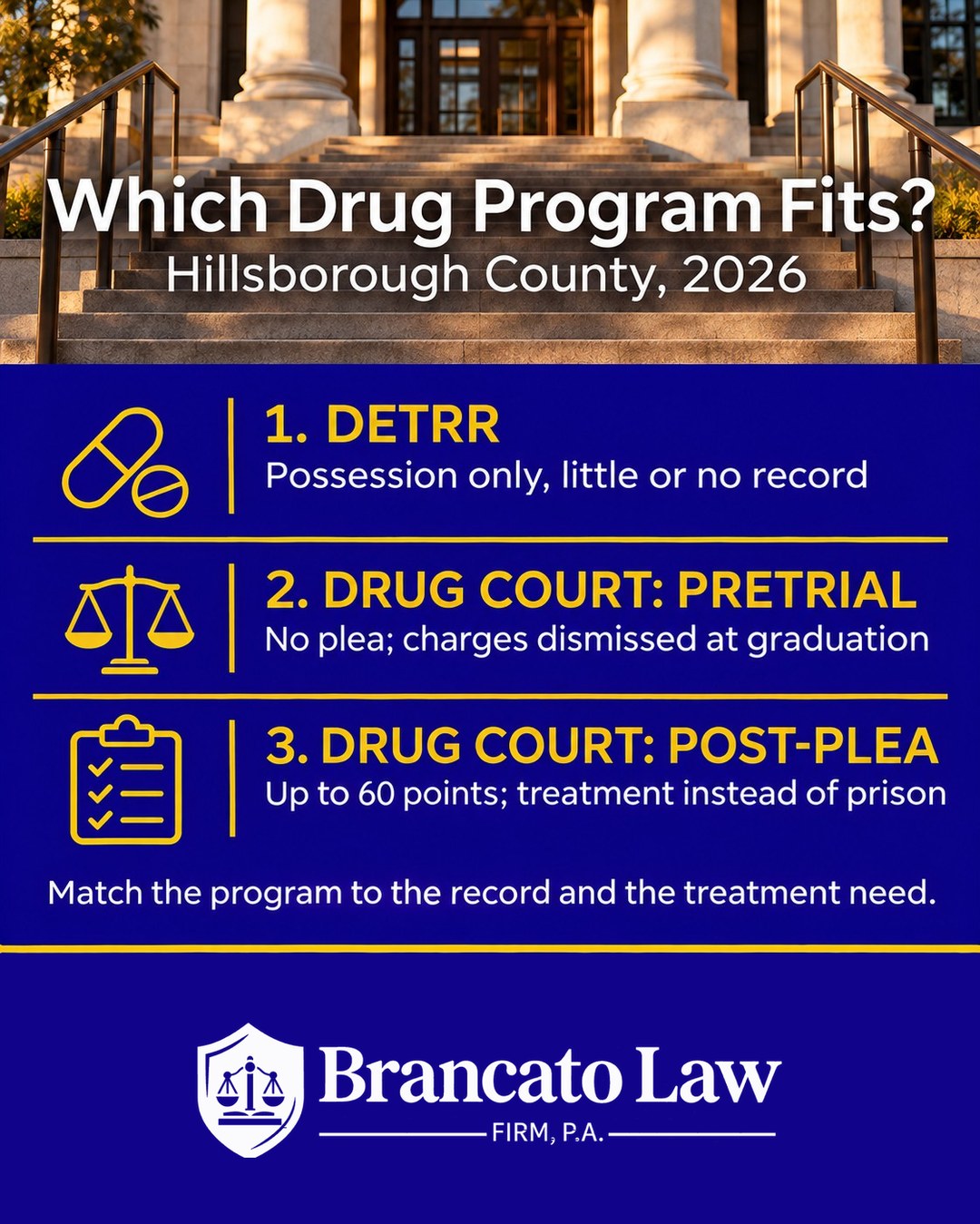
DETRR is usually better for a first-time possession case, and drug court is for the more serious case. DETRR (Drug Education and Treatment Reducing Recidivism) is the State Attorney’s Office program for low-risk people accused only of possession, with little or no prior record and a lighter treatment need. Drug court is built for deeper addiction, prior felonies, felony charges beyond simple possession, and cases where the scoresheet already points toward prison.
| Program | Best fit | Plea required? | Result on success |
|---|---|---|---|
| DETRR | Possession only, low risk, little or no record | No | Possession charge dismissed |
| Drug court, pretrial track | Nonviolent felony, up to two prior nonviolent felonies, real substance problem | No | Charges dismissed |
| Drug court, post-adjudication track | Nonviolent felony, scoresheet up to 60 points, including prison-scored cases | Yes | Probation ends successfully; prison avoided |
Choosing the right rung matters. A person who could qualify for DETRR should not spend 14 months in drug court, and a person with a serious addiction may fail a lighter program and lose the chance at a dismissal. Our attorneys match the program to the person’s record, the charge, and an honest look at the treatment need. Our guide to Hillsborough County diversion programs compares every program, from MIP to drug court. Veterans whose drug use is tied to a service-related condition should also look at Veterans Treatment Court.
How long does Hillsborough drug court take?
Hillsborough drug court lasts at least 6 months and up to 14 months or more, depending on the participant’s risk and treatment need. The court assigns one of four tracks based on a validated risk assessment (the LS/CMI) and a clinical assessment, according to the ADTC Policy and Procedure Manual (revised August 1, 2026).
| Track | Risk and need | Phases | Minimum length |
|---|---|---|---|
| Track 1 | High risk, high need | 5 | 14 months |
| Track 2 | Low risk, high need | 4 | 12 months |
| Track 3 | High risk, low need | 4 | 12 months |
| Track 4 | Low risk, low need | No phases | 6 months |
Time alone does not move a participant forward. The court’s tracks and phases chart sets minimum days for each phase, and the participant must apply for each phase advance, meet the phase requirements, and get the judge’s approval.
What does drug court require week to week?
Drug court requires random, observed drug testing at least twice a week for the whole program, regular court appearances, treatment, recovery support meetings, and monthly meetings with a probation officer. The ADTC participant handbook spells out the daily rules:
- Call the testing line every day and report within 8 hours when selected.
- Appear in court on Wednesdays at 9:00 AM, in Courtroom 52A on the fifth floor of the Criminal Annex at the George E. Edgecomb Courthouse, twice a month in the first phase and monthly later if compliant.
- No alcohol and no cannabis or THC in any form, including medical marijuana. Kratom counts as a prohibited synthetic.
- Disclose every prescription and file a physician form before taking new medication. FDA-approved medication for opioid use disorder is allowed through approved providers.
- Get the judge’s permission before leaving the county overnight.
Sanctions for slips are graduated, from extra testing or community service up to short jail stays, which the manual limits to three to five days. Incentives work the other way: reduced testing, fewer court dates, and early phase advancement. Under the manual, a participant is not punished for behavior caused by structural barriers.
Does your defense attorney stay involved during drug court?
Yes, and the defense attorney should. Under the 10 key components in section 397.334, the defense attorney is part of the drug court team, working in a nonadversarial way with the judge, the prosecutor, and the treatment providers while protecting the participant’s due process rights. Many private attorneys do not see it that way: they negotiate admission, consider the case worked out, and step away, and the participant goes through a year or more of drug court without a lawyer in the room.
Our attorneys stay aboard as part of the treatment team. We advocate for the client when the team discusses sanctions, incentives, and phase advancement, and we serve as an additional counselor and legal advisor when a slip or a new problem comes up. That matters most at the moments that decide the case: a positive test, a missed treatment appointment, a new arrest, or a hearing on unsuccessful discharge.
The Brancato Law Firm does not charge extra for drug court, even though it can keep us on a case for more than a year, as long as the person entering has a genuine desire for treatment and to turn their life around. We would rather be part of the solution than look at drug court in terms of time and money.
What does drug court cost?
Drug court participants pay supervision costs and statutory court costs, and treatment costs depend on insurance and income. Providers are told to use no-cost treatment resources first. The judge can convert court costs to community service at $15 per hour, and a participant may owe a lab fee when a confirmation test comes back positive. Pretrial graduates owe no statutory fine, while a pretrial participant who is unsuccessfully discharged still does.
What happens if you fail drug court?
If a pretrial participant is unsuccessfully discharged, the case returns to the original felony division and the prosecution starts again where it left off. If a post-adjudication participant is discharged, probation ends and the judge resentences, which can mean jail or prison. Before any unsuccessful discharge, the judge holds a hearing, and the defense attorney can present mitigation and ask for continued participation with tighter conditions.
A new arrest is handled under the administrative order. A new violent felony means transfer back and unsuccessful discharge. A new misdemeanor or nonviolent felony leads to a hearing, and the judge decides between discharge and continued participation. Reentry after a discharge is possible at the judge’s discretion.
Does drug court work?
Research shows that adult drug courts reduce reoffending. A meta-analysis of 154 independent evaluations by Mitchell, Wilson, Eggers, and MacKenzie in the Journal of Criminal Justice (2012) found that adult drug court participation cut general recidivism from about 50% to about 38%, and the effect lasted at least three years. The OPPAGA findings on Florida’s expansion courts point the same way, with completers about half as likely as similar offenders to pick up a new felony conviction within two years.
What should you do now if you were charged with a drug felony in Hillsborough County?
Act before the first plea offer. The first weeks after an arrest decide which programs are still available, so the steps below should happen early in the Hillsborough criminal case timeline:
- Do not talk about the case or about drug use with police, jail staff, or on recorded jail calls.
- Get a professional substance abuse evaluation through your attorney, so the result is protected and ready to file.
- Gather your prior record and any treatment history, because prior felonies and past program failures affect eligibility.
- Have your attorney score the case on the Criminal Punishment Code scoresheet to see whether the 60-point limit applies.
- Compare DETRR, pretrial drug court, and post-adjudication drug court before accepting any offer.
For more on handling a drug case before it is filed, read how to fight a drug charge in Florida before it is filed.
Frequently asked questions about Hillsborough drug court
Do you have to plead guilty to get into drug court in Hillsborough County?
No, not on the pretrial track, which requires only a speedy trial waiver and ends in dismissal. The Brancato Law Firm uses the pretrial track whenever a client qualifies, and we turn to the post-adjudication track, which does require a guilty or no contest plea, only when pretrial drug court is not available. You can read more about how our attorneys handle drug cases on our Tampa drug charge defense page.
Can drug court keep me out of prison if my scoresheet calls for prison?
Yes, if the offense is a nonviolent felony and the scoresheet totals 60 points or fewer, a judge may sentence you to post-adjudication drug court under section 948.01(7) instead of prison. The attorneys at The Brancato Law Firm check the scoresheet line by line, because correcting a few points can bring a case under the 60-point limit.
Can a prior felony keep me out of pretrial drug court?
Three or more prior felonies, or any violent prior felony, make a person ineligible for pretrial drug court, and one or two nonviolent priors let the judge deny admission in their discretion. Our attorneys at The Brancato Law Firm answer that discretion with treatment records, a fresh evaluation, and a concrete treatment plan.
Can I use medical marijuana while in Hillsborough drug court?
No, the Hillsborough drug court bans cannabis and THC in any form, including medical marijuana, and alcohol is prohibited too. The Brancato Law Firm reviews a client’s prescriptions before admission so the physician form is filed before any positive test.
Does completing drug court clear my record?
Completing the pretrial track dismisses the charges, which can open the door to sealing or expunging the arrest record if you are otherwise eligible. The Brancato Law Firm explains those options at graduation, and our pre-file advocacy work aims to keep a charge from being filed in the first place when the facts allow it.
What happens to my drug court case if I get arrested again?
A new violent felony arrest leads to transfer back and unsuccessful discharge, while a new misdemeanor or nonviolent felony leads to a hearing where the judge decides whether you stay in. Our attorneys at The Brancato Law Firm prepare mitigation for that hearing, because a well-supported request can keep a participant in the program.
Does my lawyer stay on the case after I get into drug court?
Not always, because some private attorneys end their work once the client is admitted, but the defense attorney is part of the drug court team and should stay involved. The Brancato Law Firm stays on the treatment team for the length of the program, at no extra charge for clients who are committed to treatment, and advocates at every review, sanction discussion, and discharge hearing.
Talk to a Tampa drug crimes attorney about drug court
Drug court eligibility is decided early, and a missed evaluation or a bad scoresheet can close the door. Call The Brancato Law Firm, P.A., founded by Tampa Criminal Defense Attorney Rocky Brancato, at (813) 727-7159. You can call us at any hour, and our office is two blocks from the courthouse. Our firm has Spanish-speaking staff, and attorney Jean-Luc Adrien speaks Spanish, Haitian Creole, and French. For more about our defense strategies, visit our Drug Crimes page. To compare every program side by side, see our Hillsborough County diversion programs guide.
The Brancato Law Firm, P.A.
620 E. Twiggs Street, Suite 205, Tampa, FL 33602
(813) 727-7159
Serving Hillsborough, Pinellas, and Pasco Counties
The Brancato Law Firm, P.A. is a Tampa-based criminal defense practice. We are not affiliated with any other Brancato-named law firms.
Visit Us

Tampa, FL 33602

Contact Us Now
Free Legal Consultation (813) 727-7159
