- Free Consultation 24/7: (813) 727-7159 Tap Here To Call Us


From First DUI to Death Penalty



What Is the DVIP Program in Hillsborough County? (2026)


Updated November 11, 2026
The Domestic Violence Intervention Program (DVIP) is a diversion program run by the State Attorney’s Office for the 13th Judicial Circuit in Hillsborough County and supervised by the Hillsborough County Sheriff’s Office. A person charged with domestic violence who has no prior felonies, no prior misdemeanor crimes of violence, and the alleged victim’s approval may sign a DVIP contract, complete a batterers’ intervention program and the other conditions, and have the charge dismissed. DVIP is limited to misdemeanor domestic violence, although the State can reduce a felony domestic violence charge to a misdemeanor so a person can enter. Entry is entirely up to the prosecutor, and an objection from the alleged victim keeps a person out.
Hillsborough prosecutors decide who gets into DVIP, and the alleged victim can stop it with a single objection. That makes the first weeks after a domestic violence arrest the time to build the case for diversion, or for no charge at all. As founder of The Brancato Law Firm, P.A., a Tampa criminal defense firm, and a former Chief Operations Officer of the Hillsborough County Public Defender’s Office, where I oversaw a staff of over 100 attorneys, I have spent more than 25 years in Hillsborough County courtrooms watching how these cases are resolved. Our attorneys review every domestic violence case for DVIP eligibility, and for whether the charge can be stopped before diversion is even needed.
What is the Domestic Violence Intervention Program in Hillsborough County?
DVIP is a diversion program, which means a case that goes through it ends in dismissal instead of a conviction. According to the State Attorney’s DVIP information sheet, the program is offered by the Office of the State Attorney for the 13th Judicial Circuit, is offered at the office’s “complete discretion,” and is supervised by the Hillsborough County Sheriff’s Office. DVIP is limited to misdemeanor domestic violence charges. In our experience, the State can reduce a felony domestic violence charge to a misdemeanor for the purpose of entering the program, which makes the request for a reduction part of the diversion strategy in a felony case. The details of DVIP do not appear on the State Attorney’s public programs page, so most of what people find online about the conditions are secondhand.
The program applies to crimes of domestic violence as Florida defines them. Under section 741.28, Florida Statutes, domestic violence includes assault, battery, stalking, and other listed offenses committed by one family or household member against another, such as a spouse, former spouse, relative, a person who lives or lived with the accused as a family, or a co-parent. Our Tampa domestic violence attorney page explains the charges themselves.
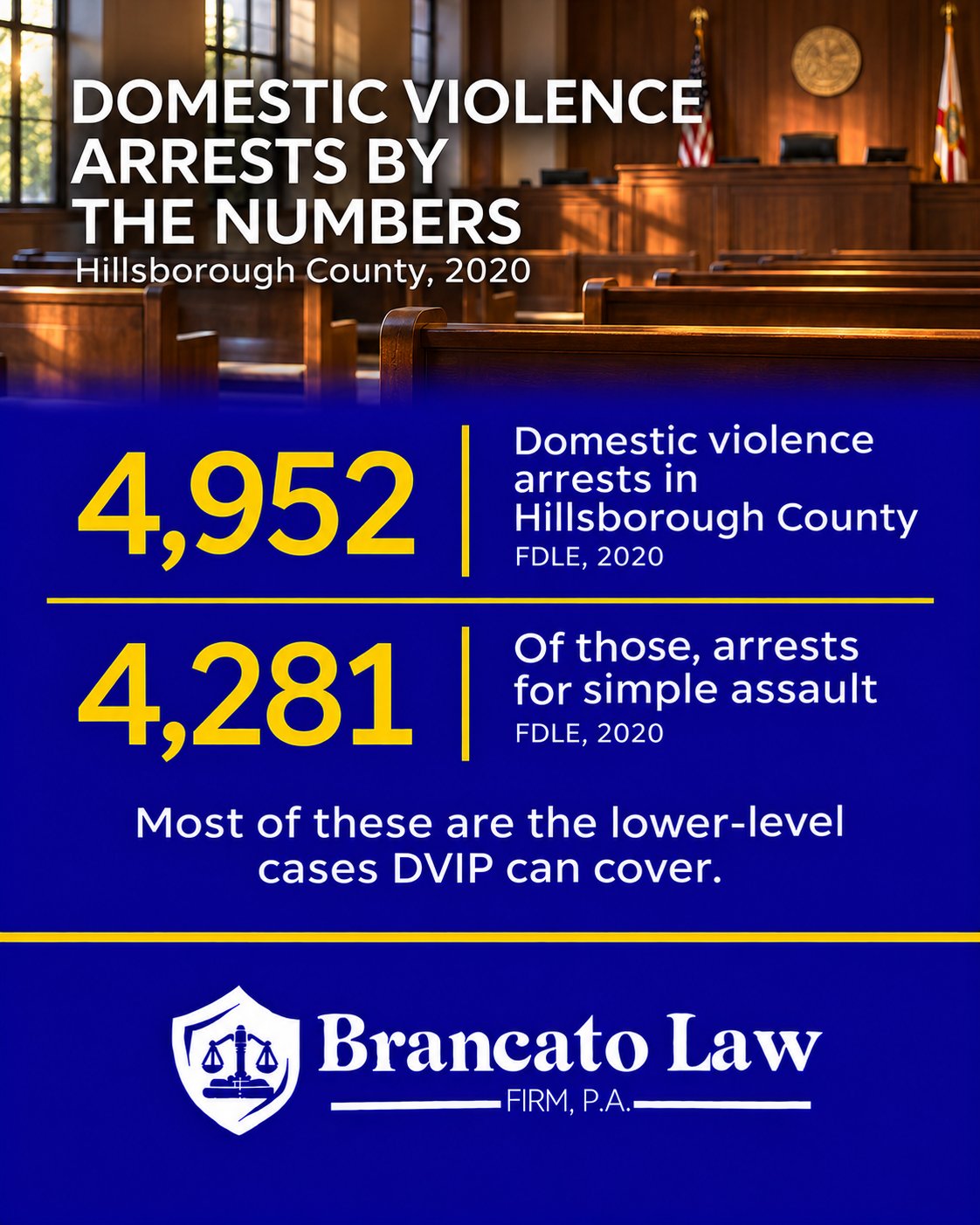
Domestic violence arrests are common in Hillsborough County. In 2020, law enforcement agencies in Hillsborough County made 4,952 domestic violence arrests, and 4,281 of them (about 86%) were for simple assault, the lowest-level assault category in the report, according to the Florida Department of Law Enforcement’s 2020 Reported Domestic Violence by Florida Jurisdiction, Arrests by Year. Most of those are the lower-level cases where diversion is on the table.
Who is eligible for DVIP?
A person is generally eligible for DVIP if they have no prior misdemeanor crimes of violence, no prior felonies, and the alleged victim approves. Those three requirements come straight from the State Attorney’s DVIP information sheet, which adds that “objection from a victim will bar a defendant from entering the program.”
| Requirement | What it means in practice |
|---|---|
| Misdemeanor charge | DVIP is for misdemeanor domestic violence. The State can reduce a felony domestic violence charge to a misdemeanor so the person can enter. |
| No prior felonies | Any prior felony on the person’s record generally rules out DVIP. |
| No prior misdemeanor crimes of violence | A prior battery, assault, or similar misdemeanor generally rules out DVIP. A prior nonviolent misdemeanor does not, by itself, appear on the State Attorney’s list of disqualifiers. |
| Alleged victim approves | The State Attorney’s Office asks the alleged victim. An objection bars entry. |
| Prosecutor agrees | DVIP is offered at the State Attorney’s complete discretion, even when the other requirements are met. |
The prosecutor has the final word, and a judge cannot override it. In Cleveland v. State, 417 So. 2d 653 (Fla. 1982), a woman charged with welfare fraud met every statutory requirement for pretrial intervention, but the state attorney would not consent, and the trial judge ordered her into the program anyway. The Florida Supreme Court held that “the pretrial diversion decision of the state attorney is prosecutorial in nature and, thus, is not subject to judicial review.” For DVIP, that means the case for diversion has to be made to the assigned prosecutor, with the facts and records that show the person belongs in the program.
Why does the alleged victim’s approval matter so much?
The alleged victim’s approval matters because an objection ends DVIP eligibility, no matter how strong the rest of the request is. In many domestic violence cases, the alleged victim does not want a prosecution at all. When that is true, the same wishes that make DVIP possible may support a request that the State not file the charge in the first place.
Our firm’s results show how that works. In November 2026, our firm prepared a custom affidavit stating an alleged victim’s wish not to prosecute a domestic battery by strangulation charge in Pasco County, facilitated communication between the alleged victim and the State, and the State declined to file charges. Our case results page lists other domestic violence cases that ended without a charge. Our post on whether a victim can drop domestic violence charges in Florida explains the limits. Past results do not guarantee future outcomes.
A lawyer for the accused must handle contact with the alleged victim carefully. A no-contact order from first appearance still applies, and any contact that looks like pressure can create a new charge. Our attorneys handle that communication so the client does not.
What do you have to do in DVIP?
A person enters DVIP by signing a contract that spells out the exact conditions of the program. According to the State Attorney’s DVIP information sheet, the person agrees to the following:
| Condition | Details |
|---|---|
| Waive speedy trial | The person gives up the right to a speedy trial, so the State can hold the case open during the program. |
| Report monthly | Monthly reporting to the Hillsborough County Sheriff’s Office. |
| Evaluation | An evaluation at a court-approved domestic violence treatment program. |
| Treatment | Any treatment the evaluation recommends, which generally includes a batterers’ intervention program and may include substance abuse treatment. |
| No contact | No contact, or no violent contact, with the alleged victim. |
| No weapons | No possession of weapons or firearms. |
| No new law violations | Any new arrest puts the program at risk. |
| Program costs | The person pays any associated program costs. |
The batterers’ intervention program is the longest part. Under section 741.325, Florida Statutes, a batterers’ intervention program “shall be at least 29 weeks in length and include 24 weekly sessions, plus appropriate intake, assessment, and orientation programming.” The State Attorney’s information sheet describes the same 29-week, 24-session program. The statute also says the program is funded by user fees paid by the people who attend it.
The program has to come from an approved provider. The 13th Judicial Circuit publishes its list of approved domestic violence service providers in Hillsborough County, with each provider’s location, hours, services, and fee schedule, including income-based sliding scales at many providers. Our attorneys walk clients through that list before they sign, so the cost and schedule are clear from the start.
How long does DVIP take, and what happens at the end?
DVIP supervision may last 12 months, but it can end sooner once the person completes every condition. According to the State Attorney’s DVIP information sheet, when the person successfully completes DVIP, the State Attorney’s Office dismisses the charges. If the person does not complete the program, the case is returned to court.
- Eligibility review. Our attorneys check the arrest report, the client’s record, and the alleged victim’s position.
- Request to the prosecutor. We ask the assigned assistant state attorney for DVIP, with the facts that support it.
- Contract. The client signs the DVIP contract, including the speedy trial waiver.
- Evaluation and treatment. The client completes the evaluation and the batterers’ intervention program or other recommended treatment.
- Supervision. Monthly reporting to the Sheriff’s Office, no new arrests, no weapons, and the no-contact terms.
- Dismissal. The State Attorney’s Office dismisses the charge after successful completion.
The speedy trial waiver is what makes this possible: it lets the State wait while the person finishes treatment. Our post on Florida’s speedy trial rule explains the right being waived.
Is DVIP better than taking a plea?
For most eligible people, yes, because DVIP ends in dismissal without a plea, while a plea to domestic violence leaves a record that Florida will never let you seal or expunge. Under section 943.0584, Florida Statutes, a conviction for assault or battery on a family or household member, or for domestic battery by strangulation, is ineligible for sealing or expunction. The statute defines conviction to include a guilty or no contest plea “regardless of whether adjudication is withheld.”
| Issue | DVIP completed | Plea to domestic violence battery |
|---|---|---|
| Case outcome | Charge dismissed by the State Attorney’s Office, with no plea entered | Conviction for sealing purposes, even with a withhold of adjudication |
| Batterers’ intervention program | Usually required | Required as a condition of at least 1 year of probation under section 741.281, unless the court states on the record why it is inappropriate |
| Jail | None as part of the program | At least 10 days in county jail if adjudicated guilty and the person intentionally caused bodily harm, under section 741.283 |
| Sealing or expunction | Dismissed charge may be eligible for expunction under section 943.0585 if the person’s record qualifies | Never eligible under section 943.0584 |
| Federal firearm rights | No conviction | A misdemeanor domestic violence conviction can trigger the federal ban in 18 U.S.C. § 922(g)(9) |
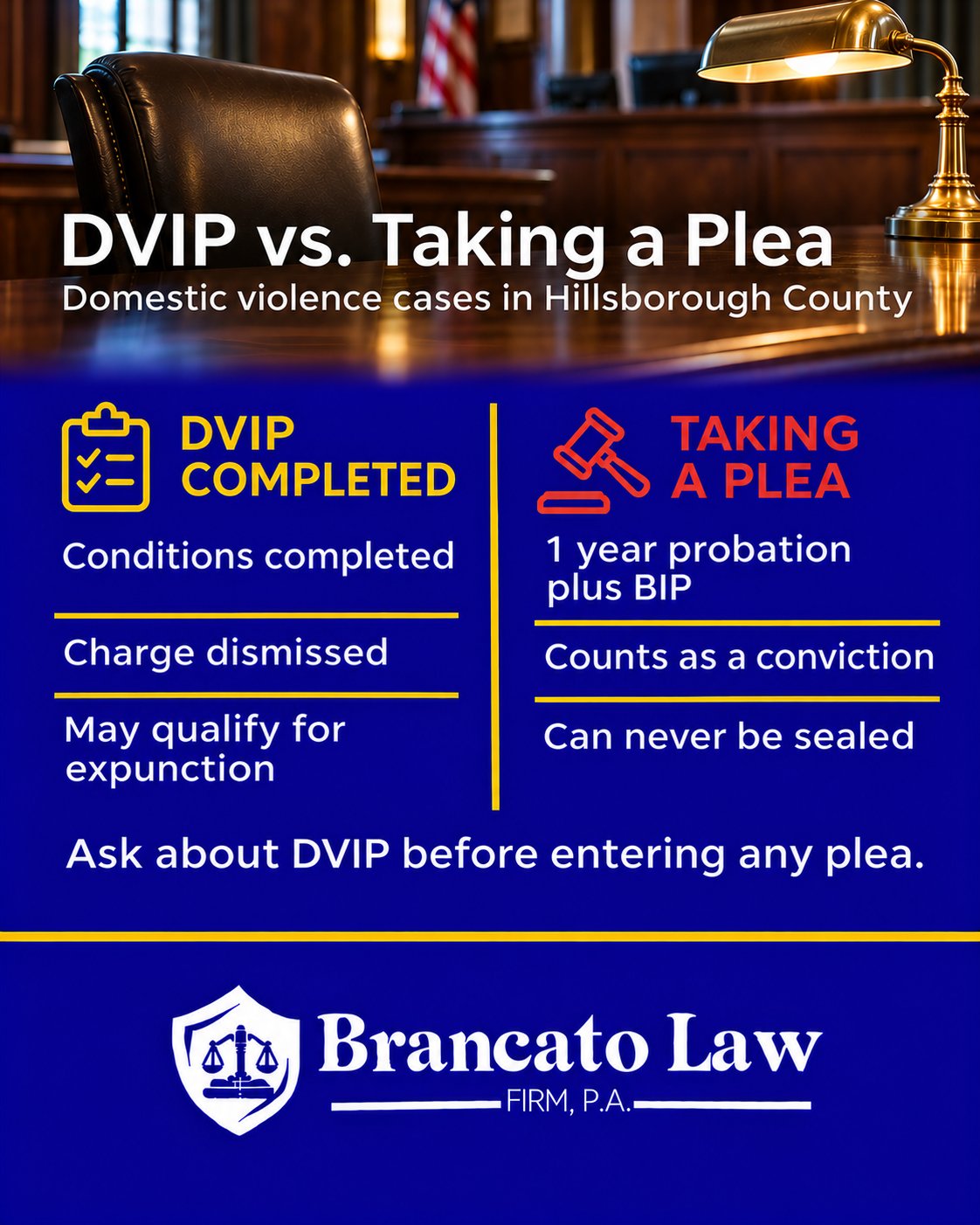
The probation terms come from section 741.281, Florida Statutes, which says a person who is found guilty, has adjudication withheld, or pleads no contest to a crime of domestic violence “shall be ordered by the court to a minimum term of 1 year’s probation” and to a batterers’ intervention program. The jail minimum comes from section 741.283, Florida Statutes. The federal firearm ban is in 18 U.S.C. § 922(g), and our post on domestic violence and gun rights in Florida covers it in detail.
A completed DVIP case is a much better starting point for clearing a record. Under section 943.0585, Florida Statutes, a person may petition to expunge a record when the charge was dismissed or nolle prossed, as long as they have never been adjudicated guilty of a criminal offense in Florida and have never had a record sealed or expunged. The person first needs a certificate of eligibility from FDLE, which comes with a $75 processing fee, and the court still decides the petition.
Is DVIP the right choice for everyone who qualifies?
No. DVIP is a good result for many people, but it costs months of treatment, monthly reporting, and program fees, and it should never be the default when the State cannot prove the case. Our attorneys look at the evidence first: what the 911 call and body camera show, whether there are injuries, whether the alleged victim will testify, and whether the client acted in self-defense. Our attorneys also go over every contract term with the client before signing, because a person who does not complete the program goes back to court.
Some clients also face consequences that diversion itself can trigger. Certain employers and licensing boards ask about diversion programs, not just convictions. Our post on whether you can be fired for being arrested in Florida covers the workplace side. When the defense is strong, our post on how to fight a domestic violence battery charge in Florida lays out the alternatives to diversion.
Does batterers’ intervention treatment actually work?
The research is mixed, and one of the leading studies was done in Florida. A National Institute of Justice special report, Batterer Intervention Programs: Where Do We Go From Here? (Jackson, Feder, Forde, Davis, Maxwell, and Taylor, 2003), describes an experiment in Broward County in which men on one year of probation were randomly assigned either to 26 weeks of batterer group counseling or to probation alone. The study found no significant differences between the two groups in reoffense rates or attitudes toward domestic violence. A companion study in Brooklyn found that men who completed a 26-week program had fewer official complaints than the control group, while an 8-week program showed no difference.
For a person charged in Hillsborough County, the research matters less than the outcome. DVIP requires the treatment either way, and completing it is what earns the dismissal. Our attorneys make sure clients understand the full commitment before they sign.
What should you do after a domestic violence arrest in Hillsborough County?
Talk to a lawyer before the State makes its filing decision, because the best outcomes, including DVIP and charges that are never filed, start early. Follow every bond and no-contact condition, do not contact the alleged victim about the case, do not post about it, and keep every paper the jail gave you. Then let our attorneys reach the prosecutor. Our page on representation before charges are filed explains that early work, our Hillsborough County criminal defense page covers the local courts, and our overview of how a Florida criminal case moves from investigation to appeal shows where diversion fits.
For more about our defense strategies, visit our Domestic Violence page.
Frequently asked questions about DVIP
Can I get into DVIP if the alleged victim objects?
No. The State Attorney’s DVIP information sheet says an objection from the alleged victim bars entry into the program. When an alleged victim supports the accused, our attorneys at The Brancato Law Firm make sure the State Attorney’s Office hears that clearly and through the proper channels, which can open the door to diversion or to no charge at all.
Can a felony domestic violence charge go to DVIP?
Only if it is reduced. DVIP is limited to misdemeanor domestic violence, but the State can reduce a felony domestic violence charge to a misdemeanor so the person can enter the program. Our attorneys at The Brancato Law Firm make the case for that reduction to the assigned prosecutor.
Can a judge order DVIP if the prosecutor says no?
No. Under Cleveland v. State, 417 So. 2d 653 (Fla. 1982), a state attorney’s pretrial diversion decision is not subject to judicial review. That is why The Brancato Law Firm builds the DVIP request for the assigned prosecutor, with the client’s record, treatment steps, and the alleged victim’s position.
Can I own a gun while I am in DVIP?
No. The DVIP contract requires the person to have no possession of weapons or firearms during the program. Our attorneys at The Brancato Law Firm explain the firearm terms before a client signs, and our post on domestic violence and gun rights in Florida covers what happens to gun rights after a conviction.
How much does DVIP cost in Hillsborough County?
The person in DVIP pays the program costs, including the evaluation and the batterers’ intervention program, and Florida law requires those programs to be funded by user fees. The Brancato Law Firm reviews the 13th Circuit’s approved provider list with each client, since many providers use income-based sliding scales.
Is DVIP available in Pinellas or Pasco County?
No. DVIP is a program of the State Attorney’s Office for the 13th Judicial Circuit, which covers Hillsborough County, while Pinellas and Pasco cases are prosecuted by the State Attorney’s Office for the Sixth Judicial Circuit. The Brancato Law Firm defends domestic violence cases in all three counties, and our case results include a Pasco domestic violence case that was never filed.
Can a domestic violence charge be dropped instead of going to DVIP?
Yes, sometimes. The State Attorney’s Office can decline to file a domestic violence charge, often when the alleged victim does not want to prosecute or the evidence is weak. Our attorneys at The Brancato Law Firm look for that result first, through pre-file advocacy, before recommending diversion.
The State Attorney’s Office decides whether to file a domestic violence charge in the first weeks after the arrest, and DVIP and a no-file decision are both won in that window. Our attorneys will review the arrest report and the alleged victim’s position, confirm DVIP eligibility, and contact the prosecutor. Call The Brancato Law Firm, P.A., founded by Tampa Criminal Defense Attorney Rocky Brancato, at (813) 727-7159. Call us at any hour; our office is two blocks from the courthouse. Our firm has Spanish-speaking staff, and attorney Jean-Luc Adrien speaks Spanish, Haitian Creole, and French.
The Brancato Law Firm, P.A.
620 E. Twiggs Street, Suite 205, Tampa, FL 33602
(813) 727-7159
Serving Hillsborough, Pinellas, and Pasco Counties
The Brancato Law Firm, P.A. is a Tampa-based criminal defense practice. We are not affiliated with any other Brancato-named law firms.
Visit Us

Tampa, FL 33602

Contact Us Now
Free Legal Consultation (813) 727-7159
