- Free Consultation 24/7: (813) 727-7159 Tap Here To Call Us


From First DUI to Death Penalty



What Is Pretrial Intervention (PTI) in Hillsborough County? (2026)


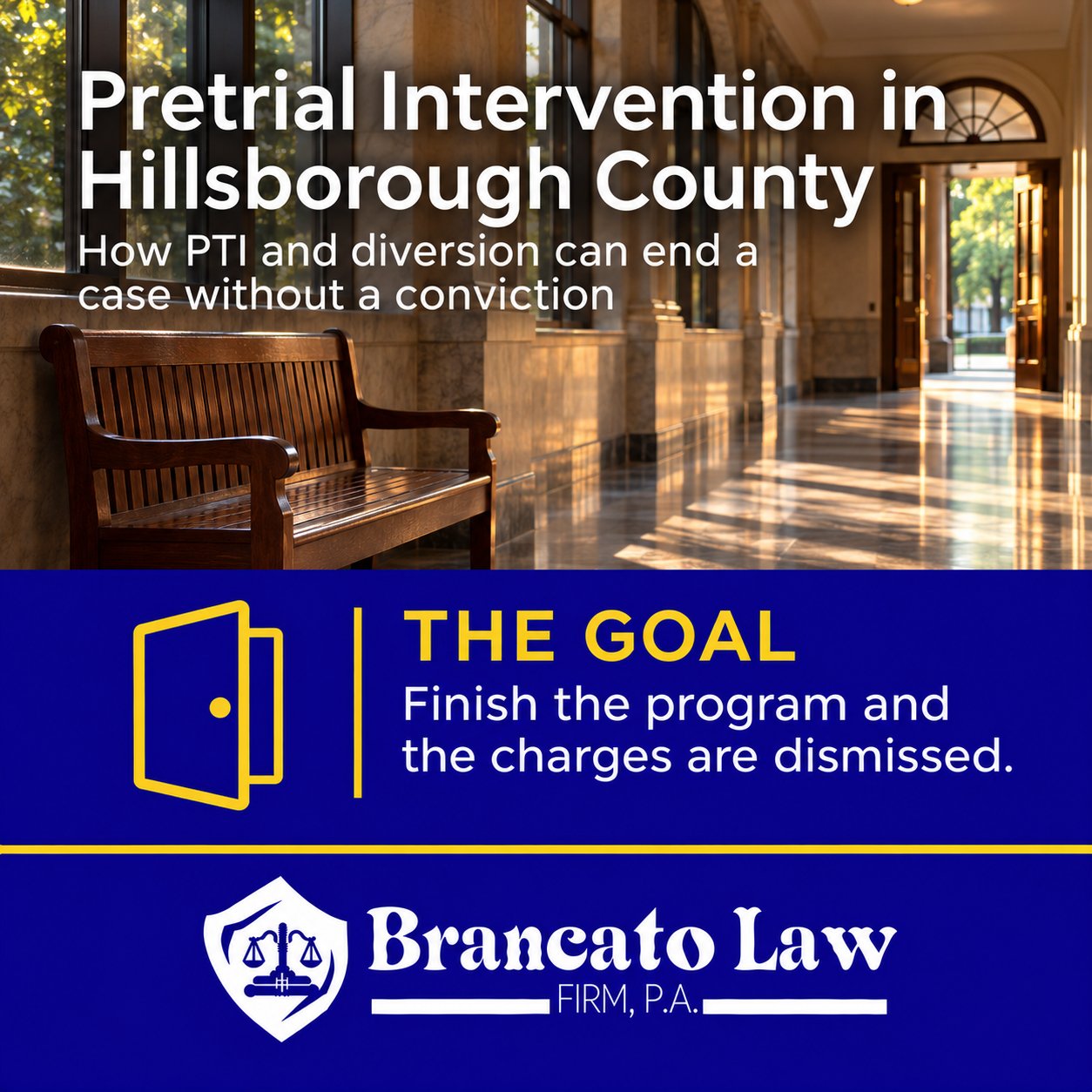
| Short answer: Pretrial intervention (PTI) is a diversion program that lets an eligible person charged in Hillsborough County complete supervision and conditions instead of being prosecuted. When the program is completed, the charges are dismissed, and a case dismissed on all counts usually qualifies for automatic sealing. General PTI under section 948.08 covers first offenders charged with a misdemeanor or third-degree felony, and it requires the consent of the State Attorney, the alleged victim, and the judge. The 13th Circuit also runs separate drug, mental health, veterans, domestic violence, and misdemeanor programs with their own rules. |
A first arrest in Hillsborough County does not have to end in a conviction. Rocky Brancato, founder of The Brancato Law Firm, P.A., has spent more than 25 years in Hillsborough County courtrooms, including service as former Chief Operations Officer of the Hillsborough County Public Defender’s Office, where he oversaw a staff of over 100 attorneys. Our Tampa criminal defense attorneys use that experience to find the diversion program that fits your charge, make the case for admission to the prosecutor, and keep you on track until the case is dismissed.
What is pretrial intervention in Hillsborough County?
Pretrial intervention is a program that pauses prosecution while the accused person completes conditions such as supervision, classes, treatment, community service, or restitution. If the person finishes, the State dismisses the charges. If the person does not, the prosecution picks up where it left off.
PTI is one of several Hillsborough County diversion programs. The Hillsborough State Attorney’s Office lists pretrial intervention for certain first-time felony offenders, supervised by the Florida Department of Corrections, alongside the Misdemeanor Intervention Program, DETRR for drug possession, the Domestic Violence Intervention Program, traffic diversion, and adult pre-arrest diversion. The 13th Judicial Circuit separately runs problem-solving courts for drug, mental health, and veterans cases. Our guide to Veterans Treatment Court diversion in Hillsborough County covers the veterans program and the 2026 change in who decides eligibility. Each program has its own entry rules, so the first job is matching the charge to the right one. For an overview of where diversion fits in a case, see our Florida criminal case process guide.
Which Florida laws control PTI and diversion?
Two statutes do most of the work. Section 948.08, Florida Statutes, creates general pretrial intervention plus separate felony tracks for substance abuse, veterans, and mental health. Section 948.16 creates the misdemeanor versions of the substance abuse, veterans, and mental health programs.
A common mistake is to call 948.08 “felony PTI” and 948.16 “misdemeanor diversion.” General PTI under 948.08 covers misdemeanors as well as third-degree felonies. Section 948.16 is limited to treatment-based programs for people charged with misdemeanors. For a first-time misdemeanor in Hillsborough County, see also the Misdemeanor Intervention Program and, before any arrest, the APAD adult civil citation.
| Program | Statute | Who can enter | Who decides | Result if completed |
|---|---|---|---|---|
| General PTI | 948.08(2) | First offender, or one prior nonviolent misdemeanor; charged with a misdemeanor or third-degree felony | Program administrator, State Attorney, victim, and judge must all consent | Dismissal without prejudice; State Attorney makes the final call |
| Felony drug PTI | 948.08(6) | Substance abuse problem; nonviolent felony; no violent charge; two or fewer prior nonviolent felonies | The court, on motion of either side or its own motion | Court must dismiss on a written finding of completion |
| Felony veterans PTI | 948.08(7) | Veteran or servicemember charged with an eligible felony | Court, under the veterans treatment court statute | Court must dismiss on completion |
| Felony mental health PTI | 948.08(8) | Mental illness; nonviolent felony, or certain officer-related or aggravated assault charges with consent | The court | Court must dismiss on completion |
| Misdemeanor treatment programs | 948.16 | Misdemeanor charge plus a substance abuse problem (no prior felony), mental illness, or veteran status | The court | Court must dismiss on completion |
Who qualifies for PTI in the 13th Judicial Circuit?
Under section 948.08(2), general PTI is open to a first offender, or a person with no more than one prior nonviolent misdemeanor conviction, who is charged with a misdemeanor or a third-degree felony. Entry also requires the approval of the program administrator and the consent of the alleged victim, the State Attorney, and the judge who presided at first appearance. The accused must agree to the program after consulting a lawyer and waive speedy trial for the diversion period.
The State Attorney’s consent is the gate that matters most. In Cleveland v. State, 417 So. 2d 653 (Fla. 1982), a woman charged with welfare fraud met every statutory requirement, but the prosecutor refused to consent. The trial judge ordered her into the program anyway. The Florida Supreme Court rejected that order, holding under the predecessor PTI statute that the State Attorney’s pretrial diversion decision “is prosecutorial in nature and, thus, is not subject to judicial review.” In practice, that means admission to general PTI is won by persuading the prosecutor, not by filing a motion.
Two details trip people up:
- The victim’s consent. The statute bars the accused and the accused’s immediate family from personally contacting the alleged victim or the victim’s family to get consent. That contact has to go through counsel and the State Attorney’s Office.
- Drug PTI is different. For felony drug cases that qualify under 948.08(6), the court decides admission on motion, and the State can block entry only by proving dealing or selling at a preadmission hearing, or the court can deny it in its discretion based on prior felonies. That gives the defense a path that general PTI does not.
What diversion programs does Hillsborough County offer?
The right program depends on the charge, the person’s record, and whether a case has been filed yet. These are the main options in Hillsborough County.
| Program | Typical charges | Key features |
|---|---|---|
| Felony pretrial intervention (PTI) | Certain first-time felonies | Supervised by the Department of Corrections; State Attorney consent required |
| Misdemeanor Intervention Program (MIP) | First-time misdemeanors | Requires State Attorney consent; application goes through the assigned prosecutor |
| DETRR | Low-risk, nonviolent drug possession | Six months arrest-free plus education or treatment; possession charge dismissed |
| DVIP | Misdemeanor domestic violence | Certified batterers’ intervention program; State Attorney consent required |
| Drug pretrial intervention (drug court) | Nonviolent felonies driven by substance abuse | Court-supervised treatment, frequent testing, 18-month agreement |
| Mental health pretrial intervention | Eligible charges where mental illness drives the case | Outpatient treatment, 18-month agreement, early termination possible after 9 months |
| Veterans treatment court | Eligible charges against veterans and servicemembers | Phase-based treatment through the 13th Circuit and the VA |
| Traffic diversion | License and registration offenses | Referral at the State Attorney’s discretion |
Florida’s newer mental health diversion law also created pretrial tracks for some people with mental illness. Our post on Florida’s mental health diversion law, the Tristin Murphy Act, explains who qualifies, and our Tampa criminal mental health lawyer page covers how we build those cases.
Can I get into PTI before charges are filed?
Often, yes. Diversion is easiest to negotiate before the State Attorney files formal charges, because the prosecutor has not yet committed to a case. In our experience, the Hillsborough State Attorney’s Office will offer diversion before filing when the defense contacts the assigned prosecutor quickly after the arrest and gives a reason to say yes.
That reason is usually a short mitigation package: proof of work or school, a clean record, a treatment evaluation already completed, restitution ready to pay, and a letter from the alleged victim where appropriate and lawful. Our representation before charges are filed is built around that window. Nearly every month, cases handled by our firm never get filed because of early advocacy.
How long does PTI last in Hillsborough County?
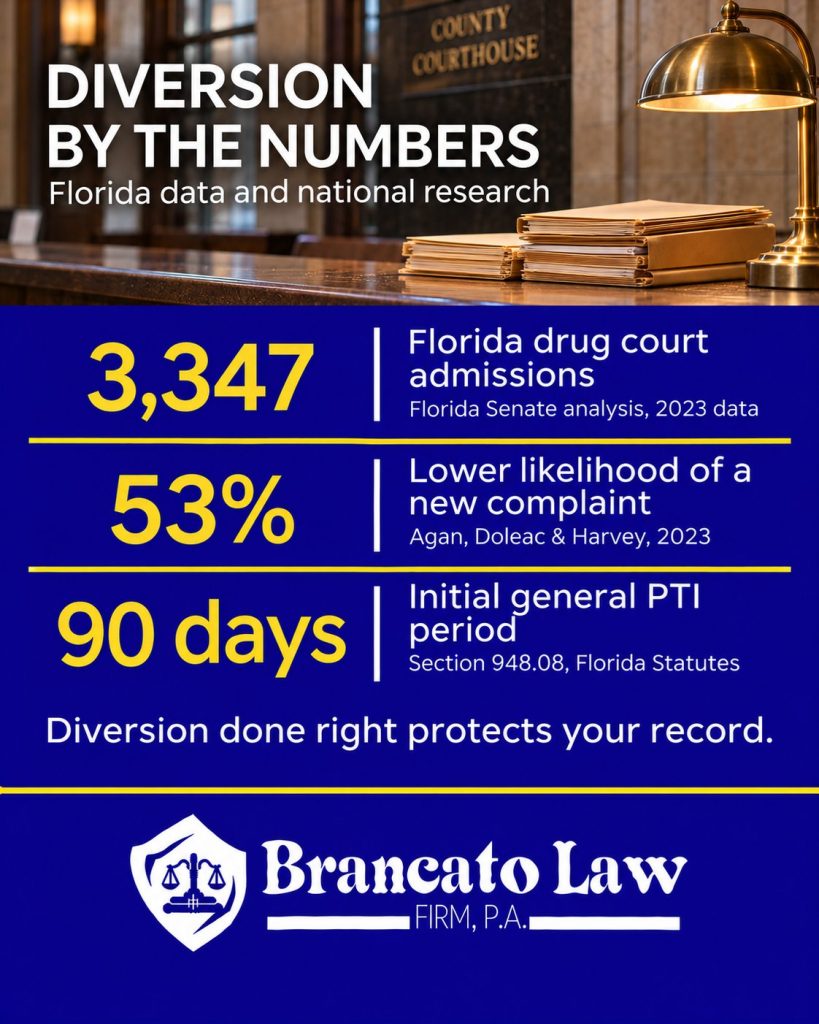
Under section 948.08(3), general PTI holds the charges for 90 days, with another 90 days available on the program administrator’s request and the State Attorney’s consent. At the end, the administrator can also recommend further supervision under 948.08(5), so the PTI agreement, not the 90-day figure alone, sets the real term.
The treatment-based programs run longer. The 13th Circuit’s drug pretrial intervention agreement sets an 18-month intervention period with five treatment phases, and its mental health PTI agreement also runs 18 months, with early termination possible after nine months of full compliance. DETRR requires six months without a new arrest.
What does PTI cost?
Under section 948.09, a person in a pretrial intervention program must pay the cost of supervision as a condition of placement, capped at the actual cost. The Department of Corrections can reduce or waive that cost for listed hardships, such as being a full-time student or supporting dependents.
The 13th Circuit’s current PTI forms list these charges. The amounts that apply to you are the ones in your signed agreement.
| Charge | Amount on 13th Circuit forms |
|---|---|
| Supervision | $40 per month (drug and mental health PTI agreements) |
| State Attorney cost of prosecution | $100 |
| Cost of investigation | $130 |
| Victim Assistance Project | $100 |
| Clerk processing fee | $12 |
| First Step of Hillsborough County | $1 per month of supervision |
| Department of Corrections surcharge | 4% of each payment (drug and mental health PTI agreements) |
Treatment, classes, drug testing, and restitution are paid separately to the provider or the victim. All money and conditions on the drug and mental health PTI agreements must be completed 30 days before the program ends.
What happens to my record after PTI?
When PTI ends in dismissal of every count, Florida’s automatic sealing law usually applies. Under section 943.0595, when a charge is dismissed or nolle prossed as to all counts, the Clerk sends the disposition to FDLE, which seals the criminal history record without a petition. Automatic sealing does not apply to forcible felonies or to listed sex offenses.
Sealing hides the record from most public searches, but some agencies and licensing boards can still see it. Many people then want the record expunged, which destroys it. Under section 943.0585, expunction requires a certificate of eligibility from FDLE, a $75 processing fee, a statement from the State Attorney, no prior adjudication of guilt, and no prior court-ordered sealing or expunction, and the judge still has discretion. Our attorneys check eligibility before you sign the PTI agreement so the record plan is part of the deal from the start.
What happens if I fail PTI?
If you do not meet the conditions, the State can end the agreement and resume prosecution. Section 948.08(4) allows the State Attorney or the program administrator to restart the case at any time if the person is not fulfilling the program’s obligations. In the drug, mental health, and veterans programs, the judge can instead order more treatment, jail-based treatment, or return the case to the regular criminal division.
Failure usually comes from three things: a new arrest, missed payments or reporting, and a positive drug test in a treatment program. Speedy trial rights waived for PTI come back when prosecution resumes. If a client is struggling, our attorneys ask for a modification or more time before the State moves to terminate, because a short extension is easier to win than a reinstatement.
Does diversion actually help?
The research says yes. A study of first-time felony defendants in Harris County, Texas, published in the Review of Economic Studies in 2021, found that diversion cut reoffending rates in half and grew employment by nearly 50% over 10 years. A 2023 study in the Quarterly Journal of Economics found that not prosecuting a nonviolent misdemeanor led to a 53% reduction in the likelihood of a new criminal complaint over two years, with the largest effects for people with no prior record. In Florida, drug courts admitted 3,347 participants in 2023, according to a 2025 Florida Senate staff analysis.
Should I take PTI or fight the case?
PTI is a strong outcome, but it is not always the best one. PTI comes with months of supervision, costs, and conditions, and a weak case may be dismissed outright through a motion to dismiss or suppress. Our attorneys review the arrest report, body camera video, and lab results first, then advise whether to push for dismissal, negotiate diversion, or both. Entering PTI is not a plea, and we often keep defense motions in reserve while diversion is negotiated.
How our attorneys get clients into PTI
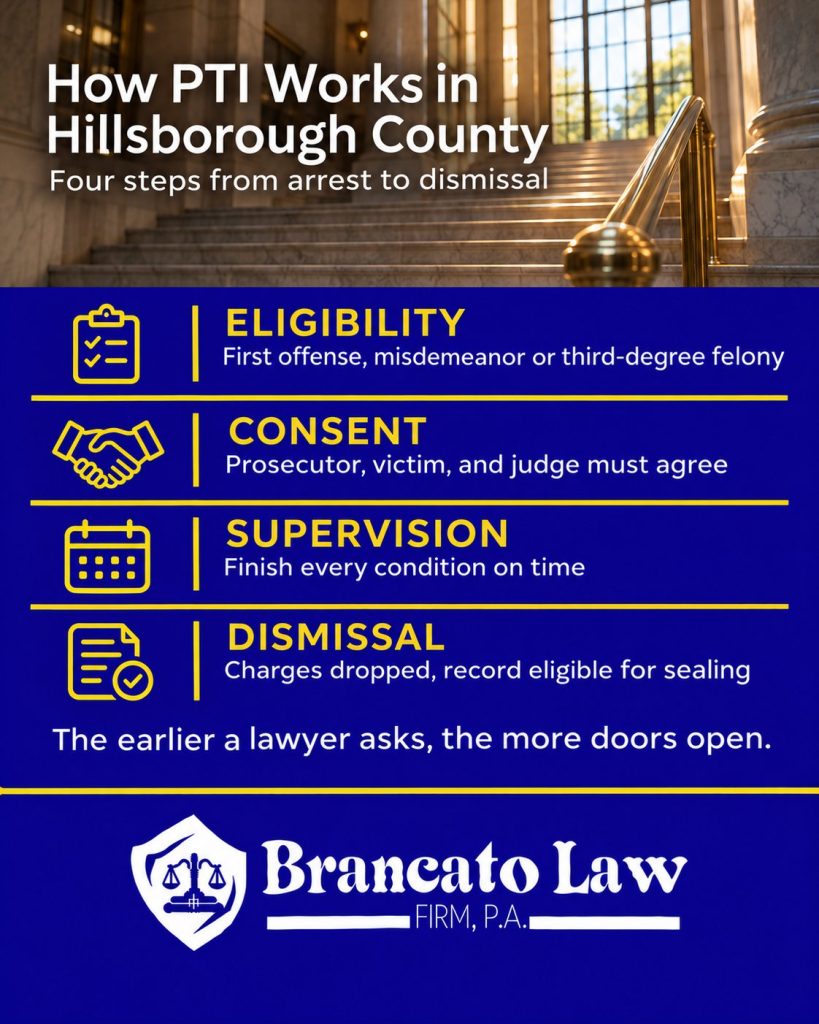
- Move before the filing decision. We contact the assigned prosecutor early, often before charges are filed.
- Match the charge to the program. General PTI, MIP, DETRR, DVIP, or a treatment court each has different gates.
- Build the mitigation package. Employment, school, evaluations, restitution, and character letters give the prosecutor a reason to consent.
- Handle victim consent the right way. All contact with the alleged victim goes through counsel and the State Attorney’s Office, as the statute requires.
- Negotiate the terms. We review length, classes, costs, and community service before you sign.
- Track completion and the record. We confirm the dismissal and follow through on sealing or expunction.
Frequently asked questions about PTI in Hillsborough County
Can a felony charge be dismissed through PTI in Hillsborough County?
Yes. Third-degree felonies are eligible for general PTI, and many nonviolent felonies are eligible for the drug, mental health, and veterans programs. The Brancato Law Firm reviews the charge and your record to identify which track fits before we approach the prosecutor.
Does the victim have to agree to PTI?
For general PTI under section 948.08, yes, the alleged victim’s consent is required, along with the State Attorney’s and the judge’s. Our attorneys at The Brancato Law Firm handle that request through the State Attorney’s Office, because the statute bars you and your family from contacting the victim to get consent.
Can I get PTI if I have a prior record?
Possibly. General PTI allows no more than one prior nonviolent misdemeanor conviction, while felony drug PTI allows up to two prior nonviolent felony convictions. Our team at The Brancato Law Firm checks your full history, including out-of-state records, before recommending a program as part of our defense work in Hillsborough County.
Will PTI show up on a background check?
The arrest stays visible until the case is dismissed and the record is sealed or expunged. When every count is dismissed after PTI, Florida’s automatic sealing law usually seals the record, and The Brancato Law Firm can then advise whether an expunction petition makes sense.
Can a judge order PTI if the prosecutor says no?
For general PTI, no. The Florida Supreme Court held in Cleveland v. State that the State Attorney’s diversion decision is not subject to judicial review. For felony drug PTI, the judge decides admission, and our attorneys at The Brancato Law Firm use that route when a client qualifies.
Is PTI available for DUI in Hillsborough County?
The Hillsborough State Attorney’s Office handles first-time, non-aggravated DUI cases through its RIDR initiative, which adds sanctions such as alcohol monitoring devices and DUI education. The Brancato Law Firm reviews every DUI for defenses first on our Tampa DUI lawyer page.
Do I need a lawyer to get into PTI?
You are not required to have one, but the statute requires you to agree to PTI after consulting a lawyer, and admission depends on persuading the prosecutor. Our attorneys at The Brancato Law Firm know how the Hillsborough State Attorney’s Office evaluates diversion requests, and our pre-file advocacy puts a complete request in front of the prosecutor early.
For more about how our attorneys defend cases in this county, visit our Hillsborough County criminal defense attorney page. To compare every program side by side, see our Hillsborough County diversion programs guide.
Talk to a Hillsborough County PTI lawyer
The best time to ask for diversion is before the State Attorney files charges, and that window can close within weeks of an arrest. Call The Brancato Law Firm, P.A., founded by Tampa Criminal Defense Attorney Rocky Brancato, at (813) 727-7159. You can call us at any hour. Our firm has Spanish-speaking staff, and attorney Jean-Luc Adrien speaks Spanish, Haitian Creole, and French.
The Brancato Law Firm, P.A.
620 E. Twiggs Street, Suite 205, Tampa, FL 33602
(813) 727-7159
Serving Hillsborough, Pinellas, and Pasco Counties
The Brancato Law Firm, P.A. is a Tampa-based criminal defense practice. We are not affiliated with any other Brancato-named law firms.
Visit Us

Tampa, FL 33602

Contact Us Now
Free Legal Consultation (813) 727-7159
