- Free Consultation 24/7: (813) 727-7159 Tap Here To Call Us


From First DUI to Death Penalty



What Is JAAP? Juvenile Civil Citations in Hillsborough County (2026)


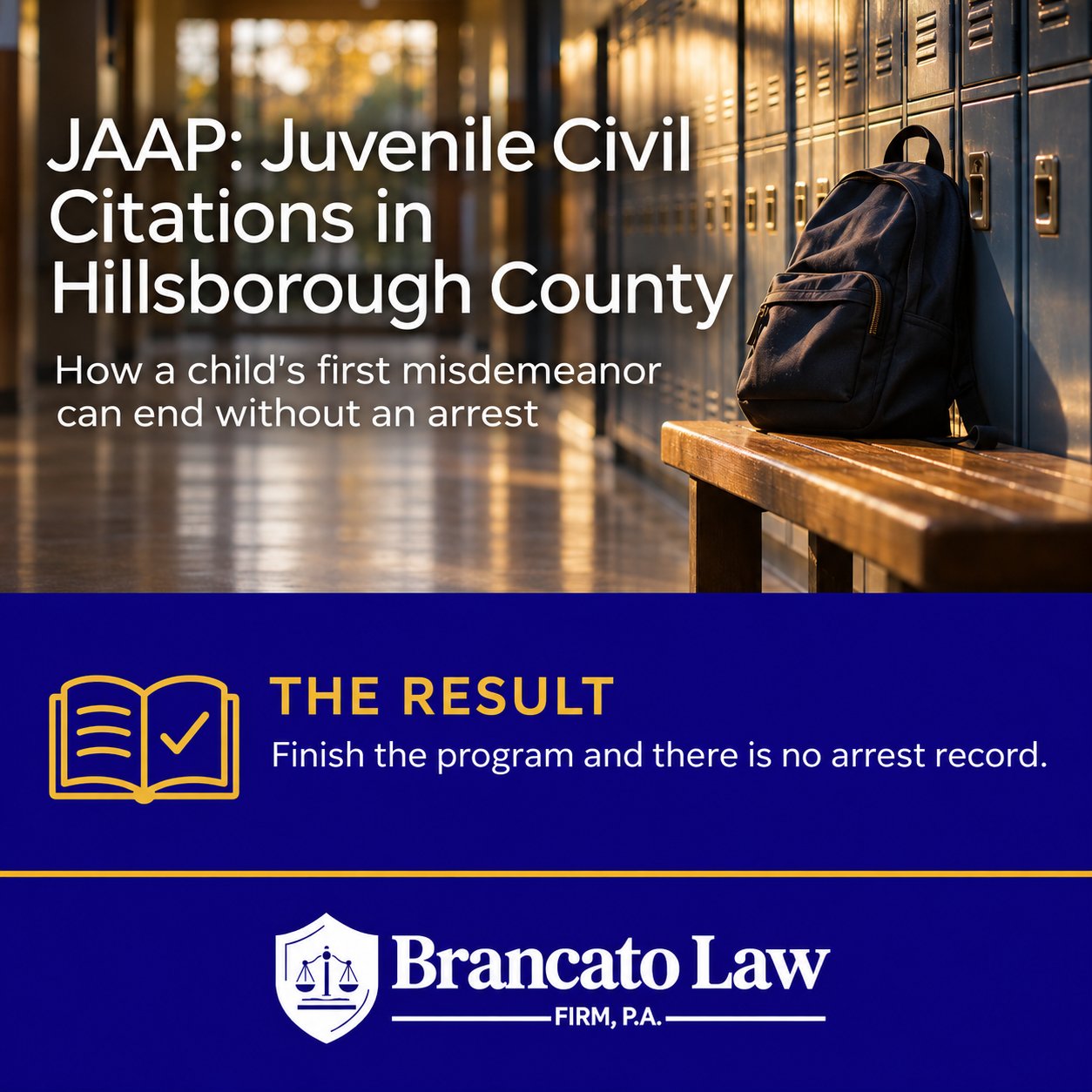
| Short answer: JAAP, the Juvenile Arrest Avoidance Program, is Hillsborough County’s civil citation program for children ages 8 to 17. When a child with no prior record commits an eligible misdemeanor, the officer at the scene can issue a civil citation instead of making an arrest. The child completes community service and other sanctions set by the Juvenile Diversion Program, and the case closes with no arrest record. Since 2021, Hillsborough officers are expected to use JAAP for first-time misdemeanors unless a supervisor approves an arrest for an extraordinary reason. |
As founder of The Brancato Law Firm, P.A., a Tampa criminal defense firm, and a former Chief Operations Officer of the Hillsborough County Public Defender’s Office, where I oversaw a staff of over 100 attorneys, I served for years on Hillsborough’s civil citation committee, helping develop and expand the use of juvenile civil citations, and I watched them change the county’s juvenile court. When I was at the Public Defender’s Office in the mid-2000s, the county’s juvenile caseload ran around 12,000 cases a year. In fiscal year 2024-25, the Department of Juvenile Justice’s Delinquency Profile shows 1,831 youths arrested in Hillsborough County. Civil citation is a big part of that change.
This post is a public service. JAAP happens at the scene, between the officer and the family, and a lawyer is usually not part of it. Here is how it works so parents know what to do in the first few days.
What is JAAP in Hillsborough County?
JAAP is the 13th Judicial Circuit’s juvenile civil citation program. It lets a police officer or deputy handle a child’s first misdemeanor with a civil citation instead of a custodial arrest. The child is not booked into the Juvenile Assessment Center, no delinquency petition is filed, and the child completes a set of sanctions instead.
Florida law requires every judicial circuit to have this kind of program. Under section 985.12, Florida Statutes, each circuit’s State Attorney, Public Defender, clerks, and law enforcement agencies must create a prearrest delinquency citation program for misdemeanors, and the State Attorney operates it. Hillsborough’s version is JAAP, which the Hillsborough State Attorney’s Office reports was launched on August 1, 2017, and expanded in 2019 to more offenses, including some family violence cases. For how JAAP fits among the county’s other options, see our guide to Hillsborough County diversion programs.
Who qualifies for JAAP?
JAAP is for first-time offenders. The 13th Circuit’s JAAP flyer describes eligible youth as ages 8 to 17, charged with a misdemeanor, with no prior involvement in the juvenile justice system. Tampa Police Department policy defines a first-time offender as a child who has never been adjudicated delinquent or had adjudication withheld, never been in a pre-arrest or post-arrest diversion program, and never been physically arrested for a crime.
| Question | JAAP answer |
|---|---|
| Ages | 8 to 17 |
| Prior record | None: no prior adjudication, withhold, diversion, or arrest |
| Charge level | Misdemeanors only |
| Excluded by state law | Offenses involving use or possession of a firearm |
| Excluded by local policy | Intimate partner domestic violence battery |
| Family violence (sibling, parent, household member) | Eligible at the officer’s discretion, with shelter placement and parental consent for placement |
| Parental consent to participate | Not required |
| Who decides | The officer at the scene, with a supervisor’s approval required to arrest instead |
Prior traffic offenses do not disqualify a child, and all eligible misdemeanors from the same incident are supposed to go into JAAP together.
Is JAAP mandatory for police in Hillsborough County?
Close to it. In a May 3, 2021 announcement, the Hillsborough County Sheriff’s Office said civil citations for first-time misdemeanors would become mandatory “absent certain extraordinary circumstances.” Tampa Police policy now tells officers to presume that a qualifying offense requires a JAAP referral. An arrest instead needs a shift or bureau commander’s approval and a documented reason, such as a threat to community safety, the safety of the victim, the nature of the offense, the lack of an appropriate shelter placement, or an assault on certain officials who do not consent to JAAP.
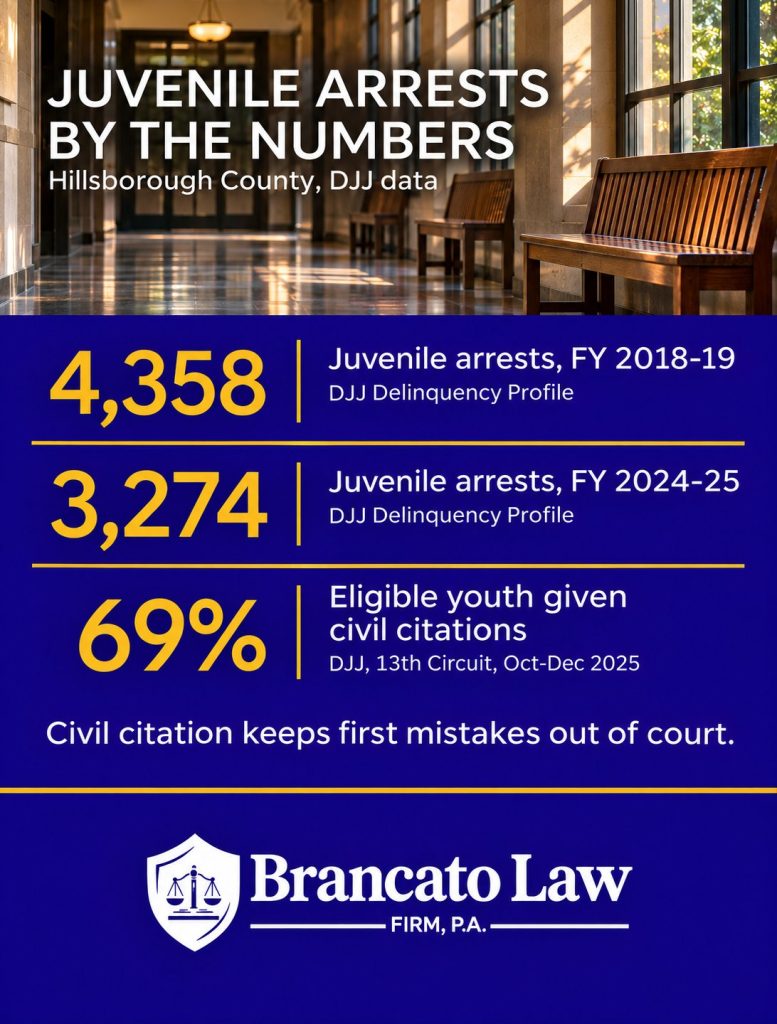
That presumption matters, but it is not universal in practice. DJJ’s prearrest delinquency citation reports show that from October through December 2025, law enforcement in the 13th Circuit issued civil citations to 151 of 218 eligible first-time misdemeanor youth, a 69% utilization rate, against 66% statewide. The Tampa Police Department cited 80% of eligible youth and the Sheriff’s Office 60%. Roughly one eligible child in three was still arrested, so an arrest for a first misdemeanor should come with a documented reason.
What does the officer do at the scene?
Tampa Police policy spells out the steps, and they show how much of JAAP happens before a family ever hears the word “program”:
- Check eligibility. The officer verifies that the child is a first-time offender through the Department of Juvenile Justice database or by calling the Juvenile Assessment Center.
- Consider the child’s age. For a child under 12, the officer must consult a shift or bureau commander about diversion options before any arrest.
- Write the citation. The officer completes the electronic charging affidavit marked “JAAP” and an offense report titled as a juvenile civil citation.
- Reach the parent. The officer makes a reasonable attempt to contact a parent or guardian, gives the family the JAAP flyer, and documents every attempt in the report.
- Handle family violence differently. In a sibling or household case, the officer contacts an approved shelter and the CINS/FINS program and needs a parent’s consent for any shelter placement.
If the officer decides to arrest instead, the report must name the extraordinary circumstance and the commander who approved it.
Does a parent have to agree to JAAP?
No. A parent’s consent is not required for a child to enter JAAP. The officer still tries to reach the parent, and the parent is expected to bring the child to the intake meeting, but a parent cannot block the citation.
That rule exists for a reason. As former chair of the 13th Judicial Circuit Juvenile Justice Board, I saw parents turn down civil citations for their children. Many of those parents had been through the juvenile justice system themselves, at a time when nothing like JAAP existed, and they did not trust a program that promised their child would walk away without an arrest record. Removing the consent requirement keeps a parent’s skepticism from costing a child a clean record.
What does a child have to do to complete JAAP?
The child completes the sanctions the Juvenile Diversion Program sets after an intake interview. Florida law lets the program require community service hours, restitution, classes, and services based on a needs assessment, such as family counseling, drug testing, and substance abuse or mental health treatment.
The Sheriff’s Office lists the kinds of sanctions JAAP uses: community service, restitution, an apology letter, specialized classes, counseling, an essay, serving on a Teen Court jury, no-contact orders, and treatment. The program is customized to the child, so two children with the same charge can have different requirements.
The first deadline is short. The 13th Circuit’s flyer tells families to call the Juvenile Diversion Program at (813) 272-6766 within two business days to register and schedule the intake meeting. For drug offenses, the meeting itself must happen within three business days of the offense. The program is located at 700 E. Twiggs Street, Suite 810, in Tampa.
Does JAAP leave a juvenile record?
A child who completes JAAP has no arrest record for that incident. The case closes without a referral to the State Attorney’s Office, and the child receives a letter of completion.
There is still a record of participation. Section 985.12 requires each program to enter the child’s information in the Department of Juvenile Justice’s Prevention Web system within seven days of admission and to report the outcome at the end. The statute also says a civil citation notice “is not considered a referral to the department,” which is why a completed JAAP case does not count as a delinquency referral. Because the program’s records show the child already used diversion, JAAP is a one-time opportunity.
If a child was arrested instead, or a case did reach the delinquency system, our post on juvenile expungement in Florida explains how those records can be cleared.
What happens if a child does not finish JAAP?
The case goes to the State Attorney’s Office. Under section 985.12, the arresting officer decides whether there is good cause to arrest the child on the original misdemeanor and refer the case for prosecution, or to let the child keep going in the program. Tampa Police policy says the Juvenile Diversion Program notifies the Clerk and the State Attorney when a child fails to enter or complete the program, and the State Attorney may charge the child or decline to prosecute.
This is the point where a lawyer matters. If a JAAP case is referred for prosecution, the family should get counsel before speaking with anyone about the incident. The Brancato Law Firm represents children in Hillsborough County juvenile court and often works to keep a referred case out of formal prosecution through post-arrest diversion or pre-file advocacy.
Does civil citation actually work?
Yes. Civil citation is the gold standard for first-time juvenile misdemeanors, and in my years on the civil citation committee it was one of the most successful tools we had for reducing recidivism. The research supports it. A Campbell Collaboration systematic review by Petrosino, Turpin-Petrosino, and Guckenburg (2010) examined 29 controlled trials covering 7,304 juveniles over 35 years and found that formal processing did not reduce crime and “appears to increase delinquency.” In other words, pushing a first-time child through court tends to make reoffending more likely, not less.
The local numbers moved in the same direction. DJJ’s Delinquency Profile shows 4,358 juvenile arrests in Hillsborough County in fiscal year 2018-19 and 3,274 in fiscal year 2024-25, a 25% drop. Statewide, juvenile arrests fell from 54,834 to 42,317 over the same period.
What should parents do if their child gets a civil citation?
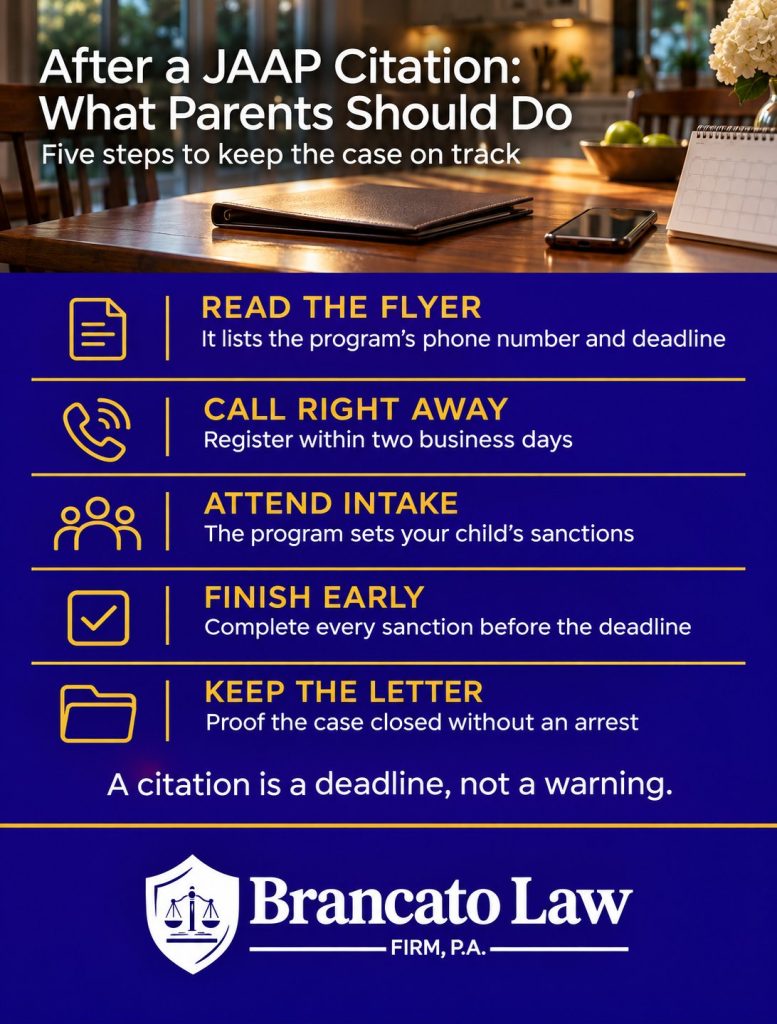
Treat the citation as a deadline, not a warning. These five steps keep a JAAP case on track:
- Read the flyer the officer gives you. It has the Juvenile Diversion Program’s phone number and the deadline to call.
- Call within two business days. Missing the intake window is one of the fastest ways to lose the program.
- Go to the intake meeting together. The program sets the child’s sanctions based on the interview.
- Finish every sanction early. Community service, classes, and restitution should be done well before the program’s deadline.
- Keep the completion letter. It is the family’s proof that the case closed without an arrest.
If the officer arrested your child instead, ask why. A first-time misdemeanor arrest in Hillsborough County should have a supervisor’s approval and a documented extraordinary circumstance. Our Hillsborough County criminal defense attorneys review those reports for families who call after an arrest.
Frequently asked questions about JAAP in Hillsborough County
What if the officer cannot reach a parent when a child is cited?
The citation can still be issued. The officer documents each attempt to reach a parent or guardian in the report, and the family still has to call the Juvenile Diversion Program to schedule intake. The Brancato Law Firm tells parents who learn about a citation late to call the program the same day, because the intake deadline is short.
Can my child get JAAP after being arrested?
JAAP itself is a pre-arrest program issued at the scene, so it is not available once a child has been arrested and referred. Florida law also allows post-arrest juvenile diversion under section 985.125, and our attorneys at The Brancato Law Firm ask the State Attorney’s Office for that kind of resolution when a child was arrested for a first offense.
Does a juvenile civil citation show up on a background check?
A completed JAAP case does not create an arrest record, and the statute says the citation notice is not a referral to the Department of Juvenile Justice. The Brancato Law Firm can explain what remains in juvenile justice databases and how that differs from a criminal history record.
Is shoplifting eligible for JAAP?
Petit theft is a misdemeanor, so a first-time petit theft is generally eligible for JAAP in Hillsborough County. If the store’s loss pushes the charge into felony grand theft, JAAP no longer applies, and our guide to theft charges in Florida explains the dollar thresholds.
Can a child get a civil citation for a fight at school?
Many school fights are charged as misdemeanor battery, which can qualify for JAAP if the child has no prior record. The Brancato Law Firm sees school-related cases turn on the details, including whether the alleged victim was a school employee, which can change both the charge level and the officer’s options.
What if my child already used JAAP once?
A child who has already been through diversion is no longer a first-time offender under JAAP’s rules. For a second incident, The Brancato Law Firm looks for other ways to resolve the case, including post-arrest diversion and defenses to the charge itself.
Talk to a Tampa juvenile defense lawyer
Most JAAP cases end without a lawyer, and that is how the program is meant to work. If your child was arrested instead of cited, or a JAAP case was referred to the State Attorney, call The Brancato Law Firm, P.A., founded by Tampa Criminal Defense Attorney Rocky Brancato, at (813) 727-7159 before anyone talks to the investigating officer. You can call us at any hour. Our firm has Spanish-speaking staff, and attorney Jean-Luc Adrien speaks Spanish, Haitian Creole, and French.
For more about how our attorneys handle cases in this county, visit our Hillsborough County defense page, and for how a case moves from arrest to resolution, see our Florida criminal case process guide. To compare every program side by side, see our Hillsborough County diversion programs guide. Adults have a similar program, the APAD adult civil citation.
The Brancato Law Firm, P.A.
620 E. Twiggs Street, Suite 205, Tampa, FL 33602
(813) 727-7159
Serving Hillsborough, Pinellas, and Pasco Counties
The Brancato Law Firm, P.A. is a Tampa-based criminal defense practice. We are not affiliated with any other Brancato-named law firms.
Visit Us

Tampa, FL 33602

Contact Us Now
Free Legal Consultation (813) 727-7159
