- Free Consultation 24/7: (813) 727-7159 Tap Here To Call Us


From First DUI to Death Penalty



What Is the RIDR Program in Hillsborough County? (2026)


Updated November 16, 2026
Short answer: RIDR (Reducing Impaired Driving Recidivism) is the Hillsborough County State Attorney’s Office program for first-time, non-aggravated misdemeanor DUI cases. A driver who qualifies completes DUI school, a victim impact panel, community service, and alcohol or drug monitoring, then pleads to reckless driving with a withhold of adjudication instead of being convicted of DUI. There is no dismissal, eligibility is at the prosecutor’s sole discretion, and the program does not stop the separate 10-day driver’s license deadline.
If this is your first DUI arrest in Hillsborough County, the question that matters most in the first week is whether you can avoid a DUI conviction at all. For many first-time drivers the answer runs through RIDR. I taught criminal procedure and courtroom testimony at the police academy, I am a member of the National College for DUI Defense, and as founder of The Brancato Law Firm, P.A., a Tampa criminal defense firm, I have spent more than 25 years in Hillsborough County courtrooms. Our attorneys screen every DUI case for RIDR at the first meeting, and we test the traffic stop, the roadside exercises, and the breath result before anyone recommends taking the deal.
How does the RIDR program work?
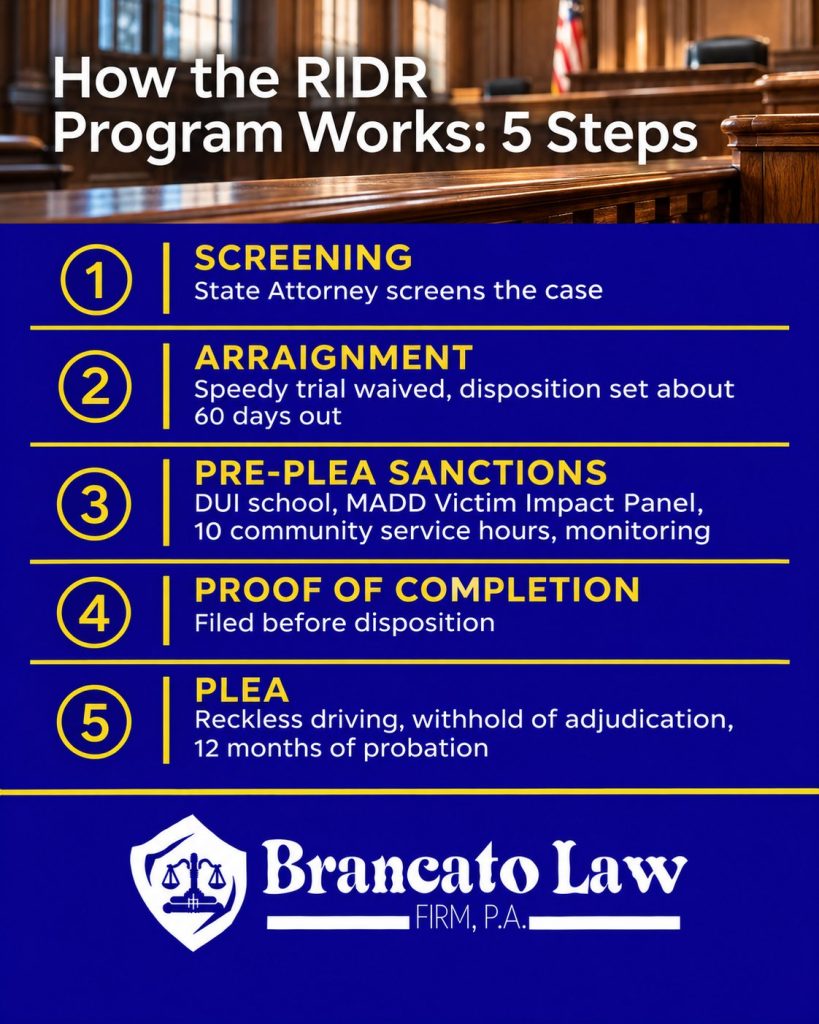
RIDR works in two stages: you complete a set of sanctions before you enter any plea, and then the State Attorney’s Office offers a plea to reckless driving under section 316.192, Florida Statutes, in place of the DUI charge under section 316.193. The office started RIDR for offenses committed on or after March 1, 2018, and its current RIDR guidelines lay out the steps. Our Tampa DUI lawyer team walks clients through them in this order:
- Screening. The prosecutor reviews the arrest report, the breath or drug result, and your record against the eligibility rules.
- Arraignment. The defense waives speedy trial, and the court sets the case for disposition about 60 days out.
- Pre-plea sanctions. You stay arrest-free, register for DUI school and begin any recommended treatment, attend the MADD Victim Impact Panel, complete 10 community service hours, and start the monitoring your level requires.
- Proof of completion. Before the disposition date, your attorney files proof that every pre-plea sanction is done.
- Plea and sentence. You plead to reckless driving and receive a withhold of adjudication and 12 months of probation, with credit for the sanctions you already finished.
Each of those steps sits inside the normal path of a county court case. Our guide to the Florida criminal case process shows where arraignment and disposition fall, and the same timeline applies to a RIDR case in Hillsborough County criminal court.
Who is eligible for RIDR in Hillsborough County?
RIDR is open to drivers charged with a first-time, misdemeanor DUI that had no crash, no minor in the vehicle, and no breath result of .20 or higher. The State Attorney’s guidelines then screen out several kinds of prior and pending cases. The office decides eligibility case by case and keeps sole discretion, including over factors that are not on its list.
| Rule | What disqualifies a driver |
|---|---|
| The current case | A felony DUI, a crash, a minor in the vehicle, or a BAC of .20 or higher |
| Prior traffic and DUI history | A prior DUI, alcohol-related reckless driving, certain driving while license suspended or leaving the scene offenses, vehicular homicide, or a prior DUI diversion |
| Prior diversion | More than one non-DUI diversion program as an adult |
| Prior felonies | An adjudication, withhold, or any part of a sentence on a felony in the five years before the offense |
| Pending matters | A pending Florida license suspension, DUI, certain suspended license or leaving the scene charges, vehicular homicide, Pre-Trial Intervention, or probation |
Two details trip people up. First, the five-year look-back in the guidelines is written into the felony rule; the prior DUI and prior DUI diversion rules carry no time limit, so a DUI from many years ago can still matter. Second, a “pending Florida license suspension” can include a suspension that has nothing to do with this arrest, such as an unpaid ticket. Our attorneys pull the full driving and criminal history before the first court date so a fixable problem does not cost a client the program.
Because RIDR is a diversion decision, a judge cannot force the State Attorney to offer it. In Cleveland v. State, 417 So. 2d 653 (Fla. 1982), a Broward County woman charged with welfare fraud met every statutory requirement for pretrial intervention, but the prosecutor refused to consent and the trial court ordered her into the program anyway. The Florida Supreme Court held that “the pretrial diversion decision of the state attorney is prosecutorial in nature and, thus, is not subject to judicial review.” The lesson for a RIDR case: the argument for admission is made to the prosecutor, with records and mitigation, not to the judge.
Discretion also works in the client’s favor. In one Hillsborough County case, our client was charged with DUI, leaving the scene, and refusal, and the crash made the client ineligible for RIDR on paper. Our attorneys built a mitigation report and treatment plan and presented it to the prosecutor, and the case was resolved the way RIDR cases are: a reduction to reckless driving with adjudication withheld. Each case is unique, and past results do not guarantee future outcomes. More outcomes are on our case results page.
What are the three RIDR levels?
RIDR sorts drivers into three levels based on the alcohol or drug evidence, and the level sets how much community service and monitoring the plea requires. Every level carries the same core plea: reckless driving, a withhold of adjudication, 12 months of probation with standard court costs, a 10-day vehicle immobilization, no alcohol or non-prescribed drugs during probation, and completion of DUI school and any recommended treatment.
| Level | Who it covers | Monitoring before the plea | Added plea conditions |
|---|---|---|---|
| Level 1 | Breath alcohol at or below .15 | Ignition interlock or continuous alcohol monitor (such as SCRAM) | 50 community service hours; 3 months of interlock or continuous alcohol monitoring |
| Level 2 | Breath alcohol above .15, or no breath sample | Ignition interlock or continuous alcohol monitor | 75 community service hours; 6 months of interlock or continuous alcohol monitoring |
| Level 3 | Drug-related DUI | No alcohol, illegal drugs, or non-prescribed drugs; PharmChek sweat patch with results sent to the State Attorney | 50 community service hours; 3 months of the PharmChek patch with results sent to HCSO Probation |
Level 2 deserves a closer look. The State Attorney’s original 2018 information sheet placed both breath results above .15 and refusals in Level 2. Florida law adds a limit: under section 316.656(2)(a), a judge may not accept a plea to a lesser offense from a driver whose breath or blood test showed .15 or more, and the office’s current guidelines describe Level 2 in terms of a case with no breath sample. The State Attorney’s Office keeps sole discretion over how those rules apply to a particular case, so a reading above .15 does not settle the question either way. If your breath result was above .15, talk with a DUI defense attorney about whether the reading itself can be challenged and how to present the case to the prosecutor.
Level 3 covers DUI cases built on drugs rather than alcohol, including marijuana and prescription medication cases. Our posts on marijuana DUI and prescription drug DUI explain the evidence those cases rely on.
Why does RIDR end in a reckless driving plea instead of a dismissal?
RIDR ends in a reckless driving plea because Florida law does not allow a withhold of adjudication on a DUI. Section 316.656(1) says no court may “suspend, defer, or withhold adjudication of guilt or imposition of sentence” for a violation of section 316.193. Reckless driving has no such bar, so the plea lets the judge withhold adjudication. That is the point of the program: the driver is not convicted of DUI.
The difference shows up in the statutes. A first DUI conviction carries a fine of $500 to $1,000 (or $1,000 to $2,000 with a BAC of .15 or higher or a minor in the vehicle), up to 6 months in jail, at least 50 hours of community service, a 10-day vehicle impoundment, and a mandatory conviction. A first reckless driving conviction under section 316.192 carries up to 90 days in jail and a fine of $25 to $500.
| Issue | First DUI conviction (s. 316.193) | RIDR reckless driving plea |
|---|---|---|
| Conviction | Adjudication mandatory under s. 316.656(1) | Withhold of adjudication |
| Maximum jail | 6 months | 90 days (statutory maximum; RIDR offer is probation) |
| Fine | $500 to $1,000; $1,000 to $2,000 at .15 or higher | $25 to $500 plus court costs |
| Community service | At least 50 hours | 10 hours before the plea, then 50 or 75 hours |
| Vehicle | 10-day impoundment or immobilization | 10-day immobilization |
| Monitoring | Interlock for at least 6 months at .15 or higher | 3 or 6 months of interlock, alcohol monitor, or drug patch |
| License points | DUI on the driving record | 4 points for reckless driving under s. 322.27 |
| Future RIDR eligibility | Ends it | Ends it (alcohol-related reckless driving disqualifies) |
A reckless driving plea is not a clean slate. It adds 4 points to your driving record under section 322.27, and the State Attorney’s own rules treat an alcohol-related reckless driving as a disqualifier, so RIDR is a one-time option. Our guide to reckless driving charges covers the charge itself.
Does RIDR stop the driver’s license suspension?
No. RIDR resolves the criminal case only; the administrative license suspension runs on its own track through the Florida Department of Highway Safety and Motor Vehicles. Under section 322.2615, a breath result of .08 or higher brings a 6-month suspension for a first offense, a first refusal brings a 1-year suspension, and the driver has 10 days from the notice of suspension to request a review or ask about a restricted license.
The two tracks affect each other. The State Attorney’s guidelines note that the ignition interlock option requires a valid license, so the license decision you make in the first 10 days shapes which monitoring device you can use for RIDR. Our attorneys make that decision with the RIDR plan in mind. Read how to protect your driver’s license after a DUI arrest for the options, and what a breath test refusal means in Florida if you declined the test.
Does the RIDR monitoring requirement reduce repeat DUIs?
The monitoring in RIDR targets a real problem. In 2023, Florida recorded 6,026 impaired driving crashes and 969 impaired driving fatalities, according to the Florida Department of Highway Safety and Motor Vehicles’ 2025 impaired driving education campaign report. The State Attorney’s guidelines say Hillsborough County has consistently ranked at or near the worst in Florida for DUI crashes, injuries, and fatalities.
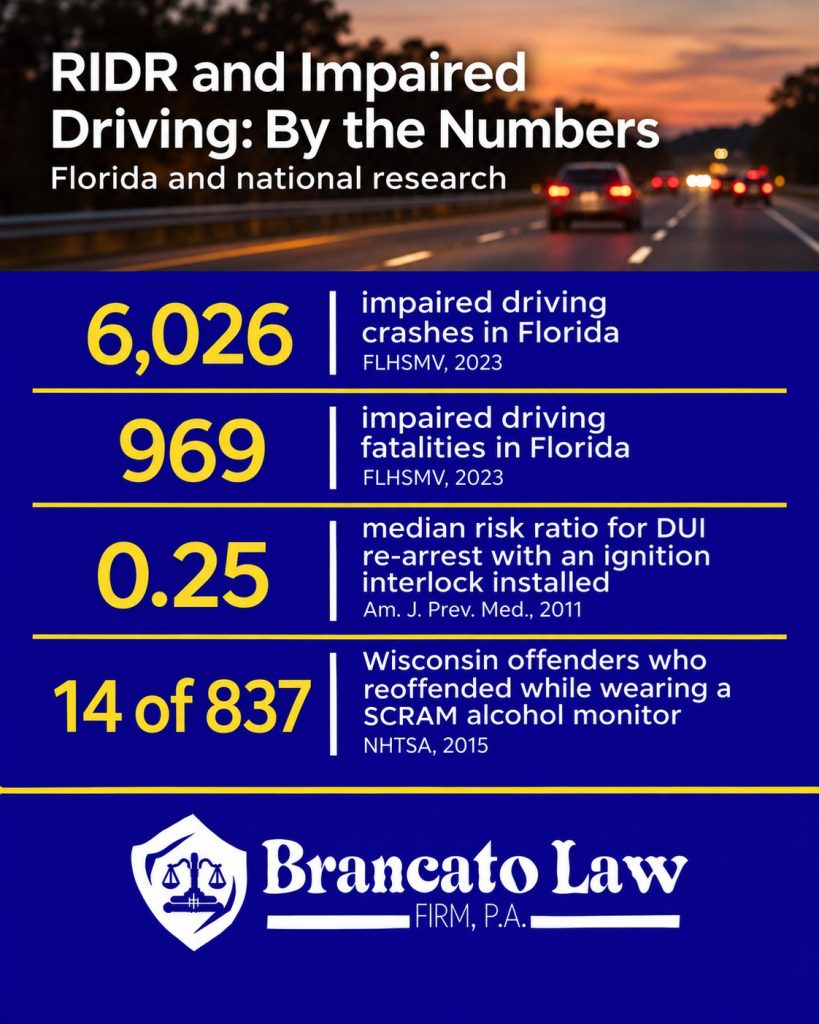
The research supports monitoring while the device is in place, and shows the effect fades afterward. A Community Guide systematic review by Elder and colleagues in the American Journal of Preventive Medicine (2011) found a median risk ratio of 0.25 for re-arrest while an ignition interlock was installed, about a 75 percent lower risk, but re-arrest rates moved back toward the comparison group once the device came off. A 2015 National Highway Traffic Safety Administration study of continuous alcohol monitoring, Comparative Study and Evaluation of SCRAM Use, Recidivism Rates, and Characteristics, found that 14 of 837 Wisconsin offenders (less than 2 percent) reoffended while wearing the device, while overall recidivism for SCRAM users was not lower than for the comparison group.
For a RIDR client, the practical point is simple: the monitoring period is a compliance test. A missed interlock sample or a SCRAM alert during the pre-plea phase is evidence the prosecutor will see. Our attorneys explain how each device works and what counts as a violation before the client installs it.
Should you take RIDR or fight the DUI?
Take RIDR only after the evidence has been reviewed, because a reckless driving plea is still a conviction for a criminal traffic offense and the program can be used once. Many DUI cases have problems that can lead to a dismissal or a better result: a stop without a lawful basis, roadside exercises scored by an officer who did not follow standardized training, or a breath instrument with maintenance gaps. Our post on how to fight a DUI charge in Hillsborough County walks through those defenses.
One of my first suppression motions was a failure-to-maintain-a-single-lane DUI stop. The officer wrote that my client also drove over a concrete curb. I went to the scene, photographed it, and there was no curb. The judge granted the motion on the officer’s credibility. A RIDR offer that arrives before anyone has looked at the scene, the video, and the breath records is an offer made before the defense knows what it has.
| Points toward RIDR | Points toward fighting the case |
|---|---|
| Clear video of impairment and a breath result at or below .15 | Stop based on a weak or contradicted traffic reason |
| Professional license or job that a DUI conviction would end | Breath instrument maintenance or operator problems |
| Client wants a fixed outcome within about 60 days | Refusal case with thin evidence of impairment |
| Prior record that would raise exposure at trial | Video that contradicts the arrest report |
What happens if you miss a RIDR requirement?
If the pre-plea sanctions are not finished and proven by the disposition date, the RIDR offer is not available and the case continues as a DUI. The State Attorney’s guidelines condition the plea on proof that every pre-plea sanction is complete, and they credit completed sanctions at sentencing only when there are no violations. After the plea, a missed condition becomes a violation of probation on the reckless driving charge, which exposes the driver to the statutory penalties for reckless driving.
How long does the RIDR program take?
Most RIDR cases move from arraignment to plea in about 60 days, followed by 12 months of probation. The license deadline comes first and is the shortest.
| When | What happens |
|---|---|
| Within 10 days of the arrest | Request a license review or apply for a restricted license under s. 322.2615 |
| Arraignment | Speedy trial waived; disposition set about 60 days out |
| Before disposition | DUI school registration, victim impact panel, 10 community service hours, monitoring installed |
| Disposition | Plea to reckless driving with a withhold of adjudication |
| Next 12 months | Probation, 50 or 75 community service hours, 3 or 6 months of monitoring, 10-day immobilization |
The State Attorney’s office runs a similar structure for drug possession cases. Our post on the DETRR program in Hillsborough County explains that one, and our broader guide to what happens after a DUI arrest in Hillsborough County covers the full case from booking to sentencing.
Frequently asked questions about RIDR
Can I get RIDR if I refused the breath test?
Yes, a breath test refusal does not by itself disqualify a driver; the State Attorney’s guidelines place cases with no breath sample in Level 2, with 75 community service hours and 6 months of monitoring. At The Brancato Law Firm, we also review whether the refusal warnings were read correctly, because that affects both the license suspension and the criminal case.
Will a RIDR reckless driving plea show up on my record?
Yes, the arrest and the reckless driving case stay on your criminal history, and the reckless driving adds 4 points to your driving record. Our attorneys at The Brancato Law Firm explain what a withhold of adjudication on reckless driving means for jobs, insurance, and later sealing questions before a client accepts the plea.
Is RIDR available for a DUI arrest in Pinellas or Pasco County?
No, RIDR is a program of the Hillsborough County State Attorney’s Office and applies only to cases prosecuted in Hillsborough County. The Brancato Law Firm handles DUI cases in Pinellas and Pasco Counties too, and we review the options each office offers; see our DUI defense page.
Can a judge put me in RIDR if the prosecutor says no?
No, the decision to offer diversion belongs to the State Attorney, and Cleveland v. State holds that it is not subject to judicial review. That is why The Brancato Law Firm builds the case for admission with records, treatment, and mitigation and presents it to the prosecutor directly.
Does a RIDR reckless driving count as a prior DUI later?
A RIDR plea is not a DUI conviction under section 316.193, but the State Attorney’s guidelines list an alcohol-related reckless driving as a disqualifier, so it bars a second RIDR. Our team at The Brancato Law Firm treats RIDR as a one-time option and weighs it against the defenses in the current case; read DUI penalties in Hillsborough County for the exposure on a later charge.
Is RIDR available for a marijuana or prescription drug DUI?
Yes, drug-related DUI cases fall under Level 3, which requires abstinence and a PharmChek sweat patch instead of an interlock. The Brancato Law Firm reviews the drug evidence first, because drug DUI cases often rest on an officer’s opinion rather than a measured level.
Talk to a Hillsborough County DUI defense attorney about RIDR
The 10-day license deadline runs whether or not you qualify for RIDR, and the pre-plea work has to be finished before a disposition date about 60 days after arraignment. Call The Brancato Law Firm, P.A., founded by Tampa Criminal Defense Attorney Rocky Brancato, at (813) 727-7159. Our attorneys will check your eligibility, protect your license, and tell you whether the evidence supports fighting the DUI before you decide. You can call us at any hour, and our office is two blocks from the courthouse. Our firm has Spanish-speaking staff, and attorney Jean-Luc Adrien speaks Spanish, Haitian Creole, and French; read about our Spanish and Haitian Creole criminal defense services.
For more about our defense strategies, visit our Tampa DUI defense attorney page.
The Brancato Law Firm, P.A.
620 E. Twiggs Street, Suite 205, Tampa, FL 33602
(813) 727-7159
Serving Hillsborough, Pinellas, and Pasco Counties
The Brancato Law Firm, P.A. is a Tampa-based criminal defense practice. We are not affiliated with any other Brancato-named law firms.
Visit Us

Tampa, FL 33602

Contact Us Now
Free Legal Consultation (813) 727-7159
