- Free Consultation 24/7: (813) 727-7159 Tap Here To Call Us


From First DUI to Death Penalty



What Is APAD? Adult Pre-Arrest Diversion in Hillsborough County (2026)


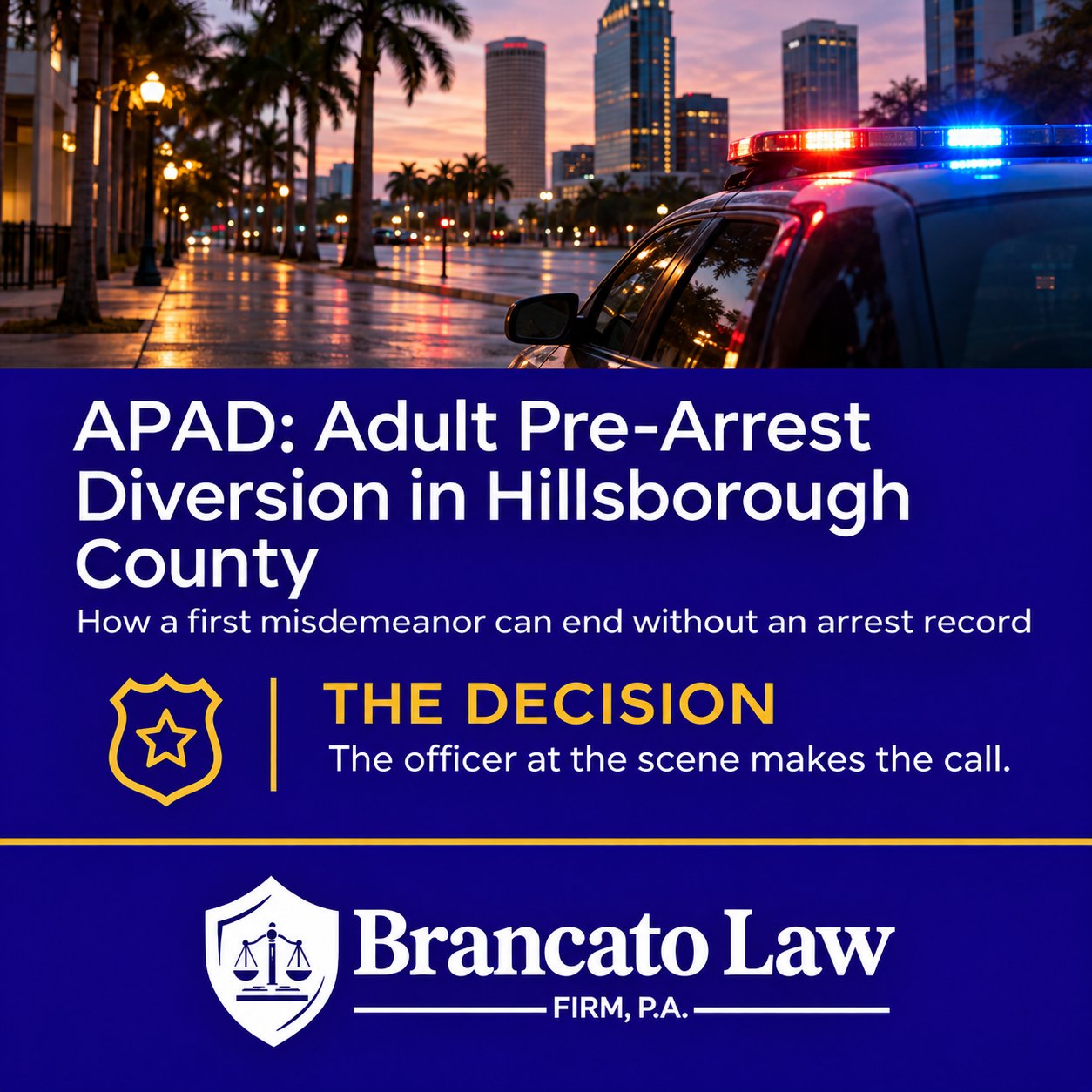
| Short answer: APAD, Hillsborough County’s Adult Pre-Arrest Diversion program, lets a law enforcement officer issue an adult civil citation instead of making an arrest for certain nonviolent misdemeanors. The adult must have no prior record, must not contest the offense, and must complete the program’s requirements, such as community service, classes, and restitution. If the adult finishes, no arrest record is created. The decision belongs to the officer at the scene, and domestic violence, DUI, and other excluded offenses do not qualify. |
Most of what decides an adult’s first misdemeanor case in Hillsborough County happens before anyone sees a judge. I learned that over more than 25 years in Hillsborough County courtrooms, including as former Chief Operations Officer of the Hillsborough County Public Defender’s Office, where I oversaw a staff of over 100 attorneys. As founder of The Brancato Law Firm, P.A., I have seen how a single arrest record follows people into job applications and background checks, and APAD exists to keep that record from being created. Our Tampa criminal defense firm publishes this guide as a public service: APAD is decided by the officer at the scene, and a lawyer is usually not part of it.
What is APAD in Hillsborough County?
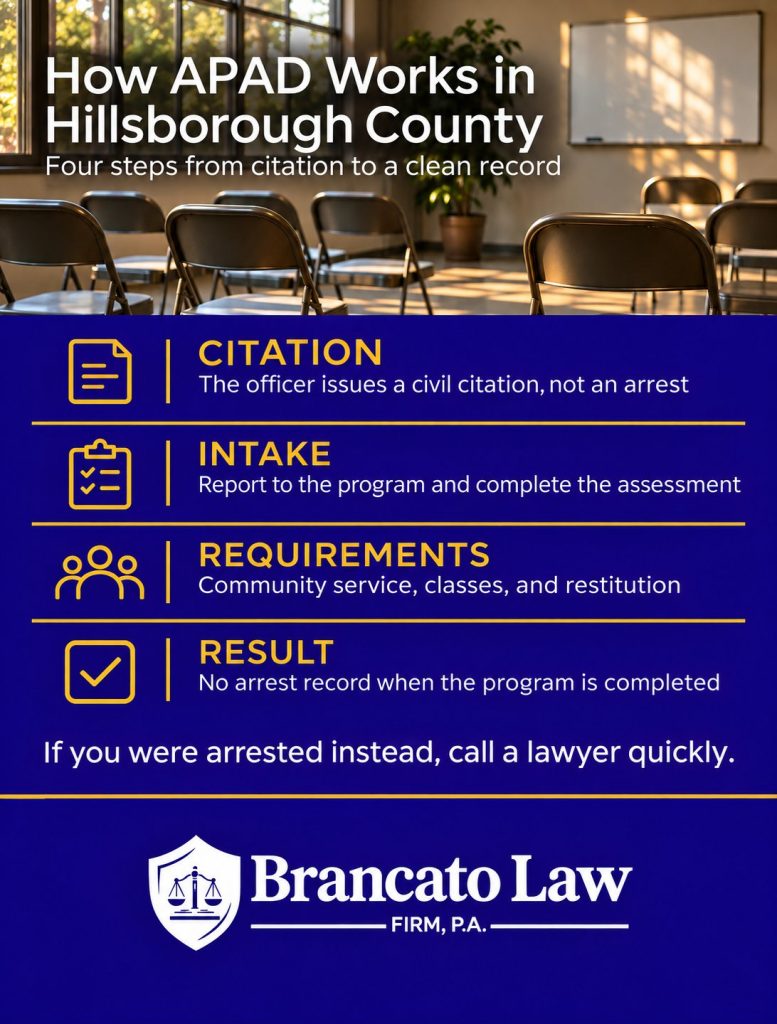
APAD is an adult civil citation program. Instead of arresting and booking someone for a qualifying misdemeanor, the officer issues a civil citation that sends the person to a diversion program. If the person completes the program, the case ends without an arrest. For the programs that apply after an arrest, see our guide to Hillsborough County diversion programs.
The Hillsborough State Attorney’s Office describes APAD as a program established in July 2017 for people with “minimal or no criminal history” who commit an eligible misdemeanor. Participants accept responsibility, complete sanctions such as drug treatment or anger management, pay restitution and costs, and avoid new offenses. If they do, no charges are filed. If they do not, the case goes to the State Attorney’s Office for prosecution. APAD is one of several Hillsborough diversion options, which we compare in our guide to pretrial intervention and diversion in Hillsborough County.
What Florida law controls adult civil citations?
Adult pre-arrest diversion is governed by section 901.41, Florida Statutes. The Legislature encourages, but does not require, local programs that let “certain adults” who complete intervention and community service “avoid an arrest record.”
Under the statute’s model program, an officer may issue a civil citation “at their sole discretion” to an adult who:
- Commits a qualifying misdemeanor designated by the local program
- Admits the offense or does not contest it
- Has not previously been arrested and has not received an adult civil citation, unless the local program allows otherwise
The participant must report for intake, receive assessment, intervention, education, and behavioral health services as needed, perform community service, and pay any restitution owed to the victim. Each local program must set a limit on how many times an adult can participate.
Which offenses qualify for APAD?
Qualifying offenses are set locally, but state law excludes some categories everywhere. Section 901.41(5) bars civil citations for violent misdemeanors, misdemeanor domestic violence, and misdemeanors involving injunction violations, stalking, and related offenses.
When Hillsborough’s program launched in early 2018, local reporting described it as covering certain nonviolent misdemeanors for people with no prior record, with exceptions including DUI, domestic battery, stalking or cyberstalking, injunction violations, and traffic offenses.
| Offense type | APAD eligible? | Options if arrested instead |
|---|---|---|
| Petit theft, first offense | May qualify under local policy | Misdemeanor Intervention Program (MIP) |
| Marijuana or drug paraphernalia | May qualify under local policy | DETRR |
| Trespass, disorderly conduct, criminal mischief | May qualify under local policy | MIP |
| Domestic violence battery | Not eligible by statute | DVIP |
| Violent misdemeanor | Not eligible by statute | Prosecution or pretrial intervention |
| Injunction violation or stalking | Not eligible by statute | Prosecution |
| DUI | Excluded when the program launched | RIDR |
| Criminal traffic offenses | Excluded when the program launched | Traffic diversion |
The officer and the local program decide eligibility case by case. A charge that “may qualify” can still end in an arrest.
What does APAD require?
APAD requires the adult to complete the program’s conditions within a set time. When Hillsborough’s program launched, local reporting described the requirements as 16 hours of community service and online education courses, among other measures, to be completed within 120 days. The State Attorney’s Office lists sanctions such as drug treatment or anger management, plus restitution and costs.
The exact requirements come with the citation and the intake paperwork. Requirements and fees can change, so the paperwork the person receives controls. Under section 901.41, the program also provides assessment and any needed intervention, education, or behavioral health services.
What happens if you don’t finish APAD?
The case can turn into an arrest and a prosecution. Under section 901.41, if the adult does not complete the program, the officer decides whether there is good cause to arrest on the original misdemeanor and, if so, refers the case to the State Attorney to decide whether to prosecute. If there is no good cause, the officer can let the person continue in the program.
At that stage, the person faces a possible misdemeanor charge and should talk to a lawyer before speaking with the officer. Our attorneys often work to resolve a referred case through the State Attorney’s Misdemeanor Intervention Program or through pre-file advocacy before a formal charge is filed.
Does APAD keep my record clean?
Completing APAD means no arrest record for that incident. That is the program’s purpose: section 901.41 describes giving adults “the opportunity to avoid an arrest record.”
That matters because an arrest record is public in Florida even when the charge is later dropped, and employers and landlords can find it. If you were arrested instead of cited, a dismissal can lead to sealing or expunction, but avoiding the arrest is better.
Does diversion work for adults?
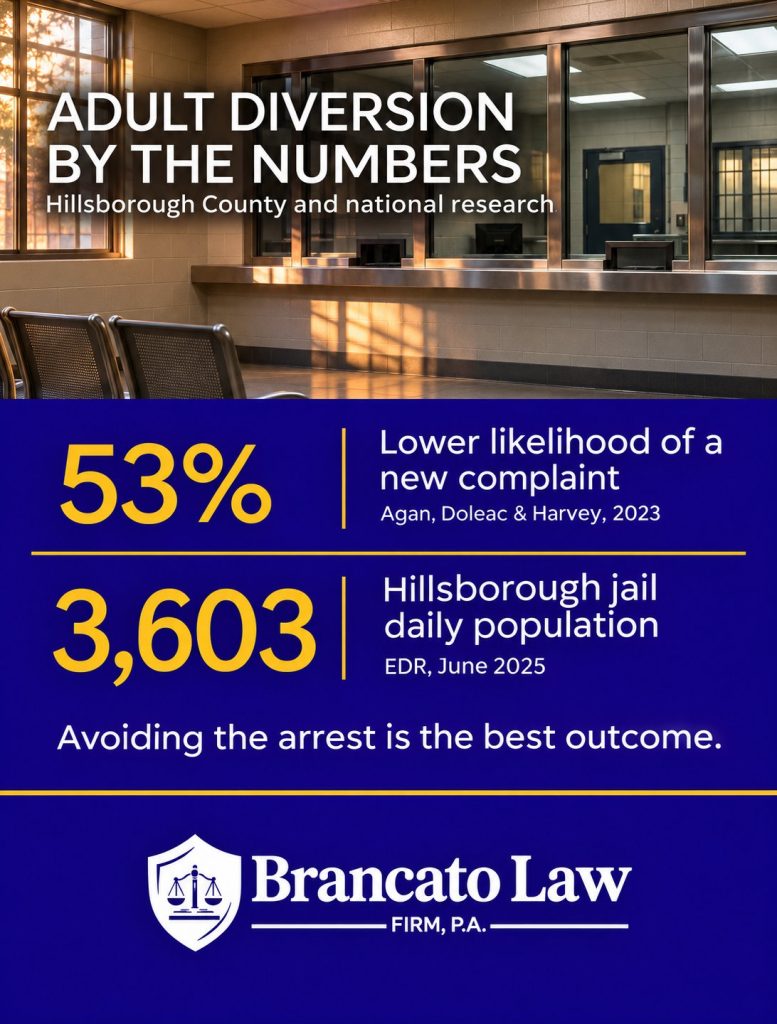
Research says not prosecuting low-level cases reduces future crime. A study published in the Quarterly Journal of Economics in 2023 found that not prosecuting a nonviolent misdemeanor led to a 53% reduction in the likelihood of a new criminal complaint over two years, with the largest effects for people with no prior record. The authors pointed to avoiding a criminal record as a key reason.
Avoiding arrest also keeps people out of jail. Hillsborough County’s jail held an average daily population of 3,603 people in June 2025, according to the Florida Legislature’s Office of Economic and Demographic Research. Every civil citation is one booking the jail does not process.
Can a lawyer get me into APAD?
Usually not. APAD is an officer’s decision made at the scene, before any lawyer is involved, and the statute gives the officer sole discretion. Once you are arrested, APAD is generally off the table.
What a lawyer can do is pursue the next-best options. For a first-time misdemeanor arrest in Hillsborough County, our attorneys ask the State Attorney’s Office for diversion through the Misdemeanor Intervention Program, DETRR for drug possession, or other programs, and press for a decision before charges are filed. Our Hillsborough County criminal defense attorneys make those requests for clients after a first arrest.
Frequently asked questions about APAD in Hillsborough County
Can I ask the officer for a civil citation instead of an arrest?
You can ask politely, but the decision is the officer’s, and section 901.41 gives officers “sole discretion.” The Brancato Law Firm advises staying calm, not arguing, and not discussing the facts beyond identifying yourself, because statements made at the scene can be used later.
Do I have to admit guilt to get APAD?
Under section 901.41, the adult must admit the offense or not contest it. The Brancato Law Firm reminds people that this is not a court plea, and that a case referred back for prosecution after failing APAD is still defended on its merits.
Can I do APAD more than once?
Each local program must set a limit on how many times an adult can participate, and the statute’s default is for people who have never received an adult civil citation. Our attorneys at The Brancato Law Firm treat a prior civil citation as part of the record when we negotiate a second case.
Is APAD available for DUI in Hillsborough County?
No. DUI was excluded when Hillsborough’s program launched, and first-time DUI cases are handled through the State Attorney’s RIDR initiative instead. The Brancato Law Firm explains that program in our RIDR guide.
What if I was arrested for something that should have been APAD-eligible?
Officers have discretion, so an arrest is not itself unlawful. The Brancato Law Firm uses the fact that a case was a first-time, low-level misdemeanor to argue for diversion through the State Attorney’s Office, often before the charge is filed.
Does APAD apply in Pinellas or Pasco County?
APAD is Hillsborough’s program. Other counties set their own adult diversion rules under section 901.41, and our attorneys at The Brancato Law Firm handle cases in Hillsborough, Pinellas, and Pasco Counties.
Talk to a Hillsborough County defense lawyer
If you were arrested instead of cited, or an APAD case was sent back for prosecution, the window to resolve it before formal charges is short. Call The Brancato Law Firm, P.A., founded by Tampa Criminal Defense Attorney Rocky Brancato, at (813) 727-7159. You can call us at any hour. Our firm has Spanish-speaking staff, and attorney Jean-Luc Adrien speaks Spanish, Haitian Creole, and French.
For more about how a case moves from arrest to resolution, see our Florida criminal case process guide, and for juvenile cases, see our guide to JAAP juvenile civil citations. To compare every program side by side, see our Hillsborough County diversion programs guide.
The Brancato Law Firm, P.A.
620 E. Twiggs Street, Suite 205, Tampa, FL 33602
(813) 727-7159
Serving Hillsborough, Pinellas, and Pasco Counties
The Brancato Law Firm, P.A. is a Tampa-based criminal defense practice. We are not affiliated with any other Brancato-named law firms.
Visit Us

Tampa, FL 33602

Contact Us Now
Free Legal Consultation (813) 727-7159
