- Free Consultation 24/7: (813) 727-7159 Tap Here To Call Us


From First DUI to Death Penalty



What Is DLAP Traffic Diversion in Hillsborough? (2026)


Updated November 16, 2026
Short answer: Traffic diversion in Hillsborough County, long known as DLAP (the Drive Legal Again Program), is a State Attorney’s Office program for certain criminal licensing and registration charges, such as driving while license suspended with knowledge and driving without a valid license. A driver the prosecutor accepts completes the program’s conditions, and the State Attorney’s Office then drops the charge with a nolle prosequi, so there is no conviction. Admission is entirely at the prosecutor’s discretion, and the reason the license was suspended weighs heavily in that decision.
A Hillsborough prosecutor deciding whether to divert a suspended-license case starts with one question: why was the license suspended? I have watched that question decide cases for more than 25 years in Hillsborough County courtrooms, including as former Chief Operations Officer of the Hillsborough County Public Defender’s Office, where I oversaw a staff of over 100 attorneys. I’m Rocky Brancato, founder of The Brancato Law Firm, P.A., a Tampa criminal defense firm, and our attorneys handle these cases by pulling the client’s driving record, identifying the reason for every suspension, and asking the assigned prosecutor for a diversion referral before the arraignment date.
What is DLAP traffic diversion in Hillsborough County?
DLAP traffic diversion is a pretrial program of the State Attorney’s Office for the 13th Judicial Circuit that resolves certain criminal traffic charges without a conviction. For years, Tampa lawyers and court staff called it DLAP, short for the Drive Legal Again Program. The State Attorney’s Office now lists it on its programs page simply as Traffic Diversion, a program that “holds low-level offenders accountable while focusing on traffic safety.” The office says referral is at its discretion and is “reserved for specific criminal traffic charges related to licensing and registration.”
The State Attorney’s Office defines diversion in its data dictionary of legal terms as a suspension of formal criminal proceedings in which the defendant has the charges dismissed after completing certain conditions. The Florida Supreme Court described diversion the same way in Cleveland v. State, 417 So. 2d 653 (Fla. 1982). In that case, a defendant met every requirement for the state’s pretrial intervention program but was refused because the State Attorney would not consent, and the court held that the decision is prosecutorial and “not subject to judicial review.” The court called pretrial diversion “essentially a conditional decision not to prosecute.”
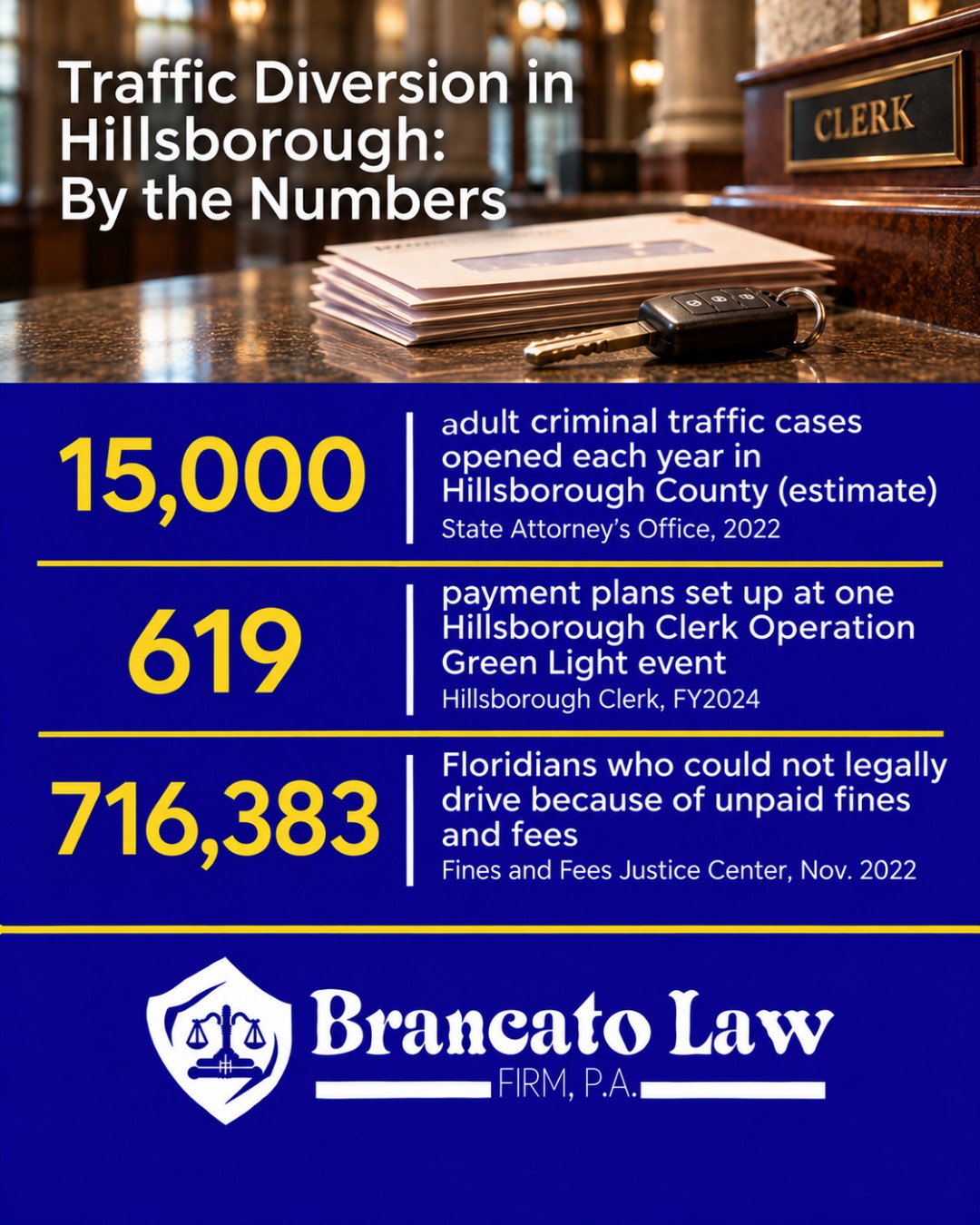
The program matters because the volume is large. In 2022, then-State Attorney Andrew Warren estimated that Hillsborough opens roughly 15,000 adult criminal traffic cases each year, according to a 2022 Tampa Bay Times report on the county’s efforts to divert driving offenses. Warren called the problem of criminal license charges built on unpaid debts “Exhibit A in criminalizing poverty.”
Which charges can go to traffic diversion in Hillsborough County?
Traffic diversion covers criminal charges about licensing and registration, and it does not cover charges about how someone drove. The State Attorney’s Office does not publish a list of eligible statutes, so the prosecutor decides charge by charge. These are the licensing and registration offenses most likely to be considered. For the full range of license and driving crimes our attorneys defend, see our Tampa criminal traffic lawyer page.
| Charge | Florida statute | Degree |
|---|---|---|
| Driving while license suspended or revoked, with knowledge (first conviction) | s. 322.34(2)(a) | Second-degree misdemeanor |
| Driving while license suspended or revoked, with knowledge (second or later conviction) | s. 322.34(2)(b) | First-degree misdemeanor; a third or later conviction carries a 10-day minimum jail term |
| Driving without a valid driver license | s. 322.03(1) | Second-degree misdemeanor (first); first-degree misdemeanor (second); first-degree misdemeanor with a 10-day minimum mandatory jail term (third or later) |
| Driving on a license expired more than 6 months | s. 322.03(6) | Violation of s. 322.03 |
| Driving with a registration expired more than 6 months (second or later offense) | s. 320.07(3)(c) | Second-degree misdemeanor |
Two related situations do not need diversion at all. Driving on a suspended license without knowing about the suspension is a moving violation, not a crime, under section 322.34(1), Florida Statutes. And under section 322.03(7), a driver charged with not having a valid license “may not be convicted” if he or she produces a license that was valid at the time of the arrest; the Clerk can dismiss that case for a $5 fee.
Charges about the driving itself, such as DUI, reckless driving, or leaving the scene of a crash, are outside this program. First-time DUI cases have their own Hillsborough program, RIDR, which ends in a reckless driving plea rather than a dismissal.
Who qualifies for traffic diversion, and does the reason for the suspension matter?
Eligibility is the prosecutor’s call, and the reason for the suspension is usually the deciding fact. Because Cleveland holds that a judge cannot override a State Attorney’s refusal to consent to diversion, the request has to persuade the assigned Assistant State Attorney.
The line prosecutors draw tracks the one the Legislature drew. Section 322.34(10) treats suspensions for financial and administrative reasons more leniently: failing to pay child support or other financial obligations, failing to comply with a civil penalty, failing to keep required insurance, and failing to meet attendance requirements for minors. For a driver with no prior forcible felony, those suspensions cannot produce more than a first-degree misdemeanor. A suspension tied to DUI, a breath or blood test refusal, a traffic offense causing death or serious bodily injury, or fleeing and eluding is different: a third conviction can become a third-degree felony under section 322.34(2)(c).
The 2022 Tampa Bay Times report captured the same distinction. Warren said officers needed to tell apart a first-time driver who lost a license over an unpaid speeding ticket and a driver whose license was taken after a DUI or another serious offense. Expect three facts to shape the referral decision:
- The reason for every suspension on the driving record, not just the current one.
- The driver’s prior record, including earlier suspended-license or no-license charges.
- Whether the driver has a realistic path to a valid license, such as a payment plan with the Clerk.
Drivers designated habitual traffic offenders face a separate and harsher scheme; see our post on habitual traffic offender defense in Tampa.
How does traffic diversion work, step by step?
Traffic diversion follows the same basic path as other Hillsborough diversion programs: referral, agreement, completion, and dismissal. The State Attorney’s Office sets the conditions, fees, and deadlines for each case, and those terms can change, so our attorneys confirm the current terms at the time of referral. This is how a typical case moves through the Florida criminal case process:
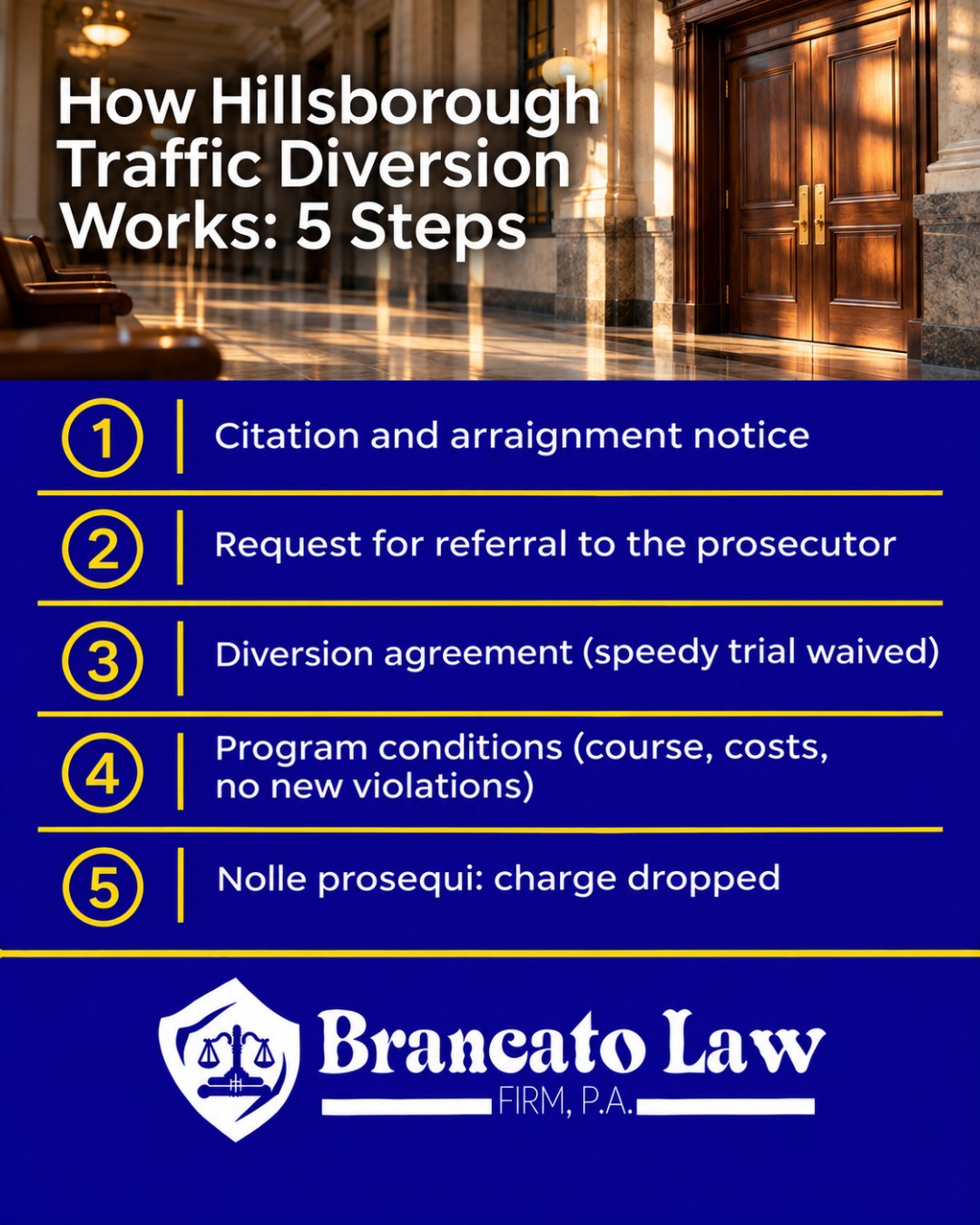
- Citation and arraignment notice. In a criminal traffic case, the citation itself is the charging document; the State Attorney’s Office treats the filing of a Uniform Traffic Citation as the filing decision. The Hillsborough Clerk mails the arraignment notice to the address on the citation, and the court appearance is mandatory.
- Request for referral. Before arraignment, the defense contacts the assigned prosecutor, provides the driving record, and explains the reason for the suspension and the plan to fix it.
- Diversion agreement. If the prosecutor agrees, the driver signs the program agreement. Expect to waive speedy trial, which lets the State hold the case open while the driver completes the program.
- Program conditions. Conditions typically include a driver-safety course, payment of program and prosecution costs, and no new law violations while the case is open.
- Dismissal. When the driver completes the conditions, the State Attorney’s Office files a nolle prosequi and the case ends without a plea or conviction. If the driver does not finish, the State can resume the prosecution, which Cleveland expressly recognizes.
What happens to my record after I complete traffic diversion?
A completed diversion ends with a nolle prosequi, and Florida law seals many of those records automatically. Under section 943.0595, Florida Statutes, FDLE “shall automatically seal” a criminal history record when the charging document was dismissed or nolle prossed as to all counts, unless the charge was a forcible felony or one of the listed sex offenses. The Clerk sends the disposition to FDLE, and “there is no limitation on the number of times a person may obtain an automatic sealing.”
Automatic sealing is separate from court-ordered expunction under section 943.0585, which requires a certificate of eligibility from FDLE and is generally available only to a person who has “never secured a prior sealing or expunction” under the listed statutes. Our attorneys check the FDLE record after a dismissal to confirm the sealing went through and advise whether a later expunction is worth pursuing.
Does traffic diversion get my driver’s license back?
No. Traffic diversion resolves the criminal charge, and the license stays suspended until the driver clears whatever caused the suspension, such as unpaid tickets, a missed court date, or an insurance lapse, and pays any reinstatement fees.
Most suspensions in Florida have nothing to do with dangerous driving. Joni Hirsch and Priya Sarathy Jones, writing in the Michigan Journal of Law Reform in 2021, reported that fewer than 3% of Florida suspension notices are for dangerous driving or other public safety concerns, and cited studies finding that 75% of people keep driving after a suspension. The Fines and Fees Justice Center’s 2023 report on Florida license suspensions found that as of November 2022, 716,383 Floridians could not legally drive because of unpaid fines and fees.
In Hillsborough County, the Clerk of Court runs Operation Green Light events to help drivers clear suspensions. According to the Clerk’s annual report for fiscal year 2024 (October 2023 through September 2024), the Clerk set up 619 payment plans and removed 605 cases from collections at its most recent event. A payment plan with the Clerk is also concrete proof, for the prosecutor, that the driver is on a path back to a valid license.
How does traffic diversion compare with pleading at arraignment?
Diversion avoids the conviction that a plea creates, and that difference compounds because suspended-license penalties climb with each conviction.
| Issue | Traffic diversion | Plea (guilty or no contest) |
|---|---|---|
| Plea entered | None | Yes |
| Outcome | Nolle prosequi (charge dropped) | Finding of guilt, with or without adjudication |
| Next suspended-license charge | No conviction from this case to count | A conviction makes the next charge a first-degree misdemeanor under s. 322.34(2)(b) |
| Costs | Program and prosecution costs set by the State Attorney’s Office | Fines, court costs, and State Attorney costs of no less than $50 per case under s. 938.27(8) |
| Record | Eligible for automatic sealing under s. 943.0595 | Stays on the record unless the person later qualifies for sealing |
| Driver’s license | Suspension remains until cleared | Suspension remains until cleared |
For a deeper look at the underlying charges, the knowledge element, and defenses, see our guide to driving while license suspended in Florida and our post on driving without a license in Florida.
What should I do right after a suspended-license citation in Hillsborough County?
Act before the arraignment date. These steps protect your chance at diversion:
- Stop driving until the license is valid. A new suspended-license charge while the first is pending gives the prosecutor a strong reason to refuse diversion and adds a second case.
- Check your license status with the Florida Department of Highway Safety and Motor Vehicles and get a copy of your driving record so you know every suspension and its reason.
- If you had a valid license when you were stopped, bring it to the Clerk; section 322.03(7) bars a conviction for a no-valid-license charge in that situation.
- Keep your mailing address current with the Clerk. The Clerk mails arraignment notices, and the Clerk’s criminal traffic page warns that missing court can lead to a license suspension, late fees, or an arrest warrant.
- Talk to a lawyer before arraignment so the referral request reaches the prosecutor before the first court date. Our Hillsborough County criminal defense attorneys work in the 13th Judicial Circuit’s traffic courtrooms and with the State Attorney’s diversion process every week.
Frequently asked questions about traffic diversion in Hillsborough County
Is DLAP the same as Hillsborough’s Adult Pre-Arrest Diversion program?
No. The Adult Pre-Arrest Diversion program, created in 2017, lets eligible first-time offenders avoid arrest for certain misdemeanors, and the 2022 Tampa Bay Times report noted that criminal driving offenses, including driving without a valid license, were excluded from it. The Brancato Law Firm handles traffic diversion as a request to the assigned prosecutor after the citation, using the driving record to show why the case belongs in the program.
Can a judge order the State Attorney to put me in traffic diversion?
No. In Cleveland v. State, the Florida Supreme Court held that the State Attorney’s pretrial diversion decision “is prosecutorial in nature and, thus, is not subject to judicial review.” That is why our attorneys at The Brancato Law Firm direct the diversion request, and the records behind it, to the assigned Assistant State Attorney rather than to the judge.
Can I get traffic diversion on a second suspended-license charge?
Possibly, but a prior charge weighs against referral, and a second conviction would be a first-degree misdemeanor under section 322.34(2)(b). The Brancato Law Firm builds second-charge requests around the reason for each suspension and proof that the driver is fixing the license; learn more from our criminal traffic defense attorneys in Tampa.
Can a suspended license charge be dropped in Florida without diversion?
Yes. The criminal offense requires proof that the driver knew of the suspension, and a no-valid-license charge cannot end in a conviction under section 322.03(7) if the driver produces a license valid on the date of arrest. Our attorneys at The Brancato Law Firm review the notice records and driving history for these defenses before asking for diversion; read more about how criminal charges get dropped in Florida.
Does traffic diversion work the same way in Pinellas or Pasco County?
Not necessarily. Traffic diversion as described here is a program of the State Attorney’s Office for the 13th Judicial Circuit in Hillsborough County, while Pinellas and Pasco Counties are in the 6th Judicial Circuit, which sets its own diversion policies. The Brancato Law Firm defends criminal traffic cases in all three counties, including through our Pinellas County criminal defense practice.
Do I need a lawyer for traffic diversion in Hillsborough County?
The law does not require one, but admission depends entirely on the prosecutor’s discretion, and the request is strongest when it arrives with the driving record and a reinstatement plan before arraignment. The Brancato Law Firm prepares that package for clients and handles the communication with the State Attorney’s Office from citation to dismissal through our Tampa traffic crime defense team.
For more about our defense strategies, visit our Criminal Traffic page. To compare every program side by side, see our Hillsborough County diversion programs guide.
Your arraignment date is the deadline that matters, because the request for traffic diversion should reach the prosecutor before it. Call The Brancato Law Firm, P.A., founded by Tampa Criminal Defense Attorney Rocky Brancato, at (813) 727-7159. You can call us at any hour, and our office is two blocks from the courthouse. Our firm has Spanish-speaking staff, and attorney Jean-Luc Adrien speaks Spanish, Haitian Creole, and French.
The Brancato Law Firm, P.A.
620 E. Twiggs Street, Suite 205, Tampa, FL 33602
(813) 727-7159
Serving Hillsborough, Pinellas, and Pasco Counties
The Brancato Law Firm, P.A. is a Tampa-based criminal defense practice. We are not affiliated with any other Brancato-named law firms.
Visit Us

Tampa, FL 33602

Contact Us Now
Free Legal Consultation (813) 727-7159
