- Free Consultation 24/7: (813) 727-7159 Tap Here To Call Us


From First DUI to Death Penalty



How Does Veterans Treatment Court Work in Hillsborough County? (2026)


| Short answer: Hillsborough County’s Veterans Treatment Court has two tracks. The pretrial diversion track (the VTC Misdemeanor Intervention Program and the VTC Felony Pretrial Intervention Program) ends in dismissal of the charges when the veteran finishes, while the post-adjudication track runs as a condition of probation. Since July 1, 2026, a judge, not the State Attorney, decides whether a veteran is eligible for the court. Whether the State can still keep an eligible veteran out of the diversion track is being argued in Hillsborough County right now, with a hearing set for December 4, 2026. |
On December 4, 2026, a Hillsborough County judge will hear argument on the question that decides whether a veteran’s case can end in a dismissal: who chooses between diversion and a probation track once a veteran is found eligible for Veterans Treatment Court. As founder of The Brancato Law Firm, P.A., a Tampa criminal defense firm, and former Chief Operations Officer of the Hillsborough County Public Defender’s Office, where I oversaw a staff of over 100 attorneys, I have watched this court grow from a misdemeanor docket into one of the most important options a veteran can have. Our attorneys follow these hearings closely so that the veterans we represent walk into Division V with the records and arguments the court is asking for today.
What is Veterans Treatment Court in Hillsborough County?
Veterans Treatment Court (VTC) is a specialized criminal court for veterans and servicemembers whose criminal case is tied to a service-related mental health condition, traumatic brain injury, substance use disorder, psychological problem, or military sexual trauma. In Hillsborough County it sits in Circuit Criminal Division V, which 13th Circuit Administrative Order S-2016-032 created as the single division that handles all eligible misdemeanor and felony veterans cases. Judge Michael J. Scionti, a veteran and Army Reserve JAG officer, has presided since January 2017, according to the 13th Judicial Circuit.
The court replaces the usual prosecution track with treatment, frequent judicial check-ins, random drug testing, supervision, and a mentor who is also a veteran. The VA’s Veterans Justice Outreach staff screen participants and connect them to treatment through the James A. Haley and Bay Pines VA systems or community providers. The Brancato Law Firm treats an eligible veteran’s case as two cases at once: the criminal charge, and the application to get into the right VTC track.
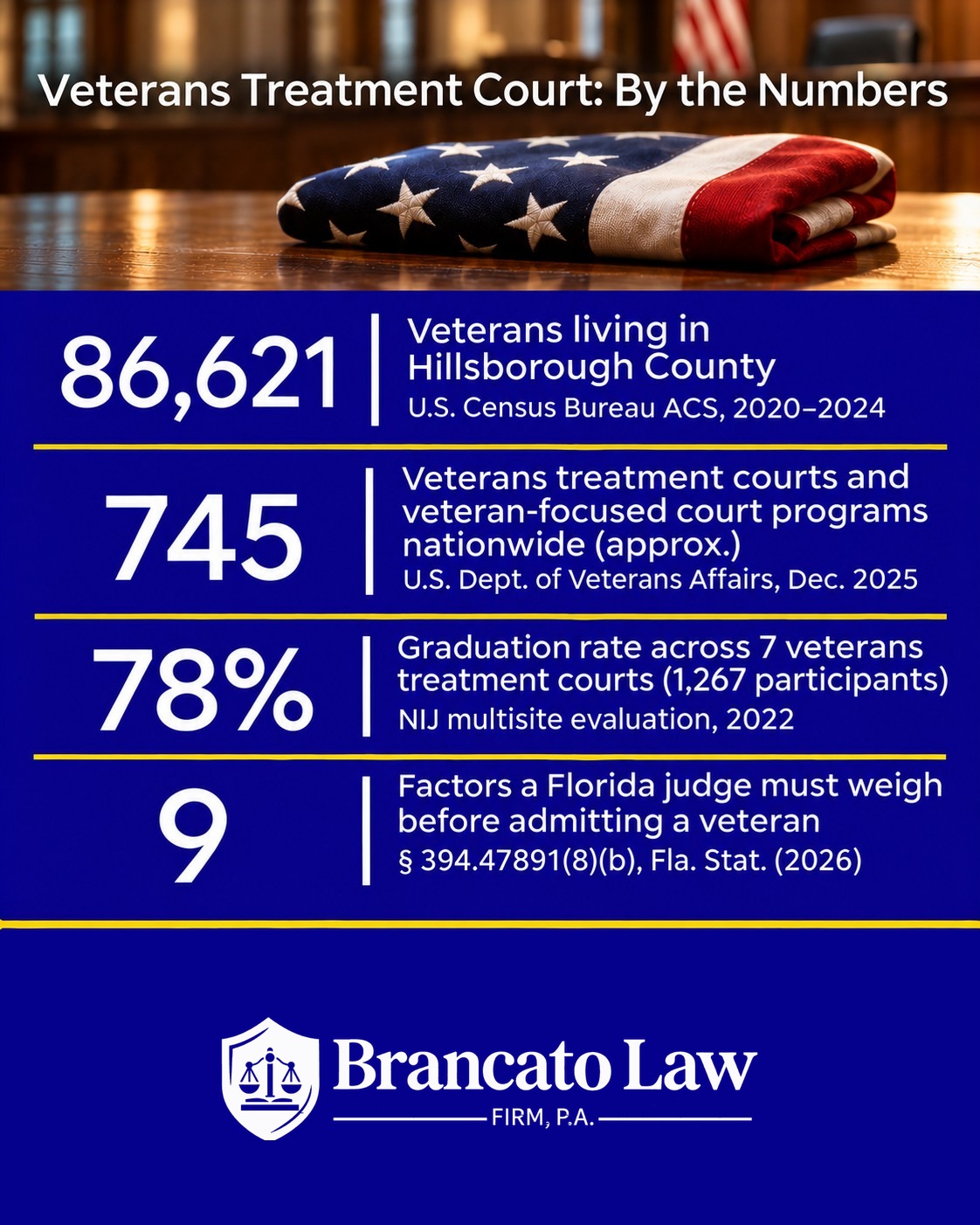
Hillsborough’s court held its first session in October 2013, added felonies in February 2015, and has served more than 200 participants with over 60 volunteer mentors, according to the 13th Judicial Circuit. It is part of a national movement: the U.S. Department of Veterans Affairs counted approximately 745 veterans treatment courts and other veteran-focused court programs nationwide as of December 2025, according to its Veterans Treatment Court inventory fact sheet. The need is local, too. Hillsborough County is home to 86,621 veterans, according to the U.S. Census Bureau’s American Community Survey (2020 to 2024).
What is the diversion program inside Veterans Treatment Court?
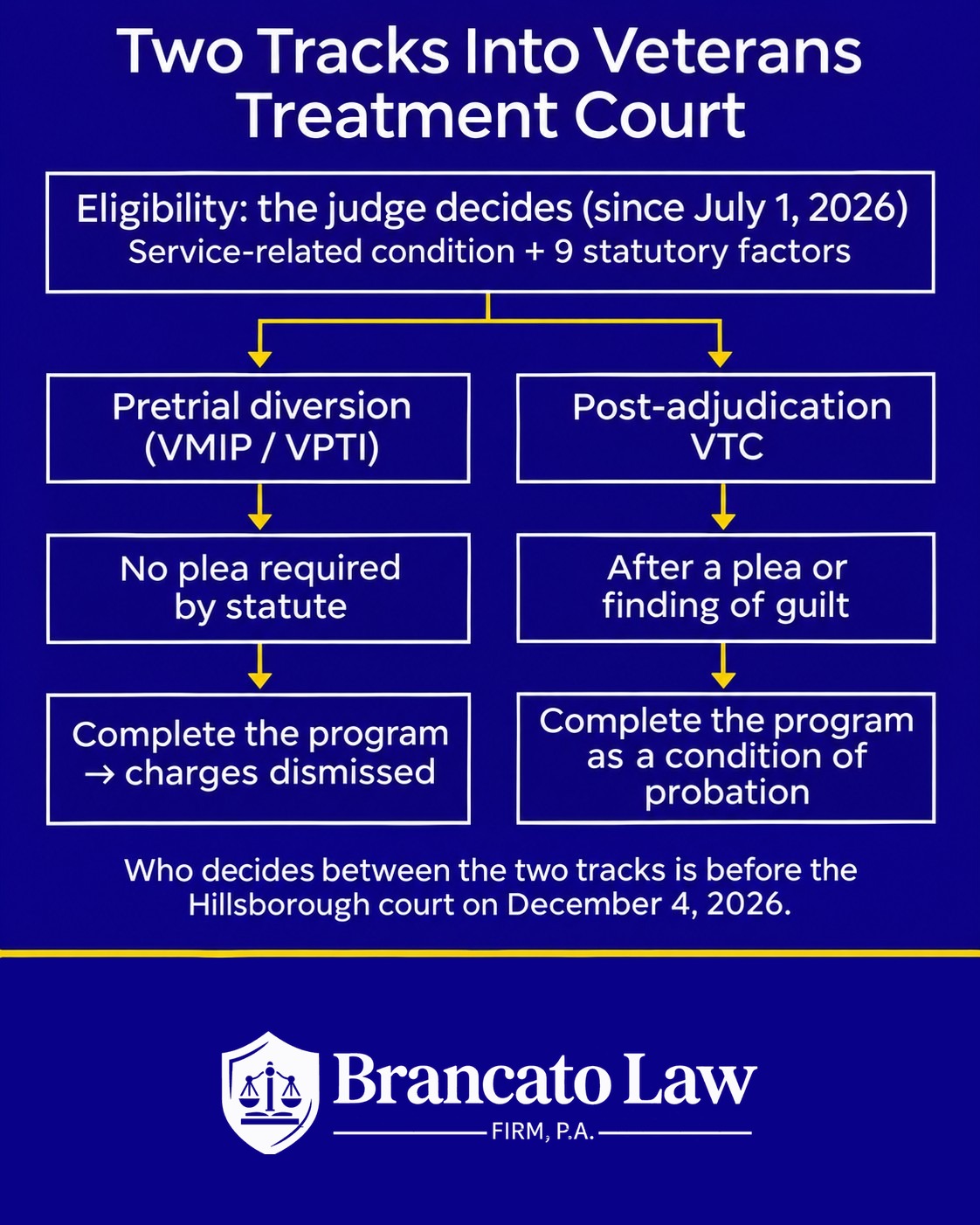
The diversion program inside VTC is the pretrial track, and it is the only track that ends in dismissal of the charges. Hillsborough runs two pretrial programs: the VTC Misdemeanor Intervention Program (VMIP) and the VTC Felony Pretrial Intervention Program (VPTI). A veteran in either program does not have a conviction while the case is pending, and at graduation the defense files an order of dismissal.
The misdemeanor version comes from section 948.16(2), Florida Statutes, and the felony version comes from section 948.08(7), Florida Statutes. Both statutes say the same thing about the finish line: at the end of the program the court considers the recommendations of the program administrator and the State Attorney, decides by written finding whether the veteran completed it, and “shall dismiss the charges” on a finding of successful completion. A veteran whose charges are dismissed may then, if otherwise eligible, petition to expunge the arrest under section 943.0585.
The post-adjudication track is different. It applies after a plea or a finding of guilt, runs as a condition of probation or community control, and can bring a reduced or terminated sentence, but the case does not disappear. A 2026 law, section 948.01(9), Florida Statutes, created a new route into this track for nonviolent felonies committed on or after July 1, 2026, and any violation of that probation is heard by the VTC judge.
| Pretrial diversion (VMIP / VPTI) | Post-adjudication VTC | |
|---|---|---|
| Statute | 948.16(2) (misdemeanors); 948.08(7) (felonies) | 948.01(9) (new for 2026 offenses); 948.06; 948.21 |
| Plea required? | No plea is required by statute | Follows a plea or finding of guilt |
| Eligible charges | Any misdemeanor; any felony not listed in 948.06(8)(c) | Nonviolent felonies (non-forcible felonies and third-degree burglary) |
| Supervision | HCSO (misdemeanors) or DOC (felonies) | Probation or community control |
| If completed | Court must dismiss the charges | Probation completed or terminated; conviction or withhold remains |
| If terminated | Case returns to the original division for prosecution | Violation of probation hearing before the VTC judge |
Who qualifies for Veterans Treatment Court in Florida?
A veteran or servicemember qualifies for Veterans Treatment Court when the judge, consulting the court’s multidisciplinary team, finds two things under section 394.47891(8), Florida Statutes: a service-related condition, and that participation is in the interest of justice and of benefit to the veteran and the community. The statute defines “veteran” simply as a person who has served in the military. “Servicemember” includes active and reserve members of every branch, Florida National Guard members, current or former Department of Defense contractors, and current or former members of an allied country’s military.
The qualifying conditions are a service-related mental health condition, service-related traumatic brain injury, service-related substance use disorder, service-related psychological problem, or experience of military sexual trauma. Discharge status is not a fixed bar. The statute gives the chief judge and the State Attorney of each circuit exclusive authority to decide whether dishonorably discharged veterans may take part. A veteran who does not qualify may still fit Florida’s mental health diversion law if the charge and record meet its terms.
The charge also matters for diversion. Any misdemeanor can go to the misdemeanor program. The felony program excludes the serious offenses listed in section 948.06(8)(c), including murder, manslaughter, sexual battery, robbery, aggravated battery, aggravated assault, first- and second-degree burglary, arson, kidnapping, and lewd offenses against children. Our post on the Captain Brock Horner boat-boarding case walks through how a burglary charge can block the felony diversion track unless it is reduced.
Once the threshold is met, the judge must weigh nine factors before admitting a veteran:
- The nature and circumstances of the offense charged.
- The circumstances of the veteran and any alleged victim, including the alleged victim’s recommendation.
- The veteran’s criminal history and any prior participation in a veterans court or similar program.
- Whether the veteran’s needs exceed the court’s treatment resources.
- The impact on the community of the veteran’s participation.
- Recommendations of the arresting agency and of the State Attorney.
- If restitution is owed, the likelihood it will be paid during the program.
- Any mitigating circumstances.
- Any other circumstances reasonably related to the case.
The statute also says it does not create a right to participate. That is why the application has to be built like a sentencing presentation, with records and mitigation that answer each factor. Our Tampa criminal mental health lawyer page explains how our attorneys connect a client’s diagnosis and history to the legal standard the court applies.
What changed in Veterans Treatment Court on July 1, 2026?
On July 1, 2026, the judge replaced the State Attorney as the gatekeeper for Veterans Treatment Court eligibility. CS/CS/HB 199, which passed the House 110-0 and the Senate 37-0 and became Chapter 2026-128, Laws of Florida, removed the requirement that a veteran apply to the State Attorney and receive the State Attorney’s approval. The court, in consultation with the multidisciplinary team, now decides eligibility, and the State Attorney’s recommendation is one of the nine factors the court must consider.
The change returns Florida to the way Hillsborough’s court worked before 2021, when the court decided admission and veterans charged with offenses like misdemeanor DUI could enter diversion. A 2021 amendment gave the State Attorney approval power, and the appellate cases show what each version meant in practice.
In Simeone v. State, 276 So. 3d 797 (Fla. 4th DCA 2019), a Palm Beach County veteran charged with patient brokering asked to be transferred to veterans court. The Fourth District held that a veteran who meets the statutory criteria is “eligible” for, but not entitled to, admission, and that the judge has discretion to decide. The court added that a judge who conditions admission on the State’s agreement abdicates that discretion.
In Maderi v. State, No. 2D21-957 (Fla. 2d DCA Apr. 13, 2022), two Pinellas County veterans charged with misdemeanor DUI met every requirement for the misdemeanor veterans diversion program, but the trial court accepted the State’s policy of keeping DUI defendants out of it. The Second District, whose decisions bind Hillsborough County courts, quashed that ruling. Under the version of the statute it applied, the court held that section 948.16(2)(a) has no DUI exception and that admission rests with the trial court, while the State remains free to object.
In State v. Mancuso, 355 So. 3d 942 (Fla. 4th DCA 2023), the Fourth District reached the opposite result under the 2021 version of the statute. A Broward County judge sent a DUI case to veterans court over the State’s objection, and the appellate court quashed the transfer because the statute then required the State Attorney’s approval. The 2026 law removed the language that Mancuso relied on.
| Period | Who decided VTC eligibility | Key case |
|---|---|---|
| Before 2021 | The court (State could object) | Simeone (2019); Maderi (2022) |
| 2021 to June 30, 2026 | The State Attorney, in consultation with the court | Mancuso (2023) |
| July 1, 2026 to now | The court, with the multidisciplinary team; State Attorney’s recommendation is a factor | First-impression hearings in Hillsborough Division V |
Why does the December 4, 2026 hearing in Hillsborough matter?
The December 4 hearing matters because it will decide whether an eligible veteran can be placed in the diversion track over the State’s objection, and diversion is the only track that ends in dismissal. Since July 1, the State Attorney’s Office has objected in several Hillsborough cases. Some objections attack eligibility itself. Others accept that the court decides eligibility but argue that the State still controls whether a case is diverted, and the State has asked the court to reconsider two DUI cases that were admitted into diversion.
The State’s position rests on separation of powers. It relies on Cleveland v. State, 417 So. 2d 653 (Fla. 1982), where the Florida Supreme Court held that a State Attorney’s refusal to consent to pretrial intervention is a prosecutorial decision courts cannot review, and on State v. Winton, 522 So. 2d 463 (Fla. 3d DCA 1988), which reversed a judge who placed a defendant in pretrial intervention without the State’s consent. The State argues that a judge may find a veteran eligible but cannot force the State to sign a diversion agreement, and that the new post-adjudication route in section 948.01(9) is the remedy when the State objects.
The defense answer starts with the statutes those cases interpreted. Cleveland and Winton applied a general pretrial intervention statute that expressly required the State Attorney’s consent. The veterans diversion statutes, sections 948.08(7) and 948.16(2), contain no consent requirement, tie admission to section 394.47891, and direct that the court “shall dismiss” the charges when the veteran completes the program. The Legislature also deleted the State Attorney approval language in 2026, and Maderi held that the State may object but cannot act as gatekeeper.
The court has already shown how it will approach eligibility. At an October 29, 2026 hearing, after testimony and argument on each statutory factor, the court found a service-related condition and admitted a veteran over the State’s objection. On the record, the State agreed that combat, deployment, VA eligibility, length of service, and time since service are not individually dispositive. Whether that veteran enters by diversion was reset for December 4 along with the other pending cases.
The December 4 hearing is set for 9:00 a.m. in Courtroom 52A, 401 N. Jefferson Street, Tampa, the Division V courtroom where Veterans Treatment Court sits. The ruling will shape every pending Hillsborough veterans case, and it may be the first step toward an appellate decision under the new statute. Our firm will update this post after the hearing. For how Veterans Treatment Court fits with the county’s other diversion programs, see our guide to Hillsborough County diversion programs and our post on pretrial intervention (PTI) in Hillsborough County.
Does a veteran have to be a combat veteran or have a VA disability rating?
No. Section 394.47891 does not require combat, deployment, a VA disability rating, VA health care eligibility, a minimum length of service, or recent service. It requires a service-related condition, and the court decides whether the evidence shows one. A VA service-connection finding is strong corroboration, but the percentage rating does not change the statutory test, and veterans who served in the reserves or never deployed have been found eligible.
Proof is where these applications are won or lost. Veterans without a VA finding can corroborate a service-related condition with other records, and The Brancato Law Firm starts gathering them at the first meeting:
- DD-214 and other service records, plus confirmation of service from the VA’s Veterans Justice Outreach liaison.
- Military medical records, Line of Duty determinations, and command investigations (such as Army AR 15-6 investigations).
- VA treatment records and any service-connected disability decision.
- Treatment records from jail medical staff and community providers that document the history of the condition.
- Sworn statements from the veteran, family members, and people who served with the veteran.
- Mitigation that answers each of the nine statutory factors, including criminal history context and a treatment plan.
Defense counsel is expected to bring this material to the court rather than wait for court staff to find it. A structured mitigation report is often the most efficient way to put the veteran’s service history, diagnosis, and treatment plan in front of the judge in one document.
What does Veterans Treatment Court require, and how long does it take?
Veterans Treatment Court requires treatment, frequent court appearances, random drug and alcohol testing, supervision, and work with a veteran mentor, and it typically lasts at least about nine months. Hillsborough’s VTC Policy and Procedures Manual sets five phases, from stabilization through transition to graduation, with minimum stays of 30, 60, 60, 60, and 60 days, and each phase also requires clean time. Advancement depends on progress, not the calendar.
The court uses incentives such as fewer court dates and reduced testing, and sanctions that range from extra community service and curfews to jail and termination. Any restitution must be paid before graduation. Graduates receive a certificate and a challenge coin, and in the diversion track the defense then moves to dismiss all charges.
Results depend on the court and the participant. A National Institute of Justice multisite evaluation (Baldwin and Hartley, 2022) of seven veterans treatment courts in Florida, North Carolina, and Texas found that 78% of 1,267 participants admitted from 2016 to 2019 graduated. Hillsborough’s own grant-funded evaluation (May 2020) reported that 40 of 89 participants (45%) had graduated, with 24 still active, and that graduates had fewer arrests and significant reductions in substance use and mental health symptoms; the authors noted the sample was small and called for larger studies.
What happens if a veteran does not finish Veterans Treatment Court?
A veteran who is terminated from the diversion track returns to the original criminal division, and the case is prosecuted as if diversion never happened. Any charge that was reduced to get into the program reverts to the original charge. Before an unsuccessful discharge, the veteran has the right to notice of the reason and a hearing with counsel. In the post-adjudication track, termination leads to a violation of probation hearing before the VTC judge and possible resentencing.
A veteran can also be discharged administratively, without penalty, when something outside the veteran’s control prevents completion, such as a medical emergency. Choosing to contest the criminal case in trial also ends participation.
What should a veteran do now if charged in Hillsborough County?
A veteran charged in Hillsborough County should raise Veterans Treatment Court as early as possible and start building the record before the eligibility hearing. Eligibility can be raised at any stage of the case, and the 13th Circuit’s administrative order allows eligible cases to be filed directly into the court even before the State Attorney files formal charges, which makes representation before charges are filed especially valuable. Each step of a felony case is laid out in our Florida criminal case process guide.
- Tell your lawyer about your military service at the first meeting, including reserve and Guard service and any service-related diagnosis.
- Request your DD-214, VA records, and military medical records now; some take weeks to arrive.
- Do not plead guilty to a charge that could be diverted without first asking whether diversion is available.
- Expect the State to raise your criminal history and the nature of the charge, and prepare mitigation that answers both.
- Watch for the December 4, 2026 ruling, which will shape whether eligible veterans can enter the diversion track over the State’s objection.
Our attorneys handle Veterans Treatment Court cases as part of our Hillsborough County criminal defense practice. For more about our defense strategies, visit our criminal mental health defense page. To compare every program side by side, see our Hillsborough County diversion programs guide.
Frequently asked questions
Can a veteran charged with DUI get into Veterans Treatment Court diversion in Hillsborough County?
Yes, a veteran charged with misdemeanor DUI is eligible to be considered for the misdemeanor diversion track, because section 948.16(2) has no DUI exception, and the Second District said so in Maderi. The Brancato Law Firm is watching closely because the State has asked the Hillsborough court to reconsider two DUI cases admitted into diversion, an issue set for December 4, 2026. Our guide to the RIDR program covers the State Attorney’s separate DUI diversion option.
Can the State Attorney block a veteran from Veterans Treatment Court after July 1, 2026?
The State Attorney can no longer block eligibility on its own, because the 2026 law gives that decision to the judge, but the State can object and its recommendation is one of nine factors the court must weigh. The attorneys at The Brancato Law Firm prepare for that objection by documenting each factor before the hearing. Whether the State can still keep an eligible veteran out of the diversion track is the open question the court will hear on December 4, 2026.
Does an other-than-honorable or general discharge disqualify a veteran from Veterans Treatment Court?
No, a general or other-than-honorable discharge does not automatically disqualify a veteran, because Florida defines a veteran as a person who served in the military. Only dishonorable discharges are treated differently: under section 394.47891, the chief judge and the State Attorney of the circuit decide whether those veterans may take part. The Brancato Law Firm reviews the discharge paperwork early so the eligibility argument fits the client’s actual record.
Do I have to plead guilty to get into Veterans Treatment Court in Florida?
No statute requires a guilty or no contest plea to enter the Veterans Treatment Court diversion track, and section 394.47891(4) allows admission at any stage of a criminal proceeding. Our attorneys at The Brancato Law Firm advise veterans not to enter a plea until diversion has been fully explored, because a plea usually moves the case into the post-adjudication track. Learn more on our Tampa mental health criminal defense page.
Can a veteran with a long criminal record get into Veterans Treatment Court?
Yes, criminal history is one of the nine factors the judge weighs under section 394.47891(8)(b), not an automatic bar. The Brancato Law Firm builds mitigation that ties a veteran’s record to the untreated service-related condition behind it, which is the connection the court is looking for. Prior participation in a veterans court program is also a factor, and in Hillsborough a prior court-ordered veterans program can affect diversion eligibility.
Can I get my record expunged after Veterans Treatment Court?
Yes, if the charges are dismissed after successful completion of the diversion track, the veteran may petition to expunge the arrest record under section 943.0585 if otherwise eligible. The Brancato Law Firm plans for the dismissal and the expungement petition from the start so the case ends with the cleanest record the law allows. Post-adjudication participants do not get a dismissal, so expungement options there are more limited.
Talk to a Hillsborough Veterans Treatment Court lawyer
The records that decide a Veterans Treatment Court application take weeks to gather, and the December 4, 2026 hearing may change how every pending case is handled, so the time to start is now. The Brancato Law Firm, P.A., founded by Tampa Criminal Defense Attorney Rocky Brancato, will review your service history, your charge, and which VTC track fits your case. Call (813) 727-7159; you can call us at any hour. Our firm has Spanish-speaking staff, and attorney Jean-Luc Adrien speaks Spanish, Haitian Creole, and French.
The Brancato Law Firm, P.A.
620 E. Twiggs Street, Suite 205, Tampa, FL 33602
(813) 727-7159
Serving Hillsborough, Pinellas, and Pasco Counties
The Brancato Law Firm, P.A. is a Tampa-based criminal defense practice. We are not affiliated with any other Brancato-named law firms.
Visit Us

Tampa, FL 33602

Contact Us Now
Free Legal Consultation (813) 727-7159
