- Free Consultation 24/7: (813) 727-7159 Tap Here To Call Us


From First DUI to Death Penalty



What Is the DETRR Program in Hillsborough County? (2026)


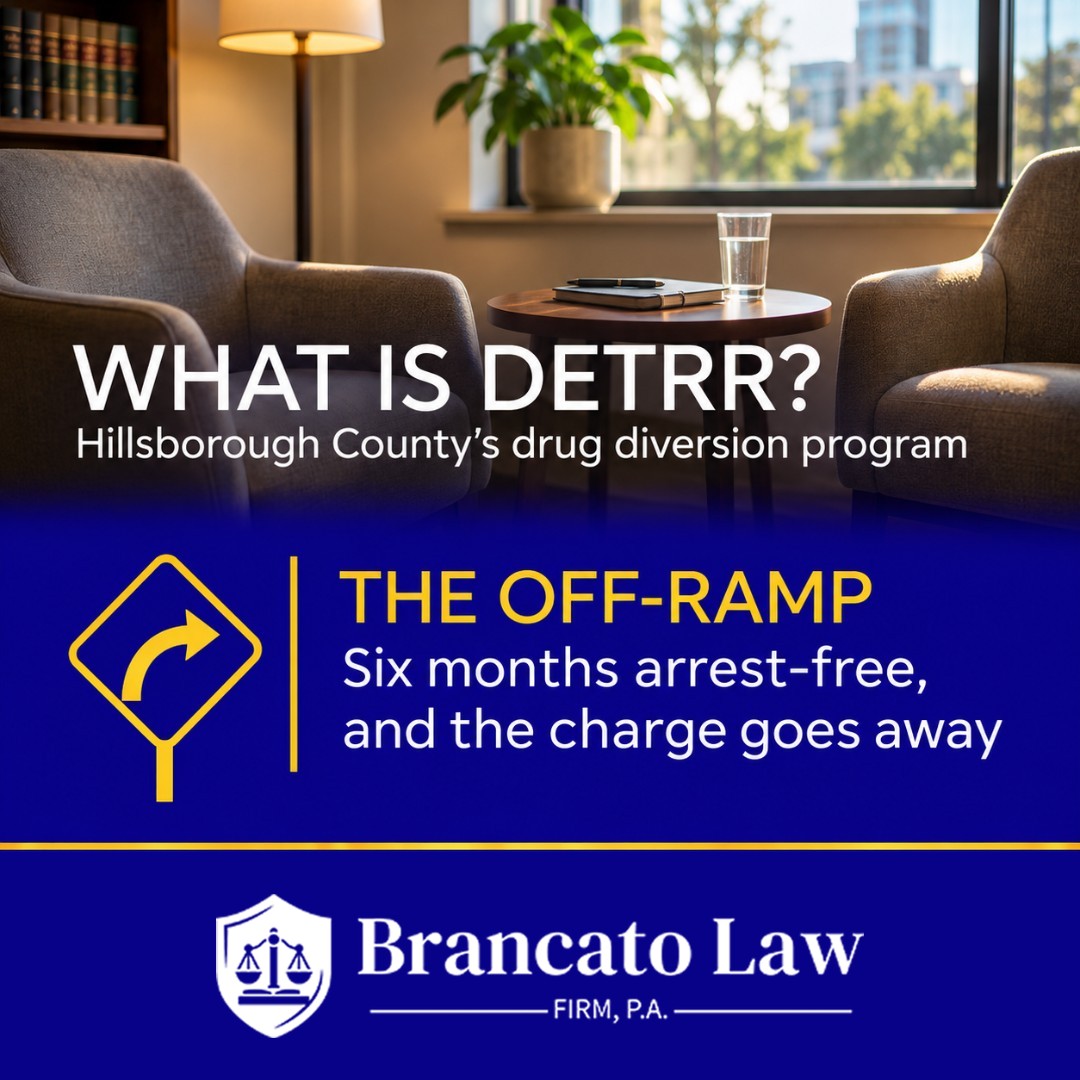
| DETRR (Drug Education and Treatment Reducing Recidivism) is the Hillsborough County State Attorney’s Office diversion program for low-risk, nonviolent drug possession cases. A person who qualifies agrees in writing to waive speedy trial, completes any drug education or treatment the program requires, and stays arrest-free for six months, and the possession charge is dismissed. It is not available for sale, distribution, trafficking, violent offenses, or people the program assesses as high-risk. |
If you were just arrested for drug possession in Hillsborough County, the most valuable weeks of your case are the ones before the State Attorney’s Office decides whether to file a charge. I am Rocky Brancato, founder of The Brancato Law Firm, P.A., a Tampa criminal defense firm, and a former Chief Operations Officer of the Hillsborough County Public Defender’s Office, where I oversaw a staff of over 100 attorneys. In more than 25 years in Hillsborough County courtrooms, I have watched DETRR and the programs before it turn possession arrests into closed cases, and our attorneys work to get eligible clients into the program before a charge is ever filed.
What is the DETRR program in Hillsborough County?
DETRR is a drug diversion program run by the Hillsborough County State Attorney’s Office in the 13th Judicial Circuit. The State Attorney’s Office describes it as “limited to drug possession cases for low-risk, non-violent offenders” and lists it among its diversion programs on its programs page. The program launched in October 2020 as a step below Drug Treatment Court, for people whose drug use does not call for the closer supervision of a treatment court.
The deal is simple. The person waives the right to a speedy trial in writing, completes whatever education or treatment the program assigns, and stays arrest-free for six months from the day they enter. If they do, the drug possession charge is dismissed. If they are arrested again, the State can go back to prosecuting the original charge. DETRR is a Hillsborough County program, so our Hillsborough County criminal defense attorneys handle it through the State Attorney’s Office in Tampa.
Who qualifies for DETRR?
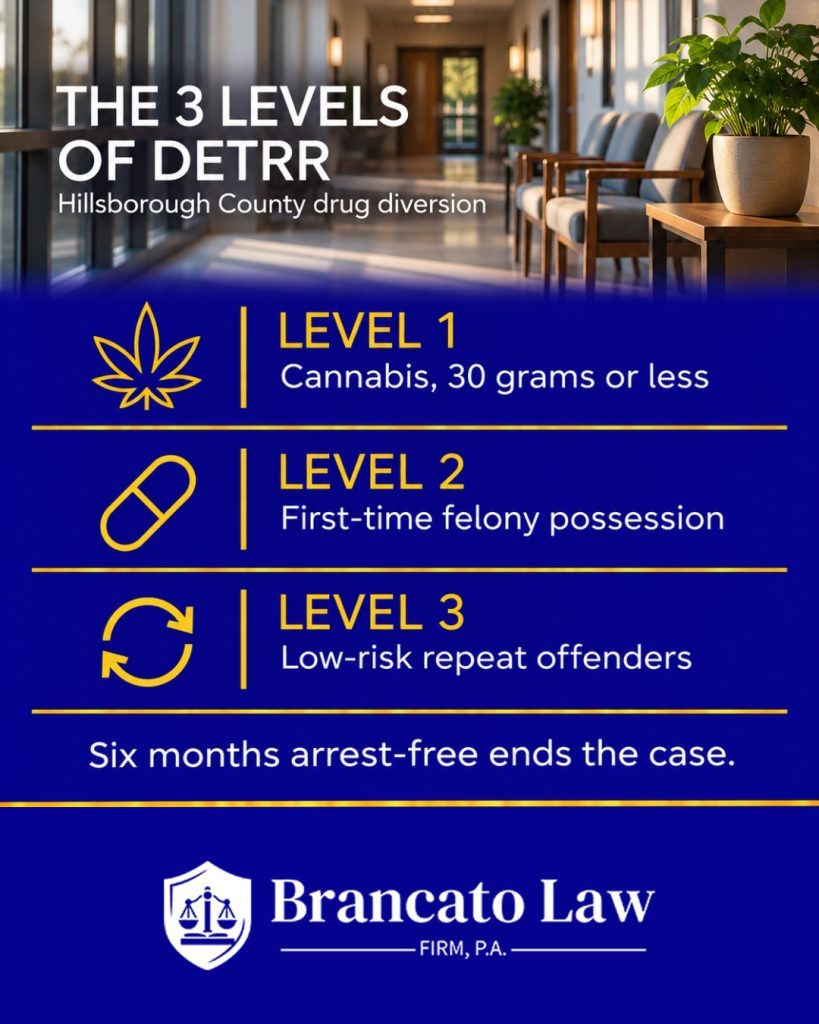
DETRR has three levels, and the level depends on the drug, the amount, and the person’s history. According to the State Attorney’s Office DETRR information sheet for defense attorneys, each level can be used only once, and a later arrest moves a person up to the next level if they are otherwise eligible.
| Level | Who it covers | What the person must do |
|---|---|---|
| Level 1 | Possession of 30 grams or less of cannabis, including oils, wax, and other THC products (synthetic cannabis excluded) | Stay arrest-free for six months; community treatment is encouraged but not required |
| Level 2 | First-time felony drug possession (any other controlled substance, or cannabis over 30 grams), with no prior felony conviction or withhold of adjudication | Complete a drug evaluation and the drug education or treatment it recommends; stay arrest-free for six months |
| Level 3 | Low-risk repeat offenders who do not qualify for Level 2, handled through Drug Court | Complete a risk-needs assessment and the treatment it calls for; stay arrest-free for six months |
Level 1 reaches further than many people expect. Under section 893.13(6)(b), Florida Statutes, possession of 20 grams or less of cannabis is a first-degree misdemeanor, and more than that is a third-degree felony under section 893.13(6)(a). Because DETRR Level 1 goes up to 30 grams, it covers some felony cannabis cases as well as misdemeanors. Our post on how much marijuana is a felony in Florida explains those weight lines.
What disqualifies someone from DETRR?
Any sign of sale or distribution, any trafficking charge, and a violent or high-risk profile keep a person out of DETRR at every level. Pending charges and felony probation also matter. The table below sorts what the State Attorney’s Office lists as disqualifying from what it says does not, by itself, rule a person out.
| Keeps a person out | Does not, by itself, keep a person out |
|---|---|
| Facts suggesting sale or distribution | A prior criminal record (Levels 1 and 3) |
| Any trafficking charge | A Criminal Punishment Code scoresheet of 44 points or more (Levels 1 and 3) |
| Being assessed as high-risk, or a violent offense | A paraphernalia charge in the same case |
| Other pending charges or cases (beyond paraphernalia, and possession at Levels 2 and 3) | Ongoing treatment at the six-month mark (Levels 2 and 3) |
| Being on felony probation (Levels 1 and 3) | |
| A prior felony conviction or withhold of adjudication (Level 2 only) | |
| Living outside Florida |
Can DETRR happen before charges are filed?
Yes, if the defense reaches the State Attorney’s Office early enough. The State Attorney’s Office materials describe DETRR in terms of dismissing a charge, and some sources treat it as a program for cases that are already filed. In our experience, the Hillsborough State Attorney’s Office will also do diversion before filing: when the defense contacts the prosecutor quickly after the arrest, the person waives speedy trial, and the office holds off on filing the charge while the person completes the program.
That timing matters. A case that is never filed leaves no charging document at all, which is the cleanest result a person can get after an arrest. The speedy trial waiver is what makes it work: it gives the State the time to wait without losing the case. This is the core of our pre-file advocacy work, and it is why the first call after a drug arrest should come early, not after the State has already filed.
How often are Hillsborough drug possession cases never filed?
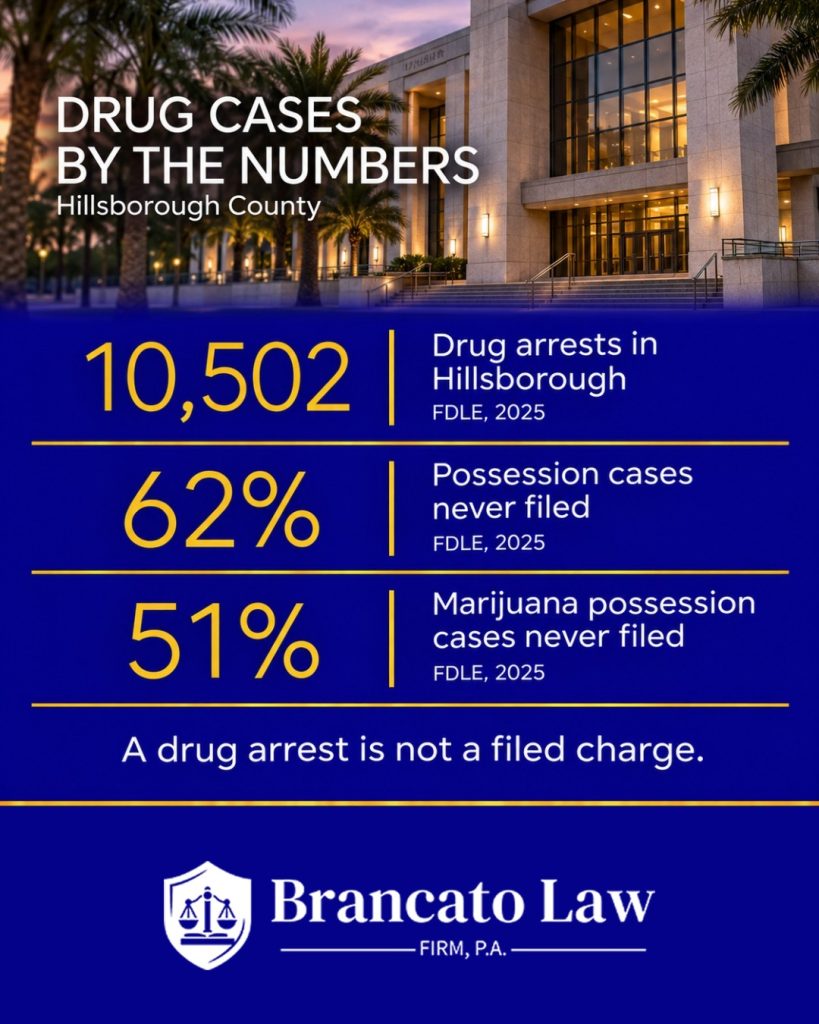
In 2025, the Hillsborough County State Attorney’s Office filed no charge in 62% of the 7,069 drug possession cases it decided, up from 27% in 2022, according to the Florida Department of Law Enforcement’s Criminal Justice Data Transparency database. Marijuana possession cases followed the same path: 51% of the 1,373 decided in 2025 were not filed. Those cases come out of a large pool. Hillsborough County recorded 10,502 drug arrests in 2025, according to FDLE arrest data published on the Florida Department of Health’s FLHealthCHARTS site.
The data does not say why a case was not filed, and pre-file diversion is only one reason. In our experience, prosecutors are also less interested in small amounts of marijuana than they were a few years ago, and roadside field tests often do not hold up once the crime lab looks at the evidence. Our post on how to fight a drug charge before it is filed covers the lab and field test issues. The point for anyone facing a possession arrest in Hillsborough is that a filed charge is far from certain, and early work by our attorneys can push a case toward the side that is never filed.
How do you get into DETRR?
Entry into DETRR runs through the prosecutor, not the judge. For Levels 1 and 2, the assistant state attorney in the felony division prepares the DETRR contract and sends it to the defense attorney for the client’s signature. For Level 3, the case goes to Drug Court for a risk-needs assessment, and the prosecutor assigned to Drug Court prepares the contract. After the case is closed into the program, the person takes the signed contract to the Florida Department of Corrections office at 1313 N. Tampa Street within 24 hours and is assigned an officer who tracks the six months.
- Our attorneys confirm eligibility from the arrest report, the substance, the weight, and the client’s record.
- We contact the assigned prosecutor, ideally before the filing decision, and ask for DETRR.
- The client signs the contract and the written speedy trial waiver.
- The client reports to the Department of Corrections within 24 hours and completes any required evaluation and treatment.
- After six months with no new arrest, the charge is dismissed, or, in a pre-file case, never filed.
The prosecutor’s decision is final. In Cleveland v. State, 417 So. 2d 653 (Fla. 1982), a woman charged with welfare fraud met every statutory requirement for pretrial intervention, but the state attorney refused to consent, and the trial judge ordered her into the program anyway. The Fourth District Court of Appeal quashed that order, and the Florida Supreme Court approved the appellate decision, holding that “the pretrial diversion decision of the state attorney is prosecutorial in nature and, thus, is not subject to judicial review.” The lesson for DETRR is practical: a judge cannot force a prosecutor to offer diversion, so the case for DETRR has to be made to the prosecutor, and made well.
Does DETRR clear your record?
No, not by itself. Finishing DETRR ends the case, but the arrest stays on the person’s criminal history until it is expunged or sealed. The State Attorney’s Office says DETRR participants are offered information about expunction at every level.
DETRR sets a person up well for expunction. Under section 943.0585, Florida Statutes, a person may petition to expunge a record when no charging document was filed, or when the charge was dismissed or nolle prossed, so long as they have never been adjudicated guilty of a criminal offense in Florida and have never had a record sealed or expunged before. The person first applies to FDLE for a certificate of eligibility, which requires a certified statement from the State Attorney’s Office and a $75 processing fee, and the court still decides the petition. A pre-file DETRR case, where the charge is never filed, falls under the first category.
Does diversion actually work?
The research says yes. A National Institute of Justice study, NIJ’s Multisite Evaluation of Prosecutor-Led Diversion Programs (Rempel and others, 2018), compared five prosecutor-run diversion programs in Illinois, Wisconsin, and Vermont with similar cases that went through regular prosecution. Diversion participants were less likely to be convicted or jailed, four of the five programs were linked to lower re-arrest rates, and diversion cases cost less to handle in all four programs studied for cost. DETRR rests on the same idea: for low-risk possession cases, treatment and a clean six months do more good than a conviction.
What should you do after a drug possession arrest in Hillsborough County?
Act within days, not weeks. The pre-file window is when DETRR can keep a charge from ever being filed, and the State Attorney’s Office can file at any time. Do not discuss the case with police or post about it, keep every paper the jail gave you, and do not pick up a new charge, since a pending case can disqualify you. Then call a lawyer who knows how the Hillsborough State Attorney’s Office handles diversion. For more about our defense strategies, visit our Drug Crimes page.
Frequently asked questions about DETRR
Can a judge order DETRR if the prosecutor says no?
No. Under Cleveland v. State, 417 So. 2d 653 (Fla. 1982), a state attorney’s decision on pretrial diversion is not subject to judicial review. That is why our attorneys at The Brancato Law Firm make the case for DETRR directly to the assigned prosecutor, with the facts and records that show the client is low-risk.
Can I get DETRR if I have a prior record?
Often, yes. A prior record does not by itself exclude someone from Level 1 or Level 3, though Level 2 is limited to people with no prior felony conviction or withhold. The Brancato Law Firm reviews the full record before contacting the prosecutor so the request goes in at the right level, and our Tampa drug crimes attorney page explains our wider approach to possession cases.
Is DETRR available in Pinellas or Pasco County?
No. DETRR is a program of the Hillsborough County State Attorney’s Office, and Pinellas and Pasco cases are handled by the State Attorney’s Office for the Sixth Judicial Circuit, which runs its own diversion options. Our attorneys at The Brancato Law Firm handle drug cases in all three counties and know which options each office offers.
What happens if I am arrested again during DETRR?
A new arrest can end the diversion and send the original case back to regular prosecution. The Brancato Law Firm treats that risk seriously from day one, which is why we walk every DETRR client through the six-month terms before they sign.
Does DETRR require a guilty plea?
No. DETRR does not require a guilty or no contest plea. The person signs a contract and a written speedy trial waiver, and after six months arrest-free the charge is dismissed or, in a pre-file case, never filed. Our attorneys at The Brancato Law Firm review every DETRR contract with the client before signing, and in a pre-file case the goal is a charge that is dropped or never filed.
The days right after a drug arrest decide whether DETRR can keep a charge from ever being filed. Our attorneys will review the arrest report, confirm which DETRR level fits, and contact the prosecutor before the filing decision. Call The Brancato Law Firm, P.A., founded by Tampa Criminal Defense Attorney Rocky Brancato, at (813) 727-7159. Call us at any hour; our office is two blocks from the courthouse. Our firm has Spanish-speaking staff, and attorney Jean-Luc Adrien speaks Spanish, Haitian Creole, and French.
The Brancato Law Firm, P.A.
620 E. Twiggs Street, Suite 205, Tampa, FL 33602
(813) 727-7159
Serving Hillsborough, Pinellas, and Pasco Counties
The Brancato Law Firm, P.A. is a Tampa-based criminal defense practice. We are not affiliated with any other Brancato-named law firms.
Visit Us

Tampa, FL 33602

Contact Us Now
Free Legal Consultation (813) 727-7159
