- Free Consultation 24/7: (813) 727-7159 Tap Here To Call Us


From First DUI to Death Penalty



Signs You Need a Criminal Defense Lawyer in Tampa: 10 Details That Raise the Stakes (2026)



You need a criminal defense lawyer in Tampa when the details attached to your charge, or to you, raise the stakes. In Florida, the same misdemeanor can end in a fine for one person and a felony, a lost license, a firearm ban, or deportation risk for another. The name of the charge tells you less than the facts around it.
At The Brancato Law Firm, our founder Rocky Brancato spent more than two decades at the Hillsborough County Public Defender’s Office, where he served as Chief Operations Officer and oversaw a staff of over 100 attorneys. From that position, he saw how charges get enhanced and how pleas get processed at volume. Hillsborough’s circuit court took in 12,317 new felony defendants in fiscal year 2024-25, and a system handling that many cases is built to move them quickly. The costliest mistake we see is treating a case as minor because of its name. Serious preparation at our firm is not reserved for serious-sounding charges.
These are the 10 signs your case needs a lawyer, ordered from the most common situations to the highest-stakes ones:
- The charge carries a domestic violence label
- You have a prior record
- You are on probation or were released from prison in the last three years
- A weapon is part of the allegation
- The drug weight crosses a trafficking threshold
- You hold a professional license, a CDL, or a place in school
- You are not a U.S. citizen
- A civil case is running alongside the criminal one
- The accusation involves a sex offense, a child, serious injury, or a death
- Someone is offering you a quick plea
Before Any Charge: A Detective’s Call or a Controlled Call
Some of the most important decisions in a case happen before anyone is arrested. Two situations come up constantly.
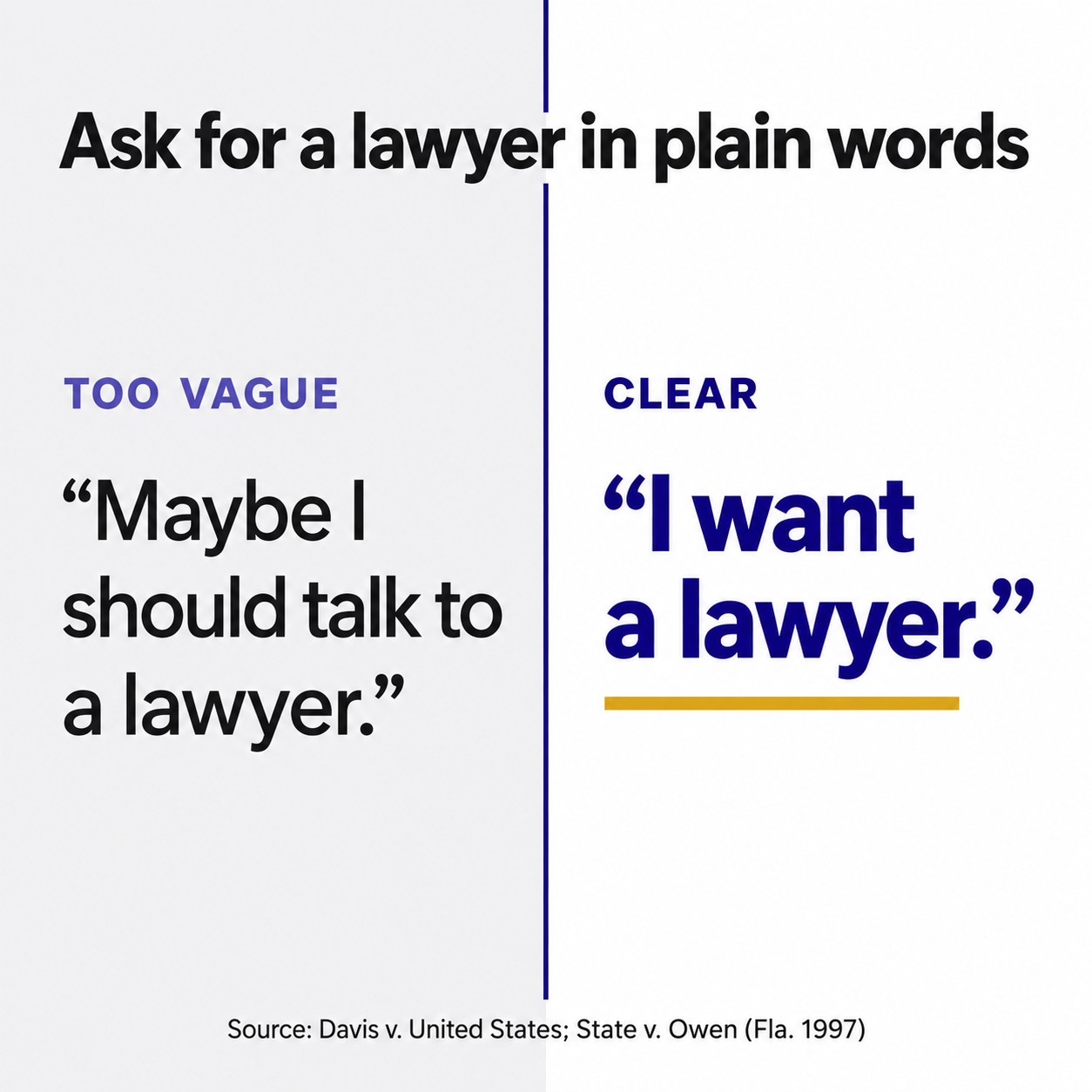
The first is a detective who calls and asks to hear your side. That interview is voluntary. You do not have to go, and Miranda warnings are generally required only when you are in custody, so a conversation is not protected just because no one read you your rights.
The second is a controlled call. The alleged victim, or someone close to the case, phones you while police listen and record, and steers the conversation toward the allegation. Florida generally requires everyone’s consent before a call is recorded, but section 934.03(2)(c) makes an exception when a person acting at law enforcement’s direction is on the call and consents, and the purpose is to gather evidence of a crime. The recording can be used as evidence, and an apology meant to calm someone down can be presented as an admission.
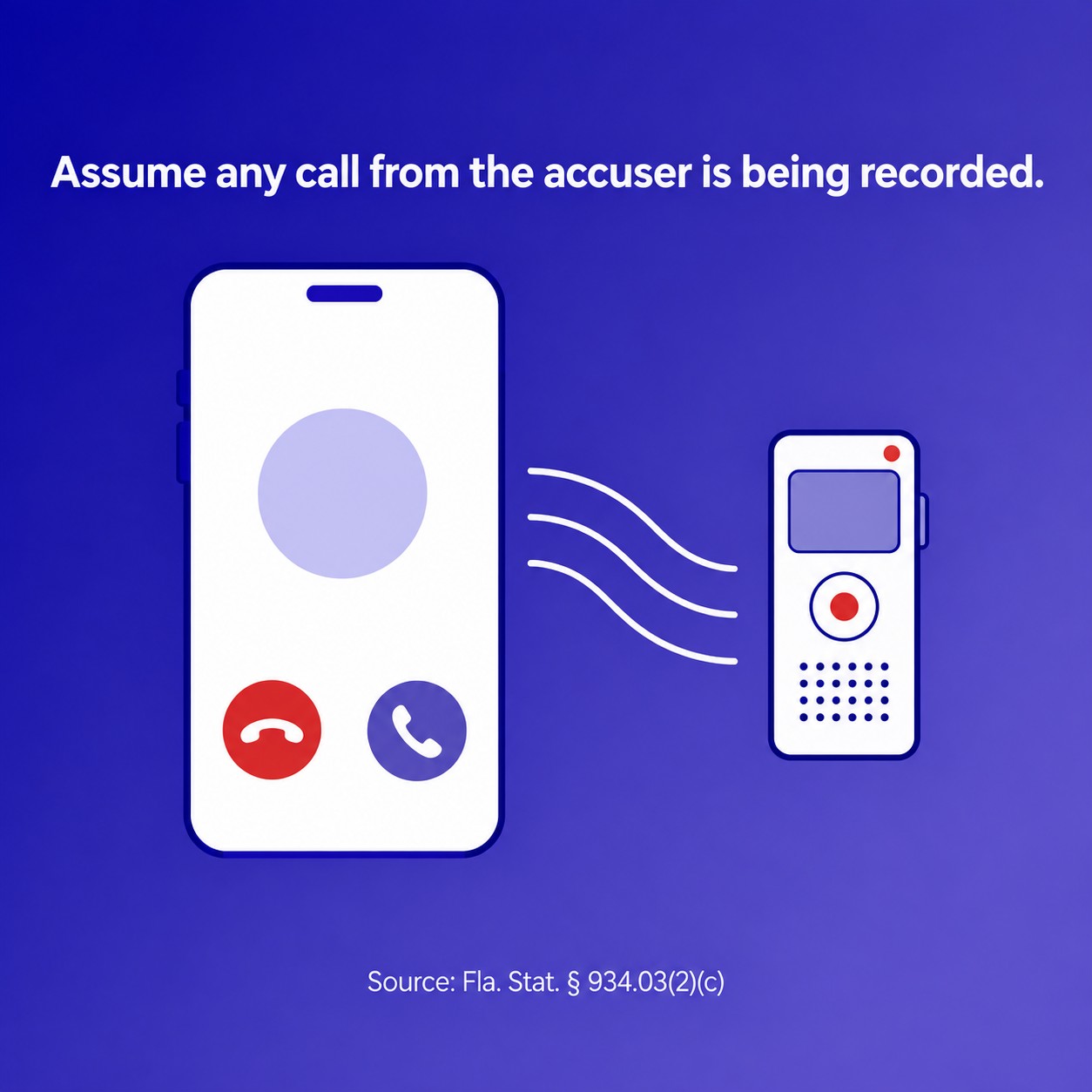
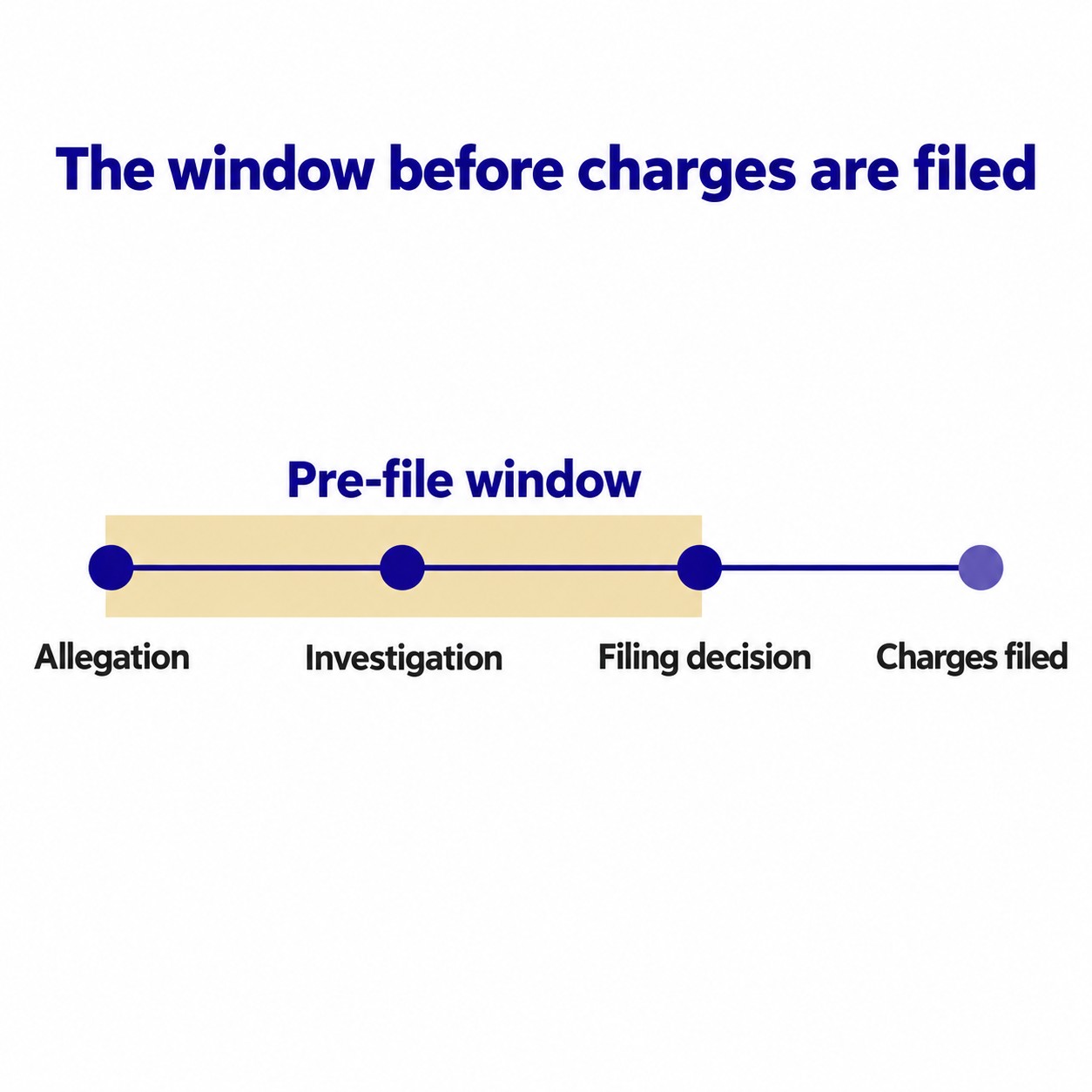
If either happens, the safest response is to say a lawyer will get back to them, and then call one. A detective’s call is also the point where a lawyer can learn what the investigation is about and, when the evidence supports it, present context to the prosecutor before a charging decision is made.
Every sign below applies whether you are innocent or you made a mistake. If police are investigating you but have not made an arrest, our guide to signs of a criminal investigation covers that stage. If someone was just arrested, start with our steps after an arrest.
1. The Charge Carries a Domestic Violence Label
Florida defines domestic violence by the offense and the relationship between the people involved. How badly anyone was hurt plays no part in the label. Under section 741.28, any assault, battery, stalking, or other listed offense between family or household members qualifies. That includes spouses, former spouses, relatives, people who live or once lived together as a family, and parents who share a child even if they never lived together.
Once the label attaches, the case changes in four ways:
- Minimum jail. If you are adjudicated guilty and intentionally caused bodily harm, section 741.283 requires at least 10 days in county jail on a first offense, 15 on a second, and 20 on a third. If a child under 16 from the household was present, the minimums rise to 15, 20, and 30 days.
- No sealing, even with a withhold. Under section 943.0584, a guilty or no contest plea to domestic assault or battery counts as a conviction even when adjudication is withheld. That record can never be sealed or expunged.
- A federal firearm ban. Under 18 U.S.C. § 922(g)(9), anyone convicted of a misdemeanor crime of domestic violence may not possess firearms or ammunition.
- A second case in civil court. A domestic violence injunction often runs alongside the criminal case (see sign 8).
The jail minimum turns on adjudication, and the sealing ban turns on the plea itself. That makes how the case is resolved more important here than almost anywhere else in Florida criminal law.
In many domestic violence cases, the allegations do not tell the full story. When the evidence supports it, we present context and evidence to prosecutors before charges are filed, and that early intervention can result in charges never being filed. See our domestic violence defense page and our guide to fighting a DV battery charge.
2. You Have a Prior Record
Florida turns several repeat misdemeanors into felonies. A plea you took years ago to get a case over with can be the reason a new case is charged as a felony.
| New offense | Prior record that triggers the upgrade | Result |
|---|---|---|
| Petit theft | Two or more prior theft convictions | Third-degree felony, s. 812.014(3)(c) |
| Battery | One prior conviction for battery, aggravated battery, felony battery, or resisting an officer with violence | Third-degree felony, s. 784.03(2) |
| DUI | A third DUI within 10 years of a prior DUI conviction | Third-degree felony, s. 316.193(2)(b)1. |
| DUI | A fourth DUI, no matter when the priors occurred | Third-degree felony, s. 316.193(2)(b)3. |
| Driving while license suspended, with knowledge | A third conviction, where the current or most recent prior suspension came from DUI, a test refusal, a death or serious-injury crash, or fleeing | Third-degree felony, s. 322.34(2)(c) |
Battery shows how one old plea sets up the next case. For the felony upgrade, the statute counts a prior plea as a conviction even with a withhold or a no contest plea. One withheld battery plea can turn the next battery allegation into a felony.
Theft from a home can reach felony level with no prior record at all. Taking $40 to under $750 in property from a dwelling or its unenclosed yard, such as a package from a porch, is third-degree grand theft on a first offense.
Not every prior escalates. A third driving-while-suspended conviction over unpaid fines is a first-degree misdemeanor with a 10-day jail minimum, and a third DUI more than 10 years after the last one stays a misdemeanor. Repeat traffic convictions can also lead to habitual traffic offender status.
3. You Are on Probation or Were Recently Released From Prison
A new arrest while you are on probation creates two cases: the new charge and a violation of probation. For some people on felony probation or community control, section 903.0351 bars any bond until the violation hearing is resolved. That rule covers violent felony offenders of special concern and certain other felony probationers arrested for a qualifying new offense. It does not apply when the only violation is failing to pay costs, fines, or restitution.
Release from prison within the last three years raises a separate risk. Under section 775.082(9), the State Attorney may seek Prison Releasee Reoffender sentencing for listed offenses committed within three years of release. The list includes robbery, aggravated battery, burglary of a dwelling, and any felony involving the use or threat of violence. If the State proves PRR status, the judge must impose:
- Life for a felony punishable by life
- 30 years for a first-degree felony
- 15 years for a second-degree felony
- 5 years for a third-degree felony
The sentence is served at 100 percent. A third-degree felony that would otherwise score to probation becomes five years in prison. The prosecutor decides whether to seek PRR, so early negotiation over that decision is often where a defense lawyer matters most.
4. A Weapon Is Part of the Allegation
Under section 775.087(1), a felony moves up one degree when the person charged carries, displays, uses, or threatens to use a weapon or firearm. The exception is an offense where a weapon is already an element.
| Charged as | Maximum prison | Reclassified to | Maximum prison |
|---|---|---|---|
| Third-degree felony | 5 years | Second-degree felony | 15 years |
| Second-degree felony | 15 years | First-degree felony | 30 years |
| First-degree felony | 30 years | Life felony | Up to life |
Maximums come from s. 775.082(3). See our guide to Florida felony degrees.
A firearm can also trigger Florida’s 10-20-Life law. For listed felonies, including robbery, burglary, aggravated battery, kidnapping, carjacking, home-invasion robbery, drug trafficking, and possession of a firearm by a felon, section 775.087(2) sets minimum mandatory prison terms:
- 10 years for actually possessing a firearm (3 years for felon in possession or burglary of a conveyance)
- 20 years if the firearm was discharged
- 25 years to life if the discharge caused death or great bodily harm
The judge cannot withhold adjudication or suspend the sentence. The fight is often over “actual possession,” which section 775.087(4) defines as carrying the firearm on your person, or having it within immediate reach with ready access and intent to use it during the offense. A gun in a glovebox does not automatically meet that test, and our gun crimes defense work often centers on it.
5. The Drug Weight Crosses a Trafficking Threshold
Florida’s trafficking statute turns on weight, including any mixture containing the drug. A quantity that sounds like personal use can carry a minimum mandatory prison term. Every trafficking offense under section 893.135 is a first-degree felony.
| Substance | Statute | Trafficking starts at | Minimum prison at that tier | Mandatory fine |
|---|---|---|---|---|
| Cannabis | s. 893.135(1)(a) | Over 25 lb, or 300+ plants | 3 years | $25,000 |
| Cocaine | s. 893.135(1)(b) | 28 grams | 3 years | $50,000 |
| Heroin, morphine, opium, hydromorphone | s. 893.135(1)(c)1. | 4 grams | 3 years | $50,000 |
| Hydrocodone or codeine | s. 893.135(1)(c)2. | 28 grams | 3 years | $50,000 |
| Oxycodone | s. 893.135(1)(c)3. | 7 grams | 3 years | $50,000 |
| Fentanyl and fentanyl analogs | s. 893.135(1)(c)4. | 4 grams | 7 years | $50,000 |
| Methamphetamine or amphetamine | s. 893.135(1)(f) | 14 grams | 3 years | $50,000 |
Fentanyl stands out. Its 4-gram tier carries a 7-year minimum, and many older sources still list 3 years because Florida raised it in 2022. The minimum rises to 20 years at 14 grams and 25 years at 28 grams.
Trafficking records can never be sealed or expunged. The defense usually starts with the lab: how the weight was measured, what was actually tested, and whether the State can prove you knowingly possessed the drug. In a cocaine possession case the firm tried to a jury, the defense turned on that knowing-possession question, and the client was acquitted. You can read how it unfolded in our case study, It’s the Client’s Call. Each case is unique. Past results do not guarantee future outcomes. Our drug crimes defense page covers these challenges.
6. You Hold a Professional License, a CDL, or a Place in School
For some people, the criminal case is the smaller problem. Several rules start a clock long before the case is resolved.
- Healthcare practitioners. Under section 456.072(1)(x), nurses, physicians, pharmacists, and other Department of Health licensees must report in writing within 30 days of a conviction, a finding of guilt, or a no contest plea, regardless of adjudication. Failing to report is its own ground for discipline. See our guide for healthcare professionals.
- Teachers. Florida’s educator ethics rule, Rule 6A-10.081, requires teachers to self-report an arrest for a long list of felonies and misdemeanors within 48 hours. Any plea, withhold, or pretrial diversion for an offense other than a minor traffic violation must also be reported within 48 hours. Talk to a lawyer before you file that report. See our guide for teachers facing charges.
- CDL holders. Under section 322.61, a DUI conviction while driving your personal car disqualifies you from driving a commercial vehicle for one year. Two such violations from separate incidents mean permanent disqualification.
- Anyone arrested for DUI. You have 10 days from the notice of suspension, usually issued at the arrest, to request review of the administrative license suspension under section 322.2615. Waiting until arraignment usually means missing it. Here is how to protect your license.
- Students. School discipline moves on its own timeline, separate from the court case. See our guide for students facing charges.
We do not represent clients before licensing boards. We protect the license through how the criminal case is resolved: the charge you plead to, whether adjudication is withheld, and whether the case ends in a dismissal or diversion instead of a plea. The forensic rigor we bring to a homicide case is the same preparation that protects a nurse’s career on a first-offense DUI charge.
7. You Are Not a U.S. Citizen
Federal immigration law defines “conviction” differently than Florida does. Under 8 U.S.C. § 1101(a)(48)(A), a withhold of adjudication counts as a conviction for immigration purposes if you pleaded guilty or no contest and the judge ordered any punishment, penalty, or restraint. Probation, a fine, or court costs can meet that test.
Florida judges give a general deportation warning during a plea. That warning is not advice about your case. In Padilla v. Kentucky, the U.S. Supreme Court held that defense counsel must tell a non-citizen client whether a plea carries a risk of deportation. Pleading at first appearance without a lawyer skips that step entirely.
We do not practice immigration law. When a client is not a U.S. citizen, we coordinate with immigration counsel before any plea is structured. Jean-Luc Adrien, one of our criminal trial attorneys and a former Division Chief at the Hillsborough County Public Defender’s Office, practices in English, Spanish, Haitian Creole, and French.
8. A Civil Case Is Running Alongside the Criminal One
Common parallel proceedings include a domestic violence or stalking injunction, a risk protection order, a custody dispute, school discipline, and a DUI administrative suspension. These proceedings are civil or administrative. Sworn testimony in them is still recorded, though, and the State Attorney’s Office can obtain it and use it against you in the criminal case. That is why one attorney should handle both.
Domestic violence injunctions. Florida courts do not have to pause an injunction hearing because a related criminal case is pending, as the First District Court of Appeal held in Speegle v. Rhoden. If you testify, you can waive your right to remain silent on the subjects your testimony covers. If you stay silent, the judge may draw a negative inference, though a ruling still needs independent evidence. A lawyer handling both cases can seek a continuance for good cause and decide whether you should testify at all.
DUI administrative hearings. The formal review hearing lets a defense lawyer subpoena the arresting officer and question them under oath long before trial. The statute bars using the department’s decision, or a written statement submitted with the review request, in the DUI trial. It says nothing about live testimony, which is why the driver usually should not testify. As a former police academy instructor, Rocky Brancato trained officers on criminal procedure and courtroom testimony. Our attorneys use that knowledge of how officers are taught to testify when they question them under oath.
Risk protection orders and custody disputes carry the same risk. See our guides to fighting a risk protection order and DUI and child custody.
9. The Accusation Involves a Sex Offense, a Child, Serious Injury, or a Death
These are major crimes. A first-degree felony carries up to 30 years in prison, or life where the statute provides. DUI causing serious bodily injury is a third-degree felony, and DUI manslaughter is a second-degree felony with a 4-year minimum mandatory prison term. Most sex offense convictions carry sex offender registration, and after an adult conviction for sexual battery, registration is for life. That cannot be undone after conviction, so the time to act is while the case is still open.
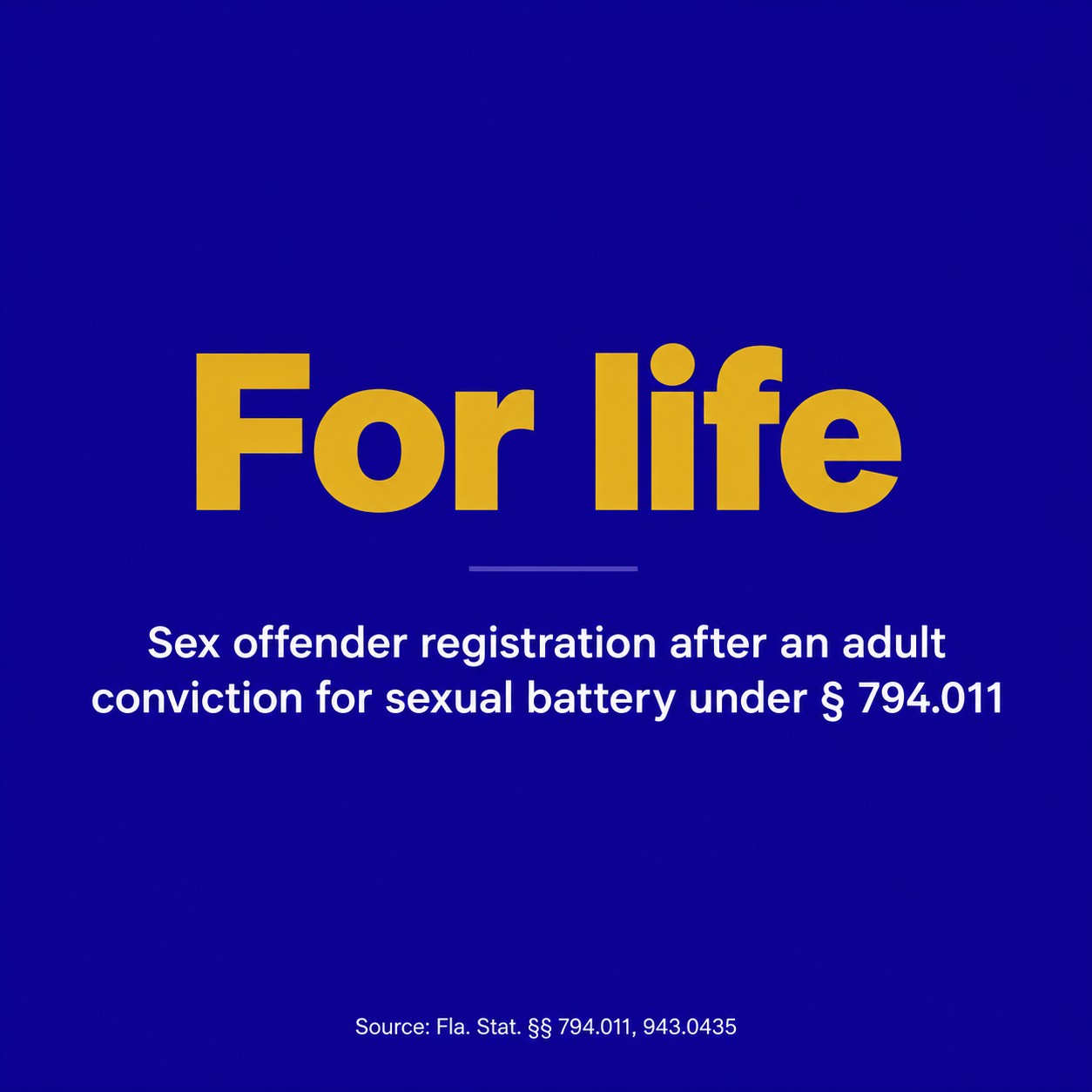
Sexual battery, child abuse, aggravated battery, and offenses that require registration are all on the list of records Florida will never seal or expunge.
These cases often turn on forensic evidence and expert testimony. Our defense team works with forensic pathologists, DNA analysts, toxicologists, and medical experts to test the State’s conclusions, with Rocky Brancato providing direct oversight on case strategy. Our forensic science defense page explains that work.
Rocky has tried more than 150 jury trials to verdict. He also meets the qualifications of Florida Rule of Criminal Procedure 3.112 to defend capital (death penalty) cases. That credential reflects the preparation standard we apply to every serious case, including sex crimes, child abuse, homicide, and other violent crime allegations. You can review our published case results. Each case is unique. Past results do not guarantee future outcomes.
10. Someone Offers You a Quick Plea
A plea at first appearance or arraignment can feel like the fastest way to end the problem. It is also permanent, and it interacts with every sign above. Florida Rule of Criminal Procedure 3.130 requires a first appearance within 24 hours of arrest, so this decision often comes before anyone has read the police report, talked to a witness, or checked whether the charge actually fits the facts. You do not have to resolve the case at that hearing. An adjudication of guilt is a formal conviction. A withhold of adjudication means the court accepts the plea and imposes a sentence such as probation without formally convicting you.
Under section 943.059, you can petition to seal a record only if you have never been adjudicated guilty of a criminal offense in Florida. One adjudication, on any charge, ends sealing eligibility for that case and every future case. Expunction under section 943.0585 is generally limited to cases that were dismissed, dropped by the prosecutor (nolle prosequi), or ended in acquittal, or to withheld cases that have been sealed for at least 10 years.
| How the case ends | Effect on your record | Can it be used against you later? |
|---|---|---|
| Dismissal, nolle prosequi, or acquittal | May be eligible for expunction, the strongest form of record relief | Not as a conviction |
| Plea with adjudication withheld (most offenses) | May be eligible for sealing, and for expunction after 10 years sealed | Counts toward the battery felony upgrade, can count as an immigration conviction, and triggers license reporting |
| Plea with adjudication withheld (domestic assault or battery) | Can never be sealed or expunged | Same as above |
| Plea with adjudication of guilt | Ends sealing eligibility for this case and any future case | Counts as a conviction for every purpose |
Sealing and expunction also depend on other statutory requirements and the judge’s discretion. Before any plea, the goal is to keep the strongest options open: a dismissal, a diversion program that ends in dismissal, a plea to a different offense, or a withhold on a charge that can still be sealed.
When a Private Criminal Defense Lawyer May Not Change Much
A standard civil traffic ticket usually does not need a private criminal defense lawyer. Under s. 775.082(5), a noncriminal violation cannot be punished with jail, and it does not create a criminal record. The exceptions are CDL holders, who face a 60-day commercial disqualification for two serious traffic violations within three years, and drivers close to a points suspension. Charges like driving while suspended with knowledge are a different matter, covered on our criminal traffic defense page.
If you cannot afford a private lawyer, the public defender’s office exists for exactly that reason, and it has capable trial attorneys. Rocky spent more than two decades there. In his book on choosing a defense attorney, he writes that a public defender can be a better choice than a low-cost private lawyer. We do not try to talk anyone into hiring the firm. When the public defender is the right call, we say so.
Under section 27.52, you qualify as indigent if your household income is at or below 200 percent of the federal poverty guidelines, or if you receive TANF cash assistance, poverty-related veterans’ benefits, or SSI. For a single adult under the 2026 poverty guidelines, that limit is $31,920 a year. You apply through the clerk of court. For more, see our comparison of the public defender vs. private attorney and our guides on choosing a defense attorney and defense attorney costs.
Frequently Asked Questions
Do I need a lawyer for a misdemeanor in Florida?
Often, yes. A misdemeanor with a domestic violence label, a prior record, a professional license, or non-citizen status can bring jail minimums, a felony upgrade on the next case, or immigration consequences. Even a simple first offense can cost you the one-time chance to seal your record if you accept an adjudication of guilt.
Can I wait until arraignment to hire a lawyer in Tampa?
You can, but some deadlines pass before arraignment. The DUI license review window closes 10 days after the suspension notice, and teachers must self-report certain arrests within 48 hours. The period before charges are filed is also when a lawyer can present evidence to the prosecutor.
Does a withhold of adjudication count as a conviction in Florida?
It depends on the purpose. A withhold keeps most records eligible for sealing, but it counts as a conviction for the battery felony upgrade, the domestic violence sealing ban, federal immigration law when punishment is imposed, and healthcare license reporting.
Do I need a lawyer if I’m innocent?
Yes. Being innocent does not change the deadlines, the plea consequences, or the enhancements described above. Our article on whether innocent people need a lawyer explains why.

Talk to a Tampa Criminal Defense Lawyer About Your Case
If any of these signs fits your situation, we can review your case in a free, confidential consultation and give you a straight answer about what it needs. We defend clients charged across Hillsborough, Pinellas, and Pasco Counties. Call (813) 727-7159 or contact us online.
The Brancato Law Firm, P.A.
620 E. Twiggs Street, Suite 205, Tampa, FL 33602
(813) 727-7159
Serving Hillsborough, Pinellas, and Pasco Counties
The Brancato Law Firm, P.A. is a Tampa-based criminal defense practice. We are not affiliated with any other Brancato-named law firms.
Visit Us

Tampa, FL 33602

Contact Us Now
Free Legal Consultation (813) 727-7159
