- Free Consultation 24/7: (813) 727-7159 Tap Here To Call Us


From First DUI to Death Penalty



How to Fight a Domestic Violence Battery Charge in Florida (2026)


Fighting a domestic violence battery charge in Florida is sometimes possible, but it almost never happens the way people expect. The alleged victim cannot drop the case. Florida law treats domestic violence as a crime against the State, not a private dispute, and the State Attorney decides whether the charges go forward. Cases are won by attacking the elements the State has to prove, exposing weaknesses in the evidence, and using the procedural tools Florida law provides: self-defense and Stand Your Ground immunity, Confrontation Clause challenges, pre-file advocacy, pretrial diversion, and negotiated pleas to non-domestic-violence offenses that preserve a clean record.
At The Brancato Law Firm, we approach a domestic violence case the same way we approach a homicide: by attacking every element the State has to prove and every piece of evidence they intend to use. Pre-file advocacy, Confrontation Clause challenges, self-defense, and careful plea negotiation make up the bulk of the playbook. The firm’s domestic violence practice focuses heavily on pre-file advocacy and on identifying false or exaggerated allegations that surface during custody disputes, divorces, and personal vendettas. This article walks through what the law actually requires the State to prove, how prosecutors build a case without the alleged victim’s cooperation, and the defenses that work in Florida courts.
A note before we go further: a domestic violence battery charge is serious. The mandatory penalties on conviction are harsh, the federal collateral consequences are permanent, and the case will not simply disappear because the alleged victim wants it to. Anyone facing one of these charges should treat it that way. Each case is unique, and past results do not guarantee future outcomes.
Why the Alleged Victim Cannot Drop Domestic Violence Charges in Florida
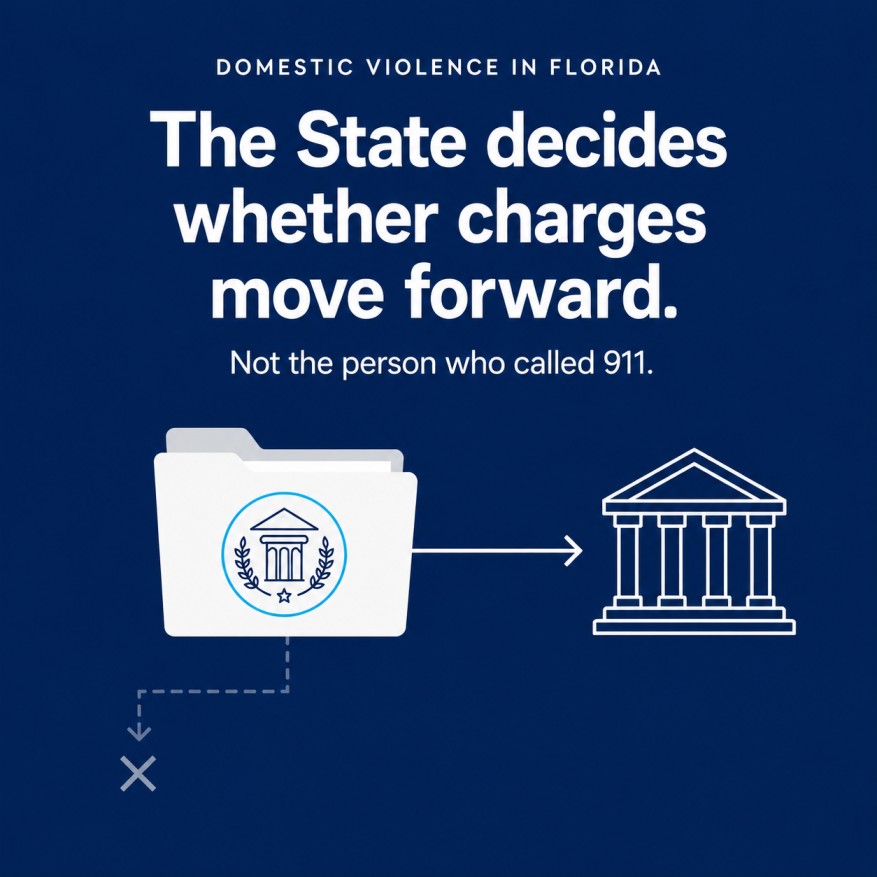
The single most common misconception about a Florida domestic violence battery case is that the partner who called 911, or who was listed as the victim on the arrest report, can call the State Attorney and have the case dismissed.
They cannot. Under Florida Statute § 741.2901, the Florida Legislature has directed every State Attorney’s Office to adopt a “pro-prosecution policy” for domestic violence and to prosecute these cases “over the objection of the victim, if necessary.” The statute spells out the reasoning: “It is the intent of the Legislature that domestic violence be treated as a criminal act rather than a private matter.”
That decision belongs to the prosecutor. The alleged victim does not file the charge, cannot drop it, and is treated by the State as a witness, not as the party in interest.
That does not mean the alleged victim is irrelevant. A recantation, a sworn affidavit explaining context the police missed, or a refusal to cooperate often weakens the State’s evidence and opens room to negotiate. But none of it ends the case automatically. The realistic question is how the State plans to prove its case without the alleged victim and what tools the defense has to dismantle that plan.
Why Both Parties Sometimes Get Arrested
Florida law treats arrest as the preferred response in domestic violence calls. Under Florida Statute § 901.15(7), if an officer has probable cause to believe a person committed an act of domestic violence, the officer may arrest without a warrant, and the decision to arrest “shall not require consent of the victim or consideration of the relationship of the parties.”
When officers respond to a domestic call and both parties say the other one started it, the statute directs them to identify the “primary aggressor” rather than arrest both. In practice, that does not always happen. Officers facing two competing stories, conflicting injuries, and limited time on scene sometimes default to arresting both. That is one of the many reasons body camera footage, 911 audio, and scene photographs deserve careful scrutiny early in the case.
What “Domestic Violence Battery” Actually Means Under Florida Law
September 2026 update: When the family member involved is an elderly parent or a disabled adult, prosecutors often file the case as abuse or neglect of an elderly person under chapter 825 rather than domestic battery, and every chapter 825 charge is a felony. Our guide, Is Elder Abuse a Felony in Florida, and What Does the State Have to Prove?, explains the “elderly person” element the State must prove and how Adult Protective Services investigations feed these cases.
A “domestic violence battery” charge is a battery under Florida Statute § 784.03 committed against a “family or household member” as that term is defined in Florida Statute § 741.28(3).
Two elements have to line up:
- A battery occurred. Under § 784.03, a battery is intentionally touching or striking another person against their will, or intentionally causing them bodily harm.
- The relationship qualifies. Under § 741.28(3), a “family or household member” is a spouse or former spouse, persons related by blood or marriage, persons currently living together as a family, persons who have lived together as a family in the past, or persons who share a child in common.
Both elements have to be proven. The State has to prove the touching, and the State has to prove the relationship. Each element is a target.
Penalties on Conviction
| Charge | Statute | Classification | Maximum Penalty |
| Domestic battery (simple) | § 784.03(1) + § 741.28 | First-degree misdemeanor | 1 year jail / $1,000 fine |
| Domestic battery, second offense | § 784.03(2) | Third-degree felony | 5 years prison / $5,000 fine |
| Domestic battery by strangulation | § 784.041(2) | Third-degree felony | 5 years prison / $5,000 fine |
| Aggravated battery (domestic) | § 784.045 | Second-degree felony | 15 years prison / $10,000 fine |
On top of the statutory maximums, a conviction triggers several mandatory add-ons underFlorida Statute § 741.281 and Florida Statute § 741.283:
- A minimum of one year of probation
- Completion of a 29-week Batterers’ Intervention Program certified by the Florida Department of Children and Families (Florida Statute § 741.325)
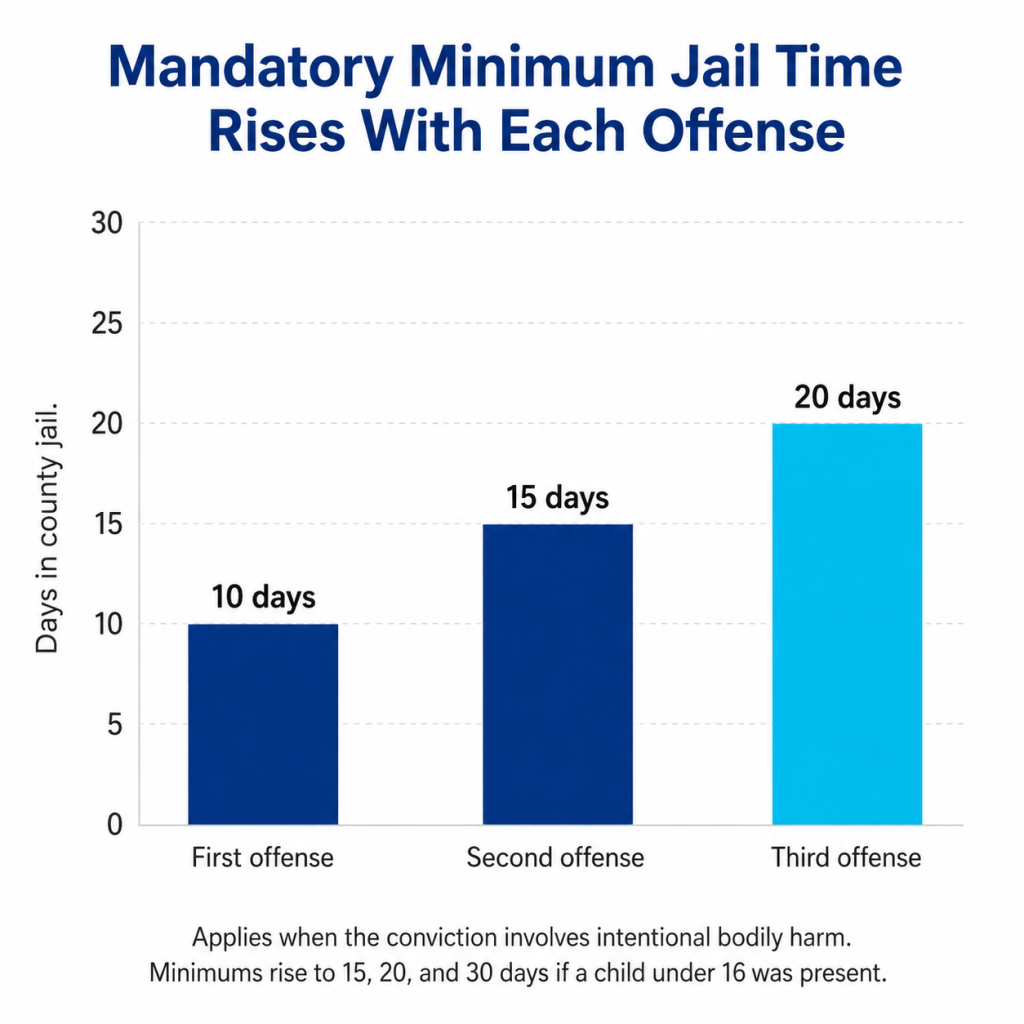
- A mandatory minimum of 10 days in the county jail if the conviction involves intentional bodily harm (15 days if the offense occurred in front of a family or household member under 16)
The 10-day jail minimum doubles to 15 days for a second offense and 20 days for a third. If a child under 16 was present, those numbers rise to 15, 20, and 30 days. These minimums come on top of any other sentence the court imposes.
How Prosecutors Prove Domestic Violence Cases Without Victim Cooperation
Prosecutors expect alleged victims to recant, to refuse to testify, or to fail to appear. Florida circuits with active domestic violence units are built around that reality. The State will try to prove the case using evidence that does not depend on the alleged victim taking the stand.
The most common pieces of that puzzle:
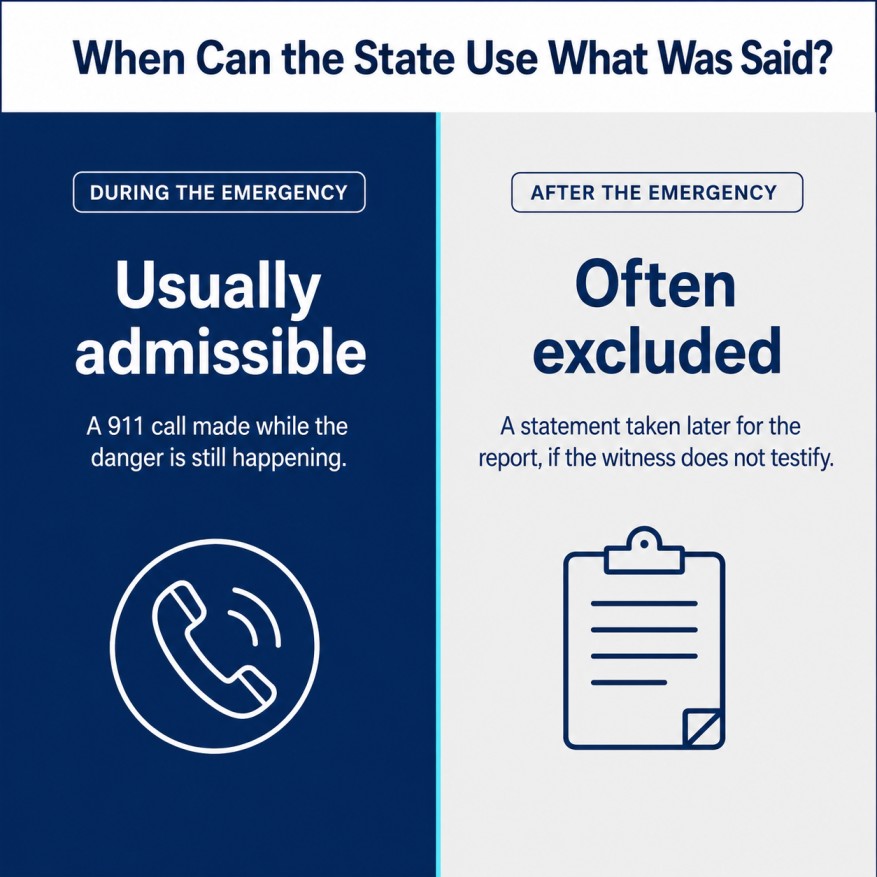
- 911 audio. When the call was made during an “ongoing emergency,” it is admissible under Davis v. Washington, 547 U.S. 813 (2006), and it usually qualifies as an excited utterance under Florida’s hearsay exception in § 90.803(2).
- Body-worn camera footage. Officer-recorded video of the scene, including statements made by the alleged victim shortly after officers arrived.
- Scene photographs. Visible injuries, broken property, and disarray photographed by responding officers.
- Officer testimony. What the officer personally observed and what was said in their presence.
- Medical records and 911 dispatch logs. Times, statements, and documented injuries that corroborate the State’s narrative.
Not all of this evidence is automatically admissible. The Confrontation Clause of the Sixth Amendment, as interpreted in Crawford v. Washington, 541 U.S. 36 (2004) and clarified in Davis, sets a real limit. Statements made to officers after the emergency ended, when the primary purpose of the questioning was to “establish or prove past events potentially relevant to later criminal prosecution,” are testimonial. Testimonial statements cannot be introduced at trial unless the witness is available for cross-examination or has been previously cross-examined.
That distinction is where good defense work begins. A 911 call placed while the alleged victim was hiding in a bathroom is likely admissible. A signed statement taken on a clipboard 45 minutes after officers separated the parties is much harder for the State to use if the alleged victim does not show up to testify.
Defense Strategies That Work in Florida Domestic Violence Cases
September 2026 update: One development worth flagging: domestic incidents in which one partner blocks a door, takes a phone, or drives off with the other person in the car are increasingly charged with kidnapping or false imprisonment on top of battery. Kidnapping requires proof of a specific intent — usually, in these cases, an intent to “terrorize” — and that element is often the weakest part of the State’s case. We break down the difference between the two charges, the bond consequences, and the defenses in our guide to kidnapping versus false imprisonment in Florida.
The path to fighting a Florida domestic violence battery charge is the path through one or more of these defenses, applied to the actual facts of the case. The right strategy depends on the evidence, the relationship, and the circuit.
Self-Defense and Stand Your Ground
Self-defense is one of the most viable defenses in domestic violence cases, particularly when the alleged victim was the primary aggressor or when the parties were engaged in mutual physical conduct.
Under Florida Statute § 776.012, a person is justified in using non-deadly force when they reasonably believe it is necessary to defend themselves or another against the imminent use of unlawful force, and they have no duty to retreat. Florida Statute § 776.032 goes further: a person whose use of force was justified is “immune from criminal prosecution.”
Immunity is raised before trial in a Stand Your Ground motion. After 2017, once the defense raises a prima facie claim of immunity, the burden shifts to the State to disprove it by clear and convincing evidence. That is a meaningful shift, and a successful immunity hearing can end the case before trial. We cover this process in more depth in our article on Florida self-defense laws and Stand Your Ground.
There is one wrinkle that matters in domestic settings. The Castle Doctrine presumption under § 776.013 generally does not apply when both parties have a legal right to be in the home. Cohabiting spouses or partners cannot use the presumption against each other. The general no-duty-to-retreat rule and the right to use proportional force still apply.
Lack of Intent and Accidental Contact
Battery under § 784.03 requires intentional conduct. Florida’s standard jury instructions require the State to prove the defendant acted intentionally, either by intentionally touching the alleged victim against their will or by intentionally causing bodily harm.
Accidental contact is a complete defense. So is contact that happened during a struggle initiated by the other party, contact that was incidental to lawful activity, or contact that did not occur at all. The State has to prove intent beyond a reasonable doubt, and many domestic violence cases turn on whether the touching met that bar.
Challenging the “Family or Household Member” Element
The relationship element is a hard, factual element the State has to prove. Most people assume any boyfriend-girlfriend battery is “domestic violence.” It is not. Under § 741.28(3), parties have to be cohabiting now, have cohabited in the past, share a child, or be related by blood or marriage. A dating relationship without cohabitation and without a child in common does not qualify.
That distinction matters enormously. A battery between two people who do not meet the “family or household member” definition is still prosecutable under § 784.03, but it is not a “domestic violence” battery. It does not carry the mandatory 10-day jail minimum, the 29-week Batterers’ Intervention Program requirement, the federal firearm prohibition under the Lautenberg Amendment, or the permanent ban on sealing the record. Sometimes the most important early move in a case is establishing that the relationship simply does not fit the statute.
Confrontation Clause Attacks
When the State’s case relies on statements the alleged victim made at the scene, the Crawford and Davis line of authority becomes the defense’s most powerful tool. The questions to ask, in this order:
- Was the statement made during an ongoing emergency, or after the situation was contained?
- What was the primary purpose of the officer’s questioning, immediate safety or building a prosecution?
- Will the alleged victim testify and be subject to cross-examination?
If the answer is that the statement was post-emergency, the primary purpose was prosecutorial, and the alleged victim is unavailable, the statement is testimonial and inadmissible. Motions in limine to exclude post-emergency statements, paired with redactions of body-cam audio, often gut the State’s case.
False Allegations in Custody and Divorce Disputes
A meaningful percentage of domestic violence allegations surface against the backdrop of pending custody, divorce, or paternity cases, where one party stands to benefit from a domestic violence finding. We treat these cases as their own category. The defense investigation looks for:
- Pending family court filings with timing that aligns suspiciously with the call to police
- Prior false reports or recantations
- Text messages, voicemails, and social media activity that contradict the allegation
- Witnesses to the alleged incident or the period immediately surrounding it
- Financial motives, including marital assets, child support, or alimony
We approach these matters with care. The goal is not to discredit a real victim. The goal is to identify cases where the allegation does not match the evidence, and to make sure prosecutors see what the police report did not capture.
Suppression of Evidence
When officers entered the home without consent, without a warrant, and without a true exigent circumstance, the evidence they collected may be subject to suppression under the Fourth Amendment. When statements were taken in custody without Miranda warnings, those statements can be suppressed under Miranda v. Arizona, 384 U.S. 436 (1966).
A suppression motion that succeeds can collapse the State’s case, particularly when the case rests on the defendant’s own admissions or on physical evidence that was obtained inside the residence.
Pre-File Advocacy: The Window Before Charges Are Formally Filed
There is a window between an arrest and the State Attorney’s formal filing decision, often a matter of weeks, where pre-file advocacy can change the trajectory of the case. The State has not yet committed to charges. The prosecutor reviewing the file has discretion to file, decline, or refile a different charge.
In many domestic violence cases, the allegations don’t tell the full story. When the evidence supports it, The Brancato Law Firm advocates directly to prosecutors before charges are filed, presenting context and evidence the police report missed. That can include sworn affidavits from the alleged victim explaining what actually happened, witness statements, text messages, video, medical records contradicting the alleged injuries, and documentation of the family or relationship dynamics that triggered the call.
This is not pressure on the alleged victim. It is due process applied at the earliest possible point. The alleged victim has the right to be heard, the right to recant if their first statement was inaccurate, and the right to provide context. When prosecutors get the full picture before the filing decision, cases sometimes never get filed at all.
The window is short. The earlier an attorney gets involved, the more likely pre-file advocacy can work. Once the information is filed in court, the leverage shifts.
Pretrial Diversion in Florida Domestic Violence Cases
Florida’s Pretrial Intervention Program under Florida Statute § 948.08 is available to first offenders, and to people with no more than one prior nonviolent misdemeanor, who are charged with a misdemeanor or third-degree felony. Eligibility for diversion in a domestic violence case requires the consent of the victim, the State Attorney, and the judge.
Several Florida circuits run dedicated domestic violence diversion tracks. The structure varies by circuit, but the typical program requires:
- A guilty plea, held in abeyance
- Completion of the Batterers’ Intervention Program
- A substance-abuse evaluation, with treatment if recommended
- Compliance with the no-contact order or modified conditions during the program
- Successful completion within roughly six to eight months
When the program is completed, the plea is vacated, and the State enters a nolle prosequi (formal dismissal). Because the case ends in dismissal, the arrest record becomes eligible for sealing or expungement, the federal Lautenberg firearm prohibition is avoided, and the conviction-based collateral consequences do not attach.
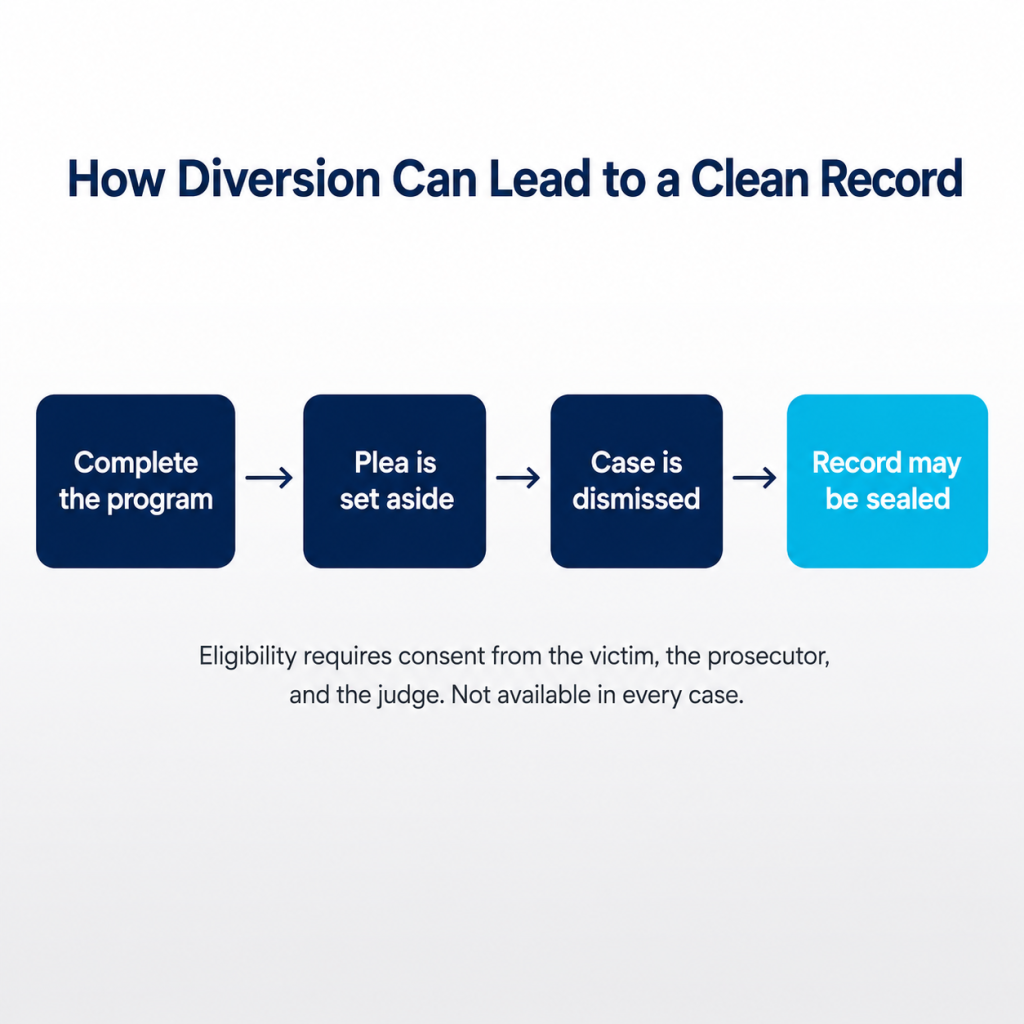
Diversion is not available to everyone. Cases involving serious injuries, prior felony convictions, or aggravated charges generally do not qualify. The Hillsborough County program operates under the local State Attorney’s Office, and acceptance is discretionary in every case. Across all of our Hillsborough County criminal defense work, diversion is one tool among several, not a default.
The Parallel Civil Injunction Process
In addition to the criminal case, an alleged victim can petition the circuit court for a civil injunction for protection against domestic violence under Florida Statute § 741.30. The injunction case is separate from the criminal case. It uses a lower standard of proof (preponderance of the evidence rather than beyond a reasonable doubt), and it can result in:
- A no-contact order
- Exclusive use of the residence
- A firearm surrender requirement
- Restrictions on child timesharing
- A mandatory Batterers’ Intervention Program
A respondent can be enjoined even when the criminal charges are ultimately dismissed or never filed. Conversely, the criminal case can resolve in the defendant’s favor while the injunction stays in place. These two cases are litigated separately, on different timelines, and require their own defense strategies.
No-Contact Orders, Pretrial Release, and Why You Should Not Reach Out
When a person is arrested for domestic violence battery, the court typically enters a no-contact order at first appearance under Florida Statute § 903.047. The order prohibits any contact with the alleged victim, including calls, texts, social media messages, and contact through third parties.
A willful violation is a separate first-degree misdemeanor under § 741.29, and the person violating the order is held in custody until first appearance on the new charge. A violation also strips away the Confrontation Clause protections of Crawford and Davis under the “forfeiture by wrongdoing” doctrine. If the State can show the defendant procured the witness’s unavailability through intimidation or pressure, the defendant loses the right to object to their out-of-court statements.
We see this dynamic constantly. A client wants to call to apologize, to coordinate childcare, or to retrieve belongings. Each of those calls can become a new charge and can hand the State a piece of evidence that lets them prove the underlying case. Modification of the no-contact order has to go through the court. It cannot be done by agreement between the parties.
Permanent Consequences of a Domestic Violence Battery Conviction
The reason this charge cannot be treated like a typical misdemeanor has very little to do with the maximum jail sentence and almost everything to do with the collateral consequences:
Federal firearm prohibition. Under 18 U.S.C. § 922(g)(9), the Lautenberg Amendment, a misdemeanor conviction for a crime of domestic violence triggers a lifetime federal prohibition on possessing or receiving firearms or ammunition. As documented by the U.S. Marshals Service, the rule reaches even federal deputies who carry firearms in the course of their official duties. There is no carve-out for law enforcement, military, or hunters.
Immigration consequences. Under 8 U.S.C. § 1227(a)(2)(E), a noncitizen convicted of a “crime of domestic violence” is deportable. The conviction can also bar cancellation of removal and DACA. Plea language matters enormously here. Florida simple battery can be committed by mere unwanted touching, and a careful record of conviction can sometimes avoid the federal “crime of violence” element.
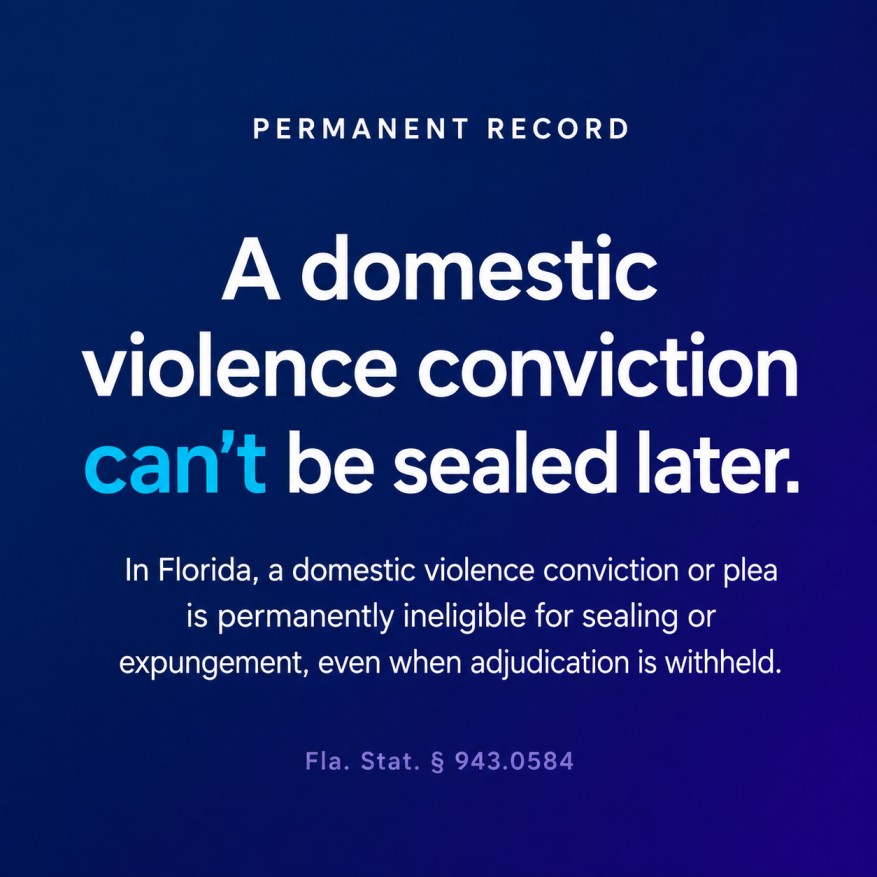
Permanent record. Under Florida Statute § 943.0584, domestic violence offenses are permanently ineligible for sealing or expungement. That bar applies even when adjudication is withheld. A guilty or no-contest plea, even with a withhold, creates a permanent, public record that cannot be cleaned up later.
Employment and licensing. The record appears on background checks indefinitely. It can affect professional licenses, including nursing, teaching, real estate, healthcare, and any role requiring federal clearance.
Custody and family law consequences. A domestic violence finding affects timesharing, parental responsibility, and the outcome of pending family court matters.
Mandatory programming and probation. One year minimum probation, the 29-week Batterers’ Intervention Program at the defendant’s expense, mandatory jail time when bodily harm is involved, and ongoing court costs.
This is why pleading guilty to “just get it over with” is rarely the answer in a domestic violence case. The day the case ends is not the day the consequences end.
Sealing or Expungement After Dismissal or Acquittal
When a domestic violence case is dismissed, nolle prossed, or ends in acquittal, the arrest record can be sealed or expunged under Florida’s general sealing and expungement statutes. The dismissal is what creates eligibility. A conviction, or a plea with adjudication withheld to a domestic violence offense, is permanently barred under § 943.0584.
That fact drives strategy. When dismissal is achievable through pre-file advocacy, motion practice, or trial, the case can ultimately be removed from the record. When the only realistic path is a plea, the focus shifts to negotiating a plea to a non-domestic-violence offense not listed in § 943.0584, such as disorderly conduct under § 877.03, breach of peace, or a non-DV simple battery where the relationship element does not qualify. A plea to a non-listed offense preserves sealing eligibility and avoids the federal Lautenberg disability.
In a domestic violence case, the label on the plea is what controls the rest of a person’s life. The wrong label triggers the Lautenberg firearm prohibition, immigration consequences, and a record that cannot be sealed.
What to Do If You Have Been Charged
The hours and days after a domestic violence arrest are some of the most important in the case. A few practical steps:
- Do not contact the alleged victim, in any form, through any channel, until the no-contact order is modified by the court. This includes social media and contact through friends or family.
- Do not give a statement to law enforcement or prosecutors without an attorney present. The right to remain silent applies whether or not Miranda warnings have been read.
- Preserve evidence. Save text messages, voicemails, photos, and any video that relates to the relationship or the incident. Do not delete anything from your phone.
- Identify witnesses. Anyone who saw the incident, was in the home, or has knowledge of the relationship dynamics may be relevant.
- Document your injuries. If you were the one who was struck, photograph any marks before they fade and seek medical attention if appropriate.
- Get an attorney involved quickly. The pre-file window is short, and the early decisions made in the case shape the entire defense strategy.
The Brancato Law Firm represents people charged with domestic violence battery, aggravated domestic battery, domestic battery by strangulation, and injunction violations across Hillsborough, Pinellas, and Pasco Counties. Rocky Brancato spent more than two decades in major-crimes work at the Hillsborough County Public Defender’s Office before founding the firm, and the firm’s Tampa domestic violence defense practice draws directly on that institutional experience. For broader background on the underlying offense, see our overview of battery charges in Florida.
If you have been arrested or are under investigation for domestic violence battery in the Tampa Bay area, call (813) 727-7159 for a free, confidential consultation. The earlier we get involved, the more options remain on the table.
Each case is unique. Past results do not guarantee future outcomes. The information in this article is for general educational purposes and does not constitute legal advice. Reading this article does not create an attorney-client relationship.
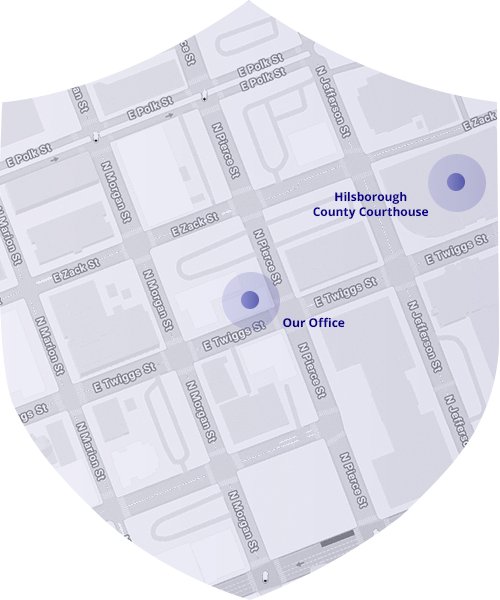
Visit Us

Tampa, FL 33602
Contact Us Now
Free Legal Consultation (813) 727-7159