- Free Consultation 24/7: (813) 727-7159 Tap Here To Call Us


From First DUI to Death Penalty



Florida’s 10-20-Life Law Explained: What 775.087 Means for Your Case


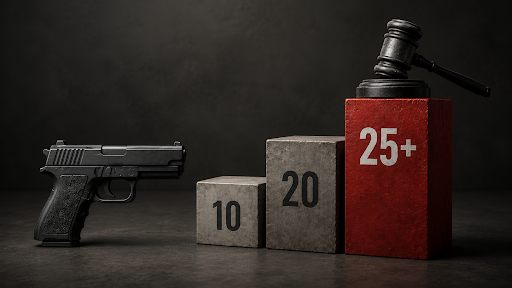
Florida’s 10-20-Life law, codified at Florida Statute § 775.087, imposes three mandatory minimum prison sentences when a firearm is used during certain enumerated felonies: 10 years for possessing or displaying a firearm, 20 years for discharging it, and 25 years to life if the discharge causes great bodily harm or death. There is no parole, no gain time, and no judicial discretion to sentence below the floor. The Brancato Law Firm brings more than 25 years of defense-side experience to firearm-enhanced felony cases across Hillsborough, Pinellas, and Pasco Counties, and the single most important thing to understand is that the mandatory minimum is the floor, not the ceiling. The fight to avoid it happens before sentencing, in the charging, investigation, and negotiation phases of the case.
If a prosecutor or deputy mentioned 10-20-Life in connection with your case or your family member’s case, you are looking at one of the harshest sentencing structures in Florida law. This article explains how the statute actually works, which felonies trigger it, how the 2014 and 2016 reforms changed the picture, how the law interacts with self-defense and Stand Your Ground, and the strategies that move a case off the mandatory floor.
What Is Florida’s 10-20-Life Law?
Florida’s 10-20-Life law is the popular name for Florida Statute § 775.087, titled “Possession or use of weapon; aggravated battery; felony reclassification; minimum sentence.” It took effect on July 1, 1999 under the slogan “Use a gun, and you’re done,” and was the centerpiece of then-Governor Jeb Bush’s anti-violent-crime agenda.
The statute does two things that defendants and their families need to understand separately:
- Felony reclassification (subsection 1). When a weapon or firearm is used during the commission of any felony where the weapon is not already an essential element, the statute “bumps up” the charge by one degree. A third-degree felony becomes a second-degree felony. A second-degree becomes a first-degree. A first-degree becomes a life felony.
- Mandatory minimum sentences (subsections 2 and 3). When a firearm or destructive device is used during one of the enumerated qualifying felonies, the court must impose 10, 15, 20, or 25-years-to-life depending on what was done with the firearm and what kind of firearm it was.
The companion provision at Florida Statute § 27.366 makes the legislative intent explicit: the Legislature wanted “zero tolerance” for firearm use in the listed felonies, and it instructed prosecutors to apply the mandatory minimums except in cases where the firearm was “incidental” rather than used in furtherance of the crime.
A few features make 10-20-Life unusually harsh compared to ordinary Florida sentencing:
- The minimum mandatory must run consecutively to any other sentence in the case.
- The defendant is statutorily ineligible for gain time, parole, or any form of discretionary early release.
- The mandatory minimum applies even if it exceeds the statutory maximum for the underlying felony.
- A judge cannot sentence below the floor, regardless of mitigating factors. Only the prosecutor can waive it.
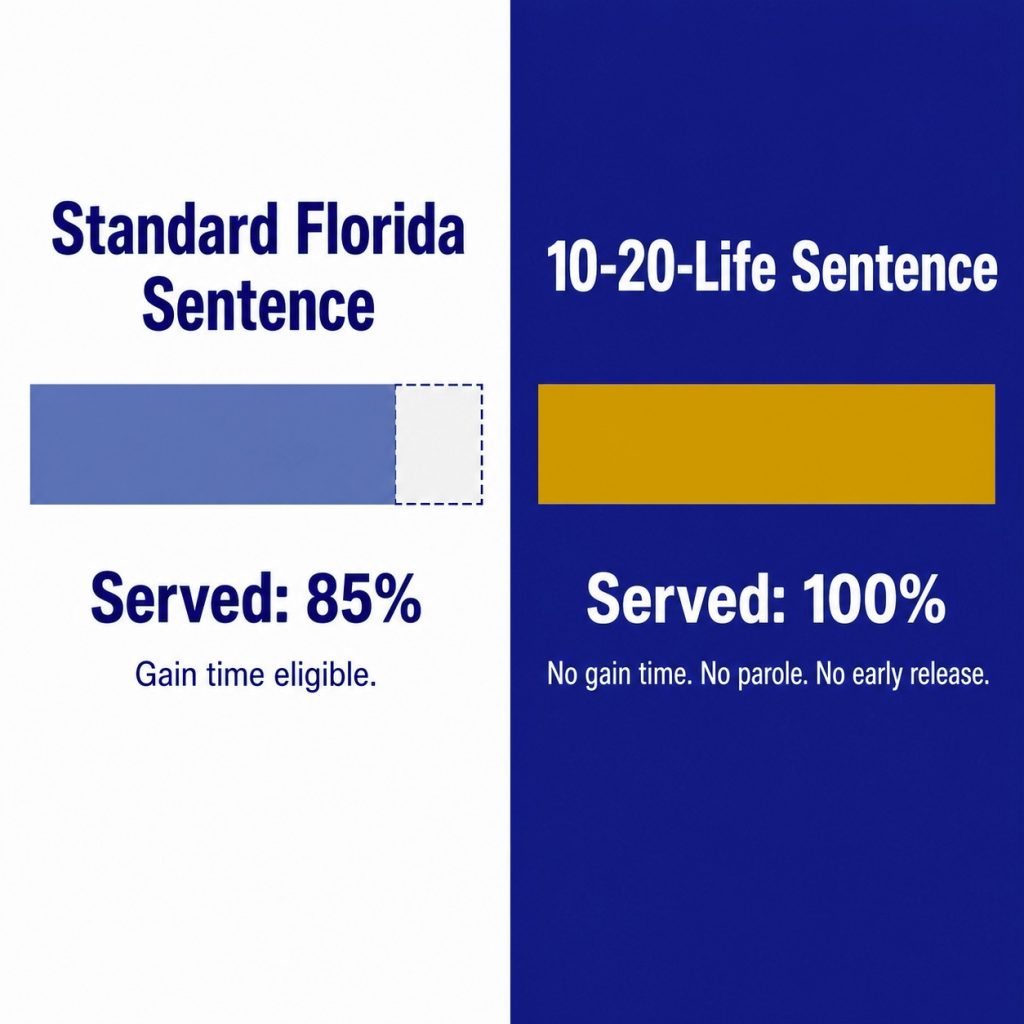
Florida abolished parole decades ago, so most prison sentences are served at 85 percent. A 10-20-Life sentence is served at 100 percent, day for day.
The Three Mandatory Minimum Tiers
The basic structure of § 775.087(2) breaks the mandatory minimum into three tiers based on what the defendant did with the firearm during a qualifying felony.
| Conduct during a qualifying felony | Mandatory minimum |
| Actual possession, carrying, displaying, using, threatening to use, or attempting to use a firearm or destructive device | 10 years |
| Discharging a firearm or destructive device | 20 years |
| Discharging a firearm or destructive device that causes death or great bodily harm | 25 years to life |
There is also an enhanced tier under § 775.087(3) for semiautomatic firearms with high-capacity detachable box magazines or machine guns: 15 years for possession, 20 years for discharge, and 25 years to life if the discharge causes injury or death.
A reduced 3-year tier exists within § 775.087(2)(a)1. It applies in place of the 10-year minimum for possession of a firearm by a felon, burglary of a conveyance, and (for offenses occurring before July 1, 2016) aggravated assault.
A few practical points that often get missed:
- Possession alone is enough. You do not have to fire the gun, point it at someone, or even say anything threatening. Carrying it during the commission of a qualifying felony triggers the 10-year minimum.
- “Displaying” is broad. Showing the firearm during the felony qualifies, even briefly.
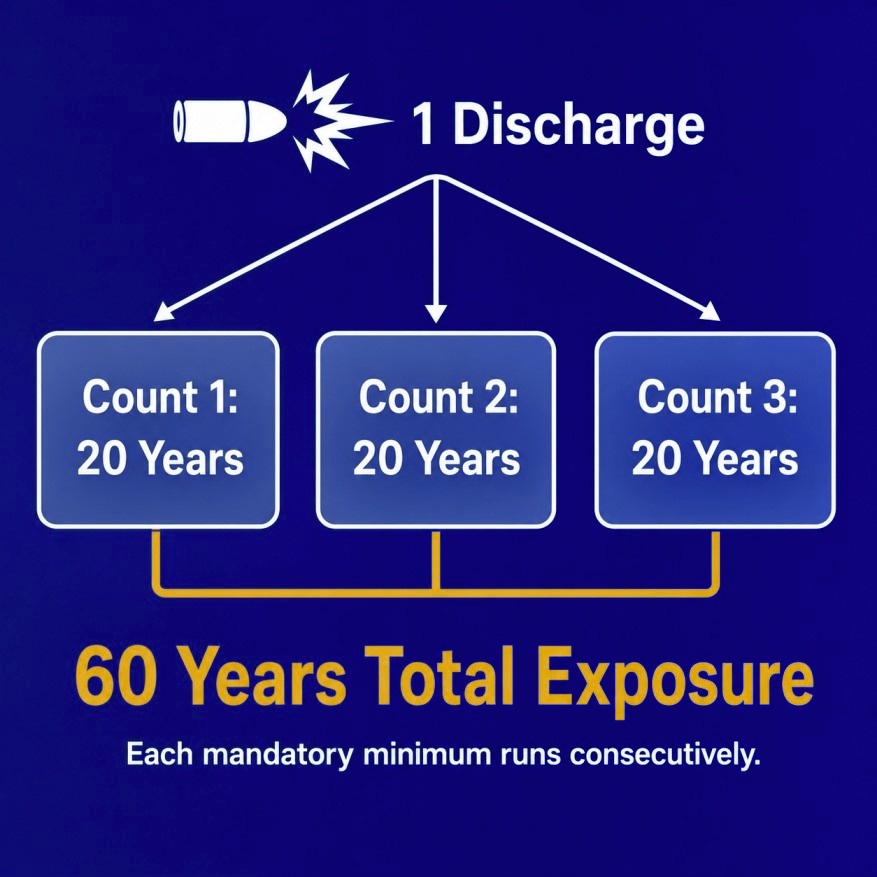
- Each count is separate. If multiple people are present during the qualifying felony, the State can file separate counts and stack the mandatory minimums consecutively. The Marissa Alexander case, discussed below, exposed how a single act of firing a single shot was charged as three separate counts, exposing her to a 60-year stack.
Which Felonies Trigger 10-20-Life?
The mandatory minimums only apply when a firearm is used during one of the enumerated felonies in § 775.087(2)(a)1. The current list, after the 2016 reform that removed aggravated assault, includes:
- Murder
- Sexual battery
- Robbery
- Burglary
- Arson
- Aggravated battery
- Kidnapping
- Escape
- Sale, manufacture, delivery, or intent to sell, manufacture, or deliver any controlled substance
- Aircraft piracy
- Aggravated child abuse
- Aggravated abuse of an elderly person or disabled adult
- Unlawful throwing, placing, or discharging of a destructive device or bomb
- Carjacking
- Home-invasion robbery
- Aggravated stalking
- Trafficking in cannabis, cocaine, illegal drugs, phencyclidine, methaqualone, or amphetamine under § 893.135
- Possession of a firearm by a felon (lower 3-year tier)
Charges that are not on this list, including standalone aggravated assault for any offense after July 1, 2016, do not trigger the 10-20-Life mandatory minimums. They may still carry serious penalties under other Florida statutes, but the day-for-day mandatory floor of § 775.087 does not attach.
This list is the single most important diagnostic tool when 10-20-Life is mentioned in a case. If the charged felony is on the list and a firearm was involved, the exposure is real. If the felony is not on the list, the charging document needs careful reading to determine what the prosecutor is actually relying on.
What Changed in 2014 and 2016
For roughly the first 15 years of the law, Florida courts had no statutory off-ramp for self-defense cases that swept up sympathetic defendants. That changed after a series of high-profile cases, most notably the Marissa Alexander case in Jacksonville, exposed how the statute was being applied to people who had fired warning shots in self-defense without injuring anyone.
The 2014 and 2016 reforms are frequently confused with each other in popular summaries. They are different statutes with different effects.
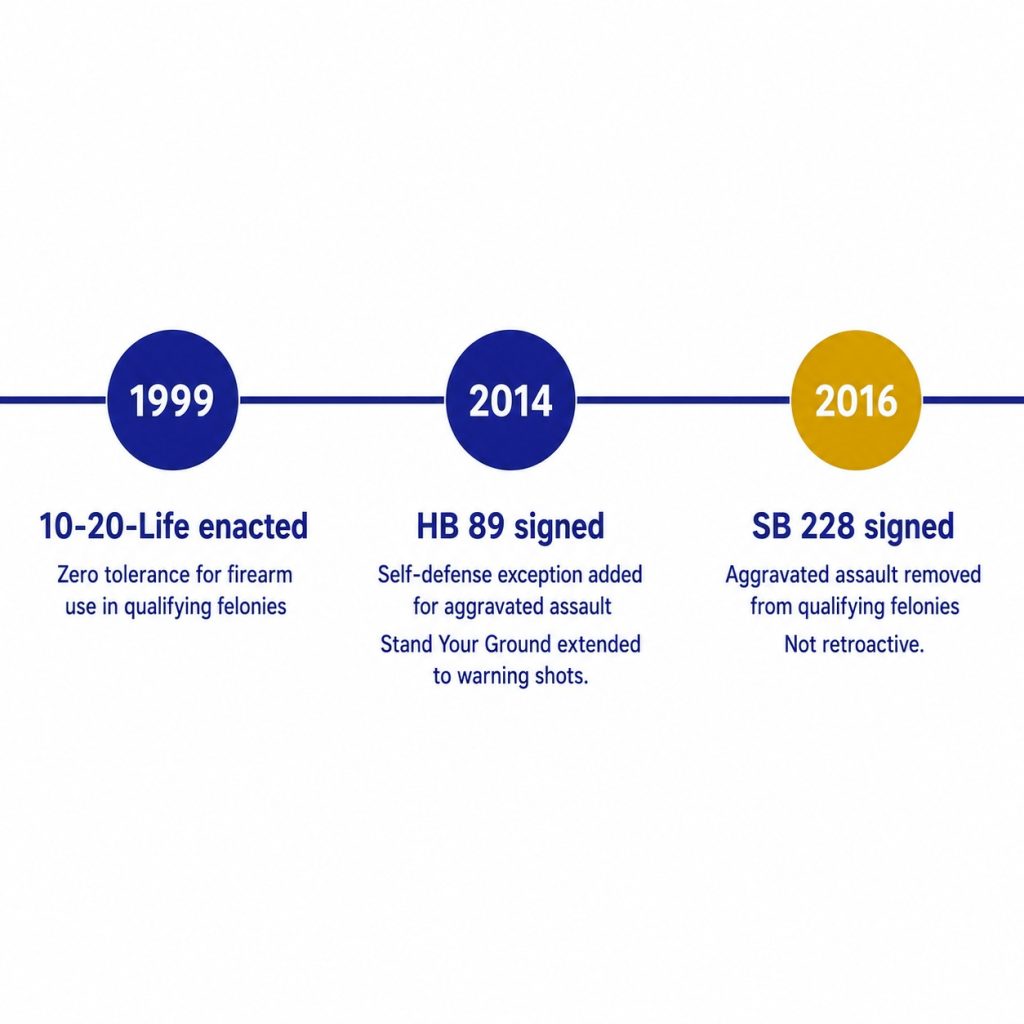
HB 89 (2014), the “Threatened Use of Force Act.” Signed by Governor Rick Scott in June 2014, this bill added a self-defense exception at § 775.087(6) that allowed a court to depart from the aggravated assault mandatory minimum if it made four findings on the record: that the defendant had a good-faith belief the assault was justifiable under Chapter 776, that the assault was not committed during another criminal offense, that the defendant did not pose a threat to public safety, and that the totality of the circumstances did not justify the mandatory sentence. HB 89 also extended Florida’s Stand Your Ground framework to threatened use of force, including warning shots. The 2014 law applied retroactively, allowing then-incarcerated prisoners to seek clemency review.
SB 228 (2016). Signed in February 2016 and effective July 1, 2016, this bill removed aggravated assault entirely from the list of qualifying felonies in § 775.087(2)(a)1. The 10, 15, 20, and 25-to-life mandatory minimums no longer apply to standalone aggravated assault charges in Florida. The 2014 self-defense carve-out at § 775.087(6) became largely moot once aggravated assault was removed from the list.
The most important caveat: SB 228 was not retroactive. People sentenced under 10-20-Life for aggravated assault before July 1, 2016 are still serving those sentences. As Families Against Mandatory Minimums noted at the time of the bill’s signing, the 2016 law was the first time Florida had repealed a mandatory minimum sentence in more than 20 years, but the change did not benefit people already serving 10-20-Life sentences for aggravated-assault-with-a-firearm convictions.
If you or a family member is facing standalone aggravated assault in Florida today, 10-20-Life is no longer in play for that charge. If you are dealing with a pre-2016 conviction, the path forward is clemency or post-conviction relief, not the statute itself. Read more about aggravated assault charges in Florida to understand current sentencing exposure.
How 10-20-Life Interacts With Stand Your Ground
Florida’s Stand Your Ground framework under §§ 776.012, 776.013, and 776.032 provides immunity from criminal prosecution if the defendant reasonably believed the use or threatened use of force was necessary to prevent imminent death or great bodily harm. The 2014 expansion confirmed that Stand Your Ground covers the threatened use of force, including displaying a firearm or firing a warning shot.
The interaction with 10-20-Life is straightforward and brutal. Stand Your Ground, if successfully invoked at a pretrial immunity hearing, is a complete defense. The case ends. There is no conviction, and 10-20-Life never attaches. If the immunity motion is denied or never filed, the case proceeds, the jury can still reject the self-defense theory at trial, and 10-20-Life can apply to whatever qualifying felony the jury convicts on.
What this means in practice:
- The Stand Your Ground hearing is decided on a preponderance of the evidence, which is a much lower standard than reasonable doubt. A defendant who can establish self-defense more likely than not at the immunity hearing is immune from prosecution.
- A failed immunity motion still preserves self-defense at trial. The same evidence can be presented to the jury, where the burden flips to the State to disprove self-defense beyond a reasonable doubt.
- Strategic timing matters. Filing the immunity motion before discovery is complete can lock in a weaker record. Filing late can cost leverage. The decision is case-specific.
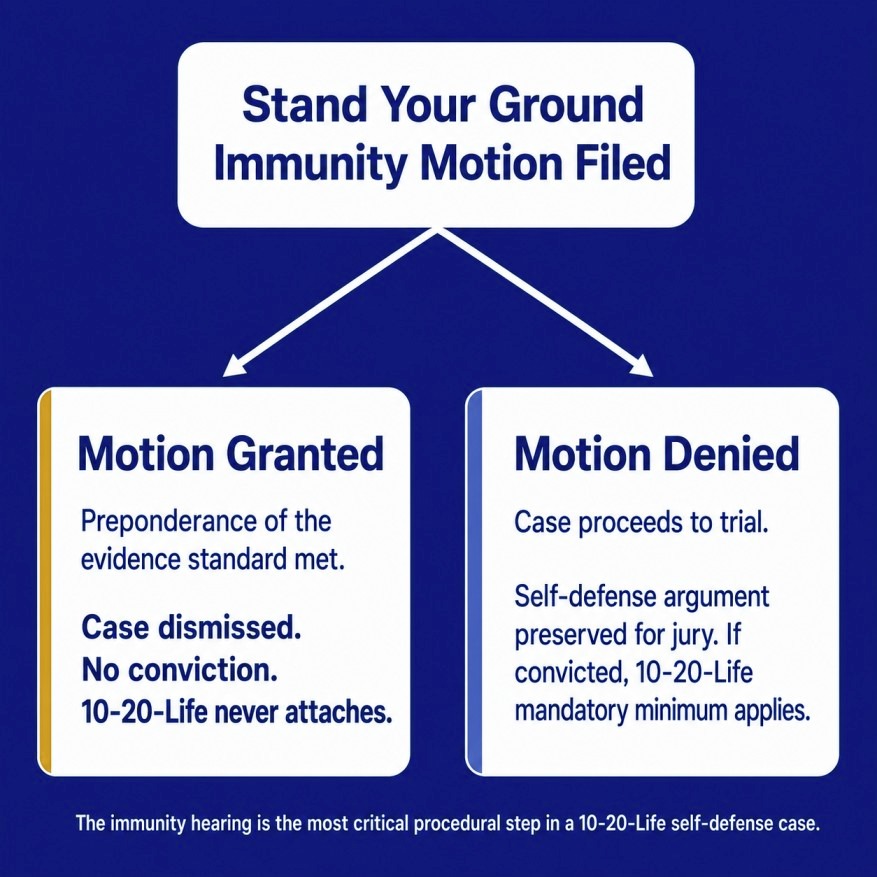
The Marissa Alexander, Orville Lee Wollard, and Erik Weyant cases that drove the 2014 and 2016 reforms all involved defendants who believed they had viable self-defense arguments, lost their pretrial immunity motions or never had them properly evaluated, went to trial, and got hit with the 20-year mandatory minimum. Stand Your Ground is a critical motion that has to be litigated carefully from the earliest stages of the case.
Why the Mandatory Minimum Is the Floor, Not the Ceiling
This is the single most misunderstood feature of 10-20-Life. The statute sets the minimum sentence the court must impose. It does not cap the sentence.
A few examples of how this plays out:
- Multiple counts stack consecutively. As the Florida appellate court confirmed in the Marissa Alexander case, when a single act of firearm use endangers multiple people, the State can charge separate counts of a qualifying felony, and each count carries its own mandatory minimum that must run consecutively. One trigger pull, three people in the room, three 20-year minimums equals a 60-year exposure.
- Discharge causing death triggers 25 to life. The top tier ranges from a hard 25-year minimum all the way to life. A jury convicting on the underlying felony plus the discharge-with-death finding does not cap the sentence at 25.
- The mandatory must be served before any other sentence in the case. It runs consecutively to anything else.
According to a Florida Department of Corrections analysis of the law’s first six years, reproduced at Encyclopedia.com, 154 felons whose longest 10-20-Life mandatory was 10 years still received total sentences of life in prison. More than 45 percent of felons who injured or killed a victim with a firearm (the 25-year-to-life tier) received life sentences.
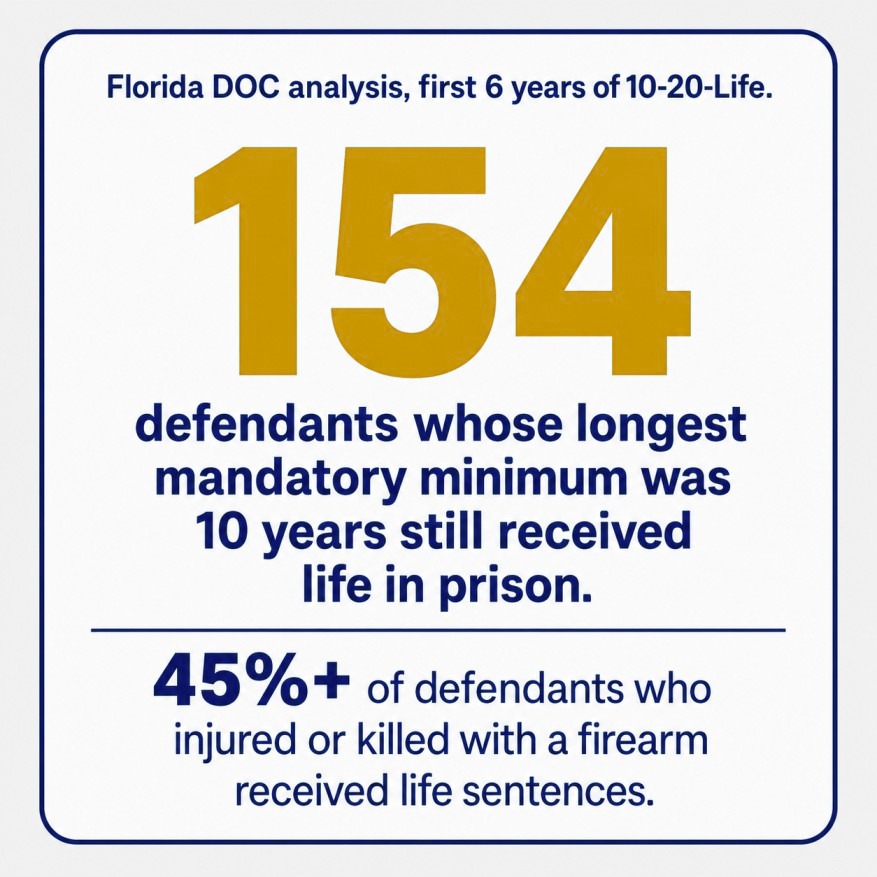
The 10-year tier is where the sentence begins. Where it ends depends on the underlying felony, the State’s charging decisions, and the judge’s discretion above the floor.
How Prosecutors Use 10-20-Life as Leverage
Because only the prosecutor can waive the mandatory minimum, and because the gap between a plea offer and a trial conviction can be enormous, 10-20-Life creates extraordinary plea pressure on defendants. Florida law (§ 27.366) requires a prosecutor who declines to apply the mandatory minimum in a qualifying case to file a written explanation in the case file. That requirement was designed to encourage application of the statute.
A typical leverage dynamic looks like this. The defendant is charged with a qualifying felony with a firearm enhancement. The State opens with a plea offer that may be 3, 5, or 7 years, depending on the facts. The trial exposure, if convicted, is the mandatory minimum on top of the underlying felony, often 20 years, served day for day. The defendant who believes they are innocent or has a viable defense faces a stark choice: take the plea, or risk the trial penalty.
The cases that drove the 2014 and 2016 reforms, including Orville Lee Wollard’s 20-year sentence for firing a warning shot in his own home, all featured defendants who turned down low pleas in good-faith reliance on self-defense arguments and got hit with the full mandatory at trial.
This is why early attorney involvement matters more on a 10-20-Life case than almost any other charge. The negotiating window is real, and it closes quickly. The decisions made in the first few weeks, including whether to talk to police, whether to file pre-file advocacy with the State Attorney’s Office, what to lock into the bond record, and how to position the case for a Stand Your Ground motion, often determine whether the case ends in dismissal, in a plea below the mandatory, or at the floor.
Defense Strategies Against 10-20-Life Charges
A defense attorney’s job on a 10-20-Life case is to defeat the underlying felony, defeat the firearm enhancement, or negotiate the case to a non-qualifying offense before sentencing exposure attaches. Arguing the mandatory minimum at sentencing comes too late. By that point, the fight is over.
The strategies that move 10-20-Life cases off the mandatory floor fall into a few categories.
Self-defense and Stand Your Ground. A successful pretrial immunity motion ends the case before sentencing exposure attaches. The motion is decided on a preponderance of the evidence and requires careful preservation of the factual record from the earliest stages of the case.
Challenging “actual possession.” The 10-year and higher tiers require actual possession. Florida case law defines actual possession narrowly: the firearm must be in the defendant’s hand or on the person, in a container being carried, or so close as to be within ready reach and under the defendant’s control. A firearm found in a vehicle accessible to multiple occupants, or in a shared residence, is generally constructive possession, which can defeat the 10-year minimum even if the defendant is convicted of a lesser firearm offense.
Challenging discharge or great-bodily-harm findings. The 20-year and 25-to-life tiers require the State to prove the firearm was discharged, and for the top tier, that the discharge caused death or great bodily harm. Forensic, ballistic, and medical-causation challenges can collapse the higher tiers and drop the case down to the 10-year possession floor or below.
Suppression of evidence. Because possession of the firearm is the gateway to the enhancement, motions to suppress under the Fourth Amendment, challenging the legality of the stop, the search, the warrant, or the chain of custody, can eliminate the firearm from evidence and collapse the entire enhancement.
Mistaken identity. Many shooting cases turn on eyewitness identification, which is a known source of wrongful conviction. Pretrial motions to suppress unreliable identifications, expert testimony on eyewitness reliability, and alibi evidence are standard tools.
Charge bargaining to a non-qualifying offense. Because only the prosecutor can waive the mandatory, the most direct path off the floor is often a negotiated plea to a non-enumerated felony or a reduced firearm-display charge under § 790.10. Post-2016 aggravated assault is no longer on the qualifying list, which has given defense attorneys more room to negotiate in cases that previously had none.
Youthful offender designation. A defendant who is 20 or younger at sentencing may qualify for sentencing as a Youthful Offender under Florida Statute § 958.04, which caps incarceration and supervision at six years and allows a judge to override the 10-20-Life minimum. This requires judicial discretion to invoke, and the threshold question is eligibility.
The right strategy in any individual case depends on the specific facts, the charging decisions of the State Attorney, and Florida case law that has developed under § 775.087. There is no template. There are only options, and the value of an experienced criminal defense attorney is in knowing which combination of options actually fits the case.
Why Early Attorney Involvement Is Non-Negotiable
The 10-20-Life cases that resolve well almost always share one feature: the defense was active before charges were filed, before the bond hearing locked in the wrong record, and before the defendant said anything to police that closed off later options.
At The Brancato Law Firm, our gun and weapons crimes practice is built around the reality that the negotiating window on these cases is short and the stakes are permanent. Rocky Brancato served as Chief Operations Officer of the Hillsborough County Public Defender’s Office, leading the largest criminal defense operation in Tampa Bay. That system-level knowledge of how charging decisions are made, where prosecutors have flexibility, and where they do not, informs every 10-20-Life case the firm handles. Rocky has tried more than 150 jury trials to verdict and is death-qualified under Rules of the Florida Supreme Court, a credential that reflects the rigorous standards required for the most serious criminal matters.
The pre-file window, the suppression motion, the Stand Your Ground motion, and the charge-bargaining conversation all happen on a clock. The defendant who hires counsel after the State has filed a 20-year exposure is fighting from behind. The defendant who hires counsel in the days after arrest, before the State has committed to a charging theory, has options that close the longer they wait.
For more, see our post on aggravated battery with a firearm.
Frequently Asked Questions About 10-20-Life
Does 10-20-Life apply to every gun crime in Florida?
No. 10-20-Life only applies when a firearm is used during one of the enumerated felonies in § 775.087(2)(a)1. Possession of a firearm without a connection to a qualifying felony, improper exhibition under § 790.10, and standalone aggravated assault for offenses after July 1, 2016 are not 10-20-Life cases.
Can a judge sentence me below the 10-20-Life mandatory?
Generally no. With limited exceptions for youthful offender designation under § 958.04, judges have no discretion to sentence below the mandatory minimum. Only the prosecutor can waive it.
What does “actual possession” mean for 10-20-Life?
Actual possession under Florida law means the firearm is in your hand, on your person, in a container you are carrying, or within your immediate ready reach and control. A firearm found in a shared vehicle or shared residence is generally constructive possession, which can defeat the 10-year mandatory minimum even on a conviction for a lesser firearm offense.
Is the 2016 aggravated assault reform retroactive?
No. SB 228 (2016) removed aggravated assault from the list of 10-20-Life qualifying felonies effective July 1, 2016, but the change does not apply to people already sentenced under the prior law. The 2014 self-defense exception under HB 89 was retroactive, but the 2016 repeal was not.
Can Stand Your Ground get a 10-20-Life case dismissed?
Yes, if the immunity motion succeeds. A successful pretrial Stand Your Ground motion under § 776.032 ends the prosecution before any sentencing exposure attaches. The motion is decided on a preponderance of the evidence and requires preservation of the factual record from the earliest stages of the case.
Will I serve 100 percent of a 10-20-Life sentence?
Yes. People sentenced under 10-20-Life are statutorily ineligible for gain time, parole, or any form of discretionary early release. The minimum is served day for day, and it runs consecutively to any other sentence in the case.
Talk to a Criminal Defense Attorney About Your 10-20-Life Exposure
If you or a family member is facing a felony charge in Hillsborough, Pinellas, or Pasco County and a firearm is involved, the time to act is now, before the State commits to a charging theory. The Brancato Law Firm offers free, confidential consultations and is available 24/7 for arrest emergencies. Call (813) 727-7159 to talk through your case with an experienced criminal defense attorney.
Each case is unique. Past results do not guarantee future outcomes.
Visit Us
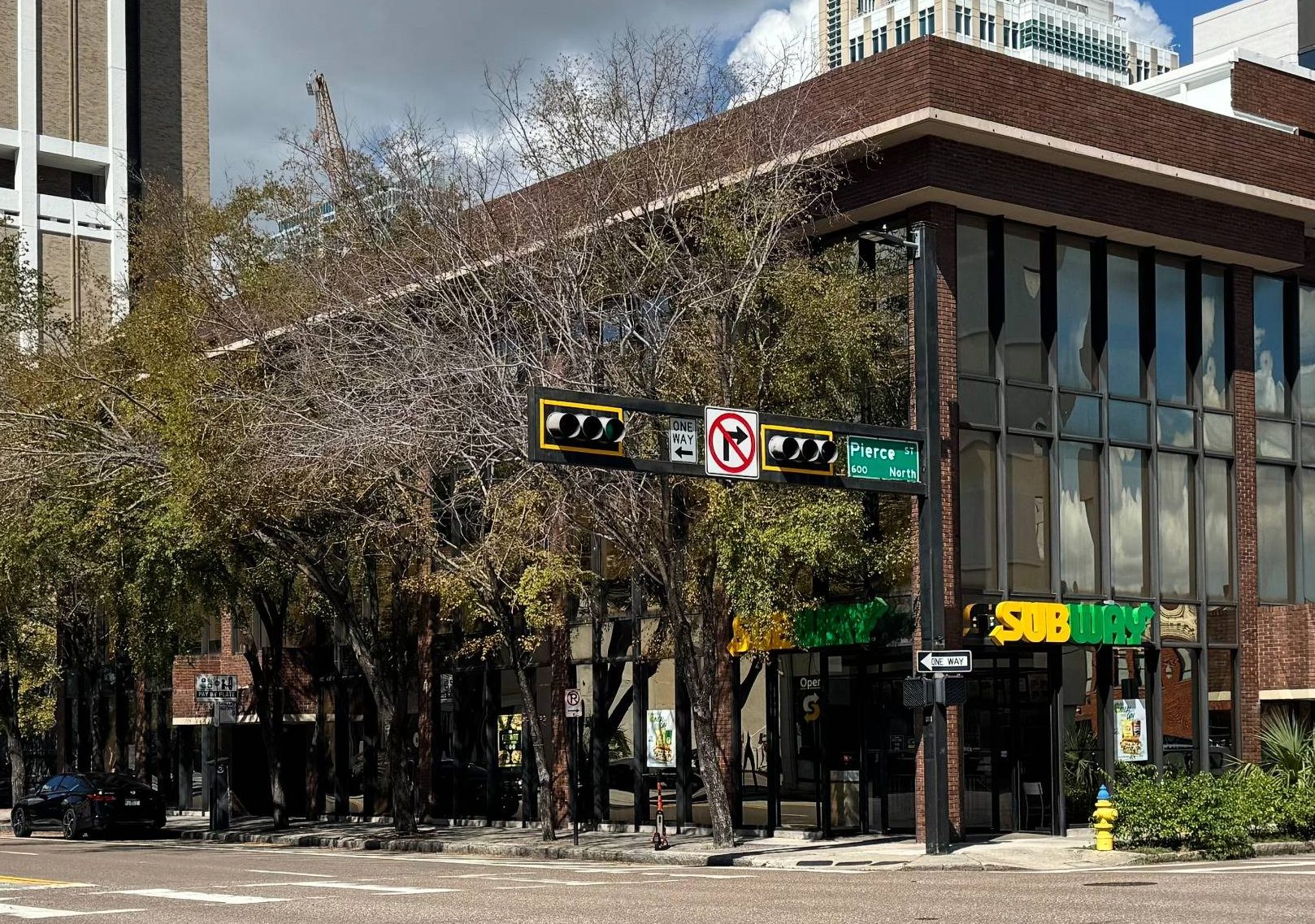
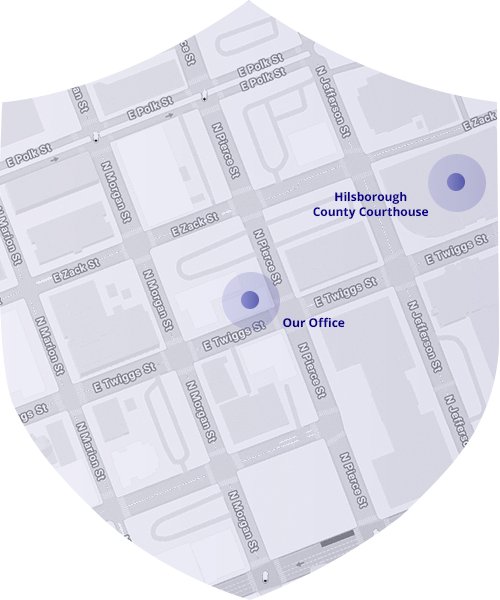
Tampa, FL 33602
Contact Us Now
Free Legal Consultation (813) 727-7159