- Free Consultation 24/7: (813) 727-7159 Tap Here To Call Us


From First DUI to Death Penalty



Can a DUI Arrest Affect Child Custody in Florida? (2026)



Updated November 14, 2026. Originally published June 2025.
| Yes, a DUI arrest can affect child custody in Florida, but it rarely changes a parenting plan by itself. Florida family judges decide time-sharing by the child’s best interests under section 61.13, and one listed factor is each parent’s ability to keep a home free from substance abuse. A first DUI with no child in the car usually matters little, while a DUI with a child in the vehicle, a crash, a very high breath result, or a pattern of drinking can lead to supervised time-sharing, alcohol monitoring, or a petition to modify. How the criminal case is handled often decides how much the family court ever hears about it. |
If you were arrested for DUI and you share children with an ex, the arrest report can reach family court long before your criminal case is over. As founder of The Brancato Law Firm, P.A., a Tampa criminal defense firm, I am a member of the National College for DUI Defense and a former police academy instructor, and I have spent more than 25 years in Hillsborough County courtrooms. Our attorneys defend the DUI with the parenting case in mind: we limit what the criminal record says, so there is less for a co-parent to use.
Our firm does not handle family law. We defend the criminal case and, when a parent needs custody counsel, we refer them to a family law attorney and coordinate so the two cases do not work against each other.
Can a DUI arrest change child custody in Florida?
A DUI arrest can change child custody in Florida only if a family judge finds that it affects the child’s best interests. Florida no longer uses the word “custody” in its statutes. Judges set “parental responsibility” and a “time-sharing schedule” inside a parenting plan under section 61.13, Florida Statutes.
Section 61.13 starts with a rebuttable presumption that equal time-sharing is in a child’s best interests. A parent who wants to cut the other parent’s time must prove by a preponderance of the evidence that equal time-sharing is not in the child’s best interests. A DUI arrest is one piece of evidence a co-parent can offer for that purpose. It is not an automatic disqualifier, and the statute contains no DUI-specific rule.
What do Florida family judges look at after a DUI?
Florida family judges look at the best-interest factors in section 61.13(3), and three of them come into play most often after a DUI. The statute lists more than 20 factors. The ones a DUI touches are these:
| Factor | What it means after a DUI arrest |
|---|---|
| A home free from substance abuse | The judge asks whether the arrest reflects a drinking problem or a one-time mistake. |
| Moral fitness of each parent | A single misdemeanor arrest carries little weight here; a pattern of arrests carries more. |
| Mental and physical health | Treatment records, evaluations, and monitoring results can answer this factor. |
| Evidence of neglect | Driving impaired with a child in the car can be argued as neglect. |
| Capacity to follow the parenting plan | Jail time, license suspension, and lost transportation can affect a parent’s ability to keep the schedule. |
The substance-abuse factor is the one that matters most. Section 61.13(3)(q) asks about “the demonstrated capacity and disposition of each parent to maintain an environment for the child which is free from substance abuse.” A family judge reads the DUI arrest report, the breath or blood result, and any later conduct to answer that question.
When does a DUI lead to supervised time-sharing or a modification?
A DUI usually leads to supervised time-sharing or a modification only when the facts show a risk to the child. The facts that most often move a family judge are these:
- A child was in the car at the time of the arrest.
- The DUI involved a crash, an injury, or property damage.
- The breath or blood alcohol level was 0.15 or higher.
- It is a second or later DUI, or there is other evidence of a drinking problem.
- The parent violated a bond condition, such as drinking while on pretrial release.
To change an existing parenting plan, the co-parent must show “a substantial and material change in circumstances” and that the change is in the child’s best interests, as section 61.13(3) requires. A single first-offense DUI with no child present often does not meet that bar. A DUI with a child in the backseat often does.
What happened when a Florida father crashed with his children in the car?
In Healy v. Healy, No. 4D2024-1087 (Fla. 4th DCA Apr. 23, 2025), a father who was intoxicated crashed into a parked car while his children were in the backseat. He was charged with DUI, DUI with property damage, and child neglect without great bodily harm. The opinion shows how fast and how far a family court can move after an arrest like that.
The mother filed an emergency motion in February 2022, and the trial court suspended the father’s time-sharing and gave the mother temporary sole parental responsibility. Five months later, the parents agreed to supervised visits twice a week, with the father using a Soberlink remote alcohol-testing device before each visit. Overnight visits followed in November 2022. Shared parental responsibility and 50-50 time-sharing were not restored until October 2023. The mother held sole parental responsibility for 20 months.
The appeal itself was about a school-enrollment dispute, and the Fourth District ruled for the mother on that issue. The lesson for parents is the timeline. A DUI with children in the car can cost a parent most of a year and a half of normal time-sharing, even when the parent later earns it back.
Does a family judge have to explain how a parent gets time-sharing back?
Yes. In the Second District, which hears appeals from Hillsborough, Pinellas, and Pasco Counties, a judge who reduces a parent’s time-sharing must give that parent specific steps to restore it. In Perez v. Fay, 160 So. 3d 459 (Fla. 2d DCA 2015), a trial court cut a mother’s supervised time-sharing from two to three hours a week to four hours a month without findings. The Second District reversed. It held that restrictions on time-sharing need competent, substantial evidence that they serve the child’s best interests, and that an order reducing time-sharing must set out the concrete steps the parent must take to reestablish it.
Perez arose from a mental health crisis, not a DUI, but the rule applies to any reduction. For a parent after a DUI, those steps are usually things like completing a substance abuse evaluation, following treatment recommendations, and passing a period of alcohol monitoring. Completing them early shortens the road back. Other districts have questioned whether the steps must always be spelled out, so the rule can differ outside the Second District.
How serious is a DUI with a child in the car in Florida?
A DUI with a child in the car is an enhanced DUI under Florida law, with a higher fine and more possible jail time than a standard first DUI. Under section 316.193(4), Florida Statutes, the same enhanced penalties apply when a driver is accompanied by a person under 18 or has a breath or blood alcohol level of 0.15 or higher.
| Penalty | Standard first DUI | First DUI with a person under 18 in the car |
|---|---|---|
| Fine | $500 to $1,000 | $1,000 to $2,000 |
| Maximum jail | 6 months | 9 months |
| Second conviction fine | $1,000 to $2,000 | $2,000 to $4,000 |
| Second conviction maximum jail | 9 months | 12 months |
Prosecutors can also file a separate child neglect charge under section 827.03, Florida Statutes, as happened in Healy. A neglect charge is a felony and is far more damaging in family court than the DUI alone. For the full penalty picture, see our guide to Florida DUI penalties.
Why do family judges take impaired driving with children seriously?
Family judges take it seriously because the data on child passengers is stark. In 2023, Florida recorded 6,026 impaired-driving crashes and 969 impaired-driving deaths, which was 28.71% of all traffic deaths in the state, according to the Florida Department of Highway Safety and Motor Vehicles’ January 2025 impaired driving report (page 4).
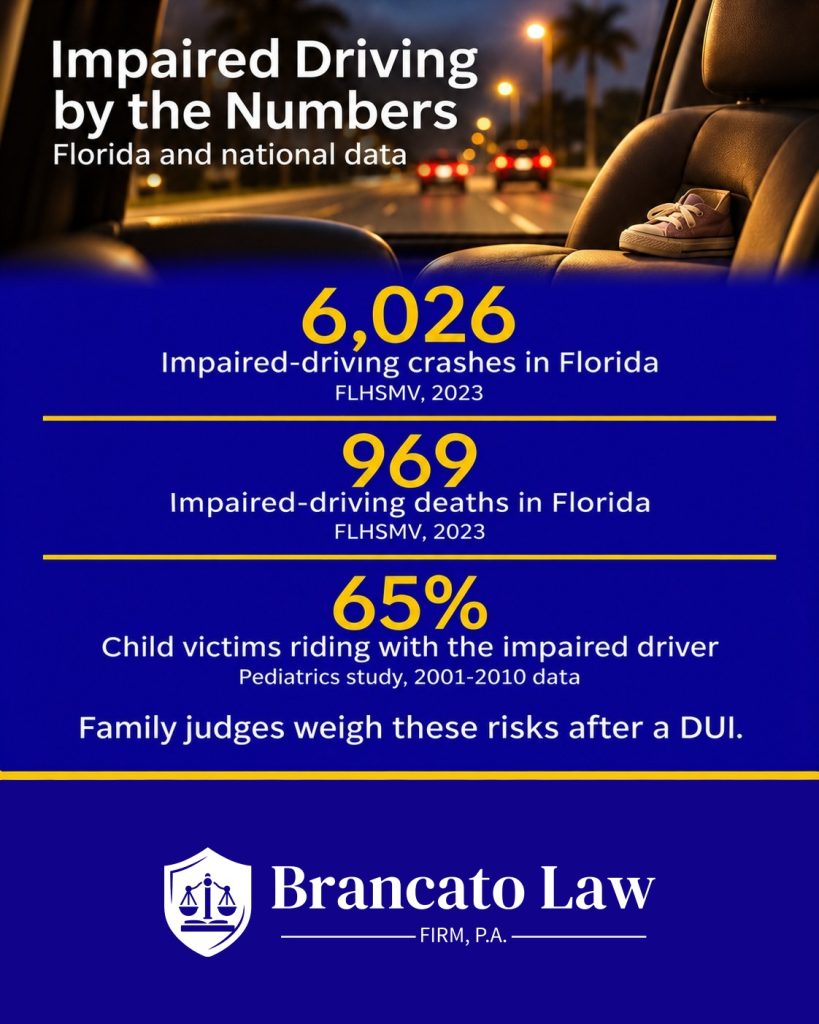
A national study published in Pediatrics in 2014 found that 2,344 children under 15 were killed from 2001 to 2010 in crashes involving at least one alcohol-impaired driver, and 65% of them were riding with the impaired driver. Most of those children were unrestrained. The study, by Quinlan, Shults, and Rudd of the Centers for Disease Control and Prevention, is available in full through PubMed Central. A co-parent’s lawyer may put numbers like these in front of a family judge, which is why the facts of your arrest matter so much.
Do the DUI case and the custody case run separately?
Yes. The DUI case and the custody case are two separate cases in two separate courts. In Hillsborough County, a first or second DUI is a misdemeanor heard in county court, while parenting plans and time-sharing are decided by the family division of the 13th Judicial Circuit. The family judge does not wait for the DUI case to end. An emergency motion to suspend time-sharing can be heard within days of an arrest, as Healy shows.
The two courts also use different standards. The State must prove a DUI beyond a reasonable doubt. A co-parent needs only a preponderance of the evidence in family court, and a family judge can consider the arrest facts even if the DUI is later reduced or dismissed. A dismissal still helps, though, because it removes the conviction and the finding of impairment that a co-parent would otherwise lean on.
| Question | DUI case (criminal) | Custody case (family) |
|---|---|---|
| Who brings it | The State Attorney’s Office | The other parent |
| Court | Hillsborough County Court | 13th Judicial Circuit family division |
| Standard of proof | Beyond a reasonable doubt | Preponderance of the evidence |
| What the judge decides | Guilt and the sentence | The parenting plan and time-sharing |
| Can it move fast? | Arraignment and pretrial over weeks or months | Emergency motions can be heard within days |
After an arrest in Hillsborough County, the driver is booked at the Orient Road Jail and held until the breath alcohol level falls below 0.05, the impairment ends, or 8 hours pass. Our guide to what happens after a DUI arrest in Hillsborough County walks through the rest of the criminal timeline, and our Hillsborough County criminal defense page covers the local courts.
How do our attorneys defend a DUI when custody is at stake?
Our attorneys defend a DUI with custody at stake by attacking the facts a family judge would rely on, not only the charge. Our Tampa DUI lawyer team starts with these steps:

- Challenge the stop. If the officer had no lawful reason to stop the car, a motion to suppress can remove every observation that followed.
- Test the evidence of impairment. We review the video, the field sobriety exercises, and the breath instrument’s maintenance records.
- Contest the child-in-vehicle enhancement. The State must prove a person under 18 was in the car, and the enhancement must be proven, not assumed.
- Negotiate with the custody case in mind. A reduction to reckless driving, often called a “wet reckless,” or a resolution without a finding of impairment gives a co-parent less to use.
- Build the record early. We encourage a voluntary substance abuse evaluation and, where it fits, voluntary alcohol monitoring, which help in both courtrooms.
For a step-by-step look at defenses, see how to fight a DUI charge in Hillsborough County.
What should a parent do in the first week after a DUI arrest?
A parent should protect both cases in the first week, because the first emergency motion often comes within days. These steps help:
- Hire a DUI defense attorney before arraignment. Early work on video and records is what makes a dismissal or reduction possible.
- Request a formal review of your license suspension within 10 days of the arrest, or the right to that hearing is lost. See our guide to protecting your driver’s license after a DUI arrest.
- Do not text, email, or post about the arrest. Messages to a co-parent are evidence in family court.
- Follow every bond condition. A violation, such as drinking on pretrial release, can do more harm in family court than the arrest itself.
- Keep up with your children’s routines. School pickups, appointments, and calls show the stability a family judge looks for.
- Talk to a family law attorney if your co-parent files anything. We can refer you and coordinate on what you say in each case.
For how the DUI case moves from arrest to trial, see our guide to the Florida criminal case process.
Frequently Asked Questions
Can my ex use my DUI arrest against me if I was never convicted?
Yes. A Florida family judge can consider the facts of a DUI arrest even without a conviction, because family court uses a lower standard of proof. The Brancato Law Firm works to get DUI charges dismissed or reduced so the arrest carries as little weight as possible when a co-parent raises it.
Will a first DUI with no child in the car change my time-sharing?
Usually not. A first DUI with no child present, no crash, and no other sign of a drinking problem rarely meets the “substantial and material change” standard to modify a Florida parenting plan. Our attorneys at The Brancato Law Firm still treat the criminal case as if a family judge will read every page, because one may.
What is the penalty for a DUI with a child in the car in Florida?
A first DUI with a person under 18 in the car carries a fine of $1,000 to $2,000 and up to 9 months in jail under section 316.193(4). The Brancato Law Firm challenges whether the State can prove the enhancement at all; our Tampa DUI defense attorneys also look for suppression issues that can end the case.
Can a judge order alcohol monitoring before I see my children?
Yes. Florida family courts can make supervised or monitored time-sharing a condition after a DUI, as the parents agreed to in Healy v. Healy with a remote alcohol-testing device before each visit. The Brancato Law Firm often recommends starting voluntary monitoring early, because clean results help in both the criminal case and the family case.
Can I be charged with child neglect for a DUI with my child in the car?
It can. Prosecutors may add a child neglect charge under section 827.03 when a child was in the car, as they did in Healy, and that felony charge is much more serious than the DUI. Attorneys at The Brancato Law Firm fight the neglect count separately, because it is often the charge a family judge weighs most heavily.
How fast can my co-parent go to family court after my DUI arrest?
Very fast. A co-parent can file an emergency motion to suspend time-sharing within days of a DUI arrest, long before the criminal case is resolved. When that happens, The Brancato Law Firm coordinates with your family law attorney so statements in one court do not hurt you in the other; for more on the criminal side, see our Hillsborough DUI arrest timeline.
Protect your record and your time with your children
For more about our defense strategies, visit our DUI Defense page.
The 10-day window to challenge your license suspension starts on the day of arrest, and a co-parent can file in family court even sooner. Call The Brancato Law Firm, P.A., founded by Tampa Criminal Defense Attorney Rocky Brancato, at (813) 727-7159 so our attorneys can start on the DUI case before the first hearing in either court. Our firm has Spanish-speaking staff, and attorney Jean-Luc Adrien speaks Spanish, Haitian Creole, and French. You can call us at any hour.
The Brancato Law Firm, P.A.
620 E. Twiggs Street, Suite 205, Tampa, FL 33602
(813) 727-7159
Serving Hillsborough, Pinellas, and Pasco Counties
The Brancato Law Firm, P.A. is a Tampa-based criminal defense practice. We are not affiliated with any other Brancato-named law firms.
Visit Us

Tampa, FL 33602

Contact Us Now
Free Legal Consultation (813) 727-7159
