- Free Consultation 24/7: (813) 727-7159 Tap Here To Call Us


From First DUI to Death Penalty



Do I Need a Lawyer If I’m Innocent in Tampa? (2026)



Updated November 4, 2026
Yes. An innocent person needs a criminal defense lawyer as much as anyone, because police and prosecutors decide whether to arrest and charge based on the evidence in front of them, not on what you know to be true. In 2024, the National Registry of Exonerations recorded 147 exonerations in the United States, and 72% of them involved perjury or a false accusation. A lawyer keeps you from making statements that can be misread, preserves the evidence that proves you did not do it, and can present that evidence to the prosecutor before charges are filed.
If police want to “just ask a few questions,” or you were arrested for something you did not do, the instinct is to explain and let the truth sort it out. In Hillsborough County courtrooms, that instinct sends innocent people into cases that take months to undo. I’m Rocky Brancato, founder of The Brancato Law Firm, P.A., a Tampa criminal defense firm, and I have spent more than 25 years in Hillsborough County courtrooms, including as former COO of the Hillsborough County Public Defender’s Office, overseeing a staff of over 100 attorneys. Our attorneys step in before the first interview or the first court date, gather the proof of innocence, and put it in front of the prosecutor while the charging decision is still open.
Why do innocent people need a criminal defense lawyer?
Innocent people need a lawyer because the system acts on evidence, and the evidence against an innocent person can look convincing. An officer needs only probable cause to arrest. A prosecutor decides whether to file charges largely from the arrest report. Neither one has to look for the proof that you did not do it, and neither one represents you.
Wrongful convictions are real and documented. The National Registry of Exonerations 2024 Annual Report counted 147 exonerations in 2024, three of them in Florida, and 3,646 exonerations nationwide from 1989 through the end of 2024. The people exonerated in 2024 lost an average of 13.5 years to wrongful imprisonment. Those are only the cases where someone proved innocence after a conviction; they do not count the innocent people who pleaded to a lesser charge to go home.
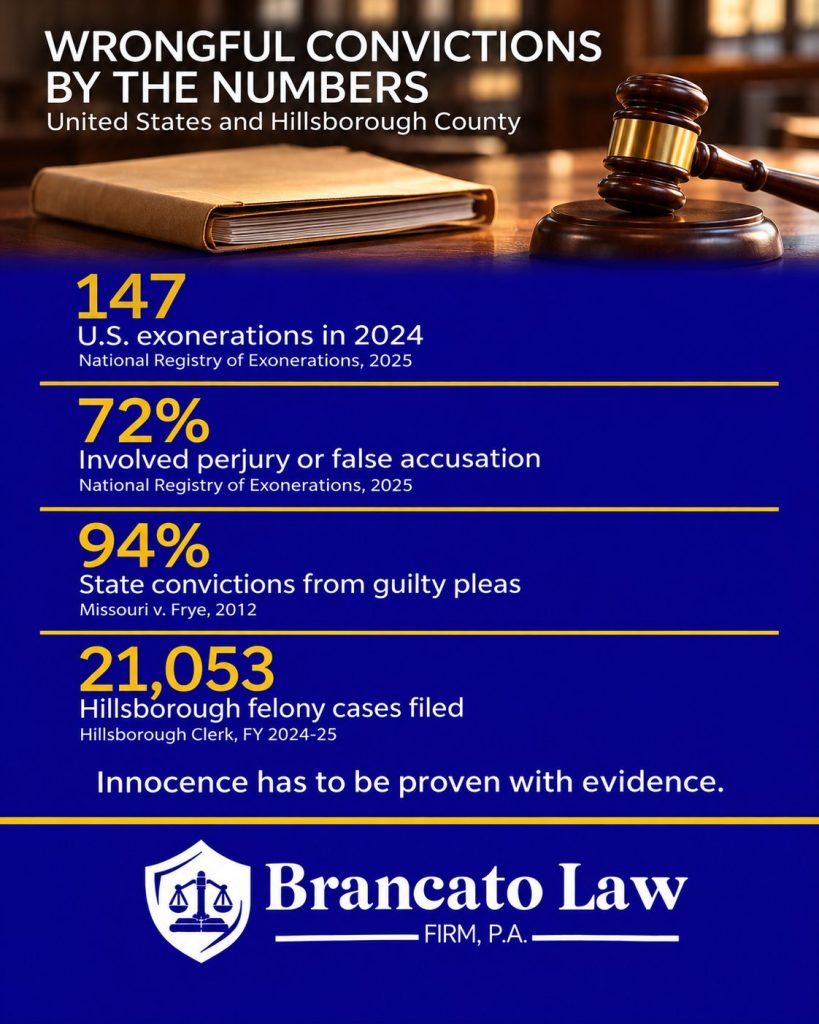
The scale of the system makes that risk concrete. From October 2024 through September 2025, the Hillsborough County Clerk of Court opened 21,053 new felony cases, according to the Clerk’s monthly outputs report for county fiscal year 2024-25. In our firm’s experience, a case moving through that volume gets close attention only when the defense supplies it.
How do innocent people end up charged or convicted?
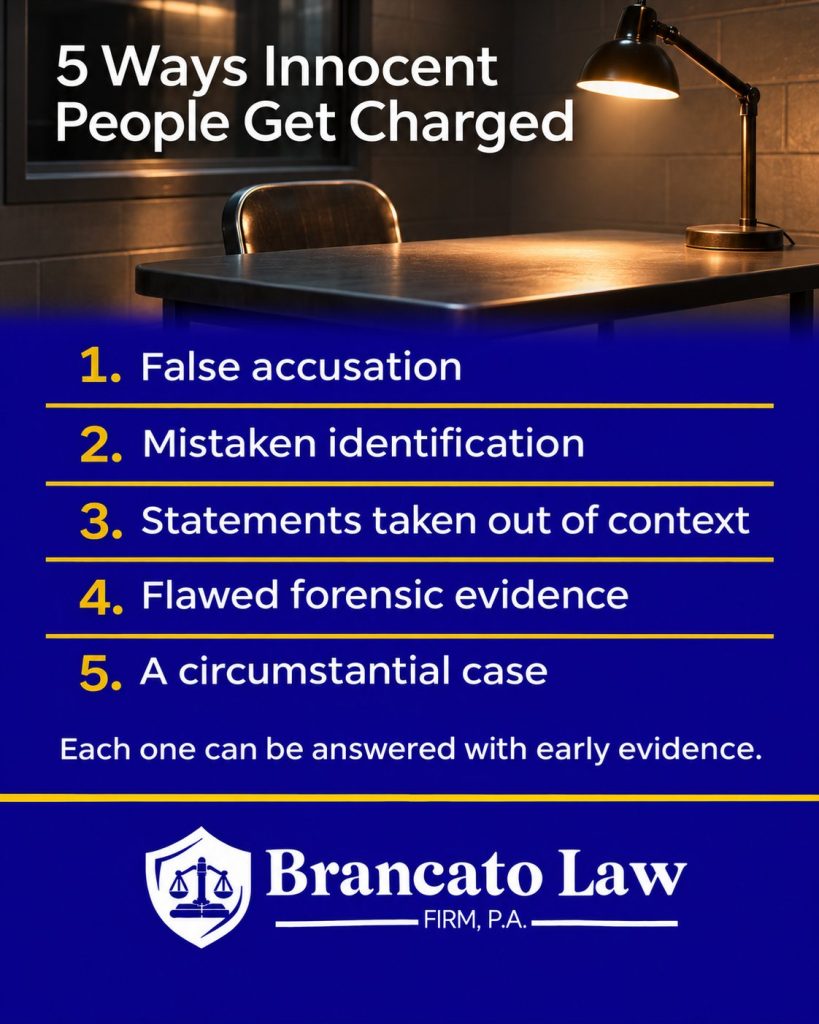
Innocent people are usually charged because of a false accusation, a mistaken identification, or their own words taken out of context. The 2024 Registry report found that 72% of that year’s exonerations included perjury or another false accusation, 71% involved official misconduct, and 26% rested at least in part on a mistaken witness identification.
| How it happens | What it looks like in a Tampa case | What our attorneys do |
|---|---|---|
| False accusation | A former partner, coworker, or family member reports a crime that did not happen | Collect texts, call logs, and witnesses that show motive and contradict the story |
| Mistaken identification | A witness picks the wrong person from a photo lineup or at the scene | Challenge the lineup procedure, find alibi proof such as phone location data or receipts |
| Statements taken out of context | An innocent person “explains” and admits being nearby, knowing the accuser, or touching an object | Stop the interview before it starts; move to suppress statements taken in violation of Miranda |
| Flawed forensic evidence | A DNA hit, fingerprint, or lab result is read as more certain than it is | Retain independent experts and test the State’s evidence |
| Circumstantial case | No direct evidence, but a chain of facts that seems to point at you | Show the innocent explanation for each link in the chain |
Our post on circumstantial evidence in Florida explains how the State builds a case without an eyewitness, and our guide to cell phone location evidence as an alibi shows how the same data police use can prove where you really were.
Should I talk to the police if I am innocent?
No. Ask for a lawyer and decline to answer questions, even if you are innocent. Officers are trained to get statements, and an innocent person who explains often confirms small facts, such as being in the area or knowing the accuser, that become the backbone of the State’s case.
The right to stay silent belongs to everyone. In Miranda v. Arizona, 384 U.S. 436 (1966), the U.S. Supreme Court held that police must warn a person in custody of the right to remain silent and the right to a lawyer, and must stop questioning once the person asks for one. Say the words out loud: “I want a lawyer, and I am not answering questions.” Then let your attorney decide whether, when, and how your side of the story is told.
If detectives have called you but no one has arrested you, that is the best time to hire a lawyer. Our firm’s representation before charges are filed puts an attorney between you and the investigation from the first phone call.
What does a defense lawyer do for an innocent client?
For an innocent client, a defense lawyer finds and preserves the proof of innocence, then gets it in front of the person deciding the case. Most of that work has to happen early, because the best evidence disappears first.
- Stop the damage. Our attorneys tell police that you will not be interviewed and handle all contact with detectives.
- Preserve evidence. Surveillance video is often recorded over within days or weeks. We send preservation letters and subpoena records, phone data, and receipts.
- Find witnesses. Police often interview only the accuser and the people the accuser names. We find the witnesses who were never contacted.
- Test the forensic evidence. Our firm works with independent experts in DNA, digital forensics, and other disciplines to check what the State’s lab reported.
- Present the case to the prosecutor. Before charges are filed, we can give the assigned prosecutor the evidence and the legal problems in writing, which can lead to a decision not to file at all.
- Try the case if needed. When the State will not drop the case, the evidence gathered early becomes the trial defense.
That approach has worked for our clients. In one Tampa sexual battery case, the State pressed forward against our client based on a misidentification and a cold DNA hit. Through our investigation, DNA analysis, and expert consultation, we showed our client was not the perpetrator, and all charges were dismissed. Past results do not guarantee future outcomes. Our Hillsborough County criminal defense attorney team handles cases like this from the first call through trial.
Why is innocence alone not enough in court?
Innocence alone is not enough because a jury decides the case on the evidence it hears, and an innocent person without a lawyer often has no way to put the right evidence in front of it. The burden of proof is on the State, but the defense still has to expose the weaknesses in the State’s case.
Research on wrongful convictions shows how often the system gets it wrong even in the most serious cases. In a peer-reviewed study, Rate of False Conviction of Criminal Defendants Who Are Sentenced to Death, 111 Proc. Nat’l Acad. Sci. 7230 (2014), Samuel Gross and colleagues estimated that at least 4.1% of defendants sentenced to death would be exonerated if they remained under a death sentence indefinitely. Those are the cases that get the most scrutiny of any in the system.
Undoing a wrongful conviction after the fact takes years of appeals and postconviction litigation, and many people never get that far. The time to prove innocence is before the conviction, while witnesses and video still exist.
What if I am guilty? Do I still need a lawyer?
Yes. A person who committed the offense still has every constitutional right, and a lawyer is how those rights turn into a better result: a dismissal when police broke the rules, a reduced charge, diversion, or a lower sentence. The right to counsel does not depend on innocence. In Gideon v. Wainwright, 372 U.S. 335 (1963), a Florida case, the U.S. Supreme Court held that a person charged with a felony in state court has a right to a lawyer even if he cannot afford one.
Most cases end in a negotiated plea, which is why the lawyer’s work matters even when guilt is not in dispute. In Missouri v. Frye, 566 U.S. 134 (2012), the Supreme Court held that defense counsel has a duty to tell the client about formal plea offers from the prosecution, and it noted that 94% of state convictions are the result of guilty pleas. The terms of that plea are where a defense lawyer earns the fee.
| Option | What it means | Florida law |
|---|---|---|
| Suppression | Evidence from an illegal stop, search, or interrogation is thrown out, which can end the case | Mapp v. Ohio, 367 U.S. 643 (1961); Fla. R. Crim. P. 3.190(g) |
| Pretrial diversion | Complete a program and the charge is dismissed | Section 948.08, Florida Statutes |
| Withhold of adjudication | The judge does not formally convict, which can keep sealing available | Section 943.059, Florida Statutes (sealing requires no adjudication of guilt) |
| Downward departure | A sentence below the scoresheet minimum when the law’s mitigating reasons apply | Section 921.0026, Florida Statutes |
The downward departure statute lists reasons a judge can use to go below the Criminal Punishment Code scoresheet, the point system that sets the lowest permissible prison sentence. One of them is that “the offense was committed in an unsophisticated manner and was an isolated incident for which the defendant has shown remorse.” Another is that the victim “was an initiator, willing participant, aggressor, or provoker of the incident.” Proving those reasons takes evidence, and gathering it is defense work.
The record matters as much as the sentence. Under section 943.059, a person can petition to seal a record only if he or she has never been adjudicated guilty in Florida of a criminal offense and was not adjudicated guilty in the case being sealed. A plea negotiated with a withhold of adjudication, or a case closed through diversion, can keep that door open; a conviction closes it.
When should I hire a lawyer if I am being investigated or was just arrested?
Hire a lawyer as soon as you learn police want to talk to you, and no later than first appearance if you were arrested. After an arrest in Hillsborough County, first appearance happens within 24 hours, and the State Attorney’s Office generally has 30 days to file charges if you are in custody and 60 days if you are out. Those windows are when innocence evidence does the most good.
Our guide on what to do after being arrested in Tampa walks through the first 48 hours and the first 30 days step by step. If cost is the worry, our post on what a criminal defense attorney costs in Tampa explains how fees are set, and our comparison of a public defender and a private attorney covers both options.
Frequently asked questions
Can I be arrested in Florida if I didn’t do anything wrong?
Yes. An officer can arrest on probable cause, which is far less than proof, so a false report or a mistaken identification can lead to an arrest of an innocent person. The Brancato Law Firm handles these cases from the first call, gathering the evidence that the arrest report leaves out and presenting it to the prosecutor before charges are filed.
Will hiring a lawyer make me look guilty?
No. Asking for a lawyer is a constitutional right, and prosecutors and judges see represented clients every day. Our attorneys at The Brancato Law Firm present innocent clients’ evidence through counsel so that nothing the client says can be twisted, which protects the client far more than a solo explanation to a detective.
Can charges be dropped before court if I am innocent?
Yes. The State Attorney can decline to file charges, file a “no information,” or dismiss a case after filing with a nolle prosequi. The Brancato Law Firm pursues that result through pre-file advocacy, putting witness statements, video, and other proof in front of the assigned prosecutor before the filing decision.
What if the person who accused me wants to take it back?
An accuser cannot drop a criminal case in Florida, because the State Attorney decides whether to prosecute. The Brancato Law Firm can help an accuser who wants to recant do so properly, such as through a sworn affidavit given to the prosecutor, without the client contacting the accuser, which can violate a no-contact order.
Should I take a plea deal if I am innocent?
Only you can decide whether to accept a plea, and you should never plead guilty to something you did not do without understanding every consequence. Under Missouri v. Frye, your lawyer must tell you about every formal offer, and our attorneys at The Brancato Law Firm explain each offer against the strength of the defense, the sentence you face at trial, and the effect on your record.
Does a public defender work for an innocent person?
Yes. A public defender represents anyone the court appoints, innocent or not, and many are excellent lawyers carrying heavy caseloads. The Brancato Law Firm offers private representation that can start before an arrest or before first appearance, which is earlier than an appointment usually begins.
Talk to our attorneys before you talk to anyone else
Before you answer a detective’s call or explain yourself to anyone, call The Brancato Law Firm, P.A., founded by Tampa Criminal Defense Attorney Rocky Brancato, at (813) 727-7159. Our attorneys can start gathering the proof of your innocence today, while video and witnesses are still available, and you can call us at any hour. Our firm has Spanish-speaking staff, and attorney Jean-Luc Adrien speaks Spanish, Haitian Creole, and French. For more about our defense strategies, visit our Hillsborough County criminal defense page.
The Brancato Law Firm, P.A.
620 E. Twiggs Street, Suite 205, Tampa, FL 33602
(813) 727-7159
Serving Hillsborough, Pinellas, and Pasco Counties
The Brancato Law Firm, P.A. is a Tampa-based criminal defense practice. We are not affiliated with any other Brancato-named law firms.
Visit Us

Tampa, FL 33602

Contact Us Now
Free Legal Consultation (813) 727-7159
