- Free Consultation 24/7: (813) 727-7159 Tap Here To Call Us


From First DUI to Death Penalty



Signs You Are Being Investigated for a Crime in Florida (2026)


If you suspect you’re under criminal investigation in Florida, you’re probably right to pay attention. Police contact with friends or family, a request to “come in and talk,” a notification from Google or Apple about a government data request, surveillance, or a search warrant can all signal that law enforcement is building a case.
At The Brancato Law Firm, we handle cases across the full spectrum of criminal investigations, from sex crime anddrug investigations to domestic violence accusations and internet sting operations. Our founder, Rocky Brancato, spent 25 years in criminal defense, including serving as Chief Operations Officer of the Hillsborough County Public Defender’s Office and training law enforcement officers at the police academy on criminal procedure and courtroom testimony. That background gives our team a direct understanding of how investigations are built, how officers are trained to develop cases, and where the real opportunities for defense begin.
The window between investigation and formal charges is often the most valuable time to act in a Florida criminal case. This article covers the signs that an investigation may be underway, what each sign tells you about where things likely stand, and what you can do to protect yourself before charges are ever filed.
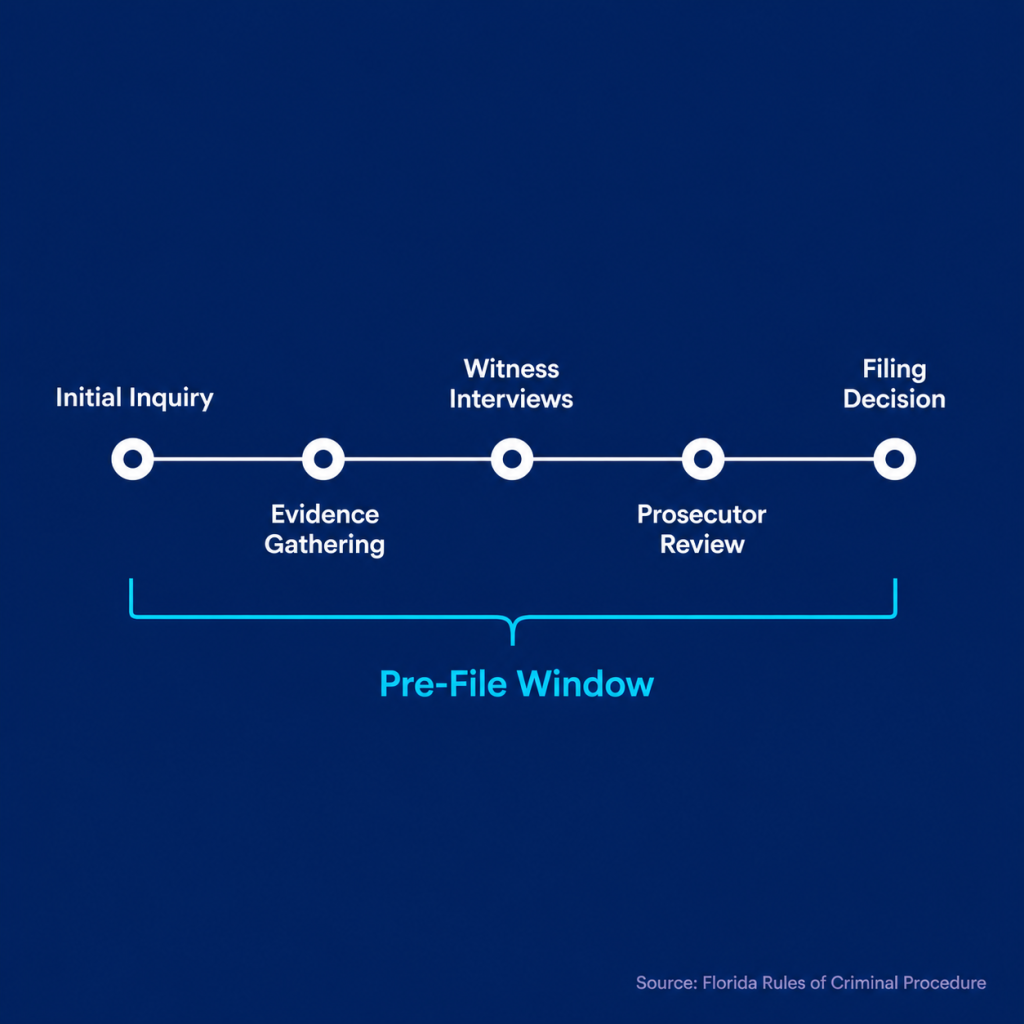
How Criminal Investigations Work in Florida Before Charges Are Filed
Most people assume a criminal case starts with an arrest. In reality, many Florida cases begin with a pre-file investigation that can last weeks or months before a prosecutor decides whether to file formal charges.
During this window, law enforcement and prosecutors have broad investigative authority. Under Florida Statute §27.04, state attorneys can summon witnesses from anywhere in the state, question them under oath, and investigate potential violations of law before any charging document is filed. State-attorney investigators have law-enforcement status and can serve arrest warrants, search warrants, and witness subpoenas connected to criminal investigations (§27.255).
For more serious cases, Florida prosecutors can also convene a grand jury. Grand jury proceedings are secret, and the grand jury has the power to subpoena witnesses, hear testimony, and return an indictment. If you are called before a grand jury, Florida law allows you to bring one attorney into the room, but only to advise and consult, not to speak to the grand jurors (Florida Statutes Chapter 905).
Florida’s public records law classifies active criminal investigative material as nonpublic while the investigation is ongoing with a reasonable, good-faith anticipation of arrest or prosecution (§119.011). You may receive very little official confirmation that an investigation exists, even when one is well underway.
All of this matters because the pre-file stage is where defense intervention can have the greatest impact. Once formal charges are filed, the case takes on its own momentum. Before that point, there is an opportunity to present evidence, provide context, and advocate directly to the prosecutor’s office to prevent charges from being filed in the first place.
Common Signs That You May Be Under Investigation
Law Enforcement Asks You to “Come In and Talk”
A request for a “voluntary interview” or an invitation to “clear something up” is one of the clearest signs that investigators consider you a person of interest. These conversations are designed to develop evidence, not to help you.
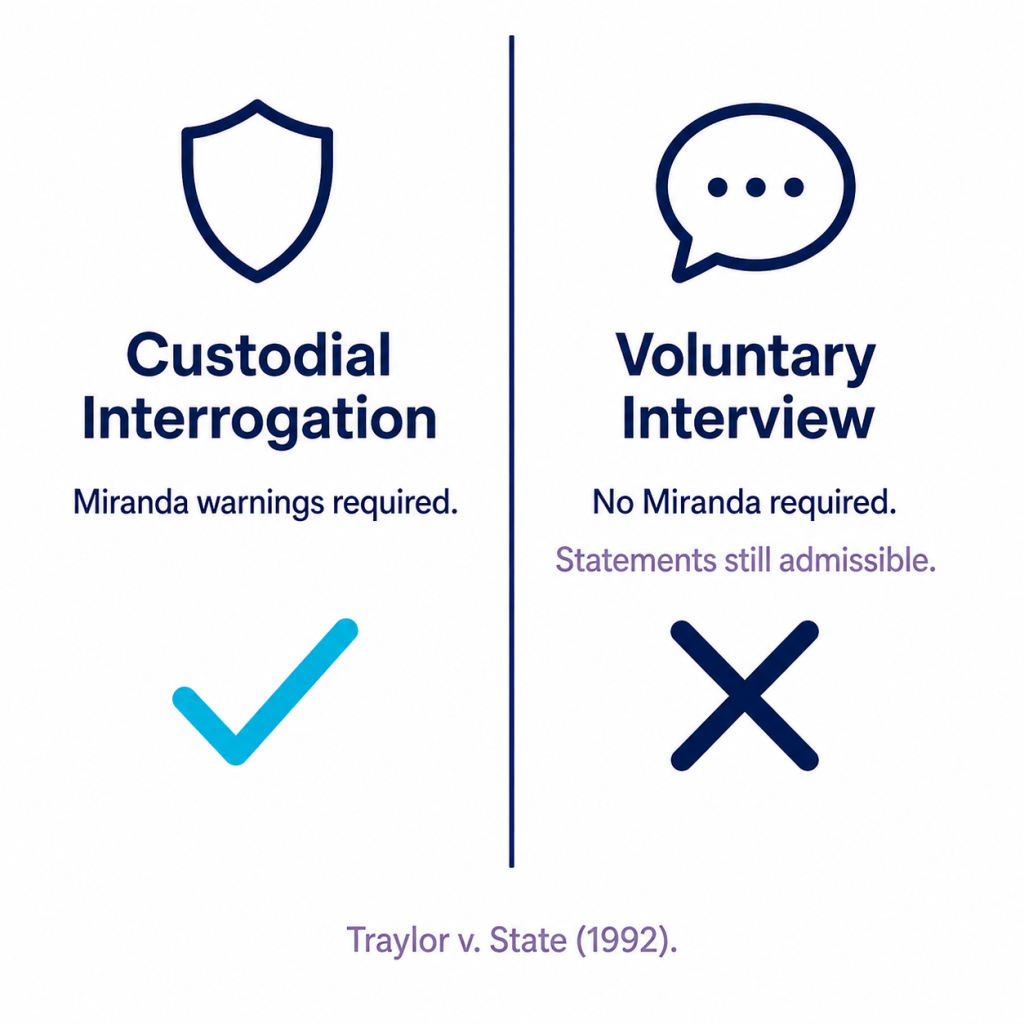
What makes this risky in Florida: Miranda warnings are only required during custodial interrogation, not during every police conversation. The Florida Supreme Court has held that the trigger for Miranda protections is whether the person is in custody, not whether they are a suspect (Traylor v. State). A noncustodial interview at a police station can produce statements that are fully admissible at trial, even if you were never read your rights.
What this sign tells you about where things stand: Investigators believe you may provide information that helps their case. They would not ask if they didn’t think the conversation could be productive for the prosecution.
What to do: Do not agree to speak without an attorney present. The fact that the conversation is described as “voluntary” does not mean your statements can’t be used against you.
People Around You Are Being Contacted
When law enforcement begins interviewing your family members, co-workers, neighbors, or friends, this typically means investigators are corroborating facts they already believe to be true. This is not usually the beginning of an inquiry. It’s a sign the investigation has progressed to the point where detectives are building context around information they’ve already gathered.
Florida law expressly recognizes that investigator and informant reports are part of criminal investigative information (§119.011), and state attorneys can formally summon witnesses for questioning under oath (§27.04).
What this sign tells you about where things stand: The investigation is past the initial stages. Investigators are testing their theory of the case against what the people in your life can confirm or deny.
What to do: Do not contact these individuals to coordinate stories, ask them what they said, or encourage them not to cooperate. Florida law criminalizes tampering with or harassing a witness, victim, or informant under §914.22.
You Receive a Subpoena or Prosecutor Summons
A subpoena or a summons from the State Attorney’s Office is a stronger signal than a phone call or a detective’s visit. It means someone with legal authority has decided your testimony or records are relevant enough to compel production.
If the subpoena is connected to a grand jury, the secrecy rules are strict. Grand jury proceedings are confidential under Florida law, though a witness may bring one attorney into the room to advise and consult (§905.17, §905.185).
What this sign tells you about where things stand: The investigation has moved into formal evidence-gathering. Prosecutors are actively evaluating whether to bring charges.
What to do: Contact a criminal defense attorney before responding. An attorney can help you understand the scope of the subpoena, whether you are a target or a witness, and how to protect your rights.
A Search Warrant Is Executed or Your Devices Are Seized
A search warrant means a judge has already found probable cause to believe evidence of a crime will be found in a specific location. Under Florida law (Chapter 933), warrants require probable cause, sworn testimony, and a description of the specific place to be searched and items to be seized. Florida imposes additional statutory protections for searches of private dwellings (§933.18).
The Florida Supreme Court has also placed constitutional limits on newer investigative techniques. In Jardines v. State, the court held that a drug-detection dog sniff at the front door of a private home constitutes a search requiring probable cause. In Tracey v. State, the court held that real-time cell-site tracking is a search that requires probable cause.
Device seizures are increasingly common and can involve phones, computers, tablets, external drives, and cloud-connected devices. The Florida Department of Law Enforcement’s forensic laboratories receive more than 100,000 items of evidence per year, and digital-evidence analysts routinely deal with encryption, deleted-data recovery, and damaged devices.
What this sign tells you about where things stand: The investigation is well developed. A judge has already reviewed evidence and concluded there is probable cause. This does not mean charges will definitely be filed, but the case is serious.
What to do: Do not interfere with the search. Do not attempt to hide, destroy, or move any items. Note the names of the officers, the warrant number if visible, and what is taken. Contact an attorney immediately.
You Receive a Notification from Google, Apple, Microsoft, or Meta
This is a sign that most articles about criminal investigations don’t mention. But it’s one of the most concrete, modern indicators that law enforcement has served legal process on a technology company holding your data.
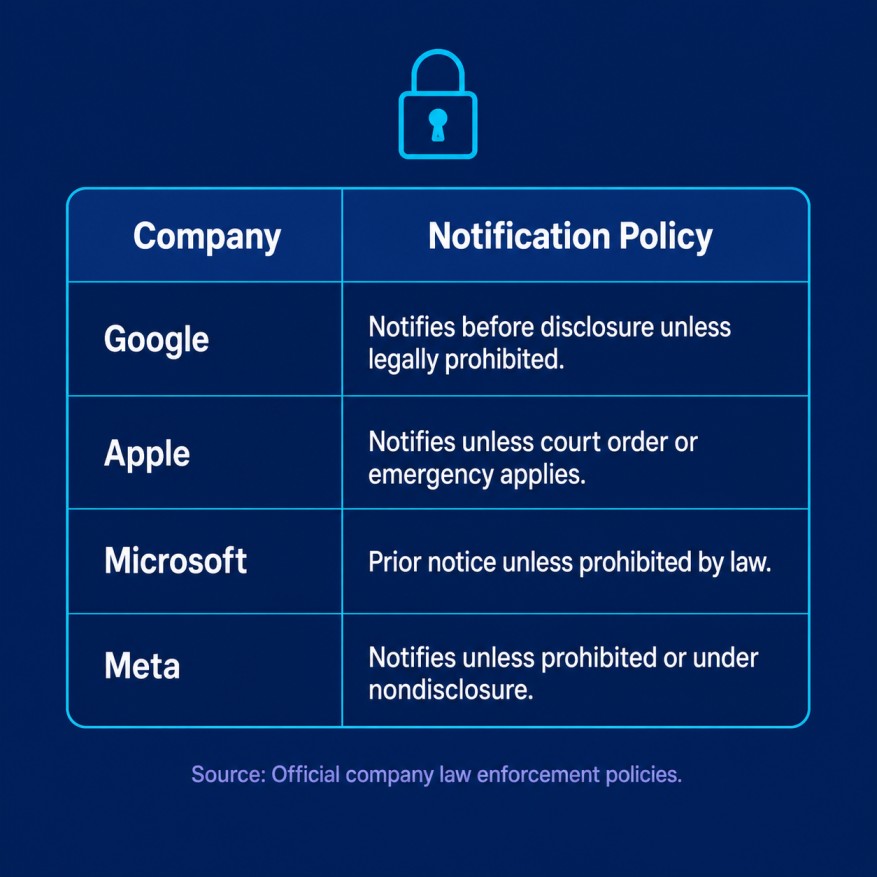
Each of these companies has a policy of notifying users when the government requests account data, unless a court order, law, emergency circumstances, or nondisclosure order prevents notification:
- Google generally emails users before disclosing information to a government agency unless notice is legally prohibited, delayed by a gag order, or blocked by an emergency
- Apple notifies customers when account information is sought unless a court order or similar exception applies, and describes delayed notice after nondisclosure periods
- Microsoft provides prior notice unless prohibited by law, and delayed notice when nondisclosure orders expire
- Meta notifies users before disclosure unless prohibited or subject to nondisclosure, with delayed notice when restrictions lift
What this sign tells you about where things stand: Legal process (a warrant, court order, or subpoena) has already been served on a company that holds your data. The notification may arrive before, during, or after the disclosure, depending on whether a nondisclosure order was in place. You may not be the target of the investigation. You could be a witness, victim, or associated account holder. But it means the investigation is real and involves your digital information.
What to do: Preserve the notification. Do not delete or purge the account. Contact an attorney who can evaluate what process was served, what data may have been disclosed, and whether any challenge or strategic response is available. At The Brancato Law Firm, we handle internet crime and digital evidence cases where tech company notifications are the first sign a client receives that an investigation exists.
You Notice Signs of Surveillance
Surveillance can take many forms: unfamiliar vehicles near your home or workplace, the sense that you’re being followed, unusual activity on your phone or accounts, or the feeling that someone is monitoring your movements.
Florida law treats ordinary observation in public spaces differently from more invasive surveillance methods. The Florida Supreme Court has placed constitutional limits on certain techniques. Real-time cell-site location tracking requires probable cause (Tracey v. State), and a drug-detection dog sniff at the front door of a home is a search requiring probable cause (Jardines v. State).
Florida’s wiretap law (Chapter 934) prohibits the intentional interception of wire, oral, or electronic communications unless a statutory exception applies. Authorized interceptions require a detailed written application explaining the target offense, the communications to be intercepted, and why less intrusive methods failed or would be too dangerous (§934.09).
Not every suspicious car or strange feeling constitutes surveillance. But if multiple signs on this list are happening at the same time, the possibility becomes harder to dismiss.
What this sign tells you about where things stand: If actual surveillance is occurring, the investigation has likely been approved at a supervisory level and may have judicial authorization. This typically indicates a more advanced stage of investigation.
What to do: Document what you observe (dates, times, descriptions) but do not confront anyone you suspect of conducting surveillance. Do not attempt counter-surveillance. Share your observations with your attorney.
Someone Approaches You with a Suspiciously Convenient “Opportunity”
If someone you don’t know well, or someone you do know who is acting out of character, presents you with an unsolicited opportunity to engage in illegal activity, you may be the subject of an undercover operation or sting.
Florida law explicitly addresses this through its entrapment statute (§777.201). Entrapment occurs when law enforcement or its agents induce or encourage a crime by methods that create a substantial risk that the offense will be committed by someone not otherwise ready to commit it. Florida courts apply both subjective entrapment (looking at inducement and predisposition) and objective entrapment (looking at whether police conduct was outrageous).
Undercover operations and controlled buys are common in drug investigations, and online sting operations are a frequent tool in internet crime and sex crime investigations.
What this sign tells you about where things stand: An undercover approach means the investigation is active and may be targeting you specifically. Law enforcement has allocated resources and personnel to the operation.
What to do: Do not engage. Do not participate in the proposed activity. Do not agree to anything “just to see what happens.” Contact an attorney.
What You Should NOT Do If You Think You’re Being Investigated
Recognizing the signs matters, but what you do next matters just as much. These are the most common mistakes people make when they suspect an investigation is underway.
| Mistake | Why It Makes Things Worse | Florida Law |
| Agreeing to speak without an attorney | Voluntary, noncustodial statements are admissible even without Miranda warnings | Traylor v. State; Myers v. State |
| Deleting texts, files, photos, or social media posts | Destroying evidence when you know an investigation is pending or about to begin is a separate crime | §918.13 (tampering with evidence) |
| Contacting witnesses to coordinate stories or discourage cooperation | Witness tampering is a felony | §914.22 |
| Posting about the situation on social media | Social media content is discoverable and increasingly central to criminal cases | Florida Bar guidance on social-media evidence |
| Fleeing or obstructing officers | Resisting an officer without violence is a misdemeanor; fleeing by vehicle can be a felony | §843.02; §316.1935 |
| Ignoring a tech company notification and purging the account | Destroys potential evidence and eliminates your ability to understand what was disclosed | §918.13; company notification policies |
Every one of these actions can create additional criminal exposure on top of whatever the original investigation involves. The instinct to “clean up” or “get ahead of it” without legal guidance is understandable, but it almost always makes things worse.
What a Criminal Defense Attorney Can Do Before Charges Are Filed
Many people assume they need to wait until they’re arrested or formally charged before hiring an attorney. That assumption costs people cases.
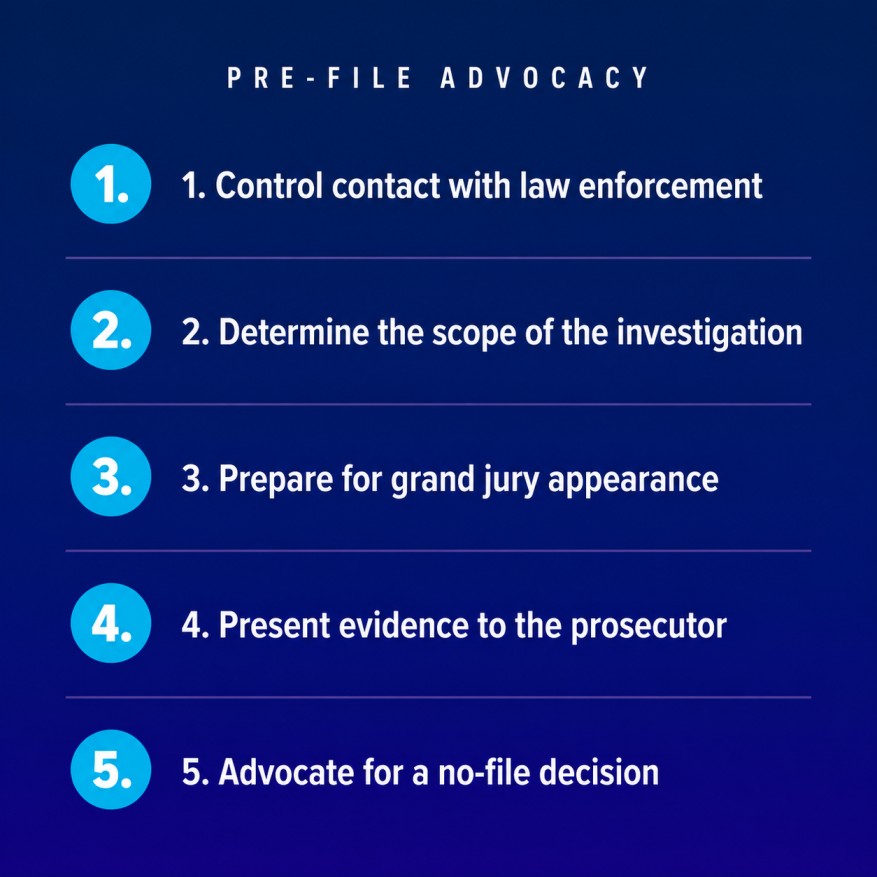
Pre-file advocacy is one of the most effective services a criminal defense attorney can provide. In the window between an investigation and a charging decision, a defense attorney can:
- Control contact with law enforcement. Once you have counsel, investigators must communicate through your attorney. This prevents the kind of unguarded statements that frequently become the prosecution’s strongest evidence.
- Determine the scope of the investigation. Your attorney can find out whether subpoenas, warrants, or data requests have been issued and what agency is conducting the investigation.
- Prepare you for a grand jury appearance. If you receive a grand jury subpoena, your attorney can help you understand your rights, prepare your testimony, and accompany you into the grand jury room as your advisor.
- Present evidence and context to the prosecutor. This is the core of pre-file advocacy. An experienced defense attorney can provide exculpatory evidence, witness statements, and contextual information directly to the State Attorney’s Office before a filing decision is made.
- Advocate for a no-file decision. Florida prosecutors sometimes review completed investigations and decide not to file charges. “Not filed on” is a recognized official outcome in the State Attorney’s system. While there is no public data quantifying how often defense-generated pre-file submissions lead to this result, the mechanism is real and well-established.
Pre-file advocacy requires an attorney who understands how the State Attorney’s Office evaluates cases and what evidence influences charging decisions. At The Brancato Law Firm, our system-level knowledge of the criminal justice system, built through years of institutional leadership at the Hillsborough County Public Defender’s Office, gives us direct insight into how these decisions are made.
This approach is especially effective in domestic violence cases, where the evidence often tells a more complex story than the initial accusation suggests, and in sex crime investigations, where early intervention with detectives can shape the entire trajectory of the case.
How Long Do Florida Criminal Investigations Last?
There is no single answer. Investigation timelines vary depending on the type of case, the complexity of the evidence, and how many agencies are involved.
| Case Type | Typical Timeline | Why |
| Domestic violence | Days to weeks | Florida authorizes arrest on probable cause without requiring victim consent (§741.29). Cases can move quickly from allegation to arrest. |
| Drug crimes | Weeks to months | Controlled buy operations, surveillance, and informant development take time. Multi-target investigations run longer. |
| Sex crimes | Months to a year or more | Forensic examinations, digital evidence extraction, victim interviews, and expert consultation extend timelines. |
| Internet crimes | Months to a year or more | Digital forensics, provider data requests, and multi-jurisdictional coordination add complexity. |
| Homicide | Months to years | Forensic pathology, witness development, records collection, and prosecutor screening all extend the timeline. Cold cases can be reopened years later. |
If you have already been arrested but not formally charged, Florida’s rules set specific deadlines. Under Rule 3.134, the State must file formal charges within 30 days if you are in custody, or within 60 days if you are on pretrial release. If those deadlines pass, the rule requires release on recognizance (on the 33rd or 63rd day, respectively), though limited extensions are available.
If you have not been arrested, there is no comparable deadline. The investigation can remain “active” as long as arrest or prosecution is reasonably anticipated. This is another reason early attorney involvement matters: without counsel monitoring the situation, you may not know the investigation has progressed until an arrest warrant is executed.
If You Recognize These Signs, Talk to an Attorney Now
The period before charges are filed is not dead time. It is the most important window in many criminal cases. What happens during the investigation, and whether a defense attorney is involved, can determine whether charges are ever filed at all.
If you recognize any of the signs described in this article, do not wait for an arrest. Contact The Brancato Law Firm at (813) 727-7159 for a free, confidential consultation. We serve clients across Hillsborough, Pinellas, and Pasco Counties and are available 24/7 for emergencies.
Visit Us

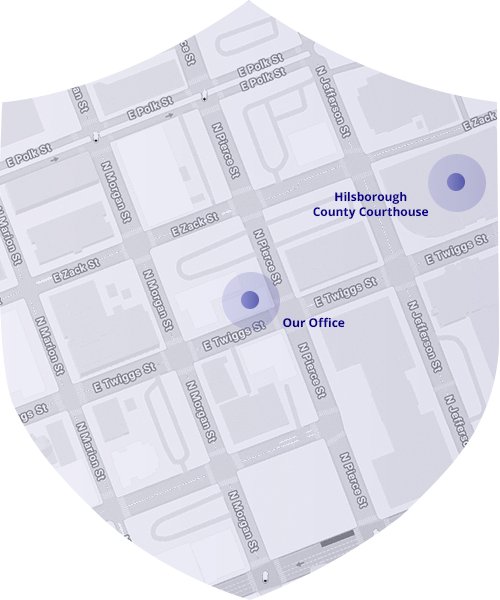
Tampa, FL 33602
Contact Us Now
Free Legal Consultation (813) 727-7159