- Free Consultation 24/7: (813) 727-7159 Tap Here To Call Us


From First DUI to Death Penalty



Teacher Arrested in Florida: What Happens to Your Certification and Job? (2026)


Updated October 21, 2026
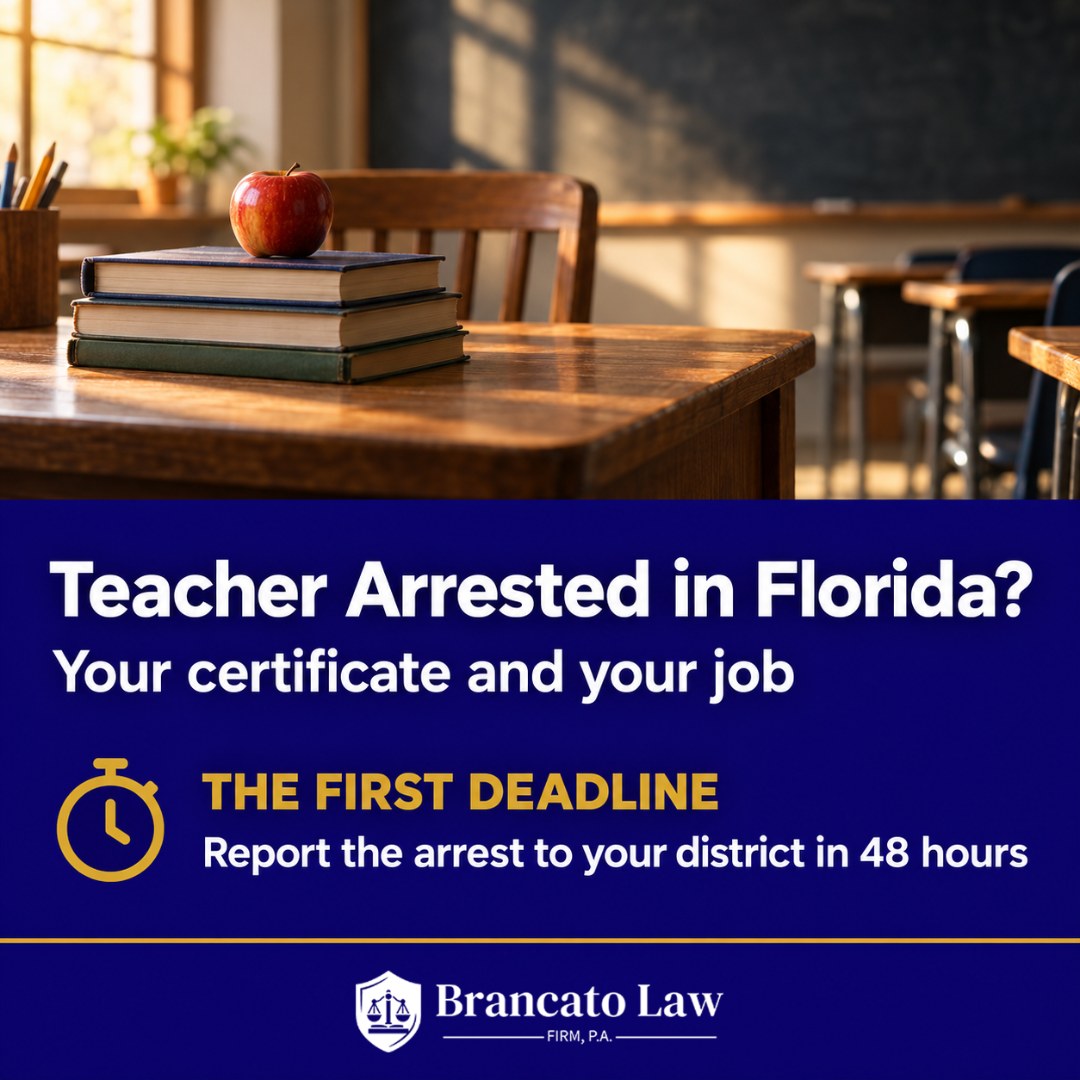
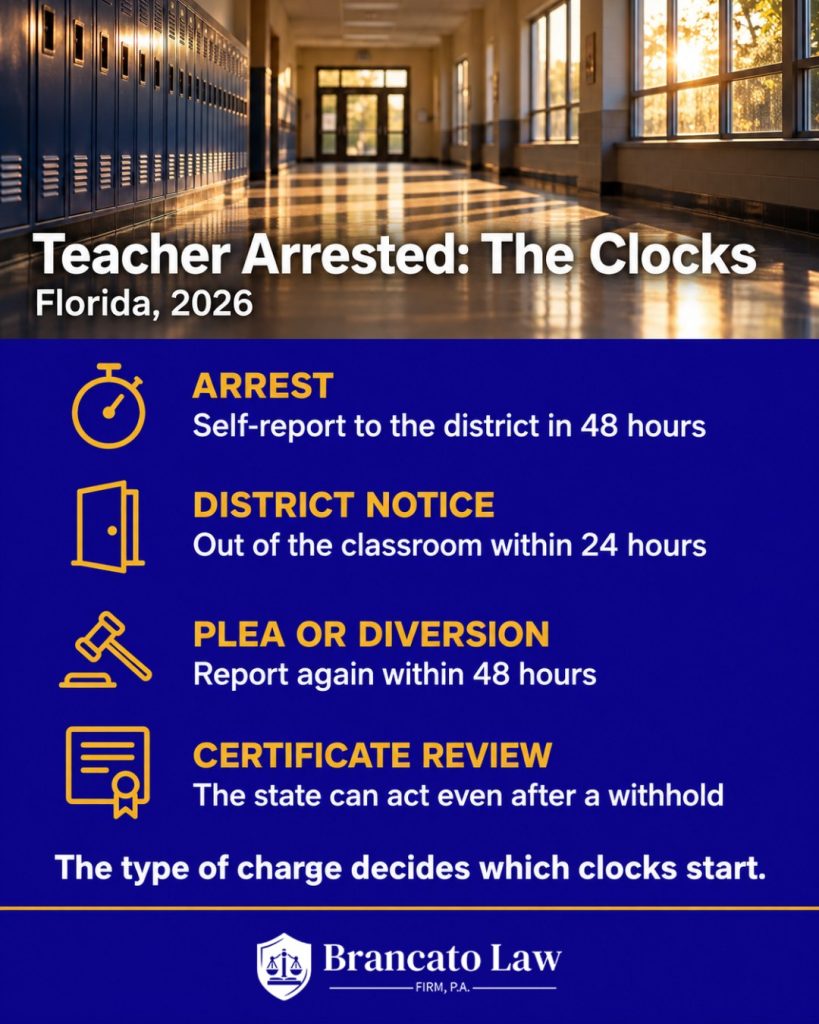
A Florida teacher arrested for any felony, or for a misdemeanor on the state’s Level 2 screening list, must self-report the arrest to the school district within 48 hours, and the district must remove the teacher from the classroom within 24 hours of notice. The Florida Department of Education can then open an investigation, and the Education Practices Commission can reprimand, fine, suspend, or revoke the educator certificate. A no contest plea or a withhold of adjudication still counts as a ground for discipline and, for listed offenses, as a disqualifying record in background screening. The strongest protection for both the job and the certificate is a criminal outcome with no plea: a no-file, a dismissal, or a diversion program that ends in dismissal.
A Florida school district’s first move after a teacher’s arrest is to read the charge, because the charge decides which deadlines start running. A felony, or a misdemeanor on the state’s Level 2 screening list, starts a 48-hour self-report clock, a 24-hour classroom-removal policy, and often a complaint to the Department of Education. I saw how child abuse and sex offense investigations are built during my years in the Major Crimes Unit of the Hillsborough County Public Defender’s Office, and I later served as that office’s Chief Operations Officer, overseeing a staff of over 100 attorneys. As founder of The Brancato Law Firm, P.A., a Tampa criminal defense firm, I have tried more than 150 jury trials to verdict over 25+ years in Hillsborough County courtrooms. Our attorneys defend the criminal case and coordinate with the teacher’s union representative and certification counsel, so the criminal strategy protects the certificate too.
Do Florida teachers have to report an arrest within 48 hours?
Yes. Under section 1012.799(2), Florida Statutes, instructional and administrative personnel must self-report any felony arrest, and any arrest for a misdemeanor listed in the Level 2 screening statute, within 48 hours to the school district authority the superintendent designates. The same statute requires a second report within 48 hours after the final judgment for any conviction, finding of guilt, withhold of adjudication, plea of guilty or no contest, or entry into a pretrial diversion program, for any offense other than a minor traffic violation.
The State Board of Education added the same duty to the Principles of Professional Conduct, Rule 6A-10.081, effective October 28, 2025. A violation of the Principles is itself a ground for discipline. Before Senate Bill 1374 took effect on July 1, 2025, the arrest-reporting duty covered only child abuse and controlled substance charges, according to the Florida Senate’s 2025 bill analysis.
| What happened | Report required by statute? | Deadline |
|---|---|---|
| Arrest for any felony | Yes | 48 hours after the arrest |
| Arrest for a misdemeanor on the s. 435.04(2) list, such as battery on a minor | Yes | 48 hours after the arrest |
| Arrest for a misdemeanor not on the list, such as a first DUI or petit theft | No arrest report under the statute; check district policy | None under the statute |
| Conviction, finding of guilt, withhold, guilty or no contest plea, or entry into diversion (any offense except a minor traffic violation) | Yes | 48 hours after the final judgment or entry into diversion |
The statute says the self-report is not an admission of guilt and is not admissible for any purpose in any civil, criminal, administrative, or judicial proceeding. That protection covers the report. It does not cover a later conversation with a principal or an investigator about what happened. Our attorneys advise teachers to report the date, the arresting agency, and the charge, and to hold any explanation until we have read the arrest report.
What happens to a teacher’s job after an arrest in Hillsborough County?
A teacher arrested for a felony or a listed misdemeanor is removed from the classroom within 24 hours of the district learning of the arrest. Section 1012.22(1)(j), Florida Statutes, requires every school board to adopt that temporary-removal policy, and the 24 hours run from notice by law enforcement or by the teacher’s own self-report. The statute does not say whether the teacher is reassigned or placed on leave, or whether the leave is paid. Those terms come from the district’s policy and the union contract.
In Hillsborough County Public Schools, arrests of employees go to the district’s Professional Standards office, part of the Division of Human Resources. The district says that office conducts internal investigations of complaints against employees, coordinates all law enforcement and child protective investigator (CPI) investigations involving employees, manages employee arrest information, and handles due process under the teachers’ union contract. Its investigators are commissioned retired law enforcement officers. For that reason, our attorneys prepare a teacher for a Professional Standards interview the same way we prepare a client for a police interview.
The criminal case adds its own limits. Hillsborough arrestees see a judge at first appearance by video from the jail, and Hillsborough County does not offer pretrial services supervision as a release option, though nearby counties do. When the alleged victim is a student, the judge may enter a no-contact order under section 903.047, Florida Statutes. Unless the court says otherwise, that order bars the teacher from coming within 500 feet of a place the student regularly frequents, which can include the school itself. Our firm handles these cases in Hillsborough County, Pinellas County, and Pasco County.
How does the Florida Department of Education investigate a teacher?
The Department of Education’s Office of Professional Practices Services investigates complaints against certified educators, and a school district must file every legally sufficient complaint with the Department in writing within 30 days of learning about it. That duty comes from section 1012.796, Florida Statutes, and it applies even if the teacher resigns. The Department’s description of the process follows these steps:
- The district or another source files a complaint, and the Department confirms the person holds or has applied for a Florida educator certificate.
- The Department opens a case and notifies the educator and the employing district.
- Investigators interview the alleged victim and witnesses and collect documents and other evidence.
- The educator is offered a meeting to respond with explanations, rebuttals, or documents.
- Department lawyers review the file, and the Commissioner of Education decides whether probable cause exists.
- If probable cause is found, the Commissioner files a formal complaint. The educator can settle, request an informal hearing before the Education Practices Commission, or request a formal hearing before an administrative law judge if the facts are disputed.
- The Commission issues a final order.
| Stage | What the statute or Department says |
|---|---|
| District complaint to the Department | Within 30 days of the district learning of it |
| Complaints involving a student’s health, safety, or welfare | Investigated immediately, ahead of other complaints |
| Probable cause on sexual misconduct with a student | Within 90 days, but the state attorney can ask in writing to hold it while the criminal case is pending |
| Confidentiality | The complaint and file stay confidential until the preliminary investigation ends |
| Before probable cause | The educator may inspect and copy the file and may request a conference |
| Instead of probable cause | The Commissioner may offer a deferred prosecution agreement, except where there is probable cause of a felony or an act of moral turpitude |
The criminal case and the Department case run on separate tracks, but they feed each other. The state attorney’s power to pause the 90-day clock means the criminal case often goes first in student-misconduct cases. A plea entered in court then arrives at the Department as evidence.
What can the Education Practices Commission do to a teaching certificate?
The Education Practices Commission can dismiss the complaint or impose penalties ranging from a written reprimand to permanent revocation of the educator certificate. Section 1012.795, Florida Statutes, lists the grounds, which include any conviction, finding of guilt, withhold, or guilty or no contest plea to a misdemeanor or felony other than a minor traffic violation, personal conduct that seriously reduces the teacher’s effectiveness, and violation of the Principles of Professional Conduct.
| Penalty | What it means |
|---|---|
| Written reprimand | Placed in the teacher’s certification file |
| Administrative fine | Up to $2,000 for each count |
| Probation | Conditions set by the Commission, annual supervisor reports, and monitoring costs paid by the teacher |
| Suspension | Up to 5 years without a position involving direct contact with students |
| Revocation | Up to 10 years, after which the person may reapply under the requirements then in effect |
| Permanent revocation | No public school position involving direct contact with students |
| Disqualification List | Placement for misconduct that would make the person ineligible under s. 1012.315, or for sexual misconduct with a student |
The Disqualification List is small. As of October 1, 2025, 79 individuals were on the Department of Education’s Disqualification List, according to a November 2025 Professional Practices Services presentation. The statute also directs the Commission to adopt rules requiring permanent revocation for an educator sanctioned on two previous occasions, with a narrow exception for administrative violations such as a missed probation fee.
Which criminal charges disqualify a teacher from working in a Florida school?
A teacher becomes ineligible for certification or for any school job with direct student contact if the person has a qualifying disposition for an offense on the Level 2 screening list in section 435.04(2), Florida Statutes. Section 1012.315, Florida Statutes, applies that list to educators. The screening statute reaches anyone who has been found guilty regardless of adjudication, who has pleaded guilty or no contest, or who has been “arrested for and is awaiting final disposition of” a listed offense. A pending case alone can keep a teacher out of a student-contact position until it is resolved.
| Charge teachers commonly face | Statute | On the Level 2 list? |
|---|---|---|
| Battery | s. 784.03 | Yes, if the alleged victim was a minor; any felony battery is listed |
| Child abuse or neglect | s. 827.03 | Yes |
| Lewd or lascivious offenses | s. 800.04 | Yes (all of chapter 800) |
| Offenses against students by authority figures | s. 800.101 | Yes (all of chapter 800) |
| Unlawful sexual activity with certain minors | s. 794.05 | Yes |
| Drug possession | s. 893.13 | Only if a felony, or if a minor was involved |
| DUI | s. 316.193 | No |
Some disqualified employees can apply for an exemption under section 435.07, Florida Statutes, by proving rehabilitation with clear and convincing evidence after completing the sentence. The exemption is closed to anyone designated a sexual predator or required to register as a sexual offender, and section 1012.315 closes it for a long list of serious offenses. Those limits are why our attorneys check every proposed plea against the screening list before a teacher signs anything.
What is Level 2 background screening for Florida teachers?
Level 2 screening is the fingerprint-based background check Florida requires as a condition of hiring and of continued employment for school staff. Under section 435.04(1), it includes a statewide check through the Florida Department of Law Enforcement, a national check through the FBI, local law enforcement records, and a search of the sex offender registries of every state where the person lived in the previous five years. Section 1012.315 assigns the eligibility decision for school employees with direct student contact to the Agency for Health Care Administration.
Education employers began using the state’s background screening Clearinghouse on April 7, 2025, and all education staff must be phased in by June 30, 2027, according to the Department’s 2025 Professional Practices Services presentation. For a teacher, the screening system is one more place an arrest record can surface, whether or not anyone at school mentions it.
Does a withhold of adjudication or no contest plea still count against a teacher?
Yes. Section 1012.795(1)(f) makes a withhold of adjudication or a no contest plea a ground for discipline, and section 435.04(2) counts a no contest plea “regardless of adjudication” for screening. Both must also be self-reported within 48 hours after the judgment. A guilty plea goes further: section 1012.795(2) makes it prima facie proof of grounds for revocation unless the teacher proves it was caused by threats, coercion, or fraud.
Ferris v. Turlington, 510 So. 2d 292 (Fla. 1987), shows both how a plea follows a teacher and how a teacher can still win the license case. Ferris was a Hernando County elementary teacher who pleaded no contest to sexual battery and received probation with adjudication withheld. A hearing officer later found that the alleged contact with the student never happened, and the Commission dismissed the revocation complaint. The Florida Supreme Court held that revoking a teacher’s certificate requires clear and convincing evidence and reinstated the dismissal. That plea would trigger today’s Level 2 screening disqualification on its own, which is why the plea decision now matters even more than it did in 1987.
Sealing or expunging the record later does not hide it from a school. Under section 943.0585, Florida Statutes, a person with an expunged record may not deny the arrest when seeking employment or licensure with the Department of Education or a school district. Pretrial diversion is different from a plea. A diversion program ends with the charges dismissed and no finding of guilt, though entering the program must still be self-reported within 48 hours and the Department can still review the underlying conduct.
| Outcome | Self-report after the outcome? | Counts as a disposition for Level 2 screening? |
|---|---|---|
| No-file (State never files charges) | No | No |
| Dismissal or nolle prosequi | No | No |
| Pretrial diversion, completed | Yes, within 48 hours of entering the program | No plea and no finding of guilt; charges dismissed on completion |
| No contest plea with adjudication withheld | Yes, within 48 hours after judgment | Yes, for listed offenses |
| Conviction | Yes, within 48 hours after judgment | Yes, for listed offenses |
What criminal charges do teachers face most often?
Most criminal cases against teachers fall into four groups: discipline or restraint allegations, sex offense allegations involving students, DUI, and drug possession. Each one carries a different screening and reporting result, so the defense plan starts with the charge.
Discipline, restraint, and child abuse allegations
Florida defines child abuse in section 827.03 to include an intentional act that could reasonably be expected to cause physical or mental injury to a child, and child abuse without great bodily harm is a third-degree felony punishable by up to five years in prison. Allegations against school employees are classified as “institutional child abuse or neglect” under section 39.01, Florida Statutes, so a teacher can face a child protective investigation and a police investigation at the same time. Our Tampa child abuse attorney team handles both tracks from the first call.
When does teacher discipline become child abuse in Florida?
Florida appellate courts have drawn a line between discipline and abuse, and two decisions show contact without injury falling short of a crime. In State v. Lanier, 979 So. 2d 365 (Fla. 4th DCA 2008), a Broward elementary teacher was charged with child abuse after she stomped on a four-year-old’s foot because he had stepped on another child’s foot, along with charges from a second classroom incident. The child had no bruise and needed no treatment. The Fourth District affirmed dismissal of all three child abuse and neglect counts on a sworn motion to dismiss, and it held that the school board’s ban on corporal punishment did not decide whether a crime occurred. The lesson for teachers is that violating a district discipline policy can cost a job without proving a felony.
Morris v. State, 228 So. 3d 670 (Fla. 1st DCA 2017), carried that reasoning to a misdemeanor. A pre-kindergarten teacher’s aide in Pensacola was charged with child abuse after a combative four-year-old spat at and kicked at her in a hallway. She slapped her hand down toward his face and caught his leg, and he fell; she said she was blocking the spit and the kick. The jury acquitted her of child abuse but convicted her of simple battery. The First District reversed and ordered a judgment of acquittal, holding that school staff acting in place of a parent are privileged to touch a student in a non-abusive way while moderately correcting him. Florida law adds a teacher-specific protection: under section 1015.05, Florida Statutes, a teacher may use reasonable force to protect himself, herself, or others, and in litigation or professional practices proceedings over that action there is a rebuttable presumption that the teacher was restoring or maintaining classroom safety. Our posts on the legal limits of discipline in Florida and on child neglect charges in Tampa cover the parent-side version of these rules.
Sex offense allegations involving students
Sex offense allegations are the most dangerous charges a teacher can face because they carry prison exposure, sex offender registration, and permanent loss of the certificate. Florida’s main statutes are lewd or lascivious offenses under section 800.04, unlawful sexual activity by a person 24 or older with a 16- or 17-year-old under section 794.05, which is a second-degree felony, and offenses against students by authority figures under section 800.101. Section 800.101 makes it a second-degree felony for any school employee, volunteer, or contractor 18 or older to solicit or engage in sexual conduct, lewd conduct, or a romantic relationship with an enrolled student, regardless of the student’s age. Our Tampa sex crimes defense lawyer team defends these cases, and our guide to unlawful sexual activity with a minor explains the penalties.
In a school case, a student may describe the allegation to a friend, a teacher, an assistant principal, a school resource officer, and a parent before a trained interviewer ever speaks with the child. The U.S. Department of Justice’s 2015 OJJDP bulletin on child forensic interviewing (Newlin et al.) warns against multiple interviewers repeatedly questioning a child and notes that opportunities for contamination increase as time passes. Our attorneys collect every one of those earlier conversations and compare them with the recorded forensic interview.
DUI
A first DUI in Florida carries up to six months in jail under section 316.193, and it is not on the Level 2 screening list. A teacher does not have to self-report a misdemeanor DUI arrest under the statute, but any conviction, withhold, or plea must be reported within 48 hours after the judgment because DUI is a criminal offense and not a minor traffic violation. A reduction to reckless driving is still a criminal disposition that must be reported. A third DUI within 10 years is a third-degree felony, and that arrest must be reported within 48 hours. Our Tampa DUI defense attorneys build the case with the reporting rules in mind.
Drug possession
Possession of 20 grams or less of cannabis is a first-degree misdemeanor under section 893.13, and it is not a listed screening offense unless a minor was involved. Possession of most other controlled substances without a prescription is a third-degree felony, so the arrest itself triggers the 48-hour self-report and the 24-hour classroom removal. Diversion is often the goal in a first-offense possession case because it ends in a dismissal without a plea. Our Tampa drug crimes attorney team negotiates diversion where the facts allow it.
Why is the criminal outcome a teacher’s best protection?
The criminal outcome is the best protection because almost every administrative consequence keys off it. A no-file or dismissal leaves nothing to self-report after the case, nothing for the Level 2 screening to count as a disposition, and no plea for the Department to use as proof. A no contest plea, even with adjudication withheld, triggers all three.
Many teacher cases start as a school or child protective investigation before anyone is arrested. That window is when our representation before charges are filed does the most good. Our attorneys request school surveillance, bus, and classroom video in writing right away, before routine retention schedules erase it. We interview witnesses, gather lesson plans and attendance records that place the teacher elsewhere, and present that evidence to the State Attorney’s Office before the filing decision. The teacher speaks to no investigator until we know what the State has.
Who handles the Education Practices Commission case?
Our firm handles the criminal case, and the teacher’s union representative or certification counsel handles the employment and Education Practices Commission side. The two tracks have to move together. A statement given to Professional Standards, a plea entered in court, or a fact conceded in a settlement with the Department can damage the other case. Our attorneys coordinate with the teacher’s union representative and license counsel at each step so that nothing said in one forum undercuts the other. The same coordination applies to other licensed professionals, as our guide to criminal defense for healthcare professionals explains.
How do you choose a lawyer who understands teacher license consequences?
Choose a criminal defense lawyer who can explain, before you plead, exactly what each possible outcome will trigger under the self-report statute, the Level 2 screening list, and the Commission’s discipline grounds. The Brancato Law Firm practices criminal defense only, from misdemeanors to capital cases, in Hillsborough, Pinellas, and Pasco Counties. Founder Rocky Brancato is a former Chief Operations Officer of the Hillsborough County Public Defender’s Office, a former police academy instructor, and the author of “How to Choose a Major Crimes Attorney – or Any Criminal Defense Attorney for That Matter.” He holds an AV Preeminent rating, has been selected to Super Lawyers, and has been named to the National Trial Lawyers Top 100.
Clients can call us at any hour, follow their case through our client portal, and expect calls returned within 24 hours. Attorney Jean-Luc Adrien speaks Spanish, Haitian Creole, and French. Our fees are flat fees that cover the whole case, including trial, quoted on the facts and intricacy of the case, with at least half up front and a payment plan for the balance while the case is pending. We are neither the most nor the least expensive firm in Tampa, and consultations are free. Our post on what a criminal defense attorney costs in Tampa explains why a separate trial fee gives a lawyer a financial incentive to settle before trial preparation.
What should a teacher do in the first 48 hours after an arrest?
A teacher’s first 48 hours after an arrest should go to the self-report, the bond conditions, and silence about the facts. Our attorneys walk teachers through these steps:
- Make the self-report within 48 hours if the charge is a felony or a listed misdemeanor, limited to the date, the agency, and the charge.
- Do not discuss the allegation with administrators, coworkers, students, or parents, and do not post or text about it.
- Do not contact the student or the student’s family, even to apologize, and follow any no-contact order exactly.
- Decline any interview with Professional Standards, a child protective investigator, or a Department investigator until a criminal defense attorney has reviewed the allegation.
- Call your union representative about leave and pay, and tell your criminal defense attorney who that person is.
- Write down names of witnesses and where cameras were, while you still remember.
Case results in the kinds of charges teachers face
These are published results from our firm’s case results page. None of these clients is described as a teacher; they show how our attorneys resolve the same charges teachers commonly face.
| Charge or investigation | Result |
|---|---|
| Lewd or lascivious conduct investigation (January 2026) | Closed with no arrest and no charges; our firm interviewed witnesses and kept the client out of a police interview |
| Child molestation investigation (March 2026) | No charges filed after our firm served as the go-between with the investigating agency |
| Unlawful sexual conduct with a minor | Charge dismissed after investigation of the accuser’s social media and inconsistent accounts |
| Aggravated child abuse | All charges dismissed after expert analysis tied the child’s injury to a congenital condition |
| DUI (July 2026) | Reduced to reckless driving to protect an airline pilot’s career |
| Drug possession, multiple counts (October 2026) | Dismissed after a diversion program; client eligible for expungement |
Past results do not guarantee future outcomes.
Frequently asked questions
I’m a teacher facing criminal charges in Hillsborough County. Can you recommend a lawyer who understands professional license consequences?
Look for a criminal defense lawyer who knows the 48-hour self-report rule, the Level 2 screening list, and how each possible plea will read to the Education Practices Commission. The Brancato Law Firm practices only criminal defense, and our attorneys build the criminal strategy around those certification rules while coordinating with your union representative or certification counsel. Founder Rocky Brancato has tried more than 150 jury trials to verdict over 25+ years in Hillsborough County. Our child abuse defense practice handles the discipline and student-allegation cases teachers face most.
Can a Hillsborough County teacher be removed from the classroom before being convicted?
Yes. Every Florida school board must have a policy removing a teacher from the classroom within 24 hours of notice of an arrest for a felony or a listed misdemeanor, under section 1012.22. Our attorneys at The Brancato Law Firm work to resolve the criminal case quickly, ideally before charges are filed, so the removal stays temporary. Pay status and reassignment depend on the district’s policy and the union contract.
Does a teacher have to report a DUI arrest to the school district in Florida?
Not under the state statute, because a first or second DUI is a misdemeanor that is not on the Level 2 screening list. The Brancato Law Firm reminds teacher clients that any conviction, withhold, or plea on a DUI, including a reduction to reckless driving, must be reported within 48 hours after the judgment. Read your district’s own policy as well, and talk with our DUI defense attorneys before you decide what to report.
Will a no contest plea with adjudication withheld cost me my teaching certificate?
It can, because Florida’s discipline statute and its Level 2 screening statute both count a no contest plea and a withhold of adjudication. Before any plea, our attorneys at The Brancato Law Firm compare it against the screening list in section 435.04 and the Commission’s discipline grounds so the teacher knows what the plea will trigger. For a listed offense, that plea can end eligibility for any school job with direct student contact.
Can a teacher be charged with child abuse for restraining or disciplining a student in Florida?
Yes, but the State must prove an act that could reasonably be expected to injure the child, and contact that causes no injury may not meet that standard. The Brancato Law Firm relies on decisions like State v. Lanier, 979 So. 2d 365 (Fla. 4th DCA 2008), where the court affirmed dismissal of child abuse charges against a teacher whose stomp on a four-year-old’s foot left no injury. A violation of school discipline policy can still lead to employment and certificate consequences.
Can teacher child abuse charges be dropped in Florida?
Yes. The State Attorney’s Office can decline to file charges or dismiss a filed case when the evidence does not support a crime. The Brancato Law Firm presents video, witness statements, and medical records to prosecutors before the filing decision through our pre-file advocacy work. Our published results include an aggravated child abuse case dismissed after expert analysis tied the child’s injury to a congenital condition.
Should a teacher talk to Professional Standards or a Department of Education investigator without a lawyer?
No, not before a criminal defense attorney has reviewed the allegation. The Brancato Law Firm advises teachers that a statement to a district or state investigator does not carry the protection the statute gives the 48-hour self-report. Investigators in Hillsborough’s Professional Standards office coordinate with law enforcement and child protective investigators, so anything said can shape the criminal case.
Talk to a Tampa defense attorney today
The district’s 48-hour rule starts running at the arrest, and the classroom-removal policy follows within a day, so the criminal defense has to start just as fast. The Brancato Law Firm, P.A., founded by Tampa Criminal Defense Attorney Rocky Brancato, defends teachers and school employees charged or under investigation in Hillsborough, Pinellas, and Pasco Counties. Call (813) 727-7159 for a free consultation, and call us at any hour if you or someone you love was just arrested. For more about our defense strategies, visit our Tampa child abuse defense page and our Tampa sex crimes defense page.
The Brancato Law Firm, P.A.
620 E. Twiggs Street, Suite 205, Tampa, FL 33602
(813) 727-7159
Serving Hillsborough, Pinellas, and Pasco Counties
The Brancato Law Firm, P.A. is a Tampa-based criminal defense practice. We are not affiliated with any other Brancato-named law firms.
Visit Us

Tampa, FL 33602

Contact Us Now
Free Legal Consultation (813) 727-7159
