- Free Consultation 24/7: (813) 727-7159 Tap Here To Call Us


From First DUI to Death Penalty



Habitual Traffic Offender in Florida: How to Fight It (2026)


Fully rewritten and updated November 14, 2026. Previously updated November 8, 2026. Originally published June 2025.
A habitual traffic offender (HTO) in Florida is a driver whose state driving record shows, within any 5-year period, three convictions for listed serious offenses such as DUI or driving while license suspended, or 15 convictions for point-assessable moving violations, under section 322.264, Florida Statutes. The designation brings a 5-year license revocation, and driving during it is a third-degree felony punishable by up to 5 years in prison. The strongest defenses usually attack the record and the convictions behind the designation, not the traffic stop.
Most habitual traffic offender cases are won or lost on the driving record, long before anyone argues about the traffic stop. I have seen that over more than 25 years in Hillsborough County courtrooms. I’m Rocky Brancato, founder of The Brancato Law Firm, P.A., a Tampa criminal defense firm, and a former Chief Operations Officer of the Hillsborough County Public Defender’s Office, where I oversaw a staff of over 100 attorneys. Our attorneys order the certified driving record and the court file behind every conviction on it, because one wrong date or one vacated plea can undo the designation.
What makes someone a habitual traffic offender in Florida?
A driver becomes a habitual traffic offender when the Florida Department of Highway Safety and Motor Vehicles (FLHSMV) record shows the required number of convictions inside any 5-year window. Section 322.264 sets two separate paths, and convictions from other states count if the offense is similar to a Florida offense.
| Path to HTO status | What counts | Key limit |
|---|---|---|
| Three serious convictions | Manslaughter by vehicle; DUI under section 316.193; any felony using a motor vehicle; driving while license suspended or revoked; leaving the scene of a crash with death or injury; driving a commercial vehicle while disqualified; driving without a valid license under section 322.03 | The three convictions must arise out of separate acts and fall within 5 years |
| Fifteen moving violations | Any 15 convictions for moving violations that carry points under section 322.27, including the serious offenses above | All 15 within 5 years |
Driving while license suspended is the conviction we see most often in Hillsborough County HTO cases, because a single unpaid ticket can start a chain of suspended-license charges. Our guide to driving while license suspended in Florida explains how those first charges work. For how The Brancato Law Firm, P.A. defends the felony itself, see our Tampa criminal traffic lawyer page.
What changed with Florida’s 2026 habitual traffic offender law?
In 2026, the Legislature added driving without a valid license to the list of HTO predicate offenses. The bill, CS/HB 35, known as “Isaiah’s Law,” was approved by the Governor on April 23, 2026, as chapter 2026-53, Laws of Florida, and took effect July 1, 2026, according to the Florida House final bill analysis. The analysis also explains that a person with no license who is designated an HTO cannot get a restricted license during the 5-year revocation.
The practical effect is that drivers who never held a valid license can now reach HTO status through three no-valid-license convictions arising from separate acts within 5 years. Anyone with two such convictions should treat the next citation as a potential felony case.
What are the penalties for driving as a habitual traffic offender?
Driving while designated a habitual traffic offender is a third-degree felony under section 322.34, Florida Statutes, subsection (5), punishable by up to 5 years in prison under section 775.082. The designation itself triggers a revocation under section 322.27(5)(a), and the person is not eligible to be relicensed for at least 5 years from the date of revocation except through the hardship process in section 322.271.
| Consequence | Rule | Source |
|---|---|---|
| License revocation | At least 5 years from the date of revocation | Section 322.27(5)(a) |
| Driving while designated HTO | Third-degree felony, up to 5 years in prison | Sections 322.34(5) and 775.082 |
| Vehicle impoundment | Required when the arresting officer finds every listed criterion, including that the driver owns or co-owns the vehicle | Section 322.34(8) |
| Misdemeanor exception | Second-degree misdemeanor for a first conviction if the HTO status came only from suspensions for unpaid fines, child support, insurance, or similar obligations and the person has no prior forcible felony | Section 322.34(10) |
| Hardship petition | Available after 12 months, business or employment purposes only | Section 322.271(1)(b) |
The misdemeanor exception in section 322.34(10) is one of the most overlooked defenses in these cases. If every suspension behind the HTO designation came from unpaid fines, child support, insurance lapses, or similar financial obligations, and the client has no prior forcible felony, a felony HTO charge may belong in county court as a misdemeanor.
How many Florida drivers lose their licenses over unpaid fines?
Hundreds of thousands each year. In 2021, FLHSMV issued 836,342 driver’s license suspension notices for failure to pay traffic fines or fees, and Florida police wrote more than 178,000 misdemeanor citations for driving on a suspended or revoked license, according to FLHSMV data reported by the Fines and Fees Justice Center in Stepping on the Gas (February 2023).
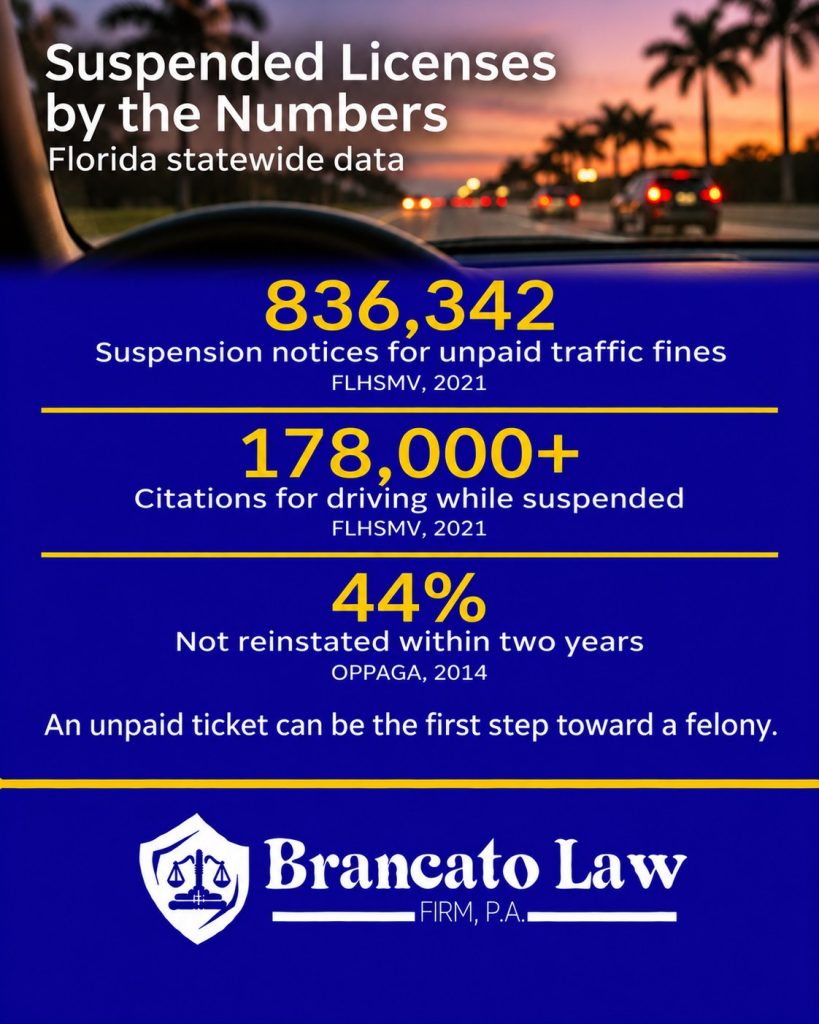
Those suspensions tend to last. The same report cites a 2014 study by the Florida Legislature’s Office of Program Policy Analysis and Government Accountability (OPPAGA) finding that 44% of people whose licenses were suspended for unpaid fines and fees were not reinstated within two years. That is how many Hillsborough County drivers reach HTO status: an unpaid ticket leads to a suspension, the person keeps driving to work, and three suspended-license convictions later the State has a felony case.
Can old convictions entered without a lawyer count toward HTO status?
Yes, under current Florida case law they can. In Nelson v. State, No. 1D2024-0105 (Fla. 1st DCA June 18, 2025), Damien Nelson was charged in Escambia County with driving while designated a habitual traffic offender. He moved to dismiss, arguing that his HTO designation rested on old pleas he entered without a lawyer. The trial court denied the motion, a jury convicted him, and the First District affirmed.
The First District relied on Patterson v. State, 938 So. 2d 625 (Fla. 2d DCA 2006), a Second District decision holding that the limits on using uncounseled convictions to enhance a later charge do not apply to the HTO offense, because the offense is defined “not by reference to prior convictions, but to an administrative designation based upon such convictions.” The Second District’s rule governs Hillsborough, Pinellas, and Pasco County trial courts.
The lesson is about timing and forum. An uncounseled plea usually cannot be attacked inside the felony HTO case itself, so our attorneys look at whether the old conviction can be challenged directly in the court that entered it. When a predicate conviction is vacated, the driving record may no longer show three qualifying convictions, and the designation itself can be challenged.
Does the State have to prove you knew about the HTO revocation?
No. In Robinson v. State, 329 So. 3d 103 (Fla. 2021), a Pinellas County case, the Florida Supreme Court held that proof that FLHSMV gave the driver notice of the HTO revocation is not an element of the crime under section 322.34(5). The court identified two elements: the defendant drove a motor vehicle on a Florida highway, and at that time the defendant’s license was revoked as a habitual traffic offender.
Robinson narrows the defense to the facts that matter: whether the person actually drove, whether the State can prove identity, and whether the designation on the record is valid. Ordinary suspended-license charges are different; under section 322.34(2), knowledge of the suspension is an element, so a missing notice can still win a misdemeanor case.
How do our attorneys fight a habitual traffic offender charge?
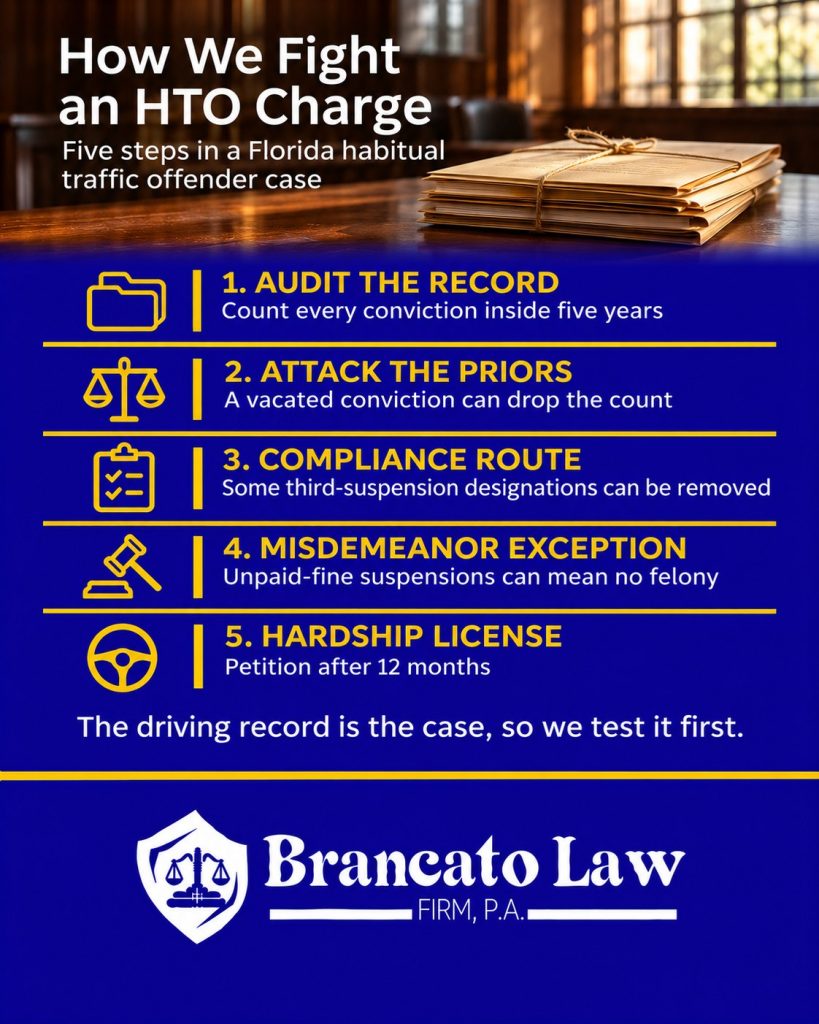
Our attorneys fight an HTO charge by testing every link in the chain the State needs, in this order:
- Audit the driving record. We count every conviction, check that three fall inside a single 5-year window, and confirm they arose from separate acts.
- Attack the predicate convictions. If an old plea was defective, we look at challenging it in the court that entered it, because a vacated conviction can drop the count below three.
- Use the compliance route. Under section 322.27(5)(b), when a designation came from a third suspended-license violation and the person provides proof of compliance for an offense listed in section 318.14(10)(a)1. through 5., the clerk must submit an amended disposition removing the HTO designation.
- Check the misdemeanor exception. Section 322.34(10) can turn a felony into a misdemeanor when the suspensions were purely financial and there is no prior forcible felony.
- Make the State prove its case. The State must prove the person drove and that the record belongs to the defendant; our firm has won a not-guilty verdict at trial in a suspended-license case by holding the State to its record evidence.
- Plan the path back to driving. A hardship petition under section 322.271(1)(b) is available after 12 months.
Our firm has also won dismissals in suspended-license cases in Hillsborough County. Past results do not guarantee future outcomes.
Can a habitual traffic offender get a hardship license in Florida?
Yes, after 12 months. Under section 322.271(1)(b), a person revoked as an HTO may petition FLHSMV after 12 months from the date of revocation, and the department holds a hearing to decide whether to reinstate driving privileges on a restricted basis solely for business or employment purposes. A driver with a DUI conviction must first complete the DUI program course and evaluation, and a person who violates the restriction loses any driving privilege for the rest of the 5-year period.
Our post on what you can drive for on a Florida hardship license explains the business purposes and employment purposes restrictions in detail.
What should you do after an HTO arrest in Hillsborough County?
Get the certified driving record and the court files for every conviction on it before the first court date, and do not drive again until the license status is resolved. A second arrest while the first case is pending makes every option worse. If the officer impounded or immobilized your vehicle under section 322.34(8), keep the paperwork, because the release rules depend on ownership. Our Hillsborough County criminal defense attorney page explains how felony cases move through the 13th Judicial Circuit.
Frequently asked questions about Florida habitual traffic offender cases
Can habitual traffic offender charges be dropped in Florida?
Yes, HTO charges can be dropped or reduced when the driving record does not support the designation, a predicate conviction is vacated, or the section 322.34(10) misdemeanor exception applies. The Brancato Law Firm starts every HTO case with a certified record audit, and our criminal traffic defense attorneys take the case to trial when the State cannot prove it.
How long does habitual traffic offender status last in Florida?
The revocation lasts at least 5 years from the date of revocation under section 322.27(5)(a), with a possible hardship license after 12 months. The Brancato Law Firm explains the reinstatement steps to every HTO client, because the end of the revocation is not automatic relicensing.
Can an HTO designation be removed early in Florida?
Sometimes. Section 322.27(5)(b) requires the clerk to remove the designation when it came from a third suspended-license violation and the person provides proof of compliance for a qualifying offense, and a revocation can also be challenged by petition to FLHSMV. The Brancato Law Firm checks both routes against the text of section 322.27 before advising a client to wait out the revocation.
Do traffic convictions from another state count toward Florida HTO status?
Yes. Section 322.264 counts any violation of another state’s law that is similar to a Florida predicate offense. The Brancato Law Firm compares the out-of-state statute with the Florida offense, because a conviction that is not truly similar should not be counted.
Is driving as an HTO a felony even if I never got the notice?
Yes. Robinson v. State held that notice is not an element of the HTO felony under section 322.34(5). The Brancato Law Firm focuses instead on whether the designation was valid and whether the State can prove you drove, which are the questions that decide most of these cases.
Charged as a habitual traffic offender? Start with the record
Our attorneys will order your certified driving record, pull the court file for every conviction on it, and tell you whether the designation holds up. Call The Brancato Law Firm, P.A. at (813) 727-7159 before your first court date, because the records take time to collect and the vehicle and license consequences start immediately. The firm was founded by Tampa Criminal Defense Attorney Rocky Brancato, our office is two blocks from the courthouse, and you can call us at any hour. Our firm has Spanish-speaking staff, and attorney Jean-Luc Adrien speaks Spanish, Haitian Creole, and French; learn more about our Spanish and Haitian Creole defense services.
For more about our defense strategies, visit our Tampa Criminal Traffic Defense page. For what happens after a felony HTO arrest, from first appearance to sentencing, see our Florida criminal case process guide.
The Brancato Law Firm, P.A.
620 E. Twiggs Street, Suite 205, Tampa, FL 33602
(813) 727-7159
Serving Hillsborough, Pinellas, and Pasco Counties
The Brancato Law Firm, P.A. is a Tampa-based criminal defense practice. We are not affiliated with any other Brancato-named law firms.
Visit Us

Tampa, FL 33602

Contact Us Now
Free Legal Consultation (813) 727-7159
