Strategic Defense,
From First DUI to Death Penalty
From First DUI to Death Penalty






| Short answer: A Tampa gun crimes lawyer defends charges such as carrying a concealed firearm while not eligible, felon in possession of a firearm, improper exhibition, discharging a firearm in public, and shooting into a building or vehicle. Since July 1, 2023, eligible adults in Florida can carry a concealed firearm without a license, so many gun cases now turn on whether the person was legally eligible and whether the State can prove possession. Felon in possession is a second-degree felony with a 3-year minimum prison term when the jury finds actual possession. The Brancato Law Firm, P.A. challenges the stop, the search, and the proof that the gun belonged to the client. |
Gun cases move fast and often begin with a traffic stop or a call about an argument. Rocky Brancato, founder of The Brancato Law Firm, P.A., has tried more than 150 jury trials to verdict, including not guilty verdicts on armed robbery with a firearm and on a second-degree murder charge tried on self-defense. Our attorneys at this Tampa criminal defense firm look first at how police found the gun, who else had access to it, and whether the client was even prohibited from having it.
Florida’s weapons and firearms laws are in Chapter 790 of the Florida Statutes. Maximum penalties for each offense level are set by § 775.082: 60 days for a second-degree misdemeanor, 1 year for a first-degree misdemeanor, 5 years for a third-degree felony, and 15 years for a second-degree felony.
| Charge | Florida law | Level |
|---|---|---|
| Carrying a concealed weapon other than a firearm, when not allowed | § 790.01(2) | First-degree misdemeanor |
| Carrying a concealed firearm by a person not eligible to carry | § 790.01(3) | Third-degree felony |
| Carrying in a prohibited place (courthouse, school, police station, polling place, and others) | § 790.06(12) | Second-degree misdemeanor |
| Improper exhibition of a weapon | § 790.10 | First-degree misdemeanor |
| Discharging a firearm in public or recklessly on residential property | § 790.15(1) | First-degree misdemeanor |
| Discharging a firearm from a vehicle within 1,000 feet of a person | § 790.15(2) | Second-degree felony |
| Shooting into a building or an occupied vehicle | § 790.19 | Second-degree felony |
| Using or carrying a firearm while intoxicated | § 790.151 | Second-degree misdemeanor |
| Possession of a firearm or ammunition by a convicted felon | § 790.23 | Second-degree felony; 3-year minimum for actual possession of a firearm |
| Short-barreled rifle, short-barreled shotgun, or machine gun | § 790.221 | Second-degree felony |
| Altering or removing a firearm serial number | § 790.27 | Third-degree felony |
| Possessing a firearm while subject to a final domestic violence or stalking injunction | § 790.233 | First-degree misdemeanor |
| Violating a risk protection order | § 790.401(11) | Third-degree felony |
| Minor in possession of a firearm, first offense | § 790.22(3) | First-degree misdemeanor |
Gun charges are common in Tampa Bay. In 2020, law enforcement made 792 weapons-violation arrests in Hillsborough County, 203 in Pinellas County, and 196 in Pasco County, according to the Florida Department of Law Enforcement. At the same time, Hillsborough County alone had 127,042 active concealed weapon licenses as of August 31, 2025, according to the Florida Department of Agriculture and Consumer Services, which shows how many people here carry lawfully. Our article on Florida gun crime laws covers each offense in more detail.
Yes, if you are eligible. Under § 790.01(1)(b), which took effect July 1, 2023, a person may carry a concealed firearm without a license if the person meets the eligibility criteria for a concealed weapon license in § 790.06. A person carrying without a license must have a valid ID and show it to police on request under § 790.013, and failing to do so is a noncriminal violation with a $25 fine.
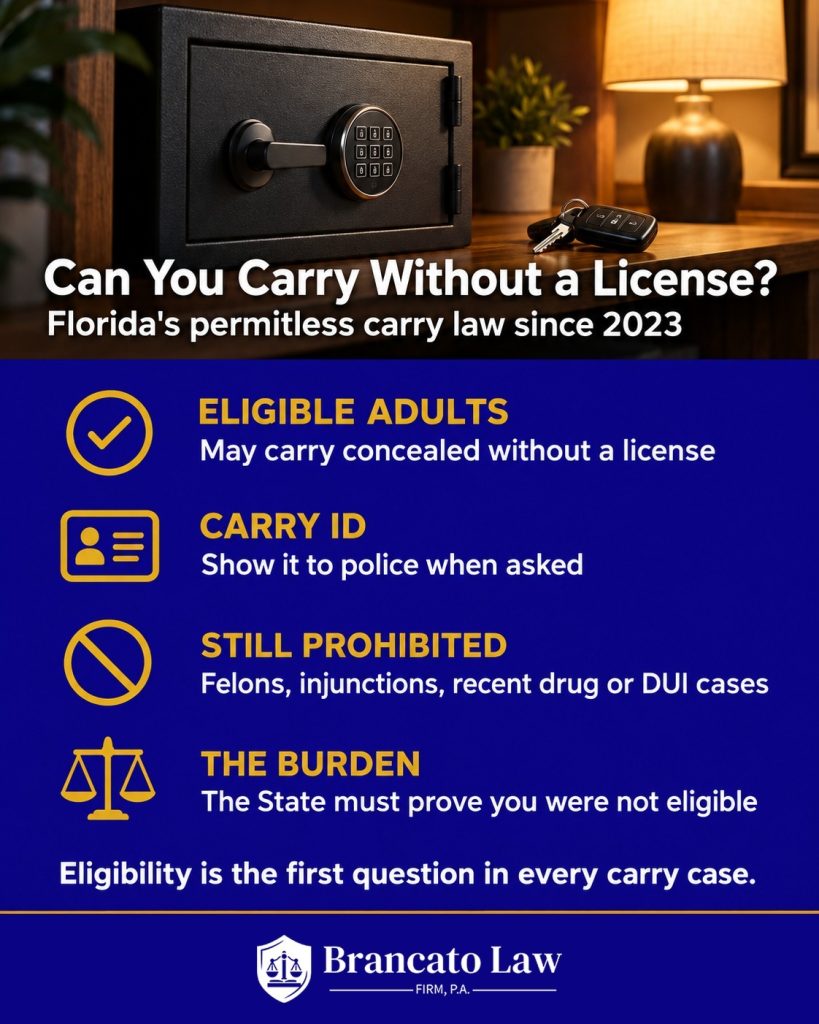
Carrying a concealed firearm is still a felony for people who are not eligible, including:
The burden is on the State. Under § 790.01(4), the prosecutor must prove the person was both unlicensed and not eligible to carry. The age requirement has also changed: in Eubanks v. State, No. 4D2025-1698 (Fla. 4th DCA June 17, 2026), the appeals court held that the age-21 requirement for concealed carry is unconstitutional as applied to adults age 18 to 20. Because no other Florida appeals court has ruled differently, that decision currently binds trial courts statewide, including in Hillsborough, Pinellas, and Pasco Counties. Whether a gun was “concealed” at all is also a fact question. In Dorelus v. State, 747 So. 2d 368 (Fla. 1999), the Florida Supreme Court held that a gun whose handle was visible in an open console, and which the officer readily recognized, was not concealed.
Florida’s open carry ban is no longer enforced against eligible adults. In McDaniels v. State, 419 So. 3d 1180 (Fla. 1st DCA 2025), the appeals court held that Florida’s open carry ban in § 790.053 violates the Second Amendment for ordinary, law-abiding adults. The State did not seek further review, and the decision binds trial courts statewide absent a conflicting ruling. Open carry still has limits. It is not allowed in prohibited places, it does not protect anyone who is not eligible to have a gun, a private property owner can still order you to leave, and displaying a gun in a rude, careless, angry, or threatening way is improper exhibition under § 790.10. Read our article on the 2025 open carry ruling.
You fight a felon in possession charge by testing whether the State can prove the person possessed the gun. Under § 790.23, possession can be actual (in hand, on the person, or within ready reach and under the person’s control) or constructive (the person knew the gun was there and could control it). When a gun is found in a shared car or home, the State must prove knowledge and control with evidence beyond the person being nearby. In A.P. v. State, 250 So. 3d 799 (Fla. 2d DCA 2018), the appeals court that covers our area reversed because a gun under the floor mat of a car carrying three people was not tied to the driver. In X.S. v. State, No. 2D21-2712 (Fla. 2d DCA Feb. 8, 2023), a Hillsborough County case, the court reversed because a statement alone could not prove possession without independent evidence.
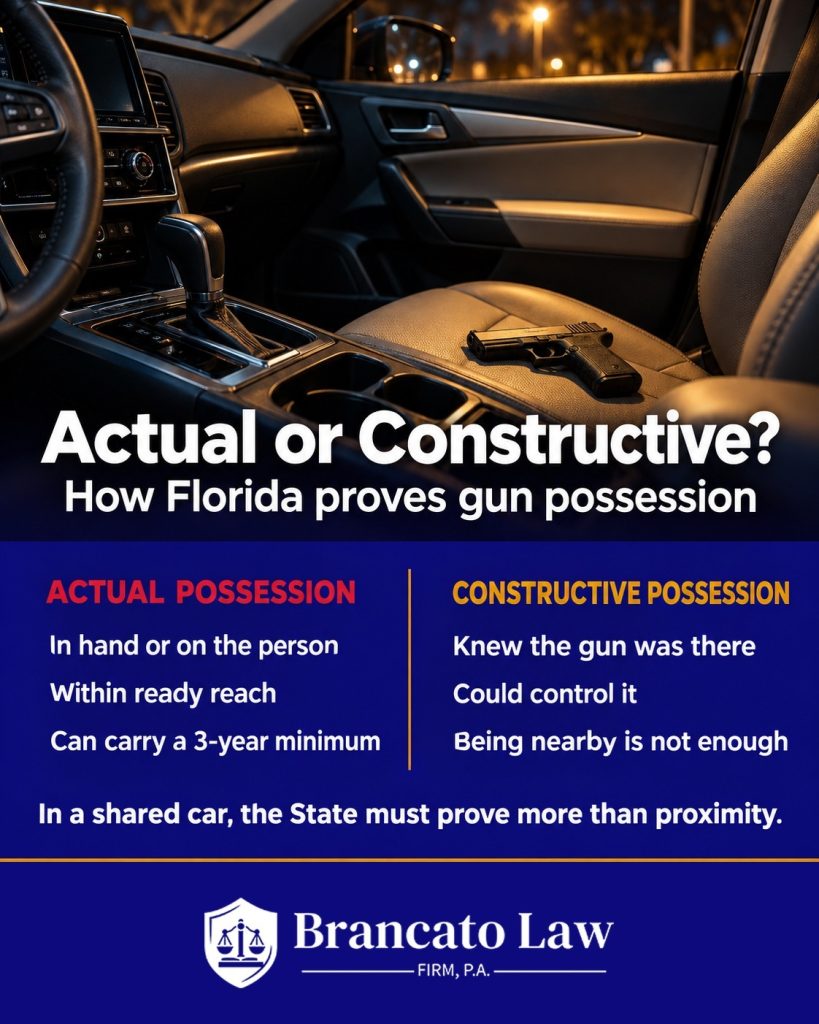
The 3-year minimum sentence for felon in possession applies only to actual possession, and the jury must find it. In Christian v. State, 313 So. 3d 725 (Fla. 2d DCA 2020), the court reversed a minimum sentence because the jury was not properly instructed on the difference between actual and constructive possession. Under § 775.087(2), the minimum rises to 10 years if the person has a qualifying prior felony in which a firearm was actually possessed. Forensic proof that a person touched a gun is weaker than most people think. A 2013 study in the Journal of Forensic Sciences found usable fingerprints on only 4.6 percent of firearm evidence items, and touch DNA led to an identification for just 1.1 percent of swabs (Nunn, 2013). See our article on whether a convicted felon can own a gun in Florida.
Many gun cases begin with a vehicle search, and evidence from an unlawful search can be suppressed. Because eligible adults can now carry concealed without a license, the presence of a gun alone says less about whether a crime is happening than it once did. The smell of marijuana is also no longer enough by itself. In Williams v. State, 421 So. 3d 809 (Fla. 2d DCA 2025) (en banc), a Hillsborough County case, the court held that the odor of cannabis alone does not give police probable cause to search a car, because hemp and medical marijuana smell the same. The question has been certified to the Florida Supreme Court. Our article on motions to suppress evidence explains how these challenges work.
A risk protection order is a civil court order that requires a person to surrender firearms and ammunition. Under § 790.401, only a law enforcement officer or agency can file the petition. A judge can issue a temporary order without notice on reasonable cause, but a final order requires clear and convincing evidence that the person poses a significant danger, after a hearing held within 14 days. A final order lasts up to 12 months and can be extended, and violating it is a third-degree felony. Separately, a person under a final domestic violence or stalking injunction cannot possess a firearm under § 790.233, and federal law makes the same conduct a federal crime. The U.S. Supreme Court upheld that federal ban for people found to be a credible threat in United States v. Rahimi, 602 U.S. 680 (2024). See our guides on how to fight a risk protection order and how Florida’s red flag law works.
Florida’s 10-20-Life law adds mandatory minimum prison terms of 10 years, 20 years, or 25 years to life when a person actually possesses or fires a firearm during certain felonies, such as robbery, burglary, aggravated battery, or drug trafficking. The jury must make a specific finding of the firearm facts. Carrying a concealed firearm by itself does not trigger 10-20-Life. Our violent crimes page and our article on Florida’s 10-20-Life law explain the tiers.
A felony conviction takes away the right to possess firearms, and restoring civil rights in Florida does not restore it. Firearm rights come back only through a full pardon or a separate grant of specific authority to own, possess, or use firearms from the Florida Office of Executive Clemency, which has a waiting period after all sentences are complete. A withhold of adjudication on a first felony is different: the person is not “convicted” for purposes of the felon in possession statute, though other restrictions may still apply. Our attorneys review a client’s record before advising on any plea that could affect gun rights.
These are results our firm has obtained. Every case is different, and past results do not guarantee future outcomes.
See more on our case results page.
Yes. Gun charges are dropped when the State cannot prove the client possessed the gun, the search was unlawful, the client was eligible to carry, or the use of the firearm was justified self-defense. The Brancato Law Firm has had firearm charges dismissed, diverted, and reduced; see our case results.
No, if you are eligible. Since July 1, 2023, Florida allows eligible adults to carry a concealed firearm without a license, but people with certain convictions, injunctions, or recent drug or DUI offenses are still prohibited. The Brancato Law Firm reviews a client’s record to determine whether the person was eligible on the day of the arrest.
For eligible adults, open carry is no longer being prosecuted after McDaniels v. State (Fla. 1st DCA 2025) held the ban unconstitutional. Prohibited places, private property rules, and the improper exhibition law still apply, and our attorneys at The Brancato Law Firm defend improper exhibition charges that arise from open carry.
Felon in possession is a second-degree felony with a maximum of 15 years, and a 3-year minimum applies only if the jury finds the person actually possessed the firearm. The Brancato Law Firm challenges whether the State can prove actual possession, which can remove the minimum sentence.
Yes, if you are eligible to possess and carry a firearm. A person who is prohibited, such as a convicted felon, cannot possess a firearm anywhere, including in a car. The Brancato Law Firm often defends cases where a gun was found in a car shared by several people.
Comply with the order, surrender firearms as directed, and prepare for the final hearing, which must be held within 14 days. The State must prove significant danger by clear and convincing evidence, and our attorneys at The Brancato Law Firm present evidence at that hearing; read our guide on fighting a risk protection order.
A gun charge can cost you your freedom and your Second Amendment rights, and the first decisions in the case matter most. Our attorneys at The Brancato Law Firm, P.A., founded by Tampa Criminal Defense Attorney Rocky Brancato, can review the stop, the search, and your eligibility today. Call (813) 727-7159 for a confidential consultation. Our firm also defends violent crimes and drug charges that often come with gun cases across Hillsborough, Pinellas, and Pasco Counties.
The Brancato Law Firm, P.A.
620 E. Twiggs Street, Suite 205, Tampa, FL 33602
(813) 727-7159
Serving Hillsborough, Pinellas, and Pasco Counties

The Brancato Law Firm, P.A. is a Tampa-based criminal defense practice. We are not affiliated with any other Brancato-named law firms.
This page is for informational purposes only and does not constitute legal advice. Each case is unique, and outcomes depend on the individual facts and circumstances involved. Past results do not guarantee future outcomes.

Tampa, FL 33602

Free Legal Consultation (813) 727-7159
