- Free Consultation 24/7: (813) 727-7159 Tap Here To Call Us


From First DUI to Death Penalty



How to Fight a Risk Protection Order in Florida (2026)



If you have been served with a risk protection order (RPO) in Florida, you can contest it at a final court hearing, challenge the evidence law enforcement presents, cross-examine the officer who filed the petition, and put on your own witnesses and records. You have very little time to do any of it. Once a temporary RPO is issued, the court must schedule the final hearing no later than 14 days after the date of its scheduling order, and law enforcement can seize your firearms before you know the case exists.
Florida created the RPO statute in 2018 under the Marjory Stoneman Douglas High School Public Safety Act. Rocky Brancato was among the first attorneys in the state to take these cases on, starting at the program’s inception while he was second-in-command at the Hillsborough County Public Defender’s Office, and he was featured in media coverage of the law the same year it passed. As a former police academy instructor who trained officers on criminal procedure and courtroom testimony, Rocky knows how law enforcement builds the petitions that lead to RPO hearings. That knowledge shapes how our Tampa gun crimes lawyers prepare every contested case.
This guide covers what an RPO is, how the process moves, what fighting one looks like at the hearing, how a motion to vacate works, and the consequences that follow the order long after the firearms are gone.
What to Do First After Being Served
The hours after service matter more than most respondents realize. Five things should happen immediately.
- Surrender all firearms, ammunition, and any Florida concealed weapon or firearm license to the serving officer, and keep the receipt you are given.
- Do not transfer, hide, or reacquire firearms while the order is active. Possessing a firearm under a valid RPO is a separate third-degree felony.
- Write down what actually happened, who was present, and who contacted law enforcement, while the details are fresh.
- Gather anything that contradicts the petition: text messages, emails, call logs, photos, medical records, and the names of people who witnessed the incident.
- Call a defense attorney the same day you are served. Subpoenas, records requests, and witness interviews take time the 14-day clock does not give you.
What Is a Risk Protection Order in Florida?
A risk protection order is a civil court proceeding under Florida Statute § 790.401 that lets a circuit court temporarily prohibit a person from possessing, purchasing, or receiving firearms or ammunition. The court issues the order when it finds that the person poses a significant danger of causing personal injury to themselves or others through firearm access.
Three features of the process surprise almost everyone who goes through it.
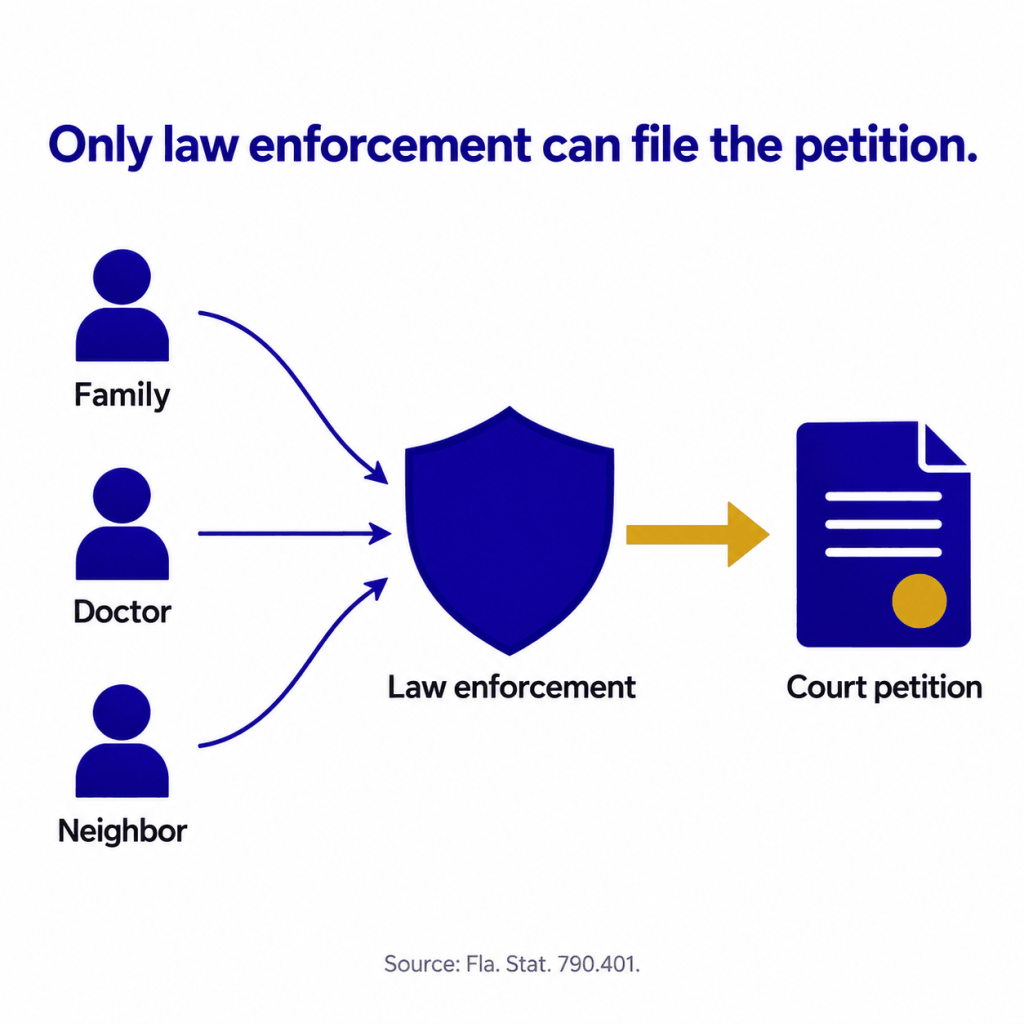
Only law enforcement can file. A spouse, family member, doctor, or neighbor cannot petition the court directly. Any of them can report concerns to law enforcement, and the investigating agency can file the petition. The person who prompted the investigation often becomes a central witness at the hearing.
An RPO is not a criminal charge. This is a civil, preventive proceeding. You will not be arrested or prosecuted because an RPO was filed against you. Violating an active RPO by possessing or acquiring firearms or ammunition is a separate third-degree felony that does carry criminal exposure. That said, many RPO petitions grow out of the same incident that produced an arrest, and the two cases run on parallel tracks. When that happens, the civil label is misleading comfort, because anything you say at the RPO hearing can surface in the criminal case. The FAQ below covers how to handle an RPO hearing with a criminal charge pending.
The rules are different from criminal court. Many of the protections people associate with criminal cases work differently here, and the differences drive strategy.
| Criminal Case | RPO Proceeding | |
| Burden of proof | Beyond a reasonable doubt | Clear and convincing evidence |
| Right to court-appointed attorney | Yes, if you cannot afford one | No current statutory entitlement |
| Who brings the case | State Attorney’s Office | Law enforcement officer or agency |
| Potential outcome | Conviction, incarceration, criminal record | Firearm and ammunition prohibition for up to 12 months |
| Discovery rights | Available under Florida Rule of Criminal Procedure 3.220 | No equivalent process |
Respondents who walk in expecting criminal-court procedure lose ground fast. Knowing which rules apply is the first step in building a defense.
How the RPO Process Works in Florida
The Temporary Ex Parte Order
For most people, the first sign of an RPO is a law enforcement officer at the door with a temporary order in hand. The court can issue that temporary ex parte order without notifying you and without giving you a chance to appear. For temporary relief, the petitioning agency has to show reasonable cause, a lower standard than the clear and convincing evidence required at the final hearing, and the court must take up the request the day it is filed or the next business day.
Once the temporary order is served, you must immediately surrender all firearms and ammunition in your custody, control, or possession, along with any Florida concealed weapon or firearm license. The serving officer issues a receipt for the surrendered property. If firearms are not surrendered, law enforcement can seek a search warrant.
Do not try to move, hide, or hold back firearms. The place to contest the legal basis for the order is in court. Deliberate possession while a valid RPO is in effect is a third-degree felony.
The 14-Day Hearing
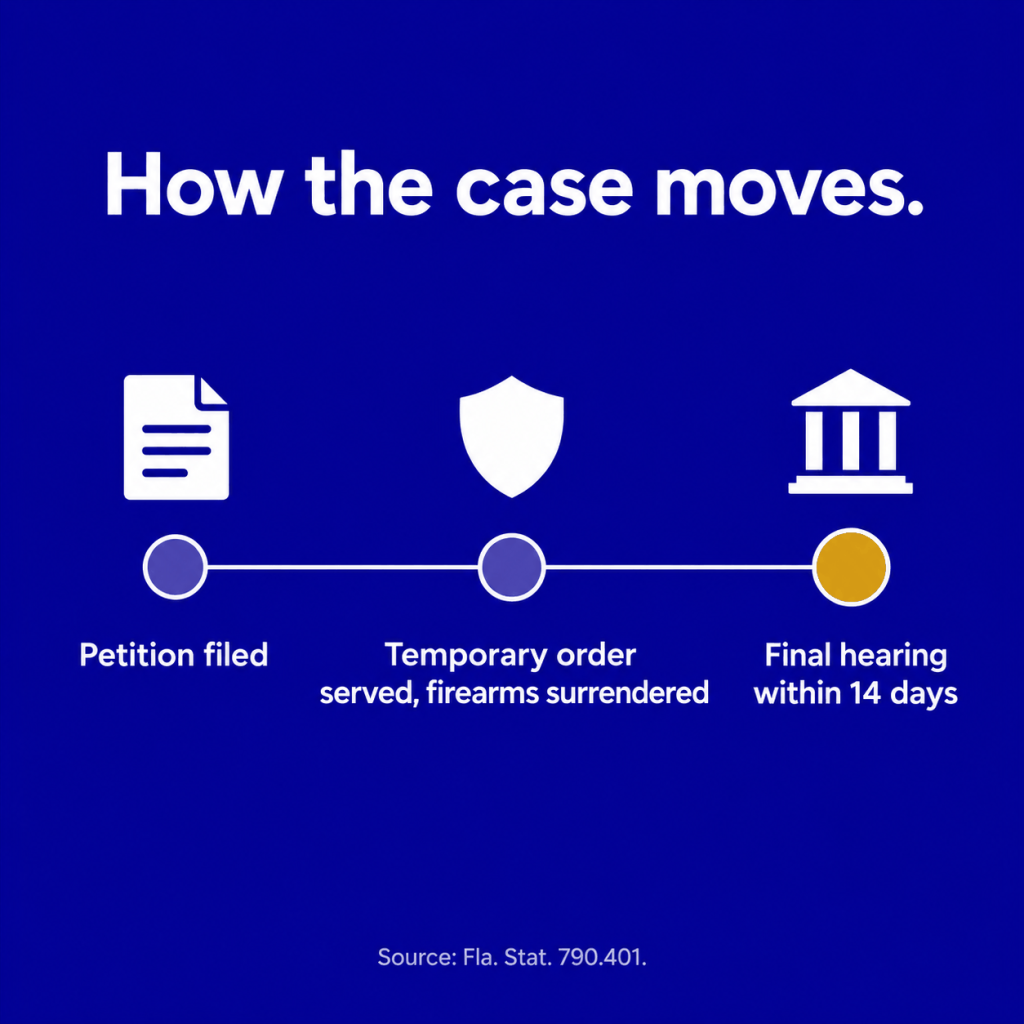
After the petition is filed, the court must schedule a final hearing no later than 14 days after the date of its scheduling order. That hearing is your opportunity to contest the order.
At the final hearing, the petitioning agency has to prove by clear and convincing evidence that you pose a significant danger of causing personal injury to yourself or others through firearm or ammunition access, possession, or acquisition. If the agency cannot carry that burden, the court should deny the petition.
If the court does enter a final RPO, it can last up to 12 months. Twelve months is the ceiling per order, not an automatic term. The agency can also seek an extension before the order expires, and each extension can add up to another 12 months if the agency again proves the danger by clear and convincing evidence.
What Judges Consider at an RPO Hearing
The statute lists 15 non-exclusive factors a court may weigh, including:
- Recent acts or threats of violence toward self or others
- Threats of violence within the previous 12 months
- Serious or recurring mental health issues
- Violations of existing protective orders
- History of domestic violence
- Use of or threats made with weapons
- Reckless display of firearms
- Recurring use of physical force or stalking behavior
- Violence-related arrests or convictions
- Corroborated substance or alcohol abuse
- Recent firearm acquisition
- Relevant information from family or household members
- Sworn witness testimony
The court can also weigh any other evidence it finds relevant.
How to Fight a Risk Protection Order at the Hearing
The final hearing is the main event. Here is what fighting an RPO actually involves.
Challenge Whether the Evidence Meets the Significant Danger Standard
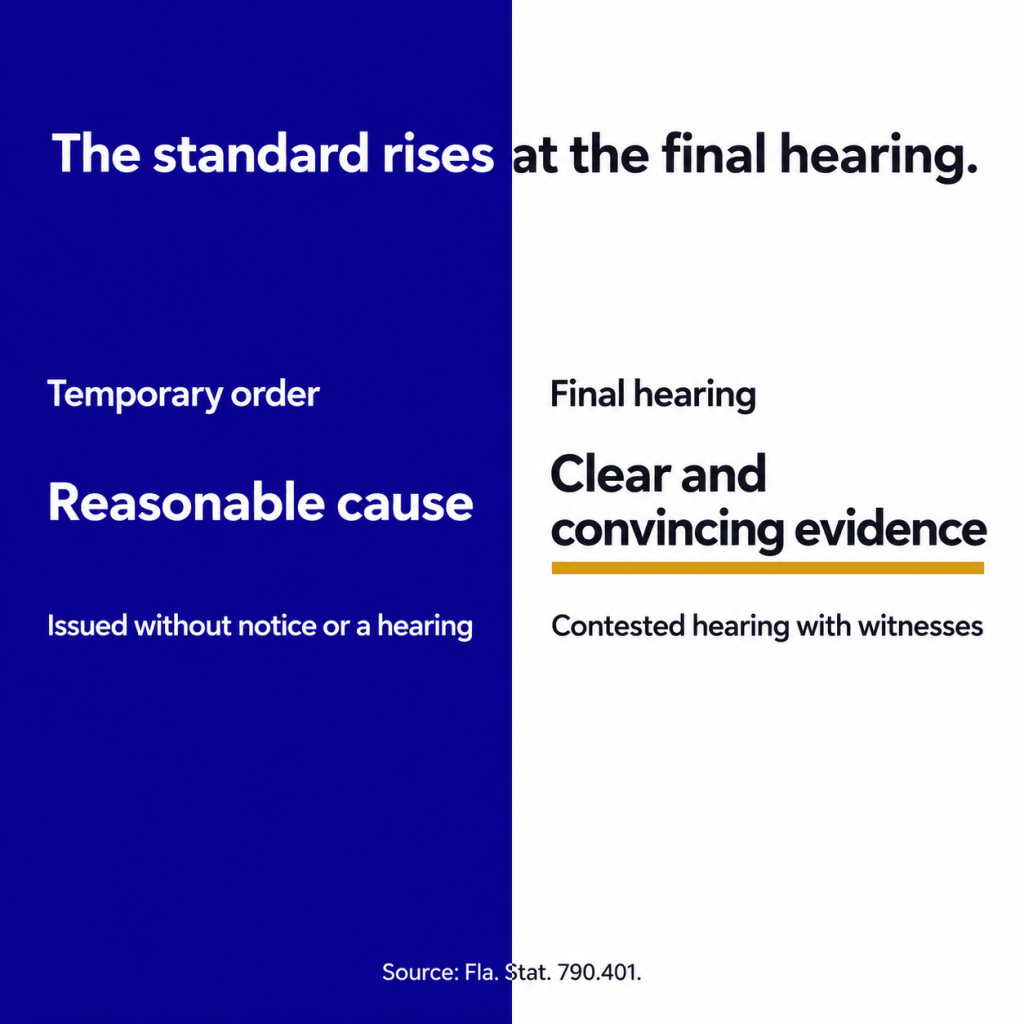
The petitioning agency cannot lean on the reasonable cause showing that supported the temporary order. At the final hearing it has to establish clear and convincing evidence of the specific statutory danger tied to firearm access.
In Davis v. Gilchrist County, Florida’s First District Court of Appeal drew the line between blowing off steam and making a genuine threat, and acknowledged that judges have to separate hyperbole from an actual plan. The order in that case was upheld because the respondent had allegedly named a specific intended victim, method, and firearm, repeated the statements to other officers, and behaved erratically at the time.
Context, specificity, credibility, corroboration, and the apparent ability to carry out a threat all move the needle. For every allegation in the petition, the defense works through the same questions. What precisely happened? Who observed it firsthand? When? Is the account corroborated by independent evidence? What connection to firearms exists? Does any document contradict the witness? Was the statement conditional, sarcastic, angry but empty, or an actual plan? What context did the petition leave out?
Cross-Examine the Petitioning Officer and Witnesses
Credibility decides a lot of these hearings. The Davis court put weight on the trial judge’s role in assessing witness credibility and demeanor, and the judge there was free to credit the law enforcement witnesses over the respondent’s expert.
That makes inconsistent reports, prior statements, body-camera footage, dispatch and 911 recordings, text messages, emails, and eyewitness testimony some of the most useful material in a contested hearing. When an officer’s sworn testimony conflicts with what the body camera recorded, or the 911 call tells a different story than the petition, those gaps are the case.
Witnesses at an RPO hearing testify under oath, and Florida treats that seriously. Under § 790.401(11)(a), a witness who makes a statement under oath at an RPO hearing that they do not believe to be true, on a material matter, commits a third-degree felony punishable by up to five years in prison and a $5,000 fine. The provision does not defeat a petition on its own. It gives the defense a framework for exposing material contradictions, and it means a witness who exaggerated has real exposure.

Get the Underlying Evidence Fast
Because the hearing arrives so quickly, the investigation has to start the day you are served. The useful material goes well beyond the four corners of the petition:
- Incident reports and police reports
- Body-camera footage
- 911 and dispatch recordings
- Text messages, social media posts, and emails
- Witness statements
- Medical or mental health evaluation records, where lawfully obtainable
- Prior injunction documents
- Evidence underlying any arrest or incident cited in the petition
An RPO is not a criminal prosecution, so the discovery rights available under Florida Rule of Criminal Procedure 3.220 do not apply the same way. Your attorney has to chase the records independently and move before the hearing date closes the window.
Request a Continuance When You Need One
When 14 days is not enough to obtain records, interview witnesses, or retain an expert, your attorney can ask the court for more time. Davis shows what happens when that request is not made cleanly. The respondent argued on appeal that limits on the hearing denied him due process, and the appellate court rejected the argument in part because the record showed no clear, unequivocal request for additional time.
Any request for more time has to be stated plainly and preserved in the record. No judge is required to grant every continuance, but a specific request that explains what still needs to be gathered protects both the hearing and any appeal that follows.
Present Evidence of Stability, Tied to the Statutory Issue
Treatment, counseling, evaluations, and character evidence help, and none of it wins on its own. The respondent in Davis had been evaluated and released after the underlying incident, and his neuropsychologist offered a favorable opinion. The appellate court still upheld the order, because mental illness is one permissible factor rather than an element the petitioner has to prove. The trial court was free to discount the expert in favor of other testimony.
A neighbor who says you are a good person does almost nothing. A witness with firsthand knowledge who can contradict a specific claimed threat, explain a disputed conversation, or show that conditions have materially changed speaks directly to a statutory factor. Documented sobriety, completed evaluations, and voluntary counseling carry weight when they connect to the reasons the petition was filed in the first place.
Filing a Motion to Vacate an RPO in Florida
If a final RPO has already been entered against you, § 790.401(6) gives you a separate path: a written request for a hearing to vacate the order.
You get one request per order. After the court enters a final RPO, you may submit one written request for a vacatur hearing. If the order is later extended, a new opportunity opens after each extension. One petition per order is accurate. One petition ever is not.
The burden flips to you. At the original hearing, law enforcement had to prove you pose a significant danger. At a vacatur hearing, you have to prove by clear and convincing evidence that you no longer do.
The timeline changes. The court must set the vacatur hearing no sooner than 14 days and no later than 30 days after your request is served on the petitioner.
| Contesting at the Final Hearing | Motion to Vacate | |
| Who carries the burden | Petitioning law enforcement agency | You, the respondent |
| Standard | Clear and convincing evidence | Clear and convincing evidence |
| What must be shown | That you pose a significant danger | That you no longer pose that danger |
| Timing | Hearing within 14 days of the scheduling order | Hearing 14 to 30 days after your request is served |
| How many chances | One contested final hearing | One request per order, renewed after each extension |
Because you only get one request per order, filing before you have built the record can burn the opportunity. What proves the point depends on why the order was entered. Passage of time without new threats or violent conduct, completed evaluations or voluntary counseling where substance abuse or mental health drove the petition, documented sobriety, evidence correcting misinformation from the first hearing, and firsthand witnesses who can speak to the specific findings all help. The statute sets the burden and the question. It does not prescribe a checklist, and what satisfies one judge in one case may not satisfy another.
Collateral Consequences of an RPO in Florida
The order reaches further than the firearms taken on day one.
FCIC and NCIC database entry. The order goes into the Florida Crime Information Center (FCIC) and the federal National Crime Information Center (NCIC). It stays in those systems for the life of the order and comes out when the order ends or is vacated. The order itself bars you from purchasing or receiving firearms or ammunition while it is in effect.
Concealed weapon license suspension. Within three business days after the order is issued, the court sends your identifying information to the Florida Department of Agriculture and Consumer Services, which immediately suspends any concealed weapon or firearm license. Reinstatement comes only after the order terminates and the department confirms your eligibility.
Public court records. An RPO is a court case, and the case does not vanish because no one was arrested or because the order expired. Florida’s criminal-history sealing and expunction process is not the ordinary mechanism for clearing an RPO case. Specific confidential information may still be protected under court-record rules, but the case itself generally stays accessible through the clerk of court’s public records.
Employment and professional licensing. The consequences are sharper when your work requires carrying or possessing a firearm. A public court case can also create occupation-specific problems depending on your employer, your licensing board, or the background checks your field requires.
Third-party firearms. When seized firearms belong to someone else in the household, the lawful owner can seek their return by proving ownership and satisfying the court that the respondent will not have access. The statute also allows the respondent to transfer surrendered firearms to an eligible third party under specified safeguards. For households with a shared safe, inherited firearms, or a collection with real value, this matters.
RPOs, Baker Act Proceedings, and Domestic Violence Injunctions
An RPO is a separate proceeding from both a Baker Act evaluation and a domestic violence injunction. One does not resolve or preclude the other. Being evaluated and released under a Baker Act hold does not answer the firearm-danger question. In Davis, the respondent had been evaluated and released, and the appellate court still affirmed the RPO because the separate statutory standard was met.
Domestic violence situations generate a large share of RPO petitions, and the statute requires the petition to identify any existing protective orders. History of domestic violence, prior protective order violations, and violence-related arrests are all evidence a judge may weigh. If you are facing both a domestic violence injunction and an RPO, each one needs its own defense strategy, and a mistake in one proceeding follows you into the other.
Do You Need an Attorney for an RPO Hearing?
Florida law does not currently give an RPO respondent a statutory right to a public defender or other court-appointed lawyer. You can retain your own attorney, and the court is not required to appoint one. A 2026 bill (HB 1455) that would have created that right cleared a House subcommittee and died before becoming law.
That leaves the decision to hire counsel entirely in your hands, on a compressed timeline, against an agency that has already built its file. The evidentiary burden, the rules on what the judge can consider, and the single-request structure of the vacatur petition all reward preparation. An attorney who has tried contested RPO hearings can pull the underlying evidence, prepare cross-examination, decide which witnesses actually help, preserve the record for appeal, and advise on whether and when to file the motion to vacate.
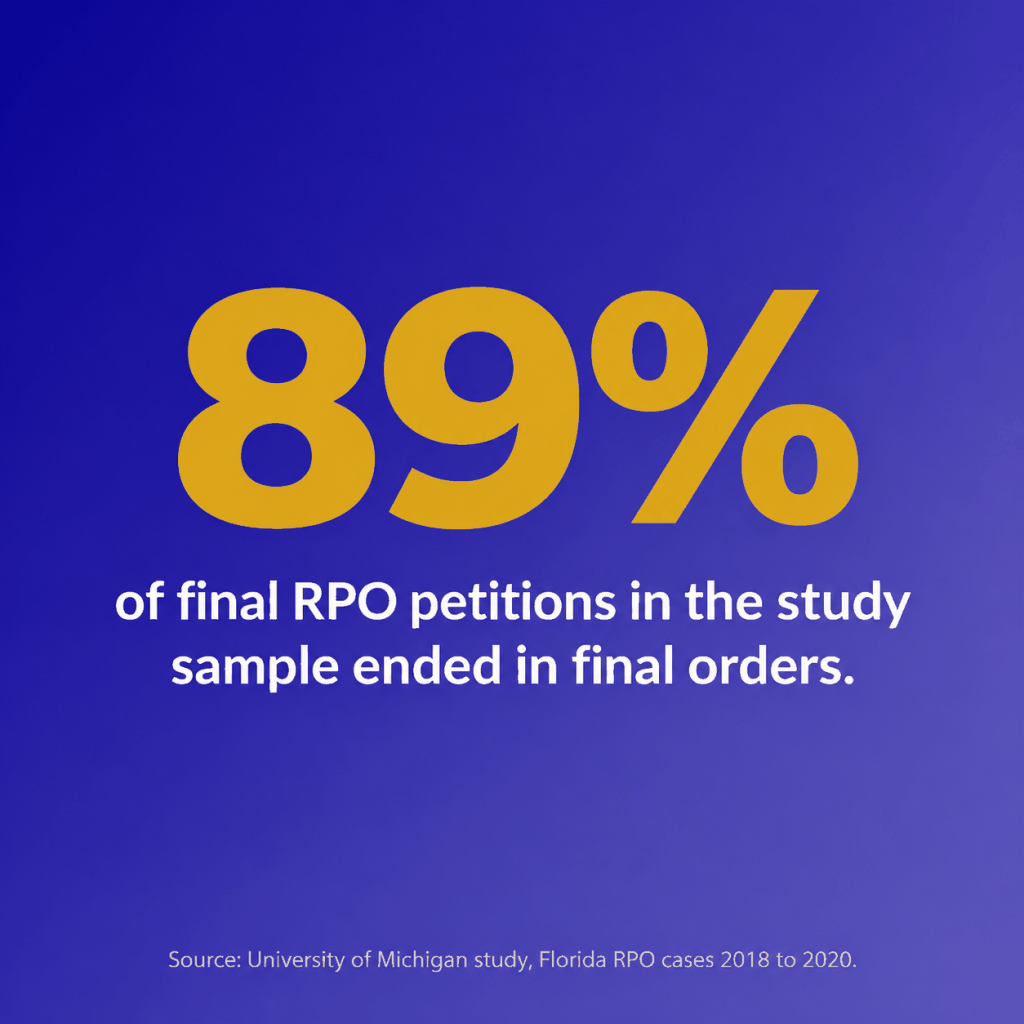
The numbers explain the urgency. State records reported by WPTV showed judges had granted nearly 1,000 risk protection orders in Hillsborough County alone between 2018 and March 2022. A University of Michigan study of Florida RPO cases filed between March 2018 and June 2020 found that 89% of final RPO petitions in its sample ended in final orders. Respondents who treat the hearing as a formality lose their firearms and their firearm rights for a year or more.
Common Questions About Florida Risk Protection Orders
How long does a risk protection order last in Florida?
A final RPO can last up to 12 months. The court sets the length it finds appropriate up to that ceiling, and the petitioning agency can request an extension of up to another 12 months before the order expires.
Can a risk protection order be expunged in Florida?
Florida’s criminal-history sealing and expunction process is not the ordinary route for an RPO, because an RPO is a civil case rather than an arrest record. The court case generally remains accessible through the clerk of court even after the order expires.
Can you get your guns back after an RPO expires in Florida?
Yes, though the firearms are not returned automatically. Once the order terminates or is vacated, the respondent has to establish eligibility and follow the return process with the agency holding the property. Our firm assists clients with recovering firearms after an RPO ends.
Does a Baker Act automatically lead to a risk protection order?
No. A Baker Act evaluation and an RPO are separate proceedings with separate standards. A Baker Act hold can prompt law enforcement to investigate and petition for an RPO, and being evaluated and released does not resolve the RPO question.
What if I have a related criminal charge at the time of the RPO hearing?
This is one of the most dangerous positions a respondent can be in, and it is common. Many RPO petitions arise from the same incident that led to an arrest, so the civil case and the criminal prosecution move at the same time, often with the same officers and the same witnesses.
The RPO hearing does not pause because a criminal case is pending. You testify under oath, and the hearing is recorded. Nothing prevents the State Attorney’s Office from obtaining that transcript and using your statements against you in the criminal case, either as admissions or to impeach you if your trial testimony differs. An unprepared respondent can hand the prosecution sworn discovery it could never have compelled on its own.
That is why these hearings belong with a Tampa criminal defense attorney rather than being treated as a standalone civil matter. An attorney who sees only the RPO can win the hearing and damage the criminal case doing it. An attorney handling both knows what the prosecution has to prove, which questions are safe to answer, and when your testimony helps or hurts the larger picture. Handled correctly, the hearing can become an advantage, a chance to question the petitioning officer under oath months before the criminal case reaches deposition or trial.
The right approach depends on the strength of both cases. That call should be made with one attorney who can see the whole board before you say a word in either courtroom.
Talk to a Defense Attorney Before Your Hearing Date
Fourteen days sounds like time. It is not. Waiting three or four days to call an attorney can consume a quarter of the window available for records requests, subpoenas, witness interviews, and hearing preparation, and the agency filed its petition with a head start.
We handle contested risk protection order hearings throughout Tampa Bay, including Hillsborough, Pinellas, and Pasco Counties. Call The Brancato Law Firm at (813) 727-7159 or contact us online for a confidential consultation.
Visit Us
Tampa, FL 33602
Contact Us Now
Free Legal Consultation (813) 727-7159