Strategic Defense,
From First DUI to Death Penalty
From First DUI to Death Penalty






| Arrested for DUI in Tampa? The Brancato Law Firm, P.A. defends DUI, breath test refusal, felony DUI, and DUI manslaughter charges in Hillsborough, Pinellas, and Pasco Counties. Our attorneys act on your license inside the 10-day deadline, test the traffic stop, the roadside exercises, and every breath or blood result, and push for a dismissal, diversion, or reduction before any plea is discussed. Call (813) 727-7159 for a free, confidential consultation. |
After a Florida DUI arrest, you have 10 days to challenge the suspension of your driver’s license, and the criminal case starts moving on a separate track the same week. Our attorneys at The Brancato Law Firm, P.A., a Tampa criminal defense firm founded by Rocky Brancato, handle both cases from the first call.
Rocky taught criminal procedure and courtroom testimony at the police academy, so he knows how officers are trained to run a DUI investigation and how they are trained to testify about it. He is a member of the National College for DUI Defense and the DUI Defense Lawyers Association, has tried more than 150 cases to a jury verdict, and served as Chief Operations Officer of the Hillsborough County Public Defender’s Office, overseeing a staff of over 100 attorneys.
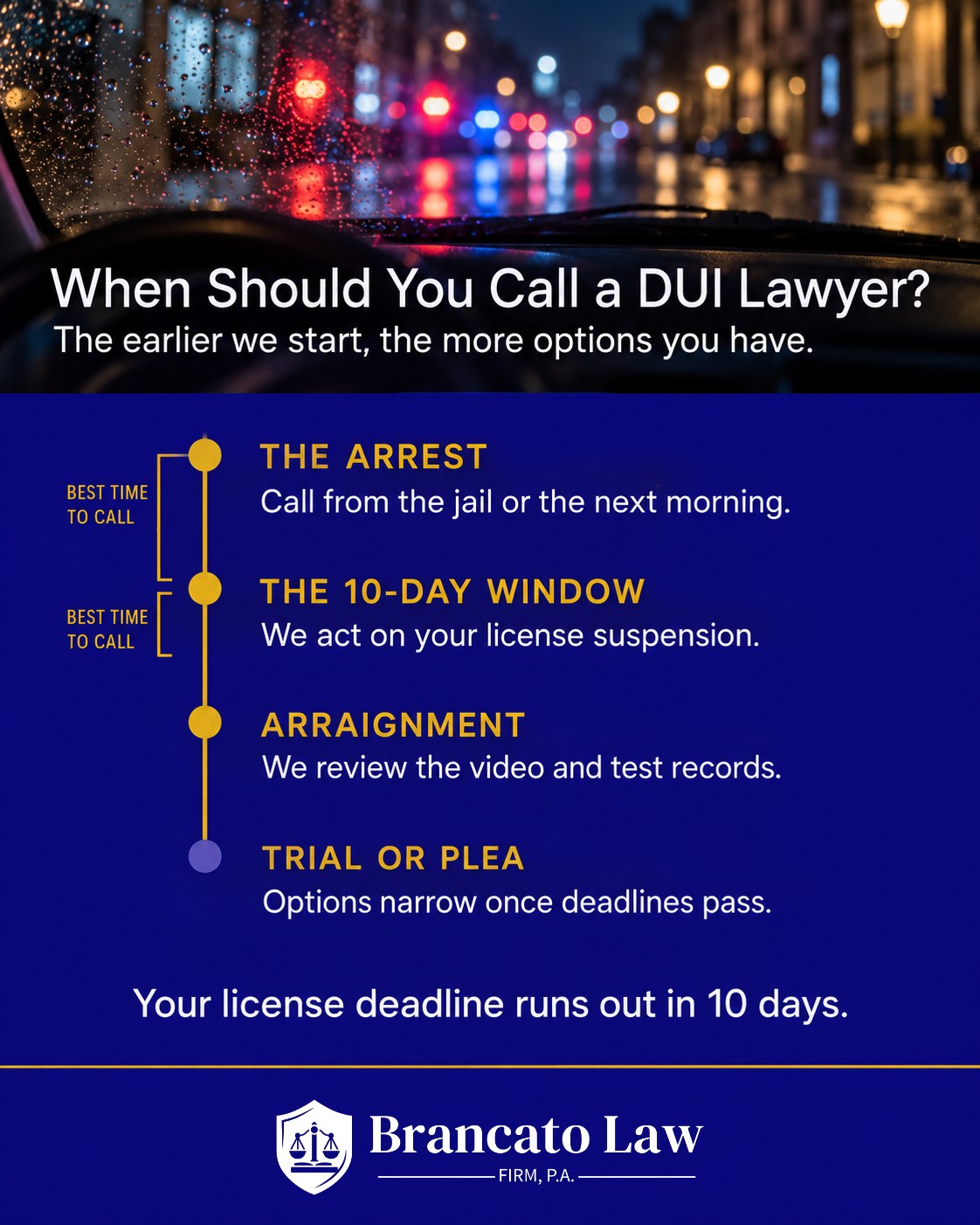
Call a DUI lawyer, then request a review of your license suspension, or make an informed decision to waive it, within 10 days of the arrest. The officer who arrested you took your driver’s license and gave you a notice of suspension that also works as a 10-day temporary permit. Under section 322.2615, Florida Statutes, you have 10 days from that notice to ask the Department of Highway Safety and Motor Vehicles for a formal or informal review. If no one acts in that window, the suspension stands without a hearing.
The suspension runs on its own clock, separate from the criminal case:
| Reason for the administrative suspension | Length of the suspension |
|---|---|
| Breath or blood alcohol of .08 or higher, first suspension | 6 months |
| Breath or blood alcohol of .08 or higher, prior suspension | 1 year |
| First refusal to submit to a breath, blood, or urine test | 1 year |
| Second or later refusal | 18 months |
There are two paths, and the right one depends on your record, your job, and the evidence:
If the suspension is upheld after a review, the law makes you wait before any hardship license: 30 days for a .08 suspension and 90 days for a refusal suspension. Our firm has taken this fight past the hearing officer. When the Department upheld a client’s suspension of both his regular license and his commercial license, Rocky filed a petition for writ of certiorari in circuit court and won an order reinstating both. Our post on overturning a Florida CDL suspension on appeal explains how, and our guide to protecting your driver’s license after a Tampa DUI arrest walks through the forms.
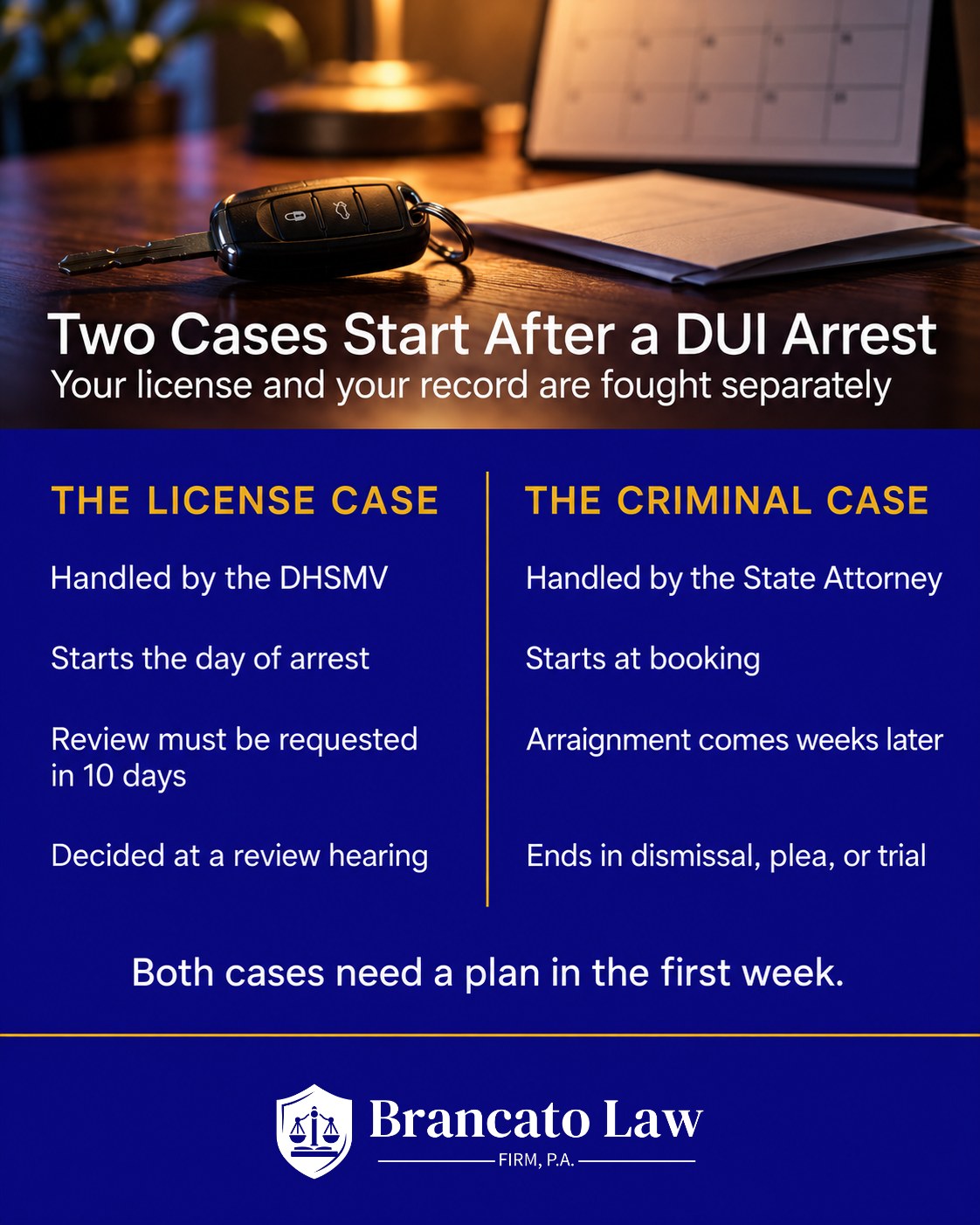
Yes. DUI charges in Hillsborough, Pinellas, and Pasco Counties are dropped, reduced, or resolved through diversion when the evidence does not hold up or when the case qualifies for a program. The State Attorney’s Office can decline to file the charge, dismiss it by nolle prosequi, or agree to reduce it to reckless driving. A judge can also suppress the evidence that the case depends on.
The difference matters for your record. Under section 316.656, Florida Statutes, a Florida judge may not withhold adjudication on a DUI. Every DUI conviction is a permanent conviction that can never be sealed or expunged. A reduction to reckless driving with adjudication withheld can leave a person eligible to seal the record later, which is why our attorneys treat the charge itself as the main fight.
Recent DUI results from our firm:
| Outcome | Charge | How our firm handled it |
|---|---|---|
| Not guilty on both counts | DUI (refusal) and resisting an officer without violence | Used the scene video at trial to show the client was not impaired and did not resist |
| Reduced to reckless driving, adjudication withheld | DUI, leaving the scene, and refusal | The crash made the client ineligible for diversion, so we built a mitigation report and treatment plan that moved the prosecutor |
| Reduced to reckless driving | DUI involving drugs (airline pilot) | Negotiated a reduction that protected the client’s career |
| Reduced to reckless driving | Marijuana DUI | Negotiated a reduction even though a lit blunt was in the car at the stop |
| License and CDL reinstated | DUI administrative suspension | Lost before the hearing officer, then won a certiorari petition in circuit court |
Each case is unique. Past results do not guarantee future outcomes. More outcomes are on our case results page, and our guide on how to fight a DUI charge in Hillsborough County covers the strategies in more depth.
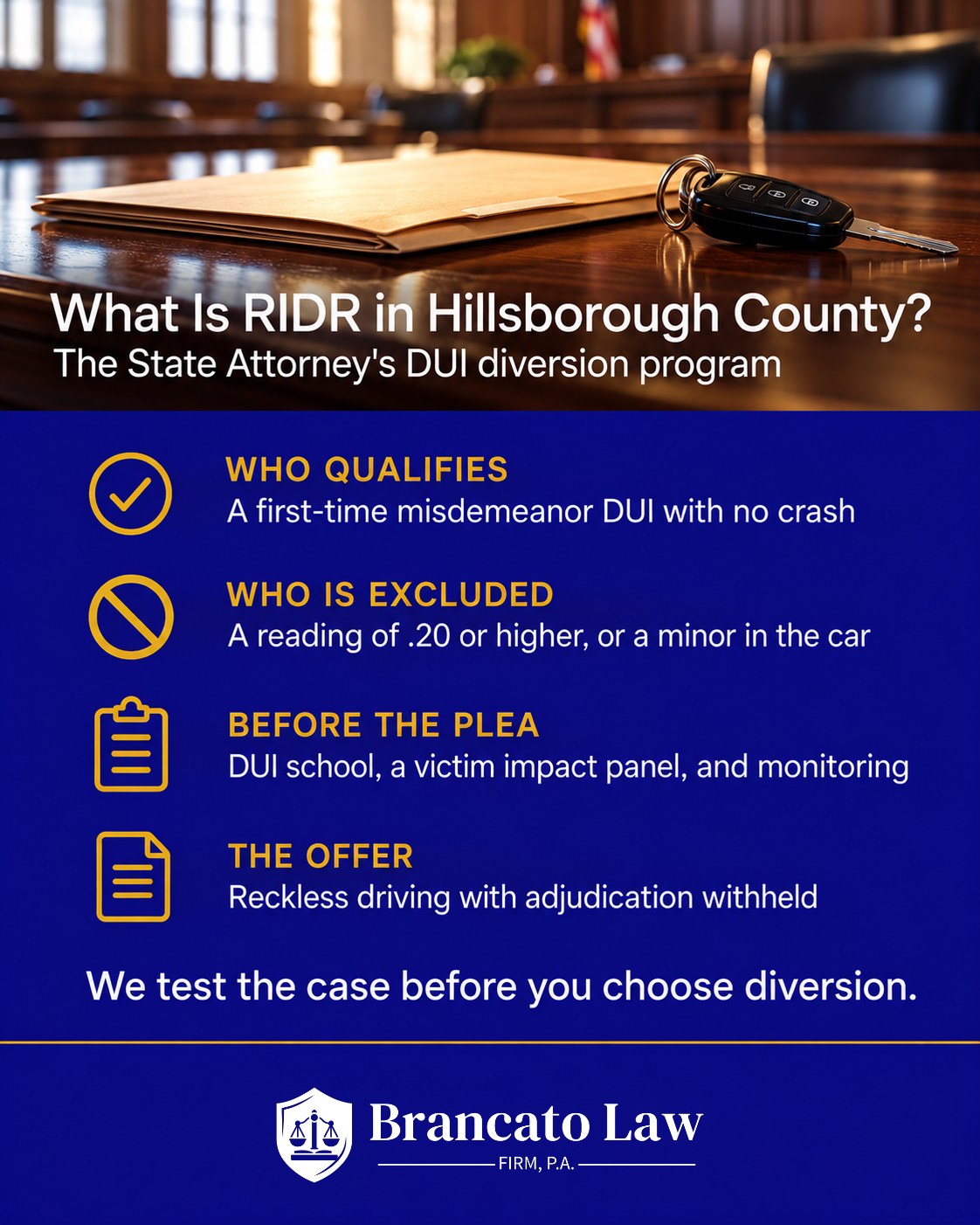
RIDR, short for Reducing Impaired Driving Recidivism, is the Hillsborough County State Attorney’s Office program for first-time, non-aggravated misdemeanor DUI cases. A person who qualifies completes sanctions before entering a plea and then receives an offer to plead to reckless driving with adjudication withheld. The rules below come from the State Attorney’s RIDR program summary.
| RIDR rule | What the State Attorney’s Office requires |
|---|---|
| Who is excluded | A breath or blood alcohol of .20 or higher, a crash, or a minor in the vehicle |
| Prior record | No prior DUI, alcohol-related reckless driving, DUI diversion, and other listed offenses, and no felony adjudication, withhold, or sentence within 5 years |
| Before the plea | DUI school and any recommended treatment, the MADD Victim Impact Panel, 10 community service hours, and an ignition interlock or alcohol monitor for alcohol cases (a drug patch for drug cases) |
| The plea offer | Reckless driving, adjudication withheld, 12 months of probation, and a 10-day vehicle immobilization |
| Monitoring after the plea | 3 months of interlock or alcohol monitoring for readings at or below .15, and 6 months for readings above .15 |
| Community service after the plea | 50 hours, or 75 hours for readings above .15 |
RIDR is not automatic. The program requires waiving speedy trial at arraignment and finishing the sanctions before disposition, and the State Attorney’s Office keeps the final say on who gets in. Our attorneys review the stop, the arrest, and the breath or blood evidence first, because a case that can be won does not need a diversion offer. When a client does not qualify, as in the crash case in the results above, we build the mitigation that gets a comparable result. Pinellas and Pasco Counties are prosecuted by a different office, the State Attorney for the Sixth Judicial Circuit, which sets its own terms.
A first DUI in Florida is a misdemeanor punishable by up to 6 months in jail and a fine of $500 to $1,000 under section 316.193, Florida Statutes. The penalties climb with a breath or blood alcohol of .15 or higher, a minor in the car, a crash, prior convictions, and injury or death. License revocation on conviction is set by section 322.28, Florida Statutes.
| Offense | Maximum jail or prison | Fine | License revocation on conviction | Other mandatory terms |
|---|---|---|---|---|
| First DUI | 6 months | $500 to $1,000 | 180 days to 1 year | Up to 1 year of probation, 50 community service hours, 10-day vehicle impoundment, DUI school |
| First DUI, .15 or higher or a minor in the car | 9 months | $1,000 to $2,000 | 180 days to 1 year | Ignition interlock for at least 6 months |
| Second DUI | 9 months (12 months at .15 or higher) | $1,000 to $2,000 ($2,000 to $4,000 at .15 or higher) | At least 5 years if within 5 years of the first | Interlock for at least 1 year; within 5 years, at least 10 days in jail and a 30-day impoundment |
| Third DUI within 10 years | 5 years (third-degree felony) | Up to $5,000 | At least 10 years | At least 30 days in jail, interlock for at least 2 years, 90-day impoundment |
| Third DUI more than 10 years after a prior | 12 months | $2,000 to $5,000 | Revocation required | Interlock for at least 2 years |
| Fourth or later DUI | 5 years (third-degree felony) | At least $2,000 | Permanent | Scoresheet sentencing |
| DUI with property damage or injury | 1 year (first-degree misdemeanor) | Up to $1,000 | Revocation required | Restitution may be ordered |
| DUI with serious bodily injury | 5 years (third-degree felony) | Up to $5,000 | At least 3 years | Scoresheet sentencing |
| DUI manslaughter | 15 years (30 years if the driver left the scene) | Up to $10,000 | Permanent | 4-year minimum mandatory prison term |
Florida law also requires a substance abuse evaluation and course, and many drivers must carry FR-44 insurance after a DUI. Our guide to Florida DUI penalties in Tampa and Hillsborough County and our post on Trenton’s Law and Florida’s enhanced DUI and BUI penalties explain these terms in more detail.
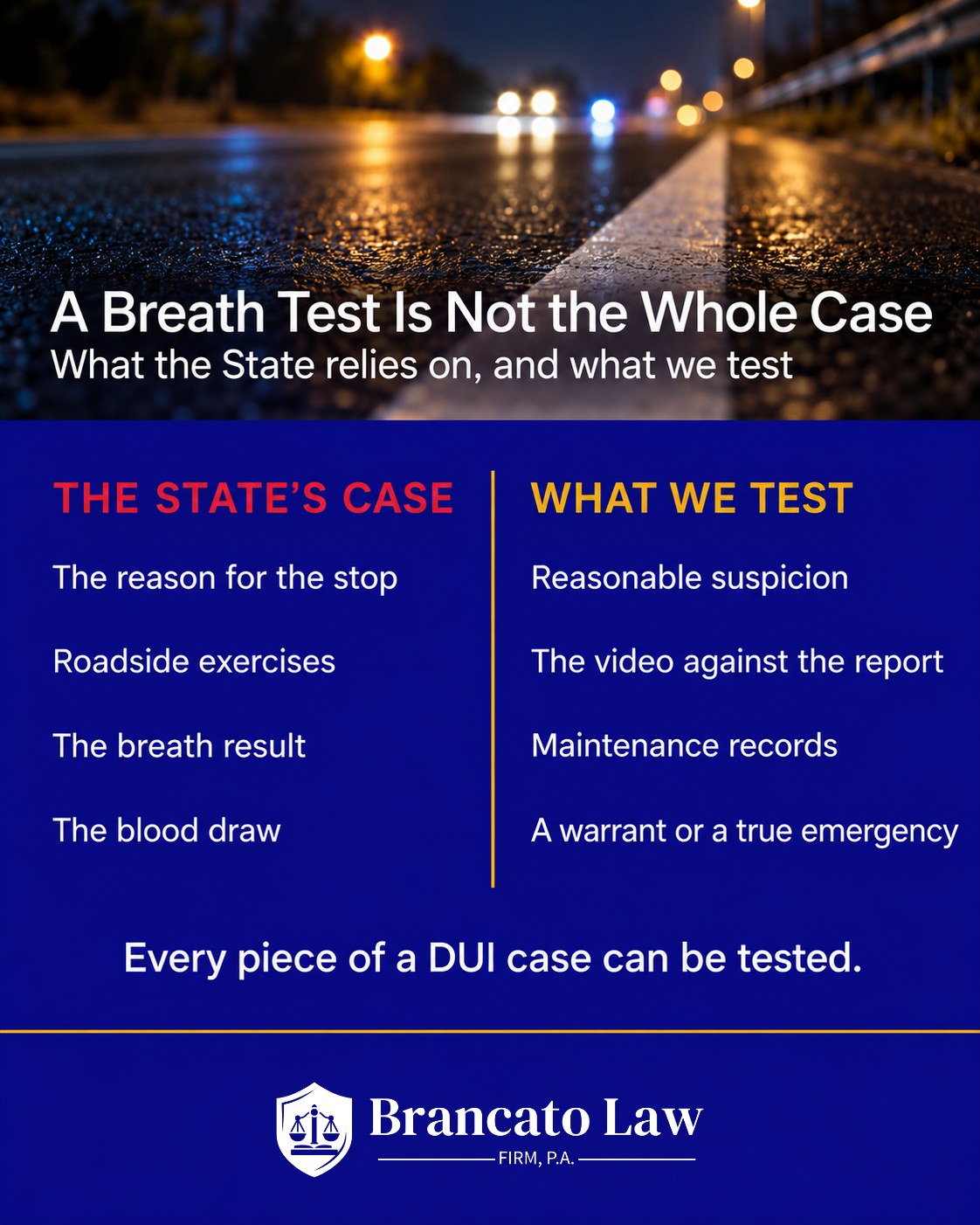
Our defense starts with the evidence the State needs most: a lawful stop, proof of impairment, and a reliable chemical test. Each one has rules, and each one can fail. Our attorneys get every video, report, and maintenance record before we talk about a plea, and we file a motion to suppress when the State’s evidence was gathered unlawfully. Read our post on mistakes to avoid after a DUI arrest in Florida for what to do while that work starts.
Police need reasonable suspicion to stop a car and probable cause to arrest. Many Tampa DUI cases begin with a weaving complaint, a crash, or a call about someone asleep in a parked car, and each fact pattern has its own rules. If the stop or detention was unlawful, the observations, exercises, and test results that followed can be suppressed.
Field sobriety exercises are weaker evidence than juries are told. The walk-and-turn, one-leg stand, and eye test come from a National Highway Traffic Safety Administration program, and officers are trained to give and score them in a specific way. Psychologist Steven Rubenzer reviewed the research in “The Standardized Field Sobriety Tests: A Review of Scientific and Legal Issues,” Law and Human Behavior, vol. 32, no. 4 (2008), and concluded that the supporting research is limited, that important confounding factors have not been studied, and that reliability is mediocre.
Because Rocky trained officers in courtroom testimony, our attorneys compare the body camera video to the officer’s report, line by line. Uneven pavement, footwear, injuries, age, weight, and nerves all affect performance, and the video often shows a different person than the report describes. Our post on how to challenge field sobriety tests in Tampa explains what we look for.
A breath result is only as good as the instrument, its maintenance, and the procedure the operator followed. Florida uses the Intoxilyzer 8000, and the Florida Department of Law Enforcement’s rules govern inspections, the operator’s permit, and the observation period before the test. Our attorneys request the instrument’s maintenance and inspection records and the operator’s records for every breath case. Mouth alcohol from reflux or dental work, a short observation period, and gaps in the maintenance history all affect the result, as our post on an Intoxilyzer that was not properly maintained shows.
A reading at the station also is not your reading behind the wheel. Alcohol keeps absorbing after the last drink, so a person can be under .08 while driving and over it an hour later. Our attorneys work with forensic toxicologists on retrograde extrapolation, which we explain in your BAC at the station is not your BAC behind the wheel.
Police generally need a warrant to draw your blood. In Birchfield v. North Dakota, 579 U.S. 438 (2016), the U.S. Supreme Court held that the Fourth Amendment allows a warrantless breath test after a DUI arrest but not a warrantless blood test. Florida courts continue to apply that line. In State v. Marlin, No. 4D2025-1448 (Fla. 4th DCA Sept. 2, 2026), the Fourth District Court of Appeal affirmed the suppression of a forced blood draw after a fatal crash and held that the natural loss of alcohol from the blood is not an automatic emergency. Our post on whether police can take your blood without a warrant in Florida explains the rule, and our post on whether the State can get your medical records in a Florida DUI case covers hospital blood results.
Florida has no legal limit for THC or prescription drugs, so the State must prove that a substance impaired your normal faculties. A valid medical marijuana card or prescription is not a defense to impairment, but the absence of a per se limit makes these cases harder for the State to prove. Our attorneys look at when the substance was taken, whether a drug recognition evaluation was done and how, and whether the lab report shows an active drug or only an inactive metabolite. Read our posts on marijuana DUI charges in Florida, DUI for prescription drugs in Florida, and driving after using medical marijuana.
Yes. Florida’s DUI statute covers a person who is driving or in “actual physical control” of a vehicle, and the standard jury instruction for DUI defines that as being in the vehicle with the capability to operate it, whether or not it is moving. These cases usually start with a welfare check, and the legal question is when a welfare check becomes a detention.
The Second District Court of Appeal, which hears appeals from Hillsborough, Pinellas, and Pasco Counties, addressed that question in a Hillsborough County case in September 2026. In State v. Fuchs, No. 2D2025-1542 (Fla. 2d DCA Sept. 9, 2026), sheriff’s deputies found a man unresponsive in the driver’s seat of a running truck at an apartment complex. After he woke up, a deputy asked him to roll down the window, smelled alcohol, and began a DUI investigation. The trial judge suppressed the evidence, finding the request turned the welfare check into a stop. The appeals court reversed, holding that the deputies could ask him to lower the window because nothing he had said or done had yet resolved their concern for his safety.
The lesson for the defense is that these cases turn on the exact sequence on the body camera video. Once an officer’s safety concern is satisfied, any further detention requires reasonable suspicion of a crime. The body camera video was not part of the record on appeal in Fuchs, and our attorneys make sure the video is in evidence at every suppression hearing we litigate.
| Evidence the State relies on | What our attorneys test |
|---|---|
| The reason for the stop or welfare check | Whether the facts gave reasonable suspicion, and when the encounter became a detention |
| Field sobriety exercises | How they were explained, demonstrated, and scored, compared against the video |
| Intoxilyzer 8000 breath result | Maintenance and inspection records, the operator’s permit, and the observation period |
| Blood test | Whether there was a warrant or a true emergency, and how the sample was stored and analyzed |
| Drug recognition evaluation | Whether each step was done, and whether the lab found an active drug |
| Refusal | Whether the arrest was lawful and the implied consent warning was read correctly |
Yes. Since October 1, 2025, refusing a lawfully requested breath, blood, or urine test is a second-degree misdemeanor for a first refusal and a first-degree misdemeanor for a second or later refusal under section 316.1939, Florida Statutes. The refusal also brings a 1-year administrative suspension, and the State can tell the jury about it under section 316.1932, Florida Statutes.
A refusal charge still has elements the State must prove. The arrest must have been lawful, the implied consent warning must have been read correctly, and the conduct must have been a real refusal. A driver who tried and could not give an adequate sample, or who asked questions and was marked as refusing, has a factual defense. Our post on whether refusing a breathalyzer is a crime in Florida covers the recent case law.
A DUI becomes a felony when it is a third DUI within 10 years, a fourth DUI at any time, a crash causing serious bodily injury, or a crash causing a death. Felony DUI cases go to circuit court and are sentenced under the Criminal Punishment Code scoresheet, and DUI manslaughter carries a 4-year minimum mandatory prison term. Our attorneys defend fatal crash cases through our Tampa homicide defense practice, with accident reconstructionists and toxicologists on the causation and impairment questions. Our posts on what DUI manslaughter is in Florida and how DUI manslaughter cases are defended go further.
Trial rights matter in these cases. In Karls v. State, No. 2D2024-0325 (Fla. 2d DCA May 7, 2025), the Second District reversed a Pinellas County conviction for DUI with property damage because the trial court barred the defense from calling a witness whose testimony went to the heart of the defense. Our post on that DUI conviction reversal explains why preparing defense witnesses early can decide a trial.
A first DUI conviction disqualifies a commercial driver from operating a commercial vehicle for 1 year, and a second conviction disqualifies the driver for life, under the federal rules in 49 C.F.R. section 383.51. The same disqualification applies to a refusal and to a DUI in a personal vehicle. A commercial driver operating a commercial vehicle is over the limit at .04. CDL holders have more at stake in both the license hearing and the criminal case, and our attorneys plan both with the career in mind.
Clients hire our firm because DUI cases are won on training, trial experience, and speed. These credentials stand behind our DUI practice:
| Credential | Why it matters in a DUI case |
|---|---|
| Former police academy instructor in criminal procedure and courtroom testimony | Knows how officers are trained to investigate DUI and how they testify about it |
| Member, National College for DUI Defense and DUI Defense Lawyers Association | Ongoing training in breath testing, toxicology, and field sobriety science |
| More than 150 jury trials to verdict, including DUI not guilty verdicts | Prosecutors know a weak case will be tried |
| Former Chief Operations Officer, Hillsborough County Public Defender’s Office, overseeing a staff of over 100 attorneys | Inside knowledge of how the 13th Judicial Circuit charges and resolves DUI cases |
| AV Preeminent (Martindale-Hubbell), Super Lawyers selection, 10.0 Avvo rating, National Trial Lawyers Top 100 | Peer and independent recognition of legal ability and ethics |

Our attorneys defend DUI arrests by the Tampa Police Department, the Hillsborough County Sheriff’s Office, the Florida Highway Patrol, and local police departments in Hillsborough County, Pinellas County, and Pasco County. Our office is at 620 E. Twiggs Street, two blocks from the Hillsborough County Courthouse, where DUI cases are heard. Trial attorney Jean-Luc Adrien speaks Spanish, Haitian Creole, and French, and our office has Spanish-speaking staff. Our firm charges a flat fee quoted on the facts and complexity of the case, and there is no separate charge for the license review hearing. Our guide to how much a criminal defense attorney costs in Tampa explains how fees are set.
Hire a lawyer within the 10-day window for the license review, and ideally before you leave the jail or the next morning. In Hillsborough County, a person arrested for DUI is booked at the Orient Road Jail and either posts the bond schedule amount or sees a judge at first appearance within 24 hours. Evidence also starts disappearing: store and gas station cameras are overwritten, and 911 recordings and dispatch logs are kept only for set periods. Our attorneys send preservation requests in the first days of the case. Our post on what happens after a DUI arrest in Hillsborough County walks through the timeline.
Impaired driving cases are prosecuted aggressively because the numbers are high. In 2023, Florida recorded 6,026 impaired-driving crashes and 969 impaired-driving deaths, 28.71 percent of all traffic deaths that year, according to the Florida Department of Highway Safety and Motor Vehicles Impaired Driving Annual Report. Prosecutors and judges see those numbers, and a DUI case needs a defense prepared for trial from the start.
Yes, the State Attorney’s Office can decline to file a DUI, dismiss it by nolle prosequi, or reduce it when the stop, the arrest, or the chemical test does not hold up. The Brancato Law Firm pushes for that result through suppression motions and independent review of the video and test records, as our guide to fighting a Tampa DUI charge explains.
The suspension starts on the date of the arrest, but the notice works as a 10-day temporary permit for an eligible driver. Our attorneys at The Brancato Law Firm request the formal review hearing or advise on the business-purposes waiver within that window, and there is no separate fee for the license hearing.
No, not if it ends in a DUI conviction, because Florida law bars judges from withholding adjudication on a DUI. The Brancato Law Firm focuses on dismissals and reductions to reckless driving, which can preserve sealing eligibility; see our Tampa criminal traffic lawyer page for reckless driving defense.
RIDR ends with a plea to reckless driving with adjudication withheld, so the participant avoids a DUI conviction. Our attorneys at The Brancato Law Firm compare that offer against the defenses in the case before advising a client to enter the program, because RIDR requires waiving speedy trial and completing sanctions up front.
No, a first DUI is a misdemeanor unless it causes serious bodily injury or death. The Brancato Law Firm defends both misdemeanor DUI cases in county court and felony DUI cases in circuit court, including DUI manslaughter through our homicide defense team.
Usually only with a warrant or a true emergency, under Birchfield v. North Dakota, 579 U.S. 438 (2016) and the Florida decisions that follow it. Our attorneys at The Brancato Law Firm challenge warrantless and forced blood draws with motions to suppress, especially in crash cases.
DUI defense is usually charged as a flat fee based on the charge, the prior record, and whether the case involves a crash, a refusal, or a commercial license. The Brancato Law Firm offers free, confidential consultations and quotes a flat fee covering the case, with no separate charge for the license review. Our guide to criminal defense fees in Tampa explains how fees are set.
The 10-day license deadline started the day you were arrested. Call The Brancato Law Firm, P.A., founded by Tampa Criminal Defense Attorney Rocky Brancato, at (813) 727-7159. Call us at any hour, and our attorneys will tell you what to do about your license this week and what we will request first in the criminal case.
The Brancato Law Firm, P.A.
620 E. Twiggs Street, Suite 205, Tampa, FL 33602
(813) 727-7159
Serving Hillsborough, Pinellas, and Pasco Counties
The Brancato Law Firm, P.A. is a Tampa-based criminal defense practice. We are not affiliated with any other Brancato-named law firms.
This page is for informational purposes only and does not constitute legal advice. Each case is unique, and outcomes depend on the individual facts and circumstances involved. Past results do not guarantee future outcomes.


Tampa, FL 33602

Free Legal Consultation (813) 727-7159
