- Free Consultation 24/7: (813) 727-7159 Tap Here To Call Us


From First DUI to Death Penalty



Is Refusing a Breathalyzer a Crime in Florida? (2026)


Updated October 22, 2026
Yes. Since Trenton’s Law took effect on October 1, 2025, a first refusal to take a lawfully requested breath or urine test is a second-degree misdemeanor in Florida, punishable by up to 60 days in jail and a $500 fine. A second or later refusal is a first-degree misdemeanor carrying up to 1 year. The refusal also brings a 1-year license suspension (18 months after a prior refusal), and the jury in the DUI case can hear about it. A refusal of a blood test is not a crime, and the State has to prove a lawful arrest and the required warnings before any refusal counts.
Most refusal cases are decided by what the officer said, in what order, before the driver said no. Body camera audio usually settles it. As founder of The Brancato Law Firm, P.A., a Tampa criminal defense firm, I bring a background that fits these cases: I am a member of the National College for DUI Defense and a former police academy instructor. Our attorneys defend refusal charges and the DUI cases that come with them in Hillsborough, Pinellas, and Pasco Counties.
This guide covers what changed in 2025, what the State must prove, how a refusal is used at trial, and what to do about your license in the first 10 days.
What happens when you refuse a breath test in Florida?
Three separate things happen when you refuse. First, the refusal is admissible in the DUI case under section 316.1932, Florida Statutes, and the prosecutor will argue it shows you knew you would fail. Second, your license is suspended administratively for 1 year, or 18 months if you refused before. Third, the refusal is now its own crime, even on a first refusal.
Florida’s implied consent law is the trade built into every driver license. By driving in Florida, you are deemed to have agreed to an approved breath or urine test after a lawful DUI arrest. The officer must tell you the consequences of refusing before the refusal counts against you. Our attorneys at The Brancato Law Firm start every refusal case by listening to that warning on the video.
Is a first refusal really a crime now?
Yes. Before October 1, 2025, a first refusal carried only the license suspension. The crime applied only to a driver whose license had already been suspended for an earlier refusal. Trenton’s Law, chapter 2025-121, Laws of Florida, changed that. Under the current section 316.1939, Florida Statutes, a first refusal is a second-degree misdemeanor and a second or later refusal is a first-degree misdemeanor.
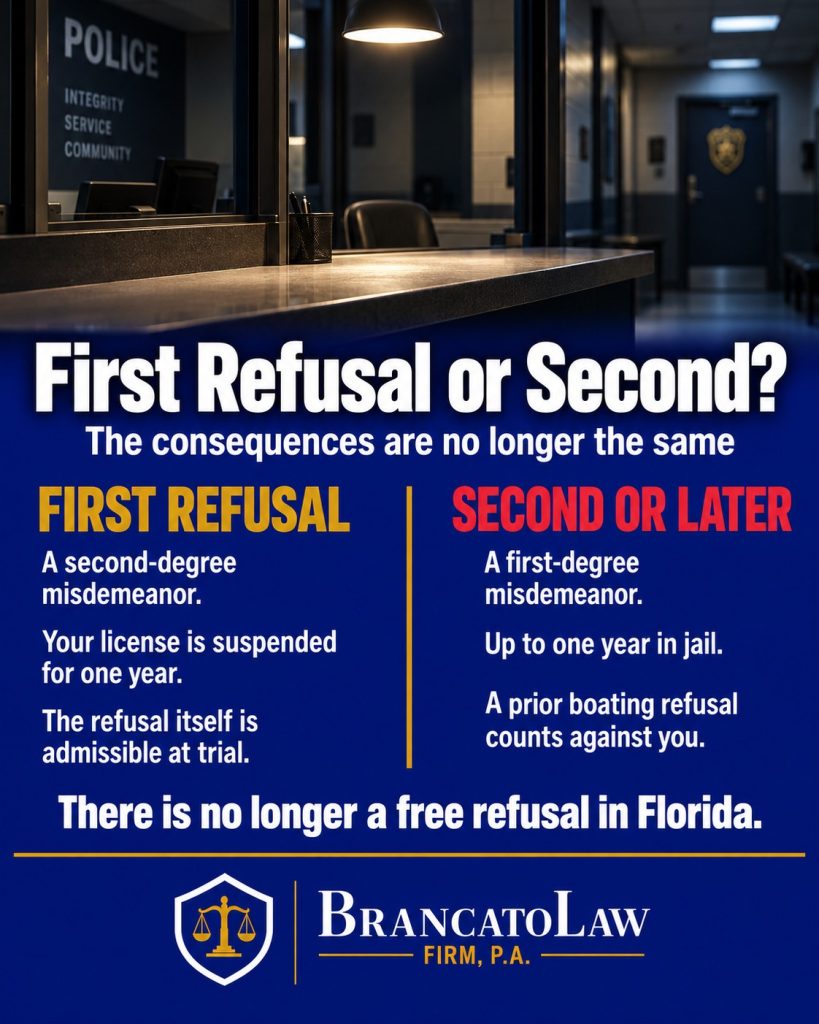
| Consequence | First refusal | Second or later refusal |
|---|---|---|
| Criminal charge | Second-degree misdemeanor: up to 60 days in jail and a $500 fine | First-degree misdemeanor: up to 1 year in jail and a $1,000 fine |
| License suspension | 1 year | 18 months |
| Use in the DUI trial | Admissible as evidence | Admissible as evidence |
| Hardship license | Possible, after a 90-day wait if the suspension is upheld at review | Not available after two refusal suspensions |
The jail and fine maximums come from section 775.082, Florida Statutes and section 775.083, Florida Statutes. One detail catches boaters. A prior fine under section 327.35215 for refusing a test after a boating under the influence stop counts as a prior refusal, so a first roadside refusal can be charged as the first-degree misdemeanor.
Is refusing a blood test a crime?
No. The refusal statute covers only breath and urine tests. Florida asks for blood only in limited situations under section 316.1932(1)(c), such as when a driver is at a hospital and a breath or urine test is impractical, and refusing blood brings a license suspension but no criminal charge.
That line follows the Constitution. In Birchfield v. North Dakota, 579 U.S. 438 (2016), the U.S. Supreme Court held that police may require a breath test as a search incident to a lawful DUI arrest, but not a blood test. Florida’s Fifth District applied that rule to our refusal statute in Williams v. State, 210 So. 3d 774 (Fla. 5th DCA 2017), which upheld a breath-refusal conviction. The Brancato Law Firm checks every charging document to confirm the State charged a test the statute actually covers.
What must the State prove to convict you of refusal?
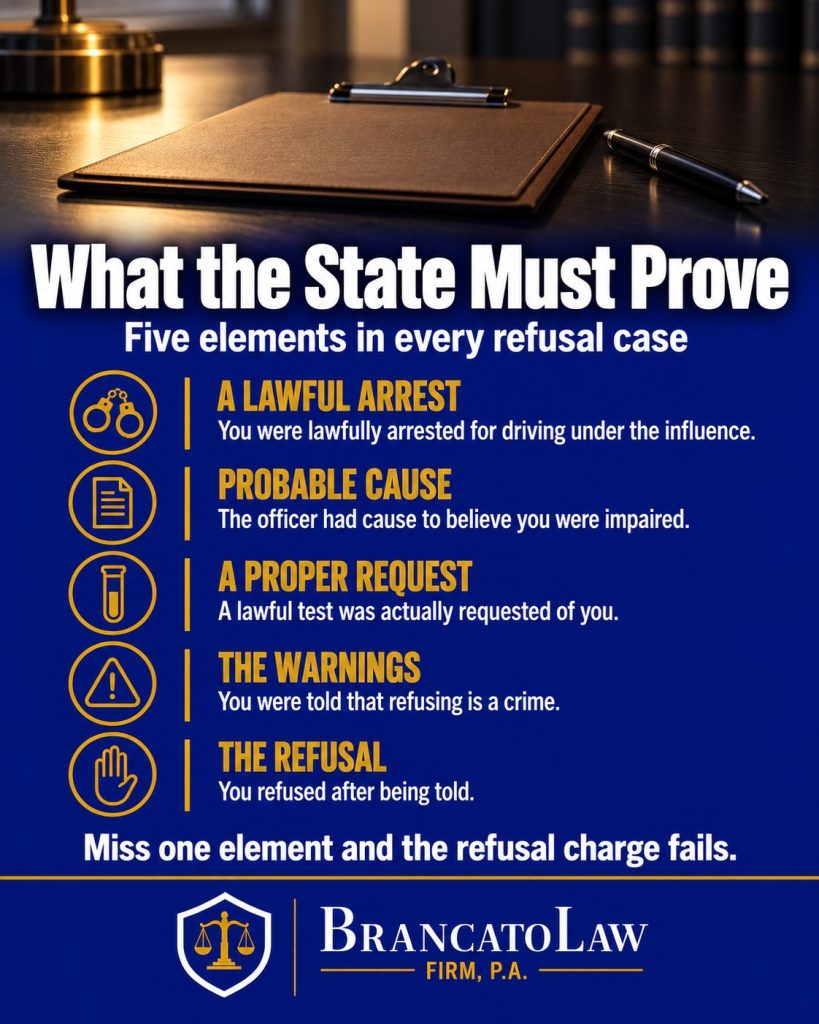
The State must prove five elements under section 316.1939(1), and each one is a place these cases fall apart:
- Probable cause. The officer had probable cause to believe you were driving or in actual physical control of a vehicle while impaired.
- A lawful arrest. You were lawfully arrested for DUI before the test was requested.
- The suspension warning. You were told a refusal would cost your license for 1 year, or 18 months after a prior refusal.
- The crime warning. You were told that refusing is itself a misdemeanor.
- A refusal after the warnings. Only after being told all of this did you refuse.
Element 4 is new, and it creates a defense that did not exist before October 2025. An officer who read an outdated implied consent card, one that said refusal was a crime only after a prior suspension, did not give the warning the statute now requires. No Florida appellate court has decided a case on this point yet, so our attorneys raise it by motion and preserve it for appeal.
Element 2 matters at the license hearing too. In Florida Department of Highway Safety & Motor Vehicles v. Hernandez, 74 So. 3d 1070 (Fla. 2011), the Florida Supreme Court held that the department cannot suspend a license for a refusal that was not incident to a lawful arrest. A bad stop can defeat the criminal refusal charge and the suspension with the same evidence.
Do you have the right to talk to a lawyer before deciding?
No. In State v. Busciglio, 976 So. 2d 15 (Fla. 2d DCA 2008), a Hillsborough County case, the Second District held that the officer’s “yes or no” question about taking the breath test is not interrogation, so the right to counsel does not attach to it. The warning in that case was read from a form provided at Central Breath Testing, the Hillsborough County Sheriff’s Office breath testing site.
In practice, this means a driver who says “I want my lawyer first” may be marked as a refusal. Whether that answer was a knowing refusal after proper warnings is still a fact question. In our experience in Hillsborough County cases, the paperwork often hardens around the word “refused” when the video shows a confused driver asking questions. Our attorneys at The Brancato Law Firm make that video the center of the defense.
How is a refusal used at the DUI trial?
The prosecutor can tell the jury you refused and argue that it shows consciousness of guilt. Section 316.1932 makes the refusal admissible. But Florida courts have set limits, and those limits win cases.
The first limit is the warning. In Howitt v. State, 266 So. 3d 219 (Fla. 5th DCA 2019), officers never told the driver any consequence of refusing. The court held the refusal could not be used to show consciousness of guilt and reversed the DUI convictions.
The second limit is the argument. In Osorio v. State, No. 3D24-0483 (Fla. 3d DCA Feb. 4, 2026), the prosecutor told the jury the defendant could have proved his innocence by blowing. The court held that comment shifted the burden of proof and ordered a new trial. Compare Paul v. State, No. 4D2025-0899 (Fla. 4th DCA Sept. 2, 2026), where the Fourth District affirmed because the prosecutor quickly turned to consciousness of guilt and repeatedly reminded the jury of the State’s burden. The lesson for trial is to object to every burden-shifting phrase.
A refusal case also has no breath number. The State’s proof rests on the officer’s observations, the driving pattern, the field exercises, and the video. When the video shows a driver who walks the line cleanly and then declines to trust a machine, the refusal looks like skepticism.
Can a refusal be suppressed?
Sometimes. An unlawful stop, an arrest without probable cause, missing or garbled warnings, and a dispute over whether a refusal happened at all can each keep a refusal out of evidence or defeat the charge.
One argument no longer works. In State v. Repple, 428 So. 3d 59 (Fla. 2025), the Florida Supreme Court held that a city officer who lawfully arrests a driver inside the city may request the breath test at a facility outside the city limits. The Sixth District applied that rule to a refusal in State v. Hart, No. 6D2024-2164 (Fla. 6th DCA May 22, 2026) and reversed a suppression order. Our attorneys focus on the arguments that survive Repple: the stop, the arrest, and the warnings.
How common are breath-test refusals in Florida?
Very common. A National Highway Traffic Safety Administration study, Breath Test Refusal Rates in the United States: 2011 Update, reported that Florida drivers refused 21,966 of 26,777 breath-test requests in 2011, an 82% refusal rate and the highest reported in the nation. NHTSA noted that states record refusals differently, so the figure is best read as a sign of how often the issue comes up.
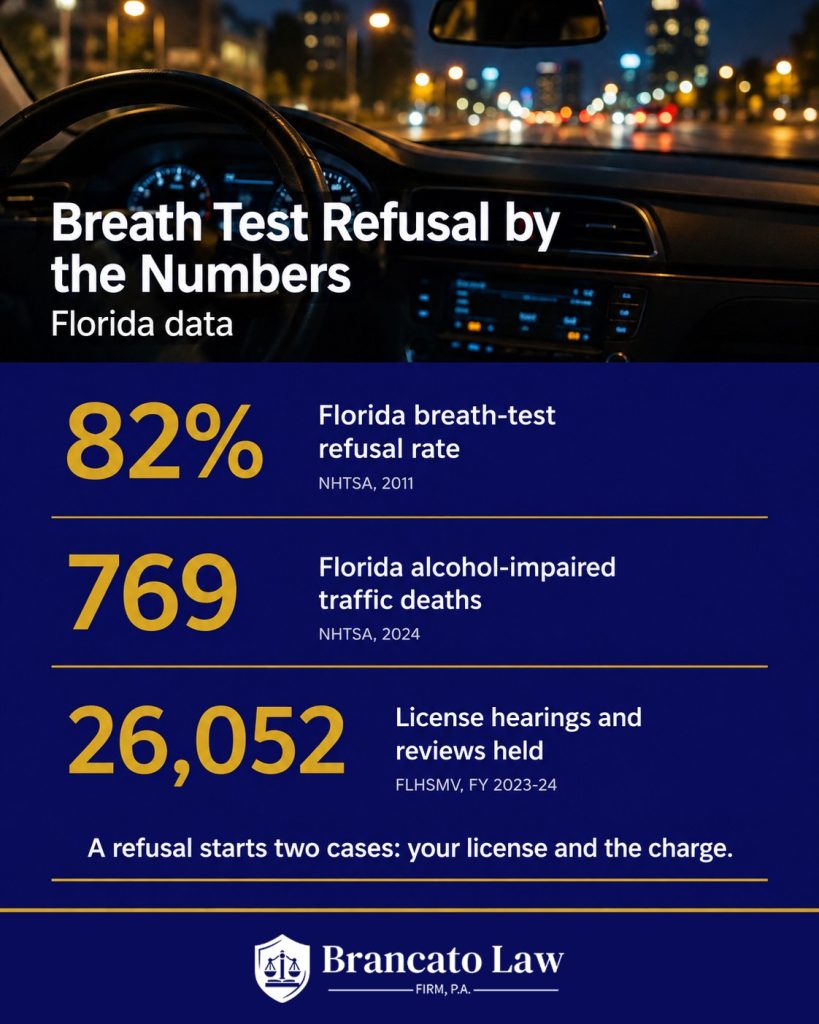
The stakes on the road are real. NHTSA’s State Alcohol-Impaired-Driving Estimates: 2024 Data counted 769 alcohol-impaired-driving deaths in Florida in 2024, 24% of the state’s 3,138 traffic deaths. On the license side, the Florida Department of Highway Safety and Motor Vehicles Inspector General reported in a 2024 audit of the Bureau of Administrative Reviews that the bureau held 26,052 hearings and reviews statewide from July 2023 through June 2024.
Research also shows a refusal does not end the case. A second NHTSA report, Breath Test Refusals and Their Effect on DWI Prosecutions (2012), found no clear relationship between refusing and the chance of a conviction at its five study sites, but convicted refusers received harsher jail and fine penalties.
Should you refuse the breath test in Florida?
There is no safe general answer anymore. Before Trenton’s Law, a first refusal cost only a suspension. Today it adds a criminal charge, a consciousness-of-guilt argument at trial, and a full year without a license. The State also does not need a breath number to prosecute, because officers document driving, field exercises, and video.
| Taking the test | Refusing the test | |
|---|---|---|
| Evidence created | A breath result the State will use, or a result under the limit | No number, but the refusal itself is admissible |
| New criminal charge | None beyond the DUI | Second-degree misdemeanor for a first refusal; first-degree after a prior refusal |
| License suspension | 6 months for a first result of 0.08 or higher | 1 year for a first refusal; 18 months after a prior refusal |
| Hardship license | 30-day wait if the suspension is upheld | 90-day wait if the suspension is upheld |
The decision is made fast, usually without a lawyer, and our work starts wherever yours ended. A refusal case is defensible, and so is a case with a breath result. The worst choice is doing nothing with the 10-day license window.
What should you do in the first 10 days after a refusal arrest?
Act on the license first. Under section 322.2615, Florida Statutes, you have 10 days from the notice of suspension to request a formal or informal review, and the temporary permit on your citation expires at midnight on the 10th day. If you miss the window, the suspension simply runs.
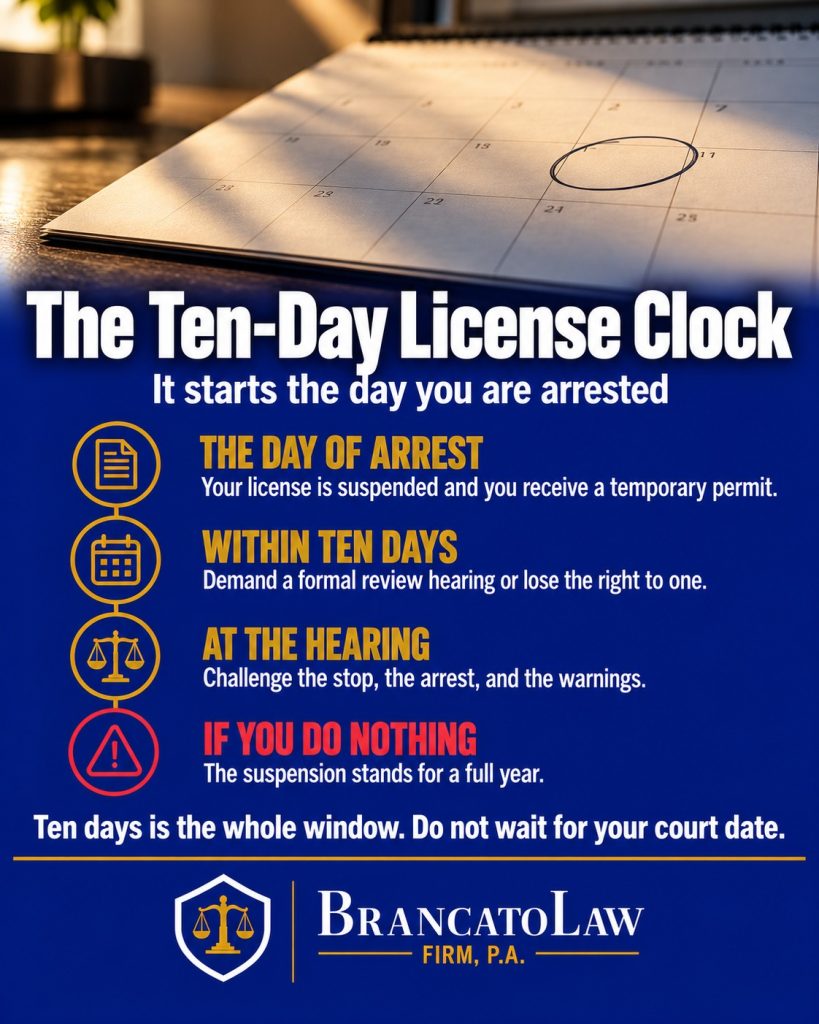
Then preserve the evidence. Body camera and dash camera video decide the warning elements, and retention periods are short. Write down what was said and in what order, list any passengers or witnesses, and do not discuss the stop with anyone but your lawyer. Our guide on how to protect your license after a Tampa DUI arrest explains the formal review hearing, the waiver option, and the Tampa hearing office.
Our attorneys handle refusal cases as part of our Tampa DUI lawyer practice, and we often use the formal review hearing to put the officer’s account under oath months before the criminal trial.
Real results in refusal cases
| Case | Result |
|---|---|
| DUI (refusal) and resisting arrest without violence | Not guilty on both counts. Scene video showed no signs of impairment and no resistance. |
| DUI, leaving the scene, and refusal (July 2026) | Reduced to reckless driving with adjudication withheld. The client was not eligible for the RIDR diversion program because of the crash, and a mitigation report and treatment plan made the difference. |
Past results do not guarantee future outcomes. More results are on our case results page.
Frequently asked questions about breath-test refusal in Florida
Can a refusal charge be dropped in Florida?
Yes. A refusal charge can be dropped or dismissed when the arrest was not lawful, the officer left out a required warning, or the evidence does not show a knowing refusal. The Brancato Law Firm reviews the body camera audio against the five elements of section 316.1939 before we talk with the prosecutor.
Does Trenton’s Law apply to a refusal before October 1, 2025?
No. The new first-refusal crime applies only to refusals on or after October 1, 2025. An older refusal still matters, because it supports the 18-month suspension and makes a new refusal a first-degree misdemeanor, and our attorneys at The Brancato Law Firm pull your full driving record to see how it counts.
What if the officer read me an old implied consent card?
Then the State may be missing an element. Since October 2025, section 316.1939 requires proof that you were told refusing is a crime, and an outdated card did not say that for a first refusal. The Brancato Law Firm compares the card and the audio word for word, and you can learn more from our DUI defense attorneys in Tampa.
Can I get a hardship license after refusing a breath test?
Often, yes. A first-time driver may qualify for a business-purposes-only license, either after a 90-day wait if the suspension is upheld at review or sooner through the eligibility review under section 322.271(7), Florida Statutes. Our attorneys at The Brancato Law Firm help clients choose between that route and a formal review hearing within the 10-day window.
Will the jury hear that I refused?
In most cases, yes, because section 316.1932 makes a properly warned refusal admissible. The Brancato Law Firm has won refusal trials by showing the jury the video and explaining the confusion, medical issues, or missing warnings behind the refusal, as our case results show.
Is refusing a urine test treated the same as a breath test?
Yes. The refusal statute covers both breath and urine tests, so either refusal can be charged as a misdemeanor if the warnings were given. Blood refusals carry only a license suspension, and our attorneys at The Brancato Law Firm check which test was requested before anything else.
Call our Tampa DUI attorneys before the 10 days run out
The license deadline runs from the notice you received at the arrest, not from your court date. The Brancato Law Firm, P.A., founded by Tampa Criminal Defense Attorney Rocky Brancato, will request the review, demand the video, and build the refusal defense from the first week. Call (813) 727-7159 for a free, confidential consultation. You can call us at any hour. Our firm has Spanish-speaking staff, and attorney Jean-Luc Adrien speaks Spanish, Haitian Creole, and French. Read about our Spanish and Haitian Creole criminal defense services.
For more about our defense strategies, visit our Tampa DUI defense page.
The Brancato Law Firm, P.A.
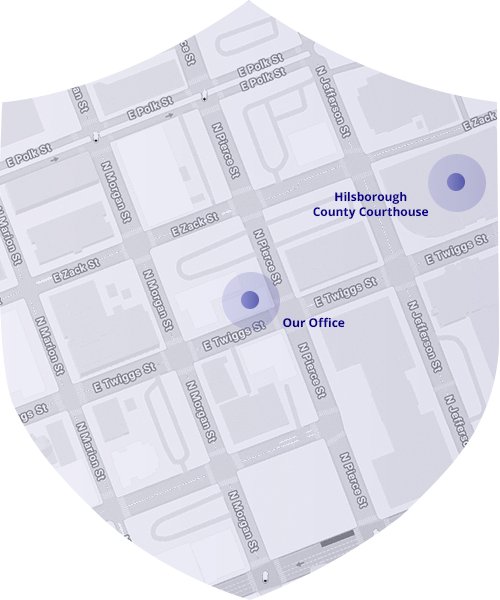
620 E. Twiggs Street, Suite 205, Tampa, FL 33602
(813) 727-7159
Serving Hillsborough, Pinellas, and Pasco Counties
The Brancato Law Firm, P.A. is a Tampa-based criminal defense practice. We are not affiliated with any other Brancato-named law firms.
Visit Us
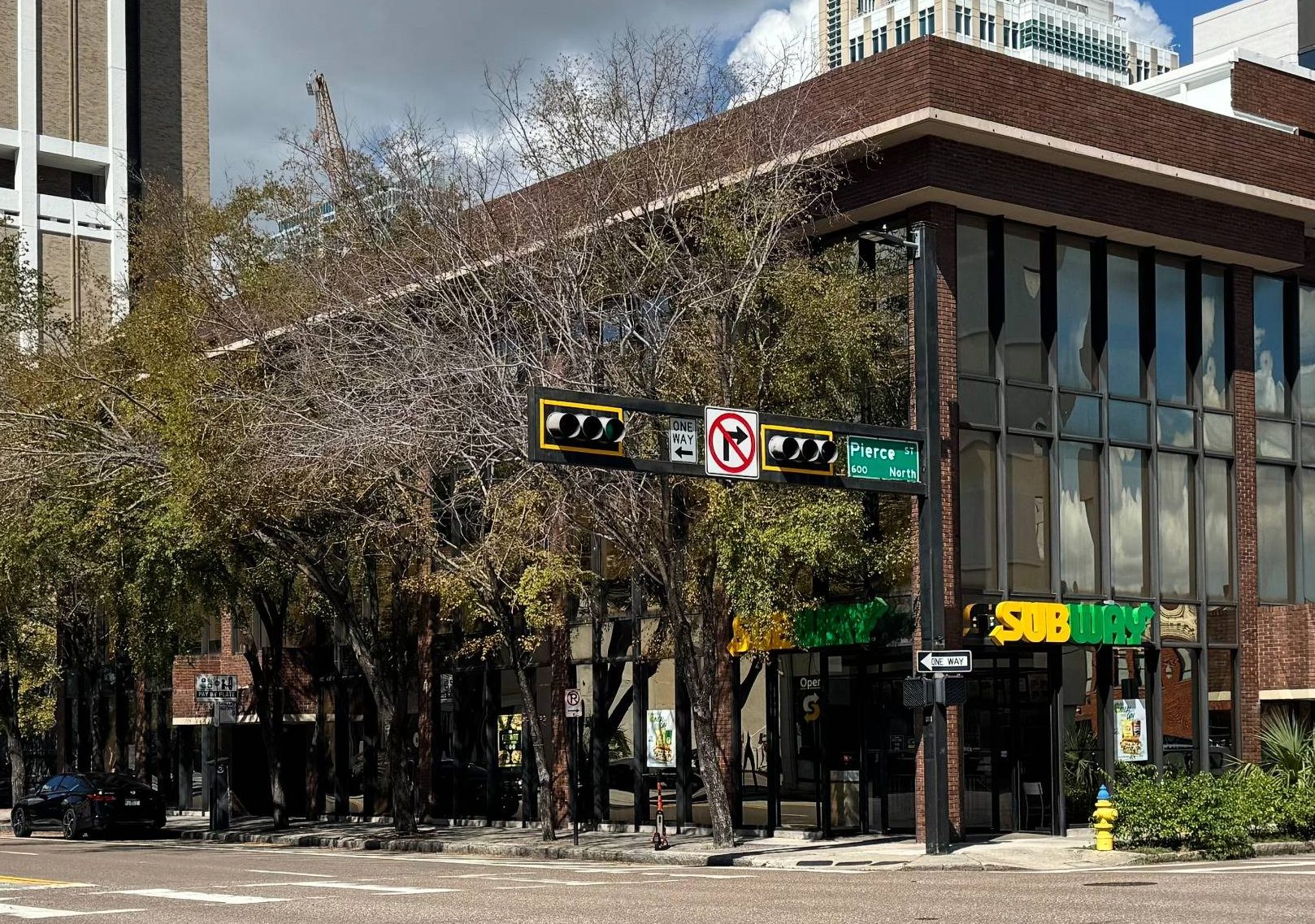
Tampa, FL 33602
Contact Us Now
Free Legal Consultation (813) 727-7159