- Free Consultation 24/7: (813) 727-7159 Tap Here To Call Us


From First DUI to Death Penalty



How to Fight a DUI Charge in Hillsborough County (2026)


Updated October 21, 2026
To fight a DUI charge in Hillsborough County, examine each piece of the State’s evidence in the order police gathered it: the traffic stop, the decision to arrest, the breath or blood test, and the video. If the stop or arrest violated the Fourth Amendment, or the test broke Florida’s testing rules, a motion to suppress can keep that evidence from the jury. Weak evidence leads to dismissals, not guilty verdicts, and reductions to reckless driving. The separate license suspension must be challenged within 10 days of the arrest.
In a DUI trial, jurors can watch the roadside video for themselves, and what they see often carries more weight than the officer’s report. I taught at the police academy before I founded The Brancato Law Firm, P.A., a Tampa criminal defense firm, so I know how officers are trained to investigate and where shortcuts show up on video. I am a member of the National College for DUI Defense (NCDD) and the DUI Defense Lawyers Association (DDLA), and I have tried more than 150 jury trials to verdict in 25+ years in Hillsborough County courtrooms. Our attorneys hold each DUI investigation to the procedures officers are taught, step by step, and use every gap to pursue suppression, dismissal, a reduction, or a not guilty verdict.
What are the defenses to a DUI charge in Florida?
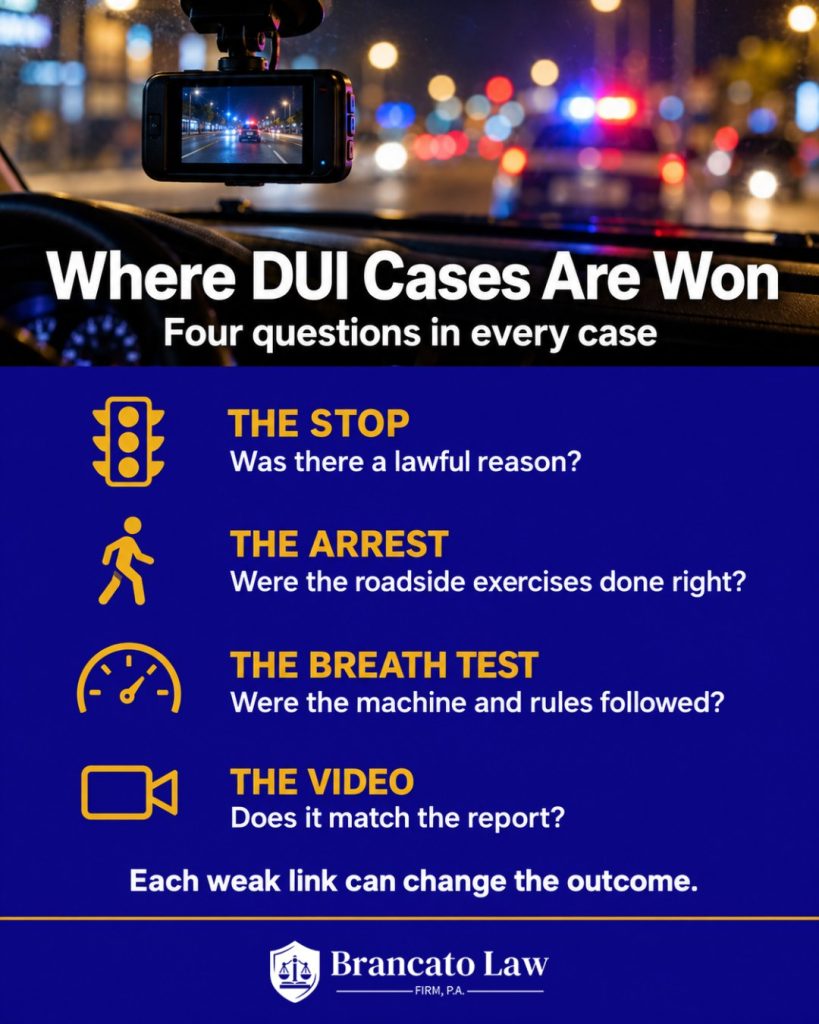
The main defenses to a Florida DUI charge attack the four things the State needs: a lawful stop, probable cause to arrest, a reliable chemical test, and proof of impairment. Under section 316.193, Florida Statutes, the State must prove the driver’s normal faculties were impaired by alcohol or drugs, or that the driver’s blood or breath alcohol level was 0.08 or higher. Our attorneys review every stage in the same order the officer built the case, because a defect early in the case can remove everything that came after it. You can read more about how our firm handles these cases on our Tampa DUI defense page.
| Stage | What our attorneys check | What a win can mean |
|---|---|---|
| Traffic stop | The video against the stated reason for the stop | Suppression of everything after the stop |
| Field sobriety exercises | Instructions, scoring, surface, footwear, injuries | No probable cause; a weaker trial case |
| Breath test | Inspection and repair records, 20-minute observation, two-sample rule | Loss of the breath result or its presumptions |
| Blood draw | Warrant or consent, collection and storage | Suppression of the blood result |
| Timing of the test | Drinking and eating timeline | Evidence the level was lower while driving |
| Drug DUI | The drug recognition evaluation and lab results | A challenge to the officer’s drug opinion |
| Refusal | The arrest and the exact warnings read | Dismissal of the refusal charge |
| Resolution | Test level, prior record, RIDR eligibility | Dismissal, reckless driving, or trial |
Was the traffic stop legal?
A DUI case can be dismissed if the officer had no lawful reason to stop the car. The Fourth Amendment requires either a traffic violation or a reasonable suspicion, based on specific facts, that the driver was impaired. Florida courts allow an officer to stop a driver whose weaving within a lane suggests impairment, so the real question in most cases is what the driving looked like.
Our attorneys compare the patrol car video, minute by minute, with the reason written in the arrest report. When the video shows a single touch of a lane line, a lawful turn, or driving that never matches the report, we file a motion to suppress. If the judge grants it, the officer’s observations, the test results and the driver’s statements that followed the stop are excluded, and the State usually cannot proceed.
Did the officer have probable cause to arrest you for DUI?
An officer needs probable cause, meaning facts that would lead a reasonable officer to believe the driver was impaired, before making a DUI arrest. Most officers build that probable cause on three standardized field sobriety exercises: the horizontal gaze nystagmus eye test, the walk-and-turn, and the one-leg stand.
The research behind those exercises is narrower than most jurors assume. The National Highway Traffic Safety Administration’s main validation study, Validation of the Standardized Field Sobriety Test Battery at BACs Below 0.10 Percent (1998), tested 297 drivers stopped by seven officers from a single San Diego police alcohol enforcement unit. It reported that the officers’ decisions about whether a driver was above or below 0.08 were accurate in 91 percent of cases, using the scoring procedures they had been trained on. A 1994 study in the peer-reviewed journal Perceptual and Motor Skills showed officers videotapes of 21 sober people. The officers rated significantly more of those sober people as impaired when they watched them perform field sobriety tests than when they watched them do ordinary tasks such as walking normally or reciting an address.
Our attorneys hold officers to their own standard. NHTSA’s accuracy figures assume the exercises were given and scored exactly as officers are trained, so every departure on the video weakens the probable cause. A probable cause challenge that fails at a suppression hearing can still succeed in front of a jury, because the same flaws go to whether the driver was actually impaired. Our post on how to challenge field sobriety tests in Tampa covers the exercises one by one.
Can a breath test be thrown out in Florida?
Yes. A Florida breath result is valid only if the test was performed substantially according to methods approved by the Florida Department of Law Enforcement (FDLE), by an operator with a valid FDLE permit, under section 316.1934, Florida Statutes. FDLE’s rules are in chapter 11D-8 of the Florida Administrative Code. They approve two instruments, the Intoxilyzer 8000 and the newer Intoxilyzer 9000, and they require, among other things:
- an agency inspection of each instrument at least once every calendar month, under rule 11D-8.006;
- at least 20 minutes before the test in which the officer reasonably ensures the driver has not taken anything by mouth or regurgitated, under rule 11D-8.007;
- at least two breath samples taken within 15 minutes of each other, with results within 0.020 of each other, and a third sample when the first two are farther apart, under rule 11D-8.002.
The Second District Court of Appeal, whose decisions bind the trial courts in Hillsborough, Pinellas and Pasco Counties, applied these rules in State v. Kilburn, No. 2D2024-0649 (Fla. 2d DCA Aug. 15, 2025). An FDLE inspector had replaced a leaking breath tube in a Sarasota County Intoxilyzer 8000 that was used in three DUI cases. The court agreed with the trial judge that replacing the tube was a repair, not maintenance, and that FDLE was not then an authorized repair facility. The breath tests from that machine were therefore not in substantial compliance with FDLE’s rules, and the State could not rely on the breath test affidavit and the legal presumptions in section 316.1934 to prove the results. Our firm wrote about that ruling in Intoxilyzer Not Properly Maintained: Florida Court Throws Out Breath Test Results.
Effective July 1, 2026, FDLE amended rule 11D-8.002 to list the Department itself as an authorized repair facility. The repair-facility argument remains available for breath tests taken before that date. For every breath case, old or new, our attorneys obtain the instrument’s inspection, maintenance and repair records, because who worked on the machine, and when, can decide whether the result comes in.
Can police take your blood after a DUI arrest in Florida?
Police generally need a warrant, valid consent, or a true emergency to draw blood in a DUI case. In Missouri v. McNeely, 569 U.S. 141 (2013), the U.S. Supreme Court held that the natural loss of alcohol from the bloodstream does not, by itself, create an emergency that excuses a warrant. In Birchfield v. North Dakota, 579 U.S. 438 (2016), the Court held that police may require a breath test without a warrant after a lawful DUI arrest, but a blood test is more intrusive because it pierces the skin, and a state may not make it a crime to refuse one.
Florida’s implied consent law covers blood in one narrow situation: the driver appears for treatment at a hospital, clinic or ambulance, and a breath or urine test is impractical or impossible, under section 316.1932(1)(c), Florida Statutes. FDLE’s rule 11D-8.012 then requires an alcohol-free antiseptic, a glass tube with a preservative and an anticoagulant, proper labeling and refrigeration, and delivery for analysis within 30 days. A missing step can keep the result out. Our post on whether police can take your blood without a warrant in Florida covers the warrant rules in detail.
When blood was drawn after a crash, charges are often not filed until the lab results come back. That gap is the time for pre-file advocacy, when our attorneys can present facts to the prosecutor before the charging decision is made.
What if your blood alcohol was still rising when you were driving?
A breath or blood test measures alcohol at the time of the test, which can be an hour or more after the driving ended. Alcohol keeps absorbing into the blood for a period after the last drink, so a driver’s level can be lower behind the wheel than at the station. In Miller v. State, 597 So. 2d 767 (Fla. 1991), the Florida Supreme Court held that a test taken within a reasonable time after the stop is admissible even if the State cannot relate the number back to the time of driving. The court treated that gap as a question of weight for the jury, which makes the drinking timeline a trial issue.
Our attorneys build that timeline from receipts, bar tabs, meals, witness statements and the time of the stop. We then work with forensic toxicologists through our forensic science defense practice. Our post on retrograde extrapolation and rising blood alcohol describes a case where that testimony mattered.
What does the video in a DUI case show?
In many DUI cases, the video is the strongest defense evidence. Depending on the agency, a patrol car camera records the driving and the stop, a body camera records the roadside exercises and the arrest, and the breath testing room may record the 20-minute observation period. Our attorneys request every recording and compare it with the report line by line: slurred speech that sounds clear, swaying that never appears, instructions that were rushed or incomplete, and observation periods interrupted by phone calls or paperwork.
In one of our firm’s published results, a jury found a client not guilty of DUI (refusal) and resisting an officer without violence after the defense relied on scene video showing the client was not impaired. Agencies do not keep every recording indefinitely, so our attorneys request them early.
How are drug DUI cases defended in Florida?
Florida has no legal limit for marijuana or other drugs, so in a drug DUI case the State must prove that a controlled or chemical substance impaired the driver’s normal faculties under section 316.193. A positive blood or urine test shows that a substance was present. It does not, by itself, show that the substance impaired the driver at the time of driving.
Many drug DUI cases rest on a drug recognition expert (DRE), an officer trained in a 12-step evaluation that ends with an opinion about which drug category caused the impairment. Our attorneys challenge the DRE’s training records, each step of the protocol, and whether the lab results match the drug category the officer named. Our posts on what a drug recognition expert is in Florida and marijuana DUI charges in Florida go deeper.
Can you beat a DUI refusal charge in Florida?
Yes, because a refusal charge has its own elements, and each one can fail. Since October 1, 2025, a first refusal to take a lawful breath or urine test is a second-degree misdemeanor, and a later refusal is a first-degree misdemeanor, under section 316.1939, Florida Statutes. The State must prove the officer had probable cause, the driver was lawfully arrested for DUI, the driver was told the specific consequences of refusing, and the driver then refused. The crime covers breath and urine tests only, and Birchfield v. North Dakota, 579 U.S. 438 (2016) bars criminal punishment for refusing a blood test.
Refusals are common. In 2022, Florida officers issued 44,001 DUI citations and recorded 14,941 breath test refusals, a refusal rate of about 34 percent, according to Department of Highway Safety and Motor Vehicles figures in a January 2024 Florida Senate Criminal Justice Committee bill analysis. The same analysis cites a 2016 study that put the national refusal rate at 24 percent.
A refusal is also admissible in the DUI case itself, but the law limits how the State can use it. In Osorio v. State, 428 So. 3d 220 (Fla. 3d DCA 2026), the prosecutor told the jury that a sober driver would have blown and “proved innocence beyond a reasonable doubt.” The Third District reversed the DUI conviction because that argument shifted the burden of proof to the defendant. Our attorneys object when the State’s argument crosses that line, and we preserve the issue for appeal. A refusal also brings an administrative license suspension of one year for a first refusal, or 18 months if the license was previously suspended for refusing, under section 322.2615, Florida Statutes.
Can a DUI be reduced to reckless driving in Hillsborough County?
Yes, and when the evidence cannot be suppressed, a reduction to reckless driving is often the realistic goal for a first-time driver. A DUI conviction always counts as a conviction: section 316.656, Florida Statutes bars a Florida court from withholding adjudication for DUI. Reckless driving under section 316.192, Florida Statutes carries up to 90 days in jail and a $25 to $500 fine for a first conviction, and the court can withhold adjudication. When the court believes alcohol or drugs contributed, it must order DUI school and an evaluation, which is why the result is sometimes called a “wet reckless.”
Two limits shape the negotiation. Section 316.656 also bars a judge from accepting a plea to a lesser offense when a breath or blood test shows 0.15 or higher, so in high-reading cases the defense work on the test result itself carries more weight. And in Hillsborough County, the State Attorney’s Office runs its own first-offender track, the Reducing Impaired Driving Recidivism (RIDR) program.
According to the State Attorney’s program sheet, RIDR is limited to first-time misdemeanor DUIs with no minor in the car, no crash, and no reading of 0.20 or higher. Before a disposition date about 60 days after arraignment, the driver completes DUI school, a MADD victim impact panel, community service, and an ignition interlock, alcohol monitor or drug patch. The State then offers a plea to reckless driving with a withhold of adjudication and 12 months of probation. The sheet says one goal is to remove the incentive to refuse a breath test, and it assigns heavier conditions to the level that covers cases with no breath sample: 75 community service hours and six months of monitoring, instead of 50 hours and three months.
Missing RIDR does not end the negotiation. In a published July 2026 result, a client charged with DUI, leaving the scene and refusal did not qualify for RIDR because of the crash. Our firm prepared a mitigation report and treatment plan, and the prosecutor agreed to reduce the case to reckless driving with adjudication withheld.
What are the penalties for a first, second, and third DUI in Florida?
A first DUI in Florida carries up to six months in jail, a $500 to $1,000 fine and a license revocation of 180 days to one year, and the penalties rise with each prior conviction and with a reading of 0.15 or higher. The table below summarizes section 316.193, section 322.28 and section 775.082.
| Penalty | First DUI | Second DUI | Third DUI |
|---|---|---|---|
| Maximum jail | 6 months (9 months if 0.15 or higher, or a minor in the car) | 9 months (12 months if 0.15 or higher, or a minor in the car) | Within 10 years of a prior: third-degree felony, up to 5 years in prison. More than 10 years after: up to 12 months |
| Mandatory jail | None set by statute | 10 days if within 5 years of a prior | 30 days if within 10 years of a prior |
| Fine | $500 to $1,000 ($1,000 to $2,000 if 0.15 or higher, or a minor) | $1,000 to $2,000 ($2,000 to $4,000 if 0.15 or higher, or a minor) | $2,000 to $5,000 if more than 10 years after a prior; at least $4,000 if 0.15 or higher, or a minor |
| License revocation | 180 days to 1 year | At least 5 years if within 5 years of a prior | At least 10 years if within 10 years of a prior |
| Ignition interlock | 6 months if 0.15 or higher | At least 1 year (2 years if 0.15 or higher) | At least 2 years |
| Vehicle impoundment | 10 days | 30 days if within 5 years of a prior | 90 days if within 10 years of a prior |
| Other conditions | Up to 1 year of probation, 50 community service hours, DUI school | Monthly reporting probation, DUI school | Monthly reporting probation, DUI school |
Our attorneys start every case by identifying which of these penalties your record and test result actually put in play. Our post on Florida DUI penalties in Tampa and Hillsborough County covers fourth offenses and other consequences.
Which criminal defense lawyers in Tampa specialize in DUI cases?
Look for a criminal defense lawyer with DUI-specific training, real trial experience, and daily familiarity with the Hillsborough County courts and the State Attorney’s programs. At The Brancato Law Firm, our practice is devoted entirely to criminal defense, from misdemeanors to capital cases, and DUI defense is a core part of it. Our founder is an NCDD and DDLA member and a former police academy instructor, and he served as Chief Operations Officer of the Hillsborough County Public Defender’s Office, overseeing a staff of over 100 attorneys. He is rated AV Preeminent, selected to Super Lawyers, named to the National Trial Lawyers Top 100, and wrote “How to Choose a Major Crimes Attorney – or Any Criminal Defense Attorney for That Matter.”
Our office at 620 E. Twiggs Street is two blocks from the Hillsborough County Courthouse, and we also defend DUI cases in Pinellas County and Pasco County. Clients get updates through a client portal, we return calls within 24 hours, and attorney Jean-Luc Adrien speaks Spanish, Haitian Creole and French.
What should you do in the first 10 days after a DUI arrest in Hillsborough County?
The most urgent step is to challenge the administrative license suspension, because section 322.2615 gives you only 10 days from the notice of suspension to request review. In those 10 days:
- Talk with a DUI defense lawyer before the review deadline passes.
- Do not discuss the arrest with anyone except your lawyer, including on social media.
- Write down what you ate and drank, and when, while you still remember it.
- Keep receipts and bar tabs, and note the names of anyone who was with you and any businesses near the stop that may have cameras.
Our post on what happens after a DUI arrest in Hillsborough County walks through the full court timeline. Our attorneys can start on the license review and the evidence requests the day you call.
DUI case results from our firm
| Charge | Result | Date |
|---|---|---|
| DUI (airline pilot; breath result slightly under the limit, drugs in system) | Reduced to reckless driving | July 2026 |
| DUI, leaving the scene and refusal (not RIDR-eligible after a crash) | Reduced to reckless driving, adjudication withheld | July 2026 |
| Marijuana DUI | Reduced to reckless driving | September 2025 |
| DUI with open containers in the vehicle | Reduced to reckless driving | September 2025 |
| DUI license suspension, including a commercial driver license | Suspension overturned in circuit court; both licenses reinstated | September 2025 |
| DUI (refusal) and resisting an officer without violence | Not guilty on both counts at jury trial |
More results are on our case results page. Past results do not guarantee future outcomes.
Frequently asked questions about fighting a DUI in Hillsborough County
Can a DUI be dropped or reduced in Florida?
Yes, a DUI charge can be dropped when key evidence is suppressed or the State cannot prove impairment, and it can be reduced to reckless driving through negotiation or Hillsborough County’s RIDR program. Our attorneys at The Brancato Law Firm have published results in which DUI charges were reduced to reckless driving, including one in which the client did not qualify for RIDR. A reduction is limited by section 316.656, which bars a plea to a lesser offense when a breath or blood test shows 0.15 or higher.
Do I need a DUI specialist in Tampa?
You need a lawyer with DUI-specific training who tries cases, whatever title the lawyer uses. At The Brancato Law Firm, our founder is a member of the National College for DUI Defense and the DUI Defense Lawyers Association, and our practice is devoted entirely to criminal defense, from misdemeanors to capital cases. That means the team negotiating your DUI is also prepared to try it. See how we approach these cases on our DUI defense team in Tampa page.
How do I choose a DUI defense attorney in Tampa, Florida?
Ask how many DUI cases the lawyer has taken to trial, what DUI-specific training the lawyer has, and who will actually appear in court with you. The Brancato Law Firm answers those questions in a free consultation, and our founder has tried more than 150 jury trials to verdict. Ask, too, how the firm communicates: our clients get updates through a client portal, and we return calls within 24 hours. Our published case results show how DUI cases have actually ended.
I was arrested for DUI in Hillsborough County and need a lawyer. What should I do first?
Call a DUI defense lawyer before the 10-day deadline to challenge your license suspension passes, and do not discuss the arrest with anyone else. The Brancato Law Firm’s office is two blocks from the Hillsborough County Courthouse, and you can call us at any hour at (813) 727-7159. Our post on what happens after a DUI arrest in Hillsborough County explains each court date that follows.
How much does it cost to fight a DUI in Tampa?
The cost of fighting a DUI depends on the evidence, how much investigation the case needs, and whether it goes to trial. The Brancato Law Firm quotes a flat fee that covers the whole case, including trial, based on the facts and complexity of your case, and our fees are neither the most nor the least expensive in Tampa. We ask for at least half up front, with a payment plan for the balance while the case is pending, and consultations are free. A flat fee that includes trial avoids a separate trial fee, which can create a financial incentive to settle before trial preparation; our post on what a criminal defense attorney costs in Tampa explains more.
Can the prosecutor use my breath test refusal against me at trial?
Yes, a refusal is admissible in Florida and the prosecutor may argue it shows consciousness of guilt, but the prosecutor may not argue that you had to prove your innocence by blowing. Our attorneys at The Brancato Law Firm object to that argument and preserve it for appeal. In Osorio v. State, 428 So. 3d 220 (Fla. 3d DCA 2026), a DUI conviction was reversed for exactly that kind of argument.
Talk with our DUI defense team about your case
Most DUI defenses depend on evidence that can disappear and deadlines that run out within days of the arrest: the 10-day window to challenge your license, and recordings that agencies do not keep indefinitely. The Brancato Law Firm, P.A., founded by Tampa Criminal Defense Attorney Rocky Brancato, starts by requesting that evidence and reviewing the stop, the arrest and the test. Call (813) 727-7159 for a free consultation, and call us at any hour. For more about our defense strategies, visit our Tampa DUI Lawyer page.
The Brancato Law Firm, P.A.
620 E. Twiggs Street, Suite 205, Tampa, FL 33602
(813) 727-7159
Serving Hillsborough, Pinellas, and Pasco Counties
The Brancato Law Firm, P.A. is a Tampa-based criminal defense practice. We are not affiliated with any other Brancato-named law firms.
Visit Us

Tampa, FL 33602

Contact Us Now
Free Legal Consultation (813) 727-7159
